




Abstract
This article argues that IA Richards’ Principles of Literary Criticism (1924) brings to light several key challenges in contemporary stylistics while pointing to their possible solutions. After introducing the scope and ambition of Richards’ book, the article examines a set of interrelated issues. The first is Richards’ ambivalent attitude to imagery, evidencing the challenges that this phenomenon poses to any systematic account of literary experience. In particular, the variability of responses associated with imagery appears at odds with the scientific need to find regularities in the responses themselves. The second issue is the troubled route between stimulus and response, which characterises not just imagery but extends to the whole of literary effects. In the spirit of Richards, the article regards such non-linearity as uncharted complexity rather than randomness, emphasising the influence of a mediating factor: namely, context itself. The article offers some initial thoughts on how to model context by exploring the testability of some feature-effect claims, including claims made by Richards himself. The issue of testability thus paves the way for an exploration of Richards’ empirical side, particularly his observations on the tension between the richness of literary experience and the simplifications imposed by experimental methods – a tension that reflects the diverging aims of the two disciplines underpinning Richards’ work: literary criticism and psychology. The article concludes by showing how Principles of Literary Criticism can help us better theorise literary effects. This is done first by focusing on Richards’ critique of the fallacy of projection, whereby the effects triggered by a work of art are erroneously re-conceptualised as the work’s inherent qualities; and, second, by reappraising Richards’ diagram representing the experience of reading a poem. I suggest that the stages of the diagram – sensations, imagery (tied vs free), reference, emotions and attitudes – grow increasingly autonomous from the stimulus (the poem), thereby cueing a parallel increase in subjective appropriation and depth of processing. In addressing these issues, the article brings to the fore the lasting legacy of Richards’ ‘thinking machine’ – as he unassumingly but fittingly called his masterpiece.
1. Introduction
A century since its appearance, IA Richards’ Principles of Literary Criticism (1924) is a rewarding and occasionally astounding reading experience for the contemporary stylistician. What underpins these pages is the author’s concern with the fundamentals of aesthetic experience, conducive to questions as overarching as the following: ‘What is the value of the arts, why are they worth the devotion of the keenest hours of the best minds, and what is their place in the system of human endeavours?’ (Richards, 2001 [1924]: 9).
Principles of Literary Criticism lives up to this ambition by engaging in a close dialogue with state-of-the-art psychology and neurology (West, 2013), while also offering cogent reflections on the methods available at the time, thereby paving the way for the empirical work expounded in Richards’ next significant book, Practical Criticism (1929; see West, 2013, 2017). As suggested by the bold quote before, Richards is one of a handful of 20th-century scholars who, following in the footsteps of Aristotle’s Poetics, have sought to turn criticism into an explanatory science tasked with providing a holistic account of literary experience. His plea for systematicity, his openly expressed dissatisfaction with earlier critical approaches, and the ambitious scope of his agenda call to mind later important works such as Northrop Frye’s Anatomy of Criticism (1957) and Michael Riffaterre’s Semiotics of Poetry (1978). A couple of quotes from these works will suffice to reveal their kinship with Principles of Literary Criticism – in scope, though not always in method: Criticism seems to be badly in need of a coordinating principle, a central hypothesis which, like the theory of evolution in biology, will see the phenomena it deals with as parts of a whole. (Frye, 1971 [1957]: 16) The theoretical aims of this book make it applicable, I believe, to all Western literature, and in all likelihood some of the rules I propose reflect universals of literary language. (Riffaterre, 1978: ix)
Interestingly, the key word ‘principle’ migrates from Richards to Frye; its regulatory undertones tighten with Riffaterre’s use of ‘rule’, which borders on deterministic necessity. Contemporary stylisticians tend to be more cautious when it comes to the blanket applicability of such principles and rules to literature. A good illustration of this changed attitude is Toolan’s contention that, ‘since the production of literature itself is not rule-governed, the stylistic pursuit of the grammar of the language of literature cannot be centrally a matter of rules either’ (Toolan, 2019: 3). To be sure, Richards’ broad principles remain constantly sensitive to context, which makes his proposals viable to contemporary stylistic theorising. The remainder of this article attempts to demonstrate this very point.
What animates Principles of Literary Criticism is nothing less than ‘the desire to link even the commonplaces of criticism to a systematic exposition of psychology’ (Richards, 2001 [1924]: 4). Such commonplaces are best thought of as elusive yet difficult-to-ignore fundamentals of criticism and aesthetics. The book’s Table of Contents provides a preliminary list of these fundamentals, those that stand out to me being (in alphabetical order): ‘allusiveness’, ‘communication’, ‘emotion’, ‘imagination’, ‘judgment’, ‘permanence’, ‘pleasure’, ‘rhythm/metre’, ‘truth/revelation’ and ‘value’. Comparably broad and/or overlapping fundamentals have found their way into the stylistics and the empirical aesthetics of the last two decades or so: ‘difficulty’ and ‘obscurity’ (Castiglione, 2013, 2017, 2019; Yaron, 2002, 2003, 2008); ‘emotion’ (Pitur and Miu, 2025; Schindler et al., 2017); ‘form’ and ‘structure’ (Fabb, 2002); ‘imagery’ (Cardilli, 2020; Castiglione, 2020; Dancygier, 2014; Gleason, 2009; Jajdelska et al., 2010; Kuzmicova, 2013); ‘intensity’ and ‘sensation’ (Stockwell, 2009); ‘situation’ (Toolan, 2016); ‘textworld’ (Gavins, 2007; Werth, 1999); and ‘wisdom’ or ‘revelation’ (Castiglione, 2022; van Peer and Chesnokova, 2022). Each of them rests on matrices of textual features patiently teased out by stylisticians. Such connecting work is a core business of stylistics, which as a whole is (or, rather, should be) geared to showing how textual features and aesthetic effects interrelate: The form-interpretation relations a stylistician may propose will rarely be expressible as absolute freestanding rules, but, as already argued, a generalizable descriptive grammar of literary texts remains the long-term goal of stylistics. (Toolan, 2019: 12; see also Leech and Short, 2007: 10–12; Riffaterre, 1971: 111–112)
The entire quotation, it is true, may invite some objections. Some might correctly argue that stylistics is not limited to the analysis of literary texts; others may take issue with the loosely metaphorical use of ‘grammar’ in reference to texts; still others might question whether detailing such grammar has always been an explicitly pursued goal in stylistics. While acknowledging the legitimacy of these objections, this article takes on the fundamental task of proposing ‘form-interpretation relations’, which I see as a building block for anything approaching a theory of text and literature genuinely rooted in stylistics itself.
However, the route to such an overarching goal is fraught with obstacles, which Richards himself identifies in Principles of Literary Criticism. Four obstacles are particularly worth discussing because of their enduring relevance to stylistic practice and theory: (1) Richards’ ambivalent attitude to imagery, evidencing the challenges that this fundamental yet elusive phenomenon poses to any systematic account of literary experience, (2) the troubled, non-linear route between stimulus and response, which characterises not just imagery but the whole of literary effects, (3) the tension between the richness of literary experience and the simplifications required by experimental methods, and (4) two proposals that are helpful to better theorise literary effects, the first being Richards’ critique of the fallacy of projection, whereby the effects triggered by a work of art are erroneously re-conceptualised as its qualities, and the second being Richards’ diagram representing the experience of reading a poem.
2. Fundamental yet subjective: Imagery and the theoretical problems that it poses
Among the fundamentals listed above, imagery remains a cornerstone of criticism, aesthetics and cognitive psychology. Within literary studies, imagery is especially polysemous, consisting of at least three related senses: ‘depictions of sensory perception in a text, the text’s construction of a vivid image in language which evokes a mental image in the reader’s mind, or any figurative use of language’ (Dancygier, 2014: 212). Other definitions similarly emphasise the reader’s experience ‘of near-sensory phenomena’ (Kuzmicova, 2013: 13) or ‘the experience of sensation without matching sensory input’ (Belfi et al., 2018: 342). These and other definitions, despite differences in how they articulate the concept, broadly agree on what imagery is. Critics, in turn, translate this concept of imagery into practice by routinely singling out phrases, clauses and sentences for their vividness, and labelling them as ‘images’. To give just one example: Richards himself in The Philosophy of Rhetoric (1936) refers to ‘had they rained’ and ‘a drop of patience’ in Shakespeare’s Othello (4:2, ll. 48, 53) as ‘liquid images’ (Richards, 2001 [1936]: 70).
The pervasiveness and elusiveness of imagery in literary-critical discourse, however, have also made it a controversial concept – to the extent that ‘the question of the nature of imagery has been second only to the problem of language in the evolution of modern criticism’ (Mitchell, 1984: 503). Imagery was repeatedly attacked, ridiculed or dismissed by behaviourist psychologists in the first half of the century, and by literary theorists of different persuasions between the 1950s and the 1980s (e.g., both in the New Criticism and post-structuralist camps). Gleason, who provides an excellent historical overview of the debate (2009: 424–428), also dwells on Richards’ stance on the issue, tracing his increasingly negative views on mental images from Principles of Literary Criticism to Practical Criticism: While not quite arguing here for the value of visual images, Richards [in Principles of Literary Criticism] at least acknowledged their prominence and sought to understand them. But by 1929 his view of images had darkened. In Practical Criticism he warned that ‘visualizers are exposed to a special danger’ (Richards, 2001 [1929]: 45) – namely, that of (foolishly) using their own visual images as a basis for literary evaluation. To Richards (ibid.: 15), images are idiosyncratic phenomena, associations that bear no logical relation to what the poet was imagining. (Gleason, 2009: 425)
Indeed, at the height of Principles of Literary Criticism, Richards not only asserts the existence of mental images, but even calls for broadening their scope from the visual to the other senses, thus anticipating core tenets from embodied cognition (see Kuzmicova, 2012, 2013, 2014): Visual images are the best known of them [mental images], but it is important to recognise that every kind of sensation may have its corresponding image. Visceral, kinaesthetic, thermal images can with a little practice be produced, even by people who have never noticed their occurrence. (Richards, 2001 [1924]: 95)
Such a mentalistic stance may appear surprising when considering the cultural context of the time. As documented by West (2013: 57), in the years immediately preceding Principles of Literary Criticism, Richards was greatly influenced by Watson’s behaviourism, which circulated in a series of publications (1914, 1919, 1924). In contrast to Richards, who took mental images seriously, Watson ‘derided images as pleasant fictions’ (Gleason, 2009: 424) and believed that they – just like consciousness in general – had no role whatsoever to play in the study of human behaviour. Far from being self-consciously anti-behaviourist, however, Richards’ stance on imagery appears rooted in an earlier approach to psychology, which West calls ‘philosophical psychology’ (West, 2013: 37–53). In philosophical psychology, introspection is a key resource for building knowledge (West, 2013: 39) and, as a consequence, the existence of the mind (and of its manifestations, including imagery) is taken for granted. Writing on mental blindness in The Principles of Psychology (1890), James treats mental images as existents, and even argues that they are highly interconnected with the external senses: For although I am blind to the right half of the field of view if my left occipital region is injured, and to the left half if my right region is injured, such hemianopsia does not deprive me of visual images, experience seeming to show that the unaffected hemisphere is always sufficient for production of these. To abolish them entirely I should have to be deprived of both occipital lobes, and that would deprive me not only of my inward images of sight, but of my sight altogether. (James, 1918 [1890]: 50–51)
Richards’ belief in the existence of mental images likely originated from observations like these – after all, in a later interview, he acknowledged the key influence of James’ work on Principles of Literary Criticism (West, 2013: 7). At the same time, though, mental images posed a serious problem for the science of criticism that Richards was trying to develop. The endlessly subjective nature of mental images appears indeed incompatible with a unified account of aesthetic experience, for ‘[f]ifty different readers will experience not one common picture but fifty different pictures’, given that, in ‘their whole reactions to a poem, or to a single line of it, their free images are the point at which two readings are most likely to differ’ (Richards, 2001 [1924]: 112).
1
Such a mismatch between the stability of the stimulus – the printed poem, or parts thereof – and the supposedly extreme variability of the responses it occasions – the subjectively experienced imagery – is clearly a threat to any reception-based theory. Richards’ solution is to consider imagery as peripheral to aesthetic experience as he envisions it. He does so by freeing aesthetic sensations from the sensorial origins of imagery, in a paragraph worthy of full quotation: The sensory qualities of images, their vivacity, clearness, fullness of detail and so on, do not bear any constant relation to their effects. Images differing in these respects may have closely similar consequences. Too much importance has always been attached to the sensory qualities of images. What gives an image efficacy is less its vividness as an image than its character as a mental event peculiarly connected with sensation. It is, in a way which no one yet knows how to explain, a relict of sensation and our intellectual and emotional response to it depends far more upon its being, through this fact, a representative of a sensation, than upon its sensory resemblance to one. An image may lose almost all its sensory nature to the point of becoming scarcely an image at all, a mere skeleton, and yet represent a sensation quite as adequately as if it were flaring with hallucinatory vividity. In other words, what matters is not the sensory resemblance of an image to the sensation which is its prototype, but some other relation, at present hidden from us in the jungles of neurology. (Richards, 2001 [1924]: 106–107)
The quotation is dense and needs to be unpacked. Richards begins by positing a one-to-many relationship between stimulus and effect: different stimuli may engender similar responses, as when we laugh (response) because of tickles (stimulus A) or a joke (stimulus B). Conversely, the same joke or tickles delivered in the same manner may elicit different responses across different people: someone may laugh, someone else may feel indifference or irritation. If this is true of reacting to jokes or tickles, then it must a fortiori be true of more complex and nuanced literary or artistic responses. Thankfully, Richards’ solution is not to surrender to relativistic despair, but rather to posit a mediating and still unknown factor (‘some other relation’) complicating the route between the most manifest properties of a stimulus (‘sensory qualities’) and their deeper corresponding effect (‘a mental event’). By doing so, he distances himself from the traditional metaphysical view of imagery, which treats the mind as a mirror and mental images as copies of sensations, a view that Mitchell (1984) ascribes to Aristotle, Hobbes, Locke and Hume. Nevertheless, Richards refers to images elsewhere as ‘fugitive elusive copies of sensations’ (2001 [1924]: 95; my emphasis), thereby betraying the influence of this tradition on his thinking.
Replacing the one-to-one correspondence assumed in the traditional metaphysical view of imagery with a three-factor relationship – rather than with chaos or whim – is evidence of a faith in rational explanation and the progressive advancement of science: if things appear messy, that is only because we still lack the means to explain them satisfactorily. The theme of progress, incidentally, is a recurring one in Principles of Literary Criticism, unfolding as it does between a palpable dissatisfaction with the current state of affairs and a hopeful anticipation of future advances. For example, in Chapter 11 (‘A Sketch for a Psychology’), Richards identifies in the ‘advance of neurology […] perhaps the only good legacy left by the War’ (2001 [1924]: 75).
When it comes to theoretical advances, the distinction that Richards draws between the image as ‘a representative of a sensation’ and something with a ‘sensory resemblance to’ a sensation calls to mind CS Peirce’s distinction between the sign as a symbol (‘a sign which refers to the Object that it denotes by virtue of a law, usually an association of general ideas’ (Peirce, quoted in Hiraga, 2005: 31)) and the sign as an icon (‘a sign which stands for something merely because it resembles it’ (Peirce, quoted in Nöth, 1990: 122)). And, when Richards refers to those images devoid of sensations as ‘a mere skeleton’, it is difficult not to be reminded of Peirce’s notion of diagram, icons that are ‘analogical to their objects in structure, but not necessarily in substance’ (Hiraga, 2005: 32). These connections become all the more compelling in light of Berthoff (1990), who argues that ‘Richards’ hermeneutics is inspired by the semiotics of CS Peirce, whose first appearance outside philosophical journals was in one of the astounding appendices gathered in The Meaning of Meaning’ (1990: 283).
If Richards is tempted to regard mental images primarily as symbols rather than as icons, that is because symbols, compared to icons, stand in a more abstract relation to the sensations triggering them (their referents or Objects, as Peirce calls them); this is what frees them from the one-to-one correspondence posited by a relation of resemblance. Being closer to ideas than to sensations, symbols may have struck Richards as better suited than icons to account for the variability of responses that he claimed in Principles of Literary Criticism and demonstrated in Practical Criticism. The same reasoning arguably underpins his preference for more abstract icons (diagrams) over sensorially saturated ones (images): their degree of autonomy from the originating sensation allows for more flexibility. Richards’ distrust in the sensorial overload of images is a long-lasting intellectual stance of his: over a decade later, in The Philosophy of Rhetoric (1936), he still takes issue with the 18th-century critic Lord Kames, accusing him of taking too literally – that is, too descriptively – Shakespeare’s reference in King Henry V to a ‘peacock’s feather’ (4:1, ll. 194–195). According to Richards, Lord Kames’ sensorial appreciation for the image makes him miss ‘the whole tenor of the passage’ (2001 [1936]: 11), especially the undertones of idleness and vanity symbolically associated with the image. Nearly a century later, Richards’ stance is picked up by Süner, who ‘underscores the futility of insisting on the concrete sensual (or visual) aspect of the image’ (2019: 59).
Neither Richards’ faith in progress nor his emphasis on image as ‘representative of sensation’ lessened his frustration with mental images, however. His ambivalence towards them lies precisely in acknowledging their pervasiveness on the one hand, and their relativistic nature on the other, which resists all attempts at formalisation.
What troubled Richards is still relevant to much contemporary theorising in stylistics and neighbouring areas. Scholars of imagery have attempted to navigate the conflicting demands of empirically attested variability and the search for scientific regularities in various ways. Kuzmicova (2013), for instance, draws a distinction between tight images, ‘mental images that are tightly connected to concrete existents in the text’, and loose images, which consist of private associations (Kuzmicova 2013: 14). Toolan eschews the terms images and imagery altogether, proposing the dynamic concept of mental picturing instead, which he defines as ‘a visualisation by the reader of a Situation’ (2016: 48) and further specifies as ‘a multiply indefinite projection, altered and enriched […] or impoverished […] with each passing paragraph of reading’ (2016: 141). The progressive form of mental picturing effectively encapsulates the reader’s imaginative activity and thus avoids the fallacy of projection, whereby effects are mistaken for qualities (see section 5 of this article). Its characterisation as an ‘indefinite projection’ (Toolan 2016: 141) aligns with Richards’ emphasis on the experienced variability of mental images, as well as with Kuzmicova’s concept of loose images. Toolan further argues that mental picturing is ‘more fixed, composed, and detailed’ (2016: 223) in what he calls passages of High Emotional Involvement (HEI). These passages are associated with a stylistic checklist (2016: 237) displaying various forms of foregrounding, inviting the reader to be ‘most intellectually, emotionally, and ethically engaged or taxed’ (Toolan 2016: 219).
Taking an experimental approach, Jajdelska et al. (2019: 9) have conceptualised participants’ responses to kinetic visual scenes (i.e., film narratives) in terms of internally constructed scenes – roughly equivalent to Toolan’s mental picturing – and likewise attributed their high individual variability to their underspecified nature.
The concept of prototypical verbal image that I am beginning to outline in my own work is yet another solution to the problem of variable responses. The prototypical verbal image is an idealised construct inductively generalised from the patterns identified in (mostly literary) textual units that many literary critics actually refer to as ‘images’. Through this construct, the tied/free and tight/loose dichotomies are recast in terms of prototypes and peripheries: my argument is that some stylistic features (e.g., deixis, metaphors, concreteness of referents, location in the text) increase the likelihood that readers will experience vivid mental images. In conformity with Toolan’s claim that ‘absolute free-standing rules’ seldom, if ever, apply in stylistics, I propose a probabilistic principle that refrains from predicting the subjective details of readers’ experience of imageable passages.
This concept of prototypical verbal image appears closely related to Stockwell’s concept of attractor (Stockwell, 2009: 20–25), although space and focus prevent me from fully addressing their overlaps here. Suffice it to say that Stockwell’s characterisation of attractors as ‘referred objects that are presented as having a unified and coherent structure and identity’, as well as their being ‘likely to be textualised as noun phrases’ (Stockwell, 2009: 24), largely applies to prototypical verbal images, too. As for the differences, attractors tend to be ‘maintained in co-reference’ (Stockwell, 2009: 24), a requirement that is only optional for prototypical verbal images – particularly in poetry, where discontinuity and surprise often play a key role in the aesthetic experience, including that of imagery.
In summary, Richards’ ambivalence towards imagery survives in the dichotomies and fragmentation underpinning recent theorisations. The variability of responses in mental imagery production is but a specific case of stimulus-response or feature-effect relationships, to which I now turn.
3. The troubled route between stimulus and response
By delving into Richards’ attitude towards imagery, the previous section has shown how later scholars have sought to reconcile the theoretical need for regularities (without which no poetics is conceivable) with the indisputable fact of contextual variation. Imagery has served as a privileged vantage point on this attitude, yet it is only a special case: to name just one example, Jeffries’ distinction between reading, ‘the kinds of responses that arise from readers’ personal experiences’ (2014: 470), and interpretation, ‘analogous to the illocutionary level of meaning as defined in relation to speech acts’ (Jeffries (2014): 486), partakes in the same dynamics. Granted that both prototypical and idiosyncratic responses to literary texts are attested, stylisticians should equally reject a one-to-one correspondence between stimulus and response (which would rule out idiosyncratic responses) and the lack of any such correspondence (which would rule out prototypical responses). This leaves us with a triadic scheme in which the response is initiated by the stimulus in a bottom-up fashion, but is then altered by ‘some other relation’ before surfacing as response, be it available through introspection (e.g., memories and mental images) and/or observable through physiological (e.g., sweating, goosebumps), behavioural (e.g., questionnaires) or neurological measures (e.g., brain activity as displayed by fMRI scans; see Jacobs, 2023).
In my view, this mediating factor is context itself; consequently, efforts at formalising the context of reception should stand at the forefront of a revamped theory of stylistics. Since it is unfeasible to pursue such a grand aim here, I will limit myself to characterising context as the set of conditions under which stimulus A causes (or is correlated to) response B.
2
To give substance to my reasoning, I will discuss a few cause-effect statements where the cause is the stimulus, marked in
The first statement comes from Principles of Literary Criticism itself: it is ‘natural to
Richards’ claim is strong, both because it is unmodalised and because it assumes only one correct prosodic rendering of the word; it is also restricted in scope, applying as it does to only one word in one single poem. What if this claim were treated as a general hypothesis according to which the word ‘loss’ will always be read in a lower pitch compared to the surrounding content words? Testing such a prediction with specifically designed elicitation tasks could tease out the conditions that make the prediction valid (always occurring in a given experiment), statistically plausible (significantly more likely than not to occur in a given experiment), statistically weak (significantly less likely than not to occur) or false (never occurring). If the lowering of the pitch occurred as frequently as alternative options (e.g., raising the pitch or keeping it steady) in comparable contextual conditions (e.g., type of reading setting, homogeneous participant sample), then the prediction would lose all general validity and would be demoted to a recommendation. Of course, the more conditions that are introduced, the weaker (and the further from the one-to-one ideal) the posited relationship between stimulus and response becomes. For example, it may be that the claim turns out to be always valid (no contextual conditions required other than those in the original claim); or valid only when reading poetry rather than, say, dictionary entries (contextual condition no. 1); or valid only when professionals (e.g., poets or actors) read poetry (contextual conditions nos. 1 and 2); or valid only when professionals read elegiac poetry (contextual conditions nos. 1, 2 and 3) but not comic verse, where ‘loss’ could actually be ironic and associated with a higher pitch; or valid only when ‘loss’ is part of a rhyme scheme; or not valid under any circumstances, that is, with ‘loss’ never read with a lower pitch by any participant.
Kraxemberg and Menninghaus (2016) have formulated a similar hypothesis:
If one considers perceived emotional content as one important dimension of sentence meaning, one could conclude that
The hypothesis is simultaneously stronger and weaker than Richards’. Stronger, because it extends its scope from a single emotional word as ‘loss’ to a larger group of emotional words; weaker, because the effect that it details – sentence-stress placement – is more conventional than pitch, and hence likely to leave readers less freedom of execution. The researchers also tone down their hypothesis by turning it into a probabilistic prediction (‘more likely’) and by making it dependent on a premise; at the same time, they broaden its validity both temporally (‘always’) and situationally, by denying the influence of key contextual conditions such as genre and register.
The fact that I have managed to collect more than 200 comparable statements manually – two of which have already been discussed, and a further two will be dealt with below – suggests that a meta-study of articles in stylistics would reveal thousands of features-effects claims awaiting classification and empirical testing. Some of these claims, of course, may be more difficult to operationalise into hypotheses or predictions than others, due to the higher complexity of the effect stated, as in the following examples: Through its very appearance of artificiality these passages [i.e., passages characterized by
While the availability of a scale measuring storyworld absorption (see Kuijpers et al., 2014) would enable us to operationalise the effect of ‘imaginative immersion’, it may be more challenging to investigate an effect of ‘realistic illusion’ – let alone a ‘frame effect’, which I interpret as a poetic counterpart to narrative immersion. Still, the abundance of feature-effect (or stimulus-response) claims in stylistics points to the importance of prototypical effects or responses. No one would deny the existence of individual variation, but efforts could be made to confine it to the ‘how’ of the effects experienced (e.g., phenomenological qualities, personal associations), thus provisionally restricting prototypicality to the binary presence/absence of the effects investigated.
In summary, a renewed theoretical emphasis on effects would imply a renewed empirical commitment for stylisticians; here, too, Principles of Literary Criticism offers insightful guidance.
4. Experimental challenges: Reductionism versus uncertain results
The idea that feature-effect claims could be profitably turned into testable hypotheses is fully in the footsteps of Richards’ faith in validated knowledge as a precondition for scientific progress. Not only did Richards himself venture into the first reader-response experiment in history, reported and discussed in Practical Criticism (Richards 1929; for details, see West, 2013: 111–126); in Principles of Literary Criticism he had already offered cogent reflections on the methods available at the time, arguing that they fell short of their research object – namely, the complexity of aesthetic response: Only the simplest human activities are at present amenable to laboratory methods. Aestheticians have therefore been compelled to begin with as simple forms of ‘aesthetic choice’ as can be devised. In practice, line-lengths and elementary forms, single notes and phrases, single colours and simple collocations, nonsense syllables, metronomic beats, skeleton rhythms and metres, and similar simplifications have alone been open to investigation. Such more complex objects as have been examined have yielded very uncertain results, for reasons which anyone who has ever both looked at a picture or read a poem and been inside a psychological laboratory or conversed with a representative psychologist will understand. (Richards, 2001 [1924]: 9–10)
These words closely foreshadow those of Van Peer (1986), who, drawing on Lindauer (1974: 59), concludes that ‘empirical research on literature should strike a balance between a reductionist approach and the broad requirements of literary relevance’ (1986: 59). Richards’ double discontent with psychological reductionism on the one hand and with ‘very uncertain results’ on the other still rings true to many conducting empirical research today. Blohm et al. (2018), for example, have investigated poeticity judgments on decontextualised lines of German poetry and modified versions from which grammatical deviation had been removed; Cánovas et al. (2015) have measured the impact that a single metaphor had on how readers imagine and thus depict the notion of time. Although both studies are rigorous in design and conducive to valuable aesthetic insights, neither makes ecological validity a priority, nor aims to offer a holistic account of readerly experience. The examples could easily multiply, making Richards’ point all the more valid: many empirical studies still refrain from using full, unaltered literary texts on the grounds that only simplified materials (and/or simplified responses) allow researchers to establish causal links by giving them full control over the variables at stake.
Studies that do use more complex stimuli tend to run into interpretive difficulties, just as Richards had warned. Two cases in point are Castiglione (2017) and Magyari et al. (2020). In Castiglione (2017), reading speed for six poems as a behavioural indicator of online processing effort was measured. The resulting differences were attributed post hoc to the degree of narrativity in each poem as this seemed the most plausible explanation. Yet, it remains a speculation introduced after the collapse of my initial hypothesis, according to which difficulty would invariably determine an increase in reading times: contrary to expectations, participants read a difficult extract from Ezra Pound’s Cantos and a much more cohesive poem by Mark Strand at roughly the same pace. Apparently, the low intersentential cohesion and unfamiliar proper names of Pound’s extract did not slow readers down. Instead, Pound’s use of direct speech and named characters may have activated a narrative schema which overrode stylistic features typically associated with difficulty. In short, there emerged a rift between a behavioural measure (reading speed) and a high-order construct (difficulty). This rift was bridged by a mediating construct (narrativity), the influence of which was initially unforeseen.
A similar rift surfaced in the work of Magyari et al. (2020), who set out to test the hypothesis that two different types of imagery, called enactment-imagery and description-imagery (Kuzmicova, 2013), would trigger different reading behaviours. The materials used were German translations of otherwise unaltered excerpts from French and British novels pre-coded for imagery type. One finding consistent with the initial hypothesis was that excerpts rich in description-imagery were more difficult to picture than excerpts dominated by enactment-imagery, according to self-report data collected via a post-reading questionnaire. One unexpected finding, however, was that imagery type for a pair of texts by different authors had no effect on reading speed. As the researchers acknowledge, this was probably because the texts used as experimental materials display differences in style other than imagery type, so confounding variables may have played a role. Methodologically, the results suggest that self-report data (e.g., questionnaire ratings) can be more apt than ‘raw’ behavioural data (e.g., reading speed) in capturing the influence of a high-level construct such as imagery.
The lesson to learn – or rather, to remember – from both studies is that unforeseen confounding variables multiply when researchers rely on complex, unaltered materials. Richards’ methodological reflection, then, is not only valid but also remains highly relevant today. One key implication is that methodologically advanced empirical work cannot (and should not) dispense with subtle theorising – a tenet that Richards himself enshrined by putting to test, in Practical Criticism, the principles that he had outlined in Principles of Literary Criticism. The fecundity of Richards’ theoretical stance is further shown in the next and last section, where I focus on two proposals that have far-reaching consequences for how we think about literary effects.
5. The fallacy of projection and the experience of reading a poem
Not only does Richards provide us with feature-effect claims whose precision is such that they could be tested after minor adjustments; and not only does he warn us against the loss of ecological validity inherent in experimental methods. He also theorises the nature of effects themselves, thus paving the way for a crucial and yet underdeveloped area in stylistic theory. This is where his legacy may emerge as most profound in the years to come. An excellent point of entry into the theorisation of effects is the fallacy of projection: Even today, such is the insidious power of grammatical forms, the belief that there is such a quality or attribute, namely Beauty, which attaches to the things which we rightly call beautiful, is probably inevitable for all reflective persons at a certain stage of their mental development. Even among those who have escaped from this delusion and are well aware that we continually talk as though things possess qualities, when what we ought to say is that they cause effects in us of one kind or another, the fallacy of ‘projecting’ the effect and making it a quality of its cause tends to recur. […] It perceptibly increases the difficulty of innumerable problems and we shall have constantly to allow for it. Such terms as ‘construction’, ‘form’, ‘balance’, ‘composition’, ‘design’, ‘unity’, ‘expression’, for all the arts; as ‘depth’, ‘movement’ ‘texture’, ‘solidity’, in the criticism of painting; as ‘rhythm’, ‘stress’, ‘plot’, ‘character’, in literary criticism; as ‘harmony’, ‘atmosphere’, ‘development’, in music, are instances. All these terms are currently used as though they stood for qualities inherent in things outside the mind, as a painting, in the sense of an assemblage of pigments, is undoubtedly outside the mind. (Richards, 2001 [1924]: 20–21)
This argument taps into the fundamental but often blurred distinction between description and interpretation: what features are “there” in a text, and what are best thought of as attributions that we infer from them? Richards’ dissatisfaction with ‘the insidious power of grammatical forms’ is remarkably close to Wittgenstein’s contention that ‘one of the great sources of philosophical bewilderment’ is the fact that ‘a substantive makes us look for a thing that corresponds to it’ (2009: 85), consequently creating new philosophical problems. As in the later Wittgenstein, in Richards’ anti-essentialist, proto-pragmatic views, reality is a construct rather than a given; no allowance is made for inherent qualities, but only for attributions. These initially stem from reactions but are then transferred back to the stimulus and eventually calcify into qualities. If the fallacy of projection is taken seriously, as it should be, then even the so-called stylistic “features” are in fact just verifiable attributions resting on a wide scholarly consensus: a linguistic expression is not metaphorical but is rather interpreted as metaphorical based on such operations as domain mapping; free indirect discourse does not inhere in a passage, but is rather an interpretive attribution resting on linguistic criteria (e.g., co-presence of grammatical forms) and ways of modelling narratological constructs such as characters and narrators. This line of reasoning could be extended to virtually all “features”.
Despite its far-reaching implications, the fallacy of projection is barely acknowledged in contemporary stylistics; to my knowledge, only Fabb (2012) and Toolan (2014) have resumed it, albeit not under this name. Fabb (2012) contends that literary form – with the exception of metre – is implied rather than inherent. He draws on Relevance Theory (Sperber and Wilson, 1995) to show that what we take to be qualities is actually the result of (strong) implicatures. Toolan (2014: 25-26) similarly reminds us that even basic grammatical descriptors such as words and sentences are attributed rather than fixed, and their boundaries depend on the analyst’s adopted framework and assumptions.
There is, of course, a downside to abandoning the fallacy of projection: the realisation that, without broad consensus on descriptive grammatical and rhetorical categories, progress in stylistics may be hindered – for example, by making it more difficult to compare findings across different studies (on this issue, see also Jeffries, 2022: 253). On a more positive note, acknowledging the fallacy of projection as a harmful mechanism underpinning literary criticism in general, and stylistic analysis in particular, helps us to think of stylistics as a pragmatic (effect-oriented) discipline investigating processes rather than entities. Many fundamentals could be reframed in terms of their perlocutory effects: rather than speak of a poem being difficult, we could talk about a poem baffling or perplexing readers; a metaphorical poem would be one inviting readers to do a lot of domain-mapping work; a fictional story creating a sense of realistic illusion would be one blurring the boundaries between the text world and the discourse world; and so on.
When texts are analysed starting from their global effects or from strands of these – the experiences that they prompt in readers – rather than from selected linguistic aspects, current hierarchies in stylistics may find themselves reversed. Linguistic choices across different levels would be grouped based on their converging aesthetic function: phenomena as formally distinct as proximal deixis, (free) direct speech, progressive aspect, and synaesthesia would functionally belong together in construing a sense of vivid presence and immersion; archaisms, overuse of honorifics and syntactic inversions would likewise collaborate in reproducing a bygone era or style period. It would not matter if archaisms belonged to diachronically connoted lexis, honorifics to social deixis, inversions to non-standard syntax, and synaesthesia to rhetorical tropes (operations at the level of discourse semantics): linguistic categories would remain of paramount importance to explain effects without necessarily being promoted to organising principles of analysis.
This proposal would crucially allow us to discriminate between a linguistic analysis and a stylistic one, as Riffaterre already wished for in his 1971 critique of Jakobson and Lévi-Strauss’ extensive analysis of Baudelaire’s poem ‘Les Chats’ (1971: 325). Indeed, good stylistics does not simply answer the question, ‘How is the text made?’ but rather, ‘How is the text made to achieve what it achieves?’ Under this broad frame, even the seemingly overarching question, ‘How does the text mean?’ would become a sub-case of the previous question – unless the notion of ‘meaning’ itself is daringly broadened from its semantic and pragmatic core to its behavioural, ethical and existential ramifications. A recent work by Jeffries (2022) is a first step in this direction as it expounds a number of textual-conceptual functions (TCFs) labelled as processes: naming, for example, subsumes lexis, whilst prioritising subsumes syntax and word order. Jeffries’ work is new not just because it theorises textual meaning, but also because it articulates how various areas of stylistic analysis interact and belong to a whole. Making the extant streets of a city legible with a new map sounds indeed more beneficial than building an entirely new street.
The already discussed concept of mental picturing (Toolan, 2016), although one step further removed from the text than Jeffries’ TCFs, is similarly oriented towards effects – as indicated by its formulation as a present participle. This way of thinking lies squarely in Richards’ footsteps: he tirelessly emphasised the reception pole of literature and, specifically in Principles of Literary Criticism, established a symbiotic link between the value of an artistic work and the experience that it affords.
Effects differ among themselves in important respects, however. Granted that both using a lower pitch when reading a word and feeling immersed in a fictional text world are both online effects (occurring during reading rather than after it), the former seems much more trivial and short-lived than the latter. Moreover, the former surfaces as a behaviour, whilst the latter occurs internally as a feeling or a state of mind, although it is still bound to have certain behavioural correlates (e.g., insulation from external distractions, still body posture). Much of this variation can be insightfully mapped onto the ‘diagrammatic representation of the events which take place when we read a poem’ (Richards, 2001 [1924]: 105) that Richards provides in Chapter 16 of Principles of Literary Criticism (‘The Analysis of a Poem’) (Figure 1): Diagrammatic representation of mental events occurring when reading a poem (from Richards, 2001 [1924]: 104).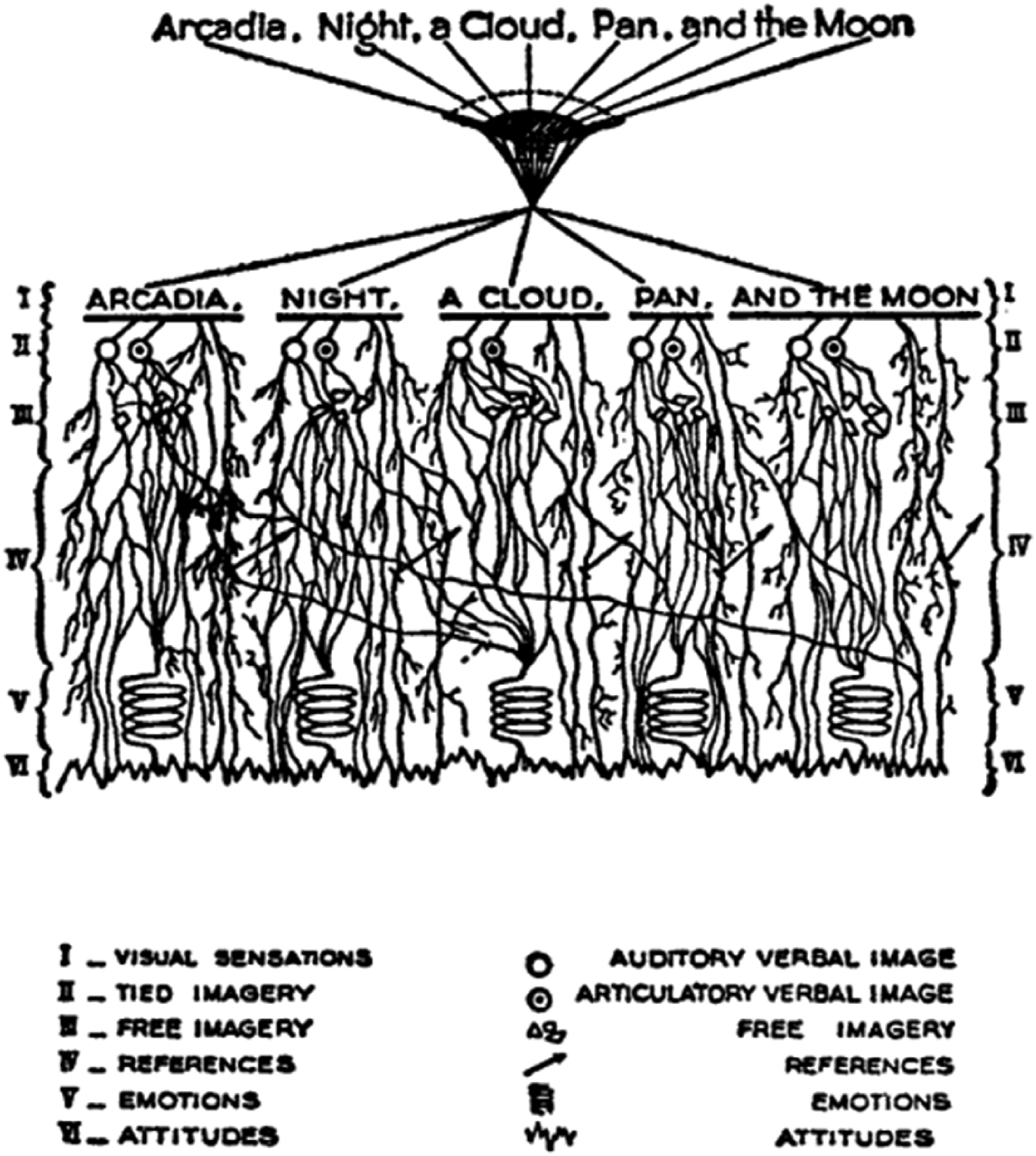
After a caveat concerning the partly misleading nature of all visual representations (Richards, 2001 [1924]: 105), Richards proceeds to illustrate his model. There are six stages (I-VI) and two columns, the left one for written decoding (reading) and the right one for spoken decoding (listening). The importance Richards gives to listening is revolutionary, as it anticipates current research focused on the affordances of reading modes and media, e.g., page versus screen, spoken versus written (e.g., Batini, 2022; Erstad et al., 2023). In what follows, however, I will focus on the left (written) column, since written texts are predominantly analysed over spoken ones in stylistics. The ‘liberty’ appearance of the diagram, incidentally, boils down to the ‘vertical lines which run capriciously downwards from the visual sensations of the words, through their tied imagery and onward to the bottom of the diagram’ and that ‘are intended to represent, schematically, streams of impulses flowing through in the mind’ (Richards, 2001 [1924]: 113).
In stage I, the final line of Browning’s poem ‘Pan and Luna’ reported at the top of Figure 1 becomes an array of visual sensations upon hitting the retina, or of auditory verbal images upon hitting the ear. Although Richards concedes that the ‘individual shapes of the letters, their size and spacing, have only a minor effect upon the whole reaction’ (Richards, 2001 [1924]: 105), he also acknowledges that such typography and formatting choices may still have an impact. In this way, he predates the concerns of multimodal stylistics (e.g., Nørgaard, 2019).
The diagram also acknowledges a difference between the printed or spoken words (written in lower-case) and the same words after being processed by the mind (written in small caps): this often elusive difference between the physical marks and their corresponding signs has been recast in terms of mediation, ‘a pre-semiotic, physical realisation of entities’ (Elleström, 2017: 668) and representation, ‘a semiotic operation, that is, the creation of meaning in the mind’ (Elleström, 2017: 663). Since Elleström’s semiotics draws on Peirce, and Peirce, as argued before, influenced Richards, such a convergence should not come as a surprise. The difference between mediation and representation becomes clear once we consider languages that we do not know: to us, their words are not signs but exist as sheer materiality, as typographic marks or soundwaves.
Stages II and III deal with tied and free imagery, respectively (see also endnote 1). The difference between them is that tied images are ‘images of words’, whilst free images are images of ‘things words stand for’ (Richards, 2001 [1924]: 108). Tied images are therefore much more closely dependent on the physical properties of the stimulus compared to free images. Tied images, in turn, can be of two kinds: auditory images, referring to ‘the sound of the words in the mind’s ear’ (Richards, 2001 [1924]: 108); and images of articulation, that is, ‘the feel in the lips, mouth, and throat, of what the words would be like to speak’ (Richards, 2001 [1924]: 108–109). These two varieties can be exactly mapped onto Kuzmicova’s imagery model (2013), where they are named speech-imagery and rehearsal-imagery, respectively. Free images are ‘pictures in the mind’s eye’ (Richards, 2001 [1924]: 108) and overlap with the constructs surveyed in section 2: loose images, mental picturing, internally constructed scenes, attractors, prototypical verbal images. Having already discussed Richards’ dissatisfaction with this kind of imagery, there is no need to elaborate further.
Stage IV deals with references, ‘those mysterious events which are usually called thoughts’ (Richards, 2001 [1924]: 111). Although thoughts or ideas are tantamount to meanings, Richards warns against the use of the word ‘meaning’ as it would create confusion. Such preoccupation with clarity is a hallmark of Richards’ writing and also underpins his previously discussed observations on the fallacy of projection. The pages on reference in Principles of Literary Criticism should be understood in relation to those in The Meaning of Meaning (1923), co-authored with Ogden and providing ‘an account of the referential function of language and the nature of thought in our interpretation of such language’ (West, 2013: 57). In Principles of Literary Criticism, Richards applies his language theory to literary reading by proposing an initial stage of literal decoding followed by a higher-level comprehension: although in ‘the reading of poetry the thought due simply to the words, their sense it may be called, comes first’, more ‘important are the further thoughts caused by the sense, the network of interpretation and conjecture which arises therefrom’ (Richards, 2001 [1924]: 114). Astonishingly, this outline is compatible with models of comprehension developed over half a century later (Kintsch, 1998; Van Dijk and Kintsch, 1983; Zwaan, 2004): these models posit an activation phase in which word meanings are accessed, followed by an integration phase in which word meanings are combined into larger units through inferences. Both terminologically and conceptually, Richards’ use of ‘network’ resembles Zwaan’s ‘sequences of integrated webs’ (Zwaan, 2004: 38) to represent the structure of a situation model, that is, of the cognitive output of text comprehension.
Stages V and VI deal with emotions and attitudes, suggesting that understanding, addressed in stage IV, is not the endpoint of the reading experience. Some pages earlier, in Chapter 13, Richards defined emotions as ‘those happenings in minds which accompany such exhibitions of unusual excitement as weeping, shouting, blushing, trembling, and so on’ (Richards, 2001 [1924]: 90), linking them to physiological or behavioural cues. Compare this definition to Dancygier’s, who, drawing on Damasio (1999, 2003), defines emotions as ‘ways in which our bodies respond to the environment (e.g., increased heartbeat, sense of warmth or cold, changes in the rhythm of breathing)’, adding that ‘these responses are then appreciated by our mental processes and identified as the “feeling” of, for example, fear’ (Dancygier, 2014: 215). Once more, Richards’ formulation would be largely endorsed by contemporary cognitivist researchers.
For all the accuracy of Richards’ psychological definition of emotions, the aesthetics invoked in Principles of Literary Criticism nonetheless requires emotions to be more than simply ‘happenings in minds’: they must also serve communicative purposes, otherwise their literary effects would be difficult to account for. Richards’ further characterisation of emotions and sensations as ‘relatively private signs’ (Richards, 2001 [1924]: 117) may appear oxymoronic, but is also effective in conveying the simultaneously communicative and allusive nature of emotions: Words, when used symbolically or scientifically, not figuratively and emotively, are only capable of directing thought to a comparatively few features of the more common situations. But feeling is sometimes a more subtle way of referring, more dangerous also, because more difficult to corroborate and to control, and more liable to confusion. (Richards, 2001 [1924]: 117)
Richards’ position, again, foreshadows current developments in pragmatics, where linguists have attempted to account for the emergence of non-propositional effects, that is, of those open-ended effects that cannot be reduced to paraphrase and involve ‘the activation of perceptual, emotional sensorimotor mechanisms’ (Wilson and Carston, 2019: 32). Wilson and Carston draw on imagery (corresponding to Richards’ free images) to exemplify non-propositional effects, arguing that Relevance Theory can account for their nature, which is less straightforward (‘more difficult to corroborate and to control’ in Richards’ words) than that of prototypical propositional effects such as speech acts (e.g., warning, promising, congratulating). Since a speaker’s intention is not overly manifest in non-propositional effects, the addressee has a larger share of responsibility in reconstruing the intention. Giving more control to the addressees, of course, increases the variability of responses and the chances of misunderstandings: whilst simple orders are virtually unequivocal, the interpretation of poems or of complex political decisions typically leads to many more divergences.
As for attitudes, Richards in Chapter 15 defines them as ‘imaginal and incipient activities or tendencies to action’ (Richards, 2001 [1924]: 100). Compared to emotions, attitudes are ‘hidden from observation’ (100), a fact, however, that ‘should not lead us to overlook how great a part in the whole experience is taken by attitudes’ (100). Attitudes seem to be located at the furthest remove from the initial stimulus – in this case, from the poem. Their perlocutory nature (‘tendencies to action’) belongs to ethics as it has potential repercussions for behaviour and not just for the short-term bodily reactions associated with emotions.
At this point, it is possible to reappraise the whole diagram in terms of stratification and depth of processing, charting effects that are increasingly autonomous from the original stimulus and increasingly embedded in the recipient’s psyche: whilst visual sensations are short-lived and superficial, tied imagery is more internalised and may resonate for longer; free imagery is even more subjective and detached from the stimulus, and the same is true – a fortiori – of reference, reference being a prerequisite for free imagery. The cognitive grasp of a poem at the level of reference is deeper (more symbolic) than the sensuous stimulation of imagery, and yet it is still not as deeply embedded as emotions and attitudes. Indeed, the endpoint of artistic and literary reception may well be the ‘after-effects, the permanent modifications in the structure of the mind, which works of art can produce’ (Richards, 2001 [1924]: 117–118). After such modifications, ‘[n]o one is ever quite the same again after any experience; his possibilities have altered in some degree’ (2001 [1924]: 118).
Rooting literariness in long-term effects is a tenet that is gaining traction in the empirical studies of literature, where it has been articulated through the prism of transformative reading (Fialho, 2019, 2024). Although literary works have the capacity to ‘be woven into the texture of readers’ lives’ (Fialho, 2019: 2), educational curricula mostly fail to reflect this, seldom if ever asking students questions as personal and as far-reaching as, ‘What is this text about for you? what does it mean for your life?’ (Fialho, 2019: 3). The pedagogically minded Richards would have readily approved of the educational potential of such a research programme. The idea that literariness chiefly lies in its long-term effects poses an additional challenge to stylistics, however: long-term effects seem less likely than short-term effects to stem from noticeable stylistic features (or attributions). It would be presumptuous to address this challenge here, but having identified it already provides a starting-point.
6. Conclusion
In this article, I have shown what a trove of insights Principles of Literary Criticism is by discussing some fundamental ideas that should be kept in mind when doing stylistics. These ideas are all interrelated, being ultimately facets of the same stimulus-response framework.
The individual variability discussed in section 2 belongs to the response pole but has palpable consequences for old and recent theoretical proposals. These typically fork into dichotomies (e.g., tied/free, tied/loose, prototypical/peripheral, reading/interpretation) to accommodate contextual variability whilst still pursuing a search for regularities without which poetics and stylistics themselves would cease to exist.
The feature-effect claims examined in section 3 are attempts to bridge the gap between fixed stimulus and varying response by teasing out individual elements of the stimulus (e.g., emotion words, metre, narratorial intrusion) and individual elements of the response (e.g., raising the pitch, attributing sentence stress, feeling immersed in the storyworld). This simplification is part and parcel of any analysis, analysis being the ‘separation of a whole into its component parts’ (Merriam-Webster online, 2011, sense 2). Following Richards, I posit a mediating factor between stimulus and response, namely context. Far from undermining the analytical vocation of stylistics, the influence of context would enhance it. This is because context itself could be modelled as the set of conditions under which a given stimulus invariably (deterministic stance) or preferably (probabilistic stance) leads to a given response.
Section 4 also dwelt on the need for (and limitations of) simplifications, but viewed them as requirements for experimental research rather than as by-products of analysis. I have shown the enduring relevance of Richards’ methodological reflections first by reviewing studies that simplify both the stimuli (e.g., decontextualised lines in original and carefully altered versions) and the responses (e.g., rating scores); and, second, by reviewing studies that preserve the original complexity of the stimuli but are liable to confound variables.
Modelling context as proposed would help to design experiments that yield unambiguous findings without oversimplifying either the stimulus or the response.
Section 5 again dwelt on the response pole of the equation, but it did so in a more optimistic vein than in section 2; Richards’ critique of the fallacy of projection and his six-stage diagram for experiencing a poem enable us to theorise effects more robustly than I believe has been the case so far. The fallacy of projection taps into the fundamental distinction between description and interpretation: Richards seems to think that a description always amounts to an interpretation, since there are no inherent features in a work of art but only those that we attribute to them. Whilst I join ranks with Fabb (2012) and Toolan (2014) in aligning with this stance, I also want to stress that a distinction between description and interpretation remains necessary: a description is an especially tight form of interpretation in which consensus is very high, just as a definition is an especially tight form of description in which consensus is – or ought to be – virtually unanimous.
The six-stage diagram demonstrates that not all attributions or effects are the same, despite their undeniably being all attributions or effects: those closest to the material aspect of the text are the most consensual but also the least informative (e.g., all readers of a text would identify the same words in it); those at the furthest remove from the text are the least consensual but also the most informative (e.g., readers rejecting or embracing the ideological stance expressed by a narrator, thereby changing or radicalising their own attitudes). The intermediate stages (free imagery, reference and emotion) probably strike the best balance between textual anchorage – a non-negotiable requirement for stylistics – and informativeness – a requirement for literary criticism and aesthetics. My own work on difficulty (Castiglione, 2019) situates itself between imagery and reference (ideational lack of accessibility) on the one hand, and emotion (interpersonal lack of alignment) on the other. Interestingly, the last three stages of Richards’ diagram (reference, emotions, attitudes) map onto the corresponding tripartition of logos, pathos and ethos in Aristotelian rhetoric – except that in Richards the stages refer to sequentially arranged steps in a process rather than to branches standing in a subordinate relationship to a hypernym (e.g., ‘means of persuasion’).
Far from being a remnant of the past, the behaviouristic stimulus-response framework that drives many of Richards’ reflections is precious for the future of a pragmatically and empirically oriented stylistics. What needs to be rejected of classic behaviourism is a deterministic one-to-one link between stimulus and behaviour, as well as its suspicion towards introspection and the mind; but certainly not the benefits of eliciting observable responses to learn about underlying cognitive effects. One could actually go as far as to say that all the experimental approaches in the social sciences are behaviouristic insofar as they draw a distinction between stimulus (materials) and response (data elicited). Starting from ascertaining the effects of creative works, such a re-oriented stylistics (which is already partly practised) would proceed to identify the textual patterns that arguably contributed to those effects. Conversely, a nuanced differentiation of linguistic categories and literary constructs can assist stylisticians in arguing for subtler effects that would otherwise go undetected.
The fact that in discussing Principles of Literary Criticism I have barely touched upon the stimulus pole (that is, the poems themselves) should not be surprising: rarely does Richards engage in textual analysis, as West has noticed (West, 2013: 129). As already laid bare by Richards’ words on imagery, the properties of the stimulus seem to him of minor importance. He would probably regard stylistic variation itself as a surface phenomenon not worth his best efforts: stylistic analysis is after all scarce even in The Philosophy of Rhetoric, where the main interest is indeed … philosophical, dwelling on general topics in semantics and pragmatics (e.g., communication, ambiguity, metaphor, sound symbolism, vocabulary) rather than on their instantiations in specific works. This lack of a sustained interest in textual structures and stylistic choices is at odds with Richards’ reputation as a formalist uninterested in contexts – a biased narrative that West (2013) rightly counters.
Nevertheless, Principles of Literary Criticism remains immensely relevant to what stylisticians have been doing and to what they may do in the future. This relevance becomes compelling as soon as we realise the extent to which stylistic practices may benefit from a theory of readerly experience as encompassing as the one that Richards developed. Richards’ erratic yet insightful masterpiece has anticipated many topics now investigated in a range of disciplines and approaches – from post-Gricean (relevance-theoretic) pragmatics to the cognitive psychology of text comprehension, from neo-Perceian semiotics to multimodal stylistics, from empirical aesthetics to pedagogically oriented approaches to literary studies. Paradoxically, it is precisely the pervasiveness of Richards’ influence that may have obscured the traces left by his work; yet, the time has finally come to acknowledge that much of our stylistic edifice rests on Richards’ shoulders.
Footnotes
Funding
The authors received no financial support for the research, authorship, and/or publication of this article.
Declaration of conflicting interests
The authors declared no potential conflicts of interest with respect to the research, authorship, and/or publication of this article.
Notes
Author biography
 ).
).