



Abstract
This article reveals the ways in which concepts associated with the humanities inform determinations of ‘outstanding universal’ aesthetic value of natural heritage under the World Heritage Convention. Language derived from humanistic ideas of beauty, the sublime and the picturesque, together with a range of images, are used in World Heritage deliberations to describe nature from, in the words of the treaty, ‘an aesthetic point of view’. However, a preference for ‘scientific method’ masks the use of humanistic approaches, impeding the development of critical approaches that could enhance World Heritage determinations. The deliberate use of humanistic methods and images to judge environmental aesthetics would, the article contends, facilitate critical inquiry without falling foul the ‘principle of legality’ – an international legal requirement of international bodies such as the World Heritage Committee to act in accordance with the powers conferred on them by the states parties under a treaty.
Keywords
Introduction
During the 2015 climate talks in Paris, visual artist Olafur Eliasson and scientist Minik Rosing brought 80 tonnes of ice from Greenland to create an artwork in the form of a clock face at the Place du Panthéon (Figure 1). In doing so, they raised complex questions about environmental aesthetics, science, art and international law. The artistic gesture attempted to bring the human assault on the environment to the dignitaries charged with agreeing international laws to stem climate change. Called Ice Watch, it gave immediate and tangible form to a ‘slow violence’ (Nixon, 2011) on the Earth’s atmosphere in the very place that, in 1851, physicist Léon Foucault famously used his pendulum to prove to the Parisian public the rotation of the Earth (Aczel, 2005: 180).
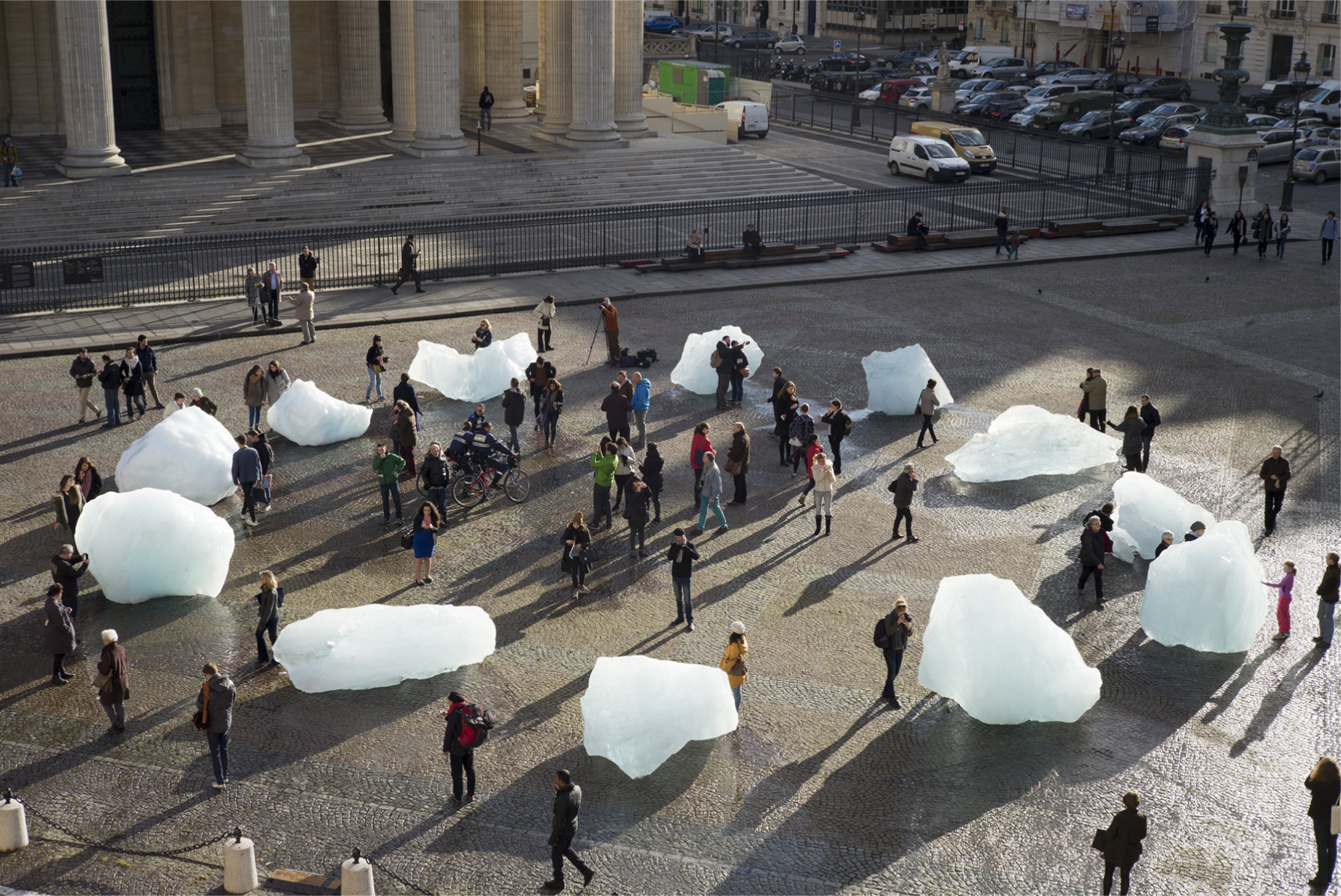
Ice Watch by Olafur Eliasson and Minik Rosing, Place du Panthéon, Paris, 2015. Photo: Martin Argyroglo © 2015 Olafur Eliasson.
The sea ice used in Ice Watch was harvested from an area south of the Ilulissat Icefjord in Greenland – a World Heritage site listed at least in part for its aesthetic significance. 1 The ‘dramatic sounds produced by the moving ice’ in the fjord are identified in the World Heritage citation as contributing to the ‘natural spectacle’ of the site (WHC, 2004). That Eliasson and Rosing have transported sea ice taken from a place at least symbolically proximate to a World Heritage site to an urban space where it would melt and disappear challenges the purpose and utility of protections under international environmental law. The artwork could be seen to destroy natural formations protected under one international treaty for their aesthetic value in order that the loss of that value might be visualized, perceived and stopped by states under another international treaty.
Eliasson and Rosing, artist and scientist, exploited environmental aesthetics in an attempt to hold international lawmakers to account. Their artwork was intended to have prospective impact on the making of international law, demonstrating that international environmental law matters to art. It is, however, less clear how art might matter to international law in the construction of aesthetic values of the environment. This article considers how humanistic method and images representing environmental aesthetics relate to the application of a long-standing international treaty: the 1972 World Heritage Convention (Convention, 1972).
Decision makers under the World Heritage Convention are required to identify natural properties of ‘outstanding universal value’ from, among others, an ‘aesthetic point of view’ (Convention, 1972: Article 2). In that process, the World Heritage Committee and its advisors engage in commentary that, this article contends, is rich in the language of art scholarship to construct meanings of aesthetic value for the world’s natural heritage. Descriptions common to humanistic notions of ‘beauty’, the ‘sublime’ and the ‘picturesque’, for example, can be seen throughout the documentation produced in support of aesthetic claims. In addition, visual sources, including in some cases visual art, are referenced by the Committee to enliven its descriptions of ‘outstanding universal’ aesthetic value.
This article maintains, however, that the Committee is uncritical in its use of methods associated with visual art and of images. The aesthetic method of World Heritage decision makers appears beholden to a concept of nature informed largely by the European Romantic movement of the 19th-century. Contemporary humanistic approaches such as eco-criticism, providing a complex account of the aesthetic value in nature, are not apparent in World Heritage determinations. An uncritical understanding of the ways in which images, including visual art, inform environmental aesthetics is also reflected in the Committee’s guidance and practice. Critical legal scholarship that investigates the legacy and manifestations of image in law – law and image scholarship – points to the various ways in which critical understandings of image can inform legal judgement.
World Heritage decision makers and their advisors do not explicitly acknowledge that they are using humanistic methods and sources to construct an aesthetic point of view. Instead, they maintain that they must engage in an objective and scientific inquiry consistent with the Convention’s stated desire for a system of protection based on ‘modern scientific methods’ (Convention, 1972: preamble). This article argues, however, that the World Heritage Committee, can, as a matter of law, openly engage humanistic method and sources. The deliberate use of contemporary humanistic scholarship would, it suggests, facilitate critical inquiry without falling foul the ‘principle of legality’ – an international legal requirement of international bodies such as the World Heritage Committee to act in accordance with the powers conferred on them by the states parties under a treaty.
Part 2 of the article describes the legal basis and process for the World Heritage Committee’s determinations of outstanding universal aesthetic value of natural heritage and explains how humanistic method and imagistic sources are used in that process. Critical perspectives on the humanistic method and imagistic sources used are examined in part 3. Part 4 considers the role of scientific method in World Heritage findings of aesthetic value and argues that the acknowledged use of critical humanistic scholarship would be consistent with the international legal principle of legality.
Three qualifications are made at the outset of the article. First, although the article contemplates a role for critical scholarship, it does not question the viability of aesthetic judgements of nature from a critical perspective. It takes as given that World Heritage inscriptions of natural properties for their outstanding universal value can and will continue to be made on an aesthetic basis for the purposes of the treaty. It maintains, however, that critical elements of humanistic scholarship should be employed by World Heritage decision makers to properly justify their legally mandated decisions on aesthetic value. Second, it is acknowledged that World Heritage decisions are highly politicized (Cameron and Rössler, 2013; Maswood, 2000). 2 The focus in this article, however, is law and legal process – recognizing all the while the intimacy between law and politics, public international law being a much lauded exemplar of that union (Koskenniemi, 2005, 2010). Finally, the term ‘aesthetic’ has a range of applications in this article. It is analysed as a legal term, appearing in the Convention to denote a particular kind of outstanding universal value attached to natural heritage. 3 Aesthetic is also used in connection with the methods of appraisal developed in the arts to analyse the merits of artistic expression. In this article, the term ‘humanistic’ will be used to describe the aesthetic methods (or means of analysis) and sources (namely images) that belong to the study of art or to the humanities more generally.
Humanistic Approaches to Aesthetic Judgements of the World’s Natural Heritage
The World Heritage Convention creates a process for assigning World Heritage status to natural heritage of outstanding universal value from, among others, an ‘aesthetic…point of view’ (Convention, 1972: Article 2). The legal basis and process for these determinations, and the role of humanistic language and image in those determinations, is described below.
Legal Basis and Process for Aesthetic Judgements
Undefined in the Convention itself, outstanding universal value has subsequently been described as ‘cultural and/or natural significance which is so exceptional as to transcend national boundaries and to be of common importance for present and future generations of all humanity’ (WHC, 2016: para 49). Natural heritage properties will be deemed of outstanding universal value under the Convention if they satisfy at least one of four criteria set out in the Operational Guidelines for the Implementation of the World Heritage Convention (‘Operational Guidelines’) (Convention, 1972: Article 11(5); WHC, 2016: para 77). Relevant to an aesthetic point of view, criterion (vii) requires natural heritage to ‘contain superlative natural phenomena or areas of exceptional natural beauty and aesthetic importance’ (‘aesthetic criterion (vii)’) (WHC, 2016: para 77). 4
The Convention creates an intergovernmental body, the World Heritage Committee, to determine the outstanding universal qualities of the natural heritage values as they apply to specific properties in individual countries. Comprising ‘expert’ representatives from 21 of the 192 states parties to the Convention (Convention, 1972: Article 8(1)), the World Heritage Committee meets annually to decide which ‘parts of the cultural or natural heritage are of outstanding interest and therefore need to be preserved as part of the world heritage of mankind as a whole’ (Convention, 1972: preamble). The Committee decides which properties are to be included on the World Heritage List and which properties will benefit from financial assistance from the World Heritage Fund (Convention, 1972: Article 11(2), Article 13(6)).
Decisions to inscribe properties on the World Heritage List are the culmination of a process that begins with the tentative listing of properties (Convention, 1972: Article 11(1); WHC, 2016: para 62), followed by the nomination of a given property by a state (WHC, 2016: paras 63, 128). 5 The nomination is then evaluated by scientific experts. One or both of the independent expert ‘Advisory Bodies’ – the International Union for the Conservation of Nature (IUCN) or the International Council on Monuments and Sites – evaluates nominated properties before they are considered by the World Heritage Committee for a decision on ‘inscription’ in the World Heritage List. 6 Justifications for World Heritage status are summarized in ‘Statements of Outstanding Universal Value’ which are approved by the Committee in its decision to list the property. 7
More than half of the natural properties on the World Heritage List could be described as having outstanding universal aesthetic value. 8 Only nine properties have been listed on the basis of the aesthetic criterion (vii) alone. These include the two 2008 inscriptions of the Monarch Butterfly Biosphere Reserve in Mexico and the Mount Sanqingshan National Park in China, as well as the 2012 inscription of the Lakes of Ounianga in Chad (Mitchell, 2013: 19).
Humanistic Language in Aesthetic Judgements
Many of the mentions of valued aesthetic qualities in the justifications of World Heritage status for natural heritage reflect the language of artistic movements that have explored the human experience of the natural environment, particularly landscape.
There are many examples of graphic representations of animals and habitats in prehistoric, ancient and indigenous cultures, but the ‘landscape’ convention that emerged in Western European art in around 1500, with earlier representations in Chinese artistic traditions since at least the period of the Five Dynasties (AD 907–60; Fitter, 2016; Whitfield, 2016), has expressed and constructed ideas of nature that persist in contemporary cultures (Brady, 2003; Carlson, 2009: 3). Reacting to the one-time celebration of order and balance in ‘natural beauty’ (Brady, 2003: 30–31), artistic movements – notably 19th-century European, British and New World Romanticism – later explored the sublime as ‘the most wild, the most fearful, the most alien of all landscapes, at once overwhelming the senses and evoking awe’ (Brady, 2003: 40). The picturesque, marked by the qualities of ‘roughness, sudden variation and irregularity’ (Brady, 2003: 39), was developed in art in dialogue with sublime concepts. Thomas Moran’s Grand Canyon of the Yellowstone (Figure 2) is exemplary of the styles and themes depicted in 19th-century paintings of New World frontiers. Landscape imagery associated with the cleansing redemptive qualities of the wild espoused by American Transcendentalism followed (Brady, 2003: 46). Landscape was a feature of modern art movements, such as Impressionism, and remains a significant element of contemporary artistic expression around the world (Mitchell, 1992; Rolston III, 2016).

Thomas Moran, Grand Canyon of the Yellowstone, 1872. Source: Smithsonian American Art Museum.
Philosophers of aesthetics disagree as to whether the environment’s aesthetic qualities can or should be described in the same terms as art (Berleant, 1993: 228; Carlson, 2000: 77). They nevertheless recognize the link between the environment and art. As philosophers Kemal and Gaskell observe, ‘natural beauty is so riddled with conceptions derived from painting and poetry that landscape refers ambiguously to parts of nature and representations of nature in paintings, photographs and film’ (Kemal and Gaskell, 1993: 2; Haapala, 2002: 47).
Taking a humanistic approach to the documentation that accompanies each stage in the World Heritage decision-making process reveals a regular reliance by the Committee and its advisors on notions of beauty, the sublime and the picturesque associated with art scholarship. 9 A report initiated by the Australian Government on the application of World Heritage Committee aesthetic criterion (vii) to the Great Barrier Reef (‘Australian report’) identifies common attributes and descriptors of aesthetic value in World Heritage Statements of Outstanding Universal Value and supporting documentation (Context Pty Ltd, 2013). Although not acknowledged as such in the World Heritage documentation itself, descriptions commonly reference themes that are typical of Western scholarship on landscape art from the 19th-century. References to diversity, combination, abundance, contrast, dramatic impact, change (seasons, weather, and light), scale, majesty, depth, steepness and wilderness, for example, appear with descriptions of landscapes that are said to be rising, falling, towering, scenic, spectacular, wild and ‘free from human influence’ (Context Pty Ltd, 2013: 11). 10
Another study on the application of World Heritage Committee aesthetic criterion (vii), commissioned by IUCN (‘IUCN study’), identifies the assessment of the Lakes of Ounianga in Chad as the most rigorous qualitative evaluation of exceptional natural beauty and aesthetic importance (Mitchell, 2013: 31). The World Heritage Statement of Outstanding Universal Value for the Lakes of Ounianga provides: The property represents an exceptional example of permanent lakes in a desert setting, a remarkable natural phenomenon which results from an aquifer and associated complex hydrological system which is still to be fully understood. The aesthetic beauty of the site results from a landscape mosaic which includes the varied coloured lakes with their blue, green and/or reddish waters, in reflection of their chemical composition, surrounded by palms, dunes and spectacular sandstone landforms, all of it in the heart of a desert that stretches over thousands of kilometres. In addition, about one third of the surface of the Ounianga Serir Lakes is covered with floating reed carpets whose intense green colour contrasts with the blue open waters. Rock exposures which dominate the site offer a breathtaking view on all the lakes, of which the colours contrast with the brown sand dunes separated by bare rock structures. The shape and distribution of the lakes, combined with the effect of the wind moving the floating vegetation in the lakes, gives the impression of ‘waves of water flowing in the desert’. (WHC, 2012)
Images in Aesthetic Judgements
Related to the use of an artistic lexicon, World Heritage Convention descriptions of aesthetic value are also intimately tied to visual image (Context Pty Ltd, 2013: 11; Mitchell, 2013: 31). The Operational Guidelines (2016) – the principal document prescribing procedures for attaining and maintaining the World Heritage imprimatur – make no specific mention of using images to support claims of aesthetic value. States are, however, required to provide ‘documentation necessary to substantiate the nomination’, including ‘images of a quality suitable for printing’ (WHC, 2016: para 132). States parties are encouraged to grant the United Nations Educational, Scientific and Cultural Organization publication rights of images provided in nomination files (WHC, 2016: Annex 5, 7a, 96). 11 In addition, the format of nominations requires states to ‘provide a sufficient number of recent images (prints, slides and, where possible, electronic formats, videos and aerial photographs) to give a good general picture of the property’ (WHC, 2016: Annex 5, 7a, 96).
A World Heritage Committee ‘Resource Manual’ advising states on how to nominate properties for World Heritage protection advises that images giving a ‘general picture of the property’ in accordance with the Operational Guidelines ‘should portray the potential Outstanding Universal Value of the property, as well as its context’ (World Heritage Centre, 2011: 121). The Manual further warns that ‘[p]oor quality images are of no use’ (World Heritage Centre, 2011: 98). Like the Operational Guidelines, however, the Manual is modest in specifically addressing the relevance of images to claims of aesthetic value. It describes the aesthetic criterion (vii) as containing two concepts: (1) ‘superlative natural phenomena’, which it says ‘can often be objectively measured and assessed’ (World Heritage Centre, 2011: 40) and (2) ‘exceptional natural beauty and aesthetic importance’. The second concept it says ‘is harder to assess’ but ‘[m]erely asserting these qualities without a robust supporting argument is insufficient’ (World Heritage Centre, 2011: 40) and ‘providing attractive photographs is inadequate’ (World Heritage Centre, 2011: 60).
In terms of practice, photographic documentation is often presented in nomination files (e.g. Figure 3) (WHC, 2016: para 132). Maps are also included (WHC, 2016: paras 127, 132). Expert evaluators may also present site photographs in their reports (World Heritage Centre, 2011: 126). These and other images, including videos, are extracted under the ‘gallery’ tab on the World Heritage List website.

Lake Yoan, World Heritage Nomination File for Lakes of Ounianga, Chad, 2011 © Sven Oehm.
References to other graphic images, notably art, are also made in the nominations and assessments. Peter Dombrovskis’ photographs of ancient trees are, for example, tied to judgements of the aesthetic qualities of Tasmania’s Wilderness. Dombrovskis and Miller’s book, The Quiet Land, is cited by Australia in its nomination of the area for World Heritage status in 1982 (Dombrovskis and Miller, 1977). Moreover, it is a mark of aesthetic quality that a property has inspired artists: The IUCN study noted earlier states that ‘sources of evidence that demonstrate aesthetic landscape values at an international level include works of art, literature, cinema, and music’ (Mitchell, 2013: 39). Unsurprisingly, art is also noted in the context of a property’s cultural value. IUCN’s evaluation of China’s Mount Huangshan states that it ‘has been eulogised throughout much of Chinese history, resulting in a rich legacy of art and literature’ (IUCN, 1990: 7). 12
Critical Approaches to Aesthetic Judgements in Art and of Image
The Committee’s use of terminology associated with art scholarship and the reliance on images in justifications of the aesthetic value of natural heritage is apparent throughout the decision-making process and in the final determinations. It is, however, uncritical. A close reading of the documentation and guidance on assessments of natural heritage suggests that World Heritage decision makers are beholden to an uncritical concept of nature informed largely by the European Romantic movement of the 19th-century. Critical approaches in contemporary art scholarship would highlight aspects of the environment’s aesthetic qualities different from those referenced by the Committee. In addition, critical understandings of the role of image in law might also demand certain considerations in the Committee’s judgement of the aesthetic value of the environment not currently addressed in relevant instruments or practice. Each aspect is considered below.
Contemporary Critical Art Scholarship on Environmental Aesthetics
Absent from the World Heritage Committee’s justifications of the aesthetic qualities of natural heritage are contemporary humanistic approaches that might provide a complex and nuanced perspective on environmental aesthetics not otherwise apparent in historic artistic scholarship on landscape. ‘Eco-criticism’, for example, would identify different aesthetic qualities in the environments represented in art from those referenced in World Heritage determinations.
Contemporary artists and art critics assuming an eco-critical approach examine environmental subjects through the lens of social and natural history. Eco-criticism proceeds on the basis that the very idea of ‘nature’ is a social construct. Art historians Braddock and Irmscher refer to eco-critical art history as a ‘probing and pointedly ethical integration of visual analysis, ecocultural interpretation, and environmental history’ which ‘pays sharper attention to the environmental embeddedness of art within a world that is both stubbornly real and infinitely vulnerable’ (Braddock and Irmscher, 2009: 4). 13 Its function, Braddock and Irmscher attest, is to expose ‘false assumptions’ about the state of the environment ‘while pointing the way to a more sustainable future’ (Braddock and Irmscher, 2009: 19). Eco-criticism is applied both to art that reflects on nature for the sake of art alone, as well as to art that actively engages law and policy on environmental protection (Matilsky, 1992: 4; Weintraub, 2012: 9).
The artistic and analytical outcomes of an eco-critical approach challenge 19th-century Western European ideas of beauty, the sublime and the picturesque, which can lead to more pluralized conceptions of environmental aesthetics. Contemporary artists from the South, for example, might be seen from an eco-critical perspective to link environmental harm to Empire and development. 14 Ghanaian-born artist, John Akomfrah, produced a video installation Vertigo Sea (2015) (Gyalui, 2015) in which he juxtaposed archival, dramatic and documentary footage on a triptych of screens which at several stages shows sea mammals – whales and seals – and polar bears, in colourful splendour and in black and white harpooned carnage. It also shows re-enactments of slaves tossed from boats to their death and asylum seekers drowned and washed ashore. Kenyan-born artist Wangechi Mutu’s animated video, The End of Carrying All (2015) (Figure 4) (Gyalui, 2015), shows a silhouetted woman climbing a rural hillside. On her head she carries her daily needs, her load growing as she climbs, from a simple cornucopia of food to an overloaded collection of modern trappings.

Wangechi Mutu, The End of Carrying All, 2015, 3 screen animated video (colour, sound), 10 minutes, looped, Courtesy of Gladstone Gallery, New York, Victoria Miro, London and Susanne Vielmetter, Los Angeles, © Wangechi Mutu.
The environmental perspectives evident in Akomfrah and Mutu’s works could be contrasted with the Romantic depictions of flora and fauna in many of the contemporary environmental artworks produced by Northern artists. 15 UK artist Tacita Dean’s Majesty (2006) pays homage to the ancient oak trees of Britain. The image depicts, the artist explained, the significance of the tree and her own sense of self and place (Fondation Louis Vuitton). French-born artist Pierre Huyghe’s video A Journey That Wasn’t (2005) ‘documents’ his trip with fellow artists and scientists to Antarctica, showing a barren and inhospitable landscape in which humans are alien while penguins and seals belong.
Artistic exploitations of Romantic concepts of nature by Northern artists, however might critique those concepts (e.g. artworks by: Hall, 2015; Laurence, 2015; Simon, 2015) while some Southern artists might celebrate them (arguably, artworks by Guo Qiang, 2013 and select works in the exhibition vita vitale, Bracker, 2015). Eco-critical analysis could reveal that the works portraying environmental destruction do not necessarily reject the landscape values of 19th-century European artists which are ever present in contemporary art from the North and South. 16 Their works might be seen instead to mourn the loss of such landscapes.
The rules, policy or practice of aesthetic determinations by the World Heritage Committee do not address a range of issues that an eco-critical perspective might highlight. They do not, for example, consider the import of descriptions such as grotesque or ‘colour contrasts’. An eco-critical approach could point to contemporary ecological art to analyse the extent to which 19th-century aesthetic values of the environment remain ‘outstanding’ and ‘universal’ for all states parties – in the North and in the South. The different representations of the environment in the works of Southern and Northern artists might speak to the development of new environmental aesthetics that should be taken into account in judgements of World Heritage. For example, with reference to Mutu’s work (Figure 4), an eco-critical approach might question or confirm the basis upon which the ‘massed congregations of birds on the shores of the lakes’ in the Kenya’s Great Rift Valley constitute an ‘outstanding wildlife spectacle’ that merits World Heritage protection on aesthetic grounds (WHC, 2011). Akomfrah’s work might be relevant to an understanding of environmental aesthetics in Ghana, a country in which no aesthetically valued natural heritage has been identified under the World Heritage Convention.
Critical Legal Scholarship on Image
The conception of image in guidance to the World Heritage Committee and states parties, like the language of the Committee’s justifications, is also uncritical. The relevant instruments identified above in part 2 provide little guidance on the role of image in World Heritage determinations of the aesthetic value of natural heritage. The guidance, this article observes, reflects none of the insights that law and image scholars have applied to identify image in law and to understand its relevance to legal judgements.
As explained by law and image scholars, law in general, and international law in particular, is not well versed in the recognition and interpretation of images from a humanistic perspective. Despite a one-time intimacy between law and image, the 17th-century Anglo-European law evolved away from visual emblems towards written text as the secular state wrenched legal authority from the Roman Catholic Church (Douzinas and Nead, 1999: 8). Image was seen as circumspect, possibly anathema, to law. Modern international law, born of Anglo-European legal thinking and method after the Reformation, might be seen to mirror the domestic trend, embracing as it did predominantly positive sources and methods (Klabbers, 2013: 12–13; Neff, 2010: 14–16, 25) with seemingly little thought for the relevance of image and visual representation.
Law and image scholarship, part of the broader law and humanities thinking (Gearey, 2001; Kenyon and Rush, 2004), has challenged the presumed sovereignty of the word in law (Douzinas and Warrington with McVeigh, 1991; Douzinas and Nead, 1999; Goodrich, 1998). It has questioned why, and the extent to which, image was ever exiled from the legal domain. It has highlighted the myriad ways in which image continues to populate legal form and thinking without being acknowledged or understood (Haight Farley, 2010; Silbey, 2012-2013). Different scholars have addressed issues from different perspectives. Some have highlighted the historical place of image, or emblems, in the promulgation of common law (Douzinas, 2000; Goodrich, 1990). Others have examined the aesthetics or image of law – its style, its methods, its ‘theatre’ (Haldar, 2016). The role of humanistic method and artistic images, graphic and verbal, has also been identified in judgments or offered as a tool for interpretation (Manderson, 2013). More tangible forms of image have been identified as part of the evidence proffered to juries and judges (Sherwin, 2011). The law’s regulation of image – notably in the form of censorship – is also a rich source for scholarship in this field (Young, 2004).
As they have exposed the roles that humanistic ideas (typically termed ‘aesthetics’ in the context of such scholarship) play in domestic law, law and image scholars advocate ‘visual literacy’ in legal method and legal education (Bańkowski et al., 2012; Sherwin, 2011). Those charged with making and applying the law, scholars suggest, should recognize and understand the role of image in law so that legal method and sources can be expanded to openly encompass humanistic understandings of image. There is, otherwise, a risk that justice will be undone by ‘misreadings’ of image. Sherwin (2011: 38–42), for example, highlights the risk of context being excluded by the selective framing of photographs or videos proffered in evidence before courts. He also describes the emotive powers of image as a potential distortion of judgement, where an image informs law but is not recognized as having done so, exposing judicial decisions to obscured bias (Sherwin, 2011: 39; Sherwin, 2012-2013: 35–36). Rush and Kenyon (2004) critique imagery in case law as betraying the bias within judicial decisions. Young (2004: 20) warns that law’s ignorance of artistic conventions can lead to ‘misjudgements’ of images while Douzinas (2000) points to the common law’s clumsy engagement with the aesthetics of art.
As well as warning against the misuse of humanistic methods and image in law, legal scholars have proposed ways in which humanistic understandings of image can inform law. Manderson (2013), for example, demonstrates the ways in which legal knowledge of artistic conventions can positively assist or inform legal judgement. He considers the relevance of JMW Turner’s The Slave Ship (1840) to a critical analysis of Australia’s law and policy on asylum seekers (Manderson, 2013). Sherwin (2012-2013) describes the potential for image to imbue law with ethical legitimacy. He points out how, on viewing footage of a physical struggle or ‘waltz’ between parents over the custody of their child, ‘knowing that one of those dancers had already set in motion a plan to murder the other’, a jury ‘cannot not respond, for once having become mindful of that which calls for a response, our response becomes an unshakable responsibility’ (Sherwin, 2012-2013: 36).
Observations made by law and image scholars to identify image in law and to argue for legal competence in humanistic methods of interpreting or finding meaning in images – so-called visual literacy – might, it is suggested in this article, also be made in connection with World Heritage determinations of nature’s aesthetic value. 17 A critical humanistic position on image could, for example, inquire as to what probative weight images bring to bear on a decision to award World Heritage status. It could help to explain the basis upon which images can be used as evidence of aesthetic claims, openly acknowledging the role of framing and composition, and the quality of the images, in directing the Committee in its judgement of aesthetic value. A critical approach to image in the guidance to the Committee and states could also explain why and how ‘providing attractive photographs is inadequate’ (World Heritage Centre, 2011: 60) to justify claims of aesthetic significance in natural sites. If it is intended by the parties to the Convention (1972) that a 19th-century European Romantic aesthetic is preferred, the guidance could identify the aspects of a nominated property that should be presented in images; if different aesthetic conceptions are to be entertained as outstanding and universal, the Committee and states could instead be guided to identify the aspects of the site relevant to those alternative conceptions.
The significance of humanistic approaches to World Heritage determinations could also be in simply identifying, in the first instance, the different types of images that inform judgements of nature’s aesthetic value. The World Heritage instruments and documentation discussed in part 2 conceive of image as graphic image. For art historian WJT Mitchell, however, graphic image is only one of five types of image. Other types – ‘optical’ projections, ‘mental’ memories, ‘verbal’ metaphors and ‘perceptual’ associations – add to the mix of images that are brought to bear in the viewing of images (Mitchell, 1986: 10). 18 Although not necessarily acknowledged as such by the states parties and Committee members, visual ‘image’, this article maintains, can be identified in World Heritage Convention practice in graphic form as well as Mitchell’s optical, mental, verbal and perceptual forms.
An optical image is that seen by a nominating state representative or an evaluating expert when physically present, for example, at the site of China’s Mount Huangshan. The mental image of Mount Huangshan is that imagined by a diplomat while sitting in proceedings of the World Heritage Committee. A distinction might be made between the ‘artistic’ graphics and ‘documentary’ images referenced in World Heritage documentation. In contrast to the raw photographs that arguably serve as a proxy for the in situ optical image of the World Heritage site (e.g. Figure 3), art contains evocative images mediated by the artists’ impressions of a site, expressing the intellectual, sensory and cultural insights of the artist (e.g. Figure 2). Graphic image as art, in this sense, crosses over with the perceptual images discussed below.
Mitchell’s verbal image equates to descriptions and metaphors employed in the Statements of Outstanding Value and supporting documentation. “[T]he impression of ‘waves of water flowing in the desert’” (WHC, 2012), for example, is noted in connection with the aesthetic qualities of the Lakes of Ounianga in Chad. Mexico’s Statement of Outstanding Universal Value for the Monarch Butterfly Biosphere Reserve speaks of a multitude of butterflies that ‘make a sound like light rain with the beating of their wings’ (WHC, 2008b).
Identifying the extensive range of perceptual images arising from World Heritage determinations of aesthetic value is beyond the scope of this article. It is the most abstract type in Mitchell’s image family. It might be characterized as a composite of impressions made on an individual over time. It is perhaps perceptual images that law and image scholar Richard Sherwin describes as ‘quickly activat[ing] patterns of seeing and feeling that we have internalized from a lifetime of watching’ (Sherwin, 2011: 2). Art historian Schama (1995) explores perceptual image in terms of landscape and memory, arguing that landscape is a socialized but personal sense of place. 19 All manner of images outside the context of reading World Heritage documentation – from Romantic landscapes to postcards – might have left impressions on a Committee member over a lifetime (Brown, 2014; Curtis, 2009; Dunaway, 2015; Wallen, 2012). For example, 19th-century painter Thomas Moran’s rendition of Yellowstone (Figure 2), purchased by the American Congress, might have contributed to a sense (among Americans and perhaps beyond) of that place’s outstanding universal value in World Heritage terms (Miller, 2009: 102). Perceptual images might also be developed by international decision makers under the influence of art that specifically targets international political and legal processes. The sculptural installation of ice by Eliasson and Rosing discussed earlier (Figure 1), for example, was part of an art festival planned to coincide with the finalization of the Paris Agreement (2015) concerning climate change. 20 The relevance, if any, of these perceptual and other types of visual images to the determinations of aesthetic significance made by members of the World Heritage Committee could be contemplated through a critical approach to image and reflected in guidance to the Committee and nominating states.
In sum, contemporary methods in humanistic scholarship – such as eco-criticism – could enable World Heritage decision makers to engage critically with artistically conceived concepts such as beauty, the sublime and the picturesque to develop more complex understandings of nature’s aesthetic significance under the World Heritage Convention. Critical scholarship on image could also help the Committee to identify and understand how images inform determinations of aesthetic value. It is, however, not clear if the humanistic approaches already adopted in World Heritage decision-making and outlined in part 2, let alone the critical humanistic approaches described here, are within the powers conferred on the World Heritage Committee under the Convention and international law. Legal parameters to the kinds of methods that can be employed by the Committee in its assessments of aesthetic value will be addressed in the next part.
Legality of Scientific and Humanistic Methods for Aesthetic Judgements of the World’s Natural Heritage
The World Heritage Convention, the rules and practices developed to administer it, the decision-making process authorized by it, the methods of interpretation required by it and the decisions made under it – elements in the governance of World Heritage – are a product of international law. The World Heritage Committee established by the Convention to administer its provisions is an international treaty organization and the decision-making process authorized by the Convention for World Heritage determinations is governed by international law (Sands and Klein, 2009: 115–6). 21 As such, the World Heritage Committee is bound by the international principle of legality requiring international bodies to act in accordance with the powers conferred on them by the states parties under the treaty (Sands and Klein, 2009: 297). To this end, the World Heritage Committee must, in the very least, conform to the ‘internal law’ of the treaty and it might also be subject to ‘external’ laws governing its decision-making (Sands and Klein, 2009: 447–8). The Convention and international law in general preference scientific method in the judgement of World Heritage status. This article argues, however, that humanistic approaches also comply with the requirements of international law. The legal bases for scientific and humanistic approaches are examined below.
Legality of Scientific Method to Determine Aesthetic Value
The members of the World Heritage Committee will be acting within the powers conferred on them under the Convention (1972: preamble) if they assign World Heritage status ‘in accordance with modern scientific methods’. The Committee attempts to conform to that requirement, basing it decisions ‘on objective and scientific considerations’ (WHC, 2016: para 23). Scientific expertise of the Advisory Bodies informs the decision-making process (IUCN, 2011). Advice given to states in a World Heritage Committee Resource Manual on how to nominate properties for World Heritage protection stresses objective method with respect to aesthetic criterion (vii). It states that ‘standards applied under this criterion are expected to meet a global standard of proof’ (World Heritage Centre, 2011: 40). The Manual indicates that nominated properties should be compared with properties previously inscribed under criterion (vii), including a ‘comparison of measurable indicators of scenic value’ (World Heritage Centre, 2011: 40).
Against this background, it is not surprising that determinations of outstanding universal value of natural heritage are dominated by criteria (viii) to (x), the three criteria for natural heritage that concern natural sciences: the ‘major stages of earth’s history’; ecological and biological evolutionary processes; and natural habitats for the conservation of biological diversity (WHC, 2016: para 77). The Australian report on the application of aesthetic criterion (vii) noted above has found that where the three ‘science-based’ natural heritage criteria are applied in combination with the aesthetic criterion, there is significant overlap in the attributes of outstanding universal value described, leading to a conclusion that ‘scientific values [evident in the other natural heritage criteria] drive the nomination and inscription of properties’ (Context Pty Ltd, 2013: 14). 22
Even justifications of aesthetic criterion (vii) give preference to quantitative measures over qualitative descriptions. There is a tendency in World Heritage documentation to rely on ‘objective’ quantitative measures to describe the superlative natural phenomena mentioned in the first phrase of criterion (vii) – the longest river, the oldest trees, the deepest lake, the tallest mountain, the largest herd – at the expense of qualitative descriptions relevant to ‘areas of exceptional natural beauty and aesthetic importance’ noted in the alternative phrase in criterion (vii) (Context Pty Ltd, 2013: 10). 23 The description of China’s Mount Huangshan’s aesthetic qualities, for example, emphasizes objective measures: ‘The property features numerous imposing peaks, 77 of which exceed an altitude of l000 m, with the highest, the famous Lianhua Peak (Lotus Flower Peak), reaching up to l864 m’ (WHC, 1990).
Seeking to identify or create a rational method for assessing nature’s aesthetic value, the World Heritage Committee has supported IUCN efforts to refine methods for evaluating natural heritage under aesthetic criterion (vii) (WHC, 2008a: para 8). The study commissioned by IUCN to explore such methods recommended that ‘[j]ustifications of the application of criterion (vii) should be supported by clear evidence of a rigorous and systematic identification of attributes that convey the values of the nominated property’ (Mitchell, 2013: 78). In recommending the development of a global typology for aesthetic assessments (Mitchell, 2013: 69, 81), the study itself assumed a scientific approach.
The weight given in the World Heritage process to science and objective method is typical of international environmental law in general. Rational objective method and ‘scientific’ evidence provides the objective premise for determinations of outstanding universal value – the ‘truth’ – on which agreement of the states parties is based (Maswood, 2000). At least from the 19th-century, international law has assumed a ‘scientific-looking positivist approach’ (Klabbers, 2013: 13) which has survived in practice, if not in the theory, of international law ever since (Allott, 1971; Ehrlich, 1962; Schachter, 1991: 35). Legal scholar, David Delaney, explains that science ‘may serve law as a source of objectivity’ (Delaney, 2003: 134) and that for realist interpreters of the law, incorporating ‘scientific representations of nature’ into law ‘serves to stabilize legal indeterminacy and thus provide a ground for neutrality and legitimacy’ (Delaney, 2003: 22). 24 International environmental law is particularly susceptible to science, both in terms of rational method and objective sources of fact where fact equates to truth. States take the ‘firm view’ that environmental measures ‘should only be adopted where there is compelling scientific evidence that action is required to prevent environmental damage’ (Sands and Peel with Fabra and MacKenzie, 2012: 6). 25
Legality of Humanistic Approaches to Determine Aesthetic Value
An omission from the guidance to the states parties in their preparation of nominations suggests a concern among World Heritage decision makers as to the relevance of humanistic method and sources. The World Heritage Resource Manual guiding states parties on nominations under aesthetic criterion (vii) repeats, almost verbatim, the views expressed in earlier guidance produced by IUCN in 2008 with one notable omission: The IUCN version states that the evaluation of exceptional natural beauty and aesthetic importance ‘tends to be more subjective’ (Badman et al., 2008: 12). The IUCN perspective was likely informed by the views expressed by participants at one of its workshops in 2005 where [i]t was noted that ‘aesthetics’ is a personal and emotionally based response (not just visual but including a range of senses and associative responses), and therefore the concept is rooted in a community/culture. It was recognized that application of this criterion has been previously mainly descriptive and often using a ‘eurocentric’ approach, and that there is a need to provide better guidance on its understanding and application. (Badman et al., 2008: 12)
The powers conferred under the Convention (1972) are not limited to scientific method or ‘objective and scientific considerations’. Under the Committee’s ‘internal’ law described in the Operational Guidelines and circumscribed by the treaty, ‘any appraisal made on [the Committee’s] behalf must be thoroughly and responsibly carried out’ (WHC, 2016: para 23). External laws, whether derived for example from general principles of international law or other concepts of ‘good’ law (Klabbers, 2008), might also apply to the Committee’s decisions. General principles of international law purportedly derived from ‘global administrative law’ – such as a requirement for reasoned decisions – might, for example, fall under the banner of external law applied to the Committee (Kingsbury, 2008, 2009; Kingsbury et al., 2005).
For the purposes of the treaty’s internal law, experts advising the Committee on aesthetic values can provide ‘thorough’ and ‘responsible’ appraisals of the aesthetic importance of natural heritage within the terms of the Operational Guidelines when they employ humanistic methods and sources in those appraisals. Thorough and responsible appraisals would extend to developing informed understandings of critical approaches in contemporary humanistic scholarship such as eco-criticism and critical understandings of image. Moreover, in terms of the external law, articulating how humanistic ideas and images inform determinations of nature’s aesthetic value would constitute, and is arguably required in, a ‘reasoned’ decision. By giving reasons for why ‘attractive photographs’ are inadequate to demonstrate the aesthetic importance of a given natural property, the World Heritage Committee could also identify images, graphic or otherwise, that are adequate and openly explain how they contribute to assessments of outstanding universal value.
Conclusion
The scientific method mandated and applied under the World Heritage Convention obscures the humanistic methods and sources already in use in the decisions of the World Heritage Committee. However, the express mention of scientific method in the Convention and international law’s proclivity for science need not be seen, as a matter of law, to exclude the Committee’s use of humanistic method and sources. Whether directed through guidance and training or by reference to experts, it is within the powers conferred under the Convention on World Heritage decision makers to use humanistic approaches and to develop an understanding of how critical humanistic scholarship can support determinations of nature’s outstanding universal aesthetic value. Critical humanistic methods such as eco-criticism and critical understandings of image could enhance the legal methods applied in the task of World Heritage determinations. They could be employed to identify different kinds of images – optical, mental, graphic, verbal and perceptual – and understand the relevance of those images to determinations. They could question assumptions, introduce new perspectives and, ultimately, contribute to the thorough and responsible appraisals that support the reasoned judgements of environmental aesthetics under the World Heritage Convention. Humanistic methods and sources adopted for World Heritage purposes might well serve other international legal regimes that protect environmental aesthetics, acknowledging the place of aesthetic value in the mix of values that motivate states to protect the environment through international law.
Footnotes
Acknowledgements
This article has greatly benefited from comments received from Professor Lee Godden and Associate Professor Shaun McVeigh. The author is also grateful to the anonymous reviewers for their insightful comments and suggested improvements.
Declaration of Conflicting Interests
The author(s) declared no potential conflicts of interest with respect to the research, authorship, and/or publication of this article.
Funding
The author(s) disclosed receipt of the following financial support for the research, authorship, and/or publication of this article: This paper has been written in the course of the author's PhD research which is being undertaken with the support of an Australian Government Research Training Program Scholarship.