



Abstract
This article explores the image and the concept of the Christa, evaluates its significance for contemporary feminist theology and spiritual practice, and suggests ways in which the notion of the Christa needs to be enlarged and developed. A distinction is made between visualizing the Christa in art and film, conceptualizing the Christa in theological discourse, imagining the Christa in fiction and poetry and ritualizing the Christa in liturgy and prayer. Whilst considerable attention has been paid to visual representations of the Christa, and feminist theologians have written about the Christa, little attention has been paid to the Christa in poetry and fiction, or as a focus of feminist prayer and ritual.
Feminist Reflection on the Christa
Within the breadth of feminist Christological discourse, the figure of the female Christ, or the Christa, is a particularly potent image, representing one means of refiguring or reassembling Christology which has been widely welcomed by some whilst critiqued by others, including feminists. In this article, I want to explore the image and the concept of the Christa, evaluate its significance for contemporary feminist theology and spiritual practice, and suggest ways in which the notion of the Christa needs to be enlarged and developed. I shall distinguish between visualizing the Christa in art and film, conceptualizing the Christa in theological discourse, imagining the Christa in fiction and poetry and ritualizing the Christa in liturgy and prayer. Whilst considerable attention has been paid to visual representations of the Christa, and feminist theologians have written about the Christa, I am not aware of any previous attempt to review theological discussion of the Christa (as I shall do here), nor to consider the figure of the Christa in poetry and fiction, or as a focus of feminist prayer and ritual.
In what follows, I shall review the development of the Christa motif in recent art works and in feminist theological writings before going on to describe and discuss my own attempt to develop the Christa via the medium of poetry and liturgical prayer. I shall critique the dominance of imagery of suffering and crucifixion in many (but not all) representations of the Christa and highlight the (relative) paucity of more biophilic, life-focused and resurrection imagery. At the same time, I will draw attention to a range of suggestive images of a risen Christa, and point up the more nuanced theological representations of the Christa in feminist theological writing (as opposed to artists’ portrayals), many of which do not simply reinforce notions of a suffering, dying Christa. Going beyond questions of gender and the association of the female with suffering, I shall also critique other aspects of the Christa symbol, and suggest that, if the symbol is to continue to have positive significance within feminist theology and not unwittingly perpetuate oppressive notions of the Christ, it must engage with a wide range of perspectives in Womanist, Body and Queer, as well as diverse feminist theologies. I shall describe and discuss my own recent attempts, via poetry and liturgical texts, to gesture towards a risen Christa who is not a denial of the suffering, crucified Christa so much as a manifestation of the possibilities of renewal and authentic saving power in women’s experiences of generating life, bearing pain and renewing love. In doing so, I hope to draw attention to the creative possibilities offered by poetic discourse for doing theology in a way which can overcome simplistic binaries between concrete and abstract thinking, visual and cognitive thought, and which can engage with theory in an embodied, narrative and imagistic manner.
Visualizing the Christa in Contemporary Art
The figure of the female Christ or the Christa has been a recurring motif in Christian feminist theological writings since the 1970s, provoked by the creation of a sculpture of that name by Edwina Sandys in 1974 for the United Nations Decade for Women: Equality, Development and Peace (1976-1985). 2 A second sculpture, ‘Crucified Woman’, by Almuth Lutkenhause-Lackey in the same year, 1974, 3 was displayed in the chancel of Bloor St. United Church, Toronto, during Lent, Holy Week and Eastertide 1979, and subsequently installed in the grounds of Emmanuel College, Toronto.
Whilst these two works are probably the best known of the so-called Christa figures, there are multiple forms of the crucified or cruciform woman in art, literature and film, as well as in feminist theology. Julie Clague (2005) has reviewed some representations of the Christa, highlighting in particular ‘Crucifixion, Shoalhaven’ by Arthur Boyd (1979-80), ‘Christine on the Cross’ by James M. Murphy (1984) and ‘Bosnian Christa’ by Margaret Argyll (1993) – but there are others. Kittredge Cherry (2007) has brought together a range of images of the female Christ, alongside those of a gay Jesus, in her book, Art That Dares: Gay Jesus, Woman Christ, and More. 4 Jill Ansell, Robert Lentz, Janet McKenzie, William McHart Nichols, Sandra Yagi and Emmanuel Garibay have each created novel and striking images of the female Christ. 5 As well as paintings and sculptures, a number of photographic images of the Christa have appeared, including reworkings of the Last Supper depicting a female Christ and female disciples 6 and more examples of the crucified female Christ. 7 Arnfríðr Guðmundsdóttir suggests a number of films in which a female Christ figure appears, including Joan of Arc in Carl Theodore Dreyer’s 1928 film, Jeanne d’Arcs Lidelse og Dǿd, Bess, the main character in Lars von Trier’s 1996 film, Breaking the Waves, and Sister Helen in Tim Robbins’ 1995 film, Dead Man Walking. 8
The dominant image of the Christa – although there are others, as I shall go on to discuss – is of a suffering, crucified or at least cruciform, often naked woman. Perhaps this reflects the need many women feel to identify with a symbol that speaks to and of their pain, oppression and negation by patriarchal religion; yet it is important to ask how helpful is the image of a crucified woman to replace that of a crucified man on the cross? Feminists themselves are divided in their reactions to the Christa figure, with a number objecting to what they see as an image which assumes the male gaze, encouraging a voyeuristic, potentially sadistic attitude towards the female body (e.g. Redmond, 1993). Others have found the image profoundly healing and liberating. Edwina Hunter (in Clague, 2005: 87), for example, responding to the Edwina Sandys ‘Christa’, spoke of the sculpture as a ‘visual sermon, and, strangely, a sermon of hope’:
No crucifix of Jesus I have ever seen has preached to me with the power of the original reality as does the Christa. No sermon in words I have ever heard preached has moved me to such oneness with all my crucified sisters everywhere – whatever their color, race, nationality, or economic standing.
I wish to suggest that, whilst the crucified woman may have its place within a repertoire of images of the Christa, by itself it is not enough and it may well be as limiting as previous traditional images of the cross. As Ivonne Gebara (2002:118) puts it, ‘While not denying the truth of the cross of Jesus and of all crosses, feminist theology contributes to the opening of life and thought to a sense of solidarity, in the cross and beyond it’. Gebara (2002: 120) argues that it is necessary to speak of many crosses, including the crosses of women, when we speak of the cross of Jesus:
One cross cannot contain all sufferings or all crosses. It would risk founding an empire of suffering, even if the end were to found the empire of love. Absolutizing the cross of Jesus is completely understandable in the context of the political theocentrism of the Middle Ages, but it has become problematic in our actual history. Even if we speak of God crucified, we deal with absolutizing one particular type of suffering and one type of manifestation of the divinity. Hence the importance of holding the memory of the crucified Jesus together with the memory of others crucified, men and women alike.
At the same time as widening our concept of the cross, Gebara wants to focus more attention on the resurrection – understood in a decidedly this-worldly and bodily way, located in the here and now – what she calls ‘Everyday resurrections’ (Gebara, 2002: 121). She speaks of the search for salvation which has to be renewed each day, in the same way as ‘every day we have to begin again the actions of eating and drinking’ (Gebara, 2002: 123). Salvation is not a once-and-for-all absolute, but ‘a movement toward redemption in the midst of the trials of existence, one moment of peace and tenderness in the midst of daily violence, beautiful music that calms our spirit, a novel that keeps us company, a glass of beer or a cup of coffee shared with another’ (Gebara, 2002: 124). ‘Salvation is a get-together, an event, a sentiment, a kiss, a piece of bread, a happy old woman’ (Gebara, 2002: 125). If these seem rather ephemeral, fleeting and impartial glimpses of salvation, perhaps they are, but they are the kinds of lived realities which tell us we are truly alive and which stimulate our hope and desire for a better future.
Marcella Althaus-Reid (2001) also writes suggestively about the resurrection of Christ in terms of Mary Daly’s notion of ‘wonderlust’, the intense longing, craving, eagerness and enthusiasm for life. Resurrection is a lusty, embodied, political experience rooted in real personal and sexual relationships, as well as in the struggle for justice. Christ’s resurrected presence can only be seen then as a craving, an enthusiastic passion for life and justice, in the diversity and unfenced identity which is searching for that land called Basileia by European theologians and ‘the project of liberation of the kingdom’ by Latin Americans, in which we are all called to be co-workers’ (Althaus-Reid, 2001: 123).
This emphasis on resurrection points us to the search for images of a risen Christa – and this is the focus of my own recent poetic work, outlined further below. Whilst visual images of a risen Christa are meagre in comparison to the plethora of images of a crucified Christa, they do exist, and there are some powerful ones.
I shall call attention to three which I find particularly potent. First, Lucy d’Souza-Krone’s rendering of a female Christ in the form of a tree of life is the centre of a panel entitled ‘The Feminine Aspect of God’ which features images of the Compassionate, Luminous/Glorious, Wisdom and Nurturing aspects of God. 9 The image shows a brown-skinned woman in cruciform shape against the trunk of a vast tree, whose roots reach down into the earth and whose branches extend into all the corners of the painting. The woman’s body and the body of the tree are entwined and barely distinguishable. Four figures – three women and a man – surround the Christa and have their arms around her, as if seeking to comfort and strengthen her. On its own, this image is indeed another crucified, suffering Christa, although it highlights the cosmic suffering of a Christa identified with the body of the earth rather than merely human or female suffering. However, the central image of the Christa on the tree of life is not the whole picture. In each corner of the painting are four strong female images of aspects of God which are connected to the tree, as if they are fruits of its branches, representing compassion, glory, wisdom and nurture – thus suggestive of the biophilic, life orientation of this image. 10
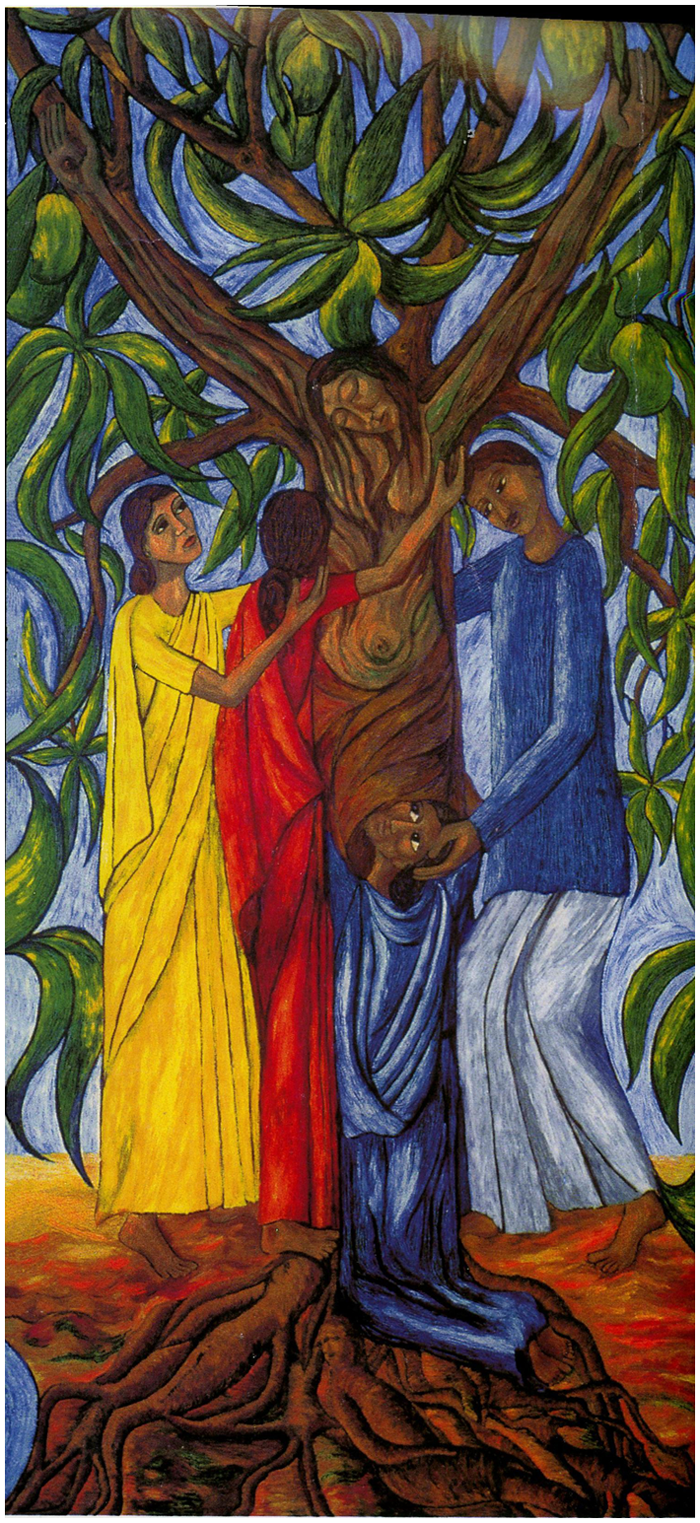
The Feminine Aspect of God by Lucy d’Souza-Krone. Reprinted courtesy of Lucy d’Souza-Krone.
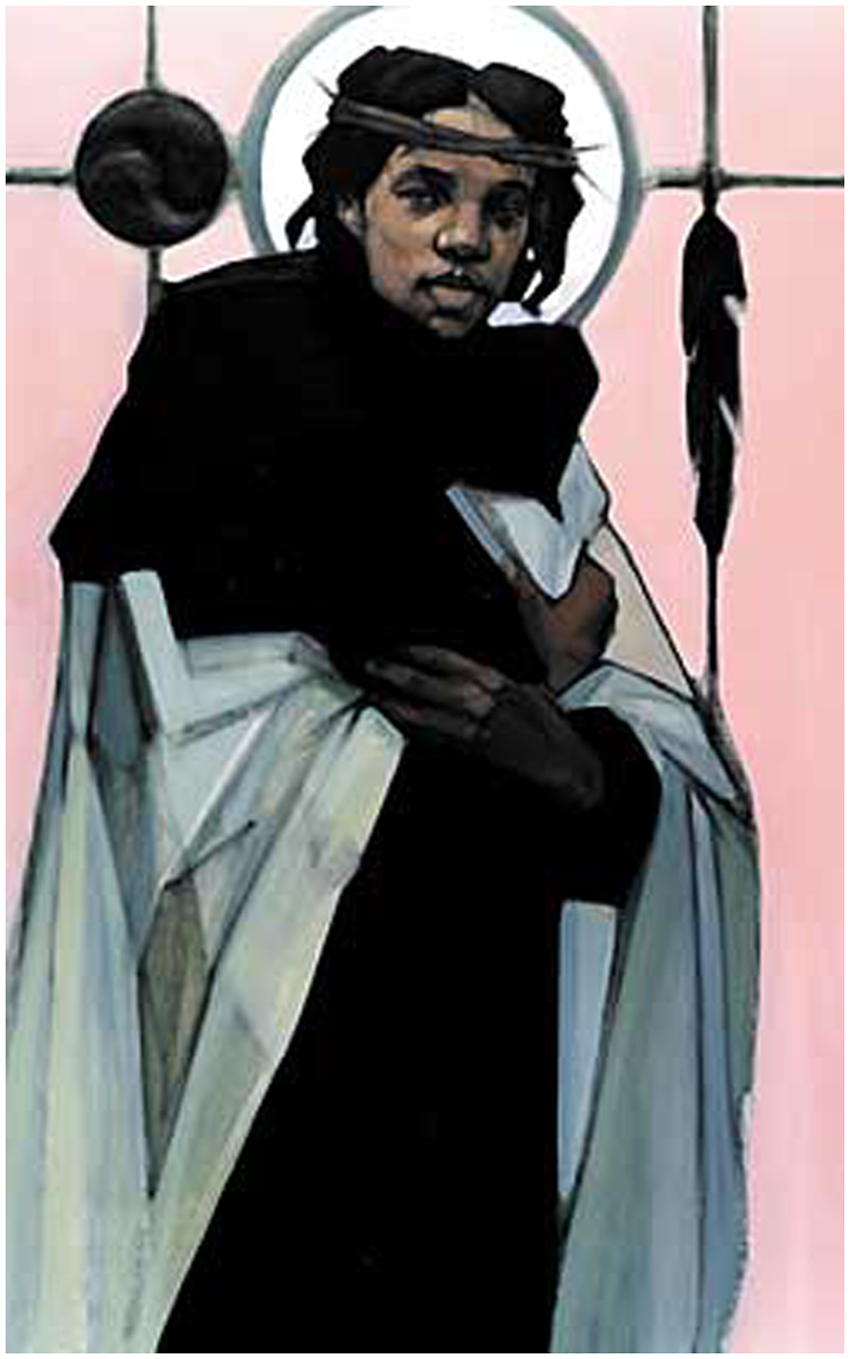
Jesus of the People by Janet McKenzie. Reprinted courtesy of Janet McKenzie.
Second, Janet McKenzie’s ‘Jesus of the People’ 11 – chosen by Sister Wendy Becket as first prize in a competition for an image of Jesus for the new millennium in 2000 – depicts an androgynous, dark-skinned and thick-lipped peasant Christa in white and black robes, with a crown of thorns and halo, suggestive of both suffering and glory. There is no suggestion of a cross, but the painting includes an Asian yin-yang symbol and an eagle feather that refers to the Great Spirit in Native American tradition. It is an enigmatic image in which the Christa folds her arms and looks out at the viewer quizzically, with a rather cool, aloof gaze, as if resisting approach. This is a strong, independent Christa who will not be colonized or subjected to voyeuristic appraisal. Although McKenzie has painted other images of a suffering Christa – notably, ‘Christ Mother’ which shows a naked female figure with outstretched arms – it is this image of a living, peasant woman Christ which I find the most original and haunting of her portrayals.
My favourite image of a risen Christa, however, is one that has been painted several times by the Filipino artist Emmanuel Garibay in various reworkings of the Emmaus story. 12 The scene is an intimate one of a group of revellers gathered around a table in some club or pub, sharing food and wine and engaged in animated conversation. As Garibay describes it, ‘this image of Jesus is an ordinary Filipino woman who drinks and tells stories with her friends. She’s telling a joke and everybody is reacting with laughter. But the real joke is that people laugh because they thought all along that Jesus was a Caucasian-looking man!’ 13 There is another joke, however, which is that, despite the very visible marks of the wounds on the woman’s hands in this image, viewers often fail to recognize this image as an image of a female Christ-figure. Tabita Kartika Christiani, an Indonesian minister, tells of using this painting with her class of some 50 students, where 31 of them did not even realize the painting showed Jesus (and many were shocked because of the association of Jesus and drinking in a bar!)(Christiani, 2008). Given that the Emmaus story itself contains at its heart the paradox of disciples failing to recognize the risen Christ in their midst, Garibay’s ability to reproduce this lack of recognition in many contemporary viewers is a stroke of genius. And perhaps there is another reason why even women do not recognize the laughing figure at the centre of the painting as a Christ figure – precisely because she is so vibrant, relaxed and exultant, offering an image of divine femininity which runs counter to so much religious iconography. Of all the images of a female Christ I have come across, this is my favourite, not only because of its joyous energy and a kind of naturalism about the very ordinariness of a female Christ figure, not only because of its striking proclamation of a Christ who meets people where they are, but also because it presents, almost uniquely amongst all the representations I have been able to find, a collective image of the Christa. I want to say that the Christa in this painting is not simply the central female figure, but is the whole group of engaged, enlivened companions. This is a visual representation of the kind of understanding of Christa-community which some relational feminist theologians have developed (see below).
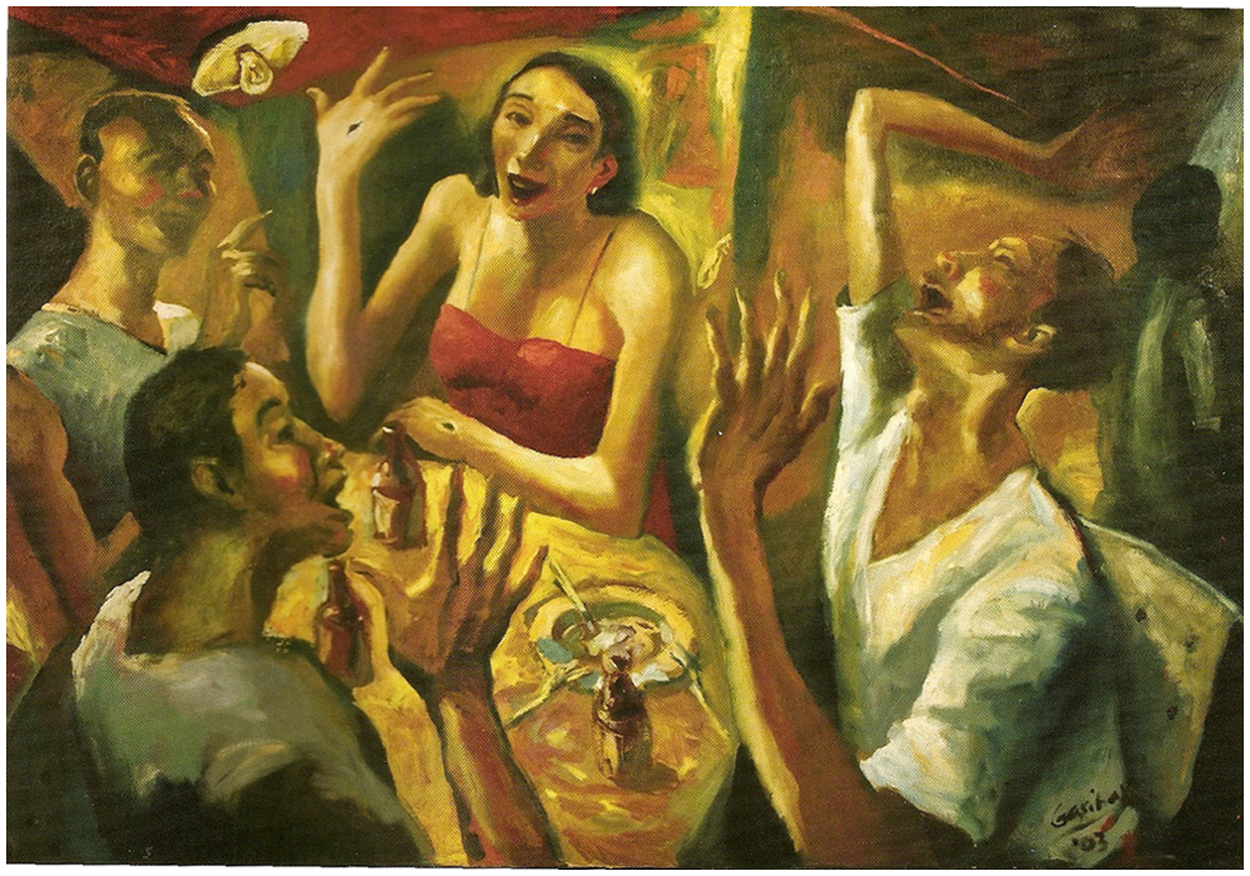
Emmaus by Emmanuel Garibay. Reprinted courtesy of Emmanuel Garibay.
Even with the widening of the repertoire of images of the Christa to include such risen forms, there are further critiques that might be made of existing portrayals. For even as feminist artists have ‘queered’ and subverted the patriarchal assumption of the male Christ by offering the alternative image of the female Christ, they have frequently, perhaps unwittingly, adopted and mirrored other assumptions about the identity of the Christ. The Christa may challenge our notions about the gender of God, but all too often images of the Christa have reinforced cultural stereotypes of beauty and bodily perfection. The Christa to date has been a slender, almost always white and young figure, conforming to cultural notions of the body beautiful. 14 Whilst broken on the cross, nevertheless she seems to conform to the image of the slim, ‘perfect’, young and nubile body of white supermodels. Where is the fat Christa, Christa in a wheelchair, the blind Christa, the black or Asian Christa? It is all too easy for white, middle-class and able-bodied feminists to reinforce our own limited notions of ethnicity, class and body image on Christ, even as we think we are breaking the mould in other ways. A female Christ needs to be as open to critique, nuance, dialogue and difference as any of the previous male Christs have been – or should have been. The symbol of the Christa will only be liberating and life-giving if it is held tensively, critically and with awareness of the idolizing tendencies human beings are apt to bring to any and every image of the divine.
Conceptualizing the Christa in Feminist Theology
A number of feminist theologians have taken up the suggestive notion of the Christa and developed it in a range of ways. In her classic Sexism and God-Talk, Rosemary Radford Ruether (1983) proposes the notion of Christ in female form (though she does not use the Christa title). She calls attention to the way in which the Christian community continues Christ’s identity and presence in the world today, and since this community includes women, it is perfectly legitimate, even necessary, for women therefore to represent Christ. ‘In the language of early Christian prophetism, we can encounter Christ in the form of our sister. Christ, the liberated humanity, is not confined to a static perfection of one person two thousand years ago’ (Ruether, 1983: 138).
Carter Heyward similarly makes a distinction between the Jesus of history – ‘a Jewish male with a particular relationship to his “abba”’ – and Christ, who ‘may be for Christians the salvific implications of the Jesus story’ or ‘the characterization of justice-making with compassion, courage, and integrity’ (Heyward, 1989: 21). Rather than focusing on the historical Jesus, she wants to speak of what can be and is ‘christic’, in other words Christ-forming or Christ-making, in our common experience and search for justice – and for Heyward, this is always allied to the search for and creation of right relations, both in the interpersonal sphere and also more widely in society at large. This enables her to speak of Christ or Christa in female, as well as male, terms – not as something external to us, but as a way of speaking about our collective responsibility for and commitment to right relation in the world. Thus Heyward speaks of believers and justice-seekers as those who are both the bearers and the fulfilment of the vision of ‘the common-wealth of joy’: ‘both theotokos, the bearer, and corpus christa, the born’. She continues:
We know that together, in solidarity, we are she: women and men, older and younger, people of different races and cultures and religions, we are she. Lesbians and gay men, heterosexual men and women, married and single, with our diverse gifts and our divergent interests, in our shared commitment to human well-being, we are she. In our own Christian faith we know that in our shared commitment to human well-being, we are she: bearer and born, mother and child. We are the Christa (Heyward, 1989: 84).
Rita Nakashima Brock develops Heyward’s relational, justice-seeking approach in her Journeys by Heart: A Christology of Erotic Power, a book that has had a significant impact on the development of the notion of the Christa. Like Ruether and Heyward, Brock argues that feminist Christology must not be centred in the historic figure of Jesus, however much it may draw on the inspiration and teachings of Jesus, because that is to make of one male individual a heroic saviour figure to whom women look for meaning and guidance, thus reinforcing what Mary Daly earlier described as ‘Christolatry’ (Daly, 1986: 74-75), an unhealthy idolization of Jesus that disempowers women and prevents us from claiming our own spiritual authority. Drawing on Audre Lorde’s (1996) classic essay on the erotic and Susan Griffin’s (1979, 1981) work on erotic power, as well as on the poems of Adrienne Rich (1981), Nakashima Brock develops a Christology of erotic power, in which Christ becomes a symbol of the fundamental power of existence which is seen as a dynamic, erotic energy of relational process. Her Christology, rather than being centred in Jesus, is centred ‘in relationship and community as the whole-making, healing center of Christianity’, a reality she names ‘Christa/Community’.
Jesus participates centrally in this Christa/Community, but he neither brings erotic power into being nor controls it. He is brought into being through it and participates in the cocreation of it. Christa/Community is a lived reality expressed in relational images. Hence Christa/Community is described in the images of events in which erotic power is made manifest. The reality of erotic power within connectedness means it cannot be located in a single individual. Hence what is truly Christological, that is, truly revealing of divine incarnation and salvific power in human life, must reside in connectedness and not in single individuals (Brock, 1988: 52).
Whilst I have not been able to find any instances of black, Womanist or Asian women theologians speaking of the Christa as such, the notion of a black female Christ figure is certainly not strange to them. Womanist theologians such as Jacquelyn Grant (1989) and Kelly Brown Douglas (1994) draw on a long tradition of black women’s struggle for liberation, as well as on the work of multiple black male theologians who have asserted that Christ is Black. Building on the liberation struggles and faith of women like Sojourner Truth, Harriet Tubman and Fannie Lou Hamer, Grant and Brown Douglas challenge the dominance of black male images of Christ in male Black Theology, and assert that ‘Christ, found in the experience of Black women, is a Black woman’ (Grant, 1986: 201). Kelly Brown Douglas speaks of a ‘womanist Black Christ’ which will ‘avail itself of a diversity of symbols and icons’, not to be confined exclusively or unthinkingly to female representations but nevertheless working consistently to ‘lift up the presence of Christ in the faces of the poorest Black women’ (Douglas, 1994: 108). Douglas reflects on the impact of her grandmother’s faith in Christ on her own theology, and images Christ ‘in the face of my grandmother, as she struggled to sustain herself and her family’ (Douglas, 1994: 177).
In her ground-breaking work, Struggle to Be the Sun Again, Chung Hyun Kyung alerts readers to the presence of a rich Asian women’s Christology which draws on female images and icons to image Christ in an Asian context (Kyung, 1991: 53-73). A number of Asian women depict Jesus as mother, woman and shaman. For example, Kwok Pui-Lan (1986), Lee Oo Chung (1986) and Marianne Katoppo (1978) each speak of Jesus as a compassionate, sensitive and pain-bearing mother, drawing on experiences and examples from their own Asian contexts. Park Soon Kyung (1983: 53) speaks of ‘Jesus the woman Messiah’ who is liberator of the oppressed, and Choi Man Ja identifies Korean women’s struggle for liberation with ‘the praxis of messiahship’, claiming that ‘women are the true praxis of messiah-Jesus, in Korea’ (Ja, 1987: 8). Perhaps most strikingly, Virginia Fabella and others speak of Jesus as the shaman who exorcises accumulated han – unexpressed anger and resentment resulting from social powerlessness – and heals and comforts the dispossessed (Fabella, 1987:15). Since in Korea the majority of shamans are women, to speak of Christ as a shaman is an Asian version of the Christa.
If Feminist Theology has developed the notion of the female Christ, and Womanist and Asian theologies the notion of the black female Christ, Queer and ‘indecent’ theologies have pushed the boundaries of this idea in more transgressive, deliberately subversive, and playful, ways. Marcella Althaus-Reid (2001) warns of the dangers of Feminist Theology becoming settled and safe, a new kind of orthodoxy, against which her own brand of ‘Indecent Theology’ is a perpetual protest. She speaks of an ‘obscene Christ’ (2001: 111), drawing on Sartre’s notion of the obscene as ‘that which renders visible the flesh as flesh’, imaging Christ not only as female but as poor female, as prostitute, as leather-clad lesbian, dying next to her lover, as the Bi/Christ who is neither male nor female, straight nor gay, beyond ‘either this or that’ ‘because there are so many sexual identities to which we do not have names to give’ (Althaus-Reid, 2001: 116). Historically, she suggests, ‘obscene Christs have appeared when people wanted to uncover the graceful pretences of current Christologies’. Thus, the Black Christ was obscene because it uncovered white racism in Christology. Similarly, the Christa is obscene because ‘it undresses the masculinity of God and produces feelings and questionings which were suppressed by centuries of identificatory masculine processes with God’ (Althaus-Reid, 2001: 111). Precisely by the visceral reactions which the viewer makes to a female crucified figure, deep cultural prejudices and attitudes to gender and sexuality are made visible for what they are. So Althaus-Reid asks, ‘Why, for instance, is the tortured male body of Christ less offensive and infinitely more divine than a woman’s tortured body? … Why is it that, confronted by the naked body of a female Christ, the heterosexual gaze is still fixed on the shape of breasts, the youth of the body and its sexual desirability?’ (Althaus-Reid, 2001:111).
As Althaus-Reid’s ‘obscene Christ’ is an attempt to destabilize and disrupt our assumptions about human sexuality and gender, similarly, Lisa Isherwood (2007) has developed the notion of the Fat Jesus as a way of drawing attention to the hatred and fear of female flesh which is manifested in heteropatriarchy, particularly towards larger, older women. She challenges the idolization of thinness in Western, post-modern cultures, exposing the gendered symbolism of the emaciated, quasi-anorexic and youthful female form which can be read at one and the same time as an internalization, in the bodies of young women, of male fear and hatred of female flesh, and as a protest against it. In heteropatriarchy, she argues, women are alienated from their bodies and their deepest desires, and this can manifest in both under-eating, the self-starvation of the anorexic, and in over-eating, the rebellion of women who refuse to conform to the ideal of feminine beauty and dare to claim their own desires. In a society in which women are groomed from an early age to be the nurturers of others and to be desired by the other, ‘women need to transform the need to be desired into an acceptance of desiring’ (Isherwood, 2007: 114). The fat woman is the woman who dares to defy patriarchal ideals of feminine beauty, size and appetite, who manifests her large desires in her own body, who takes up as much space in the world as she needs and wants – thus incurring the hatred and punishment of society. Our christologies, Isherwood argues, both mirror and create the social and symbolic worlds we inhabit, and so she is in search of ‘a Christ of womanly abundance’, an ‘erotic Christ’ who is ‘fully embodied, sensuous and seeking vulnerable commitment, alive with expectancy and power’, a Christ who ‘enables women to find their subjectivity and power’ and ‘live more fully in their skins’ (Isherwood, 2007: 7, 118-19). Although Isherwood never explicitly speaks of this fat Jesus as a fat Christa, nevertheless, it is clear that the fat Jesus is predicated on the celebration of fat women’s bodies, sexualities and desires, and so she can speak of the fat Christ as ‘she’. ‘We need the abject fat Jesus who bulges out all over the edges and carrie[s] her embodiment proudly and differently in the world’ (Isherwood, 2007: 142).
Kwok Pui-Lan discusses many of these, and a few other, 15 re-gendered images of Christ in Postcolonial Imagination and Feminist Theology, situating her discussion within a postcolonial feminist framework and offering the notion of Jesus/Christ as a ‘hybridized concept’ in which ‘the space between Jesus and Christ is unsettling and fluid, resisting easy categorization and closure’ (Kwok, 2005: 171). She suggests that there has been a particular explosion of hybridized images of Jesus in the second half of the twentieth century ‘because of the struggle for political independence and cultural identity of formerly colonized and oppressed peoples’ (Kwok, 2005: 182). Her essay raises many important questions around theological reconceptualizations of the Christ, as I hope my own discussion does, including the centrality of interpretation of the passion and suffering of Christ, the need to guard against an implicit anti-Semitism which has marked some white feminist Christological discourse and for post-colonial refigurations to be alert to the possibility of reinscribing gender and sexual stereotypes. These are just some of the more obvious critical issues foregrounded by the theological development of the notion of the Christa.
Imagining the Christa in Poetry and Fiction
Whilst the Christa has been visualized in various art forms and conceptualized in theological terms, She can also be imagined, narrated and realized through story, poem, ritual and prayer – and it is to these two forms of approach that I now turn in this and the following sections. Such literary means of approaching the Christa appear to have been far less developed than the visual and the conceptual forms reviewed above, 16 and they are the focus of my own recent work (Slee, 2011), in which I have attempted to develop a sustained poetic reflection on the Christa in a loosely structured sequence of poems and prose texts centred around the passion narratives and the liturgical celebration of holy week and Easter.
Writing the Christa in fictional and poetic terms provides another means of creatively imagining a female Christ figure and generating a feminine symbolic discourse that may be regarded as part of the broader literary quest of feminist writers to create an écriture feminine – a literature for and by women rooted in and inscribed upon the female body.
17
Fiction and poetry have been major resources for women’s theological and spiritual quest since the birth of second wave Feminist Theology – and doubtless in earlier times too – and there is a significant literature exploring the place of both in women’s spiritual lives, although this literature has not made much impact on a great deal of Feminist Theology (e.g. Christ, 1980; Ostriker, 1993; Walton, 2005; Llewellyn and Sawyer, 2008). I see my own work as situated within such a feminist theological poetics, and echo the words of Millicent C. Feske (1995: 103) when she asserts that:
it is essential that women be able to imagine their redemption in both fiction and theology in ways that will bear fruit concretely in terms of the ability to resist restrictive or abusive social relationships without fear or retribution and to experience lives constituted by women’s hopes and desires for wholeness and healing.
In particular, writing the Christa in a sequence of poems and liturgical pieces has enabled a more sustained imaginative engagement with the Christa than is possible in one or two isolated representations, whether visual or textual, and to do theology creatively and critically in a way which I hope engages seriously with theory and with some of the larger philosophical questions engaging Feminist Theology today (the nature of God and human/female identity and agency, questions around suffering and redemption and whether it is possible to reconfigure a more biophilic form of Christian faith, and so on) but is also concrete and accessible to ‘ordinary’ theologians who have not received the extensive formal education of professional theologians. 18 In the sequence of pieces offered in my book, I have sought to use creative writing of various kinds (poetry, liturgical texts, short prose reflections) to explore aspects of the Christa which have not been (much) thought or imagined previously, thus pushing against the limitation of the female Christ figure to a suffering and dying woman, who is generally young, white, thin and conforms to idealized versions of feminine beauty. I have imagined and fictionalized Christa as a girl and a teenager, 19 as an undesirable, conventionally ‘ugly’ woman rejected by the male gaze, 20 as a passionate, erotically desired and desiring lover; 21 Christa as both friend 22 and mother; 23 Christa as an old woman or crone; 24 Christa as a fat and ‘loose’ woman; 25 a sick Christa suffering from migraines, anorexia or ME; 26 a Christa constantly on the run from home and in pursuit of freedom and danger; 27 Christa as a manifestation of the divine endlessly disappearing and returning, frequently unrecognized and rejected but welcomed in unlikely ways and by unlikely types; 28 Christa as a community of those seeking liberation; 29 and above all, various manifestations of a risen Christa. 30
Because I wrote a good deal of the book on a sabbatical in Aotearoa, New Zealand, the Christa also took on distinctly Antipodean characteristics and associations, manifesting as an elusive Maori woman, 31 merging with the landscape which, in Maori tradition, is infinitely precious and sacred, 32 as well as appearing at various hot pools and thermal springs which are such a feature of the New Zealand landscape, 33 offering a fresh perspective on various biblical narratives and images of healing. Whilst this transpired as a result of historical accident – I just happened to be writing the book in another country – it was a fortuitous one because it offered me the opportunity to engage with a landscape, culture (or series of cultures) and context markedly different from (whilst sharing some connections with) my own, and thus to discern signs of the Christa in difference and otherness – one of the central features of the Gospel resurrection narratives, where the Risen Christ is encountered as stranger, unrecognized and incognito, manifesting in unexpected ways and places.
At the same time, I have not ignored dimensions of the suffering Christa in this exploration, and many of the pieces in my book narrate women’s suffering and pain – my own, as well as that of others known to me, the collective pain of women and that of the earth. The Christa is identified both as and with ‘every woman forced to have sex who didn’t want it’, ‘every girl trafficked out of her own home country’, ‘the woman sleeping in the underpass’, ‘women who walk a thousand miles through a war zone’, 34 and, in a sequence of poems inspired by Melissa Raphael’s (2003) The Female Face of God in Auschwitz, Christa appears amongst and as women in the Nazi death camps who washed, tended and lavished care on each other, manifesting a tender, compassionate maternal divine who, Raphael suggests, may have survived the Shoah in a way that the patriarchal God of post-Holocaust Judaism has not. 35 These poems inspired by Raphael’s account of women’s experience in the Holocaust, as well as others in the book, refuse a false binary between a suffering and a risen Christa, suggesting as they do that women’s capacity to offer ministration to each other in places of the utmost brutalization and degradation is a signal of transcendence at the heart of the most extreme forms of human and specifically female suffering and annihilation. If the quest for a risen Christa cannot speak into the most extreme forms of female suffering and abuse, albeit without valorizing or perpetuating them, it is ultimately a misguided and vacuous search. This is where I have to part company with those, like Nakashima Brock and Rebecca Parker in their recent writings (2001, 2008), who wish to displace the cross entirely from Christian faith. Whilst I certainly share the conviction that much Christian atonement theology has been profoundly harmful to women and other oppressed groups, I believe that there are ways of theologizing the cross that are generative of human liberation – indeed, that a right theology of the cross and resurrection are essential to all human flourishing. 36 To put this in classically Christian terms, the risen Christ/a is the transformed crucified Christ/a, and the crucified Christ/a has no meaning or identity apart from her reappearance as the risen one. Or, as Stephen Burns has expressed this, ‘whilst an overemphasis on the cross can be damaging, so too can a narrow focus on resurrection’, 37 risking a facile, triumphalist faith that refuses to engage with the reality of suffering. Christian faith – and therefore the Christa – is properly paschal, if not cruciform. 38
Whilst each of the various expressions of the Christa in my book is offered as a potential image of the feminine divine manifesting in a variety of faces and forms in contemporary women’s lives, the very plethora of images and narratives is also intended to refuse any literal reading of any of them. Whilst Christa may indeed manifest as an anorexic teenager or an old Maori woman, she cannot be limited to any one of her representations. She is all of these things and none of them, and the final chapter of the book, exploring Ascension and after, pushes away from any limitation of the Christa to historical and human concretion. Vitally important though it is for women to realize the feminine divine in images, symbols and narratives which connect with our own lives, there is a transcendent mystery to the risen and ascended Christa which ultimately eludes every attempt to grasp and hold her. As I suggest in the final chapter, ‘Christa has to depart so that the kin-dom of Christa may flourish, so that women and men may learn to look to one another, and to the non-human creatures of the earth, as those who now incarnate the body of Christa’ (Slee, 2011: 135).
Ritualizing the Christa in Liturgy and Prayer
Visualizing, conceptualizing and imagining the Christa in a variety of media each offer distinctive and mutually informing ways of approaching the feminine divine. Yet, whilst appreciating each of these forms, many of us are looking for something more: forms of ritual and worship that address the Christa and offer a means of authentic feminist Christian prayer that does not repudiate the Gospel traditions of Jesus of Nazareth but offers a more liberating alternative to prayer ‘in the name of Jesus’, at least as this is has been typically practised throughout the majority of Christian tradition, in which ‘Jesus is overwhelmingly depicted in …regal, patriarchal images’, his masculinity emphasized as a symbol of male power, his innocent suffering valorized and traditional gendered relationships between male and female reinforced (Procter-Smith, 1995: 93).
As I have suggested elsewhere, ‘liturgy and prayer are … the places of primary theology – as theologians have always known’ (Slee, 2008: 189). Feminist liturgists, alongside poets, artists and theologians, are those at the forefront of creative reappropriation of repressed feminine imagery for God – the rediscovery of Wisdom, goddess and Marian traditions, amongst others – as well as offering newly-minted language, drawing on but moving beyond existing tradition, to nourish and inform our praying and living. Prayer to and with the Christa forms a significant part of a wider repertoire of feminist-inspired prayer and is a particularly powerful means of expressing both continuity with Christian traditions of prayer to and in Christ and significant widening and critiquing of those traditions – although, interestingly, it has not been much developed by feminist liturgists and is not mentioned by Procter-Smith (1995) in her summary of feminist strategies for praying ‘in the name of Jesus’. 39 Whilst Christian doctrine has always held that the pre-existent Christ – Word, Wisdom and Person of God – is beyond gender and every other accident of human personhood (though finding full expression in the historical person of Jesus of Nazareth), the images and language associated with Christ throughout Christian history have been almost exclusively patriarchal, such that it is virtually impossible to disassociate the term ‘Christ’ from male gendered experience, imagery and understandings. To pray to and in Christa is an explicit recognition both of the larger reality of the Christ symbol that has been repeatedly betrayed and distorted in history, an attempt to reclaim this wider reality, and an assertion of the participation of women and girls in the image of God.
I have found few examples of prayer to and in Christa in the literature of feminist liturgy, though Miriam Therese Winter (1992) offers a number of psalms and canticles which either include reference to Christa or explicitly address her.
40
In my own liturgical writings, whilst I have addressed occasional prayer texts to Christa as far back as the late 1990s (e.g. Slee, 2004:124-25), this has become a more deliberate, sustained and systematic enterprise in my recent work. In Seeking the Risen Christa, prayer texts of various kinds weave themselves throughout the book and, whilst I was not conscious of this at the time, I see now that I have used the full range of Christian prayer forms to name and address the Christa. Thus, there are confessions, litanies, canticles, quasi-credal statements, Eucharistic texts and a series of collects for different seasons of the liturgical year. Some of these are reworkings of pre-existing Christian liturgical texts; for example, ‘A canticle for Passiontide’ reworks a traditional Passiontide canticle based on Isaiah 63,
41
in which the blood-stained messianic figure of the scriptural text becomes a Christa figure soaked in women’s blood ‘that has been hounded out of the sanctuary’. Or ‘A daughter’s prayer of abandonment’ is loosely based on the Good Friday reproaches in which God reproaches the people for their failure to respond to God’s loving care; in my text, Christa speaks as a daughter abandoned by her father, reproaching the Father who has betrayed and deserted her. ‘A litany to Christa our friend’, based on Christ’s words in John 15:13, adapts and reworks a traditional Franciscan prayer
42
used at the beginning of the office, as a repeated refrain:
We adore you, O Christa, and we bless you because out of love for your friends, you freely laid down your life.
Whereas the Franciscan original venerates the cross as a means of redemption, my reworked version intends to venerate friendship and its free acts of love, including sacrificial love. My litany was inspired by Barbara E. Reid’s (2007) Taking Up the Cross, where she rejects the idea that understanding the death of Jesus as a sacrifice or atonement for sin is the dominant New Testament model. Rather, she suggests, the Gospels describe a Jesus who ‘freely offers forgiveness for sin during his lifetime without cultic sacrifice and without any reference to his death’ (Reid, 2007: 46). In particular, John’s Gospel offers the model of Jesus as the friend who voluntarily lays down his life for his friends out of love. Reid offers a number of examples of biblical and contemporary women who, standing in this tradition, give their lives willingly and freely out of deep love. Thus my litany attempts to find a way of naming costly, sacrificial love that is rooted in a fundamental life rather than death orientation (what Daly would name ‘biophiliac’ as opposed to ‘necrophiliac’) and that does not valorize violence.
Other prayer texts take traditional forms, such as the collect, or confession, and seek to invest them with new theological content, whilst offering prayer in continuity with centuries of liturgical practice. Janet Morley’s classic prayer text, All Desires Known (Morley, 2005) is a fine example of this approach, and her collects have been widely used in many churches worldwide as well as in Womenchurch groups and settings. My own modest attempt at a series of Christa collects (Slee, 2011: 148-50) offers short prayers addressed to Christa for some of the key points of the liturgical year, in the hope that these might also find their way into a range of liturgical contexts and help to shape Christian prayer that explicitly affirms the capacity of women to be in Christ/a and Christ/a to be in the form of women. A variety of confessions, whilst similar in form to many classic texts, seek to express contrition and repentance for sins that are not often named in Christian assemblies – for example, a ‘confession for Good Friday’ is concerned primarily with false namings of the cross and complicity with theologies of victimization and abuse, rather than identifying human sin with the cause of the cross, and a ‘litany for Passiontide’ is a prayer for mercy on ‘the bleeding body of the earth’, expressive of the ecofeminist conviction that the suffering body of Christa is the suffering body of the cosmos.
These liturgical texts, in a variety of forms and styles, invoke Christa as sister, girl-child, bi-girl, mother, lover, priest, stranger, victor, friend, beloved, healer, and many other christic titles. Prayer to Christa is also offered in and through concrete female images, both biblical and contemporary – Christa is imaged in biblical characters such as Jairus’s daughter, Miriam and Lo-ruhamah, 43 but also as a fictionalized character, Esther, Jesus’ sister, 44 and as various contemporary characters from fiction and film – Billy Elliot, Jamil Malik (the hero of Slumdog Millionaire) and Paikea Apiranau (the heroine of Whale Rider), 45 demonstrating that Christa can take form in male as well as female form, and in a variety of cultural settings. There is a strong note of desire and longing throughout many of the prayer texts, and a constant reiteration of the invocation for the Christa to ‘come’: ‘come as a girl’, 46 ‘come out of the shadows’, 47 ‘come to us in female flesh’. 48 At the same time, there is an equally strong affirmation of the Christa who has already come and is continually coming, albeit unrecognized, unwelcomed and un-named – as the one incarnated in women’s bodies and the body of the earth, the one who sits at table-fellowship marked by welcome, hospitality and inclusivity, the one who is present to and with the most acute human suffering, as well as in resistance to violence and abuse, and in the quest for freedom, justice and integrity in creation.
In other words, prayer to and in the Christa has a strongly eschatological character, rooted in the conviction of the christic presence – past, present and future – to all times and places, affirming the specific history and tradition in which Christa has been manifest (the history of Jesus of Nazareth, yes, but also the history of the countless women and men who have continued the christic presence of Jesus throughout history) and, at the same time, refusing to limit the activity of the risen Christa to any one time or place or any specific trajectory of historical expression. To pray to the Christa who has come, is coming and will come again, is to affirm the radical historical openness of Christian tradition which can never be contained by the past but constantly seeks the freedom and largesse of the Spirit who is continually given in new forms to those who will seek her. Such prayer to and in the Christa is, itself, a creative wellspring for new forms of theology which will doubtless generate new expressions of the risen and ascended Christa – visual, conceptual, literary, liturgical and in manifold other ways – as yet unimaginable, unthinkable and unsayable. So the cry for the Christa to continue to come and reveal her presence amongst us is one that feminist prayer will not cease to offer.
Footnotes
1
2
See www.edwinasandys.com, accessed 28 March 2012. The image is also included in  .
.
4
5
See Cherry (2007) and , accessed 28 March 2012, for examples of these works.
6
For example, Renée Cox’s ‘Yo Mama’s Last Supper’, a 5-panel colour portrayal with Cox herself as a naked Christ figure surrounded by twelve black apostles – at http://www.geektimes.com/michael/site/archive/2001/03-01/images/ReneeCoxYoMamasLastSupper.jpg, accessed 12 December 2011 – and Francois Girbauld’s portrayal of the Last Supper with female Christ and 11 female disciples, one male, at , accessed 12 December 2011.

7
For example, a whole sequence of stylized photographs of a female crucified Christ can be found on the Passion of a Goddess site, at http://www.passionofagoddess.com, accessed 28 March 2012. See also, a variety of images in : 61, 71-75 109.
8
See the blog site, ‘Female Christ in Arts’ at http://femalechristinarts.blogspot.com/?zx=fde40161dd7d7538, accessed 28 March 2012, for extensive listings of the female Christ in art, sculpture, photographic and film form. See also, for her reading of Breaking the Waves and Dead Man Walking, in which she critiques the former for offering a stereotypical view of a woman who finds meaning in life through fulfilling the needs and desires of others, and applauds the depiction of Sister Helen in Dead Man Walking as a powerful agent who becomes a Christ to her neighbour.
10
d’Souza-Krone’s work features other symbols of the Christa, notably the centre-piece of her Lenten hunger-cloth featuring images of women in the Bible, which shows a woman kneading bread (from one of Jesus’s parables of the kingdom), well-known in the UK as the cover image of the first edition of Bread of Tomorrow, a collection of prayers edited by Janet Morley (1992). Available at , accessed 28 March 2012.
12
See http://www.emmanuelgaribay.com and , accessed 12 December 2011. I have used one of these images as the cover illustration for my book, Seeking the Risen Christa. It is reproduced here with the permission of the artist.
14
Sheia Redmond (1993) describes Lutkenhause-Lackey’s ‘Crucified Woman’ as ‘anorexic’ in her extreme thinness, inviting the kind of critique of the idolization of the thin female body that has developed in her Fat Jesus.
17
26
27
28
29
31
36
37
In a private email correspondence.
38
I owe the distinction between ‘paschal’ and ‘cruciform’ to Stephen Burns. A visual representation of the Christa which perhaps expresses this identification of the risen and crucified most powerfully is Sandra Ikse’s complex tapestry, ‘I Will Choose Life’, created following the death by drowning of her four-year-old son, and combining imagery of crucifixion, Marian imagery – particularly traits of the Mater Dolorosa and the sheltering Madonna of Mercy – and symbols of resurrection and rebirth. In : 89.
39
: 108-112) suggests four strategies developed by feminists as alternatives to traditional Jesus-oriented prayer: first, omission and absence of Jesus-referents and their replacement by a focus on the lives of women; second, the use of nonverbal symbolic referents to point to Jesus; third, the relational representation of Jesus in the company of women and, fourth, the elision of Jesus with the female image of Sophia.