



Abstract
The socio-historical events and libertarian cultural movements of the 1960s and 1970s shaped the Catholic mother-daughter relationship for the women in this feminist genealogical study. This study is based on interviews with 36 Anglo-Australian Catholic women – 13 sets of mothers and daughters – as well as dialogue between my mother and myself about family photographs. Women’s stories of secondary school days tell of the formation of lady-like identities circumscribed through uniform regulations, the cult of the Virgin Mary and ceremonies of everyday Catholic school life. The abject maternal body resurfaces in adolescence with the flow of menstrual blood, and the heralding sexuality of young women is circumscribed through patriarchal institutions such as Catholicism. Amid their silenced and contested dialogue, although years apart, the stories between mothers and daughters in this study drew parallels.
Keywords
Introduction
Over centuries patriarchal discourses have constructed and invaded the concept of motherhood and the mother-daughter relationship in a diverse range of sites and ideologies, including religious discourses. I argue that it is crucial to feminist scholarship that this relationship is deconstructed, destabilized and unhinged from patriarchal discourses so that this intimate bond between women can be re-constructed in our own feminine terms. In this paper my intention is to use the theories of Luce Irigaray and Julia Kristeva to interrogate some of the guiding presumptions in Catholic discourse, and to partially and particularly reconceive the positioning of female corporeality as it is currently constructed and read as matter, as form, and in spatio-temporal locations for a specific group of Anglo-Australian middle class Catholic women who are mothers and daughters.
I set out to analyse the mother-daughter nexus and its socio-historical construction within the discourse of Catholicism. This is a personal as well as conceptual and political journey. Specifically, I undertake a matrilineal genealogy to re-examine the dominant representations of the mother-daughter relationship within my own as well as my school-friends’ matrilineal history. The objective of my exploration is not only to deconstruct dominant Catholic constructions and images of the mother-daughter nexus but also to uncover tinges of maternal associations and relations that have been erased and concealed by patriarchal regimes such as Catholicism. This paper is about giving the mothers and daughters in this study a history, a context and a voice that is distinct from discourses of maternity so that both mothers and daughters can be reconstituted as self-referential subjects.
Looking for a Theory
Three fields of feminist literature are of interest to this study. As the study is about my own personal history, the first field of inquiry is feminist autobiographical literature, which has largely emerged since the 1980s. This literature is representative of a range of feminist disciplines; however, it is predominantly located within the field of feminist literary criticism. As the personal became political in the women’s movement of the 1970s, there was an upsurge of interest in historical as well as contemporary autobiographical texts by women (Jelinek, 1980, Jelinek, 1986; Hoffman and Culley, 1985; Culley, 1991, Helibrun, 1988; Lionnet, 1989; Braxton, 1989; Personal Narratives Group, 1989; Bell and Yalom, 1990; Kadar, 1992; Smith, 1987; 1993). Alongside this focus on the personal, theoretical questions began to be raised about the humanist subject: ‘Is there an authorial I?’ What also emerged was an interest in the semiotic relationship around texts, for instance, the interrelationship between the reader and writer of the text, and the symbiotic connection between the autobiographical text and the author-writer’s standpoint. Feminist autobiographical theory examines differences between men’s and women’s styles of writing, and some feminist autobiographical theorists interweave constructs of class, race and ethnicity into analyses. With the advent of post-structuralist theorizing of the subject as multiple and dispersed, feminist autobiographical theorists developed tools to deconstruct the female autobiographical subject, as she was constituted within discourses of patriarchy (Metta, 2010; Smith and Watson, 2010).
As autobiographers and feminist theorists searched for a sense of ‘who am I’, they appropriated the conceptual analytic tools of psychoanalytic theory in a search of their elusive maternal origins. This leads my literature review into the second field of scholarly inquiry, which is literature that focuses on a conceptual analysis of the mother-daughter nexus. There is a large body of research on the mother-daughter relationship within the discipline of feminist psychology, which is represented by object-relations theory (Dinnerstein, 1977; Chodorow, 1978) . This theory places the mother as the primary object for the pre-oedipal daughter and is used to explain gender formation. This theoretical framework has been remarkably influential in feminist theorizing on the mother-daughter nexus. Three feminist literary theorists, who are aligned with cultural studies, have engaged with these theories in an attempt to name and give women a signature (Hirsch, 1989; Kaplan, 1992; Walters, 1992). In contrast radical feminists, such as Adrienne Rich (1986) analyse the mother in relation to her positioning within patriarchy. Rich constructs an ‘aura’, a feminine essence around the mother that aims to challenge the object-relations mother-blame analyses. However, this analytically contains women within masculinist constructs of motherhood and conceptualizes mothers as constrained by their essentialized bodies.
From this literature I began to formulate the theoretical direction which I wanted to take. However, the literature had not analytically raised the issue of religion and the mother-daughter nexus. Hence, I searched further into the area of women and Catholic discourse. In recent decades an increasing diversity of literature has become available on the topic of a female presence in Catholic discourse. Three collections of anthologies that provide vibrant, visceral accounts from women of their experiences growing up Catholic were published in the 1980s and 1990s (Nelson and Nelson, 1986; Bennett and Forgan, 1991; Sumrall and Vecchione, 1992). These autobiographical stories echo many of the themes, opinions and nuances the women in this study expressed.
Feminism within religious studies is a growing discipline and takes varying forms. Some feminist theorists attempt to reform Catholic doctrine whilst other feminist critics examine the infrastructures of Catholic discourse so as to dismantle and discredit the master’s house. Many of these texts are by women who do not acquiesce to prescribed roles as Catholic women, but who ask questions and want answers about the negation of women within Catholicism. They are women who want their silenced voices heard so that they can begin to fill the patriarchal gaps with a feminine presence. These women want to celebrate the survival and agency of Catholic women who have been suppressed in both mind and body by Catholic discourse. They are also in search of a divine image which affirms them as (Catholic) women (Daly, 1968; Ruether, 1981; Weaver, 1985; Wallace, 1988; Dillon, 2010; Manning, 2012).
Recent literature that is particularly relevant to this paper is the proceedings of the American Academy of Religion panel conducted in November 2012, and subsequently published in the Journal of Feminist Studies in Religion in Spring 2014. The papers examine some of the challenges and dilemmas of current political deliberation and public policy with regard to reproductive rights. Two essays that are of importance to this paper are authored by Marvin Ellison (2014) and Kate Ott (2014). Ellison considers feminist liberation ethics in relation to reproductive justice, whilst Ott argues that the Catholic Church muffles historical and contemporary theological debate in the field of moral theology, particularly with regard to contraception, abortion and sexual ethics more generally speaking.
The literature review at this point provided me with an overview of a diverse range of theoretical positions pertaining to the autobiographical subject, the mother-daughter relationship, and women and Catholicism. However, the question remained as to how I was going to link these three fields of inquiry together analytically. A theoretical position was required which would explore and uncover Catholicism as a patriarchal discourse and pedagogical regime that displaces and controls the mother-daughter relationship, the feminine and female sexuality for its own patriarchal purposes.
Conceptual Framework
In this paper, I want to provide a space for an analysis of how individual mothers and daughters have complied yet struggled with, have contested and at times rejected, the powerful and normative positioning of the mother-daughter nexus within Catholic discourse. I discovered that the work of the French feminists Luce Irigaray and Julia Kristeva are analytically instructive in the context of women and Christianity. Although both women position themselves very differently in relation to the concept of the divine, they both offer alternative forms of analysis, which are useful to this paper. Both theorize the ‘divine’ or ‘God’ as an abstraction, conceptual/spiritual signifier. Irigaray contends that God holds the potential for the representation of a space and time for the concept ‘woman’. In contrast, for Kristeva religion represents a semiotic system re-coded in the language of the symbolic.
I turn to Irigaray’s writings and philosophies as her theoretical gaze offers meaningful insights into the mother-daughter relationship as it is positioned in religious discourse. Irigaray’s psychoanalytic poststructuralist theories provide tools and strategies for deconstructing the structures and language of Catholic discourse, and for positioning this analysis within individual women’s stories. Her theories aim to disrupt and unsettle patriarchal religious discourse, and construct new images for women that are formed within their own specific female likenesses. Her writings help me to sift out the excessive speaking stance of the Catholic women represented in this study so as to construct a feminist analytic space that argues and searches for sexual specificity. Hence, throughout this paper Irigaray’s deconstructive and metaphorical tools provide an analytic means to come to a partial understanding of the relationship between Catholic mothers and daughters. Simultaneously it shapes this explanation and reflection.
In contrast to Irigaray, Kristeva finds a space for women in Christian doctrine in the residue of maternity. Part of this residue lies in the uncertain anxiety, the ‘war’ of mother-daughter relations. The Virgin Mary represents a daughter yet she has no daughter. This intense bonding between women that is located in the mother-daughter nexus lies unrepresented in Marian symbolism, yet, as will be discussed, Marian symbolism was central to the school curriculum for Catholic girls.
Kristeva’s (1982) concept of abjection is also useful to this analysis as according to Kristeva woman is particularly related to polluting objects, which are classified as excremental and menstrual. This gives woman a specific connection to the abject. The excremental threatens identity from the outside whilst the menstrual threatens from within. Kristeva contends that it is the function of defilement rites, including that of menstrual and excremental objects/substances that distinguish the ‘boundary’ between the maternal semiotic authority and the paternal symbolic law. Kristeva claims that historically, religion played a role in purifying the abject. Kristeva’s theory of abjection sets out a theoretical framework for examining the representation of the abject-feminine in relation to the role of women in mothering.
This paper intends the reader to actively engage with the text. This engagement implies that readers construct their own subtext, which at strategic and relevant moments can shift from a constructionist to an essentialist reading of ‘woman’. It is acknowledged that this seepage risks being read as representing all women in a guileful representational politics.
In order to uncover the excesses/residues of maternity I undertook a feminist matrilineal genealogical search. The study involved interviewing 36 women who included women I attended secondary school with, some of their sisters and their mothers, as well as women within my own family. In all, 13 cohorts of mothers and daughters were interviewed who were between the ages of 20 and 80. The mothers in the study are represented with the term ‘Mrs’ whilst the daughters are designated by a first name. Pseudonyms are used for all the women except my mother and myself.
Casual conversations and semi-structured open-ended interviews with these women, photographs, and my own memories of growing up Catholic constitute the data for analysis. By combining interviews with photographs, the study aims to be responsive to a range of feminist deconstructive tools and theoretical gazes. The photographs prompted other memories of Catholic womanhood, and acted as a mnemonic triggering device and impetus for discussion between my mother and myself. It is argued that one cannot get to women’s lives and experiences without a multiple-layered feminist methodology, and without the risk taking of employing novel analytic and methodological approaches (Keary, 2012). This study tells the partial histories of a group of middle-class Anglo-Australian Catholic women, and expresses attitudes, partialities, and subjective standpoints. The aim of this paper is not to deliver a true historical description of the Catholic mother-daughter nexus, but rather to relate a narrative of the perspectival local and contextual knowledges (Wheatley, 1994) of a particular group of mothers and daughters.
The School Uniform
The socio-historical events and libertarian cultural movements of the 1960s and 1970s shaped the relationship between mothers and daughters in the study. It was an era in which dominant ideologies were disrupted and overturned. Within this era of dramatic social and cultural change the older women in this study – the mothers – tried to rear us, their daughters in terms of a religious belief system, which was taking on different forms at the Catholic educational institutional level.
In particular, one historical event in the Catholic Church that separated out the formative years for the mothers and daughters in this study was Vatican II. Vatican II involved the constitution, decrees and pronouncements imparted by the Vatican Council between 1962 and 1965. The Second Vatican Council that was called by Pope John XXIII aimed to align the Church’s institutions and teachings to a contemporary context in order to fortify the Church’s assemblage (Lesko, 1988). Vatican II exercised its reforms on the Church at structural, linguistic and individual levels. Whilst these reforms were being implemented and were producing dramatic social and cultural change in the Church, our mothers attempted to bring us, their daughters, up in terms of a religious creed that heralded changing and different practices for Catholic schooling. This resulted in dissonance in the relationship between mothers and daughters on occasions (Keary, 2014).
The women’s stories of secondary school days told of the formation of lady-like identities circumscribed through uniform regulation and the ceremonies of everyday Catholic school life. Kristeva’s abject maternal body resurfaces in early adolescence with the flow of menstrual blood. This era of dissent, nonconformity and uncertainty can be heard in the voices of the women in this study.
Although through the interview process it was my idea to revisit life at school, my mother seemed to rise to the occasion, and enjoyed remembering tales of her own secondary school days.
– And then after grade six I was sent in to secondary school for form one. And I went in on the tram to Walkman St., Richmond, near Church St. and walked up there. At secondary school we were brought up in a very different style to the primary school where the strap ruled. At secondary school it was a matter of doing it for yourself. If you didn’t do your homework you were punishing yourself because you wouldn’t learn anything. It was left to you to either do your homework or not to do your homework. After a while you found that everybody did do their homework because they all wanted to learn.
We had a ritual that each child had a cupboard to put their shoes in. We wore lace up shoes to school but then when we got to school we wore strap shoes. We had to change (shoes) everyday. They were for the pupils at school the strap shoes and you changed when you were going home at night again. That was a little ritual that was done in those days.
- And what did the nuns look like in those days?
- Well those nuns wore a black uniform with a bonnet, with little scrolls around the bonnet, around the face. They were real ladies. The Reverend Mother there had been presented. She was an English woman. She’d been presented in court before she became a nun.
- Been presented where?
- At court.
- What does that mean?
- Been presented before the Queen and the King. She was a lady… We were brought up in the English style being ladies. And you used to have to do a curtsy. We had mark days, and once a week we’d have as our…and the Reverend Mother and Mother Veronica would be there and your marks for the week would be read out. And as each one stood up they had to curtsy and they were very particular about this… But they were beautiful women and very very talented and they gave each child personal interest.
It wasn’t a big school in those days. The chapel was there and it was always open. We used to run in there at lunchtime and say a prayer. We had mass once a month for the day scholars to come in with the boarders. The boarders had mass everyday to which the day scholars were invited to once a month and we had breakfast afterwards, and lovely fresh French rolls. They were lovely….
I found my mother’s story fascinating. The secondary Catholic ladies convent had served for my mother as a site of contestation in which she constructed specific types of feminine identities, and devised and embodied identities for herself. My mother may not have been entirely self-aware and knowledgeable of this contestation yet she actively participated in it. At secondary school my mother was beginning to peruse the choices available to her in her adult-life and the representation of Reverend Mother, who had been presented in court, could potentially be used as a role model. Through the rituals of everyday school life she was learning how to occupy the position of ‘lady’ and how to engrave her body to conform to that space. At secondary school ‘it was a matter of doing it for yourself’.
Apart from the formation of a lady-like identity there were also sites and objects of pleasure that my mother constructed. There were ‘the lovely fresh French rolls’ once a month and perhaps even running into the chapel at lunchtime to say a prayer offered her a sense of satisfaction. These moments of pleasure were also part of the meanings of what it was for my mother to be feminine and Catholic during her secondary school days in Melbourne in the 1940s. They are also part of how my mother, as a teenager, came to understand herself as a young Catholic woman (Matthews, 1995).
I yearned to hear more so I dug out some photos of my mother at secondary school. It was enjoyable for us both to look at the grainy photos, and resurrect events and happenings of her secondary school days.

- That’s Dr. Mannix, that’s a special one to keep. That’s Archbishop Mannix, that’s a proud one to have…very proud to have it. Archbishop Mannix was a wonderful man. He used to come and say mass once a term. It was very special to have him visit. He didn’t do it to all the schools, there were only a few that had that.
Dr. Mannix was the head priest who led the Catholic Church in Melbourne during the era. My mother is proud of this photo, and takes pleasure in the fact that he visited only a few schools. She stands third from the right in the photo and even though many years have passed, in some ways my mother’s stance has not changed. In her adult life she was still overshadowed by the priests and archbishops who, according to the obstinacies of Catholic discourse, were deemed the spiritual leaders for both men and women. They are the archetypes of those who are close to God. As a daughter I feel ambivalent about the photo. I am proud that my mother has an honourable moment to share with me. However, from a feminist standpoint the photo represents the domineering influence that men have held and still hold within the hierarchical ranks of the Catholic Church. As Casey (1995) asserts, ‘The contemporary institutional church is seen as a regressive organisation dominated by a privileged male hierarchy who exacerbate tensions by exerting authoritarian control’ (1995: 41). Yet I see that within the boundaries of Catholic secondary schooling of the 1940s, the meaning embedded in that photo for my mother is one of dignity.

- Now this was where we were all going into town for a procession…. M was captain of the school and E was the next year. For a procession, a march, probably it was mass at St. Patrick’s cathedral and a march around there somewhere. We were all dressed up you see. We all had special hats and new blouses. We had starched collars on our blouses. They were big blouses and big collars.
- What other rituals did you have at school?
- We also had a washroom where we all had hats and we’d always have to wear our hats and gloves before leaving the school grounds. If you were reported in the tram for not having your gloves on you were in big trouble. Different people would report you.
- We also wore tunics and blouses with starched collars. We had a straw hat for summer and a navy blue felt hat for winter. However, gloves were abolished in my early years of secondary school.
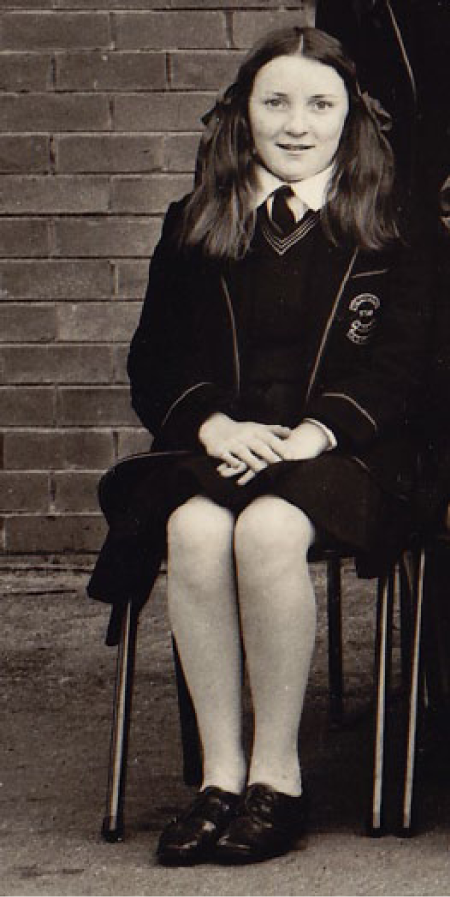
The uniform composed of blazers, tunics, blouses with big starched collars and hats hung from the bodies of both mother and daughter. It was an essential ingredient in the constitution of a middle class Catholic woman. The nuns fussed and bothered over the preciseness of this attire. Girls knelt on the desk so the nuns could check that the skirt hem lay not more than the regulated number of inches above the knee. The uniform was supposed to assist us to control our minds and bodily habits. It signified crucial information about our sexuality and was supposed to hide our desirous corporeality as bloodied women.
The uniform, for both mother and daughter, could be a source of pride and pleasure; it represented both the security and alienation of Catholic school life. It signified belonging to a particular segment of private schooling. The uniform streamlined the look of parochial schooling and presented a clean, tidy and neat demeanour to the public. It represented a specific model of femininity. The school uniform symbolized new and enhanced opportunities for the daughters of ordinary Catholic families. It singled us out from the rest of our contemporaries who stood both below and above us on the class hierarchy.
The degree to which girls respected the school uniform depended on their own circumstances and the extent to which this representation met their particular adolescent desires and misgivings. To don the school’s uniform was to submit oneself to the school and its rituals, policies and ideology. Girls both represented, and became identified with, the school whilst in uniform. There were always girls who rebelled (Lesko, 1988) by wearing long skirts, short skirts, no hats or dilapidated old blazers. These girls chose not to hear the nuns, the prefects or perhaps even their mothers. At this stage of adolescent development, appearance including uniforms, could easily become a source of contention between mother, daughter and school authorities. Rebellious girls could be bold yet cautious, deceptive yet straightforward in their insolence.
To accord to the school rules and regulations dressing in the school uniform entailed a certain amount of dressing up or for some insubordinate girls it could involve an element of dressing down. The school uniform represented a component of ‘display’ or ‘performance’. As Kuhn (1995) contends, ‘Dressing up as opposed to mere dressing implies… a more than purely functional attitude towards clothes: it points to the element of display, of performance, inherent in certain relations to dress’ (1995: 51). Dressing up insinuates an association of ‘fabrication, construction, production’ (Kuhn, 1995: 51) and is associated with the construction of gender; as well it signals the very artifice of that construction. Care and attention to the school uniform, and moreover general appearance of schoolgirls constitutes the social, cultural and psychical construction of femininity. It is part of the way Catholic girls are formed and as Kuhn goes on to assert, ‘Clothes, as they make the little girl, also make the grown woman (1995: 52).
Child of Mary

- That’s me. And you know we had a medal around our bosom, around our necks and that was a Child of Mary medal. If you were a Child of Mary you were one of the senior pupils of the school, one of the responsible pupils. To get that you had to have steps and pass the steps each term. You would apply for your next step …There was the Children of Mary and then there was the…what was it? There were three steps up and it had to be approved by Reverend Mother and also the teachers. If they let you pass then you went for the next step and that was the highest step the Children of Mary. The younger ones had the Infant Jesus and then there was the Holy Angels for the junior ones. That was that…we were all Children of Mary by… I got knocked back several times for being immature (laughs). That’s what they reckon I was immature.
My mother was moulded and trimmed for the future she upheld as a dutiful Catholic wife and mother. Catholic discourse ensured that the substance of my mother’s mind and body was controlled through the elevation of ‘Our Lady’. Catholicism places the Virgin Mary on a very high pedestal so that it is extremely difficult if not impossible for women to leap into knowing and understanding their own female identity. However, my mother’s allegedly excessive immaturity slowed down her progress to the rank of Child of Mary. My mother’s undeveloped, unformed womanhood threatened the institution of the Child of Mary. Her immaturity lay at the margin between Catholic culture and chaos, order and anarchy, reason and the abyss.
Kristeva claims that religious descriptions of motherhood, specifically the myth of the Virgin Mary, cease to provide an explanation and understanding of motherhood. She writes about the ‘cult of the Virgin’ that has been employed by Western patriarchal discourses to conceal the disquieting elements of maternity and the mother-child nexus (Kristeva, 1987). The cult of the Virgin regulates maternity and mothers through violence towards them. In a similar vein to sacrifice, the cult of the Virgin encompasses the violence of semiotic drives by turning violence against them. The Virgin’s sole gratification is her child who belongs to everyone, while her silent grief belongs to her. Kristeva claims that the representation of the Virgin conceals the tension between the maternal and the law of the father; in this case the Catholic Church (Oliver, 1993).
The cult of the Virgin conceals the semiotic maternal body; in particular what Kristeva names the ‘abject’ maternal body. My mother’s feminine immaturity typifies abjection. She is unhappy, and perturbed by her so-called immaturity. For Catholicism, she represents the dangerous zone against which Catholic discourse must grapple to preserve itself. Therefore, she is scolded for being close to disorder and chaos, but then idealized and elevated to the position of Child of Mary once she displayed the requisite ‘maturity’. The Child of Mary represented a defence against the wilderness and abyss that could envelop Catholic discourse, and its God created in the image of man. Catholicism, the very victorious masculine, as Kristeva (1982: 70) notes, ‘confesses through its very relentlessness against the other, the feminine, that it is threatened by an asymmetrical, irrational, uncontrollable power…’ My mother’s immaturity, ‘That other sex, the feminine becomes synonymous with a radical evil that is to be suppressed’.
Catherine Treston, in conversation with her mother and two sisters reminisces on her Art classes at school that were taught by a nun – Sr. R. She ruminates that her sister Crystal received better marks than her for producing a statue of the Madonna:
I remember, she whipped up her four pieces (of Art) towards the end of semester, within a couple of weeks of the final semester. She dipped some cloth in clay and twisted it and stood it up and it looked like a standing up blob. And then she put wishbones around it and called it ‘Madonna practicing wishful thinking’. She did a few things like that and she got a better mark than I did. It was really creative but I couldn’t see it at the time…
But Sr. R was good, she was able to accept that Crystal would be different and she was creative…
The seductiveness of religion, even for an adolescent girl, is with the capacity to represent it through art – religion’s semiotic aspect – and integrate it into its patriarchal symbolic. Crystal’s sister, mother and the teacher-nun – Sr. R., all appeared to see the creativity and cunning in Crystal’s art piece even if it was ‘whipped up’ in a short period of time for examination purposes. Crystal, who was a bit ‘different’ according to her mother, represented the Madonna in an aspirant way, as a ‘wishful’ thinker. The Madonna was artfully positioned as an intellectual, a symbolic feminine religious ‘thinking’ figure. Kristeva contends that the arts signify a more or less effective way to sublimate the abject. In some ways Crystal was redirecting, re-channeling the traditional image of the Madonna.
Kristeva argues that it is from the place of the semiotic that subversion of the (masculine) symbolic can occur. She contends that this patriarchal structure can be disturbed by the unruly semiotic with its plurality of meanings and sounds that are associated with bodily drives and energies. The solemn intellectual account where words and meanings are determined is disrupted by the rhythms, intonations, repetitions and sounds-plays of the semiotic, which Kristeva names ‘jouissance’ (Kristeva, 1984). Kristeva views this transgression as taking place in a range of ways including through art. The authority of the phallus can be destabilized; it can be taunted and mimicked through creative language such as Crystal exemplified in her statue of the Madonna. Kristeva is sensitive to the poetic language of religion including its art. Art is perceived as opening into, and intensifying from the semiotic; it has the ‘capacity for letting jouissance come through’ (Kristeva, 1984: 80).
Irigaray argues that women need to re-cipher the symbol of the mother so that we can re-assert ourselves as women who not only give birth to children but who are also creators of cultural representations and symbols. As women, we must give back to the mother her fertility, which is both cultural and biological. In one sense, Crystal re-ciphered the image of the Madonna and created her as an agentic feminine figure. Crystal produced a representation of the Madonna in which her biology was implicit, yet she positioned her within the cultural realm of intellectual.
The Virgin Mary is the symbolic embodiment, receptacle, the container, for those qualities which society sanctions – humility, self-abnegation, modesty – all of which serve as societal controls. These attributes represent compliance to the status quo. Yet, at the same time, the Virgin Mary, as Grosz suggests, elicits ‘an archaic, primal shelter, the protective maternal harbor’ (1989: 83). Kristeva argues that the Christian imagery of maternity, as represented in the cult of the Virgin Mary, is an effort to overcome the contradictions inherent in the symbolic stance on maternity. Maternity is both ‘respected’ and ‘obliterated’, both sexless and passionate. Both my own mother’s delayed naming as a Child of Mary, and Crystal’s creative modelling of the Madonna open up the tension embodied in the cult of the Virgin as it is located between the (unruly) maternal and the law of the Father (the Catholic Church).
Puberty
The female body is a central signifier and narrative in Catholic discourse. Its meaning, in Catholic discourse, is made visible in the adoration of the Virgin Mary. As adolescent girls how we came to understand our bodies reflects not only on our Catholic upbringing but also on the multiplicity of dynamic and competing cultural, social and medical discourses about the female body popularized during those times. A number of contesting patriarchal discourses were vying for our bodies. Our adolescent bodies were under attack from all angles, whilst our mothers’ bodies were constructed as slow decay within the realms of popular and religious discourses.
Discourses of culture and religion permeated the mother-daughter relationship with regard to the onset of womanhood. In particular, menstruation – a deeply personal and uncontainable experience of our female bodies – was an aspect of our imminent womanhood that came under scrutiny by our mothers; yet at times, it lay under-scrutinized. There was not much said between my mother and myself about the onset of menstruation. The topic was cloaked in secrecy and silence; yet it was a secret that was shared between us. I sensed it was a significant stage in my life, although an uncomfortable one, both bodily and psychically. It was embarrassing yet also liberating, as it was the next step in the maturing not only of my body but also my mind. My mother acknowledged it and directed me toward the appropriate sanitary attire.
Similar to its investiture in some mother-daughter relationships menstruation according to girls’ magazines was to be ‘both visible and invisible’ (Driscoll, 2002: 95). Menstrual advertising proliferated with advertisements for tampons, and the brand I chose was ‘carefree’. This provided an image of a laid back, relaxed and untroubled girl. However, my mother and I disagreed on the notion of the concealment of blood, and she cautioned me against the use of tampons. My mother’s messages about menstruation, rather than being medical, were about the changing energy level and rhythm of menstruation. She would warn me about doing too much whilst menstruating. At the time, I thought my mother was being overcautious and excessively concerned about menstruation. My mother’s sentiments, peer pressure and the strong cultural messages that were being imparted to me by the media about menstruation were contouring in contradictory ways my notions of young womanhood. Moira Gatens from a psychoanalytic perspective claims, ‘that the flow of blood would have profound psychical significance for the pubertal girl is clear and that this significance would centre around ideas of castration, sexual attack and socially reinforced shame is highly probable’ (1983: 149).
Kristeva recognizes that the horror of menstruation is not directly linked to the ambiguities of sexual difference. Instead of marking the difference from female to male she contends it distinguishes the difference between men and mothers. The horror of menstruation functions to connect women to a (supposedly natural) maternity and does not account for women’s sexual specificity, a residual femininity not signified by maternity.
The horror of menstrual blood, the living matter, which helps to produce and sustain life, is a refusal of the expelled link between the mother and the foetus, a border, as it were, between one existence and another that is not the same as not yet separate from it … a threatening boundary or threshold between life and non-life, between male and female. It marks the site of an unspeakable debt of life (an ‘umbilical’ debt) that both the subject and culture owe to the mother but can never repay (Grosz, 1989: 76).
Bodily changes in the pubertal girl are often signified as sexual development. It signals an unwilled and uncontrollable avowal of the sexual body (Driscoll, 2002). Therefore, there is more to puberty than the physical flow of blood. Elizabeth Grosz underscores the importance of the sexual specificity for theories of corporeality: Women’s bodies do not develop their adult forms with reference to their newly awakened sexual capacities. Rather her bodily development is dramatically over coded with the resonances of motherhood… Puberty is not figured as the coming of a self-chosen sexual maturity but as the signal of immanent reproductive capacities…the onset of menstruation is not an indication for the girl of her developing sexuality, only her coming womanhood (Grosz, 1994: 205).
The appropriate realization of puberty in adult sexuality stresses distinctive gendered acts of heterosexuality and identity. Puberty represents an interconnection between corporeal functions and privatized control (Driscoll, 2002).
The most critical notion of sexual development for the Catholic girl is that of virginity. The emerging corporeal essence of the adolescent girl proposes a sinful, evil temptation just like Eve was to Adam in the Garden of Eden. In the eyes of Catholicism a woman’s maidenhead is sacred and a gift from God. Adolescent girls were encouraged to pray to the Virgin Mary that this gift would remain precious and untouched. Mrs. Fenwick and Catriona, her daughter, tell the story:
- Friends often talk amongst themselves about how their parents told them about sex or whether they did. I always remember the brochure that you gave me that probably every Catholic mother gave their children at the time. ‘A letter to my daughter from Mary’ and it was about…
- Oh really I don’t remember it; I’m cringing (laughs).
- It was a classic about, it didn’t use the word maidenhead but it was basically about looking after your very precious gift that God had given you. But you weren’t exactly told what it was. Just that now you are growing up, you have a special woman’s gift and pray to Mary and she’ll look after you.
- My mother gave me a poem to read but I think it was about flowers and seeds (laughs).
However, despite the Catholic Church’s doctrine and literature, as the 1970s passed, the pedagogy of sexuality in Catholic education for girls was slowly shifting. The proclamations of Vatican II and the cry for liberty of social conscience were influential, and advocated that Catholic schools and/or religious communities adopt individual stances on this issue. In Australian society in general, dialogue surrounding the contraceptive pill was topical, there was abortion law reform, and the sole parent pension was introduced (Kaplan, 1996). Familial structures were undergoing rapid change. The Catholic community was not totally estranged from these and other social influences.
Although during my upper secondary school years, any interest in sex was frowned upon, the school decided that it was not dealing with disembodied minds but with young women. Hence, one session on contraception was conducted as part of our religious education instruction. In our final year of school we were assembled into the school-hall for a lesson on contraception. I think the fact that the school chose to recognize this discourse gave me more satisfaction than the information presented during that session. An issue was however that this progressive educational discourse on human sexuality did not involve our mothers. Our mothers heard haphazardly, if at all, of their daughters’ new found knowledge on contraception:
- I can remember you (Mary - her eldest daughter) coming home from the biology class and the teacher had told you the pill was the way to go if you weren’t wanting to have children. You came home and told me.
- How did you feel about that as a mother?
- Well I didn’t think that that was the right thing to be teaching.
- So that was the end of the conversation.
- She wasn’t interested in a conversation.
- So if I had have gone out at fifteen years of age and met any Tom, Dick or Harry I would be pregnant basically because I had no support.
There was an enormous disjunction within the Catholic Church’s discourse on human sexuality and in particular contraception. The Church, through the proclamations of Vatican II, had outlawed contraception. This ruling not only created disturbances in the mother-daughter nexus, but also placed immense pressure on our mothers’ intimate relationships. As Mrs. Manns notes ‘sometimes it was sheer hell’. Catholic women were left to anguish over whether or not to obey the Church’s ruling whilst their daughters at school were receiving teachings in human sexuality and contraception, even if to a limited degree.
The feminist movement both historically, and in contemporary times, aims to enable women to contest their subjugation and make claim to their own moral agency. Self-determination in relation to procreation, in particular, is one element where women can have a say in the construction of their own subjectivity. Whilst women are denied choice to determine control over their sexuality and bodies - for example through communiqués issued by the Catholic Church - what is conveyed is that women’s bodies do not belong to them (Ellison, 2014). Ott outlines this universal stifling of dialogue in current times on Catholic moral theology and states, ‘Simply put, the Church continues to systematically silence theological dialogue, its own history and, consequently, future developments in moral theology related to contraception and abortion, and sexual ethics more broadly’ (2014: 138). Ellison asserts that the consequence is that ‘Women are then at risk of becoming infantilized, disempowered and unable to develop the necessary capacity for self-initiating moral agency’ (2014: 127).
With recent developments in medical technology there is a proliferation of subject positions that women can occupy in terms of reproductive choices. In discourses of Catholicism ‘woman’ is congruent with mother or virgin (a nun-like figure), or the improper whore. However, women including Catholic women are taking up new subject positions outside traditional categories; yet whether these new subject positions open up real and viable options for women is another feminist concern. Many women, including practising Catholics, are making up their own minds about procreation and contraception. They may name themselves ‘Catholic’ but they are determining which Church rulings they will follow and which to ignore. As Adelaine Piper, a daughter asserts, ‘I don’t think that many women of my generation in Australia actually worry about what the Church says as far as contraception… I would be surprised if it causes any grief as it would have done in Mum’s day’. The hegemony which Catholic discourse in the 1950s and 1960s had over women and their bodies as reproductive objects faded with the concept of liberty of ‘social conscience’ and with growing knowledge of and medical advances in birth control.
It is argued that the forging of rules and polemics, including Vatican II and the ensuing encyclicals are determined within a patriarchal hierarchical system (Keary, 2014). This silences women by denying them access to a public forum of cultural and social revision, and re-conception of Catholic discourse. Catholic women, mothers and daughters, encounter tension over the Catholic Church’s intrusion into their private and intimate lives. The real problem is that this tension is still prevalent today for many Catholic women across the globe. As Ott concludes’ the hierarchy’s promotion of an institutional conscience over and against the lived realities and individual conscience of women and silencing of theological dissent calls out for theological inquiry for the benefit of the faithful’ (2014: 147).
Conclusion
In conclusion, for the purpose of this feminist genealogy I undertook a multi-methodological approach to data collection and analysis, and employed psychoanalytic theories including that of the French feminists, Luce Irigaray and Julia Kristeva to problematize and disclose the patriarchal texts, rituals and pedagogies of Catholicism. I contend that I strategically capture at specific historical instances the material conditions of women’s lives so that it does not become the ‘forfeited terrain of patriarchy’ (Cixous, 1981). That is, I position myself as both research and object of inquiry inside history and inside a female body. This is not to suggest that Irigaray’s and Kristeva’s theories are based in essentialist epistemologies, but rather asserts the need for political feminist texts which capture the material conditions of women’s embodied lives.
Discourses of pious reproduction shroud and enshrine women within a patriarchal definition of the maternal. Kristeva points out that the futile, unfeasible image of the Virgin Mary aims to control the power of the excessive female body, which threatens the political vistas of Catholic discourse. This unattainable representation of the mother figure eclipses the significance of the particularities of women’s identity and place in the social. It codes and names women only within a context of sin and evil, and assassinates the image of the mother.
It is difficult for us as adult women to make sense of the confused and contradictory images of femininity, sexuality and relationships that are offered to us in contemporary culture. It has been argued by Kristeva that the female body can never be totally repressed or excluded so Catholic discourse contains and restrains the corporeality of women through its rituals, language and images. Like our mothers, as daughters we have had to carve out our own direction in life. Our mothers’ adolescent years were contained by the prevailing dominant traditional ideologies of Catholic womanhood. In contrast, as daughters, our entrance into womanhood was shaped by reformations in the Church and secular voices of liberation. For our mothers’ daughters, the position of women had shifted, and gender relations were renegotiated, enabling a variety of options available to us as young women. These options, however, were only available to the daughters because many of them negated the teachings and rulings of the Catholic Church on a range of issues, including that of sexuality and contraception.
Footnotes
Funding
This research received no specific grant from any funding agency in the public, commercial, or not-for-profit sectors.