



Abstract
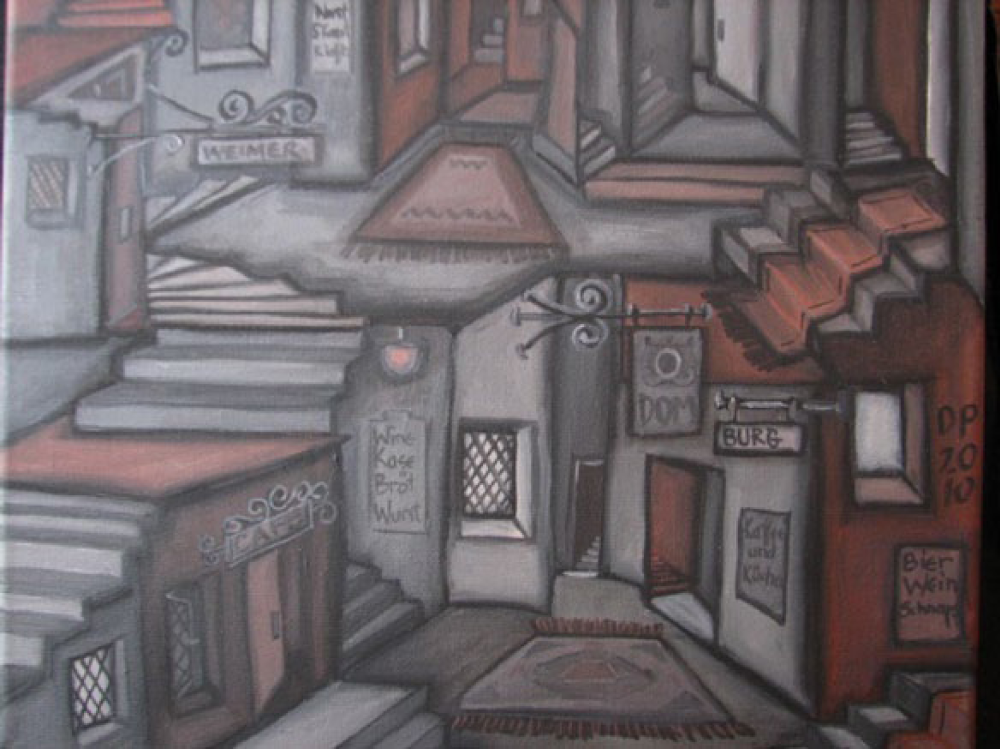
In this article I make links between melancholia, creativity and communion with God at a personal level, referencing John’s gospel, ‘God’s house has many rooms’ (14.2–3) and ‘The Mansions’, a text written by Theresa of Avila where the ‘mansion’ is an analogy for the space in which God’s omniscient love is realized. My paintings were formed from the day-to-day lived experience of ‘psycheache’ (Joiner, 2005: 37) and are a graphic representation of a non-explainable reality. I see in these paintings a transcendent reality for they are the markings I made to express a state-of-being that could not be articulated. During this episode of Depression I painted dark interiors with rambling corridors, flights of steps and doorways leading into rooms empty of people.
Introduction
I am confident to speak now about a time when I was silent and could only fully express the grief through artwork. For many years I believed Depression and suicidal ideation signaled an aberrant personality and believed any disclosure would impact negatively on my social relationships and employment opportunities. It is through my own research and self-analysis that I have come to an understanding that mental illness is a feature of the human condition and that it is also a space in which redemption, creativity and transcendence is possible. Depression does not define who I am; it is simply an aspect of my Self.
The paintings that form the series ‘In God’s House’ are a narrative of the Self showing an accumulation of imagery (Graham, 2000: 126) in which personal and universal symbols and motifs combine to encourage the viewer to interpret my story. My artist-self was compelled to do art-making, becoming the voice through which my story could be told without me being labelled as ‘mad’. It is in those spaces of unspeakable melancholia and madness that the richness of the creative spirit is generated.
Perhaps in that nexus of Narrative Inquiry and Feminist Theology, we should listen to the stories of perplexity and confusion and remember that the stories are given as a gift of another’s other-ness. The narratives of despair, whether they are told in words or images, are ‘the lives and voices of unique liberatory patterns of resistance to patriarchal oppression’ (Newell, 2013: 117).
Autoethnography and Narrative Inquiry
I employ Autoethnography and Narrative Inquiry as theorizing and methodological tools. Both sit comfortably with Feminist Theology for they hold that the intention of the research is to uncover individual stories and explore the connections between lived experiences, their relationships, and their world. The individual’s story is the focus. For me, Autoethnography has many advantages for it is concerned with the analysis of personal stories that seek to understand lived experiences within a cultural context. It allows a researcher to confront their own experience of marginalization and to challenge everyday assumptions about sensitive issues. Autoethnography gives me the opportunity to examine how my lived experience of Depression is the attempt to make sense of who I am and who I wish to become. Autoethnography allows a researcher to retrieve memories for analysis and to reveal raw emotion, silences, secrets and the epiphanies that transform the trajectory of a person’s life (Ellis et al., 2011).
Narrative Inquiry as theory and method allows me to consider the positioning I have ascribed to the characters (and myself as narrator) within this specific story while seeking to expose how I frame my story of self within over-arching meta-narratives. Narrative Inquiry encourages collaborative reflexivity between researcher and participant as they make sense of their lived and imagined experiences. In my research, I as researcher am able to analyse and engage with the self-I-was to develop a collegial reflectivity about ‘our’ story. Through the piecing together of individual stories, we learn how experiences may become transformative and learn how individuals are affected by institutionalized discourses and dominant political and cultural constructs.
In this article, as in my research, I am positioned as both the researcher and participant for I am re-searching and analysing my own art-work, the Depression episode and my art making practices from five years ago. Narrative Inquiry allows me to stand back from my experiences and set up a dialogue between my researcher-self and my participant-self on the how and why of my lived experience. It reflects the fellowship that is the hallmark of communion with God.
Depression and Melancholia
I utilize Narrative Inquiry to analyse my own experiences and speak openly of a subject – Depression – that is common to many people, but which is often marginalized by cultural-medical, political-patriarchal meta-narratives or veiled in euphemisms. We live in a culture in which Depression, anguish, suicidal ideation and grief are common experiences but often devalued and considered as ‘an indulgence, having no merit, no social value, rationed out like coins to the deserving poor, a commodity the strong and self reliant were too proud to need’ (James, 1988: 89).
The website of the White Cloud Foundation of Australia (2014) and of Beyond Blue Australia (2012) report that at any one time approximately one million Australians will experience Depression. Both websites predict that by 2030 it will become the most significant health concern affecting one in seven people at some point in their lives. It resonates with many women, including women who experience eating disorders and post-natal Depression (Mindframe, 2014). Depression, including melancholia and anxiety, is a quality of the human condition and rather than sedate, ignore or pathologize it, there is a need to understand it for ‘psychic anguish may in some cases be a more appropriate response than the numbness, denial, and adaption that so-called healthy persons manage to maintain in the face of our society’s sicknesses’ (Greider, 2007: 95; Newell, 2013: 116).
The medical language of these experiences has become ‘a jargon that denies complexity and erases individuality, reducing all experience, all suffering to a set of almost programmatic responses’ (Bradley, 2009). Each account is analysed to test its validity as a ‘true’ mental-illness experience and then unravelled to determine its causes and the way back to happiness as quickly as possible.
My episode of Depression was comprehensive in terms of its duration and intensity, but I was not prepared to forgo my misery, for I knew that happiness is only transient, and only one of many emotions. Like Bradley (2009) I was prepared ‘to accommodate the idea that agitation and pain, sadness and hurt might be more than mere stages to be overcome on the road to wholeness, or might have positive qualities it cannot describe or explain’.
In the despair of Depression and then in the shame of being construed as deviant, I like others could not speak about what I felt, nor did I have the words to write out my despair. I was alone and isolated. In the process of art-making I made a dark room in which the Self could be dissolved into a ‘not’-being.
The Cocoon of Satisfying Darkness (2010).
My Self dwelt within a black, blank space and sought to avoid any light. The initial paintings depict dark rooms and shadowy corners behind stairwells and these rooms can be interpreted as old-style prison basements. There are no people in any of the earlier paintings. The sense of self has been subsumed by the darkness. Blair (2013) writing about creativity and Depression, refers to recent studies in which the level of our social engagement could be linked to levels of happiness. In the time of the Depression I preferred to be on my own for it made it easier to dwell in the not-space. I considered the not-space and the desire for death ‘as alluring, even sustaining’ (Joiner, 2005: 92) for I believed it would be a resolution to the anguish I endured and a state of peace would be secured.
Joiner (2005: 132–33) proposes that the lack of connection to other people and an attraction to the darkness indicates disengagement with the world, a desire for death and a susceptibility to suicidal ideation. I painted my not-Self into the darkness. At this point of the Depression I did not want to escape it. It had formed a protective cocoon that prevented me from talking to another person. I refused to speak for I was ashamed that another person would know of my inability to manage my world, my thoughts or my Self. The blankness was an attempt to dissolve the Self, so I would be invisible to God. I believed that if I could not see me, then God could not see me. O’Donohue (2000: 172) describes this as the place and space we are afraid to go to for it is forsaken ‘shadow land’.
If the darkness was a ‘No-where’ (O’Donohue, 2000: 224), or a not-space, then I believed there was no need for words, thoughts or feelings. The Self was ‘not’ for it had ceased to be. The darkness of not-space became my subjectivity and my identity. I was a ‘not’ – not here and a ‘not’ being. My subjectivity no longer mattered and thus, had no matter. Joiner (2005) theorizes that one of the drivers to suicide ideation is the belief that our identity is worthless. My paintings tell me that my identity as a competent teacher had been eradicated and my Self had integrated itself into a void so my sense of Self was ‘not’. Bradley’s account in his on-line article, ‘Never Real and Always True: On Depression and Anxiety’ (2009), is similar, ‘It was not a matter of feeling dulled, or anaesthetized, more a sense that I had become less real, or at least less engaged by questions of the self’. O’Donohue would argue that it is in this state that we are highly self-critical and our fears ‘long to turn the mansions of the soul into haunted rooms’ (2000: 172), but the Self is intrinsically afraid of ‘not’ being and will wait for the despair to pass.
However, Depression, melancholia and mental illness have also been linked with mystical and spiritual experiences (Dillon, 1995: 517; Jackson and Fulford, 1997: 42). In Renaissance times Marsilio Ficino argued that melancholia was the manifestation of a yearning ‘to transcend the concern of the everyday, and strive towards the divine’ (Bradley, 2009). As a culture we have come to believe that extra-ordinary experiences are inimical to a rational, logical approach to a scientific world. ‘It was a concept deriving from medical discourse that fundamentally modified and redefined the phenomena it described, and in doing so turned forms of popular religious experience into pathological entities’ (Goldberg, 1999: 36–37 quoted in Newell, 2013: 22).
In our cultural and social narrative, experiences which are different, strange or foreign are marginalized and stigmatized, especially in the area of mental illness (Government of Western Australia Mental Health Commission, 2010). I remained silent and worked my emotions and psycheache into the paintings of doom-laden interiors. We remain silent or speak in euphemisms because the terror of voicing such experiences places us outside the dominant order.
The Many Rooms of God’s House
Theresa of Avila, a Medieval feminist theologian, like the anonymous authors of the Bible, used the analogy of a dwelling place to describe her encounter with God. She described the soul as a Mansion that is structured like a castle into which our Self must enter to meet and have communion with God. Theresa’s comparison of the in-dwelling of God’s light with the courtyard of a mansion is part of the tradition of analogical description within the Catholic imagination. It is founded in the concept of Creation in which God is ‘disguised’ within everything, including matter and non-matter.

Stairing Down the Walls (2011).
O’Donohue (2000: 170) compares our thoughts to rooms. If we restrict our visions we create tiny rooms that will cripple any possibility. Fox (2012: 7) refers to ‘the deep places in our own hearts and souls’, citing Bede Griffiths’ analogy of a cave and Hildegard of Bingen’s analogy of a house of wisdom to explain the deepest place of our being that leads to meditation and contemplation.
When I analyse these paintings now I can see why and how they were formed. The light is fractured and broken shadows dominate claustrophobic rooms and tunnel-like corridors. As the artist, I was trying to find a dark room in which the Self could be dissolved into a ‘not’-being. The paintings of rooms are a metaphor for my relationship with God for they show the rooms of my own soul in which God lives.
My paintings of rooms and endless corridors lead the eye backwards and forwards across the canvas, creating tension in the viewer. There is always something out of reach, never fixed, and beyond the boundary of the painted panel. The eye is always moving. O’Donohue (2000: 100) explains this ceaseless motion without ‘frame or frontier’ as the soul’s refusal to allow a space in which the Self can confront God.
The Light in the Rooms
In all the paintings from this series there are very small areas of lighter tones with pale green, lemon and rose. These are the sources of light that will always be found in the darkness. When I look at them I can see that I was reassuring my Self that the light of God was still accessible. God had remained within my ‘house’ and was not going to leave. The unconscious Self who painted the raw emotion painted the light as a symbol of God. Hildegard of Bingen (Fox, 2012: 11) believed even the deepest darkness contained light, and it is cosmic wisdom that saturates and renders all things and all matter with a numinous luminosity.
I had painted God in each room intuitively, for I had unconsciously engaged in a meditative practice which ‘is the kind of thinking at the heart of prayer, namely, the liberation of the Divine from the small prisons of our fear and control’ (O’Donohue, 2000:171). God waited in each of the rooms. No matter how much I tried to obliterate the light I was unsuccessful, for God would not let me remain in darkness. As I changed the palette from low tones into bright tones I understood another future was possible.
O’Donohue (2000: 224) cautions us about the dark space in which we wish to hide. If we resist it and fight it, then it remains fixed around us, for ‘Suffering has its own reason… When you stop resisting its dark work, you are open to learning what it wants to show you’ (2000: 225). At the point of surrendering the Self to a state of not-being, the darkness that had once been doom-laden became God-laden. O’Donohue (2000: 104) considers it is at this moment when the soul, aware that the cloak of darkness has been used to prevent our self from seeing God, suddenly yearns to bring our Self into communion with God.
A gentle awakening can be seen as brighter tones emerge in my paintings, with the inclusion of flower and tree motifs and ceiling-less rooms. The interiors of complicated corridors and rooms are painted in grey-scale tones and include patches of royal blue and aqua. The rooms are still empty of people. The darkness becomes softer for God’s light is erasing fear and dissolving despair.
The Courtyard of God’s House
The courtyard is the central or focal point of our being. It may be likened to a space that is physical, such as a library, sunroom or garden where we can sit and reflect. It is the space in which God’s presence is tangible and the arena in which any thought-filled response, reflection, introspection or meditative act becomes God-directed. Action, implementation and art-making are the result.
Theresa of Avila recommends deliberate actions through reflective prayer, through meditation, through scrupulous self-analysis and through authentic wonderment. The acceptance and recognition of the light piercing the courtyard is a ‘vision that far surpasses our limited imagination leaving a great fear… because our nature is too weak to bear so dread a sight’ (Zimmerman, 1997: 238). Theresa suggests that St Paul’s conversion was a response to this as a violent tumult before it ebbed into a perfect calm (Zimmerman, 1997: 240). ‘The vision passes as quickly as a flash of lightning, yet this most glorious picture makes an impression on the imagination that I believe can never be effaced until the soul at last sees Christ to enjoy Him for ever’ (Zimmerman, 1997: 237).
Communion with God
In exposing the rawness and the shadows of that bleak space, the Self that was silenced refuses to remain quiet or be ignored. I reject the patriarchal tag of ‘mad woman’ and refute the patriarchal pathologizing of emotional instability. I claim this moment as the turning-point when I came to acknowledge the Self’s hungry quest for communion with God. This is what I know now. At that time, I was paralysed by self-criticism and unable to see beyond the despair-narrative. During the most tormented moments of depression I believed peace could only be achieved through death for in death there would be complete integration with God.
Peace I leave with you; my peace I give you. I do not give to you as the world gives. Do not let your hearts be troubled and do not be afraid (Jn 14.27 NIV).
I was willing to surrender into the not-space of death and give up my sense of Self to be a ‘no’-thing. In doing so I believed I would achieve a peace in which communion with God became a lived reality. But this thinking was flawed for without ‘being’ it was impossible to have any relationship with Self, God or others. The paintings show that there was a point when the despair was breached. This fracturing and rupturing of tangled thought allowed communion with God. O’Donohue (2000: 185) refers to this as the ‘aha’ moment or as the dot of light that empowers a person to loosen pebbles, to remove walls and then to dismantle the prison. At that moment there is a sense of wonder because the Self remembers the deliciousness of that abandonment into the communion with God. God’s spirit suffuses and saturates. It is the in-dwelling of God.
Creativity and Imagination
The debate about links between creativity and melancholia continues. This article does not debate the connection but describes how my creativity in art-making awakened me from an episode of Depression into deep relationship with God. Darkness, according to O’Donohue (2000: 205–207) is not alien to the human soul for ‘darkness is one of our closest companions’. Both are linked in our biblical tradition.
The first lines of Genesis speak of this, ‘In the beginning, when God created the universe… everything was engulfed in darkness’ (Gen. 1.1–2 GNT). O’Donohue explains that darkness is matter used by the soul to protect and shelter itself from ‘too much outside light into the secret centre of the mind’ (2000: 207); if we had the courage to look into the haunted rooms we would see a vital Self that had been banished at a time of grief, pain and difficulty (2002: 173).
When Depression and melancholia are articulated through the creative arts of text, song, dance, music and painting, it can be the well-spring of creativity and the space in which Communion with God is possible. If art-making is an act of Creation then as Greeley (2000; from Eldebo 2003) suggests, art-making emerges from imagination through the stories we tell ourselves and others. Art-making is shaped by our every-day experiences because, as Eldebo (2003 quoting Greeley, 2000) says ‘God lurks everywhere’.
O’Donohue (2000: 136, 338) and Fox (2012: 81–94), in recounting the philosophies of Hildegard of Bingen, believe the dark space is the arena from which creativity emerges. It is after via negativa or the ‘oppression of sadness’ that the Self becomes aware of the power that is transmuted into via creativa, both a healing principle and an energy source for inspiration.
Art-making
Art-making is a record of the effort to see through to the essence of life and access the undercurrent that runs through all things. Keating (2009), in Robert Henri’s writing about art-making, identifies Henri’s intuitive linking of creativity with the sacred. Henri believed art-making to be a result of a creative force ‘shot through with mystery’ (2009: 123) for the artist has discovered ‘the underlying pulse of life as a deeply felt knowing’ (2009: 131). Mystery and pulse are synonyms for communion with God. Through art-making an individual can interrupt the mundane experience of the here-and-now and enter into a realm in which communion with God is experienced. The art-object is a result of that experience and a by-product of the experience of transcendence as it emerges from an intense and heightened level of being. It is the state of arousal that delivers us out of the ordinary moment and the art-work produced during those moments is its manifestation (Keating, 2009: 129).
Paintings, as art-objects can express an emotion or a circumstance through the use of universal themes, symbols and techniques, or they can be a personal expression of the episode referencing private themes and symbols. A painting can be both expressive of an emotion and an expression of an emotion. Graham (2000: 27) questions if the emotion should be felt by the painter and the audience or held within the work itself. Yet a painting created from an outpouring of emotion could be considered a therapeutic activity. The creation of an art-object, however, remains a process of self-discovery, whether it is through analytical planning or as a spontaneous burst of emotion.
It is by imaginative construction that the artist transforms vague and uncertain emotion into an articulate expression. The process of artistic creation is thus not a matter of making external what already exists internally … but a process of imaginative discovery. And since the psychic disturbance with which it begins is the artist’s, art is a process of self-discovery. Herein, in fact, lies its particular value – self-knowledge (Graham, 2000: 34).
Bergson (2002: 91) suggests that the art will always be an inadequate construction of what was experienced by the artist, although it is the artist’s calling to make visible the rawness of grief, fear and trauma. While sympathetic, the viewer must recognize the impossibility of capturing all the nuances of symbol and motif used by the painter. If a person has not experienced the specific circumstances – such as grief, abandonment, hunger – they may have difficulty reading the emotion conveyed within the art-object. People who have not experienced imprisonment or lived as a refugee may be unable to see or feel the nuances of trauma and day-to-day despair as expressed within a painting, sculpture, music or poem.
Any art-work that portrays the experience of Depression is highly personal because each person’s Depression cycle and emotional patterning is unique. Although Depression is a part of the human condition, the artistic expression during these episodes may or may not resonate with others. My representation of raw emotion is mediated through art-making as my incoherence is worked into a concrete form that can be recognized by others. Emotion is lived and re-lived in the process of art-making and is sharpened through articulation. ‘The sensual and emotional experience contained in a work of art is not ‘raw’ felt experience, but experience mediated by the thought and imagination of the artist’ (Graham, 2000: 34).
Newell (2013: 111) explains that as humans we are always coming ‘to be’ through artwork because artwork is the language that evades pathologizing, is always flexing and changing and this opens up the possibility for transcendence with God.
Flâneur
It is the researcher’s role to interpret the ‘story’ of an art-object in order to analyse the embedded narrative the artist is unable to articulate. In this article I am positioned as a researcher analysing the trauma narrative that compelled my artist-Self to paint. As a researcher I re-view what my artist-Self wanted to tell other people. As part of the researcher role I take on attributes of the ‘flâneur’ who strolls and observes, becomes integrated with the artist-Self but remains anonymous, and who lives within the rooms of the paintings to make meaning about the lived experience of the artist-Self.
Charleson (2011: 21) tinkers with the traditional meaning of ‘flâneur’ to provide an alternate perspective about the relationship between viewer, artist and artwork, describing the viewer as one who becomes the ‘meaning-giver’ to the artwork rather than the ‘meaning-taker’. The researcher-Self as flâneur – makes meaning from viewing and analysing the paintings and the context of the artist-Self, while recognizing that the Self-to-be is already changed by the experience of the self as researcher-flâneur. The past and the future amalgamate, and this melding alters the motifs and symbols of the paintings.
My paintings of the murky rooms can be interpreted by a viewer who has experienced similar emotions, for the viewing of another’s artwork provides an opportunity to enter into a deep and transformative relationship with one’s own self and with the artist (Keating, 2009: 129). Holly (2013: 90) and Hartney (2014) believe that the emotions the viewer develops from seeing a piece of artwork are heightened when the viewer knows the intention of the painter because a connection is forged between the viewer, artist and the art-work.
The viewer as flâneur, develops an understanding because the process of viewing ‘is charged with engagement, interpretation and response to the work in terms of what meaning it has for them and where it intersects with their lives’. The flâneur becomes the one who senses the ‘secretions of unknowability’ (Squire, 2012: 73) and positions themselves as a partner in the narrative created by the artist, changing their narrative of self to accommodate their reactions to the artwork.
Communion with God is a Call from the Future
The flâneur-Self observed how my art-making behaviours were a manifestation of my attempts to make sense of Depression and during the shift towards a rich communion with God the flâneur-Self signalled that a change was upon me. It is as though ‘Irredeemable sadness must precede utterance, and it is loss that causes one to try and find the essential object of being from which one is separated, first in the imagination and then in words’ (Dillon, 1995: 517).

Welcome the Light (2011).
Although I had not understood a change was happening, my flâneur-Self had and had interrupted the Depression narrative by speculating and going ahead to my future to: ‘prepare a place for you, I will come back and take you to be with me’ (Jn 14.3 NIV) to be in God’s house where I am.
This moment is the beginning of the resolution of Spirit and Self. However a tension existed between letting go of an old narrative and taking up a new narrative. The old narrative made me miserable but it was familiar. A narrative of the imagined future required courage.
The researcher-Self understands that the silence and incoherence of the Depression episode had been advantageous, for the inability to articulate despair and death ‘works against closure and allows for the opening of future contexts’ (Squire, 2012: 73). The paintings as a series document what can now be regarded as a ‘splinter’ episode lived in anticipation of the future.
The anticipation of the future is the site from which we can take flight into the unknown, breaching dimensions of time and place to craft another narrative. This narrative of anticipation is an imagined future, encompassing the past and nostalgia, ephemerality and melancholia, and the impossibility of knowing our future and our death.
In the centrifuge of Depression I came to understand and accept that death will happen at some time in my future. I no longer desired death because I knew it would happen. It was a definite. I no longer had a need to exist in, or search for the not-space. The art-making process had liberated me from the desire to bring forward my future death.
Rather, I understood how art-making had directed my Self into an encounter with my future Self through relationship with God. Belinda von Mengersen (2014) suggests that through art-making we are able to transcend all temporalities of being and leap into the unknown because time, craft and narrative become embodied. The physicality of art-making insisted that my Self must live. The embodiment of crafting is a powerful vehicle to make real to the self an abstract reality (von Mengersen, 2014: 109). Art-making provided the rupture in time to allow God to call me towards a new context of being.
Squire (2012) makes a case for this splinter or ‘interruption’ as an insertion of the future. It is a record created for the future allowing an analysis at a future date. The creation of the paintings is a call from the future assuring the Self that there will be a time in which I will ‘be’, will be embodied, will ‘become’ once again. ‘Its call is also a gift, always opening up the possibility of a new context; in responding to that call, therefore we are always on the move, always living and making a story’ (Squire, 2012: 71).
The gift from the future or the call-to-be in the future is similar to the concept of the prophetic call narrative in which God speaks and we are compelled to answer (Bratcher, 2013) even if we do not wish to listen. To hear and respond to such a gift requires a person to be in communion with God. Both Squire and Bratcher concede that the call or gift from the future may happen by accident but there is a still a need to recognize it and accept it as a gift.
The Courtyard
The last painting of my series is unfinished. The painting is dominated by royal blue, aqua and aquamarine blue. The walls slant into the middle of the canvas and there is no ceiling. Instead of a roof the room is open to a vast sky of rich blue filled with stars. Where the walls end, there runs a long shelf of books. The central room is a courtyard with three figures playing cards over supper. The courtyard is both the cognitive and the spiritual space in which God’s light can infiltrate each aspect of our lived experience. For Theresa of Avila (Zimmerman, 1997), the courtyard is the space in which the self dissolves as communion with God saturates thought and emotion with the Holy Spirit. Fox (2012: 7) refers to ‘the deep places in our own hearts and souls’ and cites Bede Griffiths’ analogy of a cave and Hildegard’s analogy of a house of wisdom to explain the deepest place of our being that leads to meditation and contemplation.

The Courtyard of Courage (2011).
The process of art-making will ‘enact the sense of what is known, what is unknown, and what is yet to be known and what will remain unknown’ (von Mengersen, 2014: 113) because it is in this space we confirm that our experiences, knowledge of Self and the inner life are indivisible and ‘the more we immerse ourselves in it, the more we set ourselves back in the direction of the principle, though it be transcendent, in which we participate and whose eternity is not to be an eternity of immutability, but an eternity of life’ (Bergson, 2002:158).
Paintings as visual narratives are able to collapse what was (memory) and what is to be (future) into the present through the process of art-making. Thus, anticipation of what is to be becomes the space in which communion with God happens.
From There to the Here-and-Now
To live with and then through the ‘psycheache’ (Joiner, 2005: 37) of Depression, and suicidal ideation requires courage and a ‘fearless endurance’ (Joiner, 2005: 9). These emotions and thoughts are natural attributes of the human condition. I suggest Depression is also a ‘gift from the future’ for it is an episode that interrupts chronological time by bringing the future forward into the here-and-now. As I considered the possible ways-of-being during the time of Depression I chose communion with God as the future to be brought forward.
This gave me the opportunity to re-assess my professional practice as a teacher and to consider alternate futures. I wanted to become an artist. I heard the call to be an artist when I was a young child but it was always put aside. Then, as happens when people ignore prophetic calls, I stumbled. During the Depression episode it was art-making, which had always been a hobby-practice that brought me back to communion with God.
My belief in who I was had been tied to the meta-narrative of economic stability, hard labour and ordered work habits. I was employed as a teacher because teaching was the profession deemed to be a safe and suitable occupation for a female. I remember the look of horror on my father’s face when I told him I wanted to go to art school to become a painter. He steered me into training as a teacher. I never really ‘became’ a teacher and the experience of Depression forced me to reconfigure my expectations of the future. Bradley (2009) said he could never imagine himself as anything other than as a writer, and during a major episode of Depression he was unable to write. I empathized with him but felt relieved that I still had retained the compulsion and desire to paint. I am now an artist and a writer who is engaged in art-making with painting and collage, story and poetry. It is the process of coming into being.
There are still episodes of Depression and because I now view them as a flâneur, seeing them as a space in which creativity will germinate and as an opportunity for communion with God I do not suppress them nor struggle with them. Rob Blair (2013) says in his blog, ‘Depression isn’t something I struggle with; it’s something I live with. It’s not an adversary so much as a roommate these days’. Pyscheache can be regarded as a time from beyond time, a gift from the future or the call from God compelling us to be. In my circumstance, art-making led to an understanding of how a Depressive episode can be rich in possibility for the future.
Footnotes
Acknowledgements
This article is an extension of a presentation at the conference for The Sacred and The Arts (2013) and part of a PhD under supervision by Dr Elaine Lindsay and Dr Michael Griffith.
Thank you to Dr Elaine Lindsay (Australian Catholic University) for her support, advice and guidance during the writing of this article.
Funding
This research received no specific grant from any funding agency in the public, commercial, or not-for-profit sectors.