



Abstract
This study analyzes two public speeches of two North-American Seventh-day Adventist women who oppose women’s ordination, in order to understand how they reconcile inequity perpetuated by their religious position that denigrates women. The two women in this study address the apparent disadvantage by reframing the issue and reordering their reality. Whereas one speaker creates other formidable sub-issues that make exclusion of women from church leadership imperative, the other speaker resorts to the elusive notion of female privilege. I demonstrate how their discourse surrounding ministry and headship illuminates the fact that gender relations and religious convictions are ordered through permeable boundaries of arbitrary lexico-semantics.
Debates on women’s ordination typically center on biblical exegesis, with each side trying to justify its position by drawing from various biblical references. Some of the most commonly known arguments against women’s ordination include the creation order as told in the book of Genesis and Apostle Paul’s statements in the New Testament promoting male headship and women’s subordinate roles at home and church. 1 Other arguments include that there are no clearly known female pastors or priests in the Bible and that Jesus’ disciples were all male. 2 Still other arguments are based on the Trinity doctrine; namely, as there is a hierarchy in the Godhead, gender relations should also have a hierarchical structure. 3 As Kim 4 pointed out in her comparative analysis of two documents written by two groups of Seventh-day Adventist Church, there is no shortage of biblical texts that either side can draw from to justify its view. Whereas the Bible gives no guidelines on ordination and the term “ordination” is never mentioned, various statements from the creation account and writings of Apostle Paul are frequently used to defend male headship.
Because those who oppose women’s ordination defend male headship and predestined gender hierarchy, and their arguments essentially promote men’s superior position, the anti-women’s ordination position is often considered to be driven by men. However, considering the issue of women’s ordination as one that places men against women in opposite positions is misguided, because some of the most vocal opponents of women’s ordination are women. Although there may be no intrinsic merit to treat gender as a variable in analyzing discourses on women’s ordination, understanding what leads some women to reject the rights of their own gender to assume leadership and how they come to terms with this apparent disadvantage could shed new light on the nature of the debate. Moreover, comparing discourses of different women could help us identify commonalities as well as any inconsistencies or dilemmas that may be inherent in the arguments.
To date, few studies have examined women’s ordination from a non-theological perspective, and even more scarce are studies exploring perspectives of lay members of the church on this issue, especially of women who oppose women’s ordination. Increasingly, more scholars are calling for taking interdisciplinary approaches to the study of religion, including linguistic ones, 5 and a number of studies which incorporate critical discourse analysis (CDA) have demonstrated the usefulness of such approaches in identifying discursive tactics used in sermons. 6 As a subfield of applied linguistics, scholars who engage in CDA share a common goal of identifying how language mediates in creating and perpetuating asymmetric power relations in society. 7 Using CDA as a conceptual framework, this study analyzes two public speeches made by two North-American Seventh-day Adventist (SDA) women who oppose women’s ordination.
Some SDA local conferences and unions in recent history have ordained women, but the General Conference (the worldwide administrative body of the SDA Church) has largely opposed ordaining women. The issue of women’s ordination has become even more contentious after a vote was taken at the 2015 San Antonio General Conference meeting on whether or not the local divisions can make their own decisions on ordaining women. The two speeches being analyzed in this study were delivered at the “Crisis Ahead” Women’s Ordination Symposium held in Bakersfield, California, in June, 2015. 8 The symposium was organized to promote male headship within the SDA church by an independent SDA ministry group, Secrets Unsealed, 9 just weeks before the Seventh-day Adventist World Church convened for the much-anticipated vote on women’s ordination.
Although the ultimate goal of critical discourse analysts is to draw insights from a broad range of data that reflect multiple perspectives and practices, insights gained through a case study on how women reconcile with perceived chauvinism promoted by their own religious conviction may reveal potentially common elements existing within various arguments put forth by women. The first speech being analyzed is entitled “We the People Must Speak” and is 1 hour 2 minutes long. The second speech is entitled “A Woman’s Full Participation in Ministry” and is about 50 minutes long. 10 The fact that these speeches were given by non-theologian females makes the study unique as it allows us to gain insights into how women come to terms with what could be perceived as their own unfair reality. Although their speeches are publicly available on the Secrets Unsealed website as well as on YouTube, I chose not to include the speakers’ names in this article. This is because while my academic profession involves critically engaging with ideologies expressed in various written and spoken texts through scholarly exchange, the speakers may not have similar means and opportunities to enter a critical dialogue due to their differing professions. 11 Therefore, in this article, I discuss ideas expressed by the speakers by referring to them as Speaker 1 (“We the People Must Speak”) and Speaker 2 (“Women’s Full Participation in Ministry”).
The two speeches include several sub-topics within them that do not receive focus in this article. I focus on the parts which I deem to be relevant for answering two key questions that prompted this research: (1) How do women cope with the sense of disadvantage perpetuated by their own religious position on women’s ordination? (2) What can we learn about their assumptions on women’s role in the church and gender relations through their lexical usage?
In what follows, I illustrate how the two speakers reframe the issue of unequal gender relations concerning women’s ordination; whereas one speaker creates other formidable, competing sub-issues that make exclusion of women from church leadership imperative and resorts to fundamental concepts such as trust and faith in God, the other speaker resorts to the notion of female privilege. I then point out the two speakers’ contrasting views on women’s role in the church and problematic assumptions that underpin the conceptualizations of headship.
Strategies for Reconciling Women’s Disadvantage
The main impetus for this study was understanding how women come to terms with the fact that their position on the issue promotes apparent disadvantage of their own gender. The analysis shows that the two speakers employ unique strategies 12 to reframe the issue of gender inequality perpetuated by their own position; whereas Speaker 1 overpasses the perceived disadvantage by redefining what she believes is at stake with the issue, Speaker 2 does so by reframing women’s position as a uniquely privileged one, from which men are excluded.
Reframing the Issue—Speaker 1
For Speaker 1, the debate surrounding women’s ordination is extremely important because, if we allow women’s ordination, It will bring a change in the way we interpret the Bible, a change in our hermeneutics. A change in our hermeneutics means this. We will have an open door in our church for gay marriage and homosexual clergy. We will have an open door for Sunday worship services. We will lose the literal six-day creation account, and there’s really no limit as to where the twisting of our doctrines stops.
The sentences above reveal her view that the disadvantage that she and other women have to face as a result of accepting men’s dominant position pales compared to the consequences of allowing women’s ordination. She believes that ordaining women will lead to “domino effects” by leading to other “perversions,” such as church-wide sanctioning of gay marriage and homosexual clergy, accepting Sunday worship, and undermining the Genesis account of 6-day creation. She recounts her frustrations with a local church in California, which allowed lesbian couples to participate in various areas of ministry. She says, What we choose to do or to not do right now on this issue of women’s ordination, if we speak or if we remain silent, will determine whether or not we are dropping our children off at a Sabbath school taught by a homosexual tomorrow. Is this what we want for the future of our church?
For her, not losing the battle on women’s ordination has paramount significance so as not to let other “dangers” mentioned above infiltrate the church. Instituting a policy that elevates only men into the authoritative position at church is not only biblical but also worthwhile and necessary because enforcing male headship and barring women from leadership positions would also keep the church from committing other grave “mistakes.”
At the same time, she deplores a “headship crisis,” saying that some Christian men are not playing their headship roles properly at home by letting their wives reign, and urges men to assert their authority. She quotes Ellen G. White’s statement from the book Education, in which White decries the lack of men who possess certain desirable qualities: The greatest want of the world is the want of men—men who will not be bought or sold; men who in their inmost souls are true and honest; men who do not fear to call sin by its right name; men whose conscience is as true to duty as the needle to the pole; men who will stand for the right though the heavens fall . . .
13
Whereas the general consensus among Adventist scholars is that the word “men” here refers to humanity, rather than male as was the case in other texts written in nineteenth century, the speaker adopts this passage to bolster her argument that lack of males who possess leadership qualities at home, as described by White, causes “disorder” at church and creates confusion regarding women’s ordination. She pleads with men to do their headship right at home in order to correct “disorder” at church. For her, women’s desire to be head and leader and not fully submitting to men’s authority at home and church are “perversion” and “sin.”
As she recognizes that men are not perfect and make mistakes, she reconciles this reality by evoking fundamental Christian concepts such as faith and trust; women should still entrust men with headship authority, no matter how inadequate and imperfect men may be, just as we trust God even when we do not understand Him. She believes that fully accepting men’s superior position is, however unrealistic and difficult it may sometimes seem, as fundamental to Christians as faith and trust in God, because We will be tested like Jesus was, not feeling God near but still choosing to trust him. Like Job, we will be tested to be able to say, though he slay me yet will I trust him. Job 13.15. This is what the entire great controversy is hinging on. Do we show the world and the universe that we subject to and acknowledge God’s authority even when we are suffering and we don’t understand? Do we choose what we think is best or what God thinks is best?
In this excerpt, she juxtaposes complete trust in God and absolute submission to men’s authority. As trust and faith constitute pillars of Christianity, nothing but submission and obedience are acceptable in women’s relations with men. The speaker believes that women should submit to men because denying men’s authority is analogous to denying God’s authority. Gender equality is superseded by abstract religious concepts such as trust and faith. In so doing, she positions women as passive beings, acquiescing to religious ideologies which do not make proper sense of their worlds or do justice to them. She stresses, “To glorify God, we do need to trust Him when we are suffering and it doesn’t make sense.” While she promotes total surrender, she says that wise women intervene and rectify by exercising influence. She quotes Ellen G. White, who said in Adventist Home, If the young man makes a wise choice, he may have one to stand by his side, who will bear to the utmost of her ability her share of the burdens of life, who will ennoble and refine him and make him happy in her love. But if the wife is fitful in character, self-admiring, exacting, accusing, charging her husband with motives and feelings that originate only in her own perverted temperament . . . because he does not gratify every whim, she will almost inevitably bring about the very state of things she seems to deplore. She will make all these accusations realities.
As she emphasizes women’s ability to influence their husbands both positively and negatively, she exclaims, “Wives, we can make or break our husbands!”
An Emphasis on Female Privilege—Speaker 2
On the contrary, Speaker 2 deflects the issue of asymmetrical gender relations promoted by her position by co-opting women into a privileged status. She tries to reduce negative perceptions attached to the exclusion of women from church leadership by emphasizing exclusive roles that only women can play without being ordained: They [women] can enter families to which ministers could find no access. Do you hear that? Women can enter families where the pastor even could find no open hearts or no open doors to go in. They can listen to the sorrows of the depressed and oppressed. They can shed rays of light into discouraged souls. They can pray with them. They can open the scriptures and enlighten them . . .
She further tries to reverse the notion of inequality by chronicling positions that women can hold. She first identifies various women who played important roles in the Bible. Don’t try to become ordained pastors or elders, she says, because there are many other “high and powerful” positions that are available only to women. She states (emphasis added), After studying God’s Word and the spirit of prophecy, it became clear to me what the Bible has to say about the powerful place that he has designed especially for women in ministry. Along the way, I was impressed, very impressed, not so much with what God had withheld from women. But what stuck out to me more was the high and powerful position that God has called women to in ministry. It is still very clear from Scripture and from the spirit of prophecy that women served in a special spiritual capacity that a man could not fill.
Furthermore, she cites a male Adventist author from the nineteenth century to suggest that women should feel a sense of relief for being exempt from “duties and burdens” that men are subjected to, thereby portraying men as being burdened and women as being privileged: He goes on to state man is entitled to certain privileges that are not given to woman and he has [sic] subjected to some duties and burdens from which the woman is exempt.
She further tries to magnify the sense of importance and exclusiveness of women’s roles by stressing men’s inadequacy to fill certain positions: Ladies, if we leave this important work and seek to fill the position of an ordained minister or worse do nothing at all, then we are leaving a vacancy that men can’t fill. That work that has been left to us men can’t fill that job.
The “special,” “high,” and “power” positions she mentions above include being a wife and a mother, showcasing a patriarchal view, deeply entrenched in pockets of conservative Christianity, that values and defines a woman primarily based on her relational functions centering on marriage. She particularly emphasizes women’s role as wife, saying that this is a unique, powerful position that only women can fill: Can anyone guess which role was mentioned the most often in the Bible? . . . It’s that of a wife. It is mentioned over 50% of the time. That is the description given to a woman as being the wife of so-and-so, and it is one of the few roles that only a woman can fill.
At the same time, she wants women to recognize that they can, and should, exert influence on men. She says that influencing one’s husband is, in fact, a form of ministry: How does the role of being a wife relate to ministry? Because, ladies, we influence our husbands for good or for ill.
She echoes Speaker 1’s phrase “make or break a man” as shown below: So ladies, we have an influence that is powerful. It can make or break a man just like a man’s influence over us can make or break us as well.
Here, she makes a priori assumption that marriage is a common course of life for women and tries to convince women to be satisfied with the status quo by conveying a false sense of security and entitlement. While she tries to emphasize women’s privileged positions as wives, she sends a message to women who do not have heterosexual marital partners that they are excluded from the privilege.
She also cites Ellen G. White’s statement that Speaker 1 quoted, as she implies that although men have authority, they need women’s help to “make” them: Those of us who are married should let our influence and refine and ennoble our spouses, make them happy in our love and lead them to Jesus.
A corollary to the notion of “influence” noted in both speakers seems to be that men lack in certain essential qualities. The above quote, used by both speakers, implies that men are unrefined and crude by default and therefore are in need of instruction and guidance of women, who possess some superior qualities. What is overlooked here is that the boundary between influence and control is often fuzzy, especially when the influencer has an explicit motive to enact changes. Social theorists such as Godwin and Scanzoni go so far as to view influence as control “if the recipient complies with or responds positively to the attempt.” 14
Speaker 2 goes on to emphasize women’s role as a mother as a unique position that only women can fill before mentioning “other familial rules which were used in ministries” such as daughter-in-law, mother-in-law, and grandmother. Once again, she invokes the power of “influences” women can exert in these familial roles (emphasis added): The ministry role that was next mentioned most frequently in the Bible and is another role that can only be filled by a woman is that of a mother . . . The Bible also mentions other familial roles which were used in ministries, such as daughter, mother-in-law, grandmother, daughter-in-law, half-sister, and these all can be powerful influences.
As can be seen, fundamental religious concepts such as faith and trust subsume gender equality in the first speech, and the repeated emphases on female privilege subsume the notion of men’s privilege in the second one. Despite these differing strategies, however, both speakers reframe power around the notion of influence, portraying women as possessing superior qualities and unique attributes that men do not have. For them, politics of influence serves as the only sanctioned, albeit subterranean, means of control and power.
Lexico-Semantics and the Construction of Ideology
If the above analysis has shown different strategies the two speakers employ as they reframe the issue of gender inequality, the following lexical analysis reveals their differing foci as reflected in the word usage of “minister” and “ministry” and a narrow conceptualization of headship. How power is reproduced through discursive means is one of the central concerns of critical discourse analysts. According to Foucault, 15 discourses do not necessarily reflect an already ordered reality. Rather, reality is ordered through discourse. The following analysis demonstrates how the discourse surrounding ministry and headship in these speeches illuminates the fact that gender relations and religious convictions are ordered through permeable boundaries of arbitrary lexico-semantics.
Minister vs Ministry
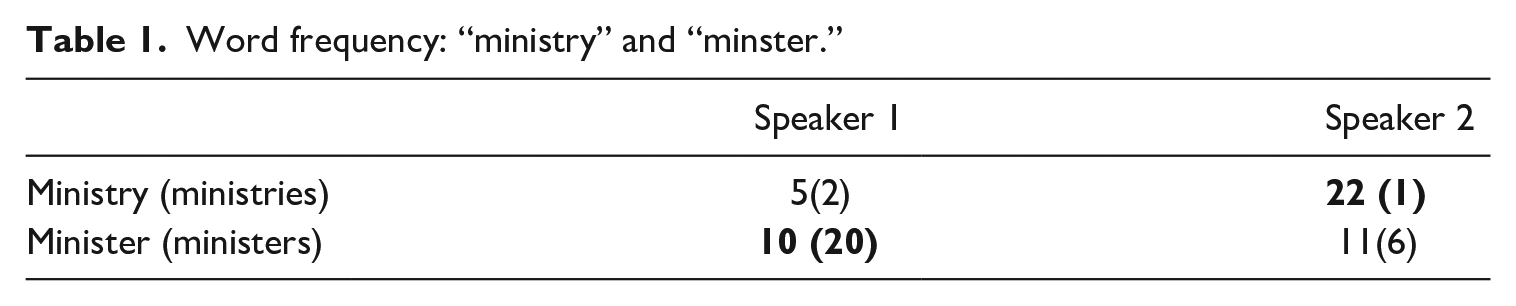
Examining the different usage of “ministry” and “minister” by the two speakers reveals their differing stances about women’s role in the church and an inherent dilemma in the debate. As Table 1 shows, Speaker 1 uses “minister(s)” far more than “ministry,” whereas Speaker 2’s usage shows the opposite pattern. Speaker 1 focuses on minister(s) as a personal noun, and Speaker 2 focuses on ministry as an abstract noun denoting function, and these different emphases lead to different foci; whereas Speaker 1 focuses on the qualifications of a minister, Speaker 2 emphasizes the importance of the women’s involvement in ministry.
Word frequency: “ministry” and “minster.”
Example usage of “ministry.”
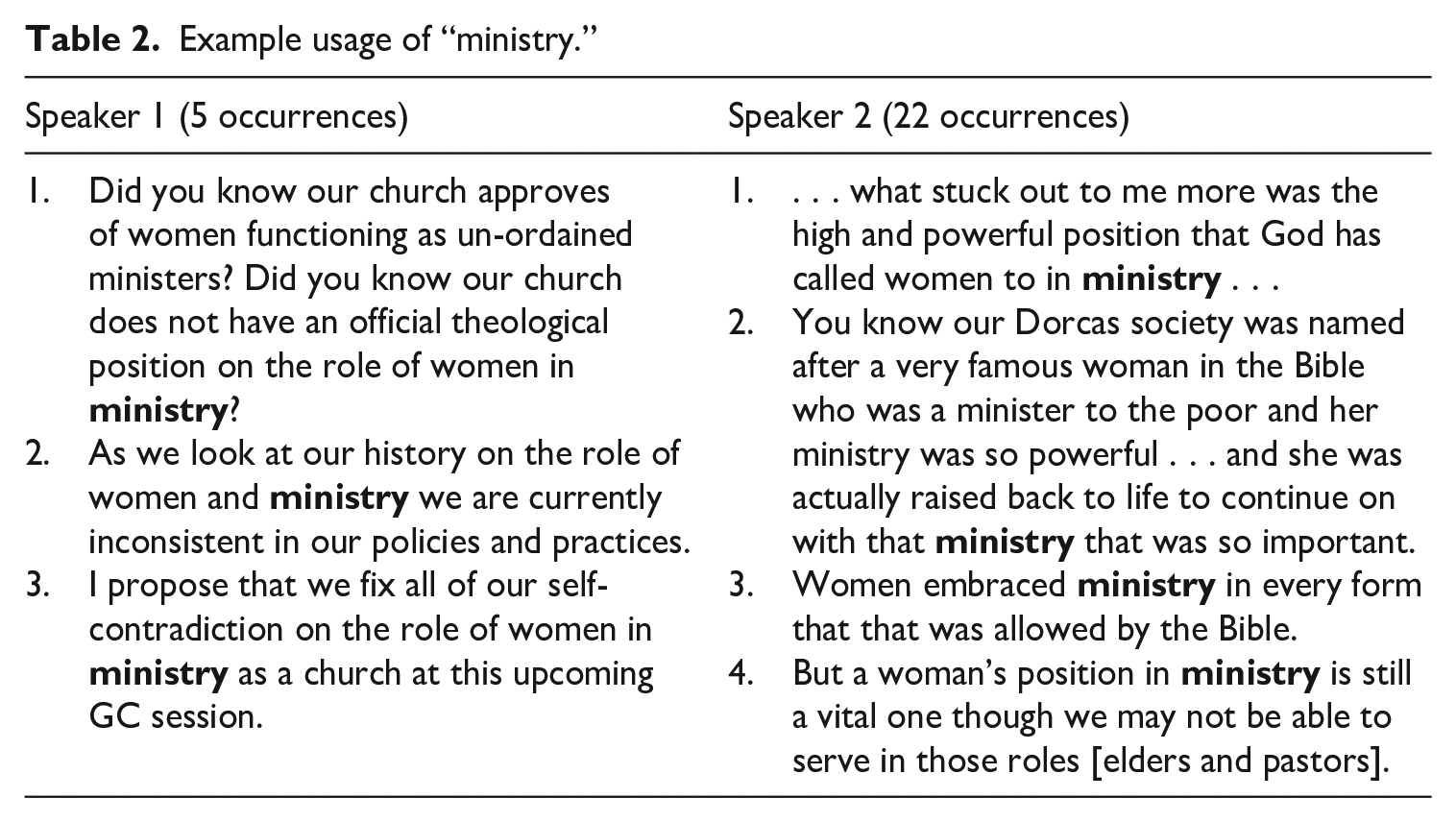
As shown in Table 2, “Speaker 1” uses “ministry” as part of the phrase “the role of women in ministry,” and the phrase collocates with words such as “position,” “history,” and “self-contradiction,” indicating that women’s involvement in ministry has political implications. As shown in the third example in Table 2, she calls for annulling the existing practice which allows women to participate in unordained ministry as pastors, associate pastors, and elders and asks the audience to make a request at the upcoming General Conference meeting to officially designate ministry—both ordained and unordained—which has the overseeing function, only to men. She says (emphasis added), It is unbiblical to have women ordained or functioning as ministers and elders. Therefore, it is very concerning to me to find out that our church allows for women to function as ordained local elders and unordained ministers. So where is the missing link? It went from a request for further study in 1974 to ordaining women to be elders and to be in ministerial roles.
The second excerpt above concerns what she perceives as an unfair, improper process in instituting a church policy several decades ago, which allowed women to be ordained elders and to assume other ministerial roles such as pastors and associate pastors. She demands that the church reverse this decision by barring women from being ordained elders and being involved in performing other ministerial roles that act as the overseer of the church. Her view reflects her strong conviction of total submission to men’s authority as shown in the previous section, whereby she urges a strict adherence to the policy that prohibits women in all positions of leadership. She decries self-contradictions within the church whereby the church allows women to perform ministerial roles while it does not ordain them (emphasis added): We have a self-contradiction in our church which needs to be fixed. In policy and practice, we ordain women as local church elders and then allow them to serve as unordained ministers. But then, we do not allow women to be ordained ministers . . . So if we want to stop being inconsistent, if we want to stop being a self-contradiction as a church, we need to vote to not let divisions go their own way on ordaining women ministers, and undo all previous decisions, which were unbiblical, hasty, uninformed, made with poor world representation and in the wrong setting . . . I propose that we fix all of our self-contradiction on the role of women in ministry as a church at this upcoming GC session.
For her, the proper way to fix this self-contradiction is to allow only men to take leadership roles and remove women from leadership positions they currently hold. She denounces the decision made at the 1975 General Conference meeting, which stated, “where biblical instructors or other women with suitable qualifications and experience are able to fill ministerial roles, they be assigned as assistant pastors.” For her, “having women in the role of elder—whether ordained or even unordained—is unbiblical.” While she is focused on defending male headship as ordained “ministers,” her usage of the term “ministry” does not include many essential roles that women play in ministry, which is in stark contrast with Speaker 2, who promotes women’s active involvement in ministry.
Speaker 2 repeatedly uses the term “ministry” as she encourages women to take an active role in various ministerial roles. Whereas Speaker 1 is against both ordained and unordained ministry as elders, pastors, and associate pastors as mentioned above, Speaker 2 promotes women’s active participation in unordained ministry, considering “ministry” in a broad sense including service to church, community, and family. She devotes much of her speech to naming various women mentioned in the Bible who played active roles, including Junia, Phoebe, and Priscilla. While emphasizing that these women were helpers, not ministers, Speaker 2 reiterates the significance of women’s work in the church and the community, which she treats as unordained ministerial roles. She also lists various roles that women in the Bible played, such as queens, land owners, maids, midwives, nannies, judges, business owners, event coordinators, city builders, financial supporters, helpers to the poor, teachers, and prophets, using these as examples of a wide range of work women can do. Furthermore, she promotes women’s involvement in ministry as gospel laborers and says that although women cannot be ordained ministers, they have been assigned to a special role as gospel laborers, emphasizing the notion of female privilege: The only roles, ladies, that he has withheld from us are that of an ordained minister or elder or deacon, and he has given women roles that only we can fill—that of a wife, that of a mother, and that special role of being a gospel laborer and helping other women specifically in our church . . .
By entitling women who engage in ministry as gospel laborers in the above excerpt, Speaker 2 tries to create a sense that a real, equally valid ministerial position exists for women. She makes a direct appeal to women to be involved in ministry: He calls upon them to go out into the harvest field and help gather in the sheaves. God is calling you ladies!
An inherent dilemma here is that those who take roles as described by Speaker 2—gospel laborers, Bible workers, Bible readers, teachers, and prophets—are undoubtedly part and parcel of “ministry,” as they “minister” to different groups of people in different, important capacities, as indicated in the second excerpt in Table 2. The boundary between ordained ministry and various other ministerial roles she encourages women to take is an illusory one, serving the purpose of preserving the power structure rather than defining functions. Denying women the title of “minister,” in order to maintain a hierarchical structure as suggested by Speaker 1, while they are “ministering” in different areas of “ministry” in these different roles, is an unjust and exploitive practice. Also, it further exacerbates inconsistencies that Speaker 1 decried.
Undergirding these inconsistencies are faulty reasoning and a monolithic view of how gender identity should be actualized, as discussed in the following section.
Headship
The notion of headship is typically at the center of women’s ordination debates. Table 3 shows a contrasting pattern in the usage of “head” and “headship” between the two speakers. Speaker 1 refers to the notion of head seven times as frequently as Speaker 2. In fact, Speaker 2 refers to the word “head” only three times, and all of them are mentioned while she quotes author J.H. Wagner. Because of the low usage of the term and relative insignificance of the notion of head in the second speech, the following discussion focuses on the use of the terms by the first speaker.
Use of “head” and “headship.”

A more frequent usage of the word “head” by Speaker 1 aligns with her emphasis on men’s unique qualifications to be leaders. As she reiterates the importance of recognizing men as heads, she presents central qualities of being head as being hegemonic. She recounts how she came to a realization that she was usurping her husband’s authority as she corrected her husband, when he complained about her mannerism: He shared it was the way I expressed myself to him—commanding, talking as if I’m the authority, getting excited, and impatient when correcting him.
She says that when expressing themselves to their husbands, women should do so by “mak[ing] requests instead of commands, asking instead of directing” because “these things make a huge difference.”
In these statements, she defines women’s acceptance of and compliance with man’s headship authority in terms of communication styles or bargaining strategies (“which make a huge difference”) by posing fluid, context-driven characteristics such as excitability, impatience, commanding, and directing as binary concepts to recognizing authority. In the same vein, she describes women who command and direct, instead of “ask,” as playing the role of head, conceptualizing headship as being in a driver seat issuing directives. Her underlying assumption is that femininity and headship exist only in the singular and that there are clearly identifiable distinctions between qualities such as assertiveness, confidence, coerciveness, and control, as well as between asking and directing. While she perceives headship as having a permanent, fixed, unidirectional quality, she sets the boundaries of headship on unpredictable, fluid, permeable, and context-driven elements.
Then, she mentions a couple she knows as an example of a dysfunctional couple dynamic: My husband and I have someone very dear to us, whose wife speaks to him very disrespectfully. It is painful and so uncomfortable to be around them because of the way she almost constantly commands him and shames him.
The wife’s behaviors described in the statement—speaking disrespectfully, constantly commanding, and shaming—are undesirable qualities for anyone regardless of gender. Here, the speaker conflates what could be character or emotional issues with qualities of women who dominate or lead. She associates perceived traits such as offensiveness and nastiness as opposite concepts to submission and femininity, thereby implying that women who lead are disrespectful and vile. In the following statement, she continues to make flawed associations between women who are assertive and those who are nagging, as she tells women not to assume superiority when correcting their husbands (emphasis added): No one is perfect. Husband makes a mistake, the wife sees the solution. The motherly inclination kicks in to correct and improve things. She corrects. But when done in a motherly way, the husband feels nagged, henpecked, and disrespected.
Perceptions such as being henpecked, nagged, and disrespected cannot always be objectified, because how a spouse’s behaviors are perceived by the partner is interlinked with complex couple dynamics which hinge upon various factors, including the couple’s history, emotional states, personality, and situational contexts, among others. Furthermore, the speaker’s assumption that man’s feelings are an adequate guide to determine whether or not a wife is treating him with respect or treating him as head is untenable. She continues to make a sweeping generalization that women who lead are unruly, and that deep down they harbor a desire to be ruled by men: Something many men find might find surprising is in most cases unruly women actually want to be tamed.
She presents couple dynamics in a zero-sum game context without recognizing the complex, varying dynamics of couples. There is a wide literature which examines how couples come to decision-making and do gender within households. 16 Just as power is multidimensional, 17 and gender is “an ongoing emergent constructs of social interaction,” 18 how couples negotiate their roles widely varies. 19 Research has shown that contemporary gender roles are characterized by interchangeability and flexibility, 20 and modern males tend to exercise less control. 21 Clearly, most couples negotiate how they assume different roles and come to decision-making based on their unique circumstances. The speaker adopts a unitary and flawed notion of headship and ignores the polysemy involved in the word and “different forms of agency in men” 22 and women.
Conclusion
This study sought to shed light on why some Christian women actively promote religious views that denigrate their own gender and how they reconcile inequality perpetuated by their religious position. For Speaker 1, gender hierarchy is as immutable as God’s authority, and submission to God and submission to men go hand in hand. What is at stake in the issue of women’s ordination is the toppling of the entire system of religious beliefs she holds. Homosexuality; going to church on Sunday instead of Saturday; challenging the idea that the earth was created in 6 days; and ordaining women to be ministers and elders—these are abominable heresies for her. She claims allowing women in ordained church leadership positions will cause all the other heresies to infiltrate the church.
On the other hand, Speaker 2 operates on the elusive notion of female privilege resorting to a false sense of entitlement. While she actively promotes women’s active involvement in ministry, she dismisses the issue of gender equality by emphasizing “doing ministry” without “being a minister.” Differing arguments put forth by the two speakers based on different foci—the religious ideology of “being” represented by Speaker 1 through the emphasis on “minister,” versus that of “doing” promoted by Speaker 2 through the focus on “ministry”—only increase inconsistencies. Speaker 1 denounces and perpetuates injustice under the guise of being “biblical.” The exclusive focus on who can “be” a minister, not who can “do” ministry, reduces the church to a hierarchical and authoritarian entity.
The findings of this study may have confirmed what has already been intuitively known by many. That is, despite appearances of solidarity, those who oppose women’s ordination are not united in how they view women’s role in the church and how they interpret and apply headship theology. Arguments on women’s ordination that hinge on a monolithic, fixed notion of head as a religious symbol are not sustainable, and any discussion of headship that does not consider various ways in which headship is operationalized is merely ideological, detached from reality. While a traditional view of headship does not take into consideration the agency of men in how they order gendered reality, the meanings of headship and masculinity in our day are multivariate; therefore, a satisfactory account of headship must take into consideration these multiple representations and practices. As Van Klinken stated, “the primary task of scholarship in religion and gender is to critically analyze in a detailed and nuanced way the complex processes in which gender is (re)produced in religious contexts.” 23
Although the perspectives of these two women cannot be seen as representing a broad range of perspectives of other women who oppose women’s ordination, the insights gained from this study can be useful for future researchers as they try to identify common discursive strategies, as well as inconsistencies which require a resolution in order to make the line of reasoning coherent, if not compelling. Further studies that comparatively analyze differing perspectives and experiences of women who represent diverse backgrounds, cultures, and denominations are needed in order to uncover flawed, shaky foundations, based on which some women champion unfair treatment of their own gender.
Footnotes
Acknowledgements
I would like to thank my colleague Gary Gray for his helpful comments on the earlier draft of this paper. His comments helped me to make more nuanced, accurate, and forcible statements in several places.
Funding
The author(s) received no financial support for the research, authorship, and/or publication of this article.
1.
For example, 1 Tim. 2.12, “I do not permit a woman to teach or to assume authority over a man; she must be quiet” (New International Version) and Eph. 5.22–24, “Wives, submit yourselves to your own husbands as you do to the Lord. For the husband is the head of the wife as Christ is the head of the church, his body, of which he is the Savior. Now as the church submits to Christ, so also wives should submit to their husbands in everything” (NIV). All biblical quotes are taken from the NIV.
2.
3.
4.
Julia Kim E-Y (2017) A comparative discourse analysis of the Seventh-day Adventist Theological Seminary’s statement “On the Unique Headship of Christ” and the response statement “An Open Appeal.” Andrews University Seminary Studies 55(1): 45–82.
5.
For example, Wijsen F (2013) Editorial: discourse analysis in religious studies. Religion 43(1): 1–3.
6.
Garner M (2007) Preaching as a communicative event: a discourse analysis of sermons by Robert Rollock (1555-99). Reformation and Renaissance Review 9: 45–70; Singh PKH and Thuraisingam T (2011) Language for reconciliation in religious discourse: a critical discourse analysis of contradictions in sermons explored through the activity theory framework. Multilingua: Journal of Cross-Cultural and Interlanguage Communication 30(3–4): 391–404.
7.
See Chilton P and Schaffner C (1997) Discourse and politics. In: van Dijk TA (ed.) Discourse as Social Interaction. London: SAGE, 206–230; see also, Fairclough N (1989) Language and Power. London: Longman.
8.
The author did not attend the conference and is not acquainted with the speakers. Their speeches were accessed through the official website of Secrets Unsealed. The author also acknowledges that her analysis and interpretation in this paper inevitably reflect her feminist perspective.
11.
Speaker 1 describes herself as a lay church member, and Speaker 2 introduces herself as a nurse. It appears, based on the conference flyer, that Speaker 2’s husband is a pastor, who also gave a speech at the same conference. In terms of their age, although they appear to be Generation X based on the author’s uninformed guess, it is not possible to confirm it.
12.
The strategies that I discuss in the article are what I have inferred by synthesizing various statements made by the speakers. I do not suggest that these strategies were purposely created by the speakers for the purpose of reframing the issue of women’s ordination.
13.
White EG (1903) Education. Oakland, CA: Pacific Press Publishing Co., 48. White EG is considered one of the main founders of the SDA church. Traditional members of the church hold the belief that she was a prophetess and messenger of God who was chosen to deliver special messages for the end times. It is suggested that this particular passage was borrowed from an article entitled “Sold Cheap,” Junction City [Kansas] Weekly Union, 2 June 1866, 1, see  (accessed 7 May 2020). My attention was drawn to this by Denis Fortin, professor of historical theology at the Seventh Day Adventist Theological Seminary, Andrews University, Berrien Springs, MI, in an email exchange with a colleague on this topic, 30 May 2018.
14.
Godwin DD and Scanzoni J (1989) Couple consensus during marital joint decision-making: a context, process, outcome model. Journal of Marriage and the Family 51: 943–957, especially 948.
15.
See Motion J and Leitch SR (2007) A toolbox for public relations: the oeuvre of Michel Foucault. Public Relations Review 33(1): 263–268.
16.
Blood RO and Wolfe DM (1960) Husbands & Wives: The Dynamics of Married Living. Glencoe, IL: Free Press; Godwin DD and Scanzoni J (1989) Couple decision-making: commonalities and differences across issues and spouses. Journal of Family Issues 10: 291–310; Spiro RL (1983) Persuasion in family decision-making. Journal of Consumer Research 9(4): 393–402; Chesley N (2011) Stay-at-home fathers and breadwinning mothers: gender, couple dynamics, and social change. Gender & Society 25(5): 642–664.
17.
Olson D, Cromwell RE and Klein DM (1975) Beyond family power. In: Cromwell RE and Olson D (eds) Power in Families. New York: Wiley, 235–240.
18.
Deutsch FM (2007) Undoing gender. Gender & Society 21: 106–127, especially 107.
19.
For instance, a study of 188 US married couples in decision-making showed that “the more husbands are committed to their wives and the marital relationship, the more control their wives possess.” See Godwin DD and Scanzoni J (1989), Couple consensus during marital joint decision-making, especially 954.
20.
Raush HL (1977) Orientations to the close relationship. In: Levinger G and Raush HL (eds) Close Relationships: Perspectives on the Meaning of Intimacy. Amherst: University of Massachusetts Press, 163–188.
21.
Voelz C (1985) Effects of gender role disparity on couples’ decision-making processes. Journal of Personality and Social Psychology 49: 1532–1540.
22.
Van Klinken AS (2011) Male headship as male agency: an alternative understanding of a “patriarchal” African Pentecostal discourse on masculinity. Religion and Gender 1(1): 104–124, especially 124.
23.
Van Klinken AS (2011) Male headship as male agency, especially 122.