



Abstract
Since the beginning of the 1990s, there has been growing academic interest in the speech act of apology. Both the nature of apologetic communicative processes and the potential of apologies to promote reconciliation remain, however, under debate. The aim of this article is to map common types of rituals found in what is termed ‘the age of apology’, to identify the processual and structural characteristics of these rituals, and to understand their contribution to restoring relations in the global arena. The analysis yields three types of rituals of apology: purification – that is, asymmetrical rituals in which the offender issues an apology in order to purify his or her dismal past but does not necessarily need the approval of an offended party; humiliation – that is, asymmetrical rituals in which the offended party forces the offender to participate in a degradation ritual as a condition for closure; and settlement – that is, symmetrical rituals in which both sides strive to restore relations. The theoretical and practical implications of these rituals are discussed.
Introduction
Over the last twenty years, a growing number of public apologies and expressions of regret have been issued by state leaders, governments, and religious organizations to communities they have wronged. The frequency of such actions in the international arena has led some scholars to term these decades the ‘age of apology’ (Brooks, 1999; Gibney et al., 2008; Lind, 2008; Nobles, 2008; Kampf, 2009a; Löwenheim, 2009) and has led to a debate about the efficacy of apologies in bringing about closure to troubling conflicts. The continued realization of apologies, however, shows that political actors attribute importance to them as a tool for helping to resolve both major and minor conflicts.
In contrast to the intuitive perception according to which the term ‘the age of apology’ would seem to refer only to moral and historical apologies for grave wrongs, the most recent literature suggests that the genre of public apology has evolved and spread to other areas of social and political misconduct (see, for example, Bilder, 2008; Cohen, 2004; Kampf, 2009b). These include apologies for severe short-term transgressions (such as those following ‘collateral damage’) and apologies for mid-range transgressions of societal or diplomatic norms. The process of public apologies that developed and expanded over time, across political arenas, and in relation to a range of ethical concerns, can be understood against the backdrop of the rhetorical approach to globalization (Fairclough, 2006; Hay and Rosamond, 2002). According to this view, representative apologies have been adopted as a type of discourse of globalization that widens the repertoire of rhetorical resources available for contemporary political figures.
Although there are many studies in the field of apologia dealing with apologies as rhetorical means for restoring damaged images of political leaders or commercial organizations (Blaney and Benoit, 2001; Benoit, 1995; Hearit, 2006), only a few discuss the characteristics of representative apologies and the new questions that this rhetorical genre raises (Edwards, 2008, 2010). One major issue that still awaits further theoretical and empirical exploration concerns the ways by which apologies in the global arena are presumed to contribute to reconciliation (Nobles, 2008; Thompson, 2008). Research on public apologies presupposes that they have a moral core; hence it tends to concentrate on the positive contribution of apologies to reconciliation. It is not surprising, therefore, that most research on public apologies is contextualized into the literature of transitional justice (Andrieu, 2009; De Grieff, 2008; Teitel, 2000), asserting that, coupled with other measures of transitional justice, apologies may be a powerful tool aiding societies to confront past wrongs and achieve reconciliation (Andrieu, 2009, 2010; Renner, 2010). In recent years, however, scholars have challenged this presupposition, according to which apologies will always promote reconciliation, providing examples of the conditions under which the reconciliatory speech act may fail (James, 2008; Lind, 2008; Renner, 2010). Focus on infelicitous apologies and their effects constitutes an initial step toward a holistic understanding of the actual role of apologies in reconciliation processes; it incorporates into the analysis of apologies the European philosophical understanding of both failure and success as an integral part of speech act theory (Derrida, 1977). The aim of this article is to further develop this line of thought by focusing on the instrumentalization of apologies in the global arena. Drawing on grounded and detailed analysis of the practical usage of apologies by leaders and governments, our aim is threefold: (1) to map common types of apologies found in what is termed ‘the age of apology’; (2) to identify the processual and structural characteristics of these apologies; and (3) to understand the contribution of such apologies to reconciliation processes in the global arena.
As the ‘age of apology’ consists of different types of mediatory processes, we expand the framework of reconciliation by adopting a utilitarian perspective on apologies. On the basis of an analysis of apologetic gestures made or received by Israel in the last two decades, 1 we identify three prototypes of rituals of apologies: purification, humiliation, and settlement. We then pinpoint which of these rituals contains the communicative components needed to realize the appeasing potential of apologies (the utilitarian goal of restoring equilibrium) and/or the reconciliatory potential of apologies (the moralistic character of the ritual). If the role of an apology is to settle a conflict, we point to the places where it may successfully realize its appeasing power, 2 or where, alternatively, it is doomed to fail.
Israel may serve as a case study for examining the global interactive characteristics of apologies since it has played a pivotal role in this growing global practice, both as ‘offended’ and as ‘offender’ vis-à-vis other international political actors. Like other nations in Asia, Africa, and the Americas, Israel has been an addressee of historical apologies, mainly from European states for their actions during World War II. For example, in 1994, Austria apologized to Israel for its part in the Holocaust, as did Lithuania in 1995, Croatia in 1997, Latvia in 1998, and Switzerland in 1999. At the same time, since the initiation of the Oslo Accords (1993), Israel has been urged to take on the role of the apologizer and acknowledge its responsibility for the suffering of the Palestinians. 3
In what follows, we characterize the structure of political processes resulting in apologies. These processes resemble the successive opening of a Russian doll: from the broader social drama, through a ritual of apology that reaches its peak in the realization of a speech act. Our focus in this article is on the moment of apology, termed here a ritual of apology. We have selected one representative case to illustrate each type of ritual: purification, humiliation, and settlement. This will allow us to identify the weak and strong spots in these political rituals in order to understand the role of apologies in bringing about reconciliation.
Political processes resulting in rituals of apology
We adopt Victor Turner’s (1957) theory of ‘social drama’ in order to understand the processual form of conflicts settled by apologies. According to Turner, social dramas begin with the breach stage, an act that is identified as the transgression of a norm or value in the crisis stage, when one of the participants – the direct victim, his or her representative, or a third party like the media – frames it as an offense. In the crisis stage, the participants are divided into those who condemn the offender by demanding restitution in the form of an apology, and those who support the offender by encouraging him or her to refuse such a demand. The transgression may also be identified in the redress stage by the offender through the realization of an apology that indicates its occurrence. Following the redress stage, several options for continuance or closure of the drama are possible: The process can regress to the crisis stage, when the first-order transgression is perceived as unforgivable, or it can develop into a second crisis stage, in which the apology itself becomes an object of controversy (such as cases in which the apology is perceived as insincere). Other options include the exclusion of the transgressor from the social structure or recognition of the presence of an unsolvable social tension. Alternatively, there may be a reintegration of the transgressor into the social structure and resolution, marking the end of the process and realizing the function of the apology as a tool for restoring equilibrium (Kampf, 2011).
At the center of the process – that is, the redress stage – stands an apology, perceived in the literature as a speech act located at a critical point in an evolving conflict (Goffman, 1971; Tavuchis, 1991). According to Austin (1962), speech acts entail communicative intentions, linguistically manifested in context. Expressions such as ‘I apologize’ cannot be verified in terms of their truth value, as they are realized in order to do things in the world – that is, to change the social world of the involved parties. An apology, for example, if it meets certain conditions that render it felicitous (the speaker believes his or her speech act is not necessarily in his or her own interest, regrets the deeds for which he or she is apologizing, and expresses his or her regret by using an appropriate formulation of words), changes the social worlds of both the offended and the offender in terms of the participants’ relative status and future relationship (Lakoff, 2000). As mentioned above, speech act theory attracted criticism both from European philosophers who questioned the felicitousness – or rather the success – of a speech act as the ruling paradigm (Derrida, 1977), and from linguists who criticized the monological nature of the theory (Linell, 1998). Later developments address these critiques, emphasizing the dialogic nature of discourse. The ‘pragmatic discourse’ approach, adopted here, treats speech acts as actions embedded within a communicative process of meaning-making (Blum-Kulka and Hamo, 2011).
The understanding of apologies as a communicative process draws attention to a transgression made in the past by an offender who regrets his or her deed and acknowledges responsibility for its consequences in the present (Olshtain, 1989; De Grieff, 2008). If the apology meets the expectation of the offended party, the transgressor will be granted forgiveness, leading to his or her reinclusion into the social structure.
The literature shows that there are several ways in which an apology can be issued – ranging from general sorrow as appeasing gesture to significant requests for forgiveness – and therefore various meanings that an apology may have (Lakoff, 2000). The basic requirements for an apology to be accepted as a moral act are a sincere regret and an acknowledgment of responsibility (De Grieff, 2008; Tavuchis, 1991). However, apologies are often realized and evaluated as utilitarian, even opportunistic acts (Kampf, 2009b; Löwenheim, 2009), in line with Derrida’s critique. In such cases, the level of sincerity apparent in an apologetic utterance is often a matter for negotiation between the apologizer and the offended party (Harris et al., 2006; Olshtain, 1989). The interpretation of the meaning of an apology depends on the context of its realization, including its timing and the offended party’s perception of both the offense and the offender. The apologizer’s interests (how much responsibility to take, whether material restitution should follow the symbolic act, the impact on reputation, etc.) and the addressee’s interpretation (is the act forgivable? is the apologizer sincere? etc.) may lead to different forms of rituals of apologies and thereby to different consequences.
The moment of apology may be understood as a ritual, in that it contains a set of repetitive patterns. 4 Ritualistic patterns related to apologies were noted early on in research focusing on religious or tribal rituals such as the Middle Eastern sulha (see Jabbour, 1993; Liebes, 1984), Japanese interactional rituals (Ide, 1998), and approaches to restorative or transitional justice (Bennett, 2008; Teitel, 2000). Patterns include fixed social roles for the participants as ‘offender’ and ‘offended’ parties, and, as part of the collective dimension of apology, an important role is also assigned to the audiences (Dayan and Katz, 1992), understood here to refer to members of each party’s group. As we demonstrate below, audiences may be moved emotionally toward confrontation (in purification and humiliation rituals) or compromise (in settlement ritual) via a staged performance of apology. Other ritualistic patterns of apologies include a speech act or gesture, reflecting and reconstructing political perceptions and relationships. The elements of rituals – the vividness of the symbolic gestures and the emotional response to these symbols – play a key role in what makes a ritual effective (Falk-Moore and Myerhoff, 1977a; Kertzer, 1988). Lastly, ritual has a formal quality, as it ‘follows highly structured, standardized sequences and is often enacted at certain places and times that are themselves endowed with special symbolic meaning’ (Kertzer, 1988: 9). These features construct rituals and ceremonies as dramatic occasions, complex types of standardized symbolic behavior that structure and present particular interpretations of social reality in a way that endows them with legitimacy.
Rituals are widely found in politics because they have the power to integrate and reconstruct a national community around extraordinary events. It might seem problematic to apply the concept of ritual to the more heterogeneous and less norm-governed global arena. However, interestingly, studies in communication, especially in regard to diplomacy (e.g. Cohen, 1997; Jönnson and Hall, 2003) show how rituals can integrate communities in the global arena as well. Dayan and Katz (1992), for example, demonstrate how media events – especially the subgenre of ‘conquests’ (e.g. Anwar Sadat’s visit to Israel or the first moon landing) – may work to connect enemy nations or even to unite the global community by focusing attention, via mass media, on major advances to humanity at large. However, as we learn from work in anthropology, rituals may be used not only to calm, but also to incite political conflict: rituals help to define the terms of ‘us’ and ‘them’, friends and foes, and serve as an arena where political competitors struggle for power (Kertzer, 1988: 128). This means that alongside the integrating power of ritual is its potential to magnify divisions between communities (Yadgar, 2003). Consequently, any application of the concept of ritual to interactions in the global arena must include an analysis of their integrating or disintegrating effects on the direct participants. In this article, we show how specific rituals of apology in the global arena achieve settlement, while others work toward division.
In the next section, we rely upon the processual form of social dramas in order to show what happens to the apologizer–addressee relationship at the moment of apology. This moment, defined here as a ritual of apology, has two modes: moral and utilitarian. As political apologies are always suspected of insincerity, we focus on the utilitarian model of apology rituals. We analyze the practical objectives that are communicatively manifested, in the discursive process of apology and within the ritual, in the form of (1) the apologizer’s reasons for realizing an apology; (2) the mode of the interaction taking place between the offender and the offended parties; and (3) the significance of the offended party’s response to the apology. This analysis will allow us to understand the benefits that one or both sides intend to achieve through the ritual, and as a result the possibility that the apology will restore equilibrium to unbalanced relations, and thereby potentially promote reconciliation, with different degrees of ‘thickness’ (De Grieff, 2008: 127). We demonstrate each prototypic ritual through cases in which Israel was involved as an offender or offended party: the apology of the Holy See to Israel/Jews in 2000 (purification ritual); the apology issued by Israel to Turkey in January 2010 (humiliation ritual); West Germany’s first apology to Israel in 1951; King Hussein’s apology to Israel in 1998; and the suggestion made in 1999 for an exchange of apologies between Israel an the Palestinian Authority (settlement ritual).
Achieving equilibrium through rituals of apology
Apology rituals can be understood through a see-saw model (see Figure 1). At the pre-transgression stage, we find a state of equilibrium, a stable condition characterized by indifference or by positive relations between states or other international actors. In offending a political actor, the offender positions him- or herself as superior to his or her victim: the offender may derive material benefits from his or her act at the expense of the offended.
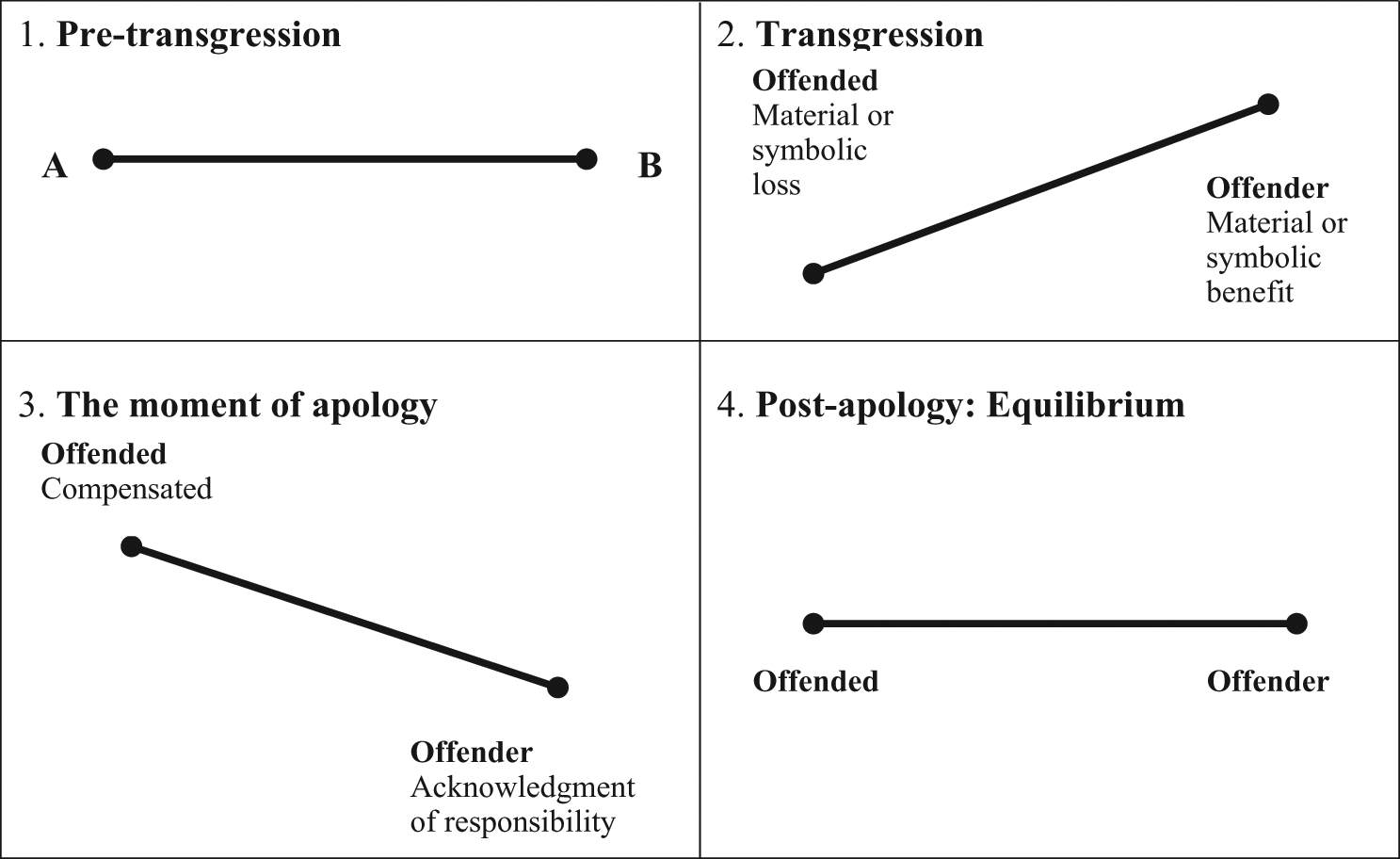
A utilitarian model of rituals of apology
On the verge of an apology ritual, the direct participants are in a state of imbalance (Leech, 1983; Tavuchis, 1991). During the ritual, the offender performs a reparative, corrective act – the apology – thus positioning him- or herself, symbolically and temporarily, as inferior to the victim. As a result, at the end of the ritual the offender restores balance by an exchange of non-balancing acts; thus, while the transgression diverts the relationship to one side, the apology is aimed at diverting it to the other, to restore equilibrium between participants. Overall, the apology ritual acts to channel political tensions into harmless directions (Kertzer, 1988: 128).
Participants within a ritual of apology construct artificial conditions of ‘positive imbalance’ (the act of apology) in order to amend a previous condition of ‘negative imbalance’ (immoral/unsocial act). This means that failing to set the conditions for a ‘positive imbalance’ by expressing an infelicitous apology not only sustains the former ‘negative imbalanced’ state of affairs, but also creates a new, second-order ‘negative imbalance’, in which the second-order transgression is the failure or refusal to issue a satisfactory apology.
The above description allows us to pinpoint those actions of participants that hinder the appeasing potential of apologies. It should be noted that the titles of the subsections that follow are formulated from the perspective of the offender – the offender is purified or humiliated – and that they reflect the state of affairs at the end of the ritual. This focus stems from our emphasis on the act of apology, which, by definition, is performed by the offender. In addition, the following descriptions shed light on the utilitarian character of the rituals, which can be used as a way to master the ritual (in purification) or as a weapon (in humiliation) in a continuing symbolic struggle (Yadgar, 2003).
Purification rituals
The aim of purification rituals is to deal with the notorious past of a transgressor who has committed a serious offence, and to allow the transgressor to purify him- or herself from this problematic past behavior by creating a new, positive self-image (see Figure 2). The goal is to create an appearance of a moral act and an image of a moral agent. The most significant characteristic of such rituals is their unilateral nature: the transgressor apologizes without necessarily taking into consideration whether the offended has agreed to participate in the ritual or whether the offended party needs or wishes for a specific formulation of apology, specific settings, etc. The act is carried out voluntarily (in line with the transgressor’s interest in making the apology), but, paradoxically, the direct offended’s response to the apology is not a necessity for the success of the ritual from the offender’s point of view. It is important to note that since the victims do not usually speak as a single voice, contrasting responses to an act of apology are not unusual. Acts that are perceived as sincere and spontaneous (such as West Germany’s Chancellor Willy Brandt kneeling at the Warsaw Memorial in 1970) are highly appreciated and admired. However, such a response seems the exception. As a unilateral act, purifying rituals more often lead to dissatisfaction on the part of the victim (Edwards, 2008), reinforcing feelings of resentment related to the initial offence. By ignoring the offended party’s desires, the apologizer symbolically positions him- or herself as superior to the victim. As a result, the imbalance that characterizes the participants’ relationship before the ritual is reinforced at the end.
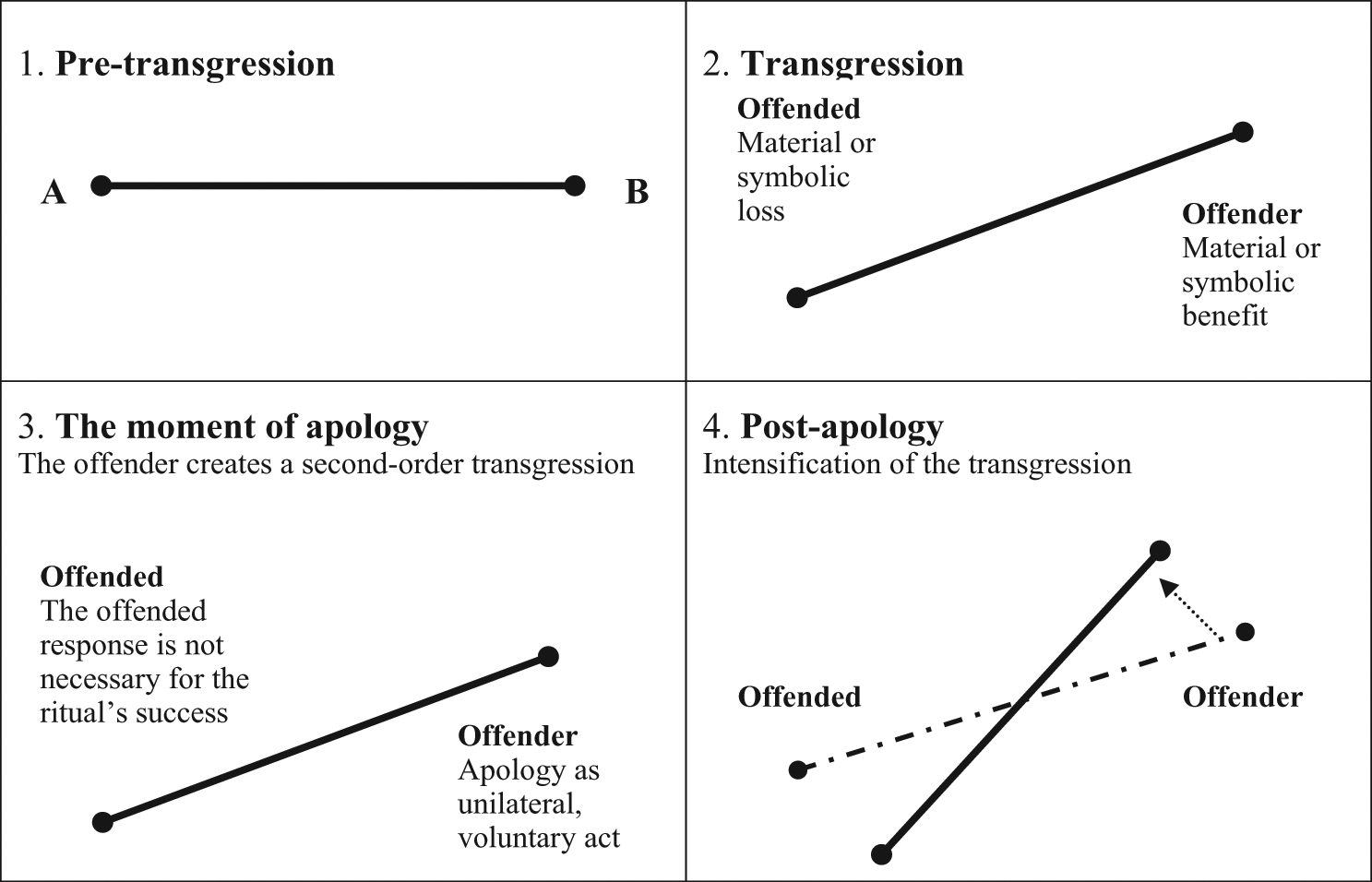
Purification ritual of apology
In most of the cases we have examined, the apologizer in purification rituals is in a position of power 5 and superiority in the international arena. The expression of sorrow (in lieu of apology) by the armies of Israel and the USA following collateral damage during the Second Intifada (2000–5) and in the wars in Afghanistan and Iraq may be seen as purification rituals directed at appeasing the international community, rather than the victims themselves. The moral self-positioning of both states achieved by the denial of intentional killing of civilians contrasts starkly with the justifications of Hamas and Al-Qaeda following terror attacks. Thus, by expressing the expected moral response, the Israeli and US armies exonerate themselves from intentionally transgressing laws of war (Kampf, 2007).
It seems that the paradigmatic case for purification rituals is that of the Roman Catholic Church’s apologies to many groups/communities, including the Jewish people, as part of its preparations for the new millennium in 2000. Each of these apologies was directed not at a human agent, but rather at God: it was God’s forgiveness that was sought, not that of the human victims or their representatives (Bauer, 2008). Therefore, the Holy See’s apologies have failed to fulfil one of the basic conditions of restorative justice, namely, addressing victims’ needs (Zehr and Mika, 1997). Around this issue of the addressee of the apologies and the words used in formulating regret, a scandal erupted when Pope John Paul II conducted a historic week-long pilgrimage to the Holy Land in March 2000. In the light of his ‘millennium apology’, in which the Pope had volunteered expressions of regret for 2000 years of Catholic sins, Jewish organizations and Israeli officials had expected that an official, historic apology would be made to the Jewish people. However, the Pope’s statement at the Western Wall did not meet the felicity conditions for a successful apology ritual. In the note the Pope placed between the stones of the Western Wall, he appealed directly to God:
God of our fathers, you chose Abraham and his descendants to bring your Name to the Nations: we are deeply saddened by the behavior of those who in the course of history have caused these children of yours to suffer and, asking your forgiveness, we wish to commit ourselves to genuine brotherhood with the people of the Covenant (cited in Marrus, 2008: 260).
The expression of this apology can be regarded as a unilateral act. Although the apology was made on the territory of the victims’ representatives, the Pope did not address the victims directly but rather addressed his apology to God, with the objective of purifying the past sins of his believers. A second declaration by the Pope during his visit to Yad Vashem again stopped short of being the hoped-for apology.
The infelicitous statement raised harsh responses from Israeli citizens, journalists, and Jewish organizations. One angry letter to the editorial page of Haaretz (2000) reads:
The headlines announce that the Pope has asked for forgiveness for the Church’s crimes against the Jews. However, a study of the details reveals that the Pope did not ask the forgiveness of the Jews but, and this is also limited, the forgiveness of his God. If we assume that he meant to ask the Jewish people’s forgiveness, I hereby declare that I do not forget and I do not forgive.
Under the title ‘Advice to the Papa’, Haaretz senior columnist Yoel Markus (2000) wrote sarcastically:
Do not forget to take your medicine. Otherwise you may experience amnesia again and when asking forgiveness for the wrongs perpetrated by Christians against Jews you will forget to mention yet again the sin called the Holocaust.
Disappointment was also expressed by representatives of Jewish organizations, who had expected a direct reference to the Holocaust in the Pope’s speech (Sheleg and Shamir, 2000).
Humiliation rituals
Apology rituals may also fail in cases where they transform into (or are constructed as) humiliation rituals (see Figure 3). As argued by several scholars, apology, even if made voluntarily, is to some degree mortifying (Benoit, 1995; Olshtain, 1989). However, in humiliation rituals, found mostly following diplomatic scandals, the humiliating element of apology is foregrounded, as the offended party forces the offender to participate in a degradation ceremony 6 as a condition for ‘settling the score’ (Bilder, 2008). Therefore, humiliating apologies are non-voluntary acts made by an offender who does not perceive himself as having acted wrongly: 7 the offended party demands an apology and sometimes conditions noncompliance with a threat. As a consequence, the offended party uses the ritual of humiliation to transform a former state of affairs, in which he or she is inferior, to a new state of affairs, in which he or she is superior.
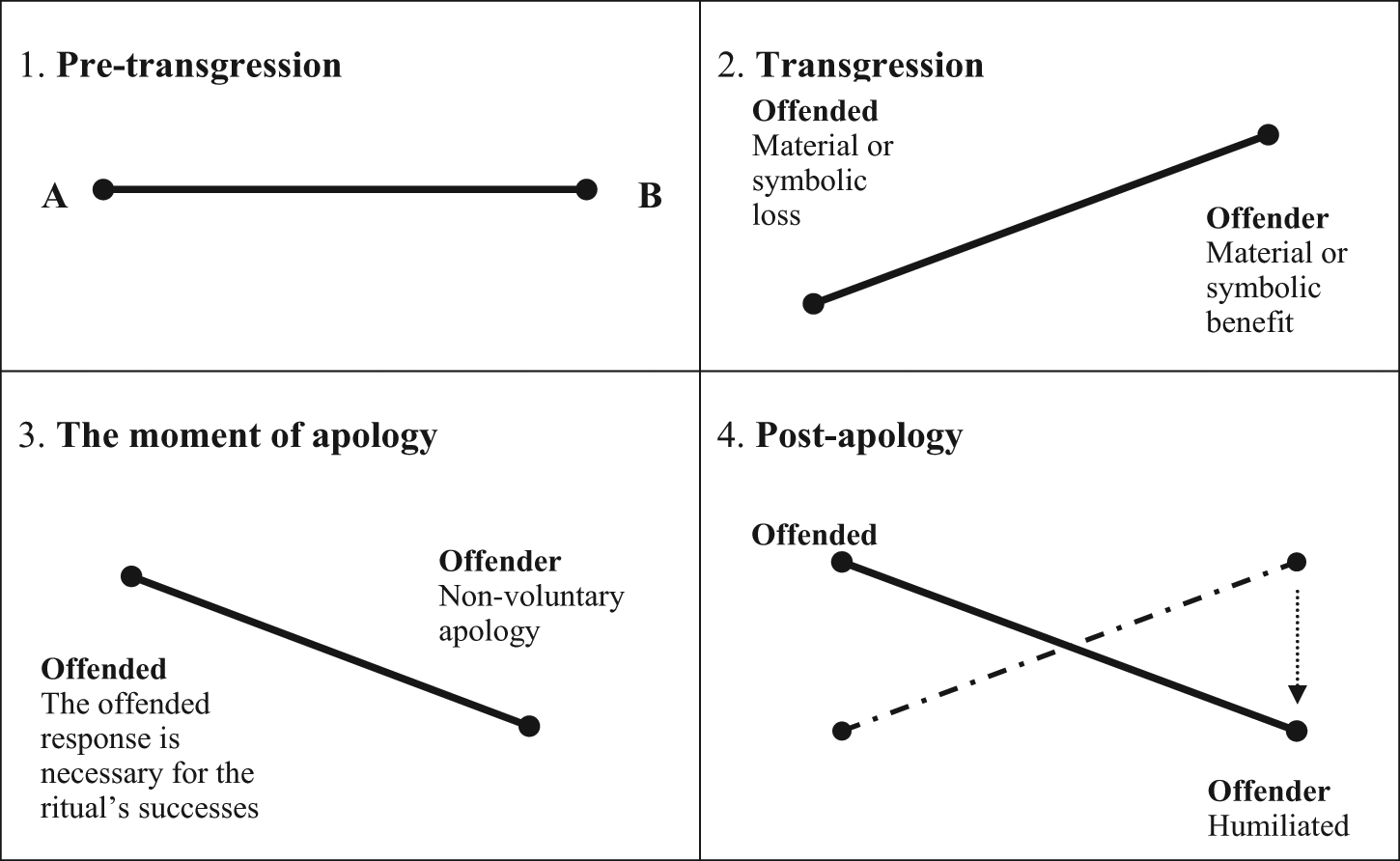
Humiliation ritual of apology
Humiliation rituals are bilateral by nature, although a threat is always pending over their dialogical development: the apology’s formula is negotiated by both sides, and sometimes, when the bargaining is tough, there is agreement on a ‘non-apology’ formulation (Kampf, 2009b; Cohen, 2004). The apology itself is directed to a specific offended party who perceives him- or herself as a victim, and his or her response to the apology is crucial for the ritual’s success from his or her point of view. In many cases, the apologizer is inferior in the local and temporary system of power, 8 because the offended party has the protection and support of a powerful state or can carry out a threat if the offender refuses to apologize: he or she can keep hostages in prison, downgrade diplomatic relations, exercise economic restrictions, etc.
From the apologizer’s point of view, this ritual is humiliating because he or she is forced to issue an apology against his or her will; according to Garfinkel (1956: 420), the public nature of such an act reinforces the humiliation. Even in cases when the apologizer is willing to create a positive closure in words or actions (such as releasing hostages, retaining the former status of diplomatic relations, etc.), and when relations are calm on the surface, there are emotional residues deriving from such rituals of humiliation that can impact future trust and cooperation between the participants.
Among the many infamous examples of such apologies in the international arena are the USA’s apology to China in 2001 for the collision of a US spy plane with a Chinese F-8 fighter plane over the China coast (‘The Hainan Island incident’); Britain’s apology to Iran in 2007 for the 15 British sailors and marines that Iran claimed had entered its waters without permission; and the Swiss apology to Libya for arresting Muammar Gaddafi’s son in 2009.
There are also several examples of humiliation rituals of apology involving Israel in the role of apologizer. Among them are the apology to Cyprus in 1998 for the transgression of Cypriot airspace by the Israeli Air Force; the apology to Switzerland in 1998 following a failed attempt to install spying equipment in the house of a Hezbollah agent in Bern; and the Israeli apology to Canada and New Zealand in 2004 following the arrest of Mossad agents who had used fake national passports of these two countries in New Zealand.
The example of humiliation rituals that is most revealing is the exchange of humiliating acts between Israel and Turkey, which at one point resulted in an apology by Israel’s Deputy Foreign Minister Danny Ayalon to the Turkish ambassador to Israel. The diplomatic crisis between Israel and Turkey began in 2008 with the decision by the Israeli government to launch Operation ‘Cast Lead’ in Gaza. Turkey, which was then serving as mediator between Israel and Syria, was surprised by the Israeli act and demonstrated its dissatisfaction at the Davos Convention in Switzerland in 2009. The relations between the two countries continued to deteriorate when two TV drama series showing soldiers from the Israel Defense Forces committing war crimes aired in Turkey in 2009 and 2010 (Soffer and Edelson, 2010). Following a statement by Turkish Prime Minister Recep Tayyip Erdoğan that accused Israel of stealing water from Lebanon (Soffer, 2010a), the Turkish ambassador was invited to Ayalon’s office, on 11 January 2010, to clarify the Turkish position. Israeli journalists were present at the meeting in order to take photos of the ambassador sitting on a low sofa, with the Israeli flag in front of him. 9 From this point on, a humiliation ritual developed, beginning with Turkish demands for an apology and an explanation for the humiliation of the Turkish ambassador (Rophe-Ofir and Edelson, 2010). Israel, the offended party at the beginning of the crisis, became the offender during the humiliation ritual. In this position, it was forced to issue a non-voluntary apology in order to stabilize relations with Turkey and to respond to the ultimatum issued by Turkish President Abdullah Gül, according to which the Turkish ambassador would be recalled to Turkey for consultations unless an apology was issued immediately. Thus, even though Israel did not perceive itself as an offender, or its act as an offense (but rather as a justifiable reaction to a previous provocation), Danny Ayalon sent an official letter of apology to the Turkish ambassador asserting that it had not been his intention to humiliate him. In response, the Turkish prime minister announced on 13 January 2010 that Turkey had accepted the Israeli apology (Wolf, 2010), and the Turkish ambassador was instructed to remain in Tel Aviv. Thus, the last stage of the humiliation ritual – the offender’s positive response to the apology as a crucial condition for the ritual’s success – was achieved. However, equilibrium did not last for long: tension between the two former allies erupted again a few months later. 10
In both purification and humiliation rituals, the offender is either exonerated or mortified, and the apology turns into a tool in a utilitarian game of power. These results support Kertzer’s (1988: 128) claim that not all rituals that regulate intergroup tensions involve the participation of both of the groups. Many are performed by only one side, which identifies the enemy, pointing to their moral inferiority while glorifying its own group. However, when self-purifying or other-humiliating motives are reduced, the see-saw approaches its balance point and the potential for a settlement or even a reconciliatory, moral apology opens up.
We now turn to the third prototypical ritual in the age of apology: settlement rituals, which best materialize the appeasing and utilitarian function of apology, and perhaps its reconciliatory and moralistic potential as well.
Settlement rituals: Finding the middle ground
Whereas in purification and humiliation rituals the utility is clearly one-sided, in a settlement ritual it is mutual: both sides agree to hold this ritual and both sides benefit from it. The settlement ritual is about finding the middle ground – the point where the interests of the two sides converge (see Figure 1). This attribute contributes to the existence of a mixture of utilitarian and moral aspects, blurring the distinction between them. In a settlement ritual, even if moral objectives were not primary, the existence of moral characteristics cannot be ignored. Here, the apology is being used to attain its original purpose: to stabilize relations. At the end of this ritual, in contrast to humiliation and purification rituals, the two sides settle their demands through evenly matched dialogue, agree on a mutual perspective regarding the events that led to the apology, and acknowledge one another.
Adhering to the dialogic principles of settlement rituals enables an apology to serve as a measure of transitional justice, transforming estranged relations into cooperation. Indeed, cooperation lies at the core of any meaningful communicative process, whether in the framework of speech act theory (Dascal, 1992) or in that of communicative-action theory (Habermas, 1987). 11 Cooperation within settlement rituals, resulting in agreement, signals to the offended party that both sides uphold the same values and norms relative both to the initial transgression (doing X was wrong) and to discursive norms (‘we’ can communicate). This recognition via shared norms facilitates the restoration of trust, which is a basic condition for reconciliation (De Greiff, 2008).
There are two options in settlement rituals. In cases in which there are clear, agreed-on offended and offender parties, the communicative demands of settlement rituals must be followed if their appeasing potential is to be realized. In cases in which both sides have been wronged, each by the other, there is a mutual interest in participating in an apology ritual that acknowledges the transgression for which each side is responsible, with the objective of bringing about settlement. In both cases, the apology is made voluntarily (as in purification rituals), and there might be a negotiation over its exact form (as in humiliation rituals). Settlement rituals are bilateral by nature (again, like humiliation rituals): the alleged offender wishes to apologize and the recipient wishes to receive an apology. The positive response of the latter to the act is crucial. The overall aim of such a ritual is to realize the apology’s social function of restoring equilibrium to the imbalanced relations.
Although it is hard to find cases that meet all of the demands of each mode of settlement ritual, the Jordanian King Hussein’s apology in 1997 for the ‘Island of Peace massacre’ and Germany’s apology in 1951 for Nazi crimes may serve as fair examples of the first option of settlement rituals. The suggestion that Israeilis and Palestinians would end the conflict by a mutual apology could serve as an example of the second option.
The apology delivered by King Hussein in 1997 to the parents of seven Israeli schoolgirls murdered by a Jordanian soldier (and through them to the Israeli public at large) is a case that implemented some of the sulha principles in state relations. Hussein visited all seven grieving families, and in each case begged for forgiveness in front of journalists, who reported these events to the Israeli public. 12 His apology was well accepted in Israel as a sincere and moral act. One of his most noble gestures was kneeling and saying to a bereaved family: ‘Your daughter is like my daughter, your loss is my loss’ (Griswold, 2007: 160). Nevertheless, as Griswold points out, the scene was intensely political. A week before Hussein’s visit to Israel, obvious tension had erupted between Israel and Jordan in the light of a letter sent by the King to Israeli Prime Minister Benjamin Netanyahu, expressing Hussein’s rage over Israeli settlement on Arab territory. By asking the Israeli parents for forgiveness, Hussein was also aiming to restore trust with the Israeli public and working relations with Israeli officials (Griswold, 2007).
The 1951 West German apology to Israel and the Jewish people may serve as another example of the one-sided settlement ritual: it embodies almost all of the features of such a settlement ritual. Chancellor Konrad Adenauer’s declaration helped to facilitate the establishment of diplomatic relations in 1965 between Israel and West Germany, setting in motion the incremental process of Germany internalizing responsibility for the past, which led to meaningful apologies that in turn helped to initiate a reconciliation process between the two states (Löwenheim, 2009).
Both moral and practical reasons were involved in the issuing of the declaration. In addition to Chancellor Adenauer’s sense of moral obligation, West Germany also had to prove that it had changed since World War II. The way to become a full and equal partner in the Western ‘family of nations’ was to make an apologetic gesture toward the Jews and Israel. Israel, for its part, was dependent upon West German reparations, and in fact the apology opened the door to direct reparations negotiations with Germany (Löwenheim, 2009; Segev, 1993).
Another element of settlement ritual in this case was the negotiation over an apologetic formula. As a precondition for the reparations agreement, the two sides negotiated a West German statement of guilt. During secret talks over the reparations agreement, Israel intervened in the apology’s phrasing by trying to dictate part of the declaration. Although Adenauer did not accept all of the Israeli suggestions, the offended party accepted Adenauer’s declaration as satisfactory (Segev, 1993; Löwenheim, 2009). Since 1951, the ritual of giving and receiving an apology has been expected and fulfilled in nearly every formal encounter between Israel and Germany, reminding both sides of the mutual understanding reached in the past.
We are sorry for the heavy suffering caused by the conflict not only to us, but also to all of the Arab nations that fought against us, including the Palestinians . . . (I)n times of peace, Israel will agree to take part in curing the wounds of war, out of good will, friendship and good neighborly relations – but under no circumstances with either a sense of guilt or responsibility for the creation of the conflict and its consequences, a conflict that we did not want and tried hard to prevent (cited in Ben, 1999).
As one side perceives itself as the sole victim while the other avoids the question of responsibility (because it too perceives itself as a victim), and as there is no agreement on whether to apologize or who should apologize and for what, the first mode of settlement rituals is impossible. Several public figures have suggested that the second mode be attempted. Meron Benvenisti, a political scientist and Haaretz columnist, proposed that in order to achieve settlement, the sides should abandon any aspiration for absolute justice and move on to a more practical solution according to which an apology will not serve as a subject for a struggle regarding the question of who is to blame. Rather, a mutual declaration should be understood as a conciliatory, utilitarian gesture that would stop the violence and allow both sides to return to conflict-resolutions talks. Such a mutual apology would thus facilitate the achievement of appeasement:
The way to become free from the stumbling block of the past is by a mutual declaration, in which each side will take the responsibility for its deeds and misdeeds, even if they are asymmetrical. Afterwards we can look for practical solutions (Benvenisti, 2001).
Concluding remarks: Rituals of apology and reconciliation
In this article, we have identified and analyzed the communicative characteristics of rituals of apology typical of the ‘age of apology’ (see Table 1): (1) asymmetrical purification rituals, in which the offender issues an apology in order to purify the dismal past of its group members, but does not necessarily need the forgiveness of a specific offended party in order to achieve its goals; (2) asymmetrical humiliation rituals, in which the offended party forces the wrongdoer to participate in a degradation ceremony as a condition for ‘settling the score’, not as a promise to settle their relations; and (3) symmetrical settlement rituals in which each side strives to achieve appeasement and restore balance to wounded relationships.
Communicative characteristics of rituals of apology
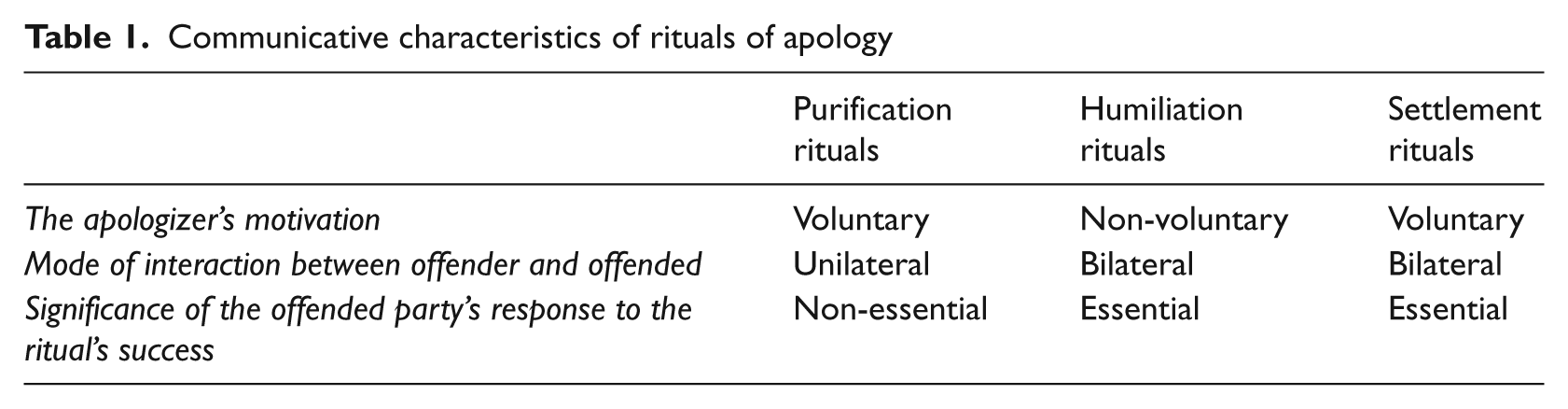
Against the backdrop of the ongoing debate in the literature regarding the role of apology in conflict (see Barkan and Karn, 2006b; Gibney et al., 2008; Lind, 2008), we analyzed the constructions of rituals of apology in order to understand what types of ritual facilitate or hinder balance in the global arena. As mentioned at the outset, many scholars tend to concentrate on the positive contribution of apologies to reconciliation. However, our focus on the utilitarian role of apologies allows us now to point at different relations between apologies and reconciliation (or the lack thereof) in global affairs. This differentiation is based upon the concepts of thick and thin reconciliation (Andrieu, 2009; De Greiff, 2008). A thick perception of reconciliation entails social or political harmony and trust, which is based on recognition by both sides that they share the same normative framework. Andrieu (2009) also adds a religious dimension to the mode of thick reconciliation by relating it to Arendt’s (1958) notions of love and forgiveness. A thin, reducible conception of reconciliation means coexistence between rivals that overcomes resentment without their necessarily forgiving or even interacting with one another. It is about finding a way to live alongside former enemies while not forgetting the past (Andrieu, 2009; De Greiff, 2008).
Our question is which type of ritual of apology leads to which type of reconciliation (or lack thereof)? It seems reasonable to argue that purification and humiliation rituals may hinder cooperation and trust, as they express and accentuate intergroup resentment at the expense of pacifying antagonisms. The unbalancing features of these rituals can be viewed as what Kertzer (1988: 127–8) called ‘the ritualization of conflict’. The reason for the failure of these rituals to achieve balance lies in the desire of one side to fulfil its own interests while ignoring the needs and wishes of the other. Such a situation leads to a unitary ritual where only one side is satisfied. Accordingly, both purification and humiliation rituals can be perceived at the group level as integrating (the members of the group are exonerated from their sins in purification rituals, or may celebrate a symbolic revenge in humiliation rituals), but these rituals divide and deepen conflicts at the international level. 13
In contrast to purification and humiliation, the choice for the middle ground, a settlement ritual, provides a safety valve for political tensions by keeping conflict within tolerable limits (Kertzer, 1988: 131). In the light of its appeasing, balancing nature, a settlement ritual can open a way to future reconciliation. It seems reasonable to argue that settlement rituals, which are built upon norm-affirming apologies, may lead, at the very least, to thin reconciliation, as they contribute to re-establishing trust. At best, settlement rituals may lay the ground for future thick reconciliation if they are accompanied by other measures of transitional justice (see De Greiff, 2008). At the in-group level, however, such rituals may lead to a tentative, disintegrative state of affairs. As we learn from cases studied in the past (Kiss, 1998; Harris et al., 2006; Lind, 2008), the attempt to reach settlement via apology may lead to vehement responses: members of the offender’s group might reject the acknowledgment of responsibility, while members of the offended party’s group might refuse to reconcile. Nevertheless, as settlement rituals are beneficial for both sides from a utilitarian perspective (ending a state of war, serving economic interests, etc.), and as they include moral values stemming from their reciprocal nature, they may – in addition to balancing the relations between political actors in the global arena – work to integrate specific groups in the long run. In sum, the choice of apology ritual can be highly significant in regard to the outcome and the prospects of settlement (or reconciliation), since each option bestows a different meaning on the events and their aftermaths and on future relations between the conflicting sides.
Our analysis shows that, instead of interpreting the mere occurrence of rituals as the main message (Falk-Moore and Myerhoff, 1977b: 8), we might understand rituals of apology as foregrounding both the meaning and the form of words (in the form of speech acts) and gestures, thus focusing attention on their actual contents. In all the three types of ritual, we found negotiation or discursive struggle among the participants over the symbolic construction of the ritual: in purification rituals, the protests of the ignored offended party; in humiliation rituals, the insistence by the offended party on a specific form of apology; in settlement rituals, the negotiation over the form of the apology. The in-group and intergroup discourse over the form and meaning of the symbols before, during, and after the ritual testify that political apologies are more than ‘cheap talk’. Rather, such discourse is aimed at constructing the pragmatic meaning of apologies: at creating in-group coherence on one side and dissatisfaction on the other, or, alternatively, at bringing about the pacification of raging emotions and thereby intergroup conciliation.
Our models of rituals of apology open up several directions for future studies. One option is the analysis of such rituals in their historical contexts as a way of understanding the construction, reconstruction, and transformation of ethnic, religious, and national identities. A second option is to focus on the role of mediators in rituals of apology and their contribution to the construction of each type of ritual. A third option might be the analysis and evaluation of the two possible modes of settlement rituals in the context of conflict resolution between Israelis and Palestinians. Here, the communicative principles of sulha (with the apology of King Hussein as the closest realization of such a ritual) may be useful. Of course, current talk about apologies and acknowledging wrongs in the context of the Israeli–Palestinian conflict may sound like science fiction. But, just as several of Jules Verne’s predictions came to pass, there is a hope that the stage of resolution in this conflict will be reached. Given this hope, it is important to consider how settlement rituals may facilitate appeasement between belligerent parties.