




Abstract
Although securitization theory has been applied worldwide, it has been accused of having only limited appositeness to the non-Western world. When the Centre for Advanced Security Theory began a collaboration with the Danish–Egyptian Dialogue Institute and the Al-Ahram Centre for Political and Strategic Studies in Cairo in 2010, securitization theory was challenged on two levels: both through its employment to analyse and act politically in a Middle Eastern context, and through the attempt to do so during and after the Arab Spring, when the entire Egyptian security sector was being re-evaluated. These unique circumstances prompted reflections on the use of non-traditional and traditional security concepts, on how the Egyptian revolution could be understood through securitization theory, and on what the experiences of this project might mean for further theory development. This article discusses these points in the light of the Danish delegation’s experiences.
Introduction
Securitization theory is a Western-based theory – one that is possibly even locally rooted, as its nickname the ‘Copenhagen School’ suggests. 1 Although the theory has been applied to cases worldwide, it has been strongly criticized for primarily being geared to Western contexts. 2
Among the arguments that challenge the theory’s application outside the West, the most common one, which is based on a misreading of the theory, is that the theory presupposes liberal democratic conditions. This overlooks the fact that the depoliticizing effect of securitization is understood in relative terms, and therefore can be observed in both democratic and undemocratic societies. A more valid criticism is that state and society are often less tightly knit, and central policy rarely permeates societies in the Third World (Curley and Siu-lun, 2008). Strongest is the general postcolonial critique that the theory makes use of Western concepts, while colonization and decolonization have created radically different societies where concepts like politics, ruler, society and rights have thoroughly different contents but have been placed under familiar names owing exactly to the colonial/postcolonial trajectory (Chatterjee, 2004). It is possible to run this critique in a deductive and definitional manner, whereby Western theories become inapplicable purely by dint of their being Western. Although this would be partly unfair to the Copenhagen School, whose element of regional security theory in particular and key ideas for securitization evolved through analysis of South Asia (Buzan and Rizvi, 1986), it is possible to approach the non-Western debate in such a dogmatic manner, and then the argument would end here. More fruitful, we believe, is to make ‘Western bias’ an empirical question – to study non-Western cases with particular attention to possible limitations stemming from Western assumptions.
The present article will focus on the case of Egypt, a non-Western country that has recently undergone a revolution, in order to make exactly such a concrete and specific assessment of how postcolonial and non-Western characteristics affect the applicability of securitization theory.However, this is done not in the traditional way of applying the theory from the outside to a separate object of analysis, but more unconventionally by way of self-reflection on a concrete cooperation where we were involved directly before, during and right after the revolution in a series of workshops exploring the potential of new concepts of security in and for the Middle East, especially Egypt. The round trip of the title is both metaphorical and literal.
First, we will present the collaboration that brought the Copenhagen School to Cairo during the revolution, as well as the preceding Middle Eastern debate on a widening of the security concept. After this, we will summarize the experiences from the concrete workshops, to establish an empirical platform from which we will finally reflect on three problems: Can securitization theory be applied to the Middle East and perhaps even contribute to democratization? How can the Egyptian revolution be analysed through a Copenhagen School lens? What has this ‘travelling experience’ meant for the Copenhagen School’s own development of the theory? This article thus turns its gaze outwards, on the Egyptian revolution, as well as inwards, on how the Middle Eastern context and the Egyptian revolution challenge the theory. 3
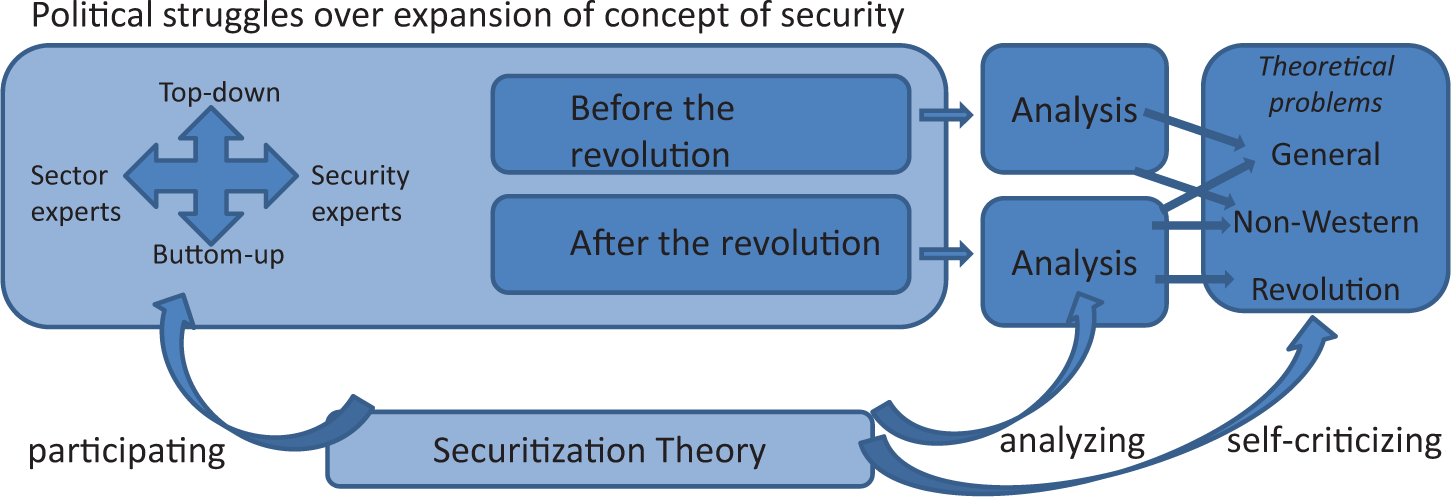
The article thus has two layers or levels. One layer focuses on the process of developing the concept of security within Egypt – both academically and politically – to incorporate ‘new threats’. Here, the issue is ‘the widening of the security concept’ and ‘new threats’, not securitization theory. Egypt was not engaged, after all, in a broad debate for or against the Copenhagen School, but in a discussion for or against (and over the form of) a potential widening of the security concept, in which we got a chance to participate. As participants, we were largely directed by securitization theory, which initially came into existence as a meta-reflection on the dilemmas of widening. Securitization theory’s role at the first level is one of ‘action research’, as it plays a part in changing the existing security practices and contributes reflections on the political–practical effects of such change, while the point of departure for debate is the widening of the security concept (as per the terms of agreement for the collaboration).
At the second level, securitization theory itself is the focus, and here we will evaluate what the theory is capable of analytically and practically. The difficulties encountered are assessed as to whether they are (1) general, (2) specifically non-Western or (3) due to the revolutionary situation. Thus, two significant shifts occur between the two layers of the article: the subject is the concept of security in the first layer and securitization theory in the second, and the format is reporting in the first layer in order to establish the conference process as empirical data, while the second level unfolds analytically as a question of the extension of the theory and its need for revision (see Figure 1). 4
Security Widening in Egypt and Securitization Theory
Securitizing Arab development
While Egypt has traditionally been focused on classic military security, and non-military approaches to security have faced difficult conditions, in 2009 the then director of the Danish–Egyptian Dialogue Institute (DEDI), Rasmus Boserup, noticed that talk of ‘non-traditional threats’, even ‘human security’, had begun to gain ground – and that to begin to talk of security in a wider sense had become possible. In April 2007, the United Nations (UN) Security Council discussed for the first time the security consequences of climate change; in 2008, the Arab Women’s Organization ran a large conference with a focus on women and human security; and the Arab Human Development Report 2009 discussed human security (United Nations Development Progamme (UNDP), 2009). This last report, the fifth in a remarkable series of reports from independent Arab intellectuals, focused on the human security concept as a framework for handling challenges to the development of Arab countries. 5 It argued that the focus by Arab countries on state security not only has been at the cost of citizens’ individual levels of security, but, paradoxically, has obscured threats to national and international security. The report argued that this called for a move from the traditional state-centric concept of security towards more transnational collaboration and a focus on the security of citizens in the face of a long list of untraditional security threats, such as organized crime, climate change and sociopolitical violence.
As a response to this, Boserup initiated the ‘Securitizing Arab Development’ collaboration in 2010. Through a series of conferences and publications, this collaboration would draw on securitization theory to discuss a possible widening of the security concept in the Arab world. The aim was to strengthen the conceptual apparatus as well as to aid the development of efficient strategies toward contemporary security threats.
DEDI is a Cairo-based institute affiliated with the Danish ‘Arab Initiative’ that seeks to strengthen local reform processes through political and cultural dialogue between Denmark and Egypt. To that end, DEDI facilitates collaborative projects with journalists, street artists, women’s organizations and researchers, among many other groups. As a part of this, DEDI brought the Centre for Advanced Security Theory (CAST), which bases a large part of its research on the Copenhagen School, and the Al-Ahram Centre for Political and Strategic Studies (ACPSS) together in the ‘Securitizing Arab Development’ project. ACPSS is a government-advising think-tank established in 1968 within the influential Al-Ahram media enterprise. ACPSS has focused particularly on regional conflicts, the interaction between the Middle East and the West, and military, economic and social issues in Egypt. It has advised various Egyptian governments, not least on security. ACPSS wanted, as a consequence of a growing academic debate on a widening of the traditional security concept and Egypt’s growing experience of untraditional security threats, to consider the widened security concept in an Arab context. 6
The conferences included European and Egyptian scholars and practitioners from a variety of fields. The intention was not to promote a particular strategy for Arab security thinking, but rather to engage politicians, academics and practitioners from the Middle East in a critical debate to define the concept of security, as well as to identify priorities for uncovering a collaborative solution from within the region itself.
The Copenhagen interest was to experience in real time how a specific regional variant of conceptual widening was hammered out. Academic debates on security have generally paid little attention to the development of distinct regional versions of ‘security widening’, where different battles and political agendas are invested in widening in different directions. Typically, locally rooted central axes and projects are at stake when ‘widening’ enters a region (Wæver, n.d.). Therefore, we at CAST were particularly alert to what defining questions and interests were at play in the Egyptian case. This task naturally changed character as the Egyptian society changed rapidly and surprisingly.
Politically and practically, the challenge for us was to provide knowledge of various security theories and of other regions’ experience of widening in a collaboration in which the final word, naturally, would be that of our partners. ‘Security’ – according to the Copenhagen School – is so ‘dangerous’ a concept that there can be a lot at stake politically when the concept is widened in one direction rather than another. Even a minor effect of our work on the delineation of security might contribute either to conflict or to the democratization of the region, depending on how it is handled. Security politics is a form of political trump card – a particular move that pushes away any deliberations and replaces them with the alleged ‘necessity’ of ‘dealing’ with a threat. Security politics therefore not only defines the handling of concrete issues, it also represents a general battlefield for determining the limits and conditions of politics, and thus has extensive significance in society, particularly in times of conflict.
When CAST entered into the collaboration with DEDI and ACPSS, the Copenhagen School not only encountered a Middle Eastern agenda, but also found itself in the midst of the Arab Spring – a double challenge for the theory. From the beginning, it was clear that the project was not only that of producing a theoretical clarification of the degree to which securitization theory could be applied by local academics and practitioners in a Middle Eastern context, but also a political project with the opportunity to affect the widening of the concept of security in a democratizing direction because, as we will argue in the following, it is not so much widening or not that is good or bad, but how the concept is widened. Obviously, the political dimension was brought to a head when Egypt suddenly found itself in the middle of a revolution, but so were debates over theory, because securitization during a revolution intensified one of the hottest questions of the theory: its concepts of politics (Gad and Petersen, 2011).
People, states and regimes in Arab security theory
As in the rest of the world, Arab security strategies have rested on a top–down security approach focusing – allegedly – on external military threats to the state (Korany et al., 1993). Ayoob (1995) argues that, in Third World countries, threats are actually more often internal and that which Buzan (1983) saw as an anomaly – that the regime uses security reasoning against its own population – becomes, in the Third World, more the rule than the exception. So, even if security politics stays within the rubric of ‘international politics’, the centre of gravity remains regime security, which Korany et al. (1993) demonstrated in an Arab context. The army is then in charge both of securing the nation’s borders and of controlling the society along regime lines, defining which societal groups and activities are acceptable and which have ‘threat profiles’ (Sayigh, 2011). Bilgin (2012) has argued that ‘traditional’ security thinking in the Arab case was actually more unconventional than widely assumed, developing quite independently of the West, integrating the challenge of state-building and moderating state-centrism through a simultaneous pan-Arabism. The ‘starting point’ of the story should therefore not be the stereotypical ‘traditionalism’, used as a straw man by the new security theories. Nevertheless, the mainstream has been limited, first of all by centring on regime and military–political threats.
With the introduction of concepts such as ‘human security’, ‘non-traditional threats’ and ‘widened security’ to the Arab world, two main schools formed (in addition to those in outright opposition to widening). One school attempts to widen the security concept as a way to give the state a handle on more of society, while the other seeks to widen security to grant a greater role for non-state actors. The first follows the fairly logical premise that if new threats emerge they must be dealt with in the same way as the old, and preferably by the usual specialized institutions (military, security sector, etc.). 7 This is exactly the scenario that securitization theory warns against. Not that it is never relevant to securitize new threats or to give official actors new competencies; one just has to be aware of the costs – for instance, in terms of concentration of power and depoliticization – and that securitization is not an automatic, necessary and ‘innocent’ reaction to objective security problems. The other school points out that the character of the new problems means that competent solutions must come from a wider array of actors. Particularly in the Arab Human Development Report, a lack of political reforms in the Arab countries is designated as a source of economic and social stagnation; security problems will therefore worsen as long as reforms default.
Seen from the perspective of securitization theory, the second strategy seems more attractive, as it politicizes and democratizes. Still, it also contains the risk that decentralizing the subjects of security will dissolve the macro-historic pacification that the modern state introduced by monopolizing security (Walker, 1997; Williams, 1998). Consequently, the risk of internal political violence increases as more actors gain authority to define questions of survival and exception.
The strongest voice in the Arab world for the second route is Bahgat Korany, who distinguishes critically between state security and social security (Korany, 1994: 173). This critical orientation seeks to redress the security focus of Arab regimes by looking at non-traditional 8 security threats, such as climate change, epidemics, organized crime and mass migration (Jacoby and Sasley, 2002; Korany, 1994). These have in common that they are not unambiguously connected to state actors, that they are not of a military nature, and that they demand coordinated action from different sectors and countries. Such a reallocation of major questions away from the state towards both its individuals and some wider transnational aggregate will, in an Arab context, often converge with a form of pan-Arabism (Barnett, 1998). This particular widening tendency is still fairly new, though, and Arab academics and policymakers are still debating how ‘Arab security’ should be understood.
Critical security theory thrives mostly in the West, and particularly in Europe, while traditional security theory dominates most of the world, including the Middle East, where recent history includes interregional wars and external invasions, as well as both internal and external power alliances that keep each other’s atomic projects in check and traditional security perceptions relevant (Ayoob, 1995; Bilgin, 2004; Buzan and Wæver, 2003; Ibrahim, 1996). 9 Many international relations scholars conclude that new concepts of security, such as human security and environmental security, occupy a secondary position in ‘real politics’, ranked below military security. Traditional security is seen as a necessity for maintaining one’s existence, while newer security issues are seen as elective add-ons, which can be handled according to surplus capacity after traditional top–down security has been safeguarded.
In societies with a strong state and military elite, new threats will typically appear as an expression of a crisis of unruliness. An example is the panic that arose in Egypt in 2009 around ‘swine flu’, one of the occasions for our partner’s interest in the collaborative project. Since the disease generally did not develop into the feared pandemic, the reaction in most affected countries could be considered exaggerated, but in Egypt the developments went particularly awry when almost all the country’s pigs were killed, to devastating effect for members of the country’s Coptic minority, whose economy was heavily reliant on the swine industry. Even though the disease originated from pigs, the crucial phase of contamination was human-to-human, and there would have been significantly more cost-effective ways of dealing with the threat. Our Egyptian partners saw this case as an expression of how new threats were more complicated to handle than traditional ones, as the people and the press became actors. They saw an increased need for strengthened state capacity in crisis handling and risk communication.
Securitization theory calls for evaluation of the practical–political implications of various forms of widening. The aim is not to argue for the securitization of these issues, but to partake in the current opening up of the Middle Eastern security political agenda to non-traditional security issues, and to facilitate as much awareness as possible of the political choices that perhaps otherwise could easily be camouflaged as technical questions of adapting to ‘new threats’.
From Copenhagen to Cairo
The collaboration consisted specifically of four minor workshops in Copenhagen and Cairo, plus a large concluding conference in Cairo, followed up by an Egyptian policy brief and an academic anthology in both English- and Arab-language editions. The subjects for the four workshops were conceptual and theoretical questions (Copenhagen, June 2010); environmental threats: epidemics, catastrophes and climate change (Copenhagen, October 2010); migration (Cairo, November 2010); and political and societal conflicts (Cairo, December 2010) – all with participation from Danish/European academic speakers invited by CAST and Egyptian academics, practitioners and policy advisers invited by ACPSS. The final conference took place in Cairo in June 2011 and was open to the public. The invited Danish and Egyptian speakers (the same academic experts, practitioners and policy advisers) were here supplemented by revolutionary political activists, journalists and bloggers; representatives of the Muslim Brotherhood and other Islamist groupings; and members of the 6th April Movement, which questioned the current security order.
The collaboration between Copenhagen and Cairo was a meeting between the Danes’ relatively abstract approach to non-traditional (and traditional) security threats, and the Arab context, on which ACPSS is an established authority. The most immediate challenge was to define what areas of threat were relevant to focus on and how the collaboration should address them. CAST placed particular emphasis on the implications of defining an issue within either the normal-political or a security frame, while our Egyptian partners urged the inclusion of traditional threats as well – two not mutually exclusive wishes. It would prove more challenging to include both top–down and bottom–up approaches (see the previous section on the two approaches), and it was explicitly negotiated as a part of the collaboration agreement that each specific issue should be viewed from both angles.
Apart from Denmark–Egypt, we also sought to facilitate a meeting between theoreticians and practitioners, and – less obviously but crucially – between security researchers and ‘issue’ specialists. A project that includes, for example, ‘climate’ as a security issue risks organizing a conference where either climate experts simply say what they usually say but where their subject has what is for them the surprisingly new status of a security issue, or security experts speak liberally on yet another issue on which they hold no real knowledge. A criterion for success was therefore to facilitate actual collaboration between security experts and issue experts, with a focus on what difference it would make to the handling of specific challenges if they were dealt with as questions of ‘security’.
The challenges of this merger were obvious at the environmental workshop, where Charlotte Tamason and Peter Mackie Jensen focused on water quality rather than on the usual question of quantity and potential conflicts over the sharing of the Nile between the countries of the Nile river basin. Their argument was that the common interest in quality should form a foundation for regional regulation of industrial use of the river and the securing of the quality of the river water used for farming. But, though the Egyptian participants recognized the need for clean Nile water, they argued that the need to secure quantity was far greater and more acute than the need for quality: Egypt, one of the largest farming economies in the Middle East, is entirely dependent on the continued water resources of the Nile, and the effects of climate change on water levels was seen as a greater threat than the declining quality of the water itself. Rising prices of food products such as wheat can be a driver for social unrest, as were the rising bread prices that figured among the reasons for the popular protests in Tunisia that started the Arab Spring. The visiting Egyptian delegation (of primarily policy advisers) focused on how an ‘untraditional threat’ could take a traditional form, which also illustrated both the difficulties of combining issue expertise with security theory expertise, and how ‘untraditional threats’, when push comes to shove, are trumped by the perceived ‘higher necessity’ of traditional threats. It was noteworthy in this respect that the most traditional security issue according to the Egyptian delegation was water.
The schism was not effectively between Danish and Egyptian participants, but often between security experts and issue experts. This was obvious again at the migration workshop in the discussion that followed Peter Seeberg’s presentation on how differently mass migration is perceived in the EU and in the Middle East. Seeberg argued that the issue had been securitized by the EU in relation to the Middle East, particularly in the case of the countries of Southern Europe. The Egyptian participants recognized real security concerns for the EU, but argued that European extreme-right securitizing discourse prevents the Union from working actively towards a solution. The security experts focused on the international relation (North Africa–Europe), and the migration experts struggled to air the relevance of migration as a security issue per se.
The biggest challenge, though, continued to be that of combining top–down and bottom–up perspectives. Ayman Zohry, an expert in forced migration, presented an overview of Egypt as a gathering point for many of the region’s refugee flows from the Middle East and African countries, and how this produces internal conflicts over resources, heightened crime rates, and marginalized and isolated societies. Sine Taarby countered by introducing a focus on refugees’ conditions during their flight, as well as on the risks connected to living in refugee camps without civil rights and access to such basic necessities as food, water, schooling, a judicial system and health clinics. To flee from insecurity thus does not necessarily bring security, either for those who flee or for those who live where they flee to, underlining the eternal question of who defines security threats: ‘Security for whom?’
In the following workshop on political and societal conflicts, police general Serag el-Rouby, formerly of the Egyptian Interpol, gave a remarkable presentation. He took it upon himself to present in great detail a comprehensive overview of organized crime and how to counter it. An awkward feeling fell on the room as he spoke of the effective but harsh methods that were put to use to this end. In spite of critical comments and challenges to his presentation, participants were not successful in encouraging him to consider whether particular distinctions delineate parts of this field as security threats and other parts as ‘normal’ crime, and what difference this makes for acceptable methods. Danish contributions to the debate focused on the inclusion of civil society in handling threats to stability through a more bottom–up process, and how civilian rights are to be secured in the process – partly inspired by problematic Danish experiences with anti-terror laws.
At the same conference, Morten Valbjørn discussed what ‘new new Middle East’ is emerging, as it becomes clear that the ‘new Middle East’ promised by the administration of US President George W. Bush is not happening. The debate touched open-mindedly on a variety of religious and political movements and developments in different parts of the Middle East – which would prove to be more relevant than we were aware of at the time. Even though the conference took place in between the first and second rounds of the Egyptian parliamentary election and participants had read about minor protests in the streets, no one during this conference foresaw the revolution waiting right around the corner. Even those Egyptian participants who, privately and off the record, were most critical of the elections and the regime suggested that young people were through with believing in ‘big politics’ and reforms of society at large; at best, opportunities for ‘small politics’ were opening up in local institutions and neighbourhoods. General attacks on the regime had proven pointless.
The first round of meetings arrived at the following results related to our three questions:
1. Our role: We had expected one, but were given two. Expected was a kind of meta-function: in correspondence with the general status of the Copenhagen School as meta-reflection on widening, we should strengthen reflexivity among participants about the political act it would be to (de)securitize issues; how a seemingly analytical discussion of what constitutes a security threat is actually a struggle over different ways to regulate the handling of these issues. In addition to this, we were given a more direct ‘advocacy’ function, as a replacement role for the ‘bottom–up’ perspective that was not very well represented, as no Egyptian civil society actors had been invited to join the workshops. ‘Action’ research thus involved a bit more of a direct actor role than was initially envisioned and intended.
2. Analysis of the politics of widening and patterns of securitization: The concrete debates, issue by issue, frequently exhibited a pattern where prominent security experts argued for a top–down widening that would strengthen the state’s hold on new issues, and were less interested in ensuring a role for new actors. They preferred to reserve new security thinking for supplementary threats, while the traditional threats remained untouched. Participant observation of the politics of widening created the empirical foundation for a securitization analysis of a distinct establishment strategy – and, more tentatively, we could identify a constellation made up of the establishment on one side and oppositional bottom–up widening on the other. The latter, however, we had mostly identified outside of the conferences and often had to represent ourselves during the debates.
3. Theoretical challenges: There were no direct problems with using the theory’s terms in the Arab context, and the ‘non-Western’ problematic expected from the debates within security theory was not apparent at the thematic workshops – or at least not where expected. Something that might seem just an operational difficulty in the project might, however, reflect a deeper theoretical issue: the experienced schism between the two main kinds of experts – the security experts and the issue experts. The schism between the positions these two groups of experts posed falls conveniently within CAST’s focus on the different rationalities of fields, 10 but securitization theory tends to assume that technical policy experts support the political agendas of a given locale, which was not always the case at our conferences. (Examples were given above of sessions where police experts followed police logic rather than strategically using security talk, and migration experts focused on specifics rather than the larger picture. We can add climate change as a session with similar features.) Is there perhaps a particular non-Western dynamic here? This is something that we will return to in the next section.
From Cairo to Cairo: Revolutions can make a difference
After these thematic workshops had taken place, thousands of demonstrators poured into the streets in large parts of the Arab world, and overwhelmingly so in Egypt.
The many legal, socioeconomic and political grievances of the Egyptian masses included habitual police brutality, emergency laws, corruption, the lack of a free press and meaningful elections, and high unemployment and food prices (MacQueen, 2011). Demands included the resignation of the regime and substantial changes to the country’s form of government. Though large parts of Egyptian society could agree on these demands, the revolution fragmented as the slogans evolved into political demands, and differences in political, economic and social interests crystallized. Revolutionary groupings divided broadly along four lines: 11
The youth initiated the protests that grew into the revolution, who were soon sidelined as they fragmented into a large number of coalitions rather than uniting in political parties, while those parties that did form had little success in subsequent elections (Sadek, 2011).
The traditional political opposition on both the right and the left, pressured by poor election results in 2010, were pushed to join anti-regime forces and to accept the leadership of the Muslim Brotherhood, though wary of its attitude towards secularism and democracy.
The Muslim Brotherhood had successfully posed itself as representing a societal call for ‘Islamic’ policies, and had grown in strength and prestige over the previous several decades, though it had also fragmented along a spectrum ranging from emulating the Justice and Development Party (AKP) in Turkey to the Salafis advocating strict implementation of the Sharia.
The civil society organizations, NGOs and human rights groups had grown massively in the previous two decades; although these were initially focused on development issues, they gradually moved onto the central political stage during the revolution.
In a revolutionary situation, the armed forces are always forced to choose between violently opposing the revolutionaries, maintaining social peace, staying ‘neutral’ (effectively supporting the revolution) or joining the revolutionaries (Chorley, 1943: 11). This choice often determines the success or downfall of the revolution or the regime, and the military’s reluctance to save the regime was decisive in Mubarak’s formal handing over of power to Egypt’s Supreme Council of the Armed Forces (SCAF) on 11 February 2011. In the next few days, the SCAF dissolved Egypt’s parliament, suspended the constitution, promised to hand over power to an elected civilian government within six months, and pledged that Egypt would remain committed to its 1979 peace treaty with Israel.
We returned for the concluding conference in Cairo in June 2011. The aim of the conference was to bring together the contributors to sum up the thematic workshops and explore linkages, contrasts and cross-cutting themes, as well as to include wider circles of interested parties in Egypt, which by this time prominently included the 6th April Movement and the Muslim Brotherhood, as well as representatives from civil society organizations and the media.
In the revolution’s aftermath, it seemed that everything in Egypt had become subject to debate, but one presentation in particular sparked a discussion that, in the context of the continuing revolution, caused the temperature of the room to rise and made the job of the simultaneous interpreters inhumane. The English-speaking discussant largely had to give up, and discussion moved fully to the audience. Once again, this was related to police general Serag el-Rouby’s presentation. This time, the presentation on organized crime and the methods of the Egyptian police was quickly interrupted by voices in the audience who turned his argumentation upside down and accused the police of being Egypt’s worst case of organized violence. Members of the audience referred both to the ordinary Egyptian police (al-shurta), controlled by the Ministry of Interior, and to the baltagiya, an unorganized group consisting of gang members and criminal informants employed by the police to carry out harsher jobs such as quelling demonstrations. The debate brought the issue of the monopoly over legitimate violence to a head, and the arguments from the room were in no way homogenous: several listeners thought that the police had every right to come down hard on troublemakers, while others expressed the view that it was exactly the brutal manner with which the police performed that task that had led them to join the protests in the streets themselves. The latter group proclaimed the military the victors of the revolution because it, early in the process, had chosen to send the police home and thereby supported the protesters.
From this debate, as well as from conversations with people outside of the conference programme, new patterns became apparent.
Relating to the collaboration’s question about developing the security concept in the Middle East, we could note (at least on the surface) greater agreement on ‘the wider security concept’ – including the controversial aspect of a wider range of legitimate security actors. Egyptian researchers, who in the previous rounds had appeared reluctant in relation to new referent objects and actors, were now far more open to a role for non-state actors.
Second, as the Copenhagen School’s analytical ambition was to use analysis of the constellation of securitizations to decode a political struggle, it was interesting to observe that the polarization that peaked with the police general’s presentation represented new patterns with untraditional threats at the core, but that nonetheless still seemed to end up ultra-traditional in nature.
Among the 6th April Movement activists, a temptation to securitize everything as ‘counter-revolutionary’ thrived. This kind of security-political defence for the ‘revolution’ against the threat from the old regime or reactionaries is, on the one hand, quite understandable in the situation both then and now in Egypt; on the other hand, however, it is also a dangerous move that can easily be used to delegitimize first the actual establishment and then more and more political opponents. 12 In the end, this kind of ‘revolutionary’ securitization often mythologizes the defence of ‘the people’ in a manner that comes close to classical ‘national security’ (only with a little more emphasis on the ‘national’ in national security than we have become used to in cases of the state’s expropriation of the term). 13
Contrary securitizations prevailed among more traditional circles – both elites with an interest in l’ancien regime and socially weak groups, who are both the first to be affected by economic problems and social instability and the most open to the impact of the media. First, ‘chaos’ was the new threat – lawlessness and economic losses stemming from political instability – and accordingly there followed demands for law and order. In the next round, the remnants of the regime, through the press, increasingly attempted to suggest quite diffuse threats from ‘foreign powers’, by which people were expected to hear the West, Israel and Iran. Finally, in a rather complex constellation, as it sensed that it was quickly losing grip of a position from which to securitize any issue, the regime employed Salafi sheikhs in its war against the revolution to question the patriotism of those who instigated the revolution, arguing that it was an American–Zionist or Iranian conspiracy (Hashim, 2011: 122). The threats drew on untraditional elements, but they are of course hyper-traditional: security equals a strong state, law and order, and unified (military) defence against foreign enemies. Internationally, the regime used the narrative of the Islamist threat to securitize the idea that free elections would bring Islamists into power, leading to instability and chaos both for Egypt and for the wider region, jeopardizing peace with Israel. Sacrificing democracy, it was hinted, was therefore a necessary evil to protect stability and peace, which was more important to the world than democracy (Yassin, 2012: 150).
The task in this situation, both theoretical and practical, can well be a form of détente between the two securitizations to avoid a possible escalation into a crisis that stops the reform process. A central task discussed with our partners was to channel the young revolutionaries’ critique of the regime into concrete complaints over police violence and demands for reforms of the security sector, because this, from other angles of society, could be seen as a form of increased ‘institution-building’, and thereby ‘stability’, as opposed to a further destabilization of society. In a situation where the revolutionaries could be castigated as a threat to social stability, prosperity and social safety, a revolutionary agenda centred on security sector reform would merge change and stability.
An unstable revolutionary situation, such as the Egyptian one, can approach the extreme where one part defends ‘change’ while the opposing part makes ‘stability’ the aim. This contrast is naturally a dimension of politics in almost all societies, but what happens when these positions are abstracted into poles and each defended against their enemy? Such a constellation erases the possibility of politics, because no common ground exists.
A relevant task for securitization theory – where analytical work might have political impact – could be to calibrate an institutional minimum structure as a common security focal point in order to secure a form of stability that facilitates change. It is a classical paradox known from, for example, the politics of East–West détente, that change is only possible when there is enough stability for absolute change to be ruled out (and the more familiar corollary is the classical conservative insight that one can only maintain by changing) (Hassner, 1968a, 1968b; Wæver, 1989). In Egypt, this pointed to security sector reform (police brutality as a procedural problem) and constitutional politics. The dominant securitizations became increasingly destructive delegitimizations of political opponents, whereas any form of productive political co-production would demand at least an additional security discourse of shared defence of the framework itself. Can opponents in a post-revolutionary climate create a policy of security for the political balancing point around which an unstable situation swings? If this theoretical achievement materializes, it will probably turn out that the comprehension of the stabilizing effect of successfully establishing such a focal point is anything but a local insight, only of relevance to ‘exotic’ cases far from home. Quite the opposite, this development will be a defining moment in the general development of the theory. We return to this in the conclusion. First, though, we look at the other layer of our agenda: what happened to widening in this phase (while, in the subsequent section, we will briefly update the political analysis).
Non-traditional security threats were seemingly both highlighted and shoved into the background by the Egyptian revolution. Middle Eastern regimes, such as Mubarak’s, that previously seemed stable and strong proved vulnerable to public pressure. New power relations were established both nationally and regionally, as security for states and citizens was reformulated. In praxis, a wider security perspective came into play in Egypt, as civilian organizations began to exert greater influence. The former security focus on the personalized central power became less prevalent, as the political order was reformed and security was increasingly considered a service the state should provide to its population rather than to itself. Whether these changes in discourse will remain dominant and will lead to a real effort to address non-traditional security threats that affect societal layers and groups outside the elites is now dependent on political persistence and focus. One of the most central questions of the security theoreticians – ‘Security for whom?’ – therefore continues to be relevant in Egypt after the Egyptian revolution.
What happened in the meantime with those more ‘technical’, non-traditional threats – those not directly related to the dominant political constellation? Did they change as a result of the altered general political situation? One example might be water, a topic that was addressed by the authors of this article in a presentation at the final conference. On the basis of the conclusions from the thematic workshop that had taken place earlier, our presentation placed the Nile in the framework of the Copenhagen School: the necessity of water from the Nile has actually always been securitized, as it was seen as being crucial to the survival of Egypt. As early as 400 BCE, Herodotus wrote that ‘Egypt is the gift of the Nile’, meaning that the country was entirely dependent on the river, and there is an abundance of quotes from more recent leaders saying that no means will be spared to secure the necessary share of the Nile basin water resources. Paradoxically, no one previously used the word ‘security’ in this context, and therefore it was never made obvious how the water question was at the top of the list in foreign policy issues. To characterize water as a security issue became possible as a consequence of the international impact of the widened security concept, and in the last 10 years the concept ‘water security’ found its way into analyses of the Nile issue, where it often serves to legitimize Egypt blocking solutions negotiated with the Nile basin states (Mekonnen, 2011). This is paradoxical, because in the same period Egypt has actually come to rely less singularly on the Nile. Indirect import of water takes place through the import of various products, and a growing proportion of the available Nile water is allocated for industry rather than farming by households. The new rhetoric of widened security has problematic political effects here, because borrowing from international conceptual trends lends legitimacy to uncooperative policies, previously equipped with less powerful arguments. Climate change threatens to worsen the water situation (Al-Marashi, 2011), but this affects the sum total of available resources, not the relative gains of competing states. The choice is therefore not between ‘non-securitized vs. nationally securitized’, but rather is one for a third option of a regional concerted securitization as the road to a water regime for the Nile when climate threats are included. Improved relations with the other Nile basin states should be high on the list of Egyptian post-revolution foreign policy, first through the ratification of an agreement between the Nile basin states on a fairer distribution of Nile water that was postponed immediately after the toppling of Mubarak.
One thing that emerged as our digestion of the inputs of theoreticians and practitioners during the collaboration was this analysis, but another was whether attention to non-traditional security threats had better, worse or different conditions in the light of the revolution. The preliminary impression was that the new voices that had emerged from the Egyptian revolution had not yet reached a point of interest in ‘distant’ issues such as non-traditional security threats. The traditional approach to security was still dominant, and there was a reluctance towards letting ‘new security concepts’ mean that Egypt should change its policies on an issue as crucial as the Nile. Otherwise opposing sides agreed on this – or the revolutionaries deferred to regime logic here, concentrating on immediate domestic struggles.
The expectation was still that new security was to be added to old security, which should be meddled with to a minimal degree. If the political changes in Egypt are to imply more openness to ‘new security politics’, this could be facilitated by a change of personnel away from the classic security elite, but also, and perhaps more probably, by new strategic conditions for Egypt developing gradually as the effects of the revolution change the relationship to Israel and the USA, and thereby perhaps necessitate more flexible politics towards the country’s western and southern neighbours. During the unstable 2011–2012 situation, foreign policy was mostly used by political actors for symbolic posturing, but the new leadership will likely adjust the total security equation of cooperation and confrontation with more emphasis on threats from Israel and the USA. When that happens, it will become expedient to cultivate more cooperative relations in other directions, such as China as well as regional actors. Redefinition of security in relation to water and migration could well become central. This regional and interregional dynamic reminds us that the new security theories should guard against a tendency to block out international dynamics and comprehend security constructions as purely internally driven, unaffected by international relations. Global and particularly regional security dynamics will empower some (de)securitizations and hamper others.
The disconnect between technical specialists and security experts was, if possible, even more apparent after the revolution than before. This problem for the theory is mirrored in one of the non-Western arguments: that the state does not permeate society as homogenously in the Third World as in Western societies (Curley and Siu-lun, 2008). Interaction capacity is lower and functional subsystems are not tightly enough knit to force consistency among de facto allied actors. This relates to the general postcolonial argument that we use words like ‘state’, ‘sovereignty’ and ‘politics’ in contexts outside the West that do not correspond to the West’s ideas of these concepts, because the paths along which different societies come to these concepts are so different (Chatterjee, 2004).
Cairo-after-the-revolution updated our conclusions:
Our role – became very small as developments gained momentum and immediate political concerns took primacy for the conference participants.
Analysis of the politics of widening and thereby the patterns of securitization: Struggles at the conference delivered empirical data for an analysis with a clear constellation. Now the poles are constituted around new questions: defence of the revolution versus defence of order against anarchy from within and foggy threats from outside.
Theoretical challenges: Two problems for the theory took centre stage: the significant disconnect between security experts and technical specialists perhaps reflected non-Western conditions; and the revolutionary situation challenged the theory’s concept of politics, which possibly presupposes an underlying stability as a frame for limited transgressions through exceptions. We will return to both in the Conclusion.
Or can they?
The previous section analysed the situation mid-2011, connecting our specific participant observations with more general analyses of the Egyptian constellation of securitizations. Important things have happened since, and although we cannot tie this part of the analysis into direct experiences in the same way, the analysis should be updated. 14
The good relations between the army and the revolutionaries mutually constructed a sense of legitimacy, patriotism and a common Egyptian goal with the revolution – expressed in the chant ‘The army. The people. One hand’. 15 This unity meant a semi-stable but very tense situation: while the military had taken it upon itself to secure the revolution, this was ‘under the watchful eyes of the revolution’ (Aly, 2012).
Within a few months of Mubarak stepping down, disenchantment between the parties was apparent, with the revolutionaries claiming ownership of the revolution and accusing the military of halting the process of change by cracking down on continuous protests, failing to effectively clear out the old regime and, crucially, not handing over power to a democratic parliamentary system. In turn, the SCAF claimed that it was holding onto power to maintain stability and secure the revolution (International Crisis Group, 2012).
In the first elections after the revolution, the Muslim Brotherhood’s Freedom and Justice Party won 47% of the seats in the People’s Assembly, and its candidate, Mohammed Morsi, won the presidency with 51.7% of valid votes. As Morsi took a symbolic oath of office in Tahrir Square, he sought to connect himself to the legitimacy of the revolution. In response, the secular camp accused Morsi of ‘hijacking’ a revolution that did not belong to him, because youth groups organized the protests on 25–27 January 2011 while the Muslim Brotherhood had only joined the uprising officially on 28 January, simultaneously meeting with the Egyptian government, which offered a licence for a political party and the release of some of its imprisoned members in return for the Muslim Brotherhood withdrawing its youth from Tahrir Square (Associated Press, 2011).
During the formal transition from rule by the SCAF to the newly elected authorities of the Muslim Brotherhood-dominated parliament and President Morsi, liberals would occasionally side with the Muslim Brotherhood when the issue was one of the military versus the civilian population (New York Times, 2012a).
The SCAF formalized the ‘right to intervene’ within the constitution, overruling parliamentary oversight and civilian control over the military (Hashim, 2011). Eventually the SCAF revived the institution of the ‘National Defence Council’ and enshrined in the December 2012 constitution that it had responsibility for ‘matters pertaining to the methods of ensuring the safety and security of the country’ (Sayigh, 2013). Although the National Defence Council is headed by the president, Egyptian Air Force officers hold a majority of the positions. It seems relevant in several ways that the civilian president did not challenge the wide-ranging realm of the military – that is, the way in which the Egyptian military permeates the country’s society and economy; but in terms of authorization to securitize, it is striking how in this area Egypt did not copy the much-touted ‘new’ AKP system of Turkey, but opted instead for an arrangement like the earlier situation in Turkey where the military had wide-ranging authority to define in the name of security the limits for politically decided developments.
This was displayed in practice already in January 2013, when Egypt’s army chief (and defence minister) warned in a speech posted on the military’s Facebook page that ‘the continuing conflict between political forces and their differences concerning the management of the country could lead to a collapse of the state and threaten future generations’ (BBC News, 2013a). In the talk of ‘a real threat to the security of Egypt and the cohesiveness of the Egyptian state’, the threat of action was obvious. On the other side, the Muslim Brotherhood has stepped up its rhetoric of ‘counter-revolutionary forces attempting to undermine the state’ and ‘remnants of Mubarak’s regime’. In 2011, the rhetoric had been harder – with, for example, a senior spokesman stating that the SCAF would not allow a ‘Khomeini to take power’ in Egypt, delegitimizing Islamists in much the same way that the Mubarak regime had done (Al Bawaba, 2011).
Within the key triangle of the military, the Muslim Brotherhood with the president, and the secular street demonstrators, mutual securitization also escalated between the latter two. Especially during November 2012, when Morsi temporarily granted himself sweeping powers, clashes escalated. Morsi
speaks darkly of imminent threats from a conspiracy of unnamed foreign enemies and corrupt businessmen. He vows to uncover counterrevolutionaries hiding under judicial robes. His advisers charge that loyalists of the former dictator have infiltrated the opposition, saying it would gladly sacrifice democracy to defeat the Islamists. (New York Times, 2012b)
Intriguingly, the rhetoric of the ‘deep state’ was used not on intelligence agencies or similar security structures, but on pro-Mubarak forces lurking within the news media and the judiciary. Securitization was clear cut in the talk of ‘secret information’ about a conspiracy and ‘real and imminent threats’ – for example, ‘If anybody tries to derail the transition, I will not allow them’ – clearly indicating that, in such a situation, all means were regarded as justified. The rhetoric was equally strong from the secular opposition, which claimed that Morsi threatened democracy both in his procedures and in the content of the constitution pushed through with these measures.
During the winter of 2012–2013, politics seemed to bog down in a standstill between ‘overreaching and majoritarian Islamists, fractious and incompetent non-Islamist opposition actors, and scheming elements of a deep state’ (Brown, 2012; see also Boserup, 2012; International Crisis Group, 2013). The constitutional referendum in December 2012 demonstrated that although the fronts have shifted since the parliamentary and presidential elections, the structural problem is similar to that of the previous period: the complete lack of willingness of all parties to grant any legitimacy to others. Secular critics of the constitution (understandably) harp on about problematic paragraphs regarding, for example, religious authorities and gender issues. Yet they fail to acknowledge the legitimacy of the parliament, the president and the constitution rooted in de facto majorities in the voting booth. Similarly, the necessity of real consensus-building in periods of transition and institution-building should be acknowledged by the elected rulers.
However, it should be remembered that Egypt formally operated under emergency law almost permanently from 1967 to 2012. All new forces have shifted to a modus where at least the threat of emergency is a threat, not implemented. Yes, it does constrain a political system if all major players use security talk about each other and depict existential threats as potentially justifying emergency measures, but it is more problematic if the emergency measures have been actually implemented and become near normal.
In the January 2013 violent clashes, a limited state of emergency was declared in areas of violence along the Suez Canal. However, Morsi backed down, delegated authority to local governments, acknowledged legitimate dissent, called for dialogue and stated, ‘I don’t want to use any extraordinary measures in the transitional period, and I would not allow myself or anyone else to go against the law’ (CNN, 2013).
The Egyptian tradition of taking legal procedures very seriously is one of a few promising elements. Also, the fact that Egypt has arguably the world’s oldest – and (relatively speaking) largest – state bureaucracy (Aly, 2012: 51) means that, in some paradoxical sense, stability and continuity are likely to materialize – to a fault, one would normally say. But, in a situation where the political actors fail to produce politically and discursively the anchoring point for stability, it may turn out to be an advantage that inertia and institutional power do provide such a point, and politics may eventually converge around it.
If the challenge of successful securitization in defence of a dynamic institutionalization is handled in the Egyptian project, the general securitization theory will be in the process of a significant development of its concept of politics. This has consequences for how our own societies are to be analysed – and perhaps acted on – as well.
From Cairo back to Copenhagen
It is well known from postcolonial studies that a theory cannot just be transferred from ‘country of origin’ to new environments. In the famous essay ‘Travelling Theory’, Edward Said (1983) wrote that new forms of the theory typically appear which are neither an exact copy nor a ‘creative misunderstanding’. In a new situation, the theory is developed to become something different and thereby more relevant. No theory is complete or closed, so it always holds possibilities which would not be fitting in the original situation, but that also would not appear in the new context without both a local effort and the contribution of the theory.
When the theory returns back home again, what does it bring with it? We have looked at three types of questions:
What was our experience as a special fringe player? Before the Egyptian revolution, our role became more extensive than we wished, as the meta-function of reflection on own actions was supplemented by the function of being a kind of replacement voice for the non-establishment voices not included in the meetings. After the revolution, the local intensity became so high that our own role became marginal. The idea of contributing as a meta-reflection, an eternally politicizing conscience that moves the security arguments from technical necessity to political choices, worked fairly well in the first phase but became ultra-demanding in the second phase. We will keep trying!
The security game of widening varies between regions – so what is the Egyptian variant? Or what will it become? In the phase leading up to the revolution, our interpretation – which we designed the project from – was that two different widening ideas competed: one that wanted to widen to create more space for ordinary people’s ‘human security’ and more actors from the civil society, and another that saw new threats as an opportunity to expand the existing security elite’s handle on society. A particularly sophisticated version of the human security variant made regime rigidity the ultimate threat – only political reforms could ultimately solve society’s internal and external challenges. There is some continuity between this and one of the ‘late-revolutionary’ discourses, as the activists point to the continuing role of powerful people from the old regime as the largest threat. More conservative forces combine individual-level worries (economy, stability and order) with diffuse external threats – lifting these into an existential state of exception.
The theory itself has been especially challenged at two points: First, the at best loose relation between technical experts, security experts and political actors must be studied more closely, particularly to clarify whether Western societies are more tightly knit (or differently differentiated) and whether that gives Western theories a distorted view of non-Western debates about widening the security concept. Second, the conceptualization of politics in securitization theory has been challenged not by the Middle East, but by the revolution. The theory assumes a basic stability as a frame for possible issue-specific exceptions, but if the entire situation is one big exception, the theory needs to thematize security politics through institutionalization. Particularly in Egypt, where dealing with security structures – military and police – is the centre of gravity for political life, a successful securitization in defence of a dynamic institutionalization could become crucial to avoiding an internal security political escalation that would greatly damage democratization.
The revolution challenges the theory’s conception of politics. Securitization theory is often criticized for being too Schmittian, but in this case it may not be Schmittian enough. Carl Schmitt’s infamous conception of politics focuses on a general situation of exception where the entire society is re-grounded. Securitization relates to limited exceptions: within an order that is not generally challenged, arguments are made for exception in a specific field. Therefore, the theory is distinct from Schmitt’s. But what if the situation turns Schmittian – open to a new order-installing actor who generalizes the exception? Does such a situation fall outside the reach of securitization theory? Yes and no. The theory does contain a Western bias here, because Western societies no longer confront (nor de facto run their politics on real expectations of) this kind of ultra-political moment. However, even in a revolution like Egypt’s, the ‘pure event’ of the ‘mass strike’ is only one moment in a longer history (Zemni et al., 2013). Thus, the political situation in Egypt since Spring 2011 has been ‘political’ in a more normal sense, and not everything is possible.
The next question is then: the theory’s concept of politics is strung between Schmittian (anti)political exceptions and an Arendtian co-creation. But, although opposites, Schmitt and Arendt jointly underprioritize institutions (Buzan et al., 1998: 141–145; Gad and Petersen, 2011). So, how are we to analyse situations where the degree of institutionalization is an open question? When the theoretical challenge here becomes particularly clear – and perhaps the solution particularly productive – it is not because the case is non-Western, but due to the revolutionary situation. Securitization theory does contain analytical terms and even empirical insights about securitization with reference to emerging institutional structures (Buzan et al., 1998: 141–163). However, existing exposés tend to assume that such securitization happens with reference to existing political structures. Meta-theoretical debates on securitization theory have pointed to two important principles: securitization is performative in the dual sense of not only installing a security situation but also installing the referent object, and any securitization tends to freeze that which it defends. Thus, we need analytical work on the instalment of political frameworks – the institutions and contexts for disagreement and struggle. That is a security issue in Cairo right now, but it is also relevant far beyond, not least in Copenhagen.
Footnotes
Acknowledgements
We owe special thanks to the journal’s anonymous reviewers, as well as Ulrik Pram Gad, Vibeke Tjalve, Karen Lund Petersen, Peter Marcus Kristensen, Rasmus Alenius Boserup and Mogens Blom for their much-appreciated comments.
Funding
This research was supported by a University of Copenhagen program of excellence grant for “CAST, Centre for Advanced Security Theory” and by a DEDI, the Danish Egyptian Dialogue Institute, grant for the project ‘Securitizing Arab Development’ (Project no. 50a).