



Abstract
This article discusses the role of private actors in the finance–security nexus. It analyses how the delegated authority bestowed upon private actors in anti-money laundering and combating terrorist financing (AML/CTF) may be perceived not as empowerment but as an expression of a threatening invasive and hegemonic order: To reap the possible benefits offered by the security paradigm in the ‘war on terror’, private actors must relinquish a degree of self-determinacy. This threat to self-determinacy, it is argued, foregrounds (affective) resistance among for-profit professionals. The article probes how for-profit professionals engage in (affective) resistance through self-authorship. Evoking Hansen’s discourse analysis on linkages and differentiation, the empirical analysis delineates how lawyers in the UK and France resist being resilient subjects in AML/CTF. It shows how for-profit professionals use self-authorship for purposes of (affective) resistance. Specifically, it finds that the linkages and counter-values subjects pin to the perceived invasive order of AML/CTF serve as poles in the fence protecting a space where professional identity is safeguarded. In this way, actors became resisting subjects when faced with obligations to be resilient. In conclusion, the article affords nuance to the role of private actors in the finance–security nexus by outlining how the forging of the first link in De Goede’s security chain is undermined.
Introduction
The attacks of 9/11 brought about ‘the beginning of a new security paradigm that includes new actors, new rationalities and a new temporality’ (Kessler, 2011: 197). Since then, the financial sector has become more entrenched in the security political agenda, and the increasing monitoring and control of financial transactions has become part and parcel of the global ‘war on terror’, as illustrated by the rise and spread of Financial Action Task Force–style regulation on money laundering and terrorist financing (FATF, 2012; Nance, 2017; Unger et al., 2014).
The ongoing ‘colonization’ of the European financial sector by matters of European public security (Amicelle, 2011; Amoore and De Goede, 2008; Boy et al., 2011; De Goede, 2010; Helgesson and Mörth, 2012; Kessler, 2011) reflects the emergence of a finance–security nexus (Power, 2013; Winer, 2003) that relies on both private and public actors to confront the challenges of money laundering and terrorist financing. Notably, Directive 2001/97/EC on money laundering (the ‘Second Directive’) and Directive 2005/60/EC on anti-money laundering and combating terrorist financing (AML/CTF) (the ‘Third Directive’) obligate banks, accountants, lawyers and a wide range of other private actors to follow a risk-based approach in their dealings with clients (European Union, 2001, 2005). This includes obligations to identify and monitor clients properly, as well as to report suspicions of illicit financial transactions to the national financial police without informing the client concerned (European Union, 2005), obligations that continue in the subsequent ‘Fourth Directive’, Directive 2015/849 (European Union, 2015).
De Goede (2017) delineates how the private actors in AML/CTF constitute the first link in a ‘security chain of financial transactions’ that spans the public–private divide. In this position, private actors are relied upon ‘to act out security’ (Kaufmann, 2016: 100) in relation to the challenges of money laundering and terrorist financing. Yet the placing of private actors in the foundry of the chain of security is not without caveats. If they do not act, the first link in the chain will not be forged. To be sure, there exists something of a ‘business case’ for private actors that may encourage proactive participation in the intertwining of finance and security on their part. There is an ongoing commercialization of security practices (Leander, 2010), and previous studies demonstrate how new security threats may constitute an opportunity for private actors in the financial sector (Aitken, 2011; Liss and Sharman, 2014) to expand their remit and increase their resource base by creating new markets for business. Opportunities to avoid less profitable market segments may also present themselves to private actors in this domain. It has, for instance, been shown that the obligation in AML/CTF to respond to security threats by reporting may be used by banks to get rid of unwanted clients (Favarel-Garrigues et al., 2009, 2011).
Nevertheless, there is a dilemma in that the delegated powers bestowed on the private actors may not be perceived as empowerment but rather as an expression of a threatening invasive and hegemonic order (see, for example, Howarth and Torfing, 2005). The positioning of private actors as first responders in the chain of security can be experienced by the private actors concerned as an expression of a top-down command-and-control definition of securitization (Buzan et al., 1998). The policymakers are perceived as the ones setting the agenda for other actors to comply with, capitalize on or resist. Yet, in the case of AML/CTF, compliance is a complex issue, as private actors are required to be proactive (European Union, 2005, 2015). In effect, we suggest, they are designated as resilient subjects charged with the responsibility to take appropriate action in the face of security threats (see Kaufmann, 2016: 100). This role, however, may not be in the interest of every private actor. The reason is that for private actors to reap the possible benefits available to them in the emerging security paradigm, they must relinquish a degree of agency and self-determinacy. By way of illustration, in relation to AML/CTF, the Council of Bars and Law Societies of Europe (CCBE, 2011: 2–3) has argued that: Providing authorities with the competence to access information on an identity from, amongst others, lawyers would clearly interfere with [the] principle of professional privilege and professional secrecy and should therefore be firmly rejected. The importance of a confidential relationship between a lawyer and his client has been established and confirmed by, amongst others, the European Court of Human Rights and the Luxembourg Court of Justice. Therefore, lawyers should at any rate be fully exempt from any obligation to provide information to competent authorities.
A related critique of Directive 2015/849 1 is that its provisions border on what is almost ‘day-to-day life’ in ‘the daily operations of businesses’, and that the impact on fundamental rights and proportionality requirements ‘need[s] to be addressed’ (CCBE, 2017: 8). In our view, these are strong words from the CCBE, positioning the legislation as an ‘invasive order’ that threatens the self-determinacy of lawyers.
To sum up, we argue that the very possibility of empowerment that may induce proactive engagement among private actors in the chain of security also contains the seeds of disempowerment, and resistance, due to extant regulation on AML/CTF being perceived as a threatening invasive hegemonic order. It is this possible disempowerment and resistance among private actors that we analyse here. The aim of the article is to contribute to the theorization of the interlinking of finance and security across the public–private divide in the chain of security (De Goede, 2017). We do so by opening the still largely black-boxed private-actor link to probe how such actors may resist being proactive in relation to security threats in spite of delegated powers and obligations. A starting point is that private actors that are explicitly governed by values other than simply those of business interest are more likely to experience AML/CTF regulation as an invasive and hegemonic order, as illustrated by the reactions of the law profession. We therefore employ the concept of the ‘for-profit professional’ (Helgesson and Mörth, 2016), a concept grounded in notions of lawyers as governed by professionalism (see, for example, Campell-Verduyn, 2015), to denote a focus on private actors that are not only primarily for-profit, like banks, but also explicitly governed by professional norms and values, like lawyers. Our specific research question is: How do private actors, and for-profit professionals in particular, resist being resilient subjects of securitization by exerting self-authorship?
To enable a more in-depth analysis of disempowerment and resistance, we add insights from the critical perspectives on change management literature to our theoretical framework. Specifically, we draw on a notion of resistance as discursive practices used by actors to construct boundaries protecting professional identity and to distance themselves from a perceived controlling or invasive power that threatens that same identity (Knights and McCabe, 2000; Mumby, 2005; Pieterse et al., 2012; Symon, 2005). This means that we mobilize the term ‘self-authorship’ to delineate and discuss the resistance that takes place in addition to, or instead of, open and formal resistance.
The article is structured as follows. First, we present and discuss our analytical and theoretical framework on securitization, and resistance, along with our three-step model for empirically identifying discursive practices of (affective) resistance and self-authorship. This is followed by a section on methods, case selection and sources. We then turn to the empirical section of the article. Subsequently, we discuss our findings with a view to issues of resistance and self-authorship. The article ends with a section in which we summarize our conclusions and discuss implications for the theorization of for-profit professionals in the finance–security nexus.
Theoretical and analytical framework
Securitization: Empowerment or disempowerment?
The empowerment of private actors is a general theme that is prevalent in the analysis of private actors and security. Studies of the privatization of armed forces and the development of PMCs (private and military companies) (Avant, 2005; Singer, 2003) are important contributions to our understanding of how the market-building capacities of private actors are widened. Similar opportunities for business are created when risk and uncertainty are commodified (Aitken, 2011; Bailes and Frommelt, 2004). What has been studied is how companies with a focus on commodities and security services can capitalize on the extensions and broadening of security, developments amplified by general trends of privatization in the public sector (Leander, 2010).
Bigo (2002) shows how everyday routines and the activities of the professionals concerned may institutionalize security in a policy field, as well as the need for business actors in that field. ‘Securitization works through everyday technologies, through the effects of power that are continuous rather than exceptional, through political struggles, and especially through institutional competition within the professional security field in which the most trivial interests are at stake’ (Bigo, 2002: 73). Indeed, threat construction itself depends on the interests and legitimation strategies of security professionals (Bigo, 1996, 2002; see also Aradau and Van Munster, 2007). Bigo’s conclusion is therefore that securitization is not the cause of the development of technologies of surveillance per se, but the result of the everyday routines of the bureaucratic apparatus (Bigo, 2002). This analysis of securitization constitutes a bottom-up perspective on securitization and security professionals.
In the classic top-down perspective on securitization, an issue becomes subjected to a security logic when actors succeed in stating that there exists an ‘existential threat, requiring emergency measures’ (Buzan et al., 1998: 24; see also Wæver, 1995). This means that security is articulated and defined by politicians and other high-level actors through discourses of drama and emergency (Buzan and Hansen, 2009). Security professionals, including private actors, are expected to comply and avoid costly sanctions. This, we argue, is securitization by command and control.
Both the bottom-up interpretation of securitization, as represented by Bigo, and the top-down interpretation of securitization, as represented by Buzan et al., contain a conceptualization of private and security professional actors as economically rational agents with two primary choices. Either private actors may opt to enrich themselves and be empowered by the securitization process, a process in which they also can take a proactive part, or they can choose to comply with the new order owing to the risk of severe sanctions in cases of non-compliance.
Overall, we agree with Bigo and others that involvement in securitization may provide opportunities for empowerment and the furthering of business interest (see Favarel-Garrigues et al., 2009, 2011). We also acknowledge that many private actors can be expected to strive to avoid costly sanctions associated with non-compliance (see, for example, Unger et al., 2014). However, we argue, there may not exist an apparent ‘business case’ for full compliance nor for proactive participation for all private actors in extant AML/CTF. First, private actors are not a homogeneous group. Notably, the concept of the ‘for-profit professional’ (Helgesson and Mörth, 2016) underscores that the interests and values of this subgroup of private for-profit actors are reliant not only on economic rationality but also on professional values and interests. Still, extant regulation on AML/CTF obliges for-profit professionals like lawyers to be proactive in the ‘war on terror’ much like other private actors, and the professional values of client confidentiality and being guardians of the rule of law are almost totally disregarded. 2 Second, and relatedly, there is the threat to self-determinacy associated with an invasive hegemonic order to consider. The political discourses of drama and emergency may result in legislation so strongly focused on the existential threat that other important values are not attended to, including core values of for-profit professionals. Anderson and Adey (2011: 1094) have discussed how ‘affects are the means through which futures are made present’. What we argue is that in the case of for-profit professionals, like lawyers, the likely future made present by their affects in relation to the regulation on AML/CTF is one that results in conditions that could weaken their power base and challenge foundational values and interests of their professional identity. In consequence, the regulation on AML/CTF may threaten self-determinacy among for-profit professionals and render it an ‘invasive order’ in their view, which, in turn, calls for resistance.
A space for identity expression: Discursive practices of resistance and self-authorship
That regulation on AML/CTF may be perceived as an invasive order, with an associated threat to self-determinacy, is further underscored by the demands for proactivity placed on private actors in the ‘war on terror’. In this ‘war’, the notion of resilience legitimizes preemptive and proactive aspects of the response to a (future) event with traumatic implications. Resilience is ‘a reverse positive geared towards anticipating rather than responding to the event’ (Brassett, 2018: 13). Resilience further ‘places the responsibility to act out security within the resilient subject, relying upon the subject’s capacity to be affected and its power to respond to urgency with action’ (Kaufmann, 2016: 100). In AML/CTF, we argue, private actors are de facto designated as resilient subjects, positioned as they are at the frontlines of the alleged war. They are thereby presumed to be affected by the security threat, and to respond accordingly. However, ‘appropriate’ action on behalf of subjects does not appear of its own accord, as critical analyses of planning and practising responses to risk and crisis indicate (Anderson and Adey, 2011; Kaufmann, 2016). Accordingly, it cannot be presumed that knowledge of what constitutes a fully appropriate response to the security threat is inherently available to private actors in AML/CTF, as previous studies of banks illustrate (Canhoto, 2008; Favarel-Garrigues et al., 2009, 2011; Helgesson, 2013).
To be clear, what is expected of the private actors in AML/CTF is not just any response but rather action appropriate ‘to neoliberal subjects living with risk’ (Grove, 2014: 250). The appropriate action for private actors with delegated authority is complex. It includes proactively gathering, recording and making use of proprietary knowledge of clients and their transactions, including the submitting of suspicious activity reports (SARs) (European Union, 2005, 2015). The latter reports embody the first in a series of translations within the chain of security (De Goede, 2017).
Moreover, the knowledge required for a proactive response to threats in AML/CTF has been described as fluid and evolving, such that ‘in contemporary security practice, background knowledge is often not settled. Regulation is relatively new and designed to remain flexible’ (De Goede, 2017: 38). In effect, the importance of the response, or ‘judgement’ (De Goede, 2017; compare Helgesson and Mörth, 2016, 2018), of the private actors in the frontline of securitization appears central for how the intertwining of finance and security evolves. Further analyses of how private actors respond are therefore pertinent, we argue, and even more so in cases where the response of private actors designated as resilient subjects is likely to be resistant rather than appropriate, as we have discussed above.
To inform our analysis of resistance among for-profit professionals in AML/CTF, and acknowledging the value of theoretical input from fields closer to the financial/private side of finance–security (see Boy, 2017), we turn to the critical change management literature. A common understanding in this literature is that resistance is a multidimensional concept (Anderson, 2008; Butsch, 2001; Pieterse et al., 2012). First, it is acknowledged that resistance may take the form of various types of open conflict (Tucker, 1993), a view of resistance that mirrors classical workplace studies such as that of Burawoy (1979). Second, it is underscored that the absence of open conflict and resistance to a change within an organization is not to be equated with ‘the demise of resistance’ (Fleming, 2005: 46). Specifically, critical change management scholars have pointed to the pervasiveness of subtle forms of resistance such as ‘careful carelessness’ (Prasad and Prasad, 2000) or ‘qualified compliance’ (Scott, 1985). What has come to be emphasized in critical change management are the daily, quotidian, discursive ways for workers to resist managerial domination (Kärreman and Alvesson, 2009). Critical change management studies are often focused on workers situated in a rather weak position relative to management (Alvesson and Willmott, 2002; Kärreman and Alvesson, 2009), but there are also studies of more powerful professional groups (e.g. Anderson, 2008; Ball, 2005; Humphreys and Brown, 2002), and the findings show that the discursive practices of resistance of the latter are rather similar to those of less powerful groups.
The critical change management literature also analyses the role of humour and irony in the workplace. In international relations, recent work has discussed how humour and irony can be used by actors to bring forth affects that enable debate and consensus-building (Dittmer, 2013). It has further been shown how humour can be instrumental in the politics of security by promoting affects among market subjects that render the expansion of the finance–security nexus innocuous or even entertaining (Goggin, 2017). In the critical change management literature, however, humour and irony are more explicitly linked to forms of resistance. Notably, this literature shows how actors attempt to stop their personal and professional boundaries from being invaded by what they perceive as overly controlling forces of management by resorting to daily discursive defence mechanisms like cynicism, joking and gossiping (Scott, 1990). An everyday form of resistance is for actors to engage in telling stories about the changes they oppose or feel ambivalent towards (Brown and Humphreys, 2003). Put differently, what is exerted is an ongoing subtle resistance, or a ‘quiet evasion’ (Scott, 1985), where actors defend and (re)construct a space of their own at work to safeguard their identity.
At the core of the research on discursive practices of resistance is how employees protect their professional boundaries and selfhood (Fleming, 2005; Fleming and Spicer, 2002). In essence, the discursive practices of resistance are about self-authorship, of actors (re)claiming the right to be in charge of how their own identities, personal and professional, may be expressed in a workplace where the voice of management is considered repressive and disempowering. For instance, cynicism can be seen as a ‘tactic of transgression employees use to thwart the cultural colonialization of their identities’ (Fleming and Spicer, 2003: 159). In this way, self-authorship and discursive resistance are part of and reflect a power struggle on how the dominant order of change promoted by management can and should be interpreted and framed (Mumby, 2005). It follows that analyses of everyday discursive resistance can serve to detect and express how disciplinary power is enacted in routines and processes of normalization that affect and change the identities and subjectivities of the actors involved (Anderson, 2008; Foucault, 1985; Thomas and Davies, 2005).
Self-authorship is especially important in times of high uncertainty, as such conditions make the gap between important values and the lived experience starker (see, for example, Hochschild, 2012). Discursive practices of resistance like expressions of cynicism may ‘help maintain a secure inner self while everything else is in a state of flux’ (Fleming, 2005: 50). Moreover, at critical junctures, the everyday discourses of resistance may be more publicly articulated and cross ‘the threshold to open resistance’ (Scott, 1990: 207). Thus, though identity threats may also be mobilized by actors to construct preferred identities (Brown and Coupland, 2015), what we focus on here are imposed identity threats affecting for-profit professionals in AML/CTF.
In summary, we argue that discursive resistance as self-authorship constitutes a potential means for actors to (re)construct a space for identity expression and create a distance to an invasive order posing a threat to self-determinacy, whether that order be the demands of managerialism or a threat arising from the obligations of securitization in AML/CTF. To place these insights on resistance from critical change management into a framework for analysing how for-profit professionals resist being resilient subjects in AML/CTF, we have chosen a step-wise analytical process. These steps are described next.
Three steps in empirically analysing discursive resistance and self-authorship
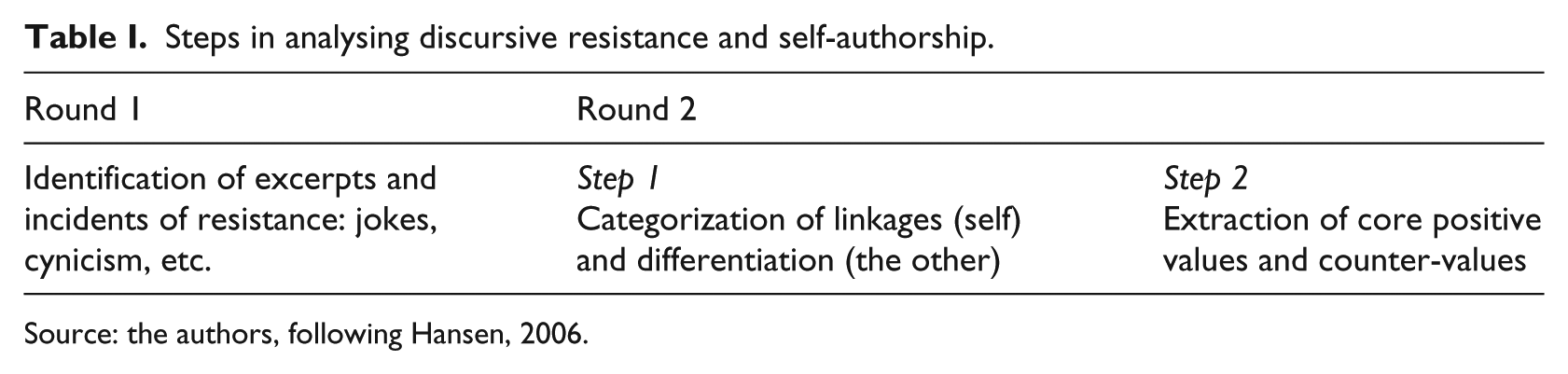
Our primary interest in the present analysis is to delineate and examine the possible array of discourses of resistance and self-authorship exhibited by the for-profit professionals in our study. The first step in the empirical analysis, as illustrated in Table I, is to engage in a close reading of the interview material. This close reading is conducted in order to identify excerpts and incidents where resistance comes to the fore, such as in jokes, cynicisms or stories told of how for-profit professionals exert self-authorship in relation to the ‘invasive order’ of AML/CTF.
Steps in analysing discursive resistance and self-authorship.
Source: the authors, following Hansen, 2006.
In the second, and main, round of analysis, we apply two categories of self-authorship: explicit articulations on linkages and differentiation. These concepts and their use in our analysis are inspired by the work of Hansen (2006). The category of linkages refers to positive values, ‘the self’ and processes of positive identity, whereas differentiation concerns ‘the other’ and more negative values and processes of identity (Hansen, 2006). The intertextual analysis in this round proceeds in two steps. The first is a close re-reading of the excerpts and incidents of resistance to AML/CTF identified in the first round, with a view to exposing the values with which informants connect themselves (linkages, ‘the self’) and the values they decouple and detach themselves from (differentiation, ‘the other’). From this reading we then, in the second step, extract a set of core positive values, along with their counter-values. It is through the findings on these values that we draw conclusions on (affective) resistance on the part of the for-profit professionals in our case and discuss the ensuing implications for the intertwining of finance–security in the chain of security (De Goede, 2017).
A qualitative comparative interview study of the foundry
One reason for the state’s increasing reliance on private actors in securitization is to obtain access to the privileged knowledge of these actors as a resource for mitigating money laundering and terrorist financing. Previous studies of the micro level on the private side of the finance–security nexus in AML/CTF have analysed how banks (e.g. Bergström et al., 2011; Canhoto, 2008; Favarel-Garrigues et al., 2009, 2011) and lawyers (Helgesson and Mörth, 2016, 2018) engage in risk management and risk assessment in AML/CTF. This research also includes specific issues of policing (e.g. Amicelle and Iafolla, 2017) and organizational redesign (Tsingou, 2018). Importantly, in the case of lawyers, issues of access to, and control over, the knowledge and client relations of these for-profit professionals have been employed by bar organizations when resisting being instruments of securitization (CCBE, 2011, 2017; Gallant, 2013; see also Helgesson and Mörth, 2018), thereby impeding the implementation of the regulation (Unger et al., 2014). To be sure, as Terry and Robles (2018) observe, regulation of AML/CTF also pays little heed to the professional values of lawyers. It is against this background, we argue, that lawyers are likely to perceive regulation of AML/CTF as an invasive order that threatens self-determinacy, which, in turn, is an impetus for (affective) resistance on their part. Hence our choice of lawyers as informants in the present study.
The study has a comparative facet, with informants from two sites: the UK and France. These sites were chosen as they represent two ends of the scale in terms of numbers of reports from lawyers to national financial police forces. UK lawyers report several thousand so-called Suspicious Activity Reports every year to the British finance police (the National Crime Agency, which replaced the Serious Organised Crime Agency in 2013). 3 French lawyers report very few, if any, to the French national finance police (Tracfin). 4 Thus, UK lawyers are seemingly compliant (see Helgesson and Mörth, 2016), but can also be viewed as engaging in over-reporting. French lawyers are seemingly less compliant (see Chèvrier, 2004). However, as discussed above, to be (seemingly) compliant does not preclude the presence of discursive resistance. To be (seemingly) compliant still allows for the possibility of resistance taking other forms, which would be fruitful for our focus on how (affective) resistance comes to the fore through self-authorship.
Nevertheless, we acknowledge that we face a methodological conundrum. The notion that compliance can accommodate or even hide resistance, together with the range of discursive practices interpreted as resistance in the literature, begs the question: How do we know if actors engage in resistance if it is not visible from the outside? Following Prasad and Prasad (2000), we argue that this problem of conceptual stretching can at least be handled, if not solved, through an analysis of the specific context of actors’ professional identity and the studied policy area of the discourse. In the present case, we know beforehand that law associations have been critical of their role as reporting entities (CCBE, 2011, 2017). Representatives of the profession have thus identified the AML/CTF obligations as signifying a critical juncture, where discourses of resistance needed to be publicly articulated. For the purposes of this study, this means that the methodological challenge is more to do with how the for-profit professionals studied resist rather than with ascertaining whether they do so.
The core of the empirical study consists of interviews with 14 lawyers in the UK and another 14 in France. Each interview was approximately one hour in length. Interviews were semi-structured with open questions. Questions were designed to enable analyses of the way lawyers talk about themselves, and other actors, in relation to AML/CTF and the obligations laid upon lawyers in securitization. In France, the interviewees were partners in law firms (both national and global). Several of the interviewees also held high-level positions within CARPA (Caisse des Règlement Pécuniaires des Avocats, the entity managing and controlling client accounts in France), and one lawyer had been a bâtonnier (the assigned actor who, in the French system, will submit reports to the French finance police on behalf of lawyers in cases of identified suspicious activities and/or transactions) in Paris for many years. Informants in the UK also worked at prestigious firms and were partners and/or money laundering reporting officers (MLROs) and compliance lawyers. In addition, we had one informant from the Law Society for England and Wales. The interviewees are listed with reference to title/position of interviewee and dates for the interview, as all informants were promised anonymity (which in many cases was a prerequisite for access).
To contextualize the interviews, we have studied documents produced by the lawyers’ and bar associations in the two countries (the Law Society for England and Wales and the French Bar Association, 5 respectively). Moreover, we have participated as observers in meetings on AML/CTF for practising lawyers organized by the two associations (one meeting in each country).
For-profit professionals in the finance–security nexus
In our step-wise analysis, we identified a range of excerpts and incidents where informants exerted self-authorship and resistance in relation to the ‘invasive order’ of AML/CTF. Below, we first highlight some findings from the first round of analysis of excerpts and incidents by providing examples of cynicism, jokes and stories. We then turn to the second and main round of analysis, focusing first on linkages and differentiation, and then on positive values and counter-values, respectively.
Excerpts and incidents: Examples of cynicism, jokes and stories
Though cynical comments and joking were expressed by informants at both sites, we found that cynical comments and explicit joking were more pronounced among UK lawyers. For instance, though the stipulated requirement to obtain independent information on the client was clearly considered cumbersome, it was still described as ‘the fun part of the UK legislation’ (Interview 9). Likewise, though reporting was prevalent, the efficacy of the regime and the results of the lawyers’ participation in securitization were ridiculed. Reporting was ‘nonsense’ (Interview 5). Still, they kept at it. The following anecdote, jocularly recounted by our informant at the Law Society, further underscores the stance of UK lawyers. The story highlights how one subject, the UK Law Society,
6
makes light of the position of another subject, the French bar, in matters of AML/CTF: We had at one point, the French bar said to the president of the Law Society: ‘This reporting thing. I’ve told my members I will go to jail rather than report! Will you go to jail too?’ NN, president at the time, went: ‘I’ll come, and you know, visit you if you like. But I ain’t going to jail for any of my members, sorry.’ And the French bar, I think at that meeting, labelled the UK Law Society as ‘the Vichy regime of money laundering’. (Interview 1)
This story was mirrored in how French lawyers referred to UK lawyers. Here, the sentiment was pejorative rather than jocular. French lawyers described themselves as belonging to a more proper legal profession than solicitors in the UK. In particular, the high-level lawyers at the French CARPA frequently used the term ‘Jersey solicitors’ (Interviews 25–29) when referring to UK lawyers. Still, we also identified some friction across French informants on this issue. Specifically, the reluctance and refusal to file SARs among French lawyers annoyed one of our French interlocutors, a bâtonnier, who maintained that the French lawyers could be regarded as ‘bad students’ (mauvaises elèves) in Europe considering the fact that UK lawyers filed so many reports (Vatier, 2016: 1).
Linkages and differentiation
Turning now to the analysis of linkages and differentiation, a main theme in the accounts of the relationship between lawyers and the order of AML/CTF was discourses on differentiation and ‘the other’. An ‘other’ that was summoned across informants was ‘the bank’ or financial services. This other was used to differentiate lawyers from other private actors without the credentials of their profession. In the words of one lawyer, ‘the directives still are written with the financial services industry in mind, and not with the professional services industry’ (Interview 3). Excerpts like this one thus underscore the professional character of ‘the self’ expressed by lawyers.
The differentiation from ‘banks’ was further explained through the use of linkages showcasing what client confidentiality meant for ‘the self’ in its relation to clients. For instance, among UK lawyers, the demand to report without ‘tipping off’ the client was reinterpreted so as to fit a competent professional self who was knowledgeable of clients and their affairs. In consequence, lawyers did not need new regulation to tell them what was suspicious and not: they already knew how to assess clients and risks on the basis of their professional knowledge and experience (Interview 13). Banks were portrayed as having short-term transactional relationships with clients, whereas lawyers had long-term and close confidential client relationships. Lawyers only took on clients they could trust: ‘When it comes to French clients, we are quite relaxed about it,’ as one of the interlocutors said (Interview 16). Like UK lawyers, the partner also emphasized how knowing a client and interacting face to face formed the basis for making judgements about trustworthiness and credibility. French lawyers are expected to be very prudent and vigilante when they obtain information from the clients, as a former director of CARPA expressed it (Interview 19). AML was no exception, it was argued. When queried, this interlocutor also explained that being ‘relaxed’ meant that one did not in fact keep any designated records on AML risk identification and risk management on French clients. The AML regulation served as a resource to draw on when helping clients avoid dealing with unknown parties that could implicate them in money laundering or terrorist financing. In practice, it was thus quite rare for the various bâtonniers to file SARs, and presumably rather rare for French lawyers to identify suspicious transactions and individuals, in contrast to UK lawyers.
Though a prevalent concern among UK lawyers, the issue of client privilege was laden with more affects among French lawyers. Client privilege was not just about client rights and interests: it was considered absolute – ‘le secret est absolu’, as three French partners put it (Interviews 20, 21, 23) – and was a matter of total confidence between lawyer and client. Client privilege was infused with values of the profession and formed part of who the lawyers were as professional selves: It’s the pride of the profession to have this obligation by law, which is legally sanctioned. But it is also a right. (Interview 18)
In line with this, French lawyers articulated more explicit resentment towards the state treating them like any ‘other’ reporting entity – notably banks. There was thus a recurring self-authorship of differentiation by the lawyers that emphasized that they were not banks, and that the legislation on AML/CTF was designed for the banking sector and not for legal professionals.
Several of our French interlocutors further likened their profession to that of a priest (comme un prêtre) (Interviews 20, 21, 24), linking the actions of their expressed selves accordingly. French lawyers did not merely advise clients: they handled their confessions (confession) (Interviews 21, 23). In consequence, theirs was not a profession where transparency was imperative (Interview 24). The truth (la verité) was not a self-evident aim either (Interview 23). Lawyers are not interested in crime prevention, it was argued (Interview 18). Rather, the secrecy, client confidentiality, was what mattered (Interview 24). French lawyers told of how it was difficult to know when confidentiality ‘begins and ends’ (Interviews 22, 23), which implies that the state’s notion that lawyers can be ‘complicit’ is more complicated from the perspective of the profession (Interviews 23, 24). The existing exemption from the obligation to report during judicial proceedings was therefore theoretical and not very useful in practice, it was said (Interviews 18, 19). The legislator had misunderstood the meaning of ‘secrecy’ for lawyers, and had confused it with bank secrecy, according to a French bâtonnier. In fact, banks are not obliged to maintain secrecy to the same extent as lawyers (Vatier, 2016).
Discourses on resistance in terms of differentiation and the ‘other’ also involved the state. Among UK lawyers, the AML/CTF obligations of the state were constituted as a threat to their independence, necessitating differentiation and careful evaluation of how to take on the designated position of resilient subject in AML/CTF. Our interlocutor at the Law Society reflected on the importance of the Law Society’s task force for identifying the threat, and for limiting adverse effects on the profession: the task force group [of the Law Society] were kind of like going, ‘Well, we can’t, we can’t go to jail, and our members can’t go to jail, and we have to figure this out.’ And I think that’s the fact that our board, or our task force group, pretty much were all money laundering reporting officers. They were the ones who were gonna go to jail if we didn’t get it right. So they had to figure out how to do it. (Interview 1)
UK lawyers highlighted instances of differentiation where they evoked a professional self that put up resistance towards undue and unreasonable affects on their professional practice, including reporting ‘nonsense’. Moreover, though irritation with AML/CTF was acknowledged, they presented selves that did not easily submit to acting in affect, even when circumstances were unreasonable: I was prepared to write off all the time – the deal aborted. I was prepared to write off all the time, you know, that four thousand quid’s worth, ’cause I just couldn’t face trying to deal with the client! (Interview 8)
Among UK lawyers, differentiation from the state involved not being ‘the police’. The stance of UK lawyers was that the police had obligations to police, while lawyers had other obligations in society, including obligations to provide professional services and advice to clients. One UK informant used the metaphors of ‘guard dog’ and ‘bloodhound’ to describe the professional self under the order of AML/CTF and the reasonable response of the self in this situation: I’m a guard dog, not a bloodhound. So I’m there to spot the obvious, and act as a deterrent. Not to hunt down every bit of information possible. (Interview 9)
Among the French lawyers, the reluctance of the state to acknowledge their ongoing professional obligations and values carried more affects. It was interpreted as a move of aggression: the AML/CTF legislation was another means for the state to attempt to control a profession that it had never ‘trusted’ (Interview 18). For the French lawyers, the ‘other’ of state agents was not a diligent bloodhound but a reprehensible collaborator. When reflecting on AML regulation and reporting, our French interlocutors
7
recurrently drew parallels with the dark experience of World War II to explain the views of the law profession. One of the interlocutors explained why ‘Vichy’ came up in the discussions. It was because what was asked of lawyers in terms of reporting under AML/CTF was ‘treason’ (Interview 20). One had to understand, the French lawyers argued, that reporting on clients to the state was far from a neutral action. Within an historical frame, reporting had strong negative connotations and was associated with being an informer or a collaborator: Historically, it’s not well seen to you know, denounce [dénoncer] people, because of, you know, World War II and so on. And I think, and I think for people it’s quite difficult to enter into this sort of…. You know in France, we don’t hold, we can’t hold the statistics on origins, and where you are coming from, and, you know, minorities and so on. (Interview 16)
Moreover, the French bar argued that even if the battle against terrorism was legitimate, they refused to be informants (delateurs) or helpers (auxiliaires) to the police, because it would mean that lawyers denied their professional oath and essential values (Conseil National des Barreux, 2012: 3). In line with this, it issued a report titled How Not To Report (Dissuader pour ne pas denoncer).
An important consequence of the strong version of client privilege applied in France is how the French bar appealed against reporting (Conseil National des Barreux, 2012). The position taken by the French bar towards AML was that lawyers ought to be exempt from reporting obligations. The French bar argued that the obligation to report directly to the financial police violated important articles of the European Convention on Human Rights (Articles 6 and 8) and other fundamental rights in European Community law, and held that the state’s AML requirement for lawyers to break client privilege strongly diminished ‘le secret professional’ (Conseil National des Barreux, 2012: 8). In 2008, the Conseil d’Etat (2008), the highest administrative court, ruled that French lawyers were not required to report directly to law enforcement but to the bâtonnier. One lawyer even told the story of a lawyer he knew who had contacted a bâtonnier to file a SAR, where the bâtonnier had responded by asking the lawyer if he wanted to ruin his reputation (Interview 16).
Core positive values and counter-values
Turning now to core positive values and counter-values, we identify several positive core values from the discourses on resistance. The first is client privilege and confidentiality, which involves having a special and unique relationship with long-term clients that lawyers as professionals can trust. These values were particularly strong among French lawyers. The comparison with being a priest among the French lawyers emphasized the sacred value of strict loyalty to clients, even if this meant not disclosing potentially criminal activities. However, French lawyers stood by values of being prudent and vigilant when meeting new clients. In addition to client privilege, we find that UK lawyers linked themselves to values of being ‘reasonable’ and flexible. In so doing, they evoked the counter-values of a stylized French lawyer who (over)dramatized the designated position of resilient subject and the threat stemming from the AML/CTF regulation that that position represented. In contrast, French lawyers underscored the values of professional ethics at the core of their selves by evoking a stylized UK lawyer of questionable repute.
There was further a consensual agreement among the lawyers that they were not just any private actors: they are and have the knowledge to make professional judgements on behalf of clients. It is with these values that the lawyers construct their self and differentiate it from ‘the other’. In so doing, they protect a space where professional identity is safeguarded. The counter-values, the negative values, are linked to what banks were perceived to be about in their relation to clients – quick exchange relationships. Lawyers will comply, but only to a degree. Unlike banks, they are not ‘true’ reporting entities.
We thus find that resisting via linkages is instrumental for lawyers to (re)construct boundaries between themselves and the state. Making use of linkages, the self and positive values when authoring identity, lawyers explicitly fortify the (existing) space in which they are in charge of who they are. Lawyers are professionals. They are there for the client. Ultimately, they are guardians of the rule of law, neither bloodhounds nor collaborators.
Discursive resistance and the self-authorship of resisting subjects
To sum up, our empirical analysis demonstrates how lawyers in the two sites experienced the regulation of AML/CTF as an invasive and hegemonic order that constituted a threat to self-determinacy. The response was resistance through self-authorship. In this section, we have shown how lawyers constructed a space where professional identity was safeguarded. In so doing, they took on a role of resisting subject in opposition to that of resilient subject in AML/CTF.
Our findings further expose differences across sites. The perceived urgency of the threat from the invasive order varied, and this was consequential for the response of the for-profit professionals. The experience of a power struggle in securitization by command and control between the threatening invasive order of AML/CTF, on one hand, and the strong for-profit professional group, on the other, was more explicit among French lawyers. French lawyers perceived the threat from the invasive order as imminent and resisted ‘in affect’. At the centre of this affective resistance were attempts to author selves that kept the threat at arm’s length, thereby protecting core values of professional identity. UK lawyers did not perceive the threat from the invasive order as equally pressing. They therefore did not resist ‘in affect’, we find. Rather, they assessed the potential affects of the threat on self-determinacy. The self-authorship of UK lawyers was thereby directed towards engaging with the threat in order to defuse it and make it more manageable, not just to keep it at a distance, while bringing forth a ‘reasonable’ professional self.
Conclusions and outlook
De Goede’s (2017) notion of the chain of security outlines the interlinking of finance and security across the public–private divide within AML/CTF. In that chain, private actors are tasked with forging the first link, as epitomized by their sending off SARs to the competent authorities. Speaking with Kaufmann (2016: 100), resilience relies ‘upon the subject’s capacity to be affected and its power to respond to urgency with action’. In AML/CTF, we argue that the chain of security illustrates how private actors are placed in the position of resilient subject in relation to the threats of money laundering and terrorist financing. Private actors are thus at the frontline of securitization and central for how the intertwining of finance and security evolves.
Against this background, the aim of the present article was to contribute to the theorization of private actors in the finance–security nexus. For that purpose, we have analysed how the delegated authority bestowed on private actors in AML/CTF could also be perceived as an expression of a threatening invasive and hegemonic order (see, for example, Howarth and Torfing, 2005): in order to reap the possible benefits offered by the security paradigm in ‘the war on terror’, private actors must relinquish a degree of self-determinacy. Moreover, we have underscored that this caveat could be cause for some private actors to resist their designated role as resilient subjects in AML/CTF. Here, we used the concept of the ‘for-profit professional’ (Helgesson and Mörth, 2016) to emphasize a focus on private actors governed by professional norms and values that were likely to perceive regulation on AML/CTF as a threatening invasive order. We then analysed one group of for-profit professionals, lawyers, and examined how they resisted being resilient subjects of securitization by exerting self-authorship in relation to the order of AML/CTF.
A main conclusion is that rather than accepting the role of resilient subject in AML/CTF, the for-profit professionals in our case invoked a role of resisting subject. Our stepwise intertextual analysis, drawing on Hansen’s (2006) work on discourse analysis of linkages and differentiation, identified how lawyers engaged in self-authorship and (re)constructed boundaries between their professional selves and the state. In this way, actors became resisting subjects when faced with obligations to be resilient. Our findings thus imply that even when designated resilient subjects do appear to have the ‘power to respond to urgency with action’ (Kaufmann, 2016: 100), they may still choose not to respond with urgency, or indeed at all.
With a view to De Goede’s (2017) chain of security, our findings further demonstrate how the private actor foundry charged with forging the first link in that chain may not fully function as the chain implies. We have also pointed to a possible cause for this outcome – that the AML/CTF regime is perceived as a threatening invasive order by the for-profit professionals. The chain of security is useful for highlighting the assigned role of private actors in AML/CTF, as well as for emphasizing the multitude of translations involved when knowledge travels through its links and across the public–private divide. However, our results suggest that the notion of a chain of security still needs to be handled with caution to avoid unwarranted reification of the role of private actors in the finance–security nexus. Future studies could look further into how translations further up the chain are impeded and impacted by the presence of resisting subjects at its beginning.
Footnotes
Acknowledgements
The authors wish to thank the anonymous reviewers for their helpful comments and feedback.
Funding
This research received financial support from the Ragnar Söderberg Foundation (Grant EF3/12/10), and from the Swedish Research Council (Grant HS 2014-648).
