



Abstract
It is today common to argue that rape is a weapon, tool or instrument of warfare. One implication is that armed groups marshal body parts for tactical and strategic ends. In this article, I interrogate this discourse of embodied mobilization to explore how body weaponry has been made intelligible as a medium for sexual violence. First, I show that, despite wide rejection of essentialist models, the penis and penis substitutes continue to occupy a constitutive role in discussions of sexual violence in both political and academic fora, where they are often said to be like weapons, a tendency I term ‘weapon talk’. Second, I trace the image of the body weapon in key threads of feminist theorizing and commentary, to show how the penis has appeared as a ‘basic weapon of force’ in various permutations. Third, I explore the weaponization of the body as it appears in military thought and in the cultural circulation of ideas about the soldiering body in which sexual pleasure and violence are frequently conflated. Building on this foundation, I propose that these literatures collectively describe an uncanny weapon object, and I draw out the significance of this term for feminist security studies and martial empiricism. In short, the uncanny haunts accounts of sexual violence in the collision of sexuality and machinery in the image of a body weapon, in the unsettling designation of sexuality as itself both familiar and dangerous, and in the strange movement of violent bodies across the boundary between wartime and peacetime. A concluding discussion draws out implications and challenges for thinking about embodied violence, advocating renewed attention to the history of weaponization as a fallible and confounding process.
Introduction
How does the body become a weapon? Posing the question presumes the existence of a problem: that there is something puzzling in the body taking weapon form. The body is, of course, always implicated in acts of violence. Since humans are irrevocably embodied, war cannot be made without a great multitude of corporeal investments, among them patriotism’s elevation of the heart rate, the labour power of military logistics, transformations of poise and reflex in basic training, and the displacement of populations in war’s wake. Yet, for all the banality of embodiment, some bodily harms continue to exert a special fascination by virtue of their intensity, and so appear exceptional in comparison to the quotidian traffic of war. Recent works have taken up the experience of the suicide bomber, the self-immolator and the hunger striker as exemplary (Bargu, 2014; Fierke, 2012; Wilcox, 2015). The body that captivates, that prompts ethical reflection or provides resources for understanding power, is most often the body of war’s victim (see, for example, Gregory, 2016). ‘The body’ – both actual and abstract – thus figures significantly in critical military and feminist literatures as an anchor for experience, a reminder of shared vulnerability and moral obligation, and a rebuke against theoretical abstractions (see, for example, Sylvester, 2012). The body, in Swati Parashar’s (2013: 626) suggestive phrase, is a ‘log book’ of war.
This article concerns one form of the weapon body at war: as a medium for the perpetration of sexual violence. The currently hegemonic view of ‘rape as a weapon of war’ invites questions about how bodies and body parts are designed and mobilized by armed groups, how these efforts relate to wider cultures of misogyny and militarism, and how training and doctrine that promotes or condones sexual violence is experienced by combatants. Recent re-evaluations of the distinctly sexual aspect of sexual violence indicate the need for a radically historicizing view of how bodies have been primed for violence (Eriksson Baaz and Stern, 2018; for a powerful example of historical work on sexuality and militarism, see Theweleit, 1987; also Gomel, 1998). Given the volume of writing and advocacy on the topic, there is clearly widespread recognition that wartime sexual violence is a brutal human rights violation. From these accounts, it may seem evident that war rape depends significantly on the use of the penis as a kind of weapon. But what may appear as an underlying physiological fact instead throws up a number of conceptual problems. What does it mean for violence to be sexual? Does the sexual dimension of violence imply a specific zone of embodiment, or a greater degree of embodiment than is the case for non-sexual violence? What kind of embodied animus, if any, is necessary for sexual violence to take place? How is the ‘masculine’ or ‘patriarchal’ character of violence correlated with the gendered body of the perpetrator of violence? And in what ways do military practices amplify or constrain the weaponization of the body? Despite the recent explosion in literature on sexual violence, these questions have been examined briefly, obliquely, or not at all. In focusing specifically on the penis as a locus for discourses of sexual violence, I therefore heed the injunction to take seriously the erotic and sexual dimension of military culture (most recently Crane-Seeber, 2016), even as key conceptual distinctions (between the sexual and the non-sexual, the war and the non-war, the body and the object) become less secure as the analysis unfolds.
In what follows, I trace how the body weapon has been interpreted by an eclectic array of feminist and military theorists. A close reading of the weapon motif reveals constitutive tensions in the interpretation of sexual violence, which in turn draw our attention to the uncanniness of sexual violence as embodied violence. I emphasize the double character of ‘interpretation’: scholars interpret empirical material and codify it according to disciplinary and methodological standards; but interpretation is also an activity of war’s participants and victims, who themselves reason about the types and causes of violence. Activists, artists and citizens in turn commemorate, memorialize and critique war. Like the other contributors to this special issue, I do not seek a definitive general theory of warring. Instead, I explore the diverging and contradictory ways in which the perpetrator body has been represented in political advocacy, feminist criticism and war thought. 1 I treat these representations not just as abstractions imposed haphazardly on the fogged reality of conflict, but as images that disclose a radically troubling field of war experience.
Although nominally at odds, feminist criticism and war thought have both taken up the theme of the body weapon, if often in fragmentary and partial ways, and I use this material to sketch a map of unruly bodies, or what Derek Gregory (2015) calls a corpography of war. By framing the weapon body in this way, I take up to two central wagers of martial empiricism: that the generative powers of war frequently produce weird, paradoxical and mysterious effects; and that the phenomena of war may be understood by starting ‘in the middle’ of a clash of fragmentary ideas and histories (Bousquet et al., 2020). A first section of the article documents the emergence of weapon metaphors – part of what I term ‘weapon talk’ – in international politics, and shows how the association of sexual violence with war objects has facilitated the application of a gender perspective in conventional security fora. In this, I follow others who have shown the importance and significant limits of ‘weapon of war’ discourse (Buss, 2009; Cohen, 2016; Eriksson Baaz and Stern, 2013; Gray, 2019; Swaine, 2015; Wood, 2018). In the second part, I begin to uncover the history of weapon talk by tracing a thread of thinking in feminist theory that has debated the status of the penis as a ‘basic weapon of force’ in various permutations. This story is not straightforward: although key motifs from the feminist literature of the 1990s have made their way into contemporary weapon talk, other aspects of feminist theory undermine monolithic readings of the body weapon. I then turn to a parallel concern in war studies with the relative degree of ‘phenomenological unity’ in acts of killing, where sexual pleasure and violence are frequently conflated. Drawing on recent scholarship, I suggest the value of a martial empiricist approach for understanding the emergence and operation of body weapons. A fourth section ties preceding threads of the argument together with the concept of the uncanny, signifying that which is both unsettling and familiar, experienced as a ‘crisis of the natural’ (Royle, 2003: 1). The uncanny is not an explanation for the prevalence of sexual violence in times of war, but a designation of affect, of war feeling, traceable in figurations of the weapon body. Feminist criticism and war thought both draw attention to the paradoxical status of a form of violence that is embodied, and thus integral to gendered personhood, but that at the same time also appears, or is assumed, to undergo a transformation in times of war: a movement between the organic and the mechanical, the familiar and the sinister, intimate but at the same time instrumental. The uncanny haunts our accounts of sexual violence in the collision of sexuality and machinery, in the unsettling designation of sexuality itself, and in the movement of violent bodies across the border between wartime and peacetime. A final discussion draws out some implications and challenges, and advocates renewed attention to the history of weaponization as a fallible and confounding process on the continuum of embodied violence.
This topic can provoke profound discomfort. The unease in reading this material, and in collating and writing about it, can be hard to articulate, echoing the haunting and horrifying dimensions of the uncanny weapon object itself. A focus on the penis as embodied weapon may seem to reify a partial view of sexual violence or endorse essentialist notions of victim and perpetrator. An article-length study of how this body part is depicted in feminist criticism and war thought perhaps appears indulgent or irrelevant given the more pressing matters of explanation and prevention. More, attending to the body of the perpetrator risks excluding the voices of victims and survivors, directing a kind of sympathy towards the agent of suffering. This last danger perhaps explains why the terminology of ‘weaponization’ has most often been applied to bodies that are seen as resisting, rather than enforcing, dominant power relations (see, for example, O’Branski, 2014). Each of these dangers demands a certain cautiousness, though each may also be qualified somewhat in advance. I argue that the penis is already commonly, if indirectly, cited as a body weapon in the literature on sexual violence, but that the significance of this framing has been under-appreciated. Reconstructing the history of this image brings to the surface a vexed relationship between the body, sexualization, weaponry and war, but does not imply that there is one uniform essence to that relationship. Despite the extended discussion of phallic metaphors, the material I present is in many ways less graphic than the testimony of sexual violence commonly included in scholarship on this theme. Although it would in principle be possible to read the uncanniness of body weapons through survivor testimony, my focus is largely on scholarly attempts to make sense of sex and war. Abstraction from the detail of atrocity may read as cold detachment, but lingering on the scene of violence is itself perilous and can contribute to a voyeuristic spectacle (see, from various perspectives, Boesten and Henry, 2018; Hartman, 1997; Segal, 1998), not least when the presumed location of violence is a civil war in Africa. This intervention, then, should be read not as a definitive survey or theory, but as a contribution to critical reflection on the explanatory frames, political rhetoric and popular representations that are applied to, and help define, gender violence.
Weapon talk
References to rape as a weapon, strategy, tactic, instrument or tool of war are today common to the point of ubiquity. The terms are largely interchangeable in practice, peppering government, academic and NGO publications and, in more pronounced form, the declarations of activists, journalists and politicians. ‘Weapon talk’ – the web of associations between acts of sexual violence, scenes of battle and weapon imagery – may be traced at least as far back as the Bosnian War of the mid-1990s, when sexual violence was announced in a brief notice in the New York Times (1993) as having taken on a new character, marked by ‘conscious intention . . . a strategic purpose in itself’. But weapon talk reached a peak in the years either side of UN Security Council Resolution 1820, which consolidated the view of sexual violence as a sometime ‘tactic of war . . . or . . . part of a widespread or systematic attack against civilian populations’ (UN Security Council, 2008). Under close scrutiny, weapon talk yields differing hypotheses and emphases, but almost always turns on a figurative relation between the act of rape and lethal military objects.
Some key examples among many: In 2009, an Amnesty International campaign coinciding with International Women’s Day declared rape to be cheaper than bullets (see Figure 1). Noting Amnesty’s slogan, Mark Malloch-Brown (2009), a junior minister in the UK’s Foreign and Commonwealth Office, asserted that ‘rape is just as effective as traditional artillery, but it is easier to obtain and cheaper to use’. Eve Ensler, author of the Vagina Monologues and founder of the City of Joy, a refuge for survivors of sexual violence in the eastern Democratic Republic of the Congo, concurred: ‘rape is a very cheap method of warfare. You don’t have to buy Scud missiles or hand grenades’ (National Public Radio, 2009). Denis Mukwege, founder and chief gynaecologist at the nearby Panzi Hospital, has stated that ‘rape . . . as a war strategy’ is ‘the most important reason, among others’ for widespread sexual violence in the region (National Public Radio, 2009). In 2019, Mukwege shared the Nobel Peace Prize with Nadia Murad specifically for their campaigns ‘to end the use of sexual violence as a weapon of war’ (Nobel Prize, 2018, emphasis added). Introducing a 2013 Security Council resolution, British Foreign Secretary William Hague argued that the international community needed to understand that rape was a ‘weapon of war . . . used to destroy lives, tear apart communities, and achieve military objectives, just the same way that tanks and bullets are’ (Hague, 2013, emphasis added). The symmetry with conventional armaments has been repeatedly invoked in the Security Council chamber, indicating the importance of weapon talk for introducing sexual violence into the discursive field of ‘international peace and security’ (for a detailed history, see Crawford, 2017). Thus Zainab Bangura, former foreign minister of Sierra Leone and then special representative of the secretary-general on sexual violence in conflict, speaking in 2014: ‘today it is still largely cost-free to rape a women, child or man in conflict. Sexual violence has been used through the ages precisely because it is such a cheap and devastating weapon’ (UN Security Council, 2014: 5).

‘Rape is cheaper than bullets.’
In the terms offered by Bangura, Hague, Mukwege, Ensler, Malloch-Brown and Amnesty International, the recognition of wartime sexual violence is bound up with the weapon form and its equivalence with other objects in an armoury. Equivalence is also calculability: in this conception of military planning, commanders identify rape as ‘the cheapest weapon of mass destruction’ (Strudwick, 2014) and act accordingly. Weapon talk encompasses two complementary rhetorical manoeuvres: the transformation of the body into an object (rape is like a gun, a tool, an instrument) and the subordination of sexualized violence to a rational military purpose (rape is a tactic, strategy, policy). 2 In any given instance, emphasis may be put on one or other side of the association, though the cumulative effect is to reinforce the sense of the body (a specific zone of the body, the body organized in a specific way) as a deployable resource. To be a weapon of war is to be a fungible element, readily mobilized within a general economy of destructiveness. Weapon status also then implies the possibility of abolition, a disarmament comparable to campaigns against chemical weapons and cluster munitions (see Eriksson Baaz and Stern, 2013: 51; Hague, 2013).
The weapon metaphor conveys purpose and agency; more, it communicates the experience of pain. As Elaine Scarry (1985: 16) argues, it is ‘not just that pain can be apprehended in the image of the weapon (or wound) but that it almost cannot be apprehended without it’. And yet there is at the same time a deep inadequacy to weapon talk: ‘the mere appearance of the sign of a weapon in a spoken sentence, a written paragraph, or a visual image . . . does not mean that there has been any attempt to present pain and, on the contrary, often means that the nature of pain has been pushed into deeper obscurity’ (Scarry, 1985: 18).
Representations of bodily pain elicit strong responses, can prompt recognition of the suffering of others, but also raise vexing questions about empathy, spectatorship and moral obligation. The wounded body is a mobilizing image. A common refrain of civil society advocacy is that wartime sexual violence makes the body into a battlefield, meaning that victim-survivors have their bodies turned against them (see, for example, Justice and Reconciliation Project, 2015). The horror of rape results from the treatment of bodies, the pain inflicted on them, pain with profound social significations and repercussions, but stems also from the fact that the violence is being done by and through bodies in a certain configuration. One of the commonly cited motives for wartime sexual violence – to wreak havoc by sundering communal norms – indeed depends on this use of bodies being improper, and understood as such by perpetrators, victims and bystanders alike.
Weapon talk has proved politically indispensable to advancing a feminist agenda at the United Nations and elsewhere (Crawford, 2017). As the excerpts from politicians and activists illustrate, an ‘international peace and security’ framing is facilitated by the equivalence with weaponry. 3 For example, in the reports of the UN Secretary General to the Security Council on conflict-related sexual violence, the emphasis on sexual violence as ‘tactic of war and terrorism’ has become more pronounced over time. 4 Yet the metaphor is also flawed: ‘rape’ is an act of violence like ‘murder’, not an instrument of violence like ‘the bullet’. In the formulae of weapon talk, the instrument of rape, the would-be equivalent of the tank, bullet or artillery battery, is rarely identified explicitly. Typologies of sexual violence today detail multiple forms of gendered harm beyond penetrative rape, but it is nevertheless the penis (occasionally the penis substitute) that remains central. In the frequent allusions to tools and weapons, the penis and its doppelgängers are ‘alluded to but not stated’ (Eriksson Baaz and Stern, 2013: 58). Others have already noted that ‘the penis is typically framed as a weapon’, and that most policy discourse assumes the ‘war functionality of the penis’ (Clark, 2019: 780). In the rhetoric of weapon talk, it is as though martial rape entailed a kind of autotopagnosia, in which the perpetrator fails to recognize his genitals as an intimate part of his person, properly intended for mutual pleasure, and instead mistakes it for an inanimate object, a tool-thing. The implicit but largely untheorized designation of the penis as a kind of weapon exemplifies ‘Scarry’s paradox’: war is the most radically embodying event of human experience, and yet the character of embodiment is disavowed in conventional ways of talking about war (McSorley, 2013: 3).
‘The basic weapon of force’
Weapon talk could be more easily dismissed as merely an advocacy shorthand were it not for the longer history of imagining the body as a weapon. Feminist thinkers and activists have worked to dismantle justifications of sexual violence as natural, private or inevitable, and feminist discourse has therefore been preoccupied with the relationship between violence and embodiment. The intensity of feminist debates over how to characterize wartime sexual violence, and how best to relate it to forms of domination outside of a discrete ‘war time’ indicate differing theorizations of bodily capacity and transformation. That the association of the penis and the weapon recurs in this literature suggests at a minimum the importance of such rhetoric for the critique of sexual violence. However, feminist deployments of the weapon metaphor should not be taken to imply acceptance of simplistic policy narratives or a validation of causal hypotheses that interpret ‘weapon’ only as hierarchical military strategy (for discussion, see Cohen, 2016; Wood, 2018). Rather, feminist thought is an archive in which the male body is conjured, its meaning and function troubled, leaving a complex legacy for contemporary projects of governance and prevention.
Feminist scholars, who were the first to set out the logic of rape as a weapon of war, have become progressively less convinced of the general strategic function of sexual violence, and increasingly wary of the political effects of attention to war rape couched in those terms (see, for example, Buss, 2009; Swaine, 2015). Though many feminists broadly endorsed weapon talk as a counter to the evolutionary theory of rape as an inevitable expression of heterosexual male lust (Eriksson Baaz and Stern, 2018), influential feminist arguments also varied subtly in the role they attributed to military rationality and conscious design. In perhaps the single most-cited article on the topic, feminist philosopher Claudia Card identified wartime sexual violence as an instrument of terror designed for enslavement and subservience. Conceding the many possible motives for individual rapists, Card (1996: 9) nevertheless resolved them into a higher strategic unity, ‘appreciable at the level of authority and command’. Catharine MacKinnon (1994: 187), the pre-eminent feminist legal theorist of sexual violence, regarded mass rape in the Bosnian War as ‘reproductive violation’ amounting to ‘a tool, a tactic, a policy, a plan, a strategy, and an instrumentality, as well as a practice’. MacKinnon’s variations indicate the shifting terrain of strategic language and the difficulty in isolating discrete motives. ‘A tactic’ signals battlefield purpose, bounded in space and time; ‘a tool’ some more adaptable element; ‘a policy’ either permissive (no one will be punished) or active (rape is a direct order); ‘an instrumentality’ revealing a deeper calculus; ‘practice’ suggestive of behaviour that is acquired, habitual, and socially sanctioned.
Others have attended less to concrete military benefits than to the utility of rape within what Megan MacKenzie (2010: 205–206) has called the ‘conjugal order’: the model of the heterosexual family as the fundamental unit of social life. On this view, rape is effective because it disrupts the symbolic relations of kinship, humiliating the adult male by the transgression of the sexual contract that marks the wife, sister or daughter as a kind of property and stand-in for the collective national body (see also Seifert, 1994). Rape becomes ‘useful’ to the extent that an audience will understand it as a desecration. Despite differences in explanatory logic, the perpetrator body appears across these accounts as mutable, directed in some moments by communal antipathies and in others by rational plans. The reason of those in authority is crucial, their foreknowledge and intent being what makes rape a weapon like any other, but also irrelevant, to the extent that logical flaws in their reasoning, or weird beliefs about sex and gender, may be disregarded, since it is the special effects of rape that make it a weapon unlike any other (see Card, 2008: 183–185).
Not all weapon talk is literal in intent, and there are other possible referents for ‘weapon’ apart from the penis. Yet the bodiliness of rape retains a special significance in many accounts, akin to an originary scene of violence or an ideal type of rape to which other conceptions of sexual violence refer. That sexual violence is embodied – and that the violence is carried out by a body-part-as-weapon – is closely tied to the emphasis on strategy. The link between the penis and the tool of war is perhaps most evident in the case of forced pregnancy, or what has been described as the deployment of ‘sperm . . . as a weapon of biological warfare’ (Card, 2008: 176; see also Diken and Laustsen, 2005; Schott, 2011). The designation of sexual violence as an element of genocide – a development closely linked to feminist advocacy and the rise of weapon talk – has tended to ‘assume, implicitly or explicitly, that the male sex of the perpetrator is a constitutive feature of the gendering of the violence’ (Sjoberg, 2016: 21). The penis is at times made the locus of genocidal sexual violence to such an extent that the link between impregnation and social death has been granted its own special biopolitical category: thanatonatality, ‘the strange paradox that the generative dimension of human sexuality is transformed into an instrument of death’ (Schott, 2015: 406). The specificity of the male body and male genitalia as a tool has been invoked more broadly still in weapon talk, where HIV/AIDS is cited as ‘a new weapon of war’ (Singer, 2002: 152), as ‘a novel psychological and biological weapon of war’ (Elbe, 2002: 167), and as an infection ‘weaponized’ across multiple conflicts (Aginam, 2012; Mills and Nachega, 2006). 5
Feminist critics of international law have long opposed ‘mechanical’ definitions of rape in which proof of war crimes depended on the degree of physical invasion rather than the context of a coercive environment (Fountain, 2013; MacKinnon, 2006; see also Mibenge, 2013). Reforms to international legal practice – among them the recognition of a broad set of sexual violence crimes – have codified the point. The penis-weapon has no special legal standing as a tool of violence: it may frequently be involved, but grave sexual crimes are entirely possible without it. And yet the definition of the International Criminal Court (2011: 8) – in which rape may also be accomplished by ‘any object or any other part of the body’ – nevertheless locates these invasions as secondary to penetration by the penis. The other objects are used as though they were body parts, replicas or parodies of an original. The apparent categorical slippage between genitalia and tools may even be noted in conventional social science definitions of rape as ‘coerced . . . penetration . . . by the penis or another object’ (Cohen, 2016: 4, emphasis added; see also Wood, 2006: 308), where the intimate body part is already figured as inert and external to the perpetrator’s body.
The somewhat overlapping and somewhat diverging meanings attributed to the penis-weapon reflect a persistent difficulty in accounting for embodied violence. The concern is conceptual, political, even mythical, as seen, for instance, in Claudia Card’s infamous conclusion to ‘Rape as a Weapon of War’: The message of domination is communicated not only by the ability to impregnate but by the ability to penetrate forcibly. Penis removal would not, of course, prevent rape with other phallic physical instruments. But it would attack the primary symbol of male dominance (which is what suggests the use of such other weapons) with which a rapist or potential rapist is most likely to identify intimately. What needs to go is the phallus. (Card, 1996: 15, emphasis in original)
Card’s speculative proposal, initially put aside until women commanded greater ‘martial power’ (Card, 1996: 16), and then renounced altogether (Card, 1997), fixated on the physicality of the penis-as-weapon. On this logic, the male body may cease to be a latent weapon, but only by removal of the most male body part (other drastic surgical interventions being insufficient). The gendered character of rape is of such intensity that even where a penis is not used it is nevertheless present, the body part to which weapon objects refer (the ‘other phallic physical instruments’). At the same time that the fantasy of punishment focuses on the penis, the true adversary is the phallus, for it is the phallus that secures masculine dominance. In psychoanalytic terms, the penis is technically only one instantiation of the phallus, although in this instance the two are treated as identical. In Card’s rendering, the penis is more than a potential bodily weapon object; it is also an archetype, so saturated with significance that there may be any number of objects that stand in for it. It is not the penis that is being used on occasion as though it were a stick or gun, but the stick or gun that are being used as surrogates for the penis.
The mechanistic view of sexual violence treats the penis as just another weapon, albeit one that is granted special battlefield effects. Despite proceeding from a radically different starting point, some feminist theory nevertheless attributes an objective weapon quality to the penis, even as it is infused with erotic agency. In relation to the ‘quasi-autonomy’ of the penis, Elizabeth Grosz (1994: 200) has written that: It may help explain the alienness of men’s capacity to reify bodily organs . . . to detach themselves from sexual engagement in order to establish a voyeuristic distance, to enjoy witnessing and enacting violence and associate it with sexual pleasure, to enjoy the idea or actuality of sex with children, as an act of conscious cruelty, to use their sexual organs as weapons (and indeed to produce weapons modeled on the image of their sexual organs).
Grosz’s phrasing only lightly modifies Susan Brownmiller’s (1975: 14) prior diagnosis of rape as arising directly from the male body, a brute anatomical disposition: ‘man’s basic weapon of force against woman’. The enforcement of patriarchy (in wartime or otherwise) is again predicated on the interchangeability of weapon objects and body parts. In these excerpts, the phallocentrism is not metaphorical but literal: the corporeal weapon generates violence. 6
Of course, the penis lacks the autarchic potency sometimes ascribed to it. Nor do all feminists afford the penis such sovereignty. The spectre of essentialism – in which gendered bodies are problematically assumed to have ‘natural’ tendencies or a uniform character – hangs over several of these accounts of gender (Hansen, 2000: 298; Harris, 1990). In the progression of feminist debates, emphasis has shifted towards a more open typology of the diverse forms of violence that are invested with sexual meaning in complex and sometimes contradictory ways (see, for example, Eriksson Baaz and Stern, 2013; Hendershot, 2018; Sjoberg, 2016). Because certain embodied forms of violence are seen as susceptible to essentialist theorizing, direct references to body parts are today less common. Many instead emphasize a process of sexualization over any essential characteristics of the male body. As Ann Cahill (2001: 139) defines it, ‘rape is an assault on a person’s embodied sexuality using eroticized weapons, whether or not they are bodily parts’. And yet, though many would accept that both weapons and body parts can be invested with sexual affect in specific war situations, the transformations of subjectivity implied by an eroticization of weaponry have been left largely implicit in the departure from second-wave feminist categories, such that the ‘sexual’ element of sexual violence is left without clear meaning (Eriksson Baaz and Stern, 2018).
‘This is my rifle, this is my gun’
The crude synonymity of genitalia and weaponry is arguably the dominant motif in the vast catalogue of associations between male sexuality and war. It has been traced at least as far back as 41 BCE, when Roman warriors loaded their slings with bullets, or glans – then, as now, meaning the head of a penis – onto which they etched threats of rape (Friedman, 2001: 25), and in as modern an armament as the nuclear weapon, enveloped from the start in priapic metaphors (classically, Cohn, 1987). The testimony of war is frequently highly sexualized, as in the recent recollection of one veteran of the Iraq War: ‘somebody would realize, Fuck, dude, we’re not shooting the right people. But it was like the beast was already going . . . . It’s like having sex with a woman, and she’s saying, “Let’s stop right now.” You can’t. You’re in it’ (Filkins, 2012). In 20th-century pop culture, the affinity between weaponry and male genitalia is encapsulated by the famous drill scene in Stanley Kubrick’s Full Metal Jacket (1987), in which US Marine cadets declaim ‘This is my rifle, this is my gun, this is for fighting, this for fun’, shouldering their carbines and tugging at their genitals in alternating rhythm (see also Mann, 2014: 118). The chant, native to actual US military training (Kovic, 1976: 89), may be read as a confession that the penis is used as a weapon, the rifle a replica of the penis, but also as a juxtaposition maintaining some distance between death and pleasure: one for fighting, the other for fun. 7
The claim that the body is used as a weapon by armed groups, in the manner of a rifle or a bullet, suggests that it is designed and deployed as a technology. As the above survey of weapon talk has shown, through the analogical association with weapon objects, located in a stereotype of battle, sexual violence is implicitly treated as achieved with ease, as mechanized. Although rarely elaborated in such terms, the recognition of the utility of sexual violence by armed groups and militaries themselves implies a whole logistics, where strategists design and optimize the body weapon, calculate its likely effects, and arrange for supply and reinforcement. 8 However, recent attempts to unpack the embodiment of soldiering suggest that technology is not an uncomplicated resource, but instead is deeply entangled with the experience and routines of historically-specific war forms (McSorley, 2012). The warring body has been treated as a kind of technology, or as part of a larger bio-technical apparatus (Brighton, 2004; McSorley, 2012; Martin, 2015). References to the body weapon in war thought parallel what Daniel Pick has identified as a ‘machine mentality’: ‘a certain crossroads of representation: the psyche potentially reduced to a machine-like state, and the machine imbued with excessive destructive power, even a kind of sexual energy’ (Pick, 1993: 21). In this tendency, war itself is figured as an organic, erotically charged activity, while sexual violence is depicted as on a mechanical continuum with other tools of war.
The evolution of military technology is commonly read as a history of increasing detachment, both in the sense of the distance between protagonists and in relation to the emotional disposition towards fighting. A graph in David Grossman’s On Killing (reproduced recently in Gregoire Chamayou’s Drone Theory) gives formal expression to this commonsense (see Figure 2; Grossman, 1995: 98; Chamayou, 2015: 116). The closer the would-be perpetrator is to the target of violence, the more psychological resistance they face in attacking. The form of violence with nearly the highest resistance and lowest distance is hand-to-hand combat. Above it, identified as the condition of most psychological difficulty and greatest proximity, is ‘sexual range’.
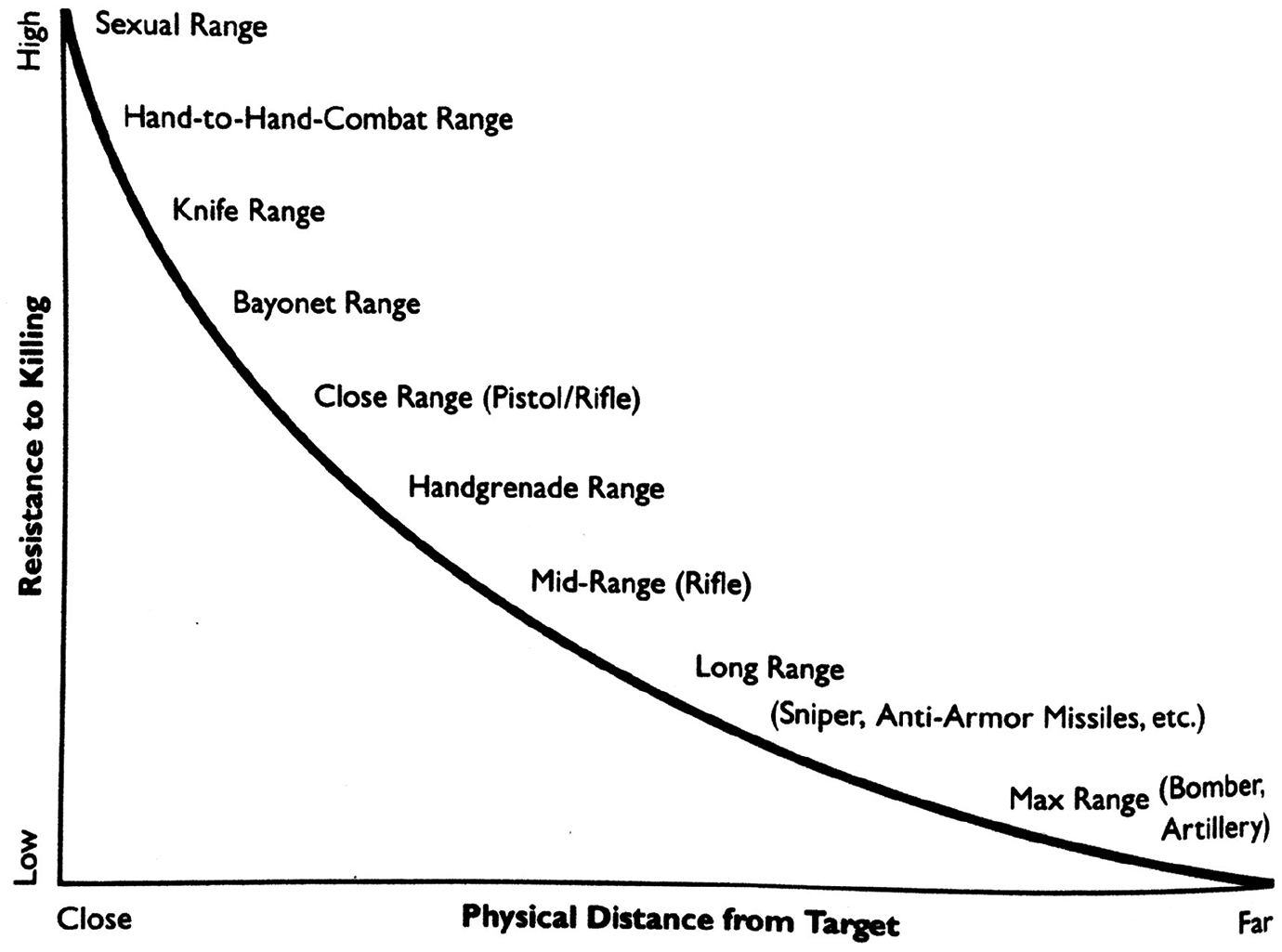
The spectrum of distance and aggression.
On Grossman’s account, far from being akin to a piece of artillery, the body and the penis are most unlikely weapons of war. The intimate familiarity of body parts elsewhere credited with the efficacy of strategic rape now appears as a powerful constraint on combatants. But, in a confounding turn, ‘sexual range’ is also for Grossman (1995: 134–137) emblematic of the visceral pleasure of war, in which psychological resistance is in part overcome. The sexual is mercurial, a site of revulsion and attraction, untrammelled excitement but also deep taboo. For Chamayou (2015), the salient point is that drone war is paradoxical in a way its forebears were not. Because of the rich detail provided by camera technology and the protracted labour of surveillance, drone operators are simultaneously close to and distant from their targets. As well as cold, calculating detachment, there is what participants repeatedly refer to as the ‘intimacy’ of drone war (Gregory, 2011: 199–203). The mediating effect of technology brings about a noteworthy break in the ‘phenomenological unity’ of the act of violence (Chamayou, 2015: 118; see also Wilcox, 2015: 144–148). The drone operator is both present and absent, their experience of killing split, as if ‘two sides of a shattered phenomenon’ (Chamayou, 2015: 119). The obvious implication is that more proximate forms of violence are therefore phenomenologically unified, experienced by combatants as cohesive, integrated and comparatively ‘natural’ moments of fighting.
Crucial as the paradox of intimate distance may be for a phenomenology of drone war, the immediacy of close-proximity killing does not mean that violence comes naturally. The difficulty in getting men to kill is a well-rehearsed theme of military sociology. On the standard account, the challenge is in maintaining composure under fire and responding in kind. The weapon object (the rifle or blade) must be integrated into a practised flow developed during training, a ‘body technique’ varying by national military culture along with the style of marching and bivouacking (Crossley, 2007: 85; Mauss, [1934] 1973: 71–72). Weapon talk does not generally describe rape explicitly as a skill combatants acquire, but must presume something like it if sexual violence is to be the equivalent of a bullet, tank or rifle. 9 Where some feminist criticism has rendered sexual violence both as an innate predisposition and as functional for patriarchy, war thought posits an analogy between sexual violence and close combat at the same time that it hints at the need for a disciplinary regime to overcome combatants’ innate resistance to embodied (sexual) violence.
In contrast to the organic presumption in which the penis simply is a weapon, or where war is seen as ‘sexual combat’ of a sort (Walter, 1950), the weaponization of body parts may instead be understood by reference to the sensory and disciplinary regimes of military life, varying by time and place. The most cited of these is ‘military masculinity’ – the collection of ideals and practices embedded in basic training, group bonding and cultural representation credited with producing soldier-perpetrators (see, for example, Morris, 1996). From a phenomenological perspective, however, the impact of military masculinity is less monolithic than often supposed. Gender histories of the US military have demonstrated that warrior identities draw on diametrically opposed codes of masculinity and femininity. Forced sexual penetration is interpreted by servicemen as evidence of both subordination and resilience (Belkin, 2012: 80–102). The paradox is, in fact, a technique: a ‘discipline-as-collapse’ (Belkin, 2012: 40). The body and body parts are granted martial status through regimes that vary both in the extent to which they authorize techniques of violence and in their stability over time (see, from a different starting point, Hoover Green, 2016).
The relationship of mobilizing doctrine and lived experience is no simpler for weapons not of the body. As Ken MacLeish has detailed, even a military technology as apparently simple as armour turns out to be freighted with contradictory meanings for those who depend on it. In the collision of fantasies of invulnerability and material experiences of wounding, soldiers symbolically organize experience in ways that consolidate their alienation from their own bodies (integral to successful discipline) but that also complicate it through acknowledgements of vulnerability. They thus negotiate a state of ‘anaesthesia’ at war (MacLeish, 2012). In this sense, at least, the penis may be much closer to the gun as an inorganic, non-sensual extension of the body than usually imagined, both because the body is ‘designed’ as a weapon by political, military and medical authorities and because weapons in general are never free of emotional, libidinal and ideological investments (space restrictions prevent a full accounting, but see Hodges, 2008; Martin, 2015; Meiches, 2017; Myrttinen, 2004).
As an intimate body part, the penis is obviously not an object invented for strategic ends. It exists as an element in the generalized male body schema, partly constituting the sense of gendered self (see, for example, Bordo, 1999; Schehr, 1997). It is perhaps this ‘familiarity’ that encourages organicist thinking, where the availability of men’s bodies for the perpetration of sexual violence becomes taken for granted, the penis and penis substitutes made subservient to strategy in more or less automatic fashion. The weight attributed to military planning is more than a question of degree: assumptions about the conscious motives of perpetrators underwrite the phenomenology of sexual violence, which all explanations must somehow accommodate. To the extent that the body is understood as the medium through which rape operates, the orientation and movement of the combatant-perpetrator within the theatre of violence confirms or challenges theoretical precepts. The corporeality of rape is graphic and so may be mistaken for positing a natural or primal scene. But the phenomenology of sexual violence does not require a ‘biological’ grounding of sexuality; the experience of war can instead be historicized, mobilizations of the body examined in terms of war’s intensely disordering forces (Brighton, 2011).
Animate objects
Bodies and body parts bear a relation to weapons and tools, but it is not that of interchangeability and disposability. Though some of the depictions of the body weapon surveyed above must be treated as speculative, in that they engage in thought experiments or extrapolate liberally from experience, empirical studies confirm that combatants frequently refer to sexual violence not as instrumental or ordered, but as deeply imbued with feelings of loss, lust, confusion and disintegration (see especially Eriksson Baaz and Stern, 2009). In circling the problem of the body weapon and the phenomenology of embodied violence, the samples of feminist criticism and war thought discussed here similarly imply an erotics that is intimate, dangerous and unsettling. The perpetrator body is a bewildering body (Sylvester, 2012: 498). References to the penis as at once mechanical and organic produce a disorienting, even nauseating, effect. They describe an uncanny weapon object.
To say that the penis-weapon is uncanny is not just to say that sexual violence is horrifying. Uncanniness instead refers to the paradoxical ways in which male body parts signify as both one thing and another in the war frame: as subservient but unruly, as sensual but insensitive, as vulnerable but utilitarian (on queer signification more broadly, see Weber, 2016). The terminology of the uncanny is itself ambiguous and unstable, its early definitions ‘equivocal’ (Cixous, 1976: 529), yielding multiple tangents (for an exploration, see Royle, 2003). In the most general terms, the uncanny is the experience of something out of place, yet strangely recognizable. It signifies an alienating sensation, originally labelled ‘aesthetic’ in the sense of ‘relating to the qualities of our feeling’ (Freud, [1919] 2003: 123; see also Fisher, 2016: 9; Royle, 2003: 6–7). Exemplars of the uncanny include the doppelgänger, the dismembered body, the phantasm and the undead (Cixous, 1976), and sometimes also those near-human terrors whose mythology is inseparable from the history of gender: the vampire, the zombie and the robot (see, for example, Creed, 1993; Ebenstein, 2016: 204–205). As these examples suggest, the uncanny is often characterized by reference to fiction, though it is not a literary genre (Royle, 2013: 18–19). Citing Ernst Jentsch, Freud ([1919] 2003: 135) first identified the uncanny situation as one where there is ‘doubt as to whether an apparently animate object really is alive and, conversely, whether a lifeless object might not perhaps be animate’. The etymology of ‘heimlich’ (homely, domestic), against which the ‘unheimlich’ or uncanny is contrasted, also conveys that which is hidden, concealed, furtive, repressed, but that threatens to break into the open, even in one usage designating a secret place on the human body (Freud, [1919] 2003: 132–133).
Although the documentary trail usually leads back to Freud and psychoanalytic categories, the uncanny is not a matter of personal psychology, nor of attributing sexual violence to mental disturbances. The uncanny is not a theory. As an affect or moment of experience, it has previously been used to describe the disorientation of those traumatized by war (Gampel, 2000). 10 The use indicates something diagnostic: an answer to the question of how participants feel war. There are inherent limits in such appeals to feeling. Claims about the lived experience of others should be treated as provisional, though it is worth noting that assumptions about motivation, cognition, meaning, trauma and memory are already everywhere in war scholarship, taken as given or described in stylized fashion for hypothesis-building. It is a commonplace of phenomenological inquiry that the body cannot be apprehended directly, only askew, in the discourses, codes and fantasies that help grant it coherence. An act of sensory translation is therefore required (Baker, 2016; see also Kinsella, 2020, for a different domain of war experience). Feminist and martial theorists draw on, even as they also rearticulate, the interpretations of combatants and others who experience war with greater immediacy. The uncanny, in other words, resides both in the experience and in the interpretation of war. Although not a direct rival to existing theories of sexual violence, phenomenological inquiry can spur or supplement explanation, casting light on unexamined assumptions or drawing attention to the micro-foundations of violence otherwise lost when detailing the strategic functions of violence.
Three resonances of the uncanny are of special relevance for existing articulations of the body weapon. First, the collision of sexuality and machinery evident in feminist theory and military sociology is quintessentially uncanny. Whether or not military strategists conceive of body parts as elements of a war machine, the recurrence of these motifs is itself part of the history of war. Why are these two vocabularies – one organic, the other mechanical – so often combined and superimposed on each other? The experience of a division and duplication of the self, including the alienation of a body object, is a significant topic for theorists of the uncanny (Cixous, 1976: 544; Freud, [1919] 2003: 142). In the context of attempts by armed groups to weaponize sexual organs, the body appears, like the parts improvised into an explosive device, to exist in ‘the fecund zone of indiscernibility between military and non-military things’ (Grove, 2016: 339).
Second, the uncanny has a distinctly sexual dimension. The warrior-automaton is an uncanny figure, but peculiarly so when the ‘animate object’ is genital. The ‘familiar’ body part (familiar to the would-be perpetrator) is made dangerous, and the danger is legitimated by reference to the war setting. The effect of a deathly double is likewise present in the re-description of rape as a parody of sex, in which the rapist has sex with his victim, but not vice versa (Cahill, 2001: 140). Unlike the gun to which it is so often compared, the penis has a cultural life beyond the battlefield. The discourse of the body weapon here intersects with the critique of sexuality in feminist theory. As Maria Eriksson Baaz and Maria Stern (2018: 309) have argued, ‘feminism’s early disassociation of the “sexual” from the “violence” of sexual violence continues to sustain the framing of “wartime sexual violence” as an act of power/dominance/violence (not of sex/the sexual) that is committed in an already exceptional state’. The either/or choice between violence and sex – a framing with a vital political history in itself – discourages analysis of the ways in which violence is imbued with sexual meaning in ways not reducible to evolutionary psychology.
Third, the uncanny co-existence of the familiar and the strange offers another way to conceive of the boundary between war and peace, which has proved especially problematic for studies of embodied violence. An ongoing dispute sets perspectives stressing the continuum of violence (in which wartime behaviour is largely explained by structural inequalities grounded in ‘peacetime’ gender orders) against those maintaining the distinctiveness of war (where sexual violence is seen as markedly different in its scale and dynamics during conflict) (see Cohen, 2016; Gray, 2019; Wood, 2018). The tension is reflected in a wider concern over how conceptual vocabulary – for example, ‘militarization’ – can misleadingly present a peacetime order unsullied by relations of force (Howell, 2018). By contrast, the uncanny is not easily calibrated in time and space. The ‘familiarity’ of the uncanny is a quality of the crossing of the object across genres or symbolic registers – by which violence outside of the rubric of war is nevertheless like a war, and violation in war appears as an extension of misogyny by other means. Though it is impossible to do justice to this point here, the uncanny is also an aspect of the movement of bodies across presumed zones of war and peace, and may be identified in the instabilities of both ‘wartime’ and the disordering nature of war itself (see Bousquet et al., 2020).
Insofar as feminist criticism and war thought are taken to reflect elements of soldier experience, the uncanniness of the body weapon unsettles instrumentalist accounts that posit rape as a weapon like any other. And insofar as sexuality and sexualized violence stalk the scene of war, it is not only perpetrators who will reckon with the paradoxical meanings of bodily weaponry. The affect of embodied violence is transmitted and reworked in broader cultural representations and political identities (see, for example, Mookherjee, 2015, on the afterlives of wartime sexual violence in Bangladesh). The interchangeability of bodies and weaponry was, for instance, one significant theme in campaigns against the Vietnam War in the United States, where the uncanny penis-weapon is unusually on display. For Judith Bernstein, the manifestation of the penis as the gun, a device of national manhood, became the central theme for decades of work, each iteration another uncanny double (see Figure 3; for a collection, Bernstein, 2016). Images like ‘The Fun-Gun’ make explicit the themes of monstrous transformation and weaponized sexuality that may otherwise be alluded to all too briefly in writings on the war. Other anti-war artists likewise couched their opposition in terms of a body-made-weapon, as though exposing the correlation of flesh and technology would also undermine the imperial project. 11 The visible collision of the machine and man in the anatomy of war reflects the intense critique of existing society that was unfolding alongside, and in significant part prompted by, the wars in Indochina, wars in which sexual violence by US forces was frequent enough to be described colloquially as ‘standard operating procedure’ (Brownmiller, 1975: 107). ‘Vietnam’ generated deep anxieties over the meaning of the war for the American body politic (Jeffords, 1989) in ways that continue to resonate, not least in the contemporary power of weapon talk.
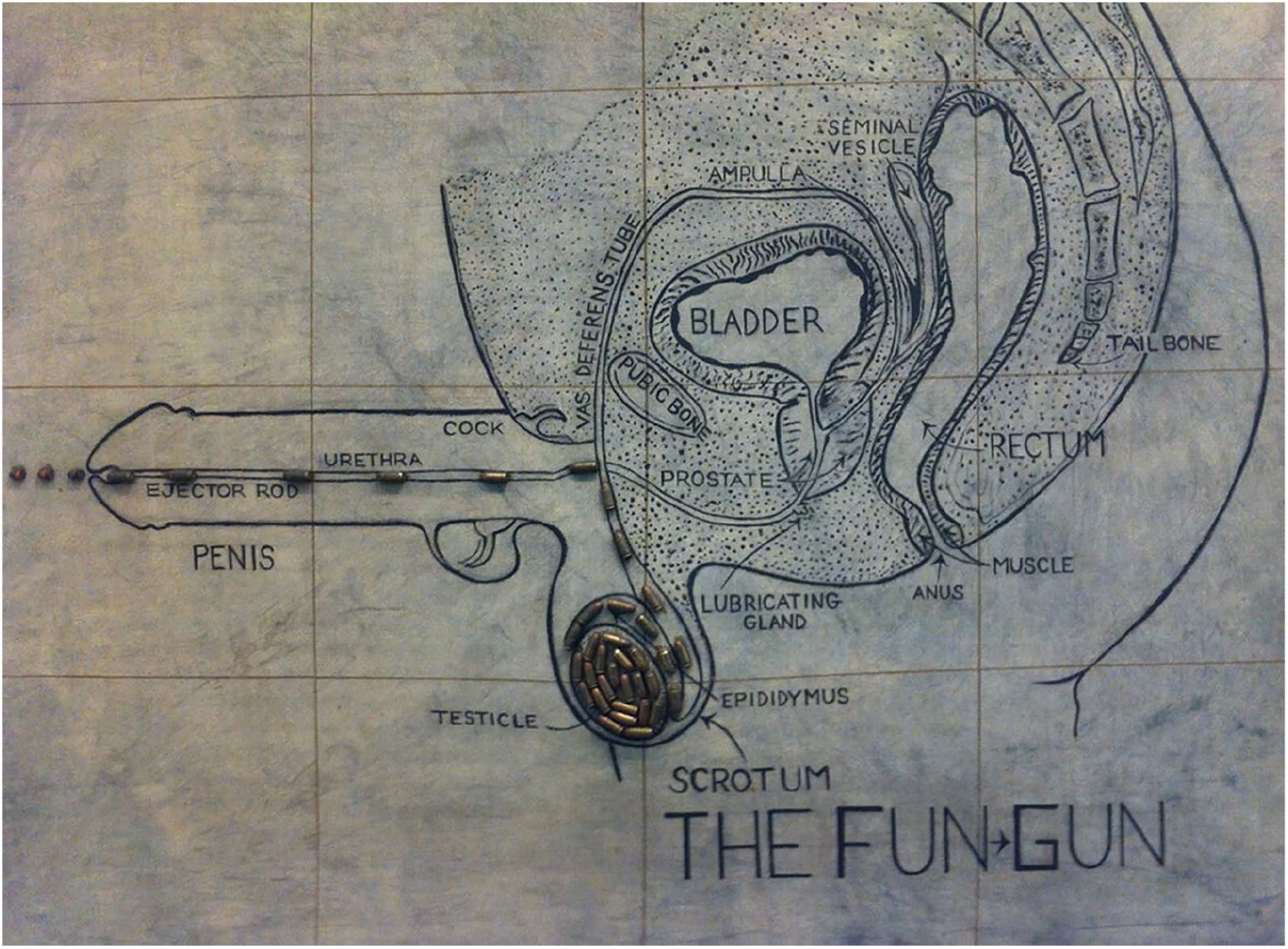
‘The Fun-Gun.’
Weapons and the weird
The uncanny quality of bodily weapon objects is disclosed by a close reading of the body-weapon image and its antecedents and echoes in feminist and martial theory. My opening survey of weapon talk sought to show the importance of this rhetorical device to contemporary advocacy and policymaking on sexual violence. The prevalence of weapon talk mirrors the reliance on simplistic explanations of sexual violence in terms of military strategy that have been widely criticized in the scholarly literature. But noting the limitations of weapon talk alone neglects the longer history of theorizing about the sexual body weapon. In the space of this article, I have briefly traced two threads of this theorizing – one being a feminist discourse on the latent weapon form of the penis, the other being references in war thought to the penis as a kind of gun, and to war as a sexual practice – to demonstrate the overlaps and shared paradox in imagining a body part as both organic and machinic. Insofar as these conceptions of the body weapon promote essentialist understanding of gender or contribute to mechanistic thinking about war bodies, they are deeply limiting and at odds with the ethos of martial empiricism. However, when treated as expressions of an uncanny experience or scene, they appear not so much as concrete theories to be disproved so much as symptoms of a profoundly unsettling process of war-becoming.
One implication of a turn away from ‘weapon of war’ and towards uncanny processes of weaponization is that the everyday theories of participants in war – their notions of gender, sexuality, war and embodiment – acquire greater significance. Previous work on the creation of body weapons strongly suggests that acts of violence are amplified by, proceed through, indeed make no sense outside of, ritualistic performances. They are regulated. This entails restriction as well as permission, a regime for justifying the actualization of violence (see particularly Bargu, 2014). This implies neither that most sexual violence in conflict situations is explained by the processual language of weaponization, nor necessarily that sexual violence is more prevalent or more brutal in wartime. Reading the politics of human weapons entails a mapping of the contested and factional discourse that informs weaponization; how bodies, body parts and bodily acts get framed according to which schematics of intimacy and distance. The transgressive character of rape means it may only imperfectly become part of public legitimation in the manner of other ritualized dramas like the show trial or public execution. Martial empiricism offers one promising route for the study of such ‘aesthetic regimes’ of war (Bousquet et al., 2020: 99–118; McSorley, 2012: 56), at least in those cases where sexual violence is a consistent part of war practice (which is by no means guaranteed; see Wood, 2018).
Instead of renouncing the ambivalence of clashing motifs in the construction of an image of sexual violence as a kind of machinery, the uncanny is an acknowledgement of war’s weirdness. The project of tracing an affect in war literatures is unconventional and brings disparate strands of scholarship into awkward dialogue. The perspective presented here is to be judged by its usefulness in opening up conceptual and documentary trajectories otherwise stymied by the simple equivalence of body parts and weaponry. The ‘aesthetic’ dimension of the uncanny is suggestive of post-structural sketches of the ‘masquerade’ of wartime bodies (Sylvester, 2012: 502). But, as an aspect of experience, the uncanny is also a resource for understanding practices of war-making and sense-making from below. Though this article has focused on intellectual efforts to decode the weird qualities of the sexual body weapon, the uncanny may be taken up as a theme for more concrete studies of mobilization and resistance. Representations of body weaponry help to constitute the meaning of conflict, in arenas far from the battlefield: the war movie, the human rights campaign, the art gallery and the policy document. As in the example of anti-war aesthetics, the efforts of military and paramilitary organizations to mobilize sexual aggression may be contrasted with attempts at counter-weaponization, where machinic and dehumanizing connotations are turned to the purpose of resistance and disarmament. In the process, the weapon body can be recognized not as an already existing tool, or a brute potentiality, but as material in another sense, shaped by fallible projects of transformation, caught between the normality and pathology of war.
Footnotes
Acknowledgements
This piece was not easy to write and has undergone so many changes that it is likely unrecognizable to its earliest audiences. I am nevertheless grateful for comments received at SOAS and City University in early 2014, at the European International Studies Association conference in Sicily in September 2015, at the Feeling War Conference at the University of Warwick in May 2017, at the Conflicted Bodies Conference at Goldsmiths in September 2017, and at University College London in February 2018. Several reviewers offered helpful suggestions and correctives that helped me sharpen my argument. Special thanks are due to Aggie Hirst for reading multiple versions and for convincing me that there was something of value worth salvaging in the project. Maria Stern and Harriet Gray both also provided crucial encouragement in what can be a disorienting and distressing field of study. I am doubly grateful to Antoine Bousquet, Jairus Grove and Nisha Shah for including the article in their special issue and for organizing the ‘Becoming War’ workshop at the Annual Convention of the International Studies Association in San Francisco in April 2018 that gave new life to some of the ideas presented here.
Funding
The author received no financial support for the research, authorship, and/or publication of this article.
