



Abstract
Villains need to be de-villainized for talking to begin; this is a cornerstone of negotiation literature. But what happens when villains are proscribed, or listed as terrorists? While an emerging body of work has started to explore the effects of proscription by emphasizing aspects of demonization and banishment, it has not so far explored how banishment ends. This article offers a theoretical and empirical contribution to this discussion by exploring the effects of proscription on the dynamic interaction between conflict parties and how negotiations still do take place with armed groups listed as terrorists. To do this it maps representations made by the Colombian government and the Revolutionary Armed Forces of Colombia through a qualitative discourse analysis of 335 statements triangulated with 50 personal interviews. The article argues that proscription makes the initiation of negotiations impossible because it leads to a form of extreme vilification. This is especially true for the government, unable to switch directly to de-vilifying its proscribed enemy. First it has to normalize its vilification – a concept I describe here as a ‘linguistic ceasefire’. This helps explain how banishment can end and peace negotiations can be initiated in an age of proscription.
Introduction
When Juan Manuel Santos took office as President of Colombia in August 2010 he was already considering the possibility of initiating peace negotiations with the Revolutionary Armed Forces of Colombia (FARC for its Spanish acronym). According to his brother Enrique Santos, President Santos was also aware that public opinion in Colombia and abroad would be strongly opposed to such a move after eight years of extreme vilification of the FARC as terrorists during the Uribe government. As his brother noted (Interview 1), the question was ‘How does this government start talking with “narco-terrorists” – how to do the switch?’
This article explores this shift. It shows how proscription, or the listing of an armed group as a terrorist organization, can forestall negotiations but also how this can be reversed. International proscription is a widespread phenomenon, with an estimated 214 blacklists worldwide (De Goede, 2011). An emerging body of work has started to explore the effects of proscription by emphasizing aspects of demonization and banishment. This work has tended to focus on the effects on the listed individuals themselves or third party and peacebuilding actors. One author who has extensively explored the nexus between listings and security is De Goede. She highlights the importance of the symbolic nature of blacklisting – describing asset freeze as a type of modern-day exile (De Goede, 2012). She also points to the productive power of lists: how they in effect materialize and organize the categories they set themselves out to describe (De Goede and Sullivan, 2015). This offers helpful insights and builds on much of what securitization has done to highlight the discursive construction of existential threats that enable exceptional measures to be deployed (Buzan et al., 1998).
Critical terrorism authors have also offered a way of looking at the terrorist label critically (Toros and Gunning, 2009) and explored the tools of conflict resolution to investigate responses to terrorism violence (Tellidis and Toros, 2015). Toros’s work in particular has shown how the naming of a group as ‘terrorist’ can forestall nonviolent responses to terrorism (Toros, 2008, 2012). We know that proscription makes engaging with armed groups in peace negotiations harder, but what has not been explored so far is how negotiations do still take place with groups listed as ‘terrorists’. How does the banishment end? And is it as simple as merely reversing the label?
By offering a processual and relational perspective to understand the effects of proscription and how these challenges are overcome, this article explains how the banishment ends through the concept of the ‘linguistic ceasefire’. This idea came out of the careful study of the pre-negotiation between the Colombian government and the FARC. Building on the notion of vilification developed by Spector (1998, 1999, 2003), the article argues that the villain who has been proscribed first needs to be brought back into the realm of ‘normal’ vilification so that further de-vilification can take place. The ‘linguistic ceasefire’ has three main components: 1) recognize the conflict, 2) drop the ‘terrorist’ label and 3) uncouple the act and the actor. It removes the symbolic impact of proscription, even if delisting is not possible ahead of negotiations.
Studying the effects of proscription on peace
As Jarvis and Legrand (2016, 2018) and De Goede (2018) have noted, proscription as a counter-terrorism measure has been neglected in the scholarly literature. The work that has explored this phenomenon in the security literature has mainly focused on the constitutive question regarding proscription; on how and why proscription regimes have come about (Jarvis and Legrand, 2016, 2017, 2018). This article contributes to this scholarly exploration of proscription by focusing instead on its consequences on peace.
The article builds on the work by human rights and humanitarian activists and researchers, lawyers and peace practitioners who have been the most prolific on the effects of proscription to date. There has been work on assessing the impact of counter-terrorism legislation on human rights (Bowring, 2010; Sullivan and Hayes, 2010), on self-determination movements and migrated diaspora (Sentas, 2014) and on the justice for stateless and other dispossessed peoples (Sentas, 2018). There has been quite a bit of work on the effects of proscription on humanitarian actors (Pantuliano et al., 2011) and on the space for civil society to operate (Howell, 2006; Cortright et al., 2011). These authors have found that counter-terrorism provisions such as proscription can criminalize humanitarian action and undermine principles of neutrality and impartiality.
Of more direct bearing on this article is the developing literature on the effect of proscription on peacebuilding (Boon-Kuo et al., 2015) and peace processes. This was initially explored by individuals or organizations directly involved in third-party mediation or peacebuilding with proscribed organizations (Ricigliano, 2005; Philipson, 2005; Helgesen, 2007; Dudouet, 2010, 2011; Haspeslagh and Dudouet, 2011, 2015; Haspeslagh, 2013; Dumasy and Haspeslagh, 2016; Palmiano Federer, 2018), or lawyers (Muller, 2008; Bialostozky, 2011; Gross, 2011) and political activists close to listed groups (Nadarajah and Sriskandarajah, 2005; Elejabarrieta Diaz, 2015). The main focus of enquiry has been the impact of proscription on third-party actors, mediators or peacebuilding actors and to a lesser degree on armed groups themselves.
This emerging body of work concludes that proscription has significant negative effects on peacebuilding actors. It has for example disabled European Union member states from playing active roles in certain conflict resolution processes (Helgesen, 2007). It has created legal uncertainties for organizations in contact with listed groups (Bialostozky, 2011; Gross, 2011) and led to self-censorship from peacebuilding organizations shifting where and with whom they work (Boon-Kuo et al., 2015; Dumasy and Haspeslagh, 2016). Proscription has disabled possible roles played by third-party actors and it has led to increased isolation on the part of listed armed groups (Haspeslagh, 2013). Moreover, the intense polarization that follows proscription has attached a stigma to entire sociopolitical communities (Sentas, 2014, 2018; Haspeslagh and Dudouet, 2015). This has had a particular impact on insider mediators, actors closely associated with an armed group who often play an important role in coaxing groups to embrace nonviolent paths (Haspeslagh and Dudouet, 2015). Proscription as an essential feature of international counter-terrorism frameworks has undermined ‘core elements of emancipatory peacebuilding work’ (Boon-Kuo et al., 2015: 3).
This article builds on these insights, but focuses the lens away from third-party actors and peacebuilders to explore how proscription has affected the conflict parties themselves and their interaction. While third-party actors play undeniable roles when it comes to supporting peace processes, particularly in intensely polarized environments, this focus risks overemphasizing the importance of external actors as opposed to the main conflict protagonists. We have little knowledge of the effects on the actors themselves or on the broader processes at play that lead parties towards peace negotiations.
Material and symbolic effects
While the labelling of opponents in armed conflicts is widespread (Bhatia, 2005) and mainly reflects one party’s judgement, international proscription, by creating a category with international recognition, can lead to far-reaching material and symbolic implications. It is not merely linguistic and discursive but has practical and legal consequences. Sanctions literature points to the role sanctions play in ‘constraining’ their targets (Biersteker et al., 2016), denying armed groups access to needed resources and cutting off their means of waging war. In the case of proscription, two main direct material consequences of being listed for an armed group are asset-freezes and travel bans. However, recent sanctions literature comes to the conclusion that the main impact of sanctions is symbolic (Biersteker et al., 2016). Similarly, De Goede’s work on the securitization of terrorist financing draws attention to ‘the highly symbolic nature of blacklisting as a modern political practice’ (De Goede, 2012: 157). Her argument that listing has to be understood as ‘societal exclusion and symbolic banishment of the affected persons’ is highly relevant to understanding the effect of proscription. Though her work is focused on individuals, it can be extrapolated to the whole group. The symbolic effect of proscription can lead to stigma, to the shame and the exclusion of the targeted entity.
This is not a by-product; it appears to be part and parcel of the proscription strategy. Pillar (2001: 152), reflecting on the United States’ proscription regime, argued that it mainly offered symbolic advantages ‘calling attention to terrorist groups as objects worthy of opprobrium’. Along the same lines, the UN Working Group on Terrorism states that ‘labeling opponents and adversaries as terrorists offers a time-tested technique to de-legitimize and demonize them’ (quoted in Toros, 2008: 412). The issue of legitimacy is central here. 1 Through international proscription, the state wins the stamp of approval and the listed armed group loses legitimacy (Helgesen, 2007).
International proscription will also affect the overarching conflict narrative; the way the conflict is understood and framed. The ‘terrorist’ label allows for a country’s problems to be seen as ‘an attack by terrorists on a legitimate democracy’ (McCartney, 2005: 10). This will affect the way the conflict is described, how the root causes are understood and whether or not the presence of the armed conflict is even acknowledged. By choosing one label, you automatically exclude another: ‘whenever we use language to understand a process or event, we necessarily exclude alternative language – and thus alternative understandings – of the same occurrence’ (Jackson et al., 2011: 113).
This framing has much to do with who shapes the meta-narrative and whether the targeted audience accepts it. By focusing on the speech act, securitization theorists make it possible to look at who the audience is and how this discourse is being received.
Moving the discussion from what is invested in the security speech to how this investment is (or is not) carried from speakers to audiences brings practice more explicitly into the picture. It is not just the speech that matters but the circulation of security speech and its appropriation or refusal by those who are addressed. (Huysmans, 2011: 372)
Proscribing an armed group crystallizes a judgement that one side in the conflict should be considered a ‘terrorist’. This shapes the understanding of the conflict. Moreover, the inclusion of names of armed groups side by side on the same list can have secondary material effects. The homogeneity of the lists creates a new reality. As De Goede and Sullivan (2015: 69) argue in their exploration of security lists, ‘list as a knowledge form has the capacity to do things’. So, lists are productive in that they ‘assemble elements that do not necessarily fit together into some larger scheme’ (Law and Mol, 2002: 7, quoted in De Goede and Sullivan, 2015). Lists are also productive in that it becomes far easier to treat them in a way that would otherwise be deemed unacceptable: ‘Once someone is labeled an evil-doer and depicted as lacking an identifiable political agenda, reasoning or negotiating with them becomes taboo: instead, they need to be pursued aggressively and quickly.’ (Jackson et al., 2011: 114)
Similarly, it can also have material effects on the type of peace pursued with the listed group. Based on the idea that if you choose to negotiate with a group listed as a ‘terrorist’, you would legitimize them and thus incite more violence (Toros, 2008). Much of the literature on labelling concludes that policies that require engagement such as negotiation and reconciliation fall outside the options that are considered (Lanz, 2011; Renner and Spencer, 2012). Here again, the symbolic effects are not merely symbolic but also productive and appear to have material implications.
Proscription and the ‘terrorist’ label as extreme vilification
One concept from the peace and conflict literature that has made it into common parlance is the notion of vilification. The idea of villainizing a non-state armed group adapted by Spector (2003) from his work on villainizing states (1998) is particularly relevant to understanding the effects of proscription. Villainizing, he explains, is the process of demonizing and dehumanizing the enemy and it needs to be reversed for official negotiations to take place. The pre-negotiation phase of peace processes involves changing the public image of the adversary (Zartman, 2008: 121). Both parties have to be in a position to convince internal factions and their constituencies that negotiations can be started in good faith.
It is well established in the negotiation literature that vilification will lead the opponent to be cast as untrustworthy, illegitimate and violent. Proscription will lead to an extreme form of this process. The previous discussion showed that proscription would affect the overarching conflict narrative. At the heart of what is understood as the conflict narrative are issues such as the root causes of the conflict and what keeps the conflict going. The main components of this heightened vilification are drawn out in Table 1.
Proscription and extreme vilification.

First, the ‘terrorist’ label allows for a country’s problems to be framed in a way that does not acknowledge the existence of a conflict and it decontextualizes the ‘terrorist’ threat. Second, while vilification usually leads the opponents to treat each other with little respect, proscription leads to such extreme demonization that the armed group may even disappear from official discourse. Third, the opponent is framed not only as untrustworthy but also as irrational. This entails that the parties cannot trust each other as possible negotiation partners. Fourth, proscription also shifts the focus from a political conflict where the legitimacy of actors or their objectives are questioned to one where the opponent is perceived as not being political – it delegitimizes the cause being fought. It simplifies the conflict into a fight against criminal actors without a political agenda, rendering eventual negotiations meaningless. Fifth, it casts the opponent not just as violent but as an actor that uses a type of violence – ‘terrorist violence’ – that is immoral so the actor itself is considered barbarous, even inhumane. Finally, it rarefies the group into being only a ‘terrorist’ group. It does not merely condemn terrorist acts, placing them in a broader arsenal of possible warfare tools, but it turns the armed group itself into being just terrorists. The act and the actor become one and the same, which has a deep effect on the possibilities for conflict resolution because no change appears to be possible.
The ‘linguistic ceasefire’
The discussion above showed that listing is, in effect, productive. A name will place emphasis on certain characteristics while neglecting others and thus lead to a more limited set of responses. So, this heightened dehumanization of the enemy justifies using methods of combat against them that are outside the laws of traditional warfare. But, more importantly for our argument, it also affects the possibility of engaging in a negotiation with armed groups labelled as ‘terrorists’.
Not only does the government in effect close down the possibility of being seen to negotiate with ‘terrorists’, but also, the labelled group may become disinclined to enter into a negotiation. That can cut off the prospect of any contact between the two sides. As Toros (2012: 96) argues, the ‘terrorist’ needs to be unlabelled to start negotiating. But what has not been explored in this literature is how this ‘unlabelling’ takes place.
Critical security literature has explored how narratives rise and fall (Kerbs, 2015) or how certain phenomena have been desecuritized, mapping out how issues have been moved ‘out of emergency mode and into the normal bargaining process of the political sphere’ (Buzan et al., 1998: 4). A key finding is that desecuritizing an issue is not as simple as securitizing it – there is no one desecuritized speech act (Hansen, 2012). So, unlabelling ‘terrorists’ is not as simple as dropping the t-word. This also raises the important question of whether the ‘terrorist’ tag can ever be truly reversed.
Desecuritization has been interpreted and applied differently (Cocksun, 2008; Hansen, 2012; Snetkov, 2017). But there has been minimal focus on how it might apply to a non-state armed group who by its very nature already embodies the securitized ‘friend–enemy’ distinction. From work that has explored desecuritization in the context of conflict resolution (Cocksun, 2008; Donnelly, 2015) it appears that peacemaking has to happen before desecuritization can take place. In the case of proscription, because extreme vilification brings the armed group beyond vilification, the group cannot be simply de-vilified or desecuritized and enter the realm of ‘normal politics’ – a step is needed in between.
There was no specific concept to understand what this might entail. The idea of a ‘linguistic ceasefire’ emerged both from the personal interviews and the discourse analysis conducted on the pre-negotiations with the FARC. As I go on to explain, several of my interviewees noted that from early 2011 Santos had shifted his rhetoric towards the FARC considerably. This was confirmed by the discourse analysis of government statements. Based on this abductive reasoning, this article offers the idea of the ‘linguistic ceasefire’ to enhance our understanding of the de-vilification process in the context of proscription. 2
I define the ‘linguistic ceasefire’ as a process through which the government starts disarming and de-escalating the language used to describe its opponent in a public fashion. There are three main components to the ‘linguistic ceasefire’. First, the government recognizes the existence of the conflict. The fight is no longer one of ‘terrorists’ against a democracy but an armed conflict with two sides (or more). This helps recontextualize the armed group and also makes the possibility of negotiating a peace agreement possible. Second, the government refrains from using the ‘terrorist’ label; the ‘terrorist’ tag is used less frequently until it is replaced by other epithets. Finally, by uncoupling the act of terrorism and the actor, the armed group is no longer just a terrorist group; it gains in complexity and change becomes a real possibility.
The asymmetrical nature of proscription means that this process of unlabelling is one-sided. It is important to consider the intrinsic difference here between the types of actors, their audiences and how proscription might affect them. Non-state armed groups do not have the same audience costs as governments both vis-à-vis the general public or international opinion. It is the government that needs to unlabel the armed group before the two-sided normal de-vilification process can start. The shift in language is a conscious and deliberate attempt at sending signals. This signalling has multiple audiences and has as much to do with intraparty as interparty dynamics. For the government, the ‘linguistic ceasefire’ is an effort to shift the image of the adversary held by the public both nationally and internationally to make public negotiations possible. This needs to happen at the highest echelons of power since not everyone can ‘“speak” security successfully’, especially when it comes to national security (Buzan et al., 1998: 27). It is also about sending signals to the armed group that they recognize them. This recognition is essential in enabling the armed group to make the strategic decision to enter into negotiations and bring their constituencies along in this transition.
Though this particular step is intrinsically linked to the broader process of de-vilification, it is helpful to try and isolate it to understand its importance and main characteristics. It also tells us something useful about the order and the chronology in which things happen. For de-vilification to occur, the villain who has been proscribed first needs to be ‘unlabelled’. A ‘linguistic ceasefire’ thus becomes a necessary condition for further de-vilification, peacemaking and potentially desecuritization. It removes the symbolic impact of proscription, breaking the banishment (De Goede, 2012), even if actual delisting is not possible ahead of negotiations.
The remainder of this article draws on two main sources of primary data to analyse these dynamics in the context of the Colombian pre-negotiations with the FARC. The first is a discourse analysis based on a review of 20 years of statements and communiqués by successive Colombian governments and the FARC: 207 statements during four Colombian presidencies (Samper, Pastrana, Uribe and Santos) and 128 communiqués by the FARC. 3 Public statements made by the conflict parties themselves are analysed to examine the language used, the associations made and how those evolved at different moments and over time.
The second feature of the data collection was based on personal semi-structured interviews with key actors from the government, the armed group, third parties and conflict analysts. Approximately 50 people were interviewed in different locations during the negotiation process. 4 These interviews were essential in efforts to understand the effect of proscription on the perception of the elite-level actors themselves. This was particularly important given that engagement with proscribed groups is not often discussed publicly.
Just terrorists: The extreme vilification of the FARC
Though the FARC had been listed as a Foreign Terrorist Organization by the United States since 1997, the developments following 9/11 and the attack against the World Trade Center led to deep symbolic and material consequences in Colombia. Symbolically, the Colombian conflict was subsumed in the broader war on terror. The FARC were integrated in the group of ‘enemies’ against which the global war was being fought.
The impact of 9/11 on the assemblage of heterogeneous armed groups and thus the productive nature of proscription quickly became apparent. The US administration no longer characterized the FARC as narco-guerrillas but started linking them with other listed entities or with the broader Islamic fundamentalist threat, eventually deploying the language of ‘narco-terrorists’. This post-9/11 reframing was felt deeply in Colombia. ‘It marked a change, it linked what happens here [in Colombia] to what happens there [in the US]’, said one analyst (Interview 3) who has followed the conflict for 45 years. The Colombian government was not a passive recipient of this change, but saw it as an opportunity to convert the armed conflict into a war against terrorists. As Borda (2010: 135) argues, it was a strategy which allowed the government to strengthen its military and political position vis-à-vis the armed groups.
When President Uribe came to power in 2002 he argued that there was no armed conflict in Colombia, just violence against a democracy, which should be considered terrorism. The political dimension of the conflict or any attempts to understand the history, social realities or grievances in the country were subsumed in the war on terror (Interviews 4 and 5). Uribe set out to change international and national perceptions of the conflict in Colombia (Interview 6). This became increasingly prominent from 2005 onwards. Uribe focused on convincing the media not to talk about an ‘armed conflict’ and to categorize the FARC as a terrorist organization.
This idea that the FARC should be considered ‘terrorists’ because they attack a ‘democracy’ became the bedrock of his narrative (Uribe, 2002). He drew a parallel with European democracies under attack of terrorism post 9/11, and argued that, because the FARC are ‘terrorists’, other countries should not support the FARC (Uribe, 2003a, 2003b, 2004a, 2004b, 2006, 2008a). Uribe set about reframing the understanding and perception of the Colombian conflict. In a speech in 2005 to the diplomatic corps in Colombia, he explained that there is ‘no conflict’ so there are ‘no combatants’, only ‘terrorists’ (Uribe, 2005a).
The shift in discourse about the FARC and the conflict was integrated by the international audience; they stopped referring to the conflict as such. One high-ranking UN diplomat (Interview 7) said the international community was under intense pressure to stop describing the situation in Colombia as an armed conflict: ‘We had to adapt in terms of language, we needed to do a certain amount of self-censorship, we found a consensus by using language that referred to the violence without talking of the armed conflict.’
What was also striking in Uribe’s major speeches is that he did not mention the FARC by name. In his inauguration speech, or in later addresses to the Colombian Congress, he never used the acronym FARC nor did he use their full name (Uribe, 2002, 2004c, 2005b). This absence from discourse rendered the FARC politically insignificant, subsumed into an amorphous ‘terrorism’ threat. This extreme vilification was compounded by the frequency with which Uribe chose to use words with the root ‘terror’ to describe them. In one speech (Uribe, 2003d) he used it 59 times.
Intrinsic to this portrayal of the FARC is the depoliticization of the armed group. Uribe painted them as a group that has no political arguments and is merely criminal, stating in 2003: ‘These cynics of violent groups continue to ask for international audiences to speak like politicians when they are miserable terrorists’ (Uribe, 2003c). At the centre of this depoliticization is the link between the FARC and drugs. Drugs and terrorism become two sides of the same coin. Uribe said that ‘the only reason for terrorism is the drugs business’ (Uribe, 2009a), and that the ‘violence’ in Colombia, which is funded by ‘drugs’, is ‘terrorism’ (Uribe, 2002, 2004b, 2004d, 2008b). He called them a ‘terror and drugs cartel’ (Uribe, 2004e). By 2009 Uribe was making direct parallels between the FARC and ‘bandits’ like Pablo Escobar.
Here we see how the extreme vilification of the FARC was layered onto previous labels that resonated in Colombia to depoliticize them. The merging of the ‘narco’ and ‘terrorist’ labels is what did the most damage to the FARC’s political and moral standing. According to one civil society activist (Interview 2): ‘For many people the term narco is stronger than being terrorist because narcotrafficking has caused so much pain in Colombia. You will find that for many people it means the same thing, narco and terrorist are equivalent.’
Unlike pre-9/11 Colombian presidents, who used the word terrorist to describe some actions committed by the FARC, Uribe used it to describe the FARC itself as a ‘terrorist group’ or ‘terrorist organization’ (Uribe, 2003b, 2004e, 2005a). By doing so, he implied point blank that no change was possible because they are just terrorists – the act and the actor were one and the same. Furthermore, he stated that no ‘appeasement’ (Uribe, 2008b, 2009b) was possible with the FARC and that Colombia had suffered a ‘dictatorship of terrorism’ (Uribe, 2005c). When the FARC started unilaterally releasing hostages he refused to acknowledge the gesture and said ‘terrorists cannot be thanked’ (Uribe, 2010).
Uribe took the vilification of the FARC to a new level over his two terms in office (see Table 2). His target audience was the urban middle classes. Public opinion in Colombia shifted radically ‘[before] they [the FARC] could be seen as legitimate actors. Then the bombardment of language and propaganda changed the imaginary, identifying them as bandits, terrorists. Uribe succeeded in changing the minds of the middle classes. He won the cultural war’ (Interview 7). By denying the existence of the armed conflict and labelling the FARC as terrorists nationally and internationally, he succeeded in portraying them as depoliticized, irrational, unprincipled, a band of criminals for whom change is not possible. This made the idea of political negotiations with the group unimaginable in the eyes of the public.
Proscription and extreme vilification.
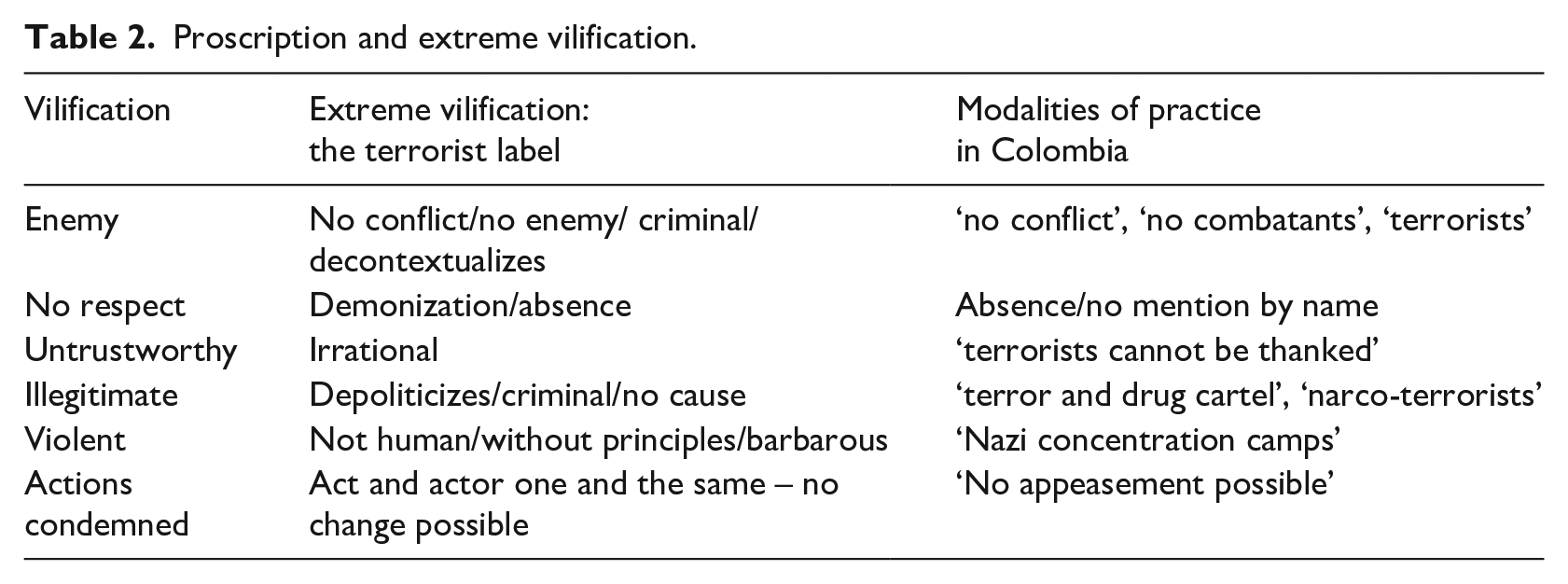
The characterizing of the FARC as terrorists both nationally and internationally also had concrete material consequences. Not only did it justify long-term and sustained war efforts, but it also delegitimized the idea of dialogue politically. By copying the language used internationally, President Uribe made clear they were terrorists with whom the government would not negotiate (Interview 8). First, if there is no conflict, just a fight against terrorists, then what would there be to negotiate? Second, if the FARC are nothing but ‘terrorists’ then how could they ever change? Even if President Uribe wanted to initiate dialogue, 5 his only options were to win the war militarily, for the FARC to give themselves up, or to subject them to justice through a demobilization process (Interview 9).
The ‘linguistic ceasefire’ and the FARC
While proscription and the inclusion of the FARC in the broader war on terror was straightforward for the Colombian government and greatly bolstered its efforts to reframe the conflict as a war against ‘terrorists’, it was much harder to reverse. When President Santos took office in 2010 he was aware he could not suddenly embark on a formal negotiation with the proscribed armed group. As Uribe’s Defence Minister, Santos had largely been expected to follow the course set by Uribe. But, unlike his predecessor, he had already come to the realization that the war could not be won militarily. He wanted to explore negotiations but knew that public opinion would be completely against it.
He could not switch directly to de-vilifying the FARC – a step was needed in between. He knew that he first needed to shift the description of the FARC back to one of ‘normal’ vilification. Several of my interviewees noted that from early 2011, ahead of the first secret meeting between representatives of the Colombian government and the FARC, 6 President Santos had started to tone down the rhetoric towards the FARC considerably, mentioning the idea of a ‘ceasefire’ (Interviews 5 and 11) and a ‘disarming of words’ (Interview 12). What this article has conceptualized as a ‘linguistic ceasefire’ has three main components: 1) recognition of the conflict; 2) dropping the terrorist label; and 3) uncoupling the act and the actor. Each of these will be explored in turn.
Recognition of the conflict
The bedrock of this shift was President Santos’s explicit recognition of the existence of an armed conflict in Colombia. He talked about the ‘victims of the conflict’ or ‘recognizing the conflict’ (Santos, 2011c, 2011d). In May 2011 he stated that ‘There has been an armed conflict in this country for a while’ (Parra, 2011). He went even further than pure rhetoric by enshrining this description in law through the Law on Victims and Land Restitution (Ley 1448, 2011).
By doing so he effectively recontextualized the FARC within Colombia’s modern history. This set the stage to repoliticize them. He argued that the ‘best way to end this conflict’ was through dialogue (Santos, 2011b). By shifting his description of the violence to an armed conflict instead of a ‘war against terrorists’ he was altering the image of the FARC – nationally and internationally – and creating the conditions for a public negotiation.
Importantly, he was also sending direct signals to the FARC. This was essential in giving the group a sense of recognition and convincing it that negotiations with this government were possible (Interview 13). Responding to the question of why they accepted a dialogue with President Santos, the FARC answered ‘We must recognize that unlike Uribe, Santos accepted that in Colombia there was an armed conflict and not a terrorist threat. And that conflict had some old causes that had to be resolved. Recognizing that was already something very important for us’ (FARC, 2014). People who have had close contact with the armed group or followed their evolution carefully confirm that this recognition was central to the FARC’s decision to engage in the negotiations with President Santos (Interviews 12, 14, 15).
Shortly after Santos’s inauguration, the government started exchanging messages with the FARC through an intermediary, Henry Acosta. In his first letter, President Santos explicitly recognized the armed conflict. According to Carlos Lozano, a long-time intermediary to the FARC, ‘This letter is the one that convinces Cano that one can trust Santos. It was difficult to think that a process with Santos was possible because he came from the Uribe government (. . .) It seemed impossible. But this letter makes Cano say “man, this is important”’ (Interview 14). Later on, just after the government recognized the conflict and embedded this description in the Law on Victims, the Colombian government and the FARC had a further three secret meetings in Venezuela between May and October 2011 (Santos Calderón, 2014).
Dropping the terrorist label
Santos quickly set the tone for a shift in discourse in his 2010 inaugural speech, declaring that he held the ‘keys to peace’ (Santos, 2010a). In his memoires of this period, his brother reflects that it was an audacious statement in a moment when public opinion ‘[did] not want to hear about terrorist groups they consider[ed] cornered and practically liquidated’ (Santos Calderón, 2014: 19). In the same speech, Santos referred to the FARC (as well as other groups that invoke ‘political reasons’) as ‘illegal armed groups’ and ‘illegal groups’. He talked about the ‘violent ones’ and the ‘guerrilla’ (Santos, 2010a). Though he still mentioned ‘terrorist leaders’ once in his inauguration speech, it is apparent that by using multiple labels to describe the FARC, he was trying to break the image of the group as merely terrorist. The identity of the FARC gained in complexity. This trend continued in subsequent allocutions where he used words such as ‘guerrilla’ (Santos, 2010c), ‘the violent ones’ (Santos, 2010j, 2011c), ‘violent groups’ (Santos, 2010b), ‘illegal armed groups’ (Santos, 2010b), ‘organization’ (Santos, 2010i), ‘subversive’ (Santos, 2011f) and ‘insurgent groups’ (Santos, 2010g) to describe the FARC. This was a long way from the sole ‘terrorist’ label affixed by President Uribe.
Frank Pearl, one of the government negotiators who was involved in the message exchanges via Henry Acosta, revealed that the FARC explicitly asked ‘not to be called terrorists or bandits, [for us] to recognize their political nature’ (Interview 10). The FARC tell the same story. Marcos Calarcá, a member of the FARC’s negotiating team, said that the government was giving them political recognition by talking to them (Interview 16).
Santos also had to shift the perception of the FARC internationally, and toured Latin American countries even before his inauguration. But the key country to convince was the United States. One could argue that Obama being in the White House instead of George W. Bush would have given Santos more leeway. But the FARC were listed as a terrorist organization in the USA where the government had spent millions of dollars on helping the Colombian government win its counter-terrorist war. Enrique Santos recalled that President Santos and his team were wondering what to do in relation to the United States: ‘It was important to convince the US and the international community of the need for dialogue’ (Interview 1).
Uncouple the act and the actor
President Santos continued to use the word ‘terrorist’ but mainly to describe the actions of the group, using expressions such as ‘terrorist act’ (Santos, 2010h, 2010j), ‘terrorism’ (Santos, 2010c, 2010d, 2010e, 2010f), ‘terrorist actions’ (Santos, 2010c) and ‘terrorist drift’ (Santos, 2011e). By not designating the FARC as terrorists but focusing on terrorist acts he was implying that the FARC could choose another path.
Having uncoupled the ‘terrorist’ act from the actor, Santos had laid the foundations for allowing the armed group to change, a path made explicit in his speeches. Santos frequently used the words ‘dialogue’, ‘reconciliation’, ‘negotiations’, ‘conversation’ and ‘peace’ (Santos, 2010a). Later on, just after the death of Alfonso Cano, he explicitly said the FARC had a choice between ‘two paths’, between ‘reason and force’ (Santos, 2011f). Shifting the label assigned to the FARC opened up the possibility for dialogue, showing how the unlabelling through a ‘linguistic ceasefire’ had concrete material effects.
The government could now portray the FARC as a negotiation partner to the Colombian public. In February 2011, Santos said he ‘value[d] positively’ the freeing of five hostages by the FARC, in stark contrast to Uribe’s refusal to even acknowledge previous releases. By distancing itself from certain practices deemed inhumane, like hostage-taking, the FARC started taking steps towards de-vilifying itself. In early 2012 the FARC abolished their infamous Law 002, which had encouraged members to kidnap people for ransom. This decision sent an important signal in the lead-up to the formal peace negotiations. From the perspective of the government, this decision was seen as fundamental to show that the villain was willing to abandon its villainous ways. It was ‘very important to establish the process [i.e. the negotiation]’ (Interview 1). It happened just as the six months’ face-to-face secret pre-negotiations were starting. This secret pre-negotiation phase culminated in the signature of a Framework Agreement on 26 August 2012, which set the stage for the start of the official negotiations.
When Santos (2012) broke the news to the nation the day after the signature of the Framework Agreement that authorities had been conducting exploratory talks with the FARC, he acknowledged the armed group had ‘worked seriously’. Later, Humberto de la Calle (2012), the government’s chief negotiator, said the FARC had ‘fulfilled’ the government’s requirements. The government was building an image for public opinion of an opponent that should be trusted to start an official negotiation.
The ‘linguistic ceasefire’ developed in parallel to the secret exploratory talks between the Colombian government and the FARC. It helped convince the FARC of the government’s willingness to negotiate and it set the stage for President Santos to make the case for negotiations with the FARC to the Colombian public.
Conclusion
Having built up the image of a ‘terrorist’ organization internationally and nationally, the Colombian government ended up with no room for manoeuvre and no possibility of initiating formal negotiations. The only way out was to put in place a ‘linguistic ceasefire’, which in practice annulled the symbolic effect of proscription and thus allowed the government and the FARC to initiate peace negotiations. This shift was possible because it was initiated by the President himself who radically shifted strategies.
But the extreme vilification of the armed group was hard to roll back. The terrorist label stuck. It continued to have an impact during the negotiation process, and in the relationship between the government and the public at large. During the summer of 2015, while the Colombian government and the FARC had already been negotiating formally for three years (and secretly for two), President Santos made a public plea to the Colombian media to ‘de-escalate the language’, saying that without a shift in the way the FARC were portrayed, moving beyond the confrontation would be very difficult (Sierra, 2015). The rejection of the peace referendum in October 2016 also illustrated some of these ongoing challenges. Over 50% of the Colombian population voted against the peace agreement, illustrating that the ‘linguistic ceasefire’ had failed to convince the larger public. This raises questions on the concept of the ‘linguistic ceasefire’. Is it just an elite-level pact to get negotiations off the ground? How far and by whom does it have to be accepted to take hold and to positively influence post-agreement transition?
The terrorist framing has also remained an issue for the ongoing transition of the listed armed group into political life and for longer-term reconciliation efforts in Colombia. One of the most pressing concerns is the security risks associated with the label both for the FARC and other social and political movements. By September 2019, 137 former FARC members and over 700 social leaders and human rights activists had been killed since the signing of the peace agreement. This has to be understood in a context where the labelling of individuals as ‘terrorists’ or ‘terrorist sympathizers’ has been used as a justification by paramilitary groups for targeted assassinations (Rojas, 2005: 229).
By exploring the symbolic and material effects of international proscription, this article offers a way of broadening the perspective on the effects of blacklisting. It shows that beyond third-party actors and individuals, proscription has deep effects on the actors themselves and their dynamic interaction. It illustrates that international proscription goes beyond shaping the ‘kind of peacebuilding possible’ (Boon-Kuo et al., 2015: 44). It shapes the kind of peace that is possible between conflict parties. It affects how the conflict itself is understood, the power relationship between conflict actors, the perception by the public and the possibility of who you can negotiate with, when and how, and whether an armed group can ever move beyond being considered ‘terrorist’.
Moreover, by developing the idea of the ‘linguistic ceasefire’, this article offers an explanation of how negotiations still do take place with proscribed armed groups. This concept can be applied to other contexts and offers a way of understanding why certain conflicts remain stuck in the ‘terrorist’ framing while others might emerge from it. This could shine a new light on cases such as Sri Lanka, the Basque country, Nepal, Somalia or Turkey. In the Basque country for instance, while the terrorist framing of Basque Homeland and Liberty (ETA for its Basque acronym) long pre-dated 9/11, international proscription greatly bolstered the Spanish government. Because Batasuna, the political party associated with ETA, was also listed internationally, the Basque independent social-political project was deeply delegitimized. When Prime Minister Zapatero tried to modify his discourse to shift public opinion towards the possibility of negotiating with ETA, he was unable to do so. One could say that Zapatero’s attempt at a ‘linguistic ceasefire’ was vociferously rejected. He was assailed as a traitor to ETA’s victims and an enabler of terrorist violence (Whitfield, 2015). The main opposition party, Partido Popular, took the extreme step of breaking relations with the government in 2006 to protest against possible negotiations. This has made negotiations between the Spanish state and ETA so far impossible.
While proscription does appear to be a successful strategy for stigmatizing and delegitimizing an armed group, this research illustrates that it is also incredibly hard to roll back and makes engaging the listed armed group in peace negotiations that much harder. The label sticks and even when the ‘linguistic ceasefire’ allows negotiations to get off the ground, the deep delegitimization of the armed group, and often the whole sociopolitical community associated with it, makes it near impossible to reverse. This affects the group’s possibility of transforming into a nonviolent political actor.
This has direct implications for policy. As a central counter-terrorism tool, proscription is now so deeply embedded in the UN system, and so widely embraced, that international actors have in effect taken sides against these listed armed groups. One fundamental problem with proscription regimes is that they criminalize the actor and not just the acts of terrorism. The broad amalgamation between actors and acts needs to end. By focusing directly on the acts, international policy could consider both the violent actions of armed groups and those of the state. By separating the act and the actor, change – and thus peace – become possible.
Footnotes
Acknowledgements
Earlier versions of this research were presented to seminars at the LSE and King’s College London, and the 2017 Annual Conference of the Conflict Research Society, Oxford. I am grateful to all those who attended these events. For comments on earlier drafts I am particularly grateful to Kirsten Ainely, Chris Alden, Christine Cheng, Faye Donnelly, Christopher Mitchell, Enzo Nussio, Mareike de Goede, Mark Hoffman, two anonymous reviewers and the editors at Security Dialogue. I am forever thankful to the CINEP peace programme for hosting me during my research in Colombia and to all those who took the time to speak with me.
Funding
The author disclosed receipt of the following financial support for the research, authorship, and/or publication of this article: This research received funding from the LSE Global South Doctoral Fieldwork Research Award.
