



Abstract
Silences are not only absences in the spoken discourse or gaps in the discursive texture of international politics. They are important nodes of this texture and, as such, they constitute the political too. The said and the unsaid may work together to reify knowledge and shape international politics. Starting from this idea, this article scrutinizes global counter-terrorism as a discursive formation, composed of a spoken and an unspoken sphere. Within the silent dimension, the work focuses specifically on the silences in far-right terrorism and extremism. Scrutinizing global counter-terrorism as a racialized formation, the article argues that these silences are produced and reproduced by whiteness. Within the international community’s debates, whiteness gives rise to two kinds of silence – silence as the unspoken and the spoken as silencing. Examining them through the prism of whiteness, the article shows that these silences allow the maintenance of white privilege. This is the privilege of not being identified as a terrorist Other and not becoming the object of counter-terrorism measures, while having this privilege silenced and hidden. This work thus shows that, as gears of discursive formations, silences are racialized and may have colors – in this case, the color of white privilege.
Introduction
Silences are an elusive topic in international politics (see, among others, Dingli, 2015; Dingli and Cooke, 2019b; Guillaume, 2018). Logocentric orders are still prioritized (Guillaume, 2018: 477) and international relations is still mostly discourse-centered, focused mainly on the ‘said’. Nevertheless, silences are important nodes of the discursive texture and they constitute international politics too (Dingli, 2015: 722). Overall, silences are in mutual constitutive relation with speech. The said and the unsaid work together to create and reify knowledge and to shape practices and, therefore, it is important to listen closely to what silences can tell us about international politics (Schweiger, 2018).
Silences may have different meanings, functions, or even effects (Dingli and Cooke, 2019a: 1). Initially scrutinized mostly by postcolonial and feminist scholars, silences were associated with ontological, epistemic, and corporeal violence and oppression (Dingli, 2015: 721). Gayatri Spivak’s seminal 1998 work ‘Can the subaltern speak?’ well represents the focus on the ways racialized subjects – above all, women – are denied the possibility to speak and are not listened to. Here, silences were examined as excluding, disempowering, and subjugating dynamics marginalizing subaltern groups (Dingli, 2015: 721; Hansen, 2000), whereas speech, voice, and the possibility to speak were mostly linked to the powerful (Schweiger, 2021). More recently, postcolonial feminist literature (see, among others, Dingli and Cooke, 2019b; Ferguson, 2003; Parpart, 2020; Parpart and Parashar, 2020) has illustrated how silence can also be performative, productive, and an empowering strategy for subaltern actors to resist oppressing structures based on (Western) logocentric orders (Dingli and Cooke, 2019a: 4; Guillaume, 2018: 477).
Inspired by these works, in this article I am interested in the silences on far-right violence that compose the global counter-terrorism architecture – a discursive constellation that, for the last decades, has been overwhelmingly focused on ‘Jihadism’ (Kundnani and Hayes, 2018; Martini, 2021). To do this, I bring together both conceptualizations (Dingli and Cooke, 2019b; Parpart and Parashar, 2020; Schröter and Taylor, 2018), by looking at silences as both discursive patterns and as mechanisms that (re)articulate structural power relations. In other words, I am not interested in focusing on actors’ use of silences, but in how power relations are (re)produced not only by the said but also by the unsaid. Paraphrasing Sophia Dingli (Dingli, 2015: 731), I examine structural silences on the far-right as a phenomenon inhabiting the hegemonic constellation of global counter-terrorism – using the UN Security Council as a case study.
The Council was tasked with the formulation of global counter-terrorism in the late 1990s (Hegemann, 2014; Kundnani and Hayes, 2018; Martini, 2021) and, since then, has been the body committed to countering terrorism in all its forms and manifestations. 1 However, its response to these terrorist threats has been different. On the one hand, the global counter-terrorism formation – i.e. knowledge, discourse, and practice – is overwhelmingly focused on ‘Islamic-inspired’ violence. Over the years, the Council has linked heterogeneous groups such as ISIL, Al-Qaeda, the Taliban, Boko Haram, and the Al-Nusra Front (ANF) 2 and discursively constructed ‘the phenomenon of international terrorism’. This global discursive formation homogenizes similarities and differences presented by these groups and writes them as a monolithic, global, Islamic threat. The writing of ‘Islamic-inspired terrorism’ as a ‘a global [. . .] threat to international peace and security’ 3 rendered the fight against it a ‘priority on the international agenda’, 4 and focused the UNSC’s counter-terrorism strategy on this violence (Kundnani and Hayes, 2018; Martini, 2021).
On the other hand, the Council’s main reaction towards far-right violence is either silence or the production of a discourse that silences this violence. Far from arguing that the two do not present differences, what this article is interested in is the Council’s very distinct construction of far-right terrorism despite the many similarities it presents to Jihadism and ‘the many ways the two feed off each other’ (Jones, 2019; Soufan Center, 2019: 11; Ware, 2020). Among the most important shared features are ‘the utility and cycle of violence (radicalization strategies); use of the internet; propaganda; recruitment; financing; and the transnational nature of the networks’, and even the instrumentalization of religion (Soufan Center, 2019: 6). The Council’s silencing discourse hides the global and structured character of far-right terrorism, its organizations, and even the violent threat this may represent. Never addressed as such by the Council, the existing literature has highlighted how the ‘globalization of white supremacy extremism’ (Jones, 2019; Soufan Center, 2019: 11; Ware, 2020) has given rise to transnational movements of far-right recruits joining conflicts such as the one in Ukraine since 2014 – nowadays one of the many ‘hub(s) in the broader network of transnational white supremacy extremism’ (Soufan Center, 2019: 8; Ware, 2020: 11). Similarly to Jihadist strategies, this has been achieved through transnational networks implementing various radicalization strategies both online and offline (Ware, 2020). Furthermore, it has been shown that far-right terrorism is responsible for similar numbers of – if not more – deaths than Jihadism in certain Western countries such as the United States (Jones, 2019; Soufan Center, 2019), Germany, Italy, or Spain (Kundnani, 2012; Ravndal et al., 2020). These dynamics led the Counter-Terrorism Committee Executive Directorate (CTED) to publish a report in which it claimed that owing to the increasingly transnational nature of extreme-right terrorism, growing efforts are being made to ensure that the response is international in scope and involves Member States, international and regional organizations, and civil society. (CTED, 2020: 6)
However, this report represents an exception and, despite the ‘transnational challenge’ this violence represents (Geltzer et al., 2019; Soufan Center, 2019: 5), the Council’s reaction towards it is different kinds of silences. Drawing on critical race scholarship (see, among others, Ahmed, 2007; Applebaum, 2011; Leonardo, 2004; Mills, 1997; Shome, 2000; Thobani, 2007; Warmington, 2020), I show how these silences reconcile far-right terrorism with the main construction of whiteness. This is the discourse that legitimizes and maintains white privilege, in this case, white (violent) subjects’ privilege of not being Otherized and becoming the focus of global counter-terrorism measures. Moreover, these silences hide far-right extremism’s link to structural white supremacy – rendering it invisible and, thus, avoiding its questioning. Shaped by global structural racialized inequalities, the Council’s counter-terrorism becomes thus a locus where whiteness and white privilege are silently rearticulated (paraphrasing Ali, 2020: 580). At the same time, these silences mutually constitute and rearticulate counter-terrorism as a discursive formation focused on non-white – above all, brown and black – subjects.
To do this, I start discussing counter-terrorism as a global racialized formation constituting racialized and racializing spoken and unspoken dimensions. Subsequently, I examine the silences in counter-terrorism through the prism of whiteness and white privilege and, then, I illustrate the Council’s relevance for this discussion. After some methodological remarks, the second part of the article traces the Security Council’s silences on far-right terrorism to show how they reproduce whiteness.
Counter-terrorism as a racializing spoken/unspoken formation
The conceptions of race advanced by postcolonial and critical race scholars are key to understanding counter-terrorism as a racialized and racializing security practice. Race is understood as ‘a way of making up people’ (Ali, 2020: 583; Omi and Winant, 2015: 105), as a social construction based on and reproduced by processes of racialization. This attributes different values, characteristics, and identities to bodies and make them politically visible, actionable, and addressable in different ways (Abu-Bakare, 2020: 81; Ali, 2020). Assigning them different qualities, these processes of construction work to reproduce and reify racialized hierarchical orderings of bodies (Abu-Bakare, 2020: 82).
Critical race scholarship focuses mostly on whiteness and non-whiteness and shows how these racial categories exist in a mutually constitutive and somewhat opposite relation (Applebaum, 2011: 14). On the one hand, non-white, and, above all, brown and black bodies are racialized as less valuable and usually constructed as dangerous, uncivilized, barbaric, irrational, and violent (Anievas et al., 2015; Shilliam, 2016). On the other hand, white bodies are, for example, constructed as more valuable, non-dangerous, civilized, rational, innocent, and peaceful (see, among others, Abu-Bakare, 2020: 81; Ahmed, 2007; Ali, 2020; Applebaum, 2011; Gentry, 2020: 60; Leonardo, 2004; Omi and Winant, 2015; Shilliam, 2016). In other words, whereas non-whiteness as a racializing process naturalizes brown and black bodies in a way that precludes them from power, whiteness legitimates (further) access to power to white bodies – through the specific features it assigns them (Gentry, 2020: 44).
These categories were formed throughout the European/Western encounter with the rest of the world – and, specifically, the need to legitimize its subjugation through the hierarchical division of races (Quijano as quoted in Gentry, 2020: 44). The hierarchical differentiation between white and non-white bodies was among the core practices of regimes of domination such as imperialism and colonialism (Ali, 2020: 4; Omi and Winant, 2015: 106; Shilliam, 2016). Nonetheless, whiteness and non-whiteness still shape and (b)order societies where they organize bodies hierarchically and reproduce dynamics of inclusion/exclusion from and within societies (Quijano in Gentry, 2020: 44). Here, racialization processes and race constructions are still at the core of ‘social institutions such as law, media, and education’ (Applebaum, 2011: 13) and also of security discourses and practices such as counter-terrorism (Abu-Bakare, 2020; Ali, 2020: 583; Gentry, 2020).
More specifically, counter-terrorism is a security formation that not only intersects with race constructions but finds its structural conditions of possibility in the racialized categorizations of subjects (Abu-Bakare, 2020; Ali, 2020; Gentry, 2020; Meier, 2022). Looking at it through the theoretical prism of securitization, counter-terrorism is a discursive formation that identifies and speaks ‘security’ and ‘terrorism’ of certain subjects perceived as an existential threat (Buzan et al., 1998), in a process of interpretation (and construction) of the threatening subjects that is highly embedded in racial interpretations of subjects. In other words, the racialized construction of brown subjects as, for example, violent, irrational, backward, hyperviolent, immoral, and barbaric renders certain subjects ‘credible terrorists’ (Gentry, 2020: 60). In their non-whiteness, therefore, lies the basis for their securitization and the crystallization of the counter-terrorism formation on them – a process that (re)articulates their construction as evil, inhuman, and barbaric ‘terrorist Others’ (Ali, 2020; Cainkar and Selod, 2018). Contrastingly, whiteness and the way it constructs white bodies – i.e. as peaceful, rational, and moral – limits the possibility of speaking of them in certain ways, for example, as security threats and terrorist Others (Gentry, 2020: 44).
Consequently, counter-terrorism is a process that finds its conditions of possibility in racial categorizations. At the same time, it is also a racializing process because, by producing security knowledge and practices, it rearticulates and normalizes these racialized constructions and the interpretations of what and who counts as a security threat (Cainkar and Selod, 2018: 165; Omi and Winant, 2015: 105). Here, whiteness and non-whiteness work together to shape the discursive formation but also the resulting security practices, for example, focusing countermeasures on certain non-white individuals, while not positioning them as referent objects of security (Meier, 2022; Breen-Smyth, 2020). Moreover, the prism of securitization also permits us to see how these racialized dynamics constitute a spoken/unspoken formation (Guillaume, 2018), as processes of (not) speaking security and terrorism revolve around non-whiteness and whiteness.
As critical security scholars remind us, security formations are not just structured by speech but also by various kinds of silences (Guillaume, 2018; Hansen, 2000). These are not just neutral absences but they are a ‘technology of power’ (Hansen, 2000: 304) and productive of specific power relations (Guillaume, 2018; Schweiger and Guillaume, 2019). Critical race scholarship thus pushes us to think of counter-terrorism as a securitization process (Guillaume, 2018; Hansen, 2000) that is shaped by two mutually constitutive racialized dimensions – i.e. whiteness and non-whiteness coming together to shape what is (not) spoken of within discourses of security. On the one hand, the spoken dimension focused on non-white subjects is based on and (re)produces non-whiteness. On the other hand, its silent – mutually constitutive – dimension is structured on and (re)articulates whiteness. This work focuses specifically on how whiteness produces silences that delink far-right violence from discourses and practices of security. These silences maintain the formations’ focus on the terrorist, non-white Other (Ahmed, 2007; Thobani, 2007: 169). However, the silent sphere of counter-terrorism also needs to be listened to as part of a discourse that reproduces whiteness and white privilege, as illustrated below.
Silences as (white) privilege
Whiteness is a discourse that places white subjects in a position of structural advantage and privilege, and legitimises this positioning (Applebaum, 2011: 17; Cainkar and Selod, 2018: 166). Critical race scholarship shows how these white advantages are the manifestations of white supremacy, i.e. a global systemic structure of supremacy of whiteness that secures domination and racial privileges (Leonardo, 2004: 137; Warmington, 2020: 25). Paul Warmington defines white supremacy as ‘a political system, a particular power structure of formal and informal rule, privilege, and socio-economic advantages’ (Warmington, 2020: 25; see also Ali, 2020). Articulated and legitimated through the discursive construction of whiteness, these advantages are examples of how this structure establishes, maintains, and reproduces sociopolitical privileges associated with whiteness – i.e. white privilege (Applebaum, 2011: 13; Frankenberg in Thobani, 2007: 171). As Zeus Leonardo puts it, white privilege is the ‘daily cognate of structural domination’ (Leonardo, 2004: 148), the manifestation of structural white supremacy. The tangible result of white supremacy, white privilege is the unearned advantages that whites possess, accrue, and benefit from over other people of color because of their whiteness (Leonardo, 2004: 137–138).
As the manifestation of normalized and invisibilized structural racialized hierarchies of domination, white privilege is granted without subjects’ ‘(re)cognition’ (Leonardo, 2004: 137) and individuals engender an utter sense of oblivion towards these advantages (Ali, 2020: 579; Applebaum, 2011: 13). In other words, white privilege is ‘unseen, invisible, even seemingly nonexistent’ (Applebaum, 2011: 13; Sullivan, 2006: 1). Moreover, white privilege is also unspoken, discursively silenced, and almost unspeakable because it ‘goes to great lengths not to be heard’ (Sullivan, 2006: 5) so as not to be challenged or questioned, and so as not to have white supremacy questioned. Depending on the sociopolitical context, white privilege may take many shapes and whiteness maintains, legitimates, and preserves it through different dynamics. Therefore, whiteness and non-whiteness represent the technology of power that maintains the hierarchical racialized structure in place and legitimizes it.
In the case studied, white privilege resides in silences on far-right (white) violence in global counter-terrorism conversations and practices – an absence that (re)produces whiteness. Here, whiteness hampers the international community’s seeing and speaking of white violence as terrorism and allows white actors the privilege of being unspoken of, unrecognized, and undetected by security discourses (Corbin, 2017: 456; Meier, 2022). Through the production of different silences, whiteness preserves white violence and subjects from becoming the focus of counter-terrorism and the securitization, demonization, and Otherization processes this entails (Corbin, 2017: 456; Dixit and Miller, 2022; Meier, 2022).
These silences represent white privilege also to the extent that they hide – while reproducing – white supremacy. The way the far-right is (not) discussed individualizes and depoliticizes white violence in ways that hide and obscure white supremacy as a system this same violence aims to defend and maintain (Ali, 2020; Gentry, 2020; Meier, 2022). Through the production of silences, whiteness reproduces and legitimizes white privilege and systemic white supremacy by hiding them, but also by rearticulating the racialized constructions that legitimize and normalize them (Dixit and Miller, 2022). In other words, these silences obfuscate white supremacy as a current system of (re)production of global racialized hierarchies of power. Therefore, when looking at white privilege, it is important to scrutinize the silences that surround it. As a technology of power, whiteness produces the two different kinds of silences discussed below – i.e. silence as the unspoken, and the spoken as silencing.
Silence as the unspoken
Silences as the unspoken can be conceptualized as the non-said, the gaps in the spoken, the absences of utterance in the said. These, however, are not just a neutral absence. As mentioned above, all hegemonic constellations are inhabited by various kinds of silences (Dingli, 2015) that constitute the conditions for what is said and the knowledge that is constructed about an issue (Schröter and Taylor, 2018). As such, the spoken and the unspoken are in a mutually constitutive relation; they co-constitute each other. They are gears of the same discourse and they maintain its hegemony and the power structures behind it. Within counter-terrorism, the silences as the unsaid work because the dominant racialized worldview determines what actors and what violence are (not) discussed as a security threat (Gentry, 2020: 62).
The absence of mentions of far-right white violence is the main kind of silence in the international community’s counter-terrorism conversations – i.e. in most cases, the Council does not refer to far-right terrorism. However, these silences are not neutral because they maintain the counter-terrorism formation in place and reproduce its focus on non-white violence. In other words, silences on far-right violence mutually reinforce the focus on non-white violence and non-white subjects. They also reinforce the racialized constructions of non-white subjects as possible security threats, leaving white subjects outside of this construction. Silences as the unsaid, therefore, are a manifestation of white privilege – i.e. the advantage of being unspoken of and unaddressed within counter-terrorism permitted by these subjects’ whiteness. Furthermore, they also safeguard and (re)articulate whiteness, obfuscating political dynamics that may contradict and challenge white supremacy and its legitimacy, e.g. the association of white violent actors with barbaric terrorism (Ali, 2020). Within discourses of security, therefore, silence as the unspoken (re)produces whiteness and renders white privilege invisible, whereas, as the next section illustrates, the ‘spoken as silencing’ safeguards these constructions.
The spoken as silencing
Silence can also manifest itself through the spoken. The Council is a political actor and, as such, it is embedded in contemporary political dynamics (Martini, 2021). In recent years, various far-right attacks and the social pressure for domestic and national responses have led various actors to acknowledge this violence (CTED, 2020) and the Council and its actors have also followed these trends. Nonetheless, as the analysis will show, these mentions do not represent a challenge to the hegemonic formation or to whiteness; on the contrary, they sustain these constructions, legitimize them, and further normalize them (Applebaum, 2011; Shome, 2000).
Specifically, it is in these dynamics that whiteness operates as a technology of power. Here, it is also reproduced, rearticulated, and reified. Whiteness works through the spoken and the silences, and subjugates certain knowledge about far-right white violence (Ali, 2020; Gentry, 2020) while constructing this in a very specific way. Safeguarding the legitimacy of white privilege, whiteness produces what Charles Mills defines as ‘white ignorance’ (Mills, 2007) – the ignorance, silencing, and misrepresentation of certain knowledge that may challenge white supremacy (see also, Sullivan, 2006: 4). Mills adds that these ‘(white) unknowledges’ distort reality in many ways (Mills, 2007: 20) and they represent the ‘contingent ways in which structured non-knowing conceals and perpetuates white supremacy’ (Ali, 2020: 587; Mills, 2007: 20).
When far-right violence is addressed in the Council, the spoken silences certain knowledge in a way that reconciles this violence with the construction of whiteness and maintains its narrative fidelity, all the while safeguarding the structure of power it legitimizes (Gentry, 2020). For example, white violence is discursively individualized, depicted as the action of lone wolves, and, above all, delinked from its structural causes and its (white) political goals linked to the defense of white privilege (Breen-Smyth, 2020; Gentry, 2020: 6; Shome, 2000: 366). The discourse also silences the colonial roots of far-right terrorism as a wider political phenomenon extending back into the international community’s racialized histories (Gentry, 2020).
Overall, these silences function together to (re)produce, maintain, and reify whiteness and white privilege. These processes are observable in the Council, unpacked in the following section as a very specific locus of production of knowledge.
The Security Council as the locus of production of counter-terrorism
Since the late 1990s, the UNSC has held 147 meetings (1998–2021) on counter-terrorism, established various counter-terrorism committees, and approved various international legal instruments including 54 Presidential Statements and 58 Resolutions, thus shaping the global legal and normative production on counter-terrorism. This architecture shows that, despite the various actors’ internal disagreements, the Council can be analyzed as a body – in this case, as an international locus of production of counter-terrorist knowledge and practice (Kundnani and Hayes, 2018; Martini, 2021: 6–10).
When the matter discussed is of high concern, the body allows all UN members and other invited speakers to join its meetings without the opportunity to vote (Martini, 2021: 10). This has resulted in meetings on counter-terrorism to be joined by a wide variety of actors. Until 2021, more than 146 member states delivered statements in the body’s counter-terrorism meetings and so did more than 46 invited speakers, including the Secretary-General, the chairs of various UN committees, representatives of other international and regional organizations, civil society members, and others. These dynamics render the Council somewhat representative of the international community.
Bringing back the securitization framework, the Council’s formation on counter-terrorism is the result of a successful securitization. The UNSC and its members can be considered both the securitizing actor that discursively securitizes an issue, and the audience that accepts, performs, and reproduces the interpretation of the threat (Baker-Beall, 2016; Martini, 2021: 15). Here, actors’ identities, genealogical conformations, and inherent power relations play a key role for the (lack of) construction of a security threat. And, the Council’s discursive formation and silences are also moulded by the genealogical and hierarchical processes of conformation of the international community.
Despite its aspiration for racial equality and horizontality (Búzás, 2021), the body is shaped by the racialized logics deriving from Western colonial expansion (Ali, 2020: 582). This was driven and justified by racism, racial hierarchies, and racial orderings centred on whiteness–non-whiteness (Abu-Bakare, 2020: 81; Gentry, 2020: 17; Razack, 2008; Thobani, 2007). Not only is counter-terrorism historically linked to the subjugation of people of color (Meier, 2022), but these colonial hierarchies are also embedded in the international community’s structure and its main institutions, e.g. globalized Western institutions such as sovereignty and the sovereign system (Gentry, 2020; Martini, 2021). Consequently, despite the historical process of incorporation of a wide variety of actors, the international community remains a ‘white polity’ (Mills, 2007: 21; 1997)
Listening to global silences: how to hear what is not said
Researching silences is a daunting task because it is difficult to identify and retrieve the meaning of something that is not said. Guillaume described silences as ‘a Pandora’s box’ (Guillaume, 2018: 476) because their meaning is highly political, historical, and socially dependent. Hence, the researcher needs to interpret these gaps without imposing her ‘horizon of expectation’ – i.e. without filling the absence with subjective interpretations (Block de Behar in Guillaume, 2018: 476). Rather than arguing that something that is not said should have been uttered (Schröter and Taylor, 2018), the article is more interested in asking the questions of what the Council’s various silences on the far-right do.
The analysis examines the body’s counter-terrorism activity included in its focus area ‘threats to international peace and security caused by terrorist acts’ (1998–2021). 5 Including more than 180 different actors’ statements, the corpus comprises more than 260 documents. These are the Council’s meetings and legal texts such as Resolutions and Presidential Statements, used, for example, to establish committees or detail the various strategies and plans for action. The corpus was entirely coded through a grounded approach – i.e. the whole corpus was examined and coded diachronically so as to be able to trace the discursive variations in the formation (Schröter and Taylor, 2018). This chronological grounded approach allowed me to observe the Council’s focus on non-white violence and, most importantly, to identify the different kinds of silences on far-right violence that emerged throughout the years. Once identified, I coded these silencing dynamics into nodes. The nodes were then grouped per theme, represented by the sub-headings of the following section, and examined through content analysis and, mostly, critical discourse analysis to reflect on their political consequences. This division is artificial as these silences and their consequences overlap in many ways, but it allowed me to show how they work within the counter-terrorism formation.
The global (white) silences on far-right violence
This section unpacks the Council’s silences on far-right violence. The first part provides an overview of the silences present in the Council’s counter-terrorism formation and shows how these somewhat reproduce white privilege. The second part focuses on the ways this violence is silenced when it is addressed.
The global silence on far-right terrorism
The lack of mentions of far-right violence and its incorporation within the Council’s counter-terrorism formation is the main dynamic observed. Overall, the body’s mentions of this violence are very sporadic within a formation that is centered almost solely on non-white terrorism. The examination of its legal production shows how white privilege can be found in legal and institutional production (Meier, 2022). Leaving white violence unaddressed to date (May 2022), far-right terrorism is never explicitly mentioned in any of the 112 (adopted or vetoed) Resolutions or Presidential Statements. Overall, the groups mentioned in the Resolutions are Al-Qaeda, ISIL, the Taliban, Boko Haram, the Al-Nusra Front – very heterogeneous organizations discursively linked together through the focus on their ‘linkages’, 6 associations, 7 and ‘the growing presence of ISIL, Al-Qaeda and their ‘affiliates around the world’. 8 Al-Qaeda’s leader bin Laden is also mentioned in various Resolutions and, in 2011, a Presidential Statement ‘welcome(d) the news’ of his death. 9 Contrastingly, the only vague mention that can be found of far-right terrorism is the Council’s condemnation of ‘terrorism in all its forms and manifestations [. . .] including those on the basis of xenophobia, racism and other forms of intolerance’. 10 This statement, however, does not refer strictly and explicitly to far-right terrorism and, in fact, similar phrases were used more commonly to condemn also the ‘terrorist acts motivated by extremism and intolerance perpetrated [. . . by] ISIL, ANF and Al-Qaida’. 11
That the Council is mostly silent about white violence is observable in its debates too. Here, this violence is mentioned – directly or indirectly – in only six meetings out of the 148 held since 1998 (4.5% of the total). Furthermore, the topic emerged only after the 2019 Christchurch attacks in New Zealand, an event that received wide international attention for the large number of casualties involved (CTED, 2020). However, despite these mentions, the dynamics of silence were not subverted. Since the 2019 attacks, the body has held 13 sessions and far-right terrorism was mentioned in five. Moreover, these were delivered only by few speakers (see Table 1), a dynamic that restricted the conversation about this violence to a minimum. Therefore, even after 2019, silences on this kind of violence have still been the main pattern.
UNSC’s activity since the attacks in Christchurch (March 2019).
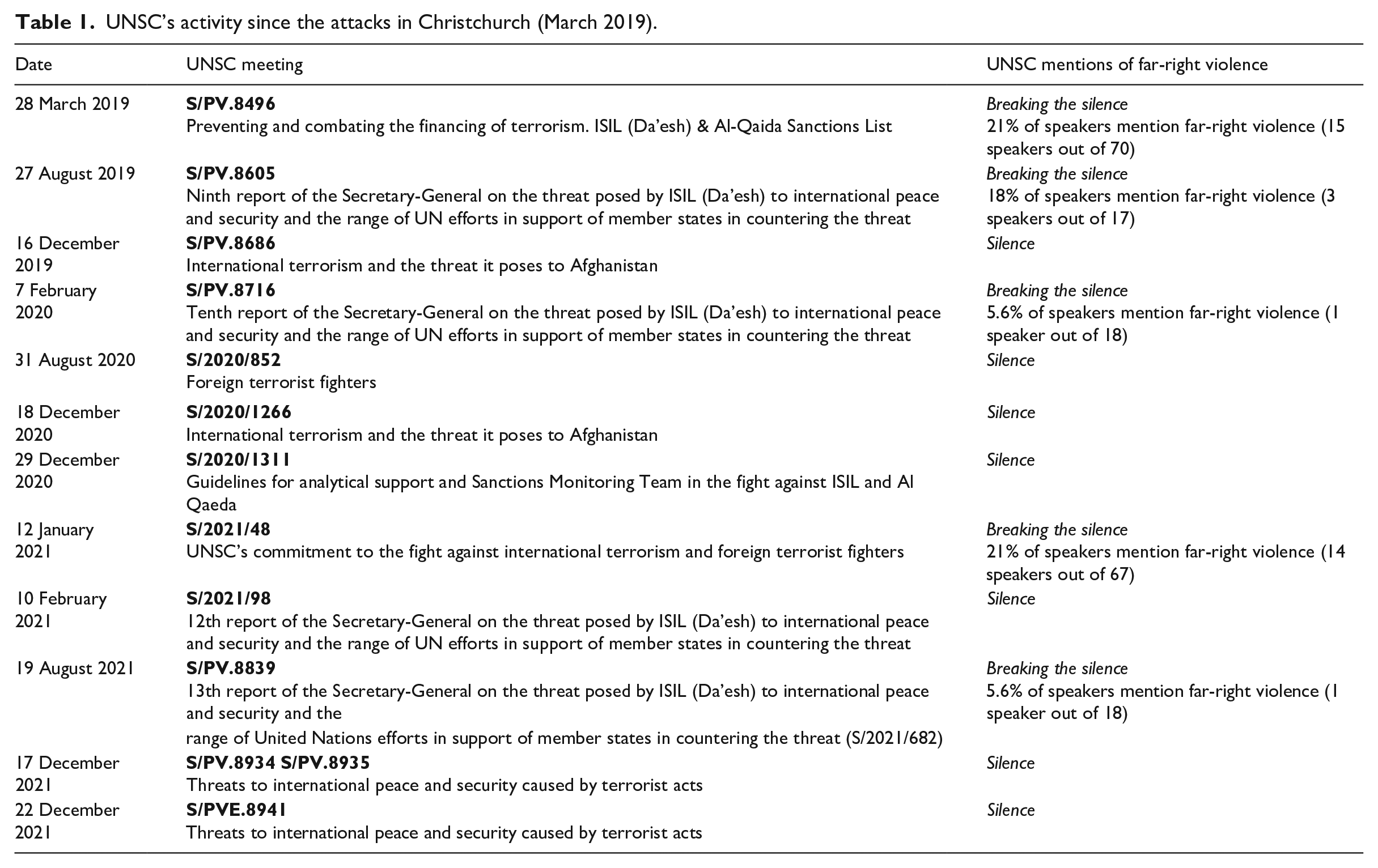
References to specific attacks are also scarce, including ones to the 2019 Christchurch events. As Table 1 illustrates, in the first meeting following the attacks, only 15 members out of 70 speakers (21%) expressed their condolences to New Zealand. Overall, three other far-right terrorist attacks are mentioned but only once and solely by the countries’ representatives. These are the 2011 and 2019 attacks in Norway 12 and the 2017 Québec City Mosque shooting. 13 Remarkably, these were not mentioned at the time of their perpetration, but in meetings that took place after 2019. As I discuss further below, the fact that these mentions took place only after 2019 (re)produces the discursive construction of this violence as new or on the rise, thus hiding its historical continuities (Applebaum, 2011; Mills, 2007; Sullivan, 2006). Moreover, none of these attacks are mentioned in Resolutions or Presidential Statements, which, in contrast, condemned various attacks carried out in previous years by Al-Qaeda, ISIL, and their affiliates such as 9/11, the bombings in Madrid (2004) and London (2005), and others like Kenya and Tanzania (1998 and 2002), Bali (2002), Russia (2002 and 2004), Iraq (2003), Turkey (2003 and 2015), Egypt (2005 and 2015), Nigeria (2015), Tunisia (2015), France (2015), and many others (see, among others, Kundnani and Hayes, 2018; Martini, 2021).
Overall, these silences reveal how counter-terrorism is a formation based on the uttered security threat vs the non-uttered non-securitized. The spoken/unspoken (re)articulates the security focus on non-white violence while leaving white violence mostly unaddressed. These silences maintain the formation’s hegemonic focus on non-white violence, thus (re)producing the white privilege of not becoming the focus of security – a dynamic that is reinforced by the silencing processes illustrated below.
The global discourse on far-right silencing of white supremacy
It should not be surprising that a few mentions of far-right violence can be found in the Council’s meetings. The body is embedded in contemporary political dynamics and, in recent years, concern about this kind of violence has increased (CTED, 2020). It is, however, in these mentions that whiteness forms discursive patterns of white ignorance that reconcile the construction of whiteness – and the legitimacy of white privilege – with the (few) discussions of far-right violence. These mentions do not represent a challenge to the hegemonic racialized formation, as the various discursive patterns that emerge maintain the formation in its hegemonic position, as this section illustrates.
Racially, ethnically, and politically motivated terrorism and extremism
The Council’s discourse constructs ‘Islamic terrorism’ as a transnational and monolithic phenomenon structured around various interlinked organizations that the discourse homogenizes. Throughout the 2000s, the Council focused specifically on ‘Osama bin Laden and his network’, 14 understood also as ‘a global network of groups’. 15 Here, the discourse linked various groups and constructed them into ‘a complex international network,’ 16 a discursive move that merged heterogeneous organizations and returned the image of a single, monolithic phenomenon. This process continued throughout the 2010s, when other groups as ISIL, ANF, and Boko Haram were linked to Al-Qaeda through a discursive thread that merged them, to become ‘ISIL, ANF and all other [. . .] groups [. . .] associated with Al-Qaida’. 17 Despite the heterogeneous nature of these groups and even their enmity, these organizations were treated as manifestations of a single phenomenon. Erasing local specificities and focusing only on transnational features, the discourse shaped the idea of a ‘globalization of terrorism’. 18 In other words, a ‘single phenomenon’ 19 of ‘global terrorism’ 20 was discursively constructed as it was understood that ‘the new wave of terrorists is like a spider’s web that connects practically all continents’ 21 – a thread that also reinforced the monolithic and international interpretation of this violence.
This feature contrasts with the discursive construction of far-right terrorism. This violence’s transnational character and global linkages of its organizations are mostly silenced discursively, and the discourse mostly individualizes this violence, interpreting it only as individuals’ behaviours and concealing its collective and structural dimensions by hiding its specific organizations. For example, it was stated that ‘today, we face transnational terrorist threats, like those of Da’esh and Al-Qaida’ and ‘individuals and groups that commit terrorist attacks connected to xenophobia, racism and other forms of intolerance’.
22
Here, non-white violence is described as a transnational threat linked to specific organizations – therefore, as a global threat the Council should face. Contrastingly, white violence is linked to individuals’ and (unnamed) ‘racist movements based on intent to incite phobia, hatred of and hostility against Muslim nations, immigrants and individuals’,
23
as Saudi Arabia argued. Resolution 2617 (2021) also condemned terrorism in all its forms and manifestations, and all terrorist acts, including those on the basis of xenophobia, racism and other forms of intolerance, or in the name of religion or belief.
24
However, constructing far-right violence as ‘racially or ethnically motivated’, 25 as the USA put it, returns the image of a somewhat individual violence. Not only do the specific groups remain unnamed and hidden, but the collective dimension of this violence is disregarded through a process of individualization – i.e. the understanding that this violence is caused by individuals’ attitudes and ideologies. As Corbin argues, xenophobia, intolerance, and racism are not structural issues, but subjective ideologies and mostly individual beliefs (Corbin, 2017: 462). Therefore, the discursive identification of these as root causes of far-right violence shifts the focus on individuals’ attitudes and motivations – hiding its collective dimension and its systemic goals such as the safeguarding of white supremacy (Abu-Bakare, 2020).
The overall depiction of far-right terrorism as ‘ideologically motivated’ 26 also contrasts with the discursive irrationalization of non-white Others through their depiction as ‘barbarous’, 27 ‘evil and despicable’, 28 ‘global evil’ 29 ; the discursive references to their ‘evil’, 30 ‘bloodthirsty ideology’ 31 ; and their ‘dastardly’, 32 ‘despicable’, 33 and ‘irrational acts’. 34 Discussing the far-right as ‘politically motivated violent extremism and terrorism’ 35 or referring to the ‘growing threat [emanating] from politically motivated violent extremism and terrorism, such as far-right and far-left violent extremism’ 36 does not return an irrational, Othering construction of this violence. The mentions of political positions – i.e. left and right – place it at a domestic level, hiding its international dimension. The association with (national) political positions somewhat rationalizes this violence, linking it to political, ideological postures but silencing its systemic goals linked to the safeguarding of white privilege and whiteness.
Moreover, defining this violence as ‘racially and ethnically motivated terrorism’
37
further racializes its targets as the discourse interprets them as ‘religious minorities and racialized communities’.
38
Here, the discourse constructs ‘racialized subjects’ while leaving whiteness as a race categorization as ‘unspoken’, as the (white) goals of the far-right’s violence perpetrated against these communities are never discussed (Corbin, 2017: 456). The functioning of whiteness can also be observed in the only statement acknowledging race and religion. The Foreign Minister of Canada stated that in the wake of acts of terrorism carried out by Muslim extremists, Western countries often call upon Muslim countries and Muslim leaders to condemn those attacks in the name of their people and their faith. It should follow that, as the Foreign Minister of a majority white and majority Christian country, I feel a specific and personal responsibility to denounce white-supremacist attacks.
39
This statement contributes to the processes of racialization of counter-terrorism. The mention of ‘white-supremacist attacks’ 40 constructs a rather vague and abstract threat, above all, if compared with the more specific identification of the threat coming from individuals constructed as ‘Muslim extremists’. 41 Reproducing a division between (white) Western vs Islamic countries and leaders, the statement contributes to the identification – and construction – of a Muslim world, community, and religion responsible for condemning non-white violence. Contrastingly, the condemnation of white violence is reduced to a ‘personal responsibility’ 42 – thus not identifying any (white) racial or religious community – or organization – that could be linked to violence.
Overall, this statement is representative of two important racializing processes: the Islamization of terrorism – the construction of religion as a source violence – and the construction of Muslim suspect communities and their securitization. While the only reference to Christianity above does not link religion and violence, the Islamization of terrorism took place through claims condemning terrorists for ‘exploiting a world religion for their own evil aims’ 43 despite the fact that ‘Islam is not a religion of extremism’. 44 Muslim countries, such as Malaysia, also linked the two, arguing that ‘as Muslims [. . .] there is a critical need for us to address the exploitation of Islam by terrorist groups [. . .] Al-Qaida, the Taliban, the Al-Nusra Front, Al-Shabaab, Boko Haram and Da’esh. They all have one thing in common – they rely on Islam’. 45 Similarly, Mali considered that ‘promoting a moderate and authentic Islam is a tangible response to extremism’. 46
The Islamization of the threat resulted in the securitization of Muslim communities. ‘Muslim communities’ 47 were interpreted as the ‘communities most vulnerable to recruitment by extremists or to self-radicalization’ 48 also because of the ‘increased recruitment by terrorist organizations of young people from Muslim minorities in Western countries’, 49 as Egypt argued. Warnings such as ‘be careful not to place whole communities under suspicion [. . .] because of acts committed by some of their members’ 50 and the concern that some security measures could ‘achieve the precise opposite of the desired effect by driving more members of the targeted groups to resort to violence’ 51 securitized these groups by discursively linking them with a potential threat inside them – and thus, writing the whole community as a possible security threat (Breen-Smyth, 2020). Reproducing the non-white spoken and white unspoken security construction, none of these processes takes place in the case of far-right terrorism as no religion is discussed in relation to it and no (white) community identified as a space in which to implement counter-terrorism – a silence that safeguards whiteness and reproduces the white privilege of not becoming security suspects (Breen-Smyth, 2020).
The hegemonic focus on non-white subjects as terrorist Others was reinforced by the phrasing of the various condemnations of ‘terrorism in all its forms and manifestations’, 52 ‘including’ 53 those perpetrated by the far-right. Here, in response to the Christchurch attacks, Iraq commended ‘New Zealand for its wise measures against terrorism in all its forms and whatever its source’. 54 The claims about the Council’s need to focus also on ‘that particular form of terrorism [right-wing extremism]’, 55 as the USA argued, returned the idea of this violence as the exception. Nonetheless, it was also argued that ‘the fight against terrorism’ had to remain centered on ‘defeating Da’esh, the Al-Nusra Front and other Al-Qaida-affiliated groups militarily’. 56 This discursive pattern reconciled the mentions of white violence with the formation’s focus on non-white terrorism, thus reproducing the white privilege of not being securitized and rendered a global threat. This violence’s exceptionality was also reproduced by the focus on Christchurch.
The 2019 Christchurch attacks and the rise of the far-right
In the first meeting after the 2019 Christchurch attacks, some countries such as South Africa extended their ‘condolences to the people of New Zealand for the horrendous attack’ 57 and paid homage to ‘all victims of terrorism, in particular the victims of the recent attacks on two mosques in Christchurch’. 58 The ‘terrorist attacks in New Zealand’ 59 had been perpetrated ‘to everyone’s disbelief’, 60 as Morocco put it, and Saudi Arabia claimed that the ‘terrorist attacks committed [. . .] in New Zealand have shaken the world’s conscience’. 61 The 2019 Christchurch attacks represent the moment the Council started expressing its concerns about ‘the growing number of far-right attacks’. 62 Members such as South Africa and the UK expressed their concern about respectively ‘the rise of violent right-wing extremist terrorism’, 63 and the ‘increase in the number of terrorist attacks motivated by extreme right-wing ideologies’. 64 Similarly, Indonesia discussed ‘the rise of another form of terrorism, which is racially or ethnically motivated’ 65 and India focused on ‘the proliferation of violent nationalism [. . .] as well as other forms of racially and ethnically motivated violence’. 66
The understanding of a ‘proliferation of extreme right-wing’ 67 terrorists works together with the narrow focus on Christchurch and discursively constructs white violence as a new phenomenon on the rise. This discursive pattern silences the existence of white violence before Christchurch and, more generally, silences its historical manifestations throughout the centuries (Ali, 2020). In other words, the construction as a phenomenon emerging in 2019 silences the continuities of racial violence embedded in the genealogical process of formation of a racialized hierarchical international community and the historical exercise of racial violence. Furthermore, delinking it from its historical manifestations also silences its link with the safeguarding of white supremacy, the overall goal of this violence – and thus it leaves whiteness untouched and unquestioned.
The only two mentions of previous far-right attacks did not challenge the silencing of this violent history. In 2019, Canada stated that ‘two years ago, a terrorist killed six people in a Quebec City mosque’, 68 and, in 2021, Norway declared that ‘this year marks 10 years since [. . .] a right-wing extremist took the lives of 77 people in Norway [. . .] and in 2019 a young man attacked a mosque, seeking to frighten and kill Muslims’. 69 Delivered in 2019 in condemnation of the Christchurch attacks, and not at the time of the perpetration of the attacks mentioned, these statements reify Christchurch as a pivotal event in the discussion of white violence – and, as such, further silence its previous manifestations. Moreover, these declarations silence the systemic and organizational dimension behind this violence, by focusing on the individuals committing the attacks and depicting their objectives as individual goals. As such, they further silence white supremacy as collective and systemic. This dynamic is observable, for example, in the identification of the goals pursued as the frightening and killing of Muslims, while white violence’s defense of white privilege remains silenced.
The silencing of the far-right’s roots in historical manifestations of white violence can also be observed in Canada’s mentions of ‘Neo-Nazis’ 70 or India’s reference to ‘neo-fascist groups’. 71 The prefix ‘neo’ conveys the idea of a new kind of far-right violence with new ideologies and attitudes. It accentuates its contemporary dimension, while somewhat silencing the possible historical continuities with Fascism and Nazism (Graef, 2022). Together with the narrow focus on Christchurch, these silencing patterns write white terrorism as an individualized and new violence – thus somewhat obfuscating its possible links to historical racialized processes of the (re)production of white supremacy. The discursive individualization and ahistoricization mutually constitute the understanding that the far-right manifests itself almost solely in the cybersphere described hereunder.
The white (cyber) lone wolf
The Council focused specifically on ‘preventing the use of the Internet for terrorist purposes’. 72 It was argued that ‘as the Christchurch attack demonstrated, much remains to be done to more effectively prevent the spread of terrorist propaganda and support the development of positive counterarguments’. 73 The Council aimed to avoid the ‘Internet becom[ing] a sanctuary for, or tool used by, terrorist groups’, 74 referring to all kind of terrorism. Nonetheless, the measures to fight non-white violence were mostly focused on countering ISIL and Al-Qaeda’s ‘sophisticated manipulation and brain-washing techniques’ 75 for ‘the spread of radicalism’ 76 to ‘vulnerable individuals in vulnerable communities’. 77 In 2017, the UNSC’s Comprehensive International Framework to Counter Terrorist Narratives 78 specifically ‘recommended guidelines and good practices to effectively counter the ways that ISIL (Da’esh), Al Qaida and associated [. . .] entities use their narratives to encourage, motivate, and recruit others to commit terrorist acts’. 79 The Council thus focused on the organizations’ radicalization strategies – thus discursively constructing an online and offline collective nature of the threat.
Contrastingly, the discussions of the cybersphere in relation to white violence centred very narrowly on individuals’ consumption of online material – silencing its collective dimension. Moreover, the Council overwhelmingly focused on the cyberspace when debating far-right terrorism. Discussed only in recent meetings (2020–2021), most of the speakers linked white violence solely to the cybersphere. For example, eight out of 14 speakers (57%) mentioning far-right terrorism in the Council’s 48th meeting (2021) referred solely to its virtual dimension. This discursive pattern constructs it as a very abstract, intangible, and undefinable threat, existing almost solely in a virtual shape. Furthermore, this strict focus on the cybersphere somewhat reinforces racialization as it suggests that white terrorists are more sophisticated than non-white terrorists. 80
On this, Canada argued that ‘hatred, unfortunately, is eternal, but the ways in which it spreads, change. Today, hatred is increasingly spread through the Internet – in online forums and on social media’. 81 Similarly, Norway noted ‘the continued references to the 2011 terrorist attack in Norway in online forums. Sadly, it has also been a motivation for terrorist actors in other countries, including the attack in Christchurch, New Zealand’. 82 Here, identifying hatred as a very vague motivation behind this violence silences its specific political goals – the safeguarding of white supremacy. Moreover, through this narrow focus, the Council constructed far-right propaganda as circulating solely in a virtual, intangible cybersphere. Here, the focus on ‘actors’ and the lack of references to any organizations or specific community, as in the case of Jihadism, silenced the collective dimension of white radicalization and its white goals – thus shielding it from a process of securitization.
Shaped by whiteness, the statements above also individualize far-right extremism and silence its – contemporary and historical – collective dimension. The narrow focus on individuals is visible in the understanding that counter-terrorism ‘requires efforts to curb the hate that fuels the spread of extremist ideologies to individuals, such as the terrorist in New Zealand’. 83 This individualization of the threat reproduces a narrow focus on the individual and silences the broader, structured collective dimension at the systemic roots and historical continuities of this racial violence.
These silencing dynamics return the image of the ‘white-supremacist terrorist’ 84 that invents his/her own ideology (Gentry, 2020: 109). They construct far-right attacks as ‘one-offs’ (Corbin, 2017: 455) and their perpetrators as exceptions to the norm. All in all, this silencing process reproduces white privilege; white individuals and communities have the privilege of not becoming the target of counter-terrorism measures (Breen-Smyth, 2020; Dixit and Miller, 2022), and far-right organizations the privilege of not becoming the focus of security measures. More deeply, the discourse silences the link to white supremacy and the maintenance of white privilege, erasing both this violence’s racist nature and its connections to an international colonial past, a process observable also in the last pattern identified.
Writing white supremacy as the Other
The last silencing pattern identified is the writing of white supremacy as Other, observable, for example, in the claim that ‘addressing the evolving threat from politically motivated violent extremism and terrorism, especially the growing number of far-right attacks, is part of [the international community’s] responsibility too’. 85 Similarly detaching the international community from white supremacy, it was argued that ‘the international community is witnessing increasing instances of ideologically motivated violent extremism [. . .] They are a threat to our democratic institutions and values’. 86 Similarly, the United States declared that ‘last year, for the first time, the State Department designated a white supremacist group as a Specially Designated Global Terrorist’, 87 without mentioning the name of the group, and the Foreign Minister of Canada, as seen above, asserted that ‘as the Foreign Minister of a majority white and majority Christian country, I feel a specific and personal responsibility to denounce white-supremacist attacks in the same way’. 88
Here, various silencing dynamics work together to safeguard whiteness as these declarations construct white supremacy as the Other. Shome describes how whiteness may preserve itself through ‘different strategies of self-naming’ where ‘instead of positioning itself as the “norm”, it begins to mark itself as the “other”, as “different”’ (Shome, 2000: 368). In line with Shome’s argument, in these quotes, whiteness identifies and writes a part of white supremacy as the Other. By doing so, however, it silences the international community’s whiteness and its structural racialized power hierarchies. Identifying and securitizing a small part of white supremacy, whiteness silences and hides white privilege and its structural racialized roots; the political goals and racialized hierarchies behind this violence are not problematized. Moreover, whiteness also reifies and legitimizes itself through the (self-)assignation of exceptional powers to counter these specific manifestations of whiteness, thus, still reproducing white privilege.
Conclusion: White global silences as privilege
International counter-terrorism is a racialized and racializing formation based on a speech/silence dichotomy, a binary that has specific colors. Emerging in different shapes, within counter-terrorism, the color of silence is white. White is also the color of privilege – i.e. the advantages white individuals are awarded because of their whiteness maintained by systemic and structural white supremacy. The article has shown that the international community’s silences on far-right terrorism are white silences – non-uttered dynamics that reproduce and reify white privilege and rearticulate whiteness. Regardless of their shape, white silences represent a privilege because they avoid the jeopardization of whiteness and white privilege – in the specific case under analysis, detaching this violence from the global counter-terrorism formation and its focus on non-white terrorist Others.
Revealing the color of these global silences permits us to see that, within counter-terrorism and, in more general security formations, silences may be a manifestation of power. The article highlights how the said and the unsaid work together to (b)order security – and, overall, societies. It shows how, in the case of global counter-terrorism, the spoken/silence dichotomy reproduces (in)security dynamics differently for white and non-white subjects. It also shows that this dichotomy reifies power and structural racialized hierarchies – relations of power that are inherited from the international community’s past and that still shape its structure. The present analysis thus pushes us to make the colors of global absences visible and to listen to what the unspoken can tell us about power and its manifestations.
Overall, scrutinizing the silences on far-right terrorism emphasizes the limits of logocentric orders – and their problematizations. It shows how global formations are composed of various, mutually constitutive spheres – in this case, the spoken and the unspoken realms. The present work thus reveals the power of the unspoken in international politics, how this may (re)produce global racialized hierarchies and, overall, the powerful colors of the racialized spoken/unspoken dichotomy in security discourse. This analysis hopes to open a space of reflection on the importance of problematizing the consequences of the colors of presences in logocentric (b)orders and the colors of the absences that inhabit them.
Footnotes
Acknowledgements
Big thanks to Elisabeth Schweiger for her inspiration and for introducing me to the role of silences in international politics. I’d also like to thank Xavier Guillaume, Noé Cornago, Thomas Cooke, Cynthia Enloe, Tom Pettinger – and all participants in our ECD (EISA) February 2021 event on ‘Silences are political! Unpacking silences as international politics’ – whose conversations inspired this article. Special thanks to Tom Pettinger for his helpful and enthusiastic advice, and to Mark Salter for his valuable comments on previous versions. Thanks to the reviewers for their generous pointers, and to this journal’s editors for their time and kindness.
Funding
The author disclosed receipt of the following financial support for the research, authorship, and/or publication of this article: I received funding for part of this project from the Juan de la Cierva – Formación scheme (FJC2020-046251-I/MCIN/AEI /10.13039/501100011033 and NextGenerationEU/PRTR) while I was a JdC researcher at UNED, Spain.
