



Abstract
The article investigates the social making of counter-terrorism in international organizations (IOs). Discussing the literatures that emphasize the (in)coherence of multilateral counter-terrorism and the diversity of interests that interact and converge in these policies, the article highlights the determinants by which an object as vague and dissensual as post-9/11 counter-terrorism is ordered and stabilized within IOs. Therefore, the article provides an alternative sociological exploration of counter-terrorism in IOs by delving into the dynamics of frictions and power. Multilateral counter-terrorism is conceptualized as a socially grounded ‘constructive ambiguity’; the catch-all category of counter-terrorism is both a patent source of conflict among IOs’ players, who fight over its meaning, and a catalyser of minimal consensus. The article isolates two types of power structures in IOs that the ambiguity of counter-terrorism supports: domination and fragmentation. Additionally, the article demonstrates how ambiguities condition the conduct and evolution of IOs’ risk management security agenda. To do so, the article takes NATO’s post-9/11 trajectory as a case study and explores two different counter-terrorism policies related to counterinsurgency warfare in Afghanistan and maritime surveillance in the Mediterranean Sea.
Keywords
Introduction
NATO, like many other international organizations (IOs), categorizes certain of its initiatives as unequivocally and logically falling within the scope of counter-terrorism. The official discourse of such organizations portrays counter-terrorism as a self-evident terminology. Counter-terrorism is naturally counter-terrorism. However, during my research interviews with NATO diplomats, military officers and international civil servants, they constantly highlighted the artificiality of the counter-terrorism category as well as, consequently, the challenge and obstacles in reaching consensus on its related policies. In July 2015, I attended a NATO exercise on non-lethal weapons at a military base in Belgium. I had the opportunity to observe a variety of equipment being tested by German, Dutch and Belgian soldiers throughout the day, including Tasers, dazzlers and sonic systems. I sought information from the Belgian military officer in charge of the exercise regarding the rationale behind the specific association of these various weapons with counter-terrorism. He replied: ‘Counter-terrorism is the overall purpose of the programme. My job is to make sure that the equipment is developed. Whether it’s for counter-terrorism, peacekeeping, law enforcement, maritime security, or any other task, it doesn’t really matter’ (Interview 1). A long-serving civil servant gave me a rather blunt response about his feeling on counter-terrorism at NATO: ‘For me, terrorism is like pornography. I don’t know what it is, but when I see it, I know it is’ (Interview 2). On a more formal tone, a diplomat from the French representation also confessed:
Counter-terrorism is complicated to handle at the multilateral level. Each country has its own vision and experience. Some want it to be militarized, some others not. Before I was at NATO, I was at the UN and it’s always the same. It’s so vague, it’s not easy. We have to deal with it. Overall, everyone around the table tries to move in the same direction. (Interview 3)
These fieldwork observations raise the broader question of the challenge posed by the heterogeneity of counter-terrorism policies within IOs such as the UN, EU or NATO, which have become substantially involved in the global fight against terrorism after 9/11. The difficulty in reaching consensus on counter-terrorism poses a major challenge for these organizations, due to both the radical uncertainty that has characterized the reframing of risks after 9/11 (Aradau and Van Munster, 2007) and the intricate political dynamics inherent to IOs.
The issue of heterogeneity in counter-terrorism efforts among IOs has been analysed in two distinct ways in the literature. The first perspective examines the coherency and effectiveness of multilateral counter-terrorism, with scholars acknowledging the challenges and difficulties involved in reaching agreements on such a sensitive topic (Argomaniz, 2011; Nesi, 2016). Bureaucratic analysis is utilized as a variant of this literature to demonstrate the role of specific institutions, such as international secretariats, in the organizational consolidation of multilateral counter-terrorism (Hegemann, 2014). However, counter-terrorism tends to be a taken-for-granted category. The aim of these works being to study the functional (un)coherency of counter-terrorism, the underlying rationale behind its production is not sufficiently addressed. A second set of works brings to the fore the complex anatomy of counter-terrorism networks, characterized under concepts such as ‘patchwork’, ‘security clouds’ or ‘security traffic jam’, made of various actors, organizations and interests (Cold-Ravnkilde and Lindskov Jacobsen, 2020; D’Amato, 2021; Den Boer and Van Buuren, 2012) that coalesce (in)formally around the shared goal of countering terrorism. The complex heterogeneity of counter-terrorism is exposed but the ways in which it is ordered through social interactions are overlooked. In other words, the literature lacks an examination of the mechanisms by which actors arrive at a consensus regarding counter-terrorism. The article aims to address this gap by unpacking how IOs actors negotiate, contest the meaning of counter-terrorism, and how consensus is reached in the face of conflicting interpretations, an area that largely remains to be explored. This investigation serves as an invitation to delve into the social foundations of counter-terrorism within IOs.
The article concentrates on NATO’s counter-terrorism after 9/11. During the bipolar era, NATO’s primary focus was on collective defence against the Soviet Union, entrenched in Article 5 of the Washington Treaty. After the Cold War, and along with the collective defence, NATO developed a ‘crisis management’ pillar to ensure Euro-Atlantic security against various risks such as terrorism (Sperling et al., 2012). Counter-terrorism was top priority before the resurgence of the Russian threat with the annexation of Crimea and the invasion of Ukraine in February 2022. 1 It has played a crucial role in the post-Cold War transformation of the Alliance (Hallams et al., 2013), as stated in NATO’s 2010 Strategic Concept, mentioning explicitly that ‘[t]errorism poses a direct threat to the security of the citizens of NATO countries, and to international stability and prosperity more broadly. Extremist groups continue to spread to, and in, areas of strategic importance to the Alliance’ (NATO, 2010: §10). Therefore, NATO’s contemporary trajectory makes this organization relevant to study multilateral counter-terrorism.
The objective of the article is to explore the social anatomy and embeddedness of the semantic multiplicity of counter-terrorism. The article shows how the radical uncertainty characterizing the contemporary discourse on terrorism can be a source of consensus in IOs. The hypothesis of this article encompasses two different aspects. The first is sociological, as it posits that counter-terrorism in IOs constitutes a constructive ambiguity. The lack of clarity of counter-terrorism is identified as a potent source of friction and cohesion. Furthermore, the semantic ambiguity associated with counter-terrorism serves as a valuable opportunity for IOs players to adjust their positions and thereby redefine the vague contours of the multilateral consensus in their favour. Therefore, what is in this article considered as counter-terrorism policy in IOs is a multilateral setting structured by an imperfect and evasive consensus around counter-terrorism. More specifically, the article explores two types of power relationships in IOs that are supported by the elasticity of counter-terrorism. The first is the domination setting, consisting in the ascendancy of an actor in counter-terrorist policies. It is explored through NATO’s International Security Assistance Force (ISAF) in Afghanistan. The second is the fragmentation setting, characterized by a fragmented distribution of power and fluid asymmetries among the players. It is explored through Operation Active Endeavour (OAE), an Article 5 maritime surveillance mission aimed at preventing and disrupting terrorist activities in the Mediterranean Sea. The second dimension of the hypothesis argues that ambiguities have practical implications that go beyond consensus-building. Ambiguities condition the conduct and evolution of IOs’ security policies. In broader terms, I show that ambiguity is a key site from which to interpret the implementation of NATO’s military interventions and, consequently, the wider development of its post-bipolar crisis management agenda.
The article analyses OAE from its creation in 2001 to its end in 2016 and ISAF from its launch in 2001 to 2012, two years before it ended. The first reason is to examine the mechanisms by which US domination grew and culminated in the military Surge from 2009 to 2012. The second reason is the beginning of the Western disengagement from Afghanistan in 2012. The article is divided into three parts. The first part offers a sociological perspective on constructive ambiguities to identify the logics of counter-terrorism negotiations in IOs. The other two parts focus on NATO’s post-9/11 trajectory and are structured similarly, with the successive exploration of the internal and external properties of the multilateral settings.
International organizations, counter-terrorism and the politics of constructive ambiguities
Ambiguities and the multilateral settings of counter-terrorism: A sociological framework
This section defines four concepts necessary for a sociological understanding of counter-terrorism in IOs: constructive ambiguities, consensus, multilateral setting and power.
Since Henry Kissinger famously qualified constructive ambiguity as ‘the deliberate use of ambiguous language in a sensitive issue in order to advance some political purpose’ (quoted in Berridge and James, 2003: 51), the notion gained attention in international studies. The interest of the concept is to understand the performativity of language in multilateral negotiations. Reaching consensus in IOs might be a complex process, due to the heterogeneity of the visions at play and the intensity of the tensions between representatives of sovereign states. Consequently, the use of vague, unclear terminologies in IOs is ‘often unavoidable and language is watered down to the lowest common denominator focal point in order to seal the deal’ (Hansen, 2016: 195). As Hansen posits, constructive ambiguity and consensus are intertwined in IOs. The aim of negotiations is to reach a consensus, and the high-stakes nature of interests involved requires ambiguity. Counter-terrorism at NATO is an interesting example, with the literature often characterizing NATO’s consensus on counter-terrorism as uncoherent (De Nevers, 2007; Hallams et al., 2013) due to the unanimity rule governing the Alliance’s decisionmaking process. Requiring all members to agree on any initiative, it often results in a lowest common denominator approach. But as Vincent Pouliot observes,
‘[u]nder the veneer of consensus, NATO is a multilateral organization with many cracks. The presence of political divides should not come as a surprise: communities are always structured by various cleavages and power struggles. What matters, from a political perspective, is how these conflicts and divergences are worked out in practice’. (Pouliot, 2016: 113)
This is exactly what this article aims to do, by addressing the crucial role of ambiguity in the institutionally and politically constrained context of NATO’s counter-terrorism.
To further elaborate on the international production of counter-terrorism, the article introduces two additional concepts: multilateral setting and power. In his political sociology of IOs, Pouliot (2011, 2016) refers to a multilateral setting as a coherent space of negotiation shaped by the influence of two factors. Players agree to collaborate by minimizing their differences (consensus) and compete for the direction of a policy to their advantage by solidifying their position and investing resources (power). The article takes ISAF and OAE as multilateral settings, within which specific power relations are deployed around the fight against terrorism. The notion of multilateral setting allows for the exploration of the sociological interdependence between ambiguity, consensus and power in the production of counter-terrorism policies by IOs. The article argues that vague terminologies emerge from specific power relationships among IOs players. I demonstrate the significance of counter-terrorism terminologies as a pivotal element in multilateral power struggles. The disputes over the meaning of counter-terrorism have practical repercussions, determining the political orientation and the technical (here military) means employed in IOs’ security initiatives. Therefore, the way counter-terrorism is framed can have different effects on the actors involved in its negotiation. It may either serve to benefit their interests or have detrimental consequences for some of them. These implications explain why the players place such importance on the terminologies they negotiate and, more particularly, on preserving ambiguities, which are essential for enabling power strategies, consensus-building and the formation of accepted multilateral hierarchies. Indeed, the principle of ambiguity is based on conflict and its mitigation through consensus. Constructive ambiguities facilitate the functional aggregation of different views and power strategies (Jegen and Mérand, 2014: 184; Rayroux, 2014: 388). In the ISAF, for instance, constructive ambiguities served power strategies such as seizing key positions in the chain of command, blurring the mission’s boundaries, troops reinforcement and the territorial division of politico-military responsibilities.
Therefore, I qualify the impact of ambiguity in the multilateral context of counter-terrorism under two dimensions: the internal and the external. The internal dimension of the multilateral settings refers to the structure of the power relationships that ambiguities catalyse. The article explores two typologies. The first is a model of domination: some actors dominate counter-terrorism settings by using ambiguity to their advantage. Doing so, they ensure their influence, while allowing others to face-save by accepting a consensus that integrates contesting positions. Simultaneously, this allows the dominant player to receive support from weaker counterparts. This is demonstrated through NATO’s mission in Afghanistan, where the United States solidified its control over the operations and secured European contributions by leveraging the ambiguity of ISAF’s counter-terrorism. In the second multilateral setting, the distribution of power in IOs counter-terrorism is fragmented and no single actor dominates. Actors have no inclination to dominance in these settings, and preserving individual preferences and leverage is key to maintaining a consensus. While maintaining ambiguity, IOs players can prioritize their interests and preferences without seeking dominance. NATO’s operation in the Mediterranean Sea (OAE) demonstrates this, showing how actors maintained ambiguity over counter-terrorism to prioritize their own interests, such as intelligence gathering and migration control, while still promoting a consensus.
The external facet of constructive ambiguities also plays a crucial role in the importation of external resources into pre-existing multilateral settings. The externality of ambiguities is useful to understanding the impact of counter-terrorism on the institutional boundaries of IOs. The claimed necessity to develop a holistic approach to counter-terrorism (combining military, civil, financial, economic tools) has compelled IOs to strengthen cooperation among their policies and with various actors such as the private sector or international institutions (Nesi, 2016). Nevertheless, the question of how IOs actors accumulate resources of authority outside of their original counter-terrorism setting remains an open field of study. From this perspective, NATO is a relevant example to examine the effects of counter-terrorism ambiguities on IOs’ boundaries. Counter-terrorism has contributed to expand its crisis management agenda beyond the collective defence realm, encompassing domains such as human security, targeted killings, critical infrastructure protection or migration control. NATO’s post-9/11 trajectory has been shaped by competition and cooperation among its different policies, as well as with international institutions, such as the EU or ad hoc military coalitions, that member-states perceived as better or equally equipped to handle these new tasks (Huysmans, 2002; Villumsen, 2015).
This article argues that the lack of clarity of counter-terrorism provides opportunity for actors to blur the borders of multilateral settings. Through these ‘liminal’ or ‘border’ transactions (Stampnitzky, 2013: 13), actors are able to multiply their sources of influence, by constructing networks with external actors and institutional spaces. Lisa Stampnitsky’s research on the weakly structured boundaries of the US terrorism experts field is instructive in this regard. The lack of a clear definition of terrorism is rooted in the way the worlds of US experts work, especially at their borders:
Yet terrorism experts have never consolidated control over the production of either experts or knowledge. New ‘self-proclaimed’ experts constantly emerge, no licensing body exists to certify ‘proper’ expertise, and there is no agreement among terrorism experts about what constitutes useful knowledge. In sociological terms, the boundaries of the field are weak and permeable. There is little regulation of who may become an expert. (Stampnitzky, 2013: 12–13)
The same might be said for the context of IOs, where counter-terrorism is subject to multiple interpretations. Counter-terrorism being opened to multiple interpretations in IOs, then the players might beneficiate from a significant leverage to rely on external resources of influence, located in other settings of the IO or in formally exogenous institutions. The internal and external dimensions of ambiguities are intertwined. External resources influence multilateral settings, leading to either domination or fragmentation. Examples are provided of the co-constitutive relationships between NATO’s counter-terrorism and other arenas. The United States’ dominance in ISAF was partly due to permeable military chains of command with the non-NATO mission Enduring Freedom. The article also examines the fragmentation effects from liminal dynamics in OAE, including military ties with the civil maritime sector and diplomatic connections with EU migration control arenas.
Methodological overview
The article is based on 68 semi-structured and anonymized interviews, some of which are not used. Fifty-eight interviews were conducted during a seven-month internship at NATO Headquarters (HQ) in Brussels from March to October 2015, while the remaining 10 interviews were conducted between 2016 and 2018. The process of obtaining the internship, conducting the interviews and implementing methodological and ethical measures could be described extensively, but, due to space constraints, I will provide a brief overview of some key aspects. I was stationed in the International Staff, within the Emerging Security Challenges Division (ESCD), which facilitated my fieldwork as the division significantly focused on counter-terrorism. My internship was a participant observation, where my role was more of an ‘observer as participant’ than a ‘complete participant’ (Gold, 1958: 217). Although I was involved in work at NATO, my primary focus was on the scientific rationale for my presence, which was rooted in sociology. My objective was to examine how counter-terrorism was negotiated by diplomatic and military actors at NATO following 9/11.
The internship was unremunerated. I was financially independent from NATO through a PhD grant from my university. This allowed me to articulate my sociological perspective and ask questions that I might not have been able to ask if I had been financially dependent on NATO. During the interviews, I emphasized that any information gathered would be used in academic publications and explicitly stated at the start of each conversation that I had no interest in obtaining classified information. In fact, classified elements, essentially related to operational procedures and technical details about military equipment, were not relevant to my research, which focused on the social logic governing relationships between actors involved in counter-terrorism. This aligns with the findings of other scholars (Amicelle et al., 2020) who have determined that classified elements are not essential for social science research on security.
During my inquiry, I sought to engage a diverse range of actors from the International Staff, the International Military Staff, national representations, as well as other relevant actors (experts, civil advisers, operators) involved in NATO’s counter-terrorism efforts. However, it is important to note that most of my interviews were conducted at NATO HQ, which limited the scope of my analysis to a particular set of actors, primarily high-level diplomats and military personnel from specific corps and institutions. A multisited approach would have provided a more detailed view of the various dynamics and actors involved in NATO’s counter-terrorism. This article does not intend to provide an exhaustive examination of all the social realities of NATO’s counter-terrorism. Instead, it offers a selective and empirically based delineation of the social achieved through onsite fieldwork at the HQ, which enables to explain crucial lines of force. To support and corroborate these empirical findings, I have used other types of publicly accessible data such as official reports and statements, press contents, official declarations and declassified cables.
Domination in multilateral counter-terrorism: NATO’s war in Afghanistan
Building the US ascendency over ISAF
After 9/11, the US-led coalition Operation Enduring Freedom (OEF) intervened in Afghanistan, resulting in the fall of the Taliban regime. The UN created a stabilization force, the ISAF, to ensure a peaceful transition. However, the Bush administration pressured for a stronger military implication from the other contributing countries, leading to the transfer of ISAF’s command to NATO in 2003. NATO’s leitmotiv was to make sure that ‘Afghanistan would never become again a safe haven for terrorists’ (NATO, 2022a). Despite this consensual objective, diplomatic struggles emerged with a fracture between member-states involved in combat missions, primarily the United States, Great Britain, Canada, in the southern and eastern provinces of Afghanistan, and the NATO states deployed in the more stable northern and western regions (Rynning, 2012: 125–127). The first ones pleaded for an increased involvement of the second ones in the fights. Consequently, NATO’s diplomatic and military players struggled to define ISAF through counterinsurgency, comprehensive approach or counter-terrorism. At NATO between 2003 and 2009, the US diplomatic-military personnel insisted on the qualification of the ISAF as a counter-terrorist and/or counterinsurgency operation in order to encourage a greater participation of European countries in combat missions (Rynning, 2012: 95–97). The latter were nevertheless
opposed to the adoption of these terminologies because it associated ISAF with a war force that would have pushed them to reinforce their presence. This is why the European allies preferred to use the term comprehensive approach, through which the use of force was understood as one tool among other non-military means. It was also the case for counterinsurgency of course, but the comprehensive approach had the virtue of being a political euphemism concerning violence. (Interview 4)
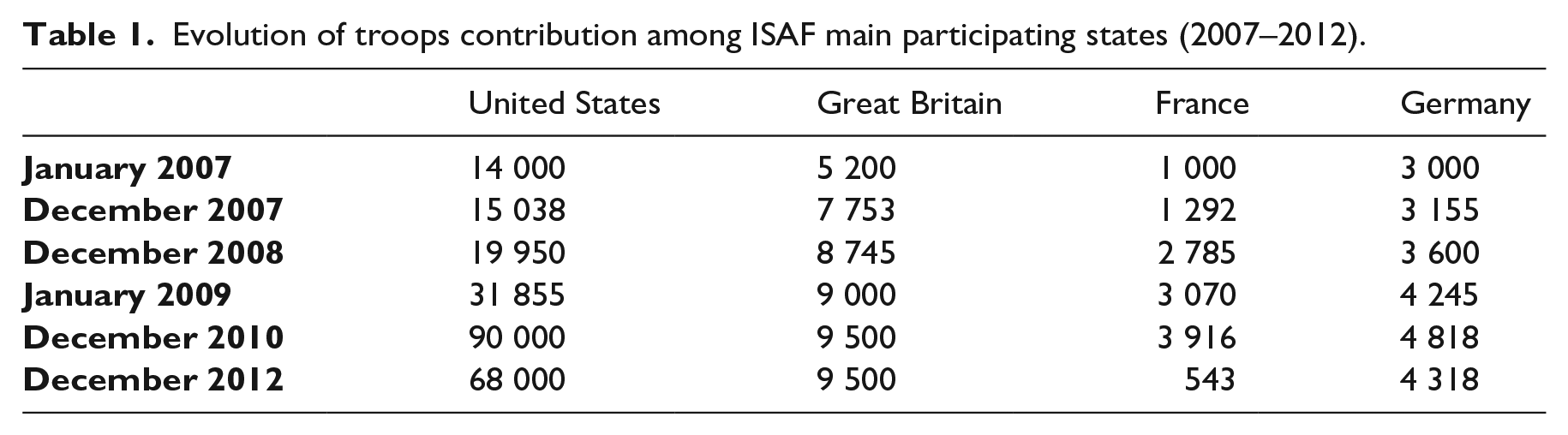
Between 2003 and 2009, the comprehensive approach was the consensual notion agreed upon by the allies to conduct ISAF. It balanced US and European positions on the use of force, leading to a vague terminology. For most European contributors, it meant a limited military engagement, in support of US leadership, combined with development coordinated by civil agencies (Pomarede, 2021: 78–79). For the United States, the comprehensive approach was a euphemism for a conflict of strong intensity in which the priority was to get larger military resources from the allies (Pomarede, 2021: 80). The US diplomacy played on this ambiguity to forge its domination. Being the predominant provider of troops (see Table 1), the United States used the comprehensive approach ‘to maintain an apparent consensus among NATO allies about the overall orientation of ISAF, while working at the same time to persuade the Europeans about the added-value of a more aggressive counterinsurgency campaign’ (Interview 5).
Evolution of troops contribution among ISAF main participating states (2007–2012).
These ambiguities on the purpose of NATO’s mission in Afghanistan reflected deeper power strategies, such as the territorial distribution of the military effort. The contributing states did not agree on the application of the comprehensive approach, and, consequently, they divided up their respective presences in the Afghan provinces, taking responsibilities and massing their troops in distinct zones – known as the ‘Regional Commands’ – to act as they saw fit. Italy, Germany, France and Spain occupied the calm zones (the north and Kabul), while the United States, Canada and Great Britain occupied the conflict zones (the south and the east). The Regional Commands were administered according to the priorities of the contributing states, which, based on national orientation and the security situation in the area, focused either on the civilian or military aspect. The military territorialization of Afghanistan reflected a consensus on investment in combat, with some states desiring to maintain distance from such operations, while the United States controlled the eastern region and was heavily involved in combats in the south (Kandahar, Helmand). The military territorialization, which was consensual and supported by the ambiguity of the comprehensive approach, reflected the United States’ domination. Indeed, large-scale offensives were primarily conducted with the participation of US troops, including in provinces not under US responsibility. Additionally, the distinction between the US and European approaches increasingly blurred due to the rise in strength of the Taliban insurgency from the mid-2000s onwards, as the insurgency extended its armed campaign, and the stable provinces became combat zones requiring US military reinforcement (Pomarede, 2021: 82).
The negotiation of the Comprehensive Strategic Political-Military Plan (CSPMP) in 2008 is worth investigating with regard to the hierarchy formed through the ambiguity over the fight against terrorism. The CSPMP aimed to formalize the Alliance’s comprehensive approach in Afghanistan. In a cable sent to Washington, Victoria Nuland, then US Ambassador to the North Atlantic Council, depicted the negotiations in the following way:
In negotiating the CSPMP in March, a number of Allies demonstrated a continuing allergy to using the word ‘counterinsurgency’ in NATO documents and/or a misunderstanding of the concept. France and Spain took a hard line against any sort of mention . . .. At the end of the day, the consensus solution was an agreement to ‘establish mechanisms for ISAF to exchange best practices and lessons learned, with a particular emphasis on . . . the counterinsurgency experience of nations’. We should use this limited opening to strengthen Allies’ understanding of COIN, and demystify both the term and the concept at NATO . . . even if under a different, more Euro-palatable name. (Note: ‘Comprehensive Approach’ rings better in European ears. End note.) (Nuland, 2008)
The United States was becoming more dominant in military actions due to the deteriorating security situation across the country and preparing its Surge, while NATO diplomacy was still hesitant to officially adopt counterinsurgency terminology. The elusive nature of the counterinsurgency/comprehensive approach combination, crystallized in the agreement over key documents such as the CSPMP, indicates that the negotiations resulted in a US–European negotiated consensus, rather than in the imposition of the US view. The United States wanted to maintain ambiguity to secure political-military support from Europe for its engagement in Afghanistan.
The effects of the ambivalence surrounding the counterinsurgency/comprehensive approach on NATO’s power dynamics were also visible at the military level in the chain of command, a crucial element in states’ strategies to influence the international conduct of operations. The diplomatic ambiguity over the comprehensive approach was articulated to the United States’ domination in the chain of command, where the US generals hold key positions. From 2006, all the ISAF Commanders (COMISAFs) were Americans, by recommendation from the Department of Defense. US COMISAFs reported to NATO’s Strategic Command (Supreme Headquarters Allied Powers Europe – SHAPE) and implemented NATO’s positions, while leveraging the ambiguity of the comprehensive approach to promote counterinsurgency.
Prior to 2009, the US COMISAFs were appointed by the US administration based on their aggressive reputation in campaigns, as exemplified by Dan McNeill (COMISAF in 2007–2008). He was commonly referred to as ‘Bomber McNeill’ due to his previous role as commander of the US Combined Joint Task Force 180 (2002–2003) in Bagram, where he oversaw targeted killings against the Taliban and Al-Qaeda. A military officer from the US Representation to NATO explained to me that the Department of Defense recommended McNeill as COMISAF ‘because he was known for his experience in the conventional use of force, which meant the elimination of the enemy’ (Interview 6; Auerswald and Saideman, 2014: 98). Supporter of an aggressive counterinsurgency approach to defeat the insurgency, McNeill (2008) declared that the comprehensive approach ‘includes a strong military option . . . . Those who talk about a comprehensive approach should not forget the combat element.’
The United States’ domination over the ISAF resulted from a cohesion between political-military players, utilizing their respective resources in NATO’s chain of command. The military ethos played a significant role in the counterinsurgency/comprehensive approach ambivalence. As a civil officer from NATO’s Operations Division put it, the latter ‘was merely a political notion, not a military one. For the militaries, comprehensive approach meant counterinsurgency, because it is a militarily usable notion in a campaign’ (Interview 7). In essence, the US generals promoted the counterinsurgency terminology to support US diplomatic goals, but also due to their familiarity with it. 2 As a result, the United States’ domination within the ISAF was a sociopolitical performance built on an articulation between diplomacy and the military and also characterized by constructive ambiguities about ISAF counter-terrorism. European strategies of resistance in the command structure also contributed to the ambiguous logic of US ascendency. To balance the United States’ influence, deputy positions to the COMISAF were created for European commanders, to promote the comprehensive approach. However, these deputies had limited influence on the top commander, highlighting the continued dominance of the United States within the ISAF (Pomarede, 2021: 90–92).
The escalation of violence following the Surge in 2009 marked a turning point in both the intensity of US dominance and US–European relations. Between 2009 and 2011, the number of US troops nearly doubled, from 40,000 to 90,000 troops (see Table 1). The objectives were to destroy the insurgency’s capacities and transfer security responsibilities to the Afghan authorities (Woodward, 2010: 284). This increase in US troops led European allies to adopt counterinsurgency in late 2009. Although NATO later referred to the ISAF as a counterinsurgency operation, albeit marginally in joint declarations, it primarily emphasized the comprehensive approach:
counterinsurgency was adopted at NATO because the US strengthened their presence in Afghanistan. Nevertheless, European allies such as France or Germany were still not comfortable with counterinsurgency. They wanted to preserve their leverage in the campaign. The comprehensive approach still made sense to them, and this is why NATO’s declarations started to mention the two notions in an interchangeable way. (Interview 8)
On the military side, Stanley McChrystal, former head of the lethal Joint Special Operations Command (JSOC, 2003–2008) that mainly operated in Iraq, was appointed COMISAF in 2009 to implement the Surge. He relied on the counterinsurgency discourse, with a greater emphasis on protecting populations than his predecessors, but with extensive experience in Special Operation Forces accumulated at the JSOC. McChrystal launched large military offensives, such as Moshtarak in 2010, the biggest ISAF operation since 2001, and increased special forces raids (Gebauer et al., 2010; McChrystal, 2012: 366). This continuous counterinsurgency/comprehensive approach ambivalence stratified the domination setting in the ISAF. During an interview, a senior diplomat from the German Representation to NATO, who had been working on Afghanistan for many years, pointed out that this ambivalence ‘allowed the US to take the ascendancy over the ISAF. It preserved the continuous reluctance of the Europeans to be militarily and politically constrained by the war consonance of the US counterinsurgency’ (Interview 9).
The US ascendancy in ISAF and the politics of power outsourcing
In order to exert their control over the mission, the US diplomatic-military personnel also relied on their simultaneous positions within both ISAF and in the US-led Operation Enduring Freedom. Qualified as counter-terrorist, Enduring Freedom was a Special Operations Forces targeted killings coalition acting against Al-Qaeda and the Taliban insurgency. The cooperation between ISAF and Enduring Freedom was prompted by internal struggles at NATO, with the United States consistently advocating for merging the two missions to support ISAF in combat operations (Rynning, 2012: 95–97). The European allies, such as France, Germany or Spain, ‘wanted to keep the operations under a separate command, due to their reluctance to see the ISAF evolve into a lethal counter-terrorist war force’ (Interview 10). A US diplomat emphasized both the ambiguity of this apparent separation and the opportunity it represented for the United States:
The link between OEF and ISAF is a complex story, which was officially viewed as separate missions by most Europeans. However, this distinction was less clear to the US side, due to both material factors, such as the Bush administration's desire to delegate more responsibility to NATO in order to manage Iraq, and practical factors, such as the American military’s combat-oriented culture. In practice, and in my opinion, the increasingly close cooperation between the two missions introduced an ambiguity: there it’s counter-terrorism, there it’s counterinsurgency . . . OK, it’s vague, it’s political, the whole point being that linking of the two operations implied the increasing Americanization of the mission, which was primarily focused on military action and combat. (Interview 11)
In 2005, a diplomatic solution was reached to conciliate the US–European views, which was termed ‘synergy’ (De Hoop Scheffer, 2005). This involved an ISAF/Enduring Freedom collaboration through a partial unification of their chains of command. The Enduring Freedom/ISAF synergy was ambiguous, as it ‘remained difficult to differentiate a delimited superposition of the missions from their effective separation’ (Interview 12; US Mission to NATO, 2007). The resulting ambivalence was mainly due to the United States’ strategy to merge the missions, and the United States’ dominance over NATO operations was reflected by the prevalence of US generals at the intersection of the ISAF/Enduring Freedom chains of command. For example, Benjamin Freakley, who served as Deputy COMISAF for security (in charge of the ISAF–Enduring Freedom articulation) in 2006–2007, previously commanded the same task force where McNeill operated in eastern Afghanistan, focusing on targeted killings. Freakley played a key role in ensuring the permeability of the two missions. When he was COMISAF, the British David Richards was openly critical of Freakley’s aggressiveness (Richards, 2014: 227). Freakley was able to influence Richards by imposing some of his preferences, as it was the case during Operation Medusa, a large-scale offensive conducted by NATO in September 2006. The British ‘opposed Freakley’s initial plan to involve the Green Berets [a group of special forces operating under OEF], as he feared that it would lead to an intensification of the fighting and the convergence of the missions’ (Interview 13). As a consequence of his involvement in both operations, ‘Freakley successfully imposed his view, utilizing his connections with the Eastern Command, where the American special and conventional forces were massed’ (Interview 13).
The decision to have the US COMISAF serve as the leader of both ISAF and Enduring Freedom forces – the ‘double hat’ principle – further solidified the United States’ dominance after the Surge (Auerswald and Saideman, 2014: 99). This was reflected in the strengthened connexion of the US diplomatic-military personnel within the ISAF/Enduring Freedom chains of command, as well as the increase of special forces operations to support the ISAF under the commands of Stanley McChrystal and David Petraeus, who has been COMISAF in 2010–2011 and also previously accustomed to the intense use of special forces in Iraq (Hastings, 2012: 356; Kaplan, 2013: 344). Despite the increased cooperation between Enduring Freedom/ISAF, ‘NATO’s mission was officially kept separate from counter-terrorism and continued to be qualified through comprehensive approach and counterinsurgency’ (Interview, NATO’s International Staff, August 2015). The following excerpt from an interview with a civil officer formerly responsible for overseeing ISAF at NATO HQ illustrates the ambiguity that characterized the evolution of NATO’s position on the fight against terrorism in Afghanistan:
The United States took growing control over NATO’s mission through the blurring of the chain of command between ISAF and Enduring Freedom – a strategy which was supported by the ambivalent uses of the categories of counterinsurgency, counter-terrorism and comprehensive approach. At the same time, the formal separation between the two operations, also made possible through the same semantic ambiguities, allowed for a working consensus between the United States and the Europeans on the ISAF.
Fragmentation in multilateral counter-terrorism: Operation Active Endeavour in the Mediterranean Sea
Building fragmentation in the militarization of the Mediterranean Sea
After the 9/11 attacks, NATO activated Article 5 of the Washington Treaty for the first time in its history, leading to the launch of OAE in the Mediterranean Sea. 3 The consensual objective of OAE was to ‘prevent and disrupt terrorist activities’ by tracking civilian ship traffic in the area. However, OAE was structured by struggles between NATO’s diplomatic and military authorities over the goal of preventing terrorist attacks in (or from) the Mediterranean. Military planners at SHAPE and operators at NATO’s Maritime Command (MARCOM) on one side, along with the diplomatic body of the North Atlantic Council on the other, were in confrontation regarding the maintenance of OAE under collective self-defence. The diplomacies of NATO’s Mediterranean member-states, such as Spain, Italy, Greece and Turkey, ‘were specifically interested in the Article 5 status of OAE for maintaining a collective sense of responsibility among the allies in the provision of military resources for the operation’ (Interview, NATO International Staff, August 2015). Given the low level of threat in the Mediterranean, the military planners estimated, conversely, that ‘OAE did not have the property of an Article 5 mission. Military commanders estimated that the mission was not a collective self-defence one, but rather a maritime security operation’ (Interview 15).
If the military recognized the importance of a NATO counter-terrorism mission in the Mediterranean in the post-9/11 context, it would be illogical to connect it to Article 5. As outlined in the introduction, NATO’s collective defence is traditionally envisioned as a consequent, lethal and punctual military reaction to an act of war. As an enduring maritime surveillance operation that did not involve the use of force and was not facing an immediate threat, OAE did not fit within the traditional understanding of Article 5. For the military, one downside of having OAE under Article 5 was the potential erosion of the credibility of NATO’s collective defence. Therefore, one of the main strategies of SHAPE was to argue about the discrepancy between the weakness of the rules of engagement (ROEs) and the Article 5 status of OAE. NATO naval forces were able to board only if the flag state of the merchant ship gave its authorization. As a consequence, SHAPE argued that ‘there was too much contrast between the self-defence spirit of OAE and what could be militarily executed. The ROEs were too weak. We hailed the ships and asked: “do you have any terrorists on board?!” That was the logic of OAE’ (Interview 16). The difference between the number of hailed and boarded vessels was indeed significant: ‘As of September 15, 2005, some 69,000 ships had been hailed and 95 boarded’ (Cesaretti, 2005). The vagueness of counter-terrorism allowed NATO’s military personnel to challenge the diplomatic position; the lack of clarity regarding risks in the Mediterranean gave the military significant leverage to articulate a contesting position relating to the restrictions in the ROEs. Consequently, ‘the military recommended to the North Atlantic Council to change the status of OAE as a non-Article 5 mission’ (Interview 17).
Despite those tensions, OAE turned into a growing intelligence-sharing platform between NATO maritime forces and law-enforcement agencies. Ambiguities played a key role in this evolution. Diplomatic and military bodies constructed a common understanding of the mission through diverse images of dangers to counter. On the diplomatic side, the evasive use of counter-terrorism guaranteed Mediterranean member-states’ security services access to information over different maritime activities, ‘such as weapons or cigarette and drug trafficking, illegal migration, organized crime’ (Interview 15). The uses of counter-terrorism created an intelligence-sharing community that diplomats of the participating states had been looking for:
SHAPE planners and the North Atlantic Council ambassadors did not know what they intended to fight in the Mediterranean. The most ironic is that it maintained a kind of consensus. SHAPE saw in OAE an intelligence-sharing operation that did not need the Article 5 cover. The North Atlantic Council, on the contrary, estimated that the unknown character of what we searched necessitated a collective self-defence posture to prevent potential attacks. (Interview 17)
The multilateral setting of OAE was different from the ISAF. In OAE, no actor was as dominant as the United States within the ISAF. While tensions existed surrounding the Article 5 status of the mission, they were rooted in a pragmatic consensus. Diplomats viewed the mission as beneficial to their national agencies, as it pertained to the evolution of most NATO member-states’ maritime strategies following 9/11, particularly the United States’ strategy, which focused on global information gathering on maritime traffic to prevent terrorist and criminal networks from utilizing maritime routes (US Department of State, 2005). This orientation required ‘an increased knowledge and global view of everything which is related to ships cargos, trajectories, personnel. OAE was an important piece of this evolution’ (Interview 18). Turkey also used OAE to increase the informational capacity of the surveillance mission Black Sea Harmony, which it had coordinated in the Black Sea since 2004. The objective was to ‘benefit from a continued tracking of vessels circulating from the Black Sea to the Mediterranean (and vice versa)’ (Interview 19). On the other side, the military planners ‘considered the policing orientation of OAE as a way to promote the renewed role of NATO maritime forces in crisis management’ (Interview 20).
Consequently, while the military may have had to conform to the North Atlantic Council’s decision to maintain the Article 5 status of OAE, it does not indicate that the military was completely dominated by the diplomatic side. As will be highlighted in the following section, the military perceived in the ambiguity of counter-terrorism an opportunity to accelerate the modernization of NATO’s maritime posture, regardless of OAE’s official Article 5 status. Furthermore, among the member-states, there was no interest in the emergence of a dominant power. The allies maintained a reasonable and evenly distributed level of engagement in the Mediterranean, enabling the participating states to collect and use the intelligence in accordance with their respective priorities. The elusive definition of counter-terrorism was a central factor in OAE’s fragmentation, as the fluidity of its meaning fostered consensus among NATO’s diplomatic-military actors.
The politics of power outsourcing in the fragmentation of multilateral counter-terrorism
OAE’s development has been shaped by three external transactions, which reproduced its fragmented structure. The first of them reinforced the diplomatic-military status quo on the Article 5 character of OAE. Due to the political decision to maintain the mission under the collective defence umbrella, SHAPE and MARCOM forged links with the civil maritime sector to improve the surveillance of Mediterranean traffic. These transactions, developed by NATO operational and planning bodies, aimed to consolidate the military symmetry between Article 5 and a maximal intelligence capacity to prevent terrorist attacks. To achieve this goal, MARCOM requested that the US Department of Transportation develop a technology allowing allies to track a large number of vessels in the Mediterranean. The Volpe Center, integrated within the US Department of Transportation, led the project and created the Maritime Safety and Security Information System (MSSIS), a data collection and distribution network that provides a real-time picture of Mediterranean traffic. The aim of resorting to non-military data was to anticipate the dangers:
Ships became suspects from the moment their trajectory deviated from the normal pattern of circulation in the Mediterranean . . . . From the moment you located suspect movements, you tracked it, and, after two or three days for instance, you could distinct what was suspect from what was not. (Interview 17)
The practice of suspicion through the MSSIS was a diplomatic opportunity to increase the access of national security services to vast amounts of data. At the same time, NATO’s planners viewed the MSSIS as a mean to reinforce the relation between Article 5 and OAE’s counter-terrorism. The increase in intelligence sharing through liminal transactions with civil actors stimulated the fragmentation of OAE. The MSSIS, originating from the porosity of OAE, reproduced an image of terrorism as a nebulous possibility, which facilitated reaching a consensus on extended maritime surveillance.
The other two external transactions were the sources of a change in the diplomatic-military status quo around the Article 5 status of OAE, reflecting the fluid structure of the setting. The reconfiguration of the status quo started from 2009 and the negotiation of the new Allied Maritime Strategy. This initiative can be traced back to the maritime officers’ initiative located in NATO’s doctrinal centres (Allied Command Transformation – ACT – and the Combined Joint Operations from the Sea Centre of Excellence – CJOSCOE). These entities promoted from early 2009 a new Allied Maritime Strategy (AMS) for NATO that reflects the contemporary developments in the use of navies. During an interview, a maritime security expert involved in the negotiations of NATO’s new strategy pointed out that behind this intention, the maritime officers wanted ‘to rehabilitate maritime forces in NATO’s architecture, dominated by land forces because of the pre-eminence of Afghanistan’ (Interview 21). For the maritime officers located in NATO’s doctrinal centres, OAE was ‘the symbol . . . of the on-going relevance of naval forces in the Alliance’ and it served as the basis for the creation of the new strategy (Interview 22). From 2009, the evolution of OAE was influenced by inter-military services struggles between the land and naval components of the Alliance. SHAPE and MARCOM also participated in the writing of the new maritime strategy. It was the product of a collusion of struggles between doctrinal military officers fighting for a better recognition of naval forces and using OAE as proof of their relevance, and OAE’s militaries, who ‘intended to influence the content of the strategic document in a way that would tighten the definition of OAE to a maritime security operation. In the eyes of the planners, OAE’s counter-terrorism gave them the opportunity to act through the new maritime strategy’ (Interview 22).
These two types of military actors had different objectives in the formulation of the strategy, yet they both recognized the need for OAE to serve as a long-term surveillance operation. The ambiguity of counter-terrorism has been exported into tensions between military services, and this dynamic was ultimately leveraged and reimported by OAE’s military actors to shape the consensus to their advantage. Endorsed by the North Atlantic Council in March 2011, the new maritime strategy revived the diplomatic-military tensions around the Article 5 status of OAE. The AMS was meant to reflect the post-Cold War evolution of maritime forces, with a focus on security missions against risks and instabilities rather than large-scale conflicts. The main purpose of NATO naval forces is to maintain the freedom of navigation and transoceanic communications by securing commercial maritime routes against transnational crime and terrorism through patrols, controls and intelligence sharing (NATO, 2011). The operational realities of OAE’s counter-terrorism which inspired the new strategy are reflected in the document under the section on maritime security, distinct from the section on collective self-defence.
By adopting the new strategy, the North Atlantic Council acknowledged a distinction between OAE as a security operation and collective self-defence. This ‘implicit distinction assumed by ACT’s and CJOSCOE’s naval officers and OAE’s military planners aimed both at improving the importance of navies in NATO and influencing the orientation of OAE’ (Interview 23). The adoption of the maritime strategy reopened the debate over the Article 5 status of OAE. Given that ‘the AMS provided a politically validated framework recognizing OAE as a maritime security operation focused on situational awareness, and freedom of navigation, SHAPE used the document to incite the NAC to finally separate OAE from the Article 5’ (Interview 24). In the aftermath of 2009, the heterogeneity of counter-terrorism was further reinforced by the extension of diplomatic-military struggles to the realm of inter-military services (naval versus land forces). The outcome of these inter-service clashes, the AMS, was then reintegrated into the ongoing tension between the NAC and SHAPE. The liminal transactions at play here represented a shift in the power dynamics of the setting, highlighting once again its fragmented nature. The military planners utilized these liminal transactions as a strategy to reinforce their positions vis-a-vis the political authorities, which, in turn, consolidated OAE’s maritime surveillance.
Notwithstanding the military pressure on diplomats through the AMS, they refused to transform OAE into a non-Article 5 mission. This situation heightened the semantic elasticity of counter-terrorism (converging with migration control) and the fragmentation of OAE’s setting. A component of the resistance was attributable to the rise of the migration crisis after 2010 in the Mediterranean at the top of the European political agenda:
Certain NATO member-states, like Italy, Spain, Greece and Turkey insisted to maintain OAE under the Article 5 regime. They saw in a potential separation the danger of a decrease in allies’ contributions to the mission, which was unacceptable in the context of the migration crisis. Article 5 was a minimal collective obligation. Seeing in OAE the opportunity to an enlarged collect of information, Greece, Turkey, or even Spain and Italy had a real interest in keeping the mission ongoing. (Interview 17)
The persistence of collective defence became intertwined with the issue of the Mediterranean migration crisis after 2010, which was unacceptable for OAE military planners, particularly after the adoption of the new maritime strategy. Resisting the military pressure, diplomatic authorities created the conditions for a consolidated fragmentation of the setting. The terrorism/migration nexus served as a site for a renewed confrontation between the NAC and SHAPE over their mission, as well as a point of convergence:
Counter-terrorism is a hard thing to qualify, you don’t have any terrorist attacks from the Med. The NAC saw in OAE a dissuasive success and an opportunity to sustain the informational control over the Mediterranean, even more in the context of the migration crisis. For SHAPE, the absence of concrete threats in the Mediterranean involved the need for a shift towards maritime security. That was the big debate between SHAPE and the NAC to qualify OAE after the adoption of the AMS. But there was even in 2014 pressure among capitals, they still wanted to have the political top-cover of collective defence. (Interview 22)
The other key liminal transaction that brought a new change in OAE’s power relationships was on the diplomatic front. The transition to the non-Article 5 mission Sea Guardian, occurring between 2015 and 2016, represented a significant change in the power dynamics between NATO’s diplomatic and military authorities. The ongoing nature of Sea Guardian demonstrates the fluidity of the relationship between NATO’s diplomatic and military bodies. The satisfaction of the diplomatic actors with the decision to transition to Sea Guardian highlights the importance they place on the overall security of the Mediterranean (NATO, 2022b), ‘all the more that Greece, Turkey, Italy had, with the transition to Sea Guardian, the guarantee of the permanent surveillance mission partly dedicated to migration control’ (Interview 25).
On the military side, SHAPE and MARCOM successfully secured the acknowledgement of NATO’s presence in the Mediterranean as a security mission. The transition to Sea Guardian was facilitated by connections forged by NATO’s Mediterranean diplomacies between the NATO and EU arenas, where they shared a similar viewpoint in order to enhance their diplomatic position and promote military measures to address the migration crisis. These diplomatic connections served the interests of Mediterranean diplomats in weakening the borders of the OAE and EU’s settings. One outcome of this diplomatic connection was the cooperation between OAE and the EU naval operation EUNAVFOR Med (Sophia), launched in June 2015 with the aim of combating the trafficking of migrants and containing the migration flows from North Africa. The OAE–Sophia cooperation aimed to share intelligence on Mediterranean maritime traffic (Dibenetto, 2016: 12).
Although NATO did not have a mandate for migration control, the vague notion of counter-terrorism allowed for its involvement in this area, which was informally in place and more officially articulated in the joint EU–NATO declaration of July 2016 concerning maritime activities (EU-NATO, 2016). It served countries such as ‘Spain, Turkey, Italy and Greece, [who] exploited the data of the OAE–Sophia intelligence sharing on the maritime traffic for migration control purposes’ (Interview 26). Consequently, the enduring presence of NATO’s maritime surveillance in the Mediterranean, which paved the way for the transition to Sea Guardian, was made possible through a diplomatic alignment between NATO and the EU on migration control. The use of counter-terrorism as a justification for this liminal transaction was advantageous due to its correlation with other security concerns, such as migration. In this regard, the shift to a non-Article 5 mission was a practical decision, particularly from a diplomatic standpoint. The Sea Guardian mission demonstrates how diplomatic authorities were able to transform a setback, in facing the military, after the adoption of the AMS, into a favourable situation, thereby underscoring the fluid structure of the setting. In essence, the ambiguity of counter-terrorism facilitated a transfer of consensus to another mission, which satisfied both the diplomatic and military actors and ensured the continuity of NATO’s maritime surveillance.
Conclusion
The article aimed to investigate the conditions under which counter-terrorism is negotiated within IOs. It analysed two arguments from the literature: one emphasizing (un)coherency in multilateral counter-terrorism, and the other positing that IOs’ counter-terrorism is a ‘patchwork’ of diverse actors and networks. However, both literatures hardly explain how this diversity of counter-terrorism is socially organized and ordered. The article proposed that counter-terrorism in IOs is a constructive ambiguity shaped by power relations and conditioning them. The article’s primary contribution to the literature on counter-terrorism in IOs is its sociological perspective. The study aimed to uncover the social forces driving two NATO counter-terrorism operations in Afghanistan and the Mediterranean. It found that counter-terrorism in IOs is characterized by both friction and cohesion, contradicting the common belief, particularly with regard to the literature on NATO, that the consensus on counter-terrorism is weak. On the contrary, the ambiguity of counter-terrorism supports and strengthens security policies. The ambiguity is rooted in power structures and power relations, which also forge consensus. The permeability of the negotiation settings is also a regulated process, conditioned by the interests of the players. Furthermore, the demonstration highlights the diversity of counter-terrorism power structures in IOs. Associating heterogeneity with dysfunctionality, as the mainstream literature suggests, is an oversimplification of the social reality in IOs. Rather, research should focus on the complex interplay of multiple social forces operating within distinct negotiating arenas. While ISAF illustrates a hierarchical setting, OAE shows a more fluid framework, with diplomatic and military authorities modifying and multiplying their strategies to alter the status quo.
The current sociological framework of counter-terrorism within IOs can provide valuable insights into the evolution of other multilateral forums, such as the UN, EU and the World Bank. Although NATO has its distinct characteristics, the consensus-building process, the unavoidability of ambiguity and the unequal distribution of power are common features of IOs. Similar examinations could be conducted on other security categories, such as piracy, the WMD proliferation, transnational crime or failed states, which are as similarly nebulous as counter-terrorism. Adopting a sociological approach to these security categories can lead to a more comprehensive understanding of the transnational struggles that underlie risk management politics.
Footnotes
Acknowledgements
I would first like to thank the anonymous reviewers and the Security Dialogue editorial board for their rich and insightful comments and recommendations. I thank Carl Müller-Crepon, Duncan Snidal and Leanne Iorio for the stimulating conversation over a first version of the paper in the context of the IR Research Colloquium at the University of Oxford (February 2022). This paper was also presented at the 2023 ISA Annual Convention in Montreal, so I thank Luca Raineri for his discussion in the Counterterrorism, Extremism Prevention, and Social Order panel. I also thank Anthony Amicelle, Didier Bigo, Alexandra Gheciu, Charlotte Heath-Kelly, Julien Jeandesboz, Frédéric Mérand, Christian Olsson and Christophe Wasinski.
Funding
The author received no financial support for the research, authorship, and/or publication of this article.
