




Abstract
This study introduces a novel polyaniline–chitosan/nano TiO2 composite (PAn-CS) synthesized through nanoparticle-incorporating to modify surface features, thereby improving its ability to adsorb and remove anionic rose Bengal (RB) dye. The composite was produced by incorporating TiO2, SiO2, or ZrO2 nanoparticles into the PAn-CS composite using chemical oxidation via a single-stage precipitation procedure. Analysis of the structural and morphological characteristics was carried out with X-ray diffraction, Fourier-transform infrared and scanning electron microscopy. The composites’ thermal stability, surface properties, and surface charge of composites were also evaluated. The adsorption process was investigated through kinetics, isotherms, thermodynamics, and mechanistic insights. Results indicated that adding nano-oxides enhanced the PAn-CS composite’s affinity for RB removal. Optimal TiO2-content at 10% wt. howed a maximum adsorption efficiency of 96% within 60 minutes at 25oC and pH 4, with a 0.025 g adsorbent dose and an initial dye concentration of 25 mg/L. Notably, the PAn-CS/TiO2 composite demonstrated the highest RB adsorption capacity of 643.62 mgg-1. The adsorption data were well fitted by the pseudo-second-order kinetic model, suggesting chemisorptions as the primary mechanism. The adsorption involved electrostatic, hydrogen bonds, and π-π interactions. The composite also showed excellent stability and reusability over five cycles, highlighting its potential for practical and sustainable dye-removal applications.

1. Article highlights
• The new polyaniline-chitosan/nanoparticle (PAn-CS/nanoparticle) composites, fabricated via chemical oxidation, demonstrated a reliable synthesis approach for advanced materials. • Loading nanoparticles, including TiO2, ZrO2, and SiO2, into the PAn-CS matrix highlighted the potential for enhanced crystallinity, surface properties, and thermal stability. • The PAn-CS/TiO2-10% composite showed superior adsorption efficiency (96%) and the highest adsorption capacity for rose Bengal (RB) at 643.62 mgg-1. • The stability and cost-effectiveness of the PAn-CS/TiO2 composite, with over 90% efficiency after five reuse cycles, underscore its potential for practical and sustainable applications.
2. Introduction
Dye pollution from various industrial sectors is a major global issue that threatens aquatic ecosystems and human health. 1 It is especially severe in regions with intense textile production, such as India, Bangladesh, and China, where large quantities of untreated effluents are released into water bodies like rivers. 2 Tackling this challenge supports the United Nations Sustainable Development Goals (UN SDGs), particularly SDG 3 Good Health and Well-being and SDG 6 Clean Water and Sanitation, through the use of effective wastewater treatment methods. 3 Among synthetic dyes, anionic rose Bengal (RB), widely utilized in textiles, has mutagenic and carcinogenic effects. Therefore, removing RB from water sources is an urgent environmental concern.
The methods usually employed in wastewater treatment ranges from physical,4,5 chemical,6,7 to the biological processes.8,9 Among these, adsorption stands out as a preferred method because of its high efficiency, simplicity, low cost, and reusability.4,10–12 Traditional dye adsorbents like activated carbon,4,13–15 biochar,16,17 as well as clay, alumina, and zeolites13,14,18 have been widely used. However, these conventional adsorbents face several challenges. Activated carbon, on the one hand, is a widely effective adsorbent for dye removal, but it suffers from the high production and regeneration costs.3–5,15 On the other hand, cheaper, naturally abundant materials (such as clay, alumina, and zeolites) exhibit limited surface multifunctionality, small pores, poor environmental sustainability and low adsorption efficiency.16–18 In contrast, advanced materials offer high adsorption capacity, reusability, and environmental sustainability, thereby reducing their cost relative to naturally abundant adsorbents.19–29
Advanced materials such as polymeric smart composites are promising as cost-effectiveness adsorbents for dye removal.119–29 Their distinctive features, such as easily adjustable surface chemistry with great mechanical strength, together with large surface area and controlled pore size as well as various structural forms, make them particularly valuable. For example, polymeric adsorbents can be tailored for specific pollutants by adding hydrophilic groups, which boosts their adsorption performance. 24 These materials possess multilayer porous structure, characterized with high adsorption capacity that can facilitate quick contaminant diffusion.
Polyaniline (PAn) is a low cost promising polymeric adsorbent for removing pollutants like dyes and heavy metals from wastewater owing to its great chemical stability, non-toxicity, excellent tunable surface chemistry, and low cost.25–27 However, pure PAn shows low adsorption efficiency due to poor water solubility and a tendency to aggregate. To improve this, surface modification techniques ranging from electrostatic deposition to graft copolymerization, as well as in situ polymerization have been employed on various substrates. 28 Recent studies have increasingly concentrated on the development of polyaniline (PAn)-based materials combined with chitosan (CS), a naturally abundant, low-cost, and environmentally friendly polymer. 29 CS is usually preferred over other natural adsorbents due to its high density of hydroxyl and amino moieties that normally facilitate strong electrostatic attractions and hydrogen-bonding interactions with acidic dye molecules. In addition, it is non-toxic, biodegradable, and readily chemically alterable, making it suitable for the fabrication of stable polymer composites.
The improved adsorption efficiency of PAn–CS composites toward dyes like Congo red methyl orange, and methylene blue in aqueous media could be attributed to their multifunctional configuration, which offers diverse active binding sites, such as hydroxyl, amine, imine, and π-conjugated groups. 30 Nevertheless, PAn–CS-based adsorbents still suffer from several drawbacks, such as poor long-term stability and limited durability under various environmental conditions.31–33 They also exhibit insufficient mechanical strength, especially in aqueous systems, along with low selectivity towards target contaminants. Furthermore, regeneration and reuse of these composites becomes difficult under severe desorption conditions that may compromise the integrity of the material structure.
Modifying the PAn-CS composite is essential for enhancing its removal efficiency in wastewater treatment. Surface engineering of PAn-CS adsorbents can be achieved through various methods such as surface functionalization,34,35 cross-linking,36,37 or the addition of nanomaterials.38–40 These modifications increase porosity, introduce new functional groups, and enhance the mechanical and chemical stability. They also improve adsorption capacity, pH adaptability, and reusability, with marginal decline over many cycles. Incorporating nanomaterials into CS- and/or PAn-CS composites aims to boost their physicochemical properties. Nanomaterials add active adsorption sites, increase surface reactivity, and develop a more porous structure. They also strengthen structural stability and promote stronger interactions between the adsorbent and pollutants. Recent advancements include modifying CS- and/or PAn-CS composites with nanomaterials, such as TiO2, 41 CuO, 42 Fe2O3, 43 ZnO, 44 Fe3O4, 45 MnO2 46 and SiO2, 47 resulting in highly effective, reusable adsorbents. Wang et al., developed a PAn/titanium dioxide composite capable of removing Acid Red G dye from water with a maximum capacity of 454.5 mgg-1. 48 Studies also report the use of PAn/silica composites to take out Orange G. 49 Shilpi et al., examined polyaniline/zirconium oxide nanomaterials for methylene blue removal. 50 Although significant research has been done on chitosan-based materials, further research is necessary to understand how the surface’s morphology, feature enhancement, and nanoparticle integration influence dye removal.
This study aims to introduce a controllable nanoparticle-loading approach to tune the surface properties of PAn-CS composites, thereby enhancing adsorption efficiency. This study achieved enhanced adsorption efficiency through the systematic synthesis of new PAn-CS/nano TiO2, PAn-CS/nano SiO2, and PAn-CS/nano ZrO2 composites, and evaluating their effectiveness in removing the anionic dye rose Bengal from water. The morphological and structural properties of the materials were analyzed using X-ray diffraction, scanning electron microscopy, and Fourier-transform infrared (FTIR) spectroscopy. Additionally, their thermal stability, surface properties, and surface charge were assessed. The adsorption process was examined via thermodynamics, isotherms, kinetics, and mechanistic analysis. Results showed that the PAn-CS/nano TiO2-10% hybrid composite achieved the highest adsorption capacity of 641 mg/g among the reported chitosan-based adsorbents for RB removal. This study underscores how the engineering of surface parameters improves adsorption efficiency, based on physicochemical features, kinetic modeling, and mechanistic insights.
3. Materials and methods
3.1. Chemicals
The chemicals used in this study were obtained from Sigma-Aldrich and utilized as received without further purification. These included medium molecular weight chitosan, aniline (C6H5NH2, 99% purity), ammonium peroxydisulfate ((NH4)2S2O8, APS, 98% purity), titanium (IV) oxide (TiO2, particle size < 5 μm, purity ≥ 99.9%), silicon (IV) oxide (SiO2, particle size 5–20 nm, purity 99.5%), and zirconium (IV) oxide (ZrO2, particle size < 100 nm). Rose Bengal (C20H2Cl4I4Na2O5), an acidic dye with a molar mass of 1017.64 g/mol, and purity ≥ 95% (see Figure 1), was also used. In addition, hydrochloric acid (HCl, ∼37%), potassium chloride (KCl, 99%), and sodium hydroxide (NaOH, ≥ 98%) were employed. Molecular structure of rose bengal dye.
The aqueous solutions pH used in this study was determined using an MM151 MAX pH meter equipped with a glass electrode. Upon every measurement, the electrode was thoroughly washed with distilled water before preserving in a 3N potassium chloride (KCl) storage solution. The pH meter was calibrated using standard buffer solutions at pH values of 4.0, 6.0, and 9.0. Adjustment of the solution pH was carried out by the careful addition of either 0.1 M sodium hydroxide or 0.08 M hydrochloric acid.
3.2. Synthesis of adsorbents
3.2.1. Synthesis of pure polyaniline-chitosan (PAn-CS) composite
PAn-CS in emeraldine base (EB) was synthesized using chemical oxidation of a single-stage precipitation method, following Pandiselvi and Thambidurai, as shown in Figure 2.
44
Approximately 0.75g of chitosan was added to 4% acetic acid and the mixture was vigorously stirred for one hour. Meanwhile, 3.06 g of PAn was dissolved in 0.5M HCl and the mixture was stirred at room temperature for 20 minutes, to form a clear solution. The reaction flask was then placed in an ice bath to cool the mixture. For polymerization, 0.3 g of ammonium persulphate was added to 0.5 M HCl, andthe monomer was introduced into this solution while stirring vigorously. The grafting was indicated by the solution gradually turning green and then emerald upon addition. Stirring continued at the same temperature for an additional hour to ensure complete reaction. The precipitation was formed after neutralising with 2M NaOH to slightly raise the pH above 7. The mixture was then kept for a full day to allow the chemical reaction to complete. The resulting blue-violet sediment was washed multiple times with distilled water, then filtered. The residue, containing chitosan and polyaniline, was throughly ground in a mortar after oven-drying for 12 hr at 80 °C. Synthesis of PAn-CS/nanoparticles (TiO2, SiO2, and ZrO2).
3.2.2. Synthesis of polyaniline-chitosan/titanium (IV) oxide, silicoin (IV) oxide, and zirconium (IV) oxide composites
Similar to the synthesis of PAn-CS, titanium (IV) oxide at 10% wt., 15% wt., and 20% wt. was added to CS prior to the addition of aniline, while stirring continuously for 5 h, following the method by Pandiselvi and Thambidurai, as shown in Figure 2. 44 The clear solution was then cooled and subjected to polymerization with aniline. Similarly, PAn-CS/SiO2 and PAn-CS/ZrO2 composites containing 10% nanoparticles by weight were synthesized. 44 The process for preparing PAn-CS/nanomaterial composites is illustrated in Figure 2.
3.3. Characterization of the synthesized adsorbents
3.3.1. X-ray Diffraction (XRD)
X-ray diffraction (XRD) patterns of all samples were obtained at room temperature using a Philips diffractometer (model 321/00). Measurements were carried out over a 2θ range of 10°–70° with a scanning rate of 5° min-1. The diffraction data were collected using Cu Kα radiation (λ = 1.541 Å) operated at 10 mA and 36 kV. The morphological characteristics of the samples were investigated by transmission electron microscopy (TEM) employing a FEI Tecnai G20 instrument operating at 200 kV, equipped with a SuperTwin lens and double-tilt holder. The nanoparticles’ average crystallite size (Dhkl) was estimated via the Scherrer equation Equation (1)
51
:

3.3.2. Fourier Transformed Infrared (FT-IR) spectroscopy
Fourier-transform infrared (FT-IR) spectra were recorded using a PerkinElmer double-beam spectrometer over the wavenumber range of 400–4000 cm-1. For analysis, the samples were prepared as KBr pellets with a ratio of 1:100 and subsequently mounted in the sample holder.
3.3.3. Scanning Electron Microscopy (SEM)
The morphological characteristics of the samples were investigated viaScanningelectron microscopy (SEM) equipped with a FEI Tecnai G20 instrument operated at 200 kV, equipped with a SuperTwin lens and a double-tilt holder.
3.3.4. Surface properties
Surface characteristics, including the Brunauer–Emmett–Teller (BET) specific surface area (SBET), total pore volume (Vp), and average pore radius (r), were evaluated using a Quantachrome NOVA automated instrument based on nitrogen adsorption measurements at 77 K. 52 The pore size distribution was further analysed using the Barrett–Joyner–Halenda (BJH) method. 53
3.3.5. Thermal Gravimetric Analysis/Differential Gravimetric Analysis (TGA/DTA)
Thermogravimetric analysis (TGA) and differential thermal analysis (DTA) were conducted using a Shimadzu DT-50 instrument under an argon atmosphere. The measurements were carried out over a temperature range of 30–1000 °C at a constant heating rate of 10 K min-1.
3.3.6. Determination of Point of Zero Charge (PZC)
The surface charge characteristics of PAn–CS/TiO2 and PAn–CS polymer composites were evaluated by determining their point of zero charge (PZC) using the salt addition method. 54 Briefly, 0.1 g of each polymer sample was dispersed in 50 mL of 0.1 M KCl solutions with initial pH (pHi) values adjusted within the range of 2–12. The colloidal solutions were stirred at room temperature for 24 hours to attain equilibrium, followed by filtration, after which the final pH (pHᵢ) was measured. The PZC was determined from a plot of pHi versus ΔpH (pHᵢ − pHi), where the point at which ΔpH equals zero corresponds to the PZC for both PAn–CS/TiO2 and PAn–CS systems. 55
3.4. Adsorption study
Once a calibration curve was established, adsorption experiments were carried out using both the pure composite (PAn-CS) and its nanoparticles across various dye concentrations. The initial assessment focused on the removal efficiency of rose Bengal dye (RB), followed by investigations into how the adsorbent dosage, initial dye concentration, pH, and temperature affected the process. Dosages of 0.01 to 0.05 g of the composites were tested, with RB concentrations ranging from 25 to 200 mg L−1 for the initial concentrations study. The pH effect was examined at pH levels 4, 7 and 9, adjusted with 0.1 M NaOH or 0.08 M HCl. Thermodynamic studies were performed at 25, 40, 50, and 60 °C, while the isotherm experiments used RB concentrations of 25 to 200 mg L−1 at pH 7 and 25 °C. For the kinetics analysis, RB concentrations of 25, 50, 100 and 200 mg L−1 were tested under the same experimental conditions as the isotherm tests. After each adsorption experiment, samples were collected at different times and centrifuged at 6000 rpm for two times.
The regeneration study involved a batch system using 0.025 g of adsorbent and 100 mL of dye solution adjusted to pH 4 (100 mg L−1) at 25°C, with 0.01 M NaOH for desorption process. Initially, the adsorption experiment was conducted by agitating the mixture of adsorbent and dye for 3 hours at 300 rpm. Afterward, the solution was filtered and the residue on the filter paper was washed multiple times with distilled water to remove unadsorbed RB. The desorption process then involved stirring the recovered residue with 0.01 M NaOH for 3 hours. Following this, the solution was filtered again, the residue (adsorbent) was washed with distilled water, dried, and reused for another cycles. 56
3.5. Quantitative determination of RB dye concentration
The concentration of RB dye before and after adsorption was determined using a UV-Vis spectrophotometer (Evolution 350 UV-Vis, Thermo-Scientific). The absorbance of RB was measured across the wavelength range of 200-800 nm to identify the wavelength of maximum absorption (



4. Results and discussions
4.1. Characterization of the synthesized adsorbents
4.1.1. X-ray diffraction (XRD)
The XRD patterns of the TiO2, SiO2, ZrO2, PAn-CS, and their composites (PAn-CS/TiO2, PAn-CS/SiO2, and PAn-CS/ZrO2) are shown in Figure 3. Commercial nanooxides (TiO2, SiO2and ZrO2) display characteristic diffraction peaks: TiO2 and ZrO2 show crystalline patterns, while SiO2 appears amorphous, consistent with standard JCPDS database cards (No. 75-1537, No. 41-1413 and No. 79-1769 for TiO2, SiO2 and ZrO2, respectively). The PAn-CS pattern (Figure 3 (a)) exhibits distinct peaks from chitosan and polyaniline, with main diffraction peaks at around 2θ = 15.2, 21.5, and 25.3o, indicating amorphous behaviour with some crystallinity, likely due to periodicity parallel and perpendicular to polyaniline chains, respectively.
58
Additionally, a broad peak near 11.2o matches the characteristic diffractogram of the original chitosan. XRD patterns of (a) PAn-CS, PAn-CS/TiO2, PAn-CS/SiO2, and PAn-CS/ZrO2 and (b) TiO2, SiO2, and ZrO2.
The peak around (20-30o) was attributed to the overlap between chitosan and polyaniline, caused the peaks to became broad due to the presence of the PAn-CS composite. 25 Characteristic peaks of nanoparticles, especially TiO2 and ZrO2, were also observed in their respective composites (PAn-CS/TiO2 and PAn-CS/ZrO2), confirming the incorporation of nanoparticles within the polymer matrix. These nanoparticle peaks showed lower intensity compared to the pure form, suggesting good interactions between polymer matrix and nanomaterial oxides. Moreover, the diffraction peaks of PAn-CS in all composites were weaker than that in pure PAn-CS, likely because the nanoparticle and the coupling agent restricted the molecular arrangement of PAn-CS. The average crystallite size for all composites, calculated using Scherrer equation, 26 were 351.2, 515.4, 428.8, and 354.1 nm for PAn-CS, PAn-CS/TiO2, PAn-CS/SiO2, and PAn-CS/ZrO2, respectively.59,60
4.1.2. Fourier Transformed Infrared (FTIR)
Figure 4 displays the FT-IR spectra of TiO2, SiO2, ZrO2, PAn-CS, and their composites (PAn-CS/TiO2, PAn-CS/SiO2, and PAn-CS/ZrO2). FTIR spectroscopy reveals the interaction between polyaniline, chitosan and the nanoparticle framework. The absorption band wave numbers and their assignments are summarized in Tables 1 and 2. The FTIR spectrum of PAn-CS aligns well with the characteristic bands reported in the literature for polyaniline and chitosan, confirming successful chitosan loading onto polyaniline.61–68 In the spectra of PAn-CS/TiO2, PAn-CS/SiO2 and PAn-CS/ZrO2, the PAn-CS bands shift to higher or lower wave numbers (Table 1). This indicates strong interactions between polyaniline, chitosan and nanoparticles,
61
which can alter the composite surface chemistry and possibly create additional active sites for dye adsorption. FT-IR spectra of (a) PAn-CS, PAn-CS/TiO2, PAn-CS/SiO2, and PAn-CS/ZrO2 and (b) TiO2, SiO2, and ZrO2. FT-IR spectral basic bands assignment of PAn-CS, PAn-CS/TiO2, PAn-CS/SiO2, and PAn-CS/ZrO2. FT-IR spectral basic bands assignment of TiO2,SiO2, ZrO2.


The results indicate that amine (–NH–) and imine (–N=) nitrogen atoms may interact with nanoparticles through protonation or complexation mechanisms, or that coordination bonds are formed between nanoparticles and nitrogen atoms of polyaniline or chitosan, or a combination of both processes.69–71 In addition, hydrogen bonding interactions are also likely to contribute to the observed shifts in spectral bands. 72 Moreover, all characteristic absorption bands of nanoparticles exhibited shifts in wave number values (either to higher or lower values) upon incorporation into the composites (Table 2). These variations further confirm the presence of interactions between the nanoparticles and the aniline monomer. 68
4.1.3. Scanning Electron Microscope characterization (SEM)
The morphological structure was examined using scanning electron microscopy (SEM). The SEM micrographs of PAn-CS, PAn-CS/TiO2, PAn-CS/SiO2, and PAn-CS/ZrO2 are presented in Figure 5. The image of PAn-CS reveals a coherent granular morphology, while the incorporation of nanoparticles into the PAn-CS matrix results in a more uniform, less coherent granular porous structure. This change is attributed to the homogeneous distribution of nano-oxides within the PAn-CS matrix, as observed in the composite samples (PAn-CS/TiO2, PAn-CS/SiO2, and PAn-CS/ZrO2) shown in Figure 5. This suggests the presence and distribution of nanoparticles within the polymer matrix. The same observations can be found in the literature.73,74 This may be due to metal ions causing aggregation and network formation of polyaniline molecular chains, probably because metal or nonmetal ions have multiple doping sites and may bind to several nitrogen sites within the polyaniline chain or creat interchain linkages among nearby chains through coordination.75,76 SEM images of PAn-CS, PAn-CS/TiO2, PAn-CS/SiO2, and PAn-CS/ZrO2.
4.1.4. Surface properties
Surface property of all polymer composites.

4.1.5. Thermal analysis
The thermal stability of both PAn-CS and its composites (PAn-CS, PAn-CS/TiO2, PAn-CS/SiO2, and PAn-CS/ZrO2) was evaluated using TGA and DTA, with results shown in Figures S3 (a) and (b). The polymer’s degradation aligned with TGA data. Figure S3 (a) shows the TGA curve for PAn-CS, which displayed three stages of weight loss. The first stage, between 80-200 °C, involved about 7 % weight loss, mainly due to residual water loss. The second stage, from 200-360 °C, showed a sharp weight decrease of 24%, attributed to the decomposition of chitosan and removal of volatile substances. 78 Beyond 360 °C, there was a steady weight loss of 45% up to 1000 °C, primarily due to the breakdown and degradation of the polymer backbone. Similar findings were reported by Kittur et al. 79 Thermogravimetric analysis (TGA) of all prepared composites (PAn-CS, PAn-CS/TiO2, PAn-CS/SiO2, and PAn-CS/ZrO2) revealed similar weight loss profiles to that of the pristine PAn-CS. However, the incorporation of nanooxide particles significantly affected the rate of mass loss, highlighting the importance of interactions between the nano-oxides and the polymer matrix in governing thermal decomposition behavior. As illustrated in Figure S3 (a), the thermal stability of the investigated samples follows the order: PAn-CS/ZrO2 > PAn-CS/SiO2 > PAn-CS > PAn-CS/TiO2.
Differential thermal analysis (DTA), presented in Figure S3 (b), provides further insight into the thermal transitions of PAn-CS and its composites. Three main endothermic/exothermic events were observed: the first peak at lower temperatures is associated with the removal of physically adsorbed water, in agreement with the TGA results; the second peak in the range of 230–300 °C is attributed to the degradation of chitosan (CS); and the third peak observed between approximately 670–900 °C corresponds to polymer backbone decomposition, which is consistent with the trends obtained from TGA analysis.
4.2. Adsorption study
4.2.1. Factors affecting RB dye removal
4.2.1.1. Effect of nanoxide into the PAn-CS matrix
The potential of the synthesized polymer and its 10% composites (PAn-CS, PAn-CS/TiO2, PAn-CS/SiO2, and PAn-CS/ZrO2), for the removal of RB was evaluated under the experimental conditions such as, adsorbent dosage of 0.05 g, initial dye concentration of 25 mg/L, dye solution pH of 7 and temperature of 25oC. As revealed by the results presented in Figure 6, the order of RB removal efficiency is PAn-CS/TiO2>PAn-CS/ZrO2>PAn-CS/SiO2>PAn-CS. Effect of incorporating different nanoparticles in PAn-CS composite on the removal of RB (adsorbent dose = 0.05g, [RB]0=25 mg L-1, pH 7, and temperature = 25oC).
This shows that the incorporation of oxides into the PAn-CS clearly enhances its affinity for the RB dye. Furthermore, the removal efficiency of PAn-CS/nanoparticles is consistent with the mean pore diameter recorded in Table 3. The higher porosity of PAn-CS/TiO2 over the other composites would promote fast adsorption which in return, brought about its outstanding performance recorded in removing RB. 80
4.2.1.2. Effect of varying composition of nano TiO2
Upon establishing PAn-CS/TiO2 as the best composite for the removal of RB, the effect of varying the proportions of TiO2 in the PAn-CS/TiO2 was examined on its affinity for RB. This investigation was conducted using an adsorbent dosage of 0.05 g, initial dye concentration of 25 mg/L, dye solution pH of 7 and temperature of 25oC. The result presented in Figure 7 affirmed the10% TiO2 composition as the optimum ratio as it resulted into the highest removal (90.2%) of RB. Further increase in the percentage of TiO2 was found not to be advantageous to the composite performance due to its progressive linking with the positive centers in the PAn-CS/TiO2 as revealed in Figure 7, thereby reducing the number of sites available for the RB adsorption. This eventually lead to the regressive decrease in the removal efficiency recorded for 15% and 20% TiO2. Effect of the proportion of TiO2 on the efficiency of PAn-CS/TiO2 in adsorbing RB dye (adsorbent dose = 0.05g, [RB]0=25 mg L-1, pH 7, and temperature = 25oC).
4.2.1.3. Effect of adsorbent dosage
The extent of adsoprtion is predicated upon the availabilty of active sites or surfaces to which the adsorbates are attached, as such, increasing the dosage of the adsorsent is believed to be beneficial until the optimum adsorbent dosage is reached.
81
This makes the quantity of adsorbent essential in effectively removing toxic dyes during wastewater treatment. To establish the optimum dose of adsorbent in our study, 0.01 to 0.05g of PAn-CS and PAn-CS/TiO2 were used to adsorp RB from the solution, while keeping the other experimental conditions constant (initial dye concentration of 34 mgL-1, dye solution pH of 7 and temperature of 25oC), and the results obtained are presented in Figure 8. The results show that the removal efficiency of both adsorbents increased markedly with dosage. However, for the PAn-CS/TiO2, the performance of 0.050g does not commensurate to its quantity when compared with that of 0.025g which is half of its concentration. This signals that 0.025g might be optimum dosage for the PAn-CS/TiO2 while the reduced efficiency of 0.05g system could be attributed to the decrease in the number of active sites owing to the agglomeration.
82
On the part of the PAn-CS, 0.025g is not the optimum dosage as its removal of RB is significantly lower than that of 0.05g, however, for the sake of comparison with the PAn-CS/TiO2 system, this concentration would be adopted. At 0.025g and lower dosages, PAn-CS/TiO2 offers higher number of active sites than the PAn-CS counterpart and this, in return resulted in the observed greater removal efficacy. However, the aggregation that might have occurred at higher dosage could be responsible for the reduced efficiency of PAn-CS/TiO2 at 0.05g which makes its performance comparable to that of PAn-CS system at the same dosage. Effect of adsorbent dosages on the RB removal efficiency: (a) PAn-CS/TiO2, (b) PAn-CS ([RB]0=34 mgL-1, pH 7, and temperature = 25oC).
4.2.1.4. Effect of initial dye concentrations
The initial dye concentration is essential in adsorption process as the quantity of dye adsorbed by the adsorbent is predicated upon the initial dye concentration.
83
However, the effect of initial dye concentration is dependent on the instantaneous relationship between the dye concentration and the number of active sites available on the adsorbent. In some cases, high initial dye concentration leads to increased dye removal efficiency whereas reverse is the case for others.
83
To examine the effect of initial dye concentration on the adsorption process, different concentrations of RB dye ranging from 25 to 200 mgL-1 were used together with 0.025g of PAn-CS and PAn-CS/TiO2composites as adsorbents at pH 7 and 25oC. The results of the percentage removal by the adsorbents at different initial concentration of RB are presented in Figure 9. As illustrated in the figure, the removal efficiency of both PAn-CS and PAn-CS/TiO2 decreased with the increasing concentration of RB. This observed trend is based on the fact that initial dye concentration usually offers the driving force to overcome the mass transfer of the dye between the liquid and the solid phase.
84
At low concentrations, the available RB molecules are more quickly taken up by adsorbents active sites whereas there is need for intra-particle diffusion for the dye molecules to diffuse to the adsorbent sites in the case of high concentrations.
84
In addition, following the rapid removal that normally occur at the first adsorption stage, there is a greater competition between the dye molecules in the high concentrations than the low concentration counterparts for the remaining active sites on the adsorbent and this eventually leads to the reduction in adsorption rate.
84
Effect of initial dye concentrations on the removal efficiency of RB by the composites: (a) PAn-CS/TiO2, (b) PAn-CS (adsorbent dose = 0.025g, pH 7, and temperature = 25oC).
4.2.1.5. Effect of initial pH
The pH is one of key variables that influence the entire adsorption process.85,86 It can impact changes on the adsorbent surface charge, thereby affecting the interaction between the dye and the adsorbent. This, in return affects the quantity of dye uptake by the adsorbent.
86
In addition, the nature of dye is essential in pH study, anionic dyes in acidic media are expected to easily attach to the adsorbent surface while cationic dyes would be more effectively bound to the surface in basic media. To evaluate the effect of pH on the removal of RB molecules from water by PAn-CSand PAn-CS/TiO2 sorbents, the dye solution was adjusted to the pH 4, 7 and 9 respectively using 0.08 M HCl and 0.1 M NaOH. The results presented in Figure 10, show that pH 4 (acidic medium) is beneficial for the removal of RB as the removal efficiency recorded for the PAn-CS/TiO2 is 96% while that of the PAn-CS counterpart is 91%. In contrast, the adsorption efficiency at pH 7 showed a modest decrease for PAn-CS/TiO2 (95%), but a marked decrease for PAn-CS (80%). On the other hand, the basic medium of pH 9, is demerit to the adsorption of the RB molecules as the removal efficiency decreased to 85% and 65 % for the PAn-CS/TiO2 and PAn-CS systems respectively. Effect of initial pH on the removal efficiency of RB by the composites: (a) PAn-CS/TiO2, (b) PAn-CS (adsorbent dose = 0.025g, [RB]0=25 mg/L, and temperature = 25oC).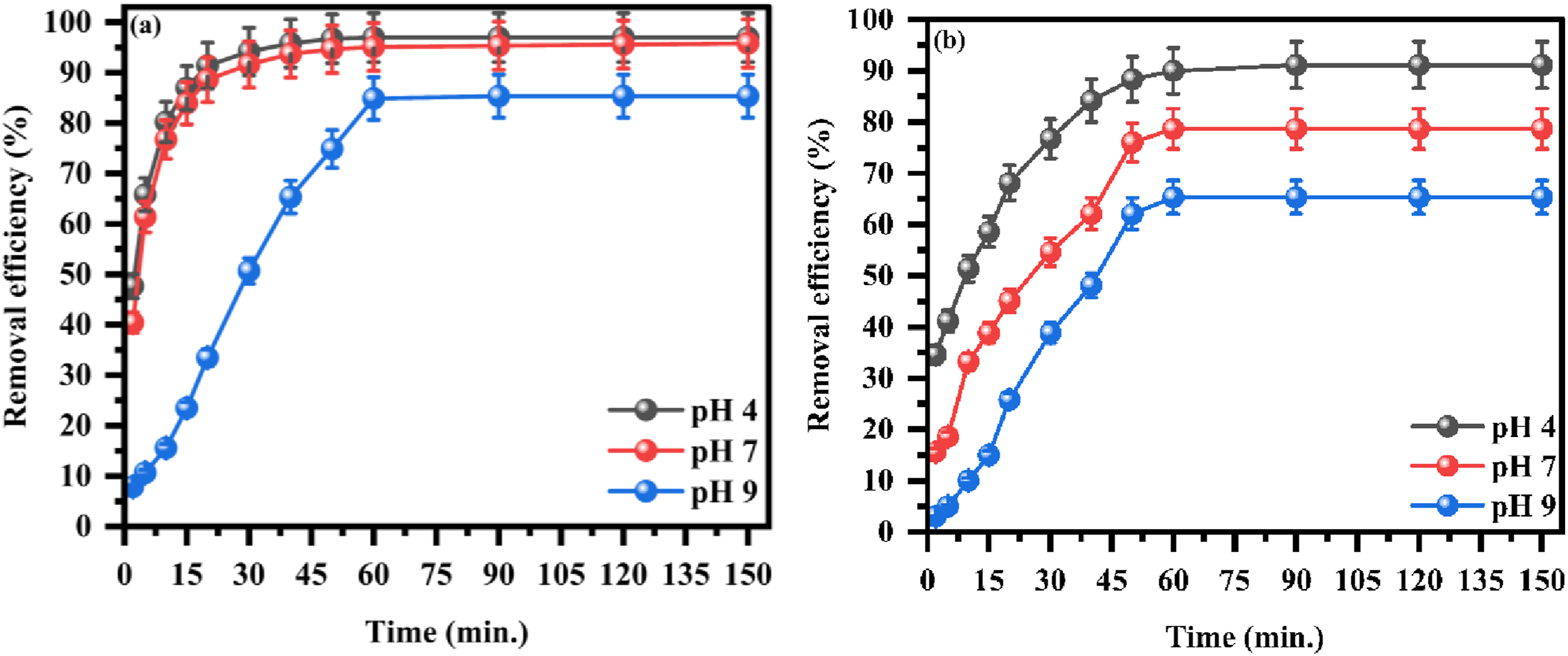
Moreover, the disparity between the RB removal efficiencies obtained in the acidic, neutral and basic media could be understood from the result of the point of zero charge (PZC) presented in Figure S4 (more details are given below in the adsorption mechanism section). Therefore, the electrostatic interaction in the acidic medium (pH < PZC) is eventually translated to the increased removal efficacy recorded. As the solution pH increases, the surface charges of both composites become neutral due to the deprotonation process. This behaviour suggests a significant contribution of electrostatic interaction between the PAn-CS or PAn-CS/TiO2 and RB dye into the adsorption process, as shown in Figure 13. Therefore, the electrostatic interaction dramatically decreases at pH higher than PZC.
4.2.1.6. Effect of temperature
Temperature is a key parameter in the thermodynamic study of adsorption process as it provides information about the nature of adsorption process being exothermic or endothermic. Moreover, the efficiency of adsorption process with respect to the change in temperature can be used to classify the adsorption into chemisorption or physisorption. Furthermore, the thermodynamic parameters such as change in Gibbs free energy, change in enthalpy and change in entropy, which are used to describe the spontaneity of adsorption process, are temperature dependent.
87
To evaluate the effect of temperature on the adsorption of RB onto PAn-CS/TiO2 and PAn-CS composites, the adsorption experiments were conducted at different temperatures ranging from 25 to 60 oC using initial RB concentration of 25 mg/L with 0.025 g of adsorbent and at pH 4.9. The results presented in Figure 11 show that increasing temperature is beneficial to the adsorption process as removal efficiency of RB rose from 96% to 99 % and 91 and 96% for the PAn-CS/TiO2 and PAn-CS systems respectively. This observation is typical of chemisorption in which the efficiency would first increase with rising temperature before decreasing as the temperature is raised further.
88
In addition, the trend recorded indicates that the adsorption process is endothermic, as such increasing temperature helps in overcoming activation energy which eventually translates to the enhanced efficiency recorded.89,90 Effect of temperature on the adsorption of RB by the composite: (a) PAn-CS/TiO2, (b) PAn-CS (adsorbent dose = 0.025g, [RB]0=25mg/L, and pH 4).
Another aspect worth discussing is the spontaneity of adsorption process which is usually inferred from thermodynamic parameters whose expressions are shown in the equations (5)–(7).
87


Thermodynamic parameters of RB adsorption onto PAn-CS/TiO2 and PAn-CS.

4.2.2. Adsorption isotherm modeling
Adsorption isotherm is a plot showcasing equilibrium relationship between the concentration of adsorbate in the liquid phase and its concentration on the adsorbent onto which it is attached, at a particular temperature.
92
The adsorption isotherms give insight into the adsorption process, its efficiency as well as mechanism.
93
Moreover, there are many isotherm models that can be used to describe adsorption system with Langmuir, Freundlich, Dubinin-Radushkevich being the commonly used ones. The Langmuir isotherm is used to describe a monolayer adsorption on a heterogeneous layer in which there is no interaction between molecules adsorbed onto the surface.
94
This model provides information about the adsorption capacity of the adsorbent. The non-linear expression for the model is given in equation (8) below
95


Parameters for adsorption isotherm models of RB adsorbed onto PAn-CS/TiO2 and PAn-CS.

Upon fitting the required parameters into equation (9), the plot illustrated in Figure S6 was obtained and all the values obtained for the equilibrium parameter were found to be below 1 for both PAn-CS/TiO2 and PAn-CS systems. This signifies favorable adsorption for the removal of RB by the two adsorbents.
98
Furthermore, the lower values obtained for the PAn-CS/TiO2 system over the PAn-CS counterpart indicate better adsorption favorability. The second empirical isotherm used to assess the adsorption process was the Freundlich isotherm. Its adoption was based on the fact that, it has ability to account for the monolayer and multilayer sorption process with the assumption that the adsorption occurs on the heterogeneous site.
99
Though, this isotherm cannot be correctly used to assess adsorption capacity of a sorbent
100
but it can rightly reveal the intensity of adsorption process.
92
Moreover, its non-linear form is illustrated in the equation (10).
101

To further examine the mode of adsorption, Dubinin-Radushkevich isotherm was adopted to predict adsorption energy which could be used to categorize the mechanism of adsorption into physisorption or chemisorption.
101
The non-linear form of this isotherm model is illustrated in equation (11).
101


Upon fitting the experimental data into the equations (11) and (12), the Dubinin-Radushkevich (D-R) isotherm plots portrayed in Figure S6 were obtained with the relevant adsorption parameters being highlighted in Table 5. As shown in the table, the correlation coefficients (R2) computed for the PAn-CS/TiO2 and PAn-CS systems are comparable to that ofLangmuir isotherm. This signal that the isotherm model could be conveniently usedto describe the adsorption of the RB onto the two composites. Besides, the trend of maximum adsorption capacity is similar to that of Langmuir isotherm with the PAn-CS/TiO2 composite having higher affinity for the RB. Moreover, the essential parameter sought for in this model is the adsorption energy (E) whose value was computed using the expression in equation (13).
The values obtained for the adsorption energies of the composite systems (Table 5) quite agree with the 8 kJmol-1, the lowest limit for chemisorption. 99 This result further corroborates the nature of adsorption revealed by the thermodynamic study earlier discussed.
4.2.3. Kinetics of adsorption modeling
Adsorption kinetics is an essential factor that reveals reaction rate and provide useful information about the adsorption mechanism and efficiency.41,102–104 Moreover, the common models normally used to describe the kinetics of adsorption system are the Lagergren pseudo-first order (PFO), pseudo-second order (PSO), and intraparticle.
104
The Lagergren pseudo-first order model portrays the rate of adsorption to be dependent on the diffusion of the adsorbate on the sorbent surface.
104
Besides, the linear form of this model can be expressed as shown in the equation (14).
104

On the part pseudo-second order model, the rate of adsorption depends mainly on the adsorption capacity of the adsorbent.
105
In addition, this model usually gives calculated equilibrium adsorption capacity that assent to the experimental data. The expression for the linear form of this model is given in the equation (15).
105

For the intra-particle diffusion model, the amount of the solute adsorbed by the sorbent is usually related to the square root of the time and the graphical representation of this correlation is employed to evaluate the rate of intraparticle diffusion in the linear region.
106
The expression for the intra-particle model is shown in the equation (16).
102

Kinetics parameter for the adsorption of RB by the PAn-CS/TiO2 and PAn-CS composites.

In contrast, at a higher concentration, there would be competition between the RB molecules for the available active sites, together with the need for the intra-particle diffusion of the dye molecules to the adsorbent sites. To further understand the kinetics of the adsorption process, the experimental data were fitted into an intraparticle kinetic model, resulting in the intraparticle plots presented in the Figures S7 and S8, respectively, for the PAn-CS and PAn-CS/TiO2 adsorption systems. The computed values of R2 listed in Table 6 for the PAn-CS/TiO2 and PAn-CS systems, suggested appreciable contribution of intraparticle diffusion into the kinetics of the adsorption of RB by the two sorbents. However, the failure of the curves to pass through the origin indicates that both film diffusion and intraparticle diffusion are simultaneously influencing the adsorption.98,108,109 The rate constants (kid) highlighted in the table shows that intraparticle diffusion rate increases with dye concentration for both adsorbents. Moreover, the values of the C presented in Table 6 are associated with the thickness of boundary layer for the film diffusion. The rise in value recorded with increasing concentration in the PAn-CS/TiO2 system indicates greater contribution from the film diffusion. On the other hand, the negative values computed for the C in the PAn-CS system could be associated with the cumulative effects of surface reaction and the film diffusion. 110
4.2.4. Adsorbent reusability
An adsorbent’s efficacy in water treatment is determined by its adsorptive capacity and reusability potential. The regeneration performance of an adsorbent is critical for large-scale applications as it addresses the cost effectiveness of adsorption process.
111
In this view, the reusability potential of the PAn-CS/TiO2 composite for the adsorption of RB was investigated in a batch system and experiments were conducted over five consecutive cycles. The result presented in Figure 12 shows that the composite put up high stability as its removal efficiency only reduced by 4% after fifth cycle. This performance could be associated with the ability of the PAn-CS/TiO2 composite to rejuvenate its active sites after each cycle.
112
However, the slight decrease in activity recorded after fifth cycle could be due non full recovery of electrostatic interactions that could be noticed after the third cycle.
113
Reusability of PAn-CS/TiO2 composite (adsorbent dose = 0.025g, [RB]0=100 mg L-1, pH 4, and 25oC).
4.2.5. Adsorption mechanism
Surface modification of PAn-CS composite with TiO2-10% nanoparticles enhanced the removal of RB dye. The TiO2which functions as spacers linking the PAn with chitosan afforded the PAn-CS/TiO2with greater porosity than the PAn-CSand this, in return aided its adsorption performance for RB removal. Moreover, the adsorption efficiency of PAn-CS/TiO2-10% is pH dependent as revealed by the different percentage removals recorded in the acidic, neutral, and basic media (as shown in Figure 10). This disparity in removal efficiency could be understood from the point of zero charge (PZC) results (see Figure S4). The pH of the acidic medium (pH 4) is lower than that of the PZC of PAn-CS/TiO2 (6.4) composite, hence bringing about the protonation of the amine and imine functional groups of the PAn-chains as well as the amine groups of CS-chain, as shown in Figure 13.
112
The proposed adsorption mechanism of RB onto the PAn-CS/TiO2 composite at pH 4.
Since RB is anionic, there would be great electrostatic interaction between the protonated moieties and the dye molecule, thereby resulting in the enhanced removal efficacy recorded in the acidic medium. On the other hand, the basic medium promotes deprotonation of the surface due to the increase in OH- ions. This causes relative repulsion between the RB dye and adsorbent surface thus, leading to a decrease in the removal percentage recorded at pH 9. The adsorption process resulting from electrostatic interaction could signal chemisorptions via ionic phenomenon. 114 However, the appreciable adsorption observed at pH 9 suggests that the adsorption process in the basic medium could be predominantly based on the π-π and hydrogen bond interactions between the anionic RB dye and polymer chains. 115 This assumption is due to the presence of aromatic rings in both the dye and PAn which normally promote π-π interaction, while the presence of the hydrogen donors and acceptors on the chitosan and dye, respectively, facilitates hydrogen bonding interaction. In addition, these modes of interaction in the adsorption process are mostly favoured in the basic medium116,117
4.2.6. Comparison with reported adsorbents
Adsorption performance of chitosan-based materials for RB removal.

5. Conclusion
In this study, a new polyaniline–chitosan/nano TiO2-10% composite (PAn-CS/TiO2) was successfully synthesized via a simple chemical oxidation process, demonstrating superior performance as an efficient adsorbent for rose Bengal (RB) dye removal. The synthesized composite was characterized by its structural, morphological, thermal stability, surface properties, and surface charge. The adsorption performance of PAn-CS/TiO2 was systematically investigated and showed dependence on several key factors, including TiO2 composition, adsorbent dose, initial RB concentration, solution pH, temperature, and contact time. Among the tested TiO2 compositions, the PAn-CS/nano TiO2-10% composite exhibited the highest adsorption capacity (641 mgg-1). The thermodynamic parameters of the PAn-CS/TiO2 composite (ΔH = 34.93 kJ mol-1 and ΔG < 0) suggest that the adsorption process is spontaneous and endothermic in nature. The more negative ΔG values observed for the PAn-CS/TiO2 system across all temperatures, compared with the PAn-CS sample, indicate a higher affinity toward RB dye molecules. The adsorption behavior was well described by the pseudo-second-order kinetic model, implying that the interaction between RB molecules and the PAn-CS/TiO2 composite is governed by chemisorption. This proposed mechanism was further supported by pH-dependent studies, kinetic modeling, and equilibrium isotherm analyses. In addition, the PAn-CS/TiO2 composite exhibited good stability and reusability over five successive adsorption cycles.
Supplemental material
Supplemental material - Nanoparticle-loaded polyaniline-chitosan composites for efficient removal of rose bengal: Synthesis, characterization and adsorption performance
Supplemental material for Nanoparticle-loaded polyaniline-chitosan composites for efficient removal of rose bengal: Synthesis, characterization and adsorption performance by Muteb F. Al-Otaibi, Yasser M. Riyad, Emad M. Masoud, and Saheed A. Popoola in Polymers and Polymer Composites.
Footnotes
Acknowledgments
The researchers wish to extend their sincere gratitude to the Deanship of Scientific Research at the Islamic University of Madinah for the support provided to the Post-Publishing Program.

Author Contributions
Muteb F. Al-Otaibi, methodology, formal analysis, data acquisition, writing-original draft preparation; Yasser M. Riyad, conceptualization, interpretation, review and editing; Emad M. Masoud, conceptualization, interpretation, review and editing; Saheed A. Popoola, design of the study, interpretation, review and editing. All authors have read and agreed to the published version of the manuscript.
Funding
The authors received no financial support for the research, authorship, and/or publication of this article.
Declaration of conflicting interests
The authors declared no potential conflicts of interest with respect to the research, authorship, and/or publication of this article: This research did not receive any specific grant from funding agencies in the public, commercial, or not-for-profit sectors.
Data Availability Statement
The data that support the findings of this study are available from the corresponding author upon reasonable request.
Supplemental material
Supplemental material for this article is available online.
References
Supplementary Material
Please find the following supplemental material available below.
For Open Access articles published under a Creative Commons License, all supplemental material carries the same license as the article it is associated with.
For non-Open Access articles published, all supplemental material carries a non-exclusive license, and permission requests for re-use of supplemental material or any part of supplemental material shall be sent directly to the copyright owner as specified in the copyright notice associated with the article.
