



Abstract
This paper addresses the myths surrounding the birth and death of Asclepios, the popular healing God of the Greeks and his place among other deities of the Greek Pantheon. The enigmatic invocation of Asclepios by Socrates, the Athenian philosopher condemned to take the hemlock, in his final moments is also discussed.
Beliefs of the common man
Born lame and unattractive, Hephaestus is the tool maker of the gods. His home in Athens, a temple well preserved to this day (Figure 1), is adjacent to the ancient agora and the jail where Socrates (469–399 BC) took the hemlock. Modern Athenians still call this temple the Theseion because it was initially believed that it had been dedicated to the legendary king Theseus. The paths of Socrates and Theseus, albeit aeons apart, were one day destined to traverse.
The temple of Hephaestus, adjacent to the ancient agora of Athens and the jail where Socrates took the hemlock. Modern Athenians still call this temple the Theseion because it was initially believed that it had been dedicated to the legendary king Theseus.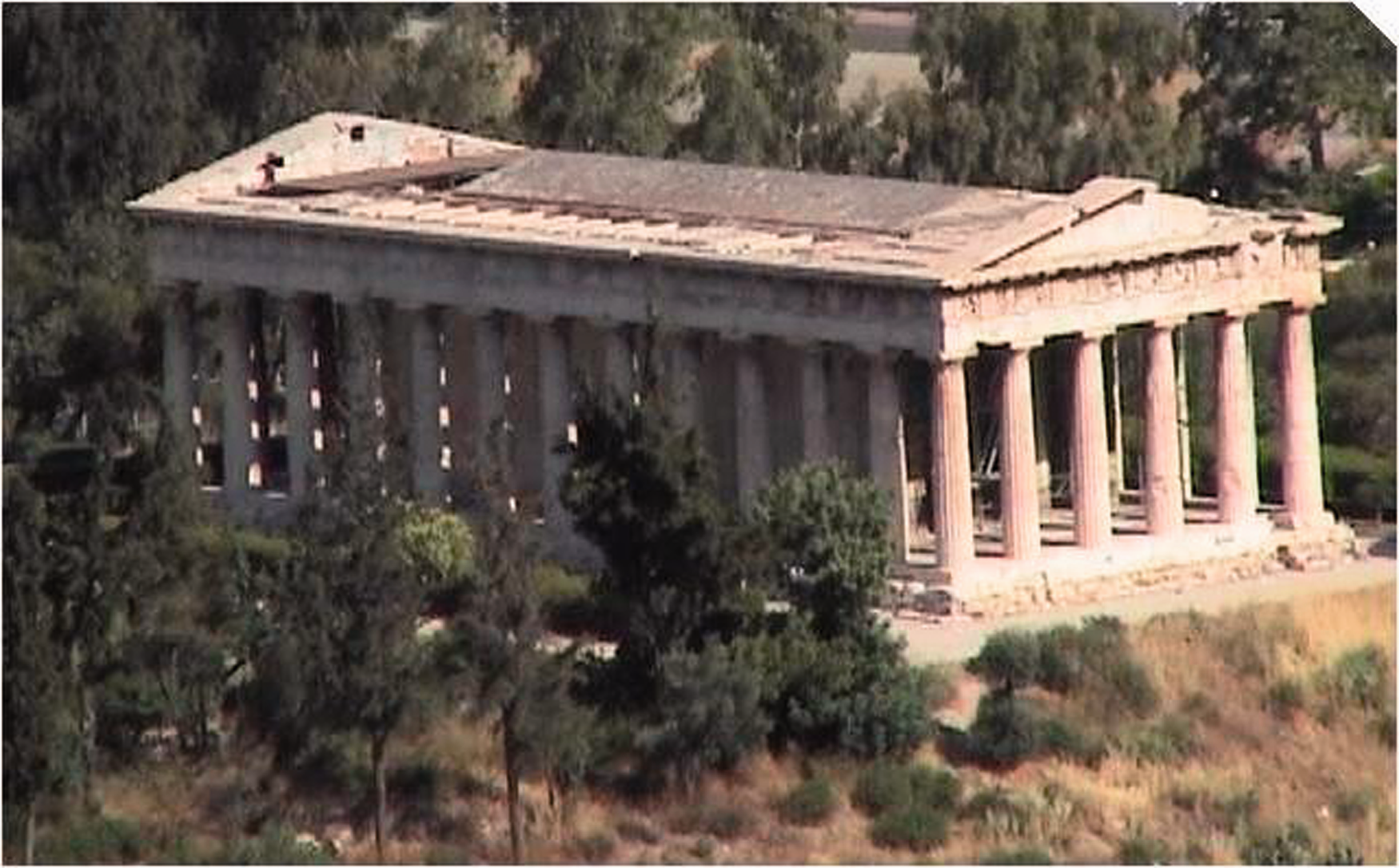
Hephaestus is married to the desirable but reluctant Aphrodite. She is attracted to Ares the masculine god of war who showers her with gifts and visits her in the matrimonial chamber. Hephaestus pretends to be away in Lemnos and on entering his palace finds the lovers still embracing. The husband invites the gods to witness the adultery; they are seized with ‘unquenchable laughter’ at the spectacle of the amorous couple trapped in Hephaestus’ invisible net, specially constructed for the occasion. Disgraced, Ares flees to Thrace and Aphrodite to Cyprus. Homer graphically describes the affair. 1
A popular theme of Attic angiographers in classical Athens is the misfortunes and tribulations of Hephaestus. In a different mythological theme painted on an Attic red figure from ca 430 BC, attributed to the painter Kleophon, the god with his tools in one hand is shown inebriate and supported by a satyr; he is led to mount Olympus with Dionysus, the god of wine, leading the way (Figure 2).
The god Hephaestus with his tools in one hand is shown on an Attic red figure from ca. 430 BC, inebriate and supported by a satyr; he is led to mount Olympus with Dionysus, the god of wine, leading the way. With the kind permission of Ekdotike Athenon AE, from the History of the Greek Nation. Archaic Hellenism; Volume B: p. 109.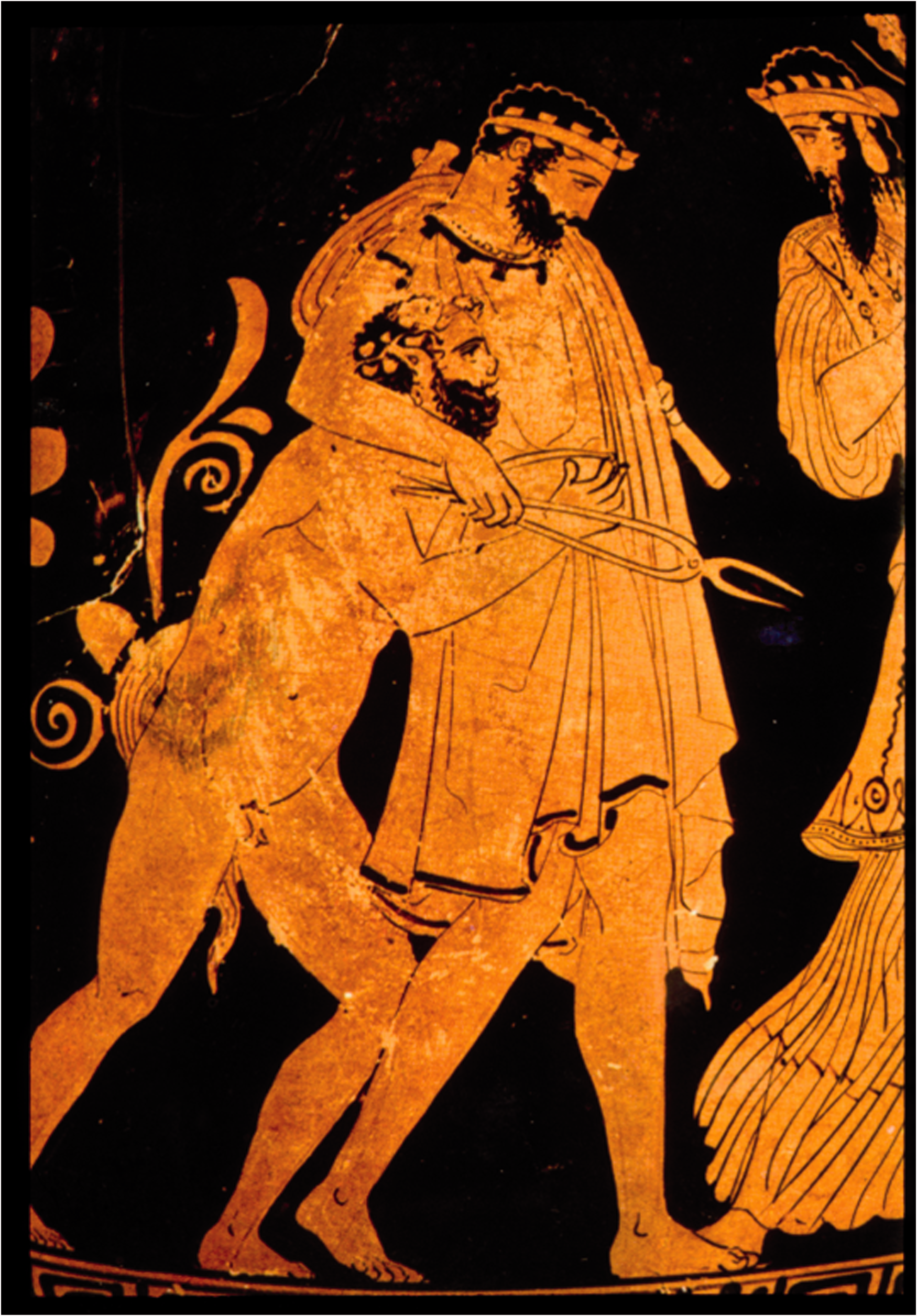
In contemporary medicine, angiography is precisely what the name implies; the painting of a vessel. In the hands of the Attic angiographers, it would be the painting of a vase or a drinking cup.
There is no notion of sin in the life of the ancient Greek; only wrongdoing and hubris, the punishable arrogance of the mortals towards their gods. In this tolerant religion of deities with human weaknesses and humour, the afterlife was of secondary importance. The primary concern of excellence on earth was cultivated in the open-air gymnasia of the polis where in favourable climatic conditions sporting activities were permitted throughout the year. Excellence was glorified in the Pan-Hellenic athletic festivals, the most famous of which was held at Olympia. Medicine developed in parallel and often in the service of these activities. 2
Asclepios
The birth and death of Asclepios the popular healing god of the Greeks is not without a certain scandal.3,4
Apollo commands the sun, is patron of the arts and the God of harmony and healing. Through the Delphic Oracle he instructs Iphitos the king of Elis in the province of Olympia to organise athletic competitions in honour of his father, Zeus. Apollo falls in love with the beautiful princess Coronis of Thessaly. She carries his child but chooses to marry a simple shepherd. Outraged, Apollo demands her death. Apollo’s twin sister, Artemis, shoots Coronis with an arrow for insulting her brother. As Coronis dies, Hermes the swift messenger of the Gods snatches the child from the womb and Asclepios is born. He is entrusted for his upbringing to the mythical centaur Chiron from whom he learns the art of healing.
The chironian ulcers were named after this centaur for being intractable even to Chiron’s treatment and were discussed by Galen, the celebrated 2nd Century AD physician from Pergamum in his treatise on the composition of medicines. 5 Chironian ulcers were taught as such in medical curricula as recently as the beginning of the 20th century. Asclepios becomes an accomplished healer who not only cures the sick but begins to resurrect the dead.
Hippolytus, son of Theseus, is killed after rejecting the advances of his stepmother Phaedra who, spurned, falsely accuses him of rape. Expelled by his father, Hippolytus storms out of the palace, mounts his chariot and speeds towards Sounion. Frightened by a sea monster sent by Poseidon, the God of the seas, Hippolytus’ horses drag him to his death. Asclepios arrives at the scene and revives the moribund Hippolytus. This transgression of the natural order is unacceptable to Zeus who incinerates Asclepios with his thunderbolt but as he dies Asclepios is transformed to the constellation of serpentarius or ophiuchus. This transfiguration may have a tenuous link to the snake and Asclepios’ staff as the symbols of medicine to this day.
However, there is worse to come for not only did Asclepios revive dying Hippolytus but it is rumoured that he received a bribe of gold for his unauthorised intervention. 6
Socrates comes to the defence of the reputation of this popular god arguing that ‘… if he [Asclepios] was the son of a god he was not avaricious … and if he was greedy of gain he was not the son of a god’. On his deathbed, moments before he departs his earthly life, Socrates will remember Asclepios one last time.
In the Homeric epic Asclepios is presented as human. His two sons Machaon, the surgeon, and Podaleirios, the physician, (Figure 3) are combatant leaders of men but also skilled in the extraction of arrows and the treatment of wounds. The deification of Asclepios comes very much later with the establishment of numerous temples to his cult, scattered throughout the Greco-Roman world. His followers pledge their professional integrity in the name of the father (Apollo), the son (Asclepios) and their progeny (Hygeia, Panacea) in what is known to us as the Hippocratic Oath.
7
Hippocrates himself (460 BC-) was reputed to be a descendant of Asclepios from the line of Podaleirios.
8
The physician Podaleirios is one of the sons of Asclepios. He and his brother Machaon, the surgeon, participated in the Trojan War. It was believed that Hippocrates was a descendant of Asclepios from the line of Podaleirios. The statue shown in this picture is in the archaeological museum of Dion at the foot of Mount Olympus. ΠΟΔΑΛΕΙΡΙΟC is inscribed in Greek at the base of the statue.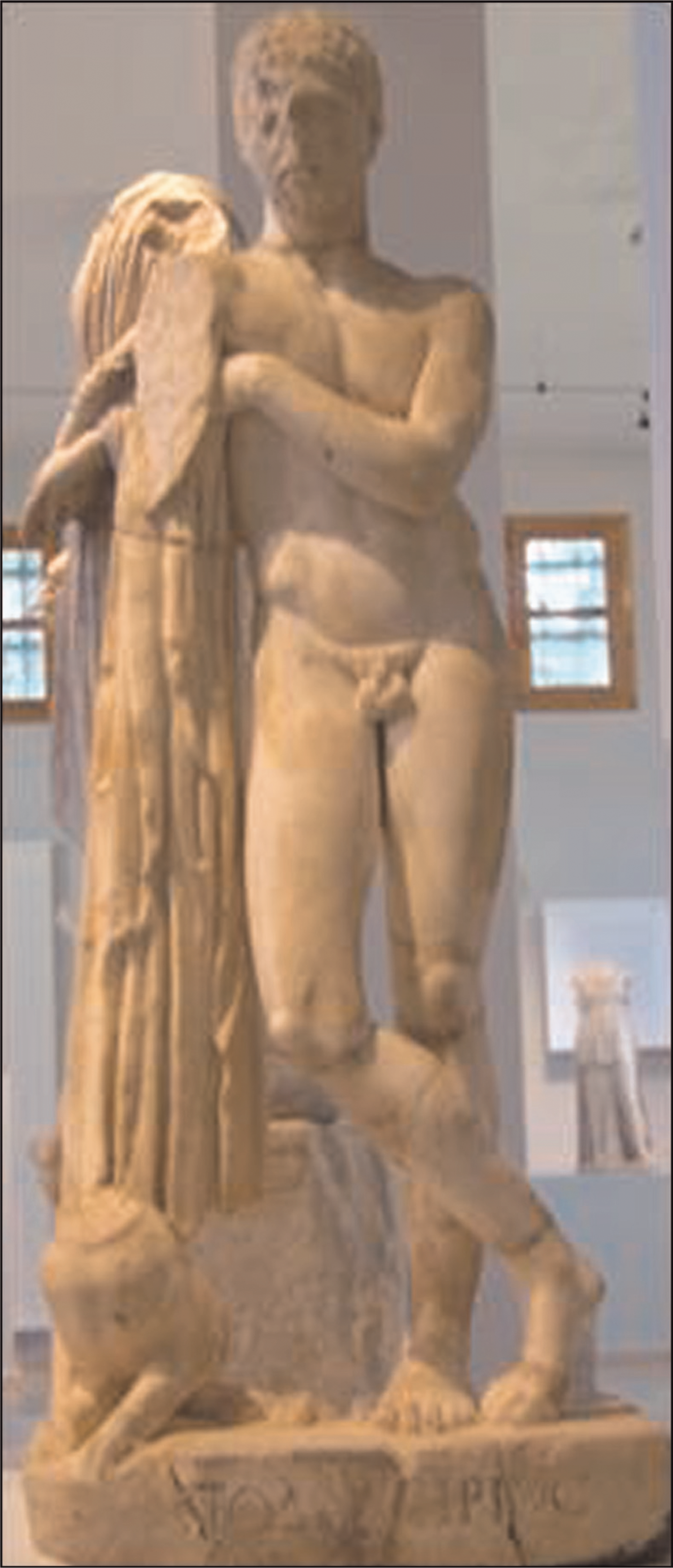
Addressing the question of Asclepios’ human or divine nature, Galen of Pergamum (129 AD-) writes ‘Whether Asclepios and Dionysus were in the first instance humans or Gods, they both deserve to be greatly honoured because the first taught us Medicine and the other the art of the vine (cultivation) … ’. 9
Alexander the Great, known for his love of the theory and practice of medicine, his ϕιλιατρɛĩν according to Plutarch, often paid homage to Asclepios during the expedition against Persia (334–323 BC). According to Arrian, when Alexander was going to Babylon he met envoys from the most famous sanctuary of Asclepios at Epidaurus. He presented them with a votive offering to take back to his temple, adding ‘Yet, Asclepios has not been kind to me, in failing to save the comrade (Hephaestion) whom I valued as much as my life’. 10
Telemachos founded the sanctuary of Asclepios on the south slope of the Acropolis in Athens. He was an Athenian citizen who in 420/19 BC brought from the great temple at Epidaurus a statue of the God to the city ravaged by the plague. In the new Acropolis museum, the visitor may see today an inscribed relief carved on both sides recording the history of the sanctuary’s establishment.
Asclepios and the dying philosopher
These gods, their myths, their alleged power to interfere in human affairs exercise Socrates’ rational mind and his incessant search for the truth and virtuous life. He roams the city of Athens questioning everyone who cares to engage in his dialogues and listen to his reasoning. In the end, his fellow Athenians condemn to death this barefoot eccentric – the wisest among them yet one who admits to knowing nothing – for corrupting the youth and for introducing new Gods to the city blessed and protected by Athena, the goddess of wisdom.
Socrates
‘Why have you come so early Crito, has the ship arrived from Delos?’
11
Incarcerated, Socrates is condemned by the State to execution by drinking hemlock. The final act will take place on the return of Theseus’ Ship from Delos. Theseus had vowed to Apollo an annual pilgrimage to the god’s birthplace, the island of Delos, if he returned safe from his expedition to Crete. This tradition was still alive in the time of Socrates with the same ship that Theseus had sailed to slay the Minotaur allegedly still in use. Executions would not take place in Athens during the Delian celebrations. Once the returning ship was seen in the distance from Cape Sounion, Socrates’ end was imminent. This is how Plato describes the final moments of Socrates as the poison takes effect: The chill had now reached the region about the groin, and uncovering his face, which had been covered, he said — and these were his last words — Crito, we owe a cock to Aesclepios. Pay it and do not neglect it.’ ‘That’ said Crito ‘shall be done; but see if you have anything else to say’. To this question he made no reply, but after a little while he moved; the attendant uncovered him; his eyes were fixed. And Crito when he saw it, closed his mouth and eyes. Such was the end, Echecrates, of our friend, who was, as we may say, of all those of his time whom we have known, the best and wisest and most righteous man.
12
Numerous attempts have been made to decipher the true meaning of the philosopher’s enigmatic last words and we may never know what dying Socrates was thinking of Asclepios, the God who behaved better than most.
