Abstract
Chopin was born in Żelazowa Wola in Western Poland. He had no formal piano tuition and one could say that his skill as a pianist was self-taught, close to a miracle. All his compositions included the piano; this was not a restriction for him. The illnesses that plagued him and the cause of his death are the subject of articles by retrospective diagnosticians.
Introduction
Fryderyc-François Chopin was born in Żelazowa Wola in Western Poland, the second child, and only son, of Nicolas and Justyna Chopin. 1 The home has been renovated and is now a museum. There is very little agreement among Chopin’s biographers as to his personality and the dates of events in his life; much seems to be shrouded in mystery. Chopin’s extraordinary and lasting popularity has few parallels in the Annals of Music, but his life story is that of legend and invention. Even the date of his birth is uncertain. His birth certificate records the date as 22 February 1810 yet he and his mother reported it as 1 March and this was the date on which it was always celebrated. However, the certificate was written almost two months after his birth, so it could easily be incorrect.1,2
Frederic’s father, Nicolas Chopin (1771–1844), was born in France on 6 April 1771. He was the son of a wheelwright. Nicolas was intelligent; he could read and write. His abilities were noticed by a Polish Administrator living in the same French village. In 1787 the administrator returned to Poland and took the 16-year-old Nicolas with him as his scribe. Nicolas never returned to France; he prospered in Poland as a tutor to children of the aristocracy and later as a professor at the Lycée.
In 1806 Nicolas married Justyna Krzyanowska (1782–1861) who also taught music to the children of aristocrats. Their first child, Ludwika (Louise 1807–1855), was born in 1807.
In September 1810, when Frederic was seven months old, the family moved to Warsaw and Nicolas was appointed Professor of French Language at the Warsaw Lyceum. The family lived in a spacious apartment in central Warsaw. Frederic’s sisters Izabela (1811–1881) and Emilia (1812–1827) were born and then the family was complete. 2
Music
Nicolas was musical; he played the flute and violin. Justyna played the piano and sang. As a result, Frederic was conversant with music in many forms from an early age. In addition to Chopin’s exposure to music in the home, his holidays were spent in the Polish countryside where he became acquainted with folk melodies and dances, the inspiration for many of his compositions. 3 Chopin’s Mazurka Opus 59 in A flat Major is typical of Polish country folk dances.
Frederic was a renowned child prodigy both as composer and pianist, and his talent was apparent from a very early age. He had no formal piano teacher – his skill as a pianist was self-taught, almost a miracle. 3 We now know that some children with that form of autism known as Asperger’s syndrome display remarkable musical and mathematical ability without tuition. They can improvise at the piano and, having heard a melody only once, can reproduce it exactly.
Chopin was not socially inept. He was loved by his parents and siblings and in return he demonstrably loved them; he did not have Asperger’s syndrome. However, he did have chest and bowel problems from a very early age and the doctor was a frequent visitor. 4
When Frederic was six years old, he began lessons from his first professional teacher, Adalbert Zywny (1756–1842), a violinist who did not attempt to teach piano but did teach Chopin the theory of music. Chopin gave his first public recital at a soirée when he was aged seven. He included two Polonaises of his own composition. The following year he gave his first public concert and played, with full orchestra, a concerto by Gyrowetz (1763–1850). 3 This was the beginning of his immense reputation.
At the age of 13 he entered the Warsaw Lyceum and soon after came under the influence of Josef Elsner (1769–1854) at the Conservatory. Elsner was a composer of opera and taught Chopin composition. Fortunately, Elsner did not constrain Chopin with academic rules but allowed him to develop his own talent. 2
In 1829, as Chopin’s time at the Conservatory was ending, he fell deeply in love with a fellow student, a singer, Constance Gladkowska. Constance was unaware of his infatuation; Chopin was too timid to approach her. He graduated in July 1829 and soon after set off for Vienna, the city of Mozart (1756–1791), Beethoven (1770–1827) and Haydn (1732–1809), which he reached on 31 July 1829 and in August he gave two concerts there to rapturous applause. He left Vienna on 19 August and returned to Warsaw where his adoration of Constance was as strong as ever. In 1830 he did approach her but they became little more than close friends. She required a more mature, more ardent lover. 3 His disappointment is depicted in the Waltz Opus 70 No.3 which accurately describes the ecstasy of love and the melancholy of it being unrequited.
Vienna
Chopin had realised by 1830 that Warsaw was too small a stage for his talents and on 2 November he left Warsaw and Poland, never to return. He arrived in Vienna on 22 November en route for Paris. This visit to Vienna was an enormous disappointment; whereas in 1829 he was happy to perform without a fee, now he was trying to earn a living and the Viennese would only provide venues: no fee. In addition, during the November of 1830 the Poles revolted against their Russian oppressors. Chopin’s mood fluctuated from black despair to a vulgar gayety. He was greatly troubled, knowing that his compatriots were being slaughtered by the Muscovites, and in this period he wrote the B minor Scherzo and the G minor Ballade. Both works depict melancholy and rage. In the Ballade, he uses Tempo Rubato, failing to keep metronome time, playing abruptly by stealing time or delaying by breaking time.2,3,5 Chopin’s Etude Opus 10.12 called ‘Revolutionary Study’ depicts the Polish uprising against the Russians.
Finally, in July 1831 Chopin left Vienna via a circuitous route and arrived in Paris in September. Paris was not just the capital of France but of the whole artistic world. His arrival followed soon after the surge in the bourgeoisie’s interest in music; pianos were being bought and lessons sought.
Paris and Delfina
Chopin quickly became immersed in the social life of the city. There was an air of permissive behaviour that both shocked and delighted him. Musically it was very exciting: Mendelssohn (1809–1847), Schumann (1810–1856) and Liszt (1811–1886) were living in Paris. Chopin gave his first public performance in Paris on 26 February 1832 in Pleyel’s Rooms before an audience of 300. Pleyel (1757–1831) manufactured pianos. Prince Radziwill (1778–1850), who Chopin knew when in Warsaw, took him to an evening at the Rothschilds’ (1792–1868) home and after dinner Chopin played the piano. Nothing like it had been heard before. His playing was inspirational, the music was seductive and the audience was astounded. Before he left, many had booked lessons. His success was now assured; he was the darling of Paris. He began earning a living teaching and playing in salons.
There were many Polish émigrés in Paris, among them Countess Delfina Potocka (1807–1885) (Figure 1). She had divorced her cruel husband and was in receipt of an annual allowance of 100,000 francs. Delfina was a great soprano, a competent pianist, stunningly beautiful and an accomplished seductress. She was dubbed ‘the great sinner’ and among her conquests were Liszt, Katrinski (1812–1859), a Polish poet and Eugene Delacroix (1798–1863) who knew Chopin very well and described him as ‘La Trinite Charmante; Chopin’s playing, composing and his personality were all in harmony, pure and inseparable’; these together with his unworldliness, his reserve and his vulnerability made Chopin irresistible to women. Delacroix also knew Delfina very well; he described her graceful movements and her ravishing beauty and he added ‘Delfina’s lips promise a passionate desire for kissing and a heavenly delight’.2,3
Countess Delfina Potocka.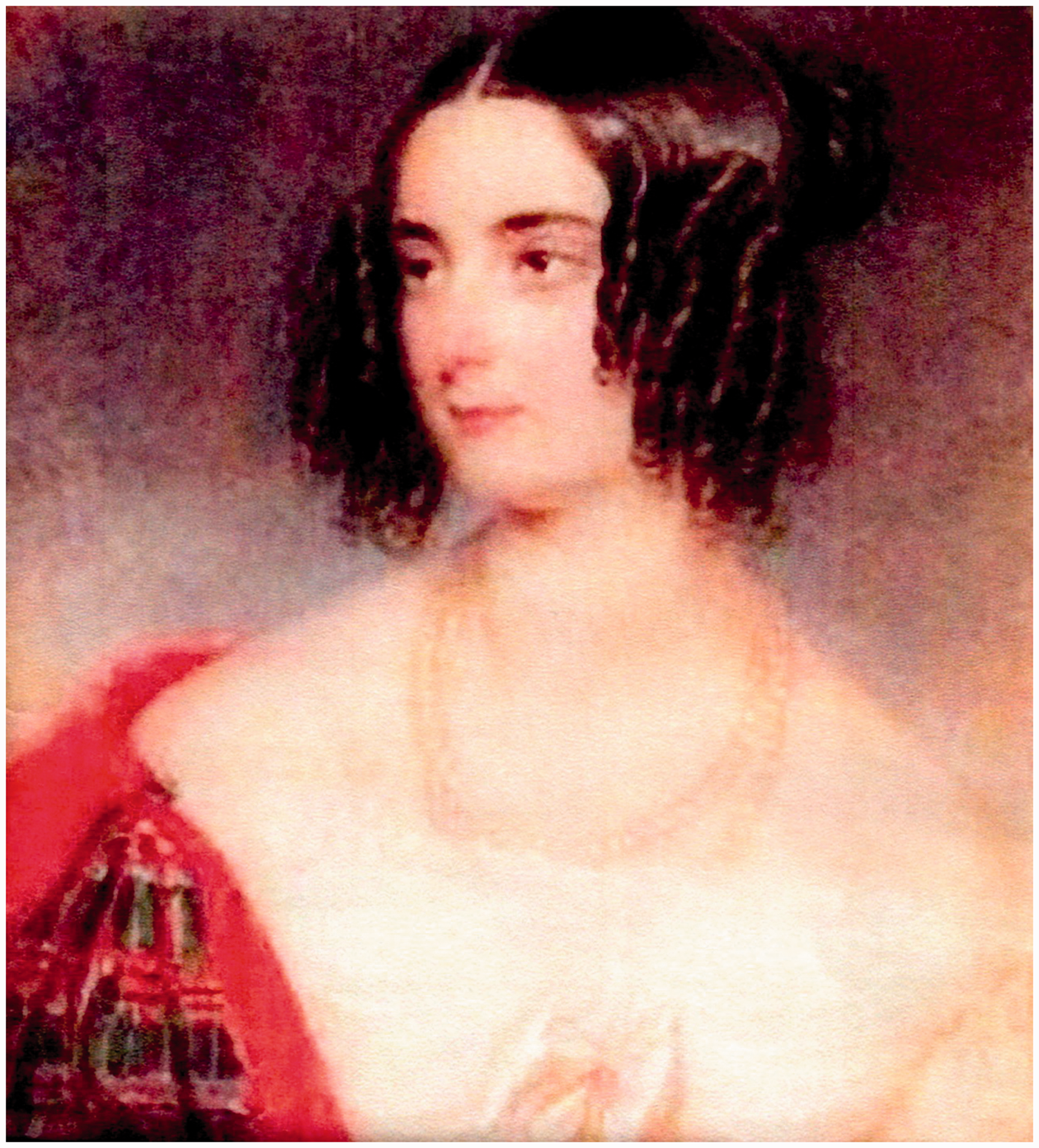
Delfina took piano lessons from Chopin (Figure 2) and soon Paris was full of rumour that they were lovers. Delfina was frequently seen entering Frederic’s rooms and staying the night. Likewise, Frederic visited her rooms and stayed overnight. Chopin denied that he and Delfina were lovers and he said as much to Liszt.
1
However, there is firm evidence that they exchanged love letters; after Chopin’s death, the Potocka family kept those Chopin had written to Delfina securely locked in a box because of their indecent nature.
3
Fryderyc-François Chopin.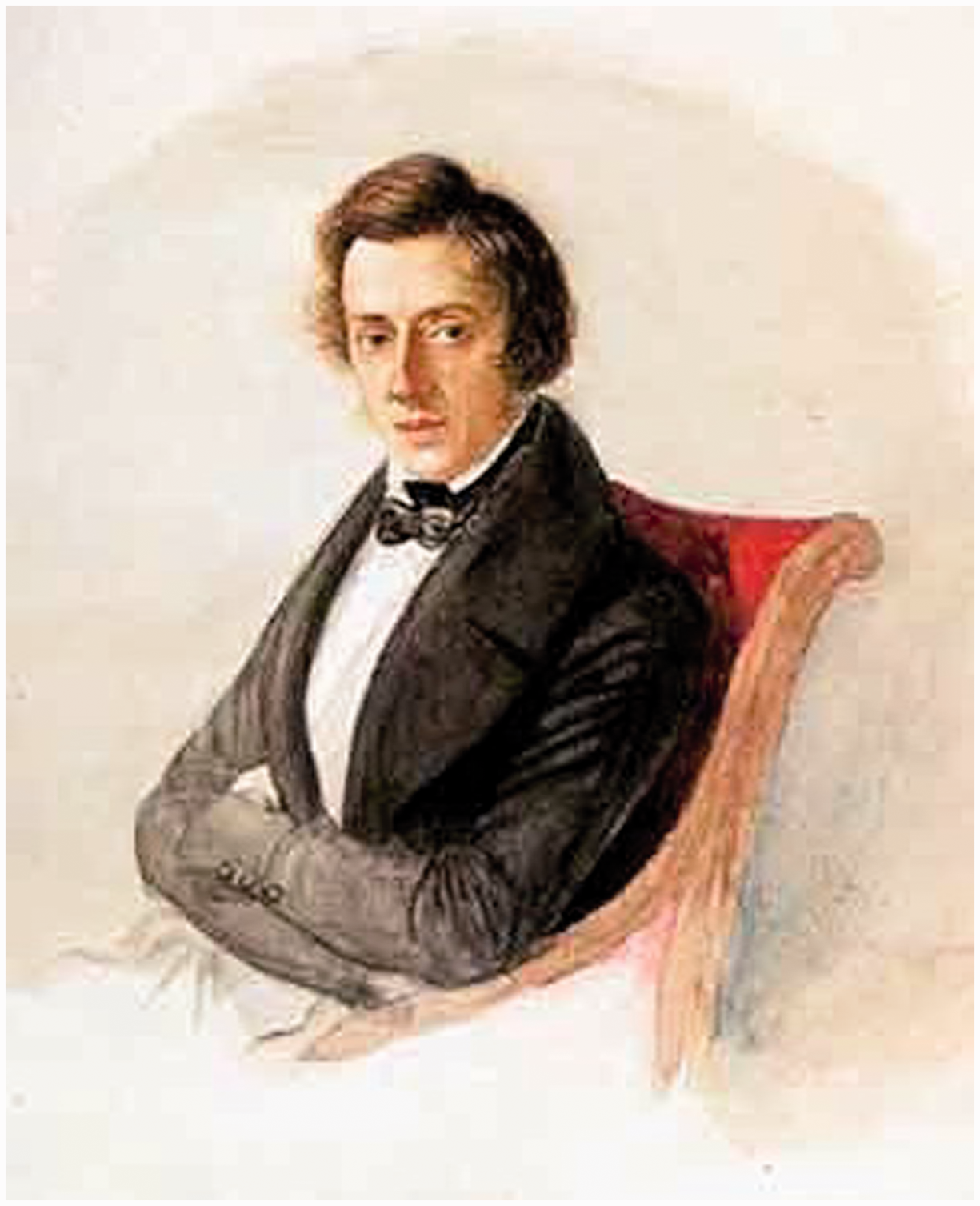
In 1939 a Polish lady and a descendent of Delfina Potocka, Pauline Czernika (–1949), announced on Radio Wilno that she had found more than 100 letters written by Chopin to Delfina and that the letters referred explicitly to their sexual behaviour. The war precluded any serious investigation into the authenticity of these letters. In 1945 Czernika repeated the claim on Radio Poznan and she read extracts with their overtly erotic content. In the letters Chopin bemoaned the fact that so much creative time and energy was lost in his intimacies with Delfina. Throughout his life Chopin wrote and spoke of husbanding his strength and his life-giving fluids in order to have the energy to compose. He would therefore abstain, believing his blood would then go to his brain. Chopin was, in fact, at his most creative during the time when the letters suggested he was with Delfina.
Long after Chopin’s death, Sigmund Freud (1856–1939) postulated that sublimation of the sex urge would provide energy for serious work. If the work requires artistic inspiration, then experiencing intimacy is surely a more likely stimulus than abstinence? So could or would Chopin have written such letters and did he in fact have an intensely erotic affair with Delfina? Opinion is divided among the biographers.
Pauline Czernika made many excuses for not producing the original letters, such as that a French officer took them to France for safe keeping when war began, that they had been mislaid, that they were stolen at the station as she was taking the letters to Warsaw for inspection. In the end, only typescripts were produced. There were many discrepancies and some events allegedly occurred when Delfina was not even in Paris; the language was deemed too crude for the reserved Chopin. The consensus now is that, although some of the letters are forgeries, some are genuine.2,3 In 1997 a film was released, ‘The Strange Case of Delfina Potocka’. Chopin’s Impromptu in A flat depicts Delacroix’s belief that Delfina’s lips promise a passionate desire for kissing.
George Sand (1804–1876)
Amandine Aurore Lucille Dupin, better known as George Sand (Figure 3), was a truly amazing woman. In 1822, when she was 18, she married Baron Dudevant (1795–1871) and became Baronne Dudevant. She soon found he was cruel and disinterested and in 1831, despite having two children Maurice (1823–1889) and Solange (1828–1899), she divorced him and took her children to Paris for a new life. This was a remarkable achievement for a woman at that time. She became one of the most controversial figures in France. She campaigned for political reform and for the rights of women. As a prolific novelist exploring the sexual feelings of women, she was successful, if controversial. Her first novel, ‘Indiana’, was written with Jules Sandeau (1811–1883) who had become her lover. She took a part of his name and changed hers to George Sand. Her behaviour became promiscuous, loud, lewd and shocking. She was a very mysterious woman; Chopin’s Etude Opus 25 No.7 is mysterious music.
Amandine Aurore Lucille Dupin, namely George Sand.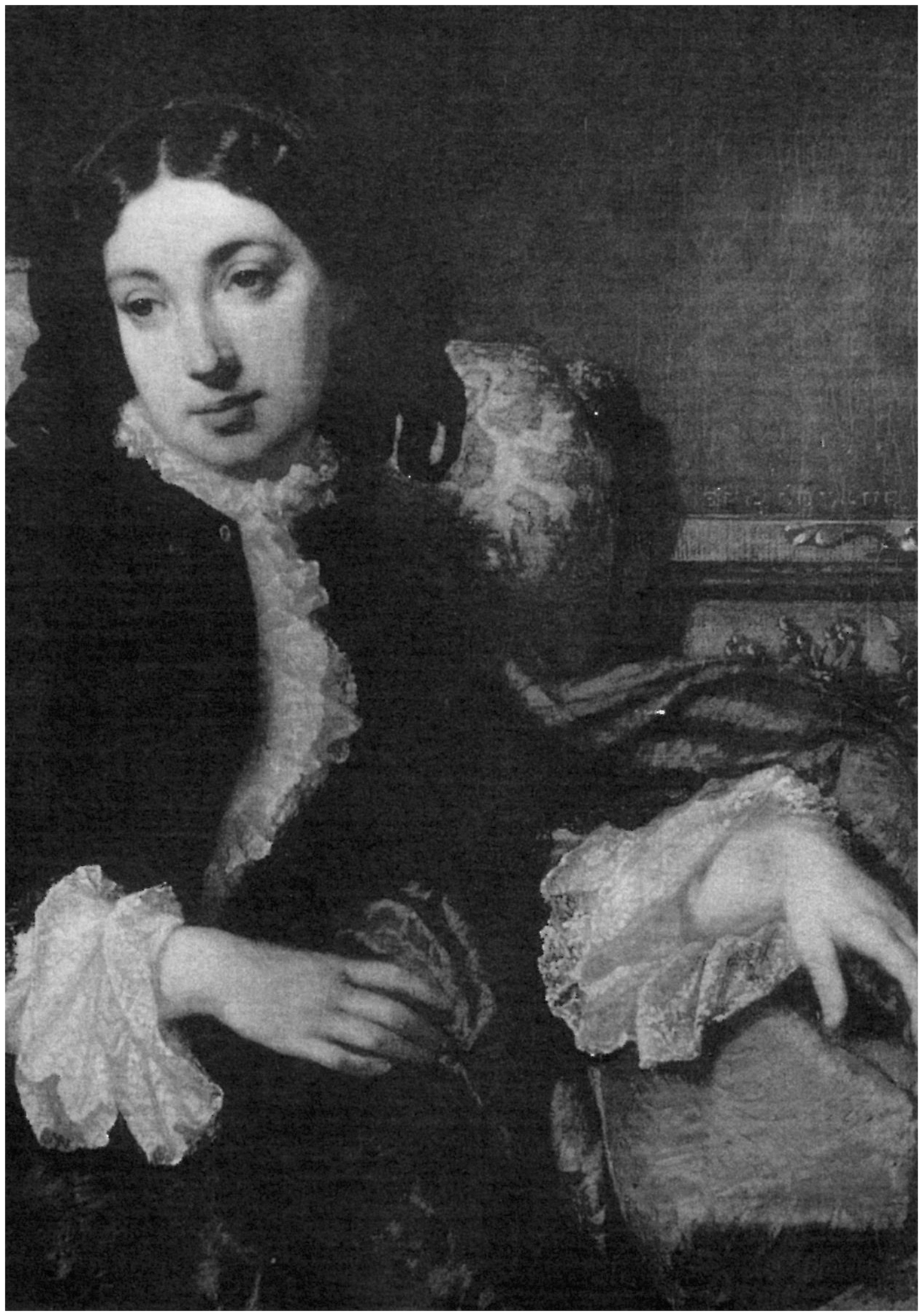
In 1836 Countess Marie d’Agoult (1805–1876), the mistress of Liszt and the mother of three of his children, hosted a party at which Chopin met George Sand. By this time Sand had had a long string of lovers; she dressed as a man and smoked large cigars. Chopin was repelled and said that he doubted she was indeed a woman. Sand was attracted to Chopin; she had heard and admired his music and had become infatuated. She wrote to a mutual friend, Count Grzymala (1793–1871), saying that she might abandon her current affair and test the strength of Chopin’s existing affair with Maria Wodzinska (1819–1896). What a wonderful phrase ‘test the strength of Chopin’s affair’ for what was to become a predatory seduction!!
In Warsaw, Chopin had taught the 12-year-old Maria Wodzinska. In 1836 he was in Dresden and was entertained by the Wodzinski family. Maria was now 17, an accomplished pianist and a beauty of her day. Frederic fell in love with her and on 9 September he proposed and was accepted. Sadly it came to naught; the Wodzinski’s were concerned about a marriage to such a very sick man. Chopin’s chest and bowel problems were now all too obvious.2,3 Chopin was devastated and he wrote the Etude 25 No.1 in F minor as a tribute to Maria’s soul.
Chopin feared George but she was unaware of his shyness so she pressed on. In December 1836 Chopin gave a party and included George among his guests. She appeared in a gown of red and white, the colours of Poland. Chopin was seduced and by 1837 their affair was an open secret; Chopin dedicated all 12 of his Opus 25 Etudes to George Sand. Now that his engagement with Maria was over, he pursued George with a passion. Their relationship was one of genuine love and devotion. Chopin’s life was enriched and the poetry of his music became finer and deeper. George had many attributes, she was a successful author and she drew one of the best portraits of Frederic.
In the summer of 1837 Chopin made his first visit to London and spent two months mostly sight-seeing. He gave a few salon recitals; his audiences were astonished with the brilliance of his playing. During this visit he stayed at number 99 Eaton Place.
For some years Chopin’s health had been deteriorating, especially in the winters. In the autumn of 1838 he and George decided to escape the harsh Paris winter. They left Paris secretly and separately to meet in Perpignan before leaving for Majorca. Their hearts were full of optimism; they would be happy basking in the warm sunshine and Chopin’s health would improve; Chopin’s Etude 10.3 describes their optimism.
Majorca
It was not a happy time. The Majorcans found that the couple were not married and, fearing that Chopin’s cough was a sign of tuberculosis, they became inhospitable. Their stay in hotels became expensive when before being ejected they were made to pay for the fumigating and cleaning of the room and bed linen. Frederic and George then decided to move to the abandoned monastery at Valldemosa. It rained most of the time; Chopin was miserable and ill. His piano was late in arriving from Paris and then it was held up in customs with a huge sum being demanded for its release. Eventually, it was released but getting it up the mountain to the monastery was a nightmare. Chopin finished his Preludes and the Polonaise in C minor.2,3 His Prelude number 15, called the Raindrop, is said to have been inspired by the sound of the rain on the monastery roof; there is a repeated A flat in the bass, the rain on the roof. The uncomfortable monastery, the miserable weather and Chopin’s health problems forced their departure in February 1839.
Nohant, near Chateauroux
George and Frederic arrived at Sand’s home in Nohant where they stayed until October 1839. Chopin was busy composing and he wrote three Mazurkas, a Nocturne and an Impromptu. He was not Sand’s only lover but she was the love of his life. There is no doubt that without her love, her devotion and her shielding him from material worries, he would have died much earlier and his musical output would have been much reduced.
The couple spent each summer from 1839 to 1846 in blissful loving harmony in her home in Nohant and during those tranquil years his genius came to maturity, his playing became superb and his gift of improvisation fantastic. Chopin’s Ballade in F major describes the peaceful serene life in Nohant.
This idyll could not last, storm clouds were gathering. In 1847, after 10 years together, they parted. The break was an extremely complicated affair. George’s children, Maurice and Solange, conspired separately against both their mother and Chopin. As a final straw there were arguments over the proposed marriage of Solange to an impoverished, scheming sculptor, Auguste Clesinger (1814–1883). Maurice drew a caricature of his Mother and Chopin – they both appear ugly and it says much about his lack of affection for them. After the parting, Sand’s novel ‘Lucrezia Floriani’ was published in which Chopin was portrayed as a dying prince. There were hurtful remarks about Chopin, saying he was asexual and impotent which greatly distressed him. He left no progeny but he most certainly was sexually active. George’s comments may have been to deliberately wound him as he had spurned her.
The loss of George Sand was a mortal blow for Chopin. Liszt tried to console Chopin, quoting Madame de Stael (1766–1817): ‘in love there are only beginnings’. 1
Chopin's illness
Retrospective diagnosis of diseases of the famous or infamous is a popular pastime for medical practitioners. No sooner is a diagnostic label attached to a subject than an essay is in preparation to refute it and to assert a different diagnosis. It is a violation of medical principles as the patient has been neither seen nor examined.
The earliest diagnosis given to Chopin’s illness was pulmonary tuberculosis which was widespread in those times. It was readily recognised as an infectious illness with both upper and lower respiratory symptoms, a chronic cough, blood stained sputum and cachexia. There was a strong history of chest problems in the Chopin family. Frederic’s father had episodes of serious chest infections though he lived until he was 74. His mother had a healthy life and died aged 87. Ludvicka, his eldest sister, had chronic chest disease from an early age and died from chest disease aged 47. Izabella was healthy and died in her seventies. The youngest sister had serious chest problems from infancy and spat blood. She died of a massive haemorrhage when only 14 but whether the bleeding was from a tuberculous cavity in the lungs or from ruptured oesophageal varices from hepatic cirrhosis is not known.
Frederic had episodes of chest infection from infancy; he was always frail, delicate and susceptible to disease. At 16 he was ill for six months with sore throat, hoarseness and cervical adenopathy. This could have been a haemolytic streptococcal tonsillitis with rheumatic fever and carditis as sequelae. Chopin was always intolerant of fats which caused him abdominal pain, diarrhoea and weight loss. Throughout his life he had difficulty gaining and maintaining weight. As an adult he tried to manage his intestinal problems by omitting fats entirely from his diet which became based on oat bran and honey. Fully grown, he was five feet seven inches tall and weighed seven stone, in the lowest 3 percentile. His thin limbs, cachexia and barrel-shaped chest are seen in a caricature (Figure 4). His first haemoptysis was in 1831 when in Paris and spitting blood continued at intervals until his death. Although spitting blood over almost 20 years is very rare in tuberculosis, it is not unknown.
4
Chopin tried to treat his body-racking bouts of coughing using belladonna and a mixture of sugar and opium. His cough was worse in the mornings and often with purulent sputum suggesting he had developed bronchiectasis.
Caricature of 1844 showing Chopin’s barrel-shaped chest.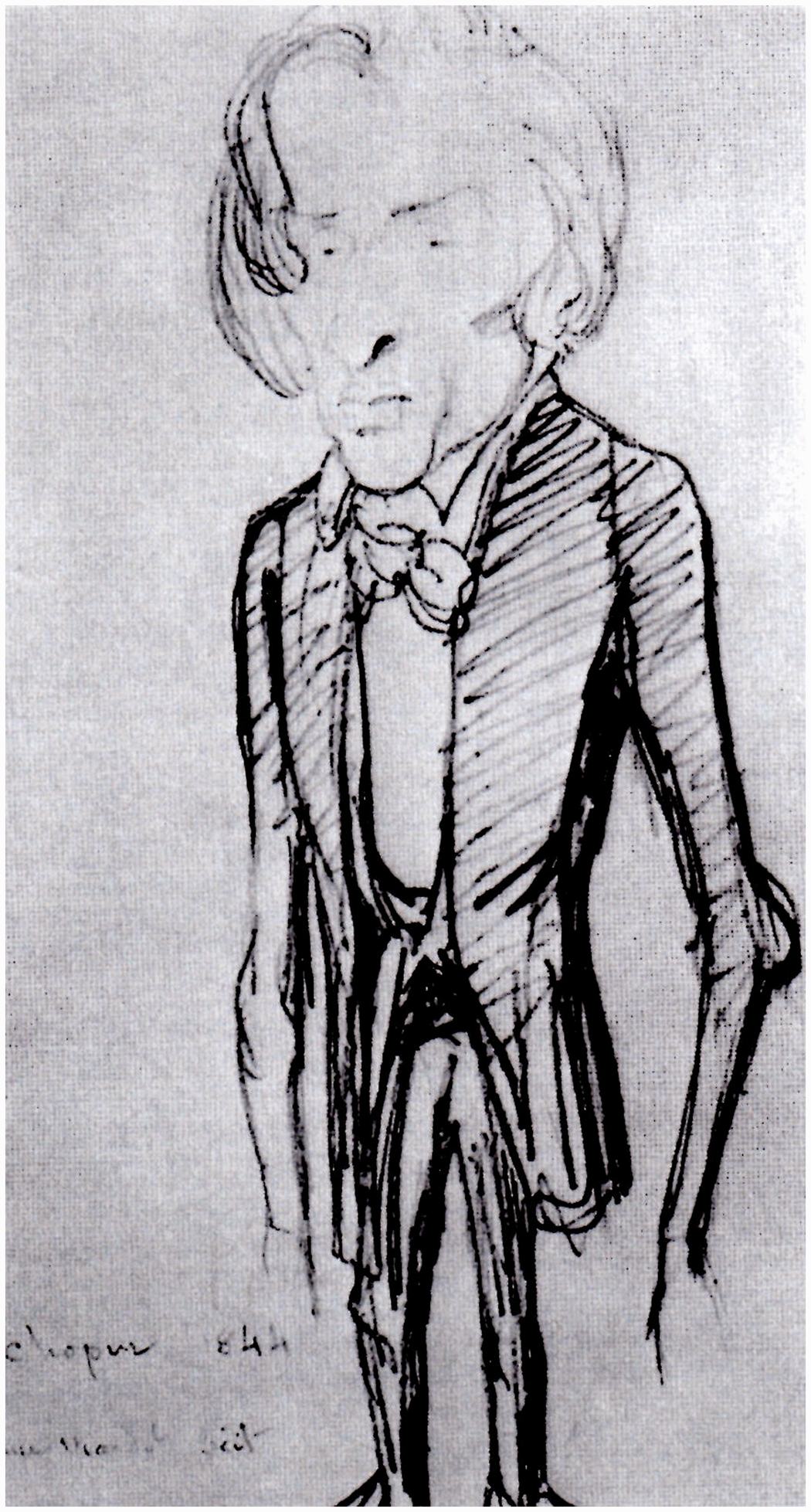
Throughout his life Chopin consulted many doctors in the various cities in which he lived. Those doctors who diagnosed tuberculosis said that he had the current treatment of purging and bloodletting. Those avoiding that diagnosis may have done so to avoid the social and economic disadvantages that follow the diagnosis of tuberculosis.
At his end, he was very breathless, unable to leave his bed, and he had gross peripheral oedema. He may have had cor pulmonale and tuberculous pericarditis. His bowel symptoms may have followed tuberculous enteritis but since those symptoms began very early in his life that diagnosis is unlikely.4,6
Since Chopin’s death, several speculative diagnoses have been proposed. In 1987 an Australian paediatrician, Doctor O’Shea, said Chopin had cystic fibrosis. His illness began in early life and may have been familial; two of his three sisters had similar symptoms. The chronic chest symptoms, haemoptysis, poor exercise tolerance, barrel-shaped chest and fat intolerance are all features of cystic fibrosis which is an autosomal recessive disorder; both parents will be carriers of the gene. Chopin had dental caries; he was infertile and had an episode of heat stroke when in Majorca and all these could be due to cystic fibrosis. O’Shea admitted that Chopin’s fingers were not clubbed but he concluded that the only diagnosis that fits all the known facts is cystic fibrosis. It has been suggested that clubbing can be prevented by excessive use of the fingers as would occur in the hands of pianists. If this is true then the toes would be clubbed! A serious objection to the diagnosis of cystic fibrosis was that, in the pre-antibiotic era, sufferers died in childhood although now we know there are grades of severity and more than 1000 mutations occur. Now many patients are first diagnosed in adult life, so dying at 39 does not exclude this diagnosis which is the commonest multi-organ disorder of Caucasians, first recognised in 1935.6,7 It is a pity that it is not known whether those who kissed him recognised that his skin tasted salty; that would have clinched the diagnosis!
Alpha1-antitrypsin deficiency was suggested by Kuzemco in 1994. This condition causes feminisation: Chopin did have very sparse facial hair; it also causes emphysema, liver failure, jaundice, ascites, diarrhoea and gastrointestinal bleeds. There is no evidence that Chopin had jaundice or ascites, and emphysema was not the cause of his respiratory problems. 6
There is a long list of other conditions causing cough and haemoptysis, some of which have been proposed and one of which is mitral stenosis of post-streptococcal infection. 4 Psychiatric conditions have also been proposed.
In March 2011 Manuel Caruncho, a Spanish doctor, published in the Journal of Medical Humanities the ‘Hallucinations of Frederic Chopin’. When in the monastery in Valldemosa, Chopin described phantoms, ghosts and ‘cursed creatures’ emerging from the piano. George Sand was well aware of these hallucinations and they are vividly described in her autobiography ‘Histoire de ma vie’. She attributes them to the expression of a sensitive and exquisite soul. His delusions were all visual, never auditory, but we must remember his self-medication included belladonna and opium which might be responsible for hallucinations. 8
On 29 August 1848 in Manchester, Chopin was performing his B flat minor Sonata and after the Scherzo he briefly left the piano before returning to complete the piece. The music critic of the Manchester Guardian mentioned it in his column and Chopin wrote about it in a letter to Solange. During these episodes he would be wild-eyed with his hair standing on end. It is customary to explain these ‘time out’ (jamais vu) moments as the hypersensitivity of the romantic soul. 8 Chopin would have facial grimaces and his eyes would be closed as if he were entranced when playing so there may be sufficient evidence to conclude that he had musicogenic epilepsy, a form of temporal lobe epilepsy.
Chopin’s Impromptu Opus 51 No.3 in G flat demonstrates the seductive nature of the composition and its performance. As a pianist Chopin’s style was unique and it did not belong to any school. Although Chopin’s hands were small, they were very supple and he could easily stretch tenths. There was a harmony between his frail physique and his playing style, generally smooth, dolce and unforced, but he could play triple forte when required. Playing frequently exhausted his frail physique; he would have to be carried from the piano stool. The tone he drew from the piano was immensely enchanting and seductive. His preferred piano was the Pleyel, with its narrow keys.
Chopin produced innovative changes to piano technique and composition. He used the thumb to play black notes; previously frowned upon, this allowed more freedom for the hands to move along the keyboard. In Etude Opus 10.5, the right hand uses only black keys. He recognised that the third and fourth fingers shared the same tendon, making the ring finger very weak, and he wrote his compositions to accommodate this. He abandoned traditional fingering for one of his own. Chopin used finger substitution to sustain the melody and played with flat fingers to produce a singing effect. His use of tempo rubato created seductive melodic tones. This deliberate hovering or rushing forward over a controlled base produced eager anticipation. He used unfamiliar sounds, ornamentation, and he abandoned enforced resolution. His musical line therefore was often unpredictable. All these innovations, including the use of flutter pedalling, created a new poetry of the piano. These revolutionary approaches changed piano composition and performance forever, allowing the beauty of sound to be irresistibly seductive.
All the elements of an intimate relationship are depicted in Chopin’s music, flirtation, passion, conquest, lament and regret, and were reproduced in his playing. A reporter wrote ‘he seems to abandon himself to impulses of fancy and indulge in a reverie: his thoughts and emotions pour out unconsciously’. Interpretation became all important and his scores gave specific instruction as to how he wanted them played. Modern copies of the scores frequently omit or alter his instructions so that exponents play passages far too fast and far too loud, losing the lyrical, the poetic and the seductive qualities. The instructions in Chopin’s scores, if faithfully followed, bring out the descriptive elements which he intended. In his Ballade No 3, the emotions of joy, melancholy, sadness, fury, hate and regret are all expressed.
All Chopin’s works involved the piano, most for solo piano; in this respect he is alone in the history of music. It was not a restriction for him and had he lived longer he might have written more orchestral music. He did write two piano concertos, 19 songs for piano and orchestra, a trio for violin, cello and piano, and the Grande Polonaise Brillante for piano and orchestra as played at the Last Night of the Proms in 2011. Many of these he also performed as solo piano pieces in concerts and recitals. He did not enjoy playing in large concert halls but preferred playing in salons with small audiences. His method of playing meant there were passages in his works that could not be heard at the back of a large concert hall. His immense reputation was achieved despite giving only 30 large-scale public concerts.
Chopin’s Etudes which he began when he was 18 represent a breakthrough for piano music. They were written to demonstrate how to resolve technical problems. They are not just great studies; they are great and beautiful music. Opus 25 No.7 was described by George Sand as the pouring out of Frederic’s soul. Among the ballades, Opus 52 No.4 in F Minor depicts the ecstasy of sex. The Nocturnes include some of his most beautiful and seductive music – the C sharp minor is a good example of the piano singing; Opus 32 No.1 depicts love and loss with a tragic end; Opus 72 No.1 in E minor was composed when he was 17 just after Emilia’s death, it is sad and melancholic. Chopin’s Preludes were written as complete compositions and they did not introduce another work, unlike Bach (1685–1750) who followed each with a fugue. They were modelled on Bach’s Well Tempered Clavichord; there was one for each of the 24 keys plus two additional preludes. George Sand described No.23 as the ‘Scent of Paradise’. No.9 is one of the darkest music ever written.2,3
Chopin’s performances were unique; his virtuosity and inspiration astounded all who heard him play, especially his fellow musicians; Schumann declared ‘Hats off gentlemen, a genius’. 1
In 1848 Paris was in revolt. Jane Stirling (1804–1859), a wealthy Scottish heiress and a former pupil of Chopin, urged him to leave Paris for London. This he did on 16 February. He gave recitals in London, Manchester and Edinburgh. His final concert was in the Guildhall in London. On this, his second visit to London, he stayed in Lancaster House off St James’s Street. Throughout this trip, Chopin’s health progressively deteriorated; he left London on 31 October 1848 and arrived back in Paris on 23 November. After Chopin returned, he gave no more lessons and he was not seen in public again. Early in 1849 he finished the Mazurkas Opus 67 No.2 in G minor and Opus 68 No.4 in F minor. These, his last works, were not published until 1855, some six years after his death and, had his dying wish been observed, we would never have heard them. His mother and sister Louise decided to ignore his instruction that all unfinished and unpublished music was to be destroyed.
Death
By the Spring of 1849 it was obvious Chopin was dying. He was unable to pay his bills but Jane Stirling made a magnanimous gift of 25,000 francs. His friends tried to lift his spirits and Delfina Potocka would visit to sing for him. Louise arrived in Paris on 8 August. On 12 October Doctor Cruveilhier (1791–1874), believing Frederic would not last the night, sent for Abbé Jelowicki who administered the Last Sacraments. Chopin’s last four days were terrible agony and he was cyanosed, oedematous and had convulsions. Louise, Solange, Sand’s daughter and his favourite pupil Guttman (1819–1882) were with him throughout. The last friend to arrive was Delfina Potocka, direct from Nice. He rallied a little and asked her to sing. The piano was moved into his room, Gutmann played and Delfina sang Stradella’s ‘Hymn to the Virgin’, Ave Maria.
The end came at 2 a.m. on Wednesday 17 October 1849 when Chopin was only 39. He left no Will but made several death wishes; his body was to be ‘cut open’ because he had a great fear of being buried alive. Auguste Clesinger (Solange’s husband) took casts of Chopin’s face and hands. Chopin’s doctor, Jean Cruveilhier, performed an autopsy. Unfortunately the death certificate and autopsy report were destroyed, probably in the fire of Paris in 1871. Louise and Grzymala, Chopin’s closest friend, were present at the autopsy. Louise took Chopin’s heart back to Poland when she returned; it now rests in a pillar in the Church of the Holy Cross in Warsaw. Louise and Grzymala reported separately that there was no sign of tuberculosis in the lungs and Grzymala added that the signs of disease that were found were not known to contemporary medicine.
Chopin had asked that Mozart’s Requiem would be sung at his funeral in the Church of The Madeleine in Paris. As the Requiem has parts for female singers and The Madeleine had never permitted female singers in its choir, the funeral was delayed for two weeks before the church relented. The church was adorned with panels of black velvet bearing the letters FC embroidered in silver. Three thousand persons attended and the cost of the funeral was borne by Jane Stirling, thereafter known as Chopin’s widow. The entry of the coffin was accompanied by Chopin’s Funeral March from his B flat minor sonata played by Liszt on the organ; Liszt also played two of Chopin’s preludes, Numbers 4 and 6, during the Offertory.
Chopin was buried in Père Lachaise Cemetery, between the graves of Bellini (1801–1835) and Cherubini (1760–1842), in accord with his dying wish. On the first anniversary of Frederic’s death, a headstone of Euterpe, the muse of music, weeping over a broken lyre, the work of Clesinger, was placed over Chopin’s grave. The grave, even now, is regularly adorned with bouquets. Chopin’s popularity has never waned.
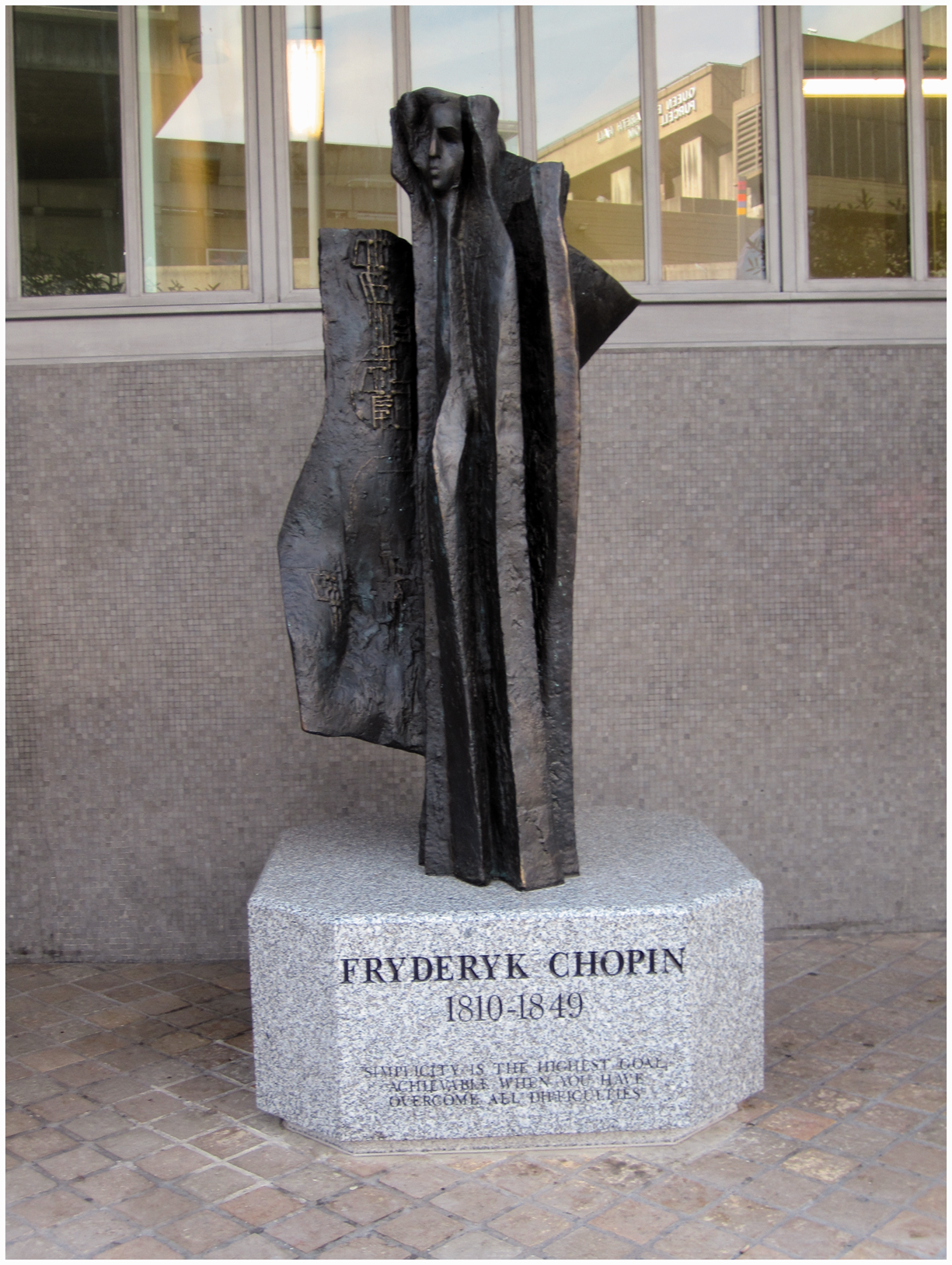
In the 1950s the Polish people gave a bronze statue of Chopin to Britain to celebrate the Festival of Britain. It was placed outside the Royal Festival Hall (Figure 5). In 1985 it was noticed that it was missing and an extensive search began. In 2010, after 25 years searching it was found buried underground beneath Waterloo Bridge. It was taken to Poland and restored and in 2011 it was unveiled for a second time outside the Royal festival Hall.
9
Chopin Statue at Royal Festival Hall.