



Abstract
Since opening in 1848, Lariboisière’s Hospital was strongly associated with the history of Paris and especially with the terrible days of the siege of Paris and the fights of the Commune. On the day after the surrender, Alix Joffroy wrote his first letter to his mother. He described the events as he experienced them, expressing his feelings about the causes of this political and military disaster and his experience there as an intern. Some weeks after the defeat of France by the Prussians, humbled Parisians attacked governmental troops. From March to May 1871 an improvised insurrectionary movement, The Commune of Paris, had taken power in the capital During the Bloody Week from 21 to 28 May 1871; this movement was suppressed by the Versaillaise Army. In his second letter, Joffroy related with great realism the tooth and nail fighting at the barricades and then the savage repression by the Army of the Communards around Lariboisière’s Hospital. Two letters preciously preserved by Alix Joffroy’s descendants give this man’s unique direct account of a tragic period of the 19th century.
Introduction
In July 1870, France was at war with Prussia. Starting on 20 September 1870, the Third and Fourth German Armies, under the command of the Royal Princes of Saxony and Prussia, laid siege to Paris. 1 On 4 September 1870 Gambetta, Jules Favre and Jules Ferry proclaimed the Republic at Paris’ Hotel de Ville after Emperor Napoleon III was imprisoned at Sedan. A Government of National Defence presided over by General Trochu had been constituted. After negotiations with Bismarck failed, the fighting continued at the same time in the provinces as well as all around Paris until 28 January 1871 when an armistice was reached.
Since its opening in 1848, the Lariboisière Hospital, which was closely associated with the terrible days of the siege of Paris in 1871, hired medical interns and among them was Alix Joffroy (1844–1908) who had been enrolled at the Faculty of Medicine in Paris in 1863. 2 Extern at 21 years old in Vulpian’s Department at the Salpetrière Hospital, temporary intern at 22 years in Berthier’s Department at the Bicêtre Hospital, Joffroy was appointed medical intern when aged 23 years. In 1871 he worked as a medical intern in Millard’s Department at the Lariboisière Hospital after having worked in Giraldes, Jean-Martin Charcot (1825–1893), Barthez and Parrot’s Departments. His teacher, Charcot, inspired the subject of his PhD, The hypertrophic pachymêningitis (of spontaneous origin) in 1873. From 1874 to 1879 he was a Senior Registrar of Lasègue at the Pitié Hospital. In 1879 he qualified as a Doctor of the Bureau Central before becoming a professor the following year. In 1885 he succeeded Jules-Bernard Luys (1828–1897) in the Small Service of the Salpétrière after two years in Bicetre Hospital. Starting in 1893 and until his death in 1908, he was in charge and he held the Chair for the Mental Illness Clinic. In 1893, Joffroy succeeded Benjamin Ball (1833–1893), Charcot’s pupil, who had held the Chair since its creation in 1879. Joffroy preceded Gilbert Ballet (1853–1916), another pupil of Charcot. 3 First President of the Society of Neurology of Paris in 1899 and of the Society of Psychiatry (1908), President of the Medical Psychological Society (1900) and of the Medical Society of the Hospitals of Paris (1901), Joffroy was elected to the Academy of medicine in 1902.
Joffroy was a pioneer in neuropathology. 4 In 1869 with Charcot he described the alteration in anterior horn cells in progressive spinal muscular atrophy, a variety of motor neurone disease. In 1870 he repeated with Duchenne de Boulogne the demonstration of labio-glosso-laryngo paralysis. In that same year with Charcot and Parrot he demonstrated the lesion of anterior horn cells of the spinal cord in infantile paralysis. After becoming an aliéniste by being named Chairman of the Mental Illness Clinic, Joffroy always remained faithful to neurology and neuropathology while undertaking many studies on afflictions with an organic aspect and he published widely on the role of infections (syphilis) and intoxications (alcohol) in the genesis of mental disorders.
Alix Joffroy's letter written on 29 January 1871, one day after the surrender
One day after the surrender of Paris Joffroy wrote on several pieces of different papers a long letter to his mother and sister living in Louppy-le-petit, now known as Louppy-sur-Chée in the Department of the Meuse.
His handwriting is fine and careful, filling up the entire page to give maximum news. He is an impatient man who expects to receive a letter showing that ‘we can send [letters] in unsealed envelopes’. The postal services had been disrupted by the war.
His tone is grave, tinged with anxiety about the living conditions imposed on his family ‘from the day when I learned that the Prussians entered into Bar-le-Duc, I can only think of you and I asked myself many times while here if there were not Prussian soldiers in our house’. Louppy-le-petit is situated less than 13 km from Bar-le-Duc that was occupied on 18 August 1870. The fast advance of the enemy and the economic disorganization explains the fact that he ‘did not receive … any news since August 19th’. Due to the Prussian invasion, most people were compelled to move but this was not the case for his family.
The war imposed terrible suffering on the French people. Famine and illness were rife. The poor sanitary conditions were favourable for the spread of epidemic disease including typhoid fever and smallpox. The poor began to die en masse. Hospital infections, where the mechanisms were not known then, were the cause of dreadful mortality rates among operated patients, the newly born and the injured, half of whom died of purulent contagion. 5 Within this hospital, in order to avoid any further contamination from the infected patients, a big tent with capacity for 22 persons was provided but this was deemed too expensive in time of war and so, instead, they had to use single tents which resulted in one out of five patients suffering from smallpox dying every day. 6 Physically, Joffroy was ‘unchanged, neither more nor less fat than before the siege’ and he tried to be reassuring by writing that he ‘did not suffer from hunger … here we didn’t want for anything’ although he added ‘apart from the fact that I ate lots of horse and leg of dog’. Like all the Parisians, he could not dream of generous food parties but had to be content with different small rations including dog, cat, horse and vermin. His state of health and his morale did not seem to have been damaged by the restrictions and food deprivations.
He said ‘The ex-emperor waged this war for no other reason only than to place his son on the throne’. As did many French persons, Joffroy agreed with Thiers who concluded that this especially bloody war, with its mass destruction of men and material, had a ‘supremely pointless’ dimension. Not having a great revolutionary or warlike mind, Joffroy was relieved and reassured by the French surrender that forbade the Germans to enter Paris. Joffroy thought this ‘so much the better, because in a vast town with so many types of people, exasperated by the ex-emperor’s bab government that everybody hated … also exasperated by the very weak government of national defence, we don’t really know what could happen’. The day after the surrender, Joffroy perceived a pre-insurrection public mood within the Parisian population which showed that the young Republic felt threatened and considered that its fatherland was betrayed and humiliated.
This letter, written the day after the surrender, coincided with the opening of the legislative campaign. The elections were to take place on 8 February 1871. Joffroy expressed his indignation and his anger with the politicians of the time.
Witness of the killings, he was very critical and stated his convictions: ‘we endured the Emperor for 20 years and now see what it has cost us … that’s what happens when an Emperor or a King is taken. These people are very costly … especially because of the employment of servants and other of all kinds who get generously paid for their work to support the power already in place’. He is quite open in expressing his anti-imperialism and anti-realistic opinions and later his republican feelings. Indeed, he gives the names of a certain number of well-known personalities that he does not favour and who are running as candidates in the elections organized at the last minute. Bismarck wanted to deal with a stable and legitimate power. The campaign’s objectives aimed, on the one hand, where to define itself for or against the war and, on the other hand, to decide on the type of regime to institute. 1
Joffroy did not wish for the election of Orléanistes such as Louis Jules Trochu (1815–1896) and Jules Ferry (1832–1893). After General Trochu had been elected to the head of the Government of National Defence, he had to resign from his post in favour of General Vinoy (1800–1880) due to the disastrous battle of Buzenval in January 1871. Jules Ferry, delegated to the administration of the Seine, directed the resupply of Paris with the help of a commission chaired by Jules Simon. In a Paris besieged by the Prussian army, some accused him of setting up the rationing of bread too late whereas others criticized him for the food restrictions that had to be imposed. Jules François Simon Suisse, commonly known as Jules Simon (1814–1896), elected Deputy of the Seine, was qualified as a nonentity as was Louis Joseph Picard (1821–1877), Minister of Finance from 4 September 1870, who was on republican opposition in 1857. They were qualified as nonentities probably because they were portrayed as too moderate Republicans. Joffroy considered Eugene Pelletan (1813–1884), Republican Deputy of the Seine who had asserted his opposition to the Empire, ‘honest but incapable’ and added ‘we don’t need either journalists or Parisian lawyers, a lot of whom are incapable and the rest not very trustworthy’. Perhaps he was referring to the period when Gambetta was the Interior Minister and who, at this time, had fired the prefects of the Second Empire and named in their place Republican activists, lawyers and journalists, to review the military situation that had deteriorated? Ever if he did not appreciate this governmental action, the fact remained that Joffroy strongly felt that ‘we need able and honest republican men. I know now only of Gambetta and Dorian’. These words, stated in a moment of emotion, indeed even despair, clearly showed that in an exceptional crisis situation Joffroy hoped for exceptional men: openly republican, totally against the restoration of the monarchy, and defenders of democratic values.
All the former deputies of Paris and all members of the Government of National Defence were defeated. Supported by a majority of monarchists, Jules Grévy was proclaimed President, a Republican from 1848, known for his moderation and his attachment to the notions of freedom and ownership. He was opposed to the radicalism of Gambetta. Adolphe Thiers was elected leader of the executive power of the French Republic. As the election results were not in keeping with Joffroy’s own ideas, it can be assumed these elections disappointed him. Those called by Joffroy as nonentities became Ministers. E Picard and J Simon became ministers of the Interior and of Education, respectively.
Joffroy, a doctor in encircled Paris
It was in an encircled Paris that Joffroy worked as a doctor and most probably as part of the Ambulance because he participated in trips outside of the Parisian walls. He gave the towns’ names and dates where he bandaged the wounded on the battlefields of Champigny (2 December), Bagneux (13 October), Bourget (21 December) and Buzenval (19 December). Mobile ambulances went after the end of the battles to look for the remaining injured who survived the cold in the snow, shocked, frozen or heaped among the dead in ruined houses, barns, churches and sometimes behind the lines of the Germans from their indications. 5 In the deployments, the ambulances were surrounded by Officers. Joffroy observed and criticized their decisions. He complained about their lack of professionalism. Some of these highly-placed officers did not know ‘the names of the villages they crossed through’. But he was not insensitive to the bravery, discipline, courage and the ardour necessary to confront the death of soldiers, navy soldiers and members of the mobile police force who formed the National Guard.
Joffroy mentions the case of ‘a marine commander at Montrouge’s Fort who, at the moment of leaving the fort, blew his brains out’. He was Larret-Lamalignie, the ex-Commander of Pei Ho. On his Memorial Medal of the Siege of Paris was inscribed ‘Captain Larret Lamalignie, a brave old sailor, who as soon as he learned at the Montrouge Fort that famine compelled Paris to surrender, preferred death sooner than desert his old gun'.7,8 The influence of political passion and a certain new democratic mind was, besides the weakening of religious ideas and an ever-increasing number of insanity cases, one of the causes of suicide according to Decaisne as quoted by Michel Caire. 9
May 1871, a letter written during the Bloody Week
After the elections of February 1871 Paris was calm again. The Parisian population was hostile to the monarchist majority at the National Assembly. Fearing a populist uprising, the National Assembly decided to abolish the pay of the National Guards and the end of the moratorium on debts, rents and bills of exchange. Misery settled on the working class. On 18 March 1871, by order of Thiers, the army tried to disarm Paris, taking over 200 cannons gathered in Montmartre and Belleville. Facing the insurrection, Thiers and the government took refuge in Versailles and decide to recapture the capital with the help of the army. The battalions of the federated National Guard, the Fedérés, and their Central Committee, with a revolutionary majority elected a Communal Council. An insurrectionary local government was set up, the ‘Commune of Paris’. On 21 May 1871 the Army troops of Versailles entered the capital. The Bloody Week began.
From 22 May 1871 Joffroy wrote a daily account until Saturday 27 May 1871. We are going to find throughout his account, which was written with spontaneity, precise details that are confirmed by historical archives both in regard to the events and to the men involved. The letter is addressed to his mother. The text is enriched with plans and sketches of the building of Lariboisière Hospital indicating the exact position of the barricades on the boulevards around it, the points of impact of shells and the location of executions by shooting (Figure 1).
Photograph of Alix Joffroy (1844–1908).
While Joffroy was ‘still in bed’ he heard ‘a hospital boy shouting in the corridor of the intern’s rooms: ‘the Versaillais have entered Paris.’ During the day he went into Paris and realized that the rumour of the entry of the Versailles Army troops into Paris had spread quite late. He was all the more surprised at this ‘good news’ as just the evening before he ‘came back to the hospital at eleven thirty in the evening’. Indeed, it was on 21 May 1871 that the Army of Versailles, informed by a Parisian Council Worker that the Porte du Point-du-Jour was sparsely guarded, entered the still sleeping capital.
The positions and the advancement of troops were, indeed, a source of worry and a topic of conversation in the corridors of Lariboisière Hospital. Joffroy tells us ‘in the day, the occupied positions are the Champ de Mars, Les Invalides, Passy Auteuil and Trocadero. In the afternoon, they learn that they are at St Lazare Station (20 minutes away from the hospital) and that on the ‘exterieur boulevards’ that pass just behind the hospital they are at Place de Clichy (20 minutes from the hospital)’. Very quickly, a quarter of Paris is in Thiers’ Army’s control. The Communards try to stop the progression of the Versaillais Army. They put up barricades on the streets around the hospital. He writes ‘at eight o’clock the troops stop at one hundred metres from the hospital opposite the entry gate of the boulevard Magenta’ where he sees ‘a commander surrounded by about sixty soldiers’. Joffroy was very eager to go and see close up what was happening, to be nearer to the centre of the action like a war reporter. He inquired about who they were – ‘they are General Dombrowski’s men’.
After the insurrection of 1863 many Poles took refuge in France, among them General Jaroslaw Dombrowski (1841–1871) who had taken an active part in the uprising of 1863 in Poland. 1 He belonged to the Parisian forces that constituted the National Guard. Colonel of the XI Legion on 6 April 1871, Dombrowski was appointed Chief of Staff having command of Paris. On 9 April 1871 he took over the defence of Neuilly and was given the important task of managing the organization and the movements of the legions of the Commune. Dombrowski had to confront Montaudon’s infantry division that entered Paris by the Porte de Saint-Ouen and which then went towards the Gare du Nord. Joffroy heard directly from the National Guard that Dombrowski ‘wanted to get away after having betrayed and lied to the Versaillais after having received 2,000,000 Francs for their entry into Paris’. In fact Dombrowski had no more troops and foreseeing an unavoidable defeat had thought, perhaps, to run away. National Guard ‘Fédérés’ stopped him at the Porte de Saint-Ouen and accused him of treason on the strength of vague rumours spread by Veysset. 1 Joffroy apparently attempted to see or catch a glimpse of the General but Dombrowski was ‘sent ahead under solid escort’. He was driven to the town hall where members of the Committee for public safety renewed their confidence in him. Later in the day, the Montaudon Division got through the barricades on the Boulevard of Ornano and Château Rouge. In the afternoon it attacked those of Myrrha Street with canons. Joffroy tells us that Dombrowski ‘returned to his troops in Montmartre’ and he was seriously injured there with ‘a bullet to his stomach’. After he had been given first aid in a pharmacy on Myrrha Street, Dombrowki was driven to Lariboisière Hospital where Doctor Cusco examined him. 10 He was still alive and Joffroy described him as ‘small, thin, 39 years old, deathly pale, wearing a moustache and a goatee, very brave, he never complained’. He was dying. Joffroy knew he probably had little time to live and comforted him in his last hours. He ‘also could not help except to advise the administration of an injection of morphine’. A few hours later ‘at three o clock’ Dombrowski died at Lariboisière Hospital.
Activities at Lariboisière Hospital
It is not so much the daily life and the medical care given at Lariboisière Hospital, nor the suffering inflicted on the Parisian, nor on himself that fascinates Joffroy. It is more the atmosphere of open rebellion in Paris, the barricades and the endeavours of the Communards to escape defeat that interested him. More than 500 barricades were put up during the Bloody Week in the course of which the Versaillais Army undertook to recapture the city. He tells, fascinated, magnetized by the scenes of fierce street fighting taking place under his nose. Some metres away from the hospital a barricade was erected at the point of intersection between the boulevards d’Ornano, Rochechouard, Magenta and La Chapelle where on each side an armed struggle began between Army soldiers and the National Guard Fédérés (Figure 2). At different times of the day he followed the progress of the fights, ‘in the morning … there are 190 men … at quarter past seven there are no more than 19’.
Lariboisière Hospital's map. Extract of Joffroy’s letter written during the Bloody Week, May 1871.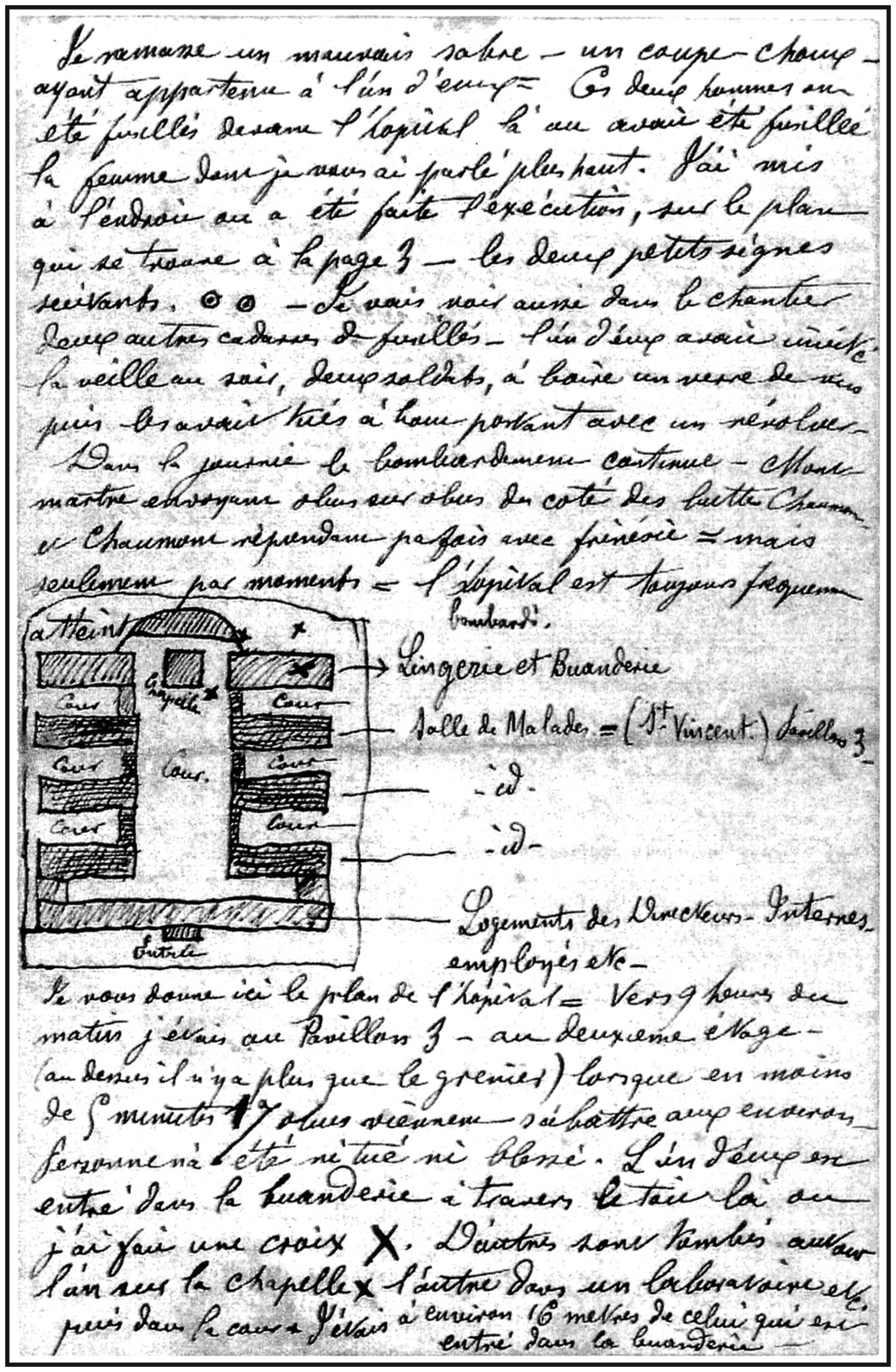
Joffroy was a direct witness of Bloody Week and many of the things he saw and heard were described honestly. His observations and accounts are those of a young spectator overwhelmed by an utmost and unhealthy curiosity – we could even say voyeur. He said that on 22 May ‘I saw 4 to 5 National Guard Fédérés killed or seriously injured. I am near enough to see a corpse in the middle of the barricade, to see a man stabbed in the face, another one in the leg’. There were thousands of deaths, thousands of arrests, summary executions some of which took place around the hospital. The war was bloody and murderous and Joffroy doesn’t spare us the violence and the deadly atmosphere and even the cruelty of these days. In the early hours on Friday 26 May Joffroy was awakened by a fellow intern colleague who was running at great speed down the corridor saying ‘someone is going to be shot at the site’. Joffroy was incited by this news to go and see the events. From his window ‘I can see the soldiers backing an insurgent against a wall, then four members of the anti-riot police of Seine and Oise ordered by a sergeant, to take aim and fire. Then the sergeant advances towards the dying man and gives the deathblow. The firing squad stays in place and they back a second insurgent against the wall and the same scene starts again’. Joffroy went out and headed hurriedly for the execution site and mingled with the crowd. He felt no pity and no compassion but ‘a real pleasure’ for these two men who ‘are barely twenty years old … according to their features … two Italians … who fired shots from time to time at the soldiers passing by without paying attention because they were in control of the area’.
The fact that Joffroy took such an interest in the tragic events around Lariboisière Hospital meant that he preferred on several occasions ‘missing dinner rather than a battle’ or running a risk by not going to sleep in the cellar unlike his colleagues: ‘I stay here although dinner is ready … the fire continued and I was called elsewhere and I left my spot with regret’. He also regretted having to leave the illuminated Parisian sky lit up by numerous fires and shells. He is able ‘to follow easily with his eyes the trace because the fuse left a lightning streak in the night’. However, sometimes the shelling obliged him to sleep in the cellar as a precaution ‘blocking up the cellar windows with plaster to avoid fire in accord with the recommendations of the military command’.
Like his colleagues, Joffroy worked day and night but his nights are short, often woken with a start or disrupted by the noise of the shells. In the day, he is obliged by his feelings of exhaustion to go ‘to throw himself on his bed to have a rest’. For example, on the night of 22 to 23 May he is awakened by ‘a huge detonation … cannon fire, big pieces of navy equipment and the noise of shooting’.
The noise was unbearable and he could not sleep. When he got up the first time he noted ‘the fighting was taking place in Montmartre. It is very close to the hospital … It is a very strategic position, very strong, and the local population includes a majority of revolutionary and communard sympathisers’. Appended to Paris in 1860, the district of Montmartre was the birthplace of the Commune. The canons of the city were erected there and the balloons that were to observe the enemy lines took off there from the square of Saint-Pierre. Gambetta took off from there for Tours. Louise Michel, a militant anarchist and one of the major figures of the Commune of Paris, was born there. Joffroy estimated that on 27 May from Montmartre ‘10,000 shells were fired in 24 hours’. Always very curious he ‘gets up, right up on the top of the hospital roof … with an eyeglass. He localized the battles between the Tuileries, Rivoli street, Saint Florentin street and the Champs Elysées … on the side of Vaugirard where a terrible fire burns’.
The cannons certainly caused fires but the Communards deliberately started other fires. Unconcerned with danger, Joffroy remained on the roof to observe the fighting and to witness the death of the Commune described as well as in any book. At midday on 23 Tuesday from his observation post beside Montmartre, he noticed the National Guard Fédérés ‘walking in the midst of the cannons in the park that is in front of Rosier Street and then suddenly these National Guard Fédérés made a speedy escape descending the very steep slope when, at the same time, another of them arrived at the slope and fell headlong and another one did the same’. Feverish, totally enthusiastic ‘he is in rapture’ when the tricolour flag appears with the Versaillais Army. Then, ‘at the top of the Solférino tower, the flag was planted’. The deliverance was close. From Wednesday 24 May he will witness battles that took place on the railway lines between the wagons with the Versaillais Army taking over the railway stations of the North, East and the towers of Saint Paul’s Church (Figure 3). It is on the evening of the 24th that he heard from an officer who came to be treated that the East station is in the hands of the Versaillais and he added ‘we are now delivered from the insurgents and we shall not see any more of them’ (Figure 4).
Barricades at a crossroad near Lariboisière Hospital. Extract of Joffroy’s letter written during the Bloody Week, May 1871. Part of May 23th and May 24th and the Lariboisière area. Extract of Joffroy’s letter written during the Bloody Week, May 1871.

But shells continued to rain on the area. He writes on 26 May that Lariboisière Hospital was not spared and ‘continued being shelled regularly’. The laundry, the linen room, the chapel and one of the laboratories were the target of cannon attacks. Joffroy ‘learned that the hospital received at least 60 shells and apart from damage to buildings and two quickly extinguished fires, they had only to regret three deaths and four injured men. In the vicinity, there is considerable more damage both to houses and in the number of deaths registered’.
Lariboisière Hospital accepts injured men, National Guard Fédérés or regular soldiers of the Army, ‘one of whom received a bullet while entering the hospital’. As in his first letter, Joffroy finds the attitude of the soldiers of the National Guard valorous but he distinguishes among the hospitalized population the sobriety of the Army contrary to that of the National Guard Fédérés. After the fall of the Commune of Paris, the role of alcohol became the object of questionable affirmations not without ulterior political motives in literary and medical writings. 9 Victims were to be found among hospital personnel – ‘a nurse and a male nurse were seriously injured, one male nurse killed and two others less seriously injured than the first two’.
Paris on fire
In a few days, 110,000 soldiers entered Paris. The National Guard Fédérés vandalized, burned and killed in front of the slow but progressive advance of the Versaillais Army. Orders had been given to gather all inflammable products and the communards intentionally set fire to the homes situated at the edge of their barricades, public buildings and monuments. Jules Bergeret (1839–1905), before taking refuge in Jersey, gave an order to burn down the Tuileries and wrote ‘the last relics of the monarchy have just disappeared. I would like the same thing for all the monuments’. The evening of 23 May, it is Paris on fire which Joffroy notices from his position: ‘They realized from the vantage point of the hospital that they had set fire to the Tuileries, to the Prefecture of Police, to the Lyric theatre and to Châtelet, to the Treasury … A big line of fire could be seen getting larger and larger … it was terrible. Paris was burning’. The picture of Paris on fire seemed to plunge Joffroy into a state of distress.
Already on the preceding day he had written that it was ‘the most painful emotion to have’. In fact ‘insurgents without weapons’ moving ahead ‘on the side of the first line soldiers’ reminded him of the events of 18 March when the Parisian crowd of Montmartre had fraternized with the Vincennes Hunters’ group of soldiers commanded by General Lecomte who had come to recover the cannons of Montmartre. But it was not to be, for ‘suddenly the insurgents came back running and a gunshot blasted out, then the shooting began more violently than ever’. The pacification attempt failed in front of him. Joffroy was overcome by a moral misery pervading all his being and revealing patriotism at the same time intense, tortured, torn and outraged. He suffered from an internal conflict that was ‘a commiseration for these men when he saw them suffering when he was close to them’ but everything was to change and this commiseration was to disappear absolutely ‘to make room for the cruellest feelings’. Joffroy could not hide his implacable, sworn aversion that contained a certain thrill when he wrote ‘I am feeling a certain pleasure to see these good patriots [the Fédérés] paying to the fatherland a small tribute, that of their life’. His exasperation with the situation transformed his sense of fairness and sincerity into that of the informer. He protested against ambush shooting and thus became an informer. From his window he ‘saw shooting from a house … I am going to signal the fact to the troops’. He became like a Brassardiers, a partisan of the Government of Versailles displaying an armband. These Parisians knew their areas well and helped the Army soldiers of the second line who were responsible for stalking the resistance fighters. House searches were carried out, even when fruitless at first, but ‘they ended up laying their hands on three men who were shot in the North railway station on the next night’. The bodies of the three shot men were brought to Lariboisière as well as ‘the body of a shot woman [and] another one for having shot at a commander at point-blank range’. Joffroy tells that one of them ‘had shot at three sentries at night. When they arrived in her room she had undressed and gone to bed … they did not find any weapons but she had forgotten or had no time to wash her hands which were very black and smelt of powder. Eventually they ended up finding her gun’. Joffroy told of no action on his part that would aim at preventing these men and women from suffering the retaliation and execution that were the consequences of their acts. Neither he nor his intern or extern colleagues of Lariboisière, in contrast to those of the hospital of Saint-Louis, Charity or the Main Hospital, were seen to do so. 5 In Saint-Antoine’s Hospital the interns succeeded in hiding some National Guard Fédérés thus helping them avoid being shot. 11 Every National Guard Fédérés and all the supposed rioters were shot on the spot if they were found with a weapon or traces of gunpowder on theirs hands. The risks were similar for those who were suspected of compliance. He made no open secret of his political opinions: his opposition to the violent acts of the National Guard ‘Fédérés’, the anarchy and the popular disorderliness. As was the case with most of the other interns and externs, he did not adhere to the Commune. 5
The facts related by Joffroy are, certainly, notable for their realism but he sometimes showed a little imagination that seems to be inspired by comic books. His account is peppered with little humorous anecdotes. When one is endowed with a sense of humour then it can make depression, mourning, shame and guilt bearable and it makes bearable a hardly real reality. It allows one, by thinking of it and here by writing it, to smile triumphantly. 12 Two days later Joffroy tells of a shell ‘ … that fell in an operating room, on a pillow and did not burst, but rolled near one of my colleagues who escaped by being covered by the feathers of a pillow’. Perhaps it was the same shell that ‘crossed through a small room on the ground floor and came, without going off, to roll under a bed during Huchard’s visit, one of the interns’. 10 Then Joffroy wrote that ‘pieces of another [bomb] entered my treatment room’. One of them crossed a few centimetres, over the head of some of the patients, entered the amphitheatre and it was miraculous that they were not performing an operation. It demolished everything. Another one fell in a water cistern located on the floor above the men’s treatment room but it did not burst … there were neither deaths nor injuries which was not always the case.
His observations are also those of a spectator who was devastated by the show before him. During the daytime of the 26th ‘the shooting can only be heard in the distance’ and in the evening Joffroy made the most of a relative peace and quiet to go into Paris. He was nearby: a fire very near the hospital. Huge stores containing oils, tallow etc, etc are burning while spreading a great light … I have never come across anything like it … in the street and on the boulevard, the news stands, the street urinals, the trees – the park benches are cut – broken – the tiles are smashed – with bullet marks on the walls – many houses are damaged by the shells – but the biggest damage is in the centre of Paris where there are big fires – considerable sized buildings entirely burned – and there were probably many victims and people burned too. It is with oil that all these fires were lit, the wives of the insurgents passed with a big pot and a brush whitewashing the floors, the windows, the walls with oil and then when the whole building was prepared they set fire to it and nothing could put it out, neither water nor anything else.
He added ‘many members of the Commune and the Central Committee had been already shot’. In the course of the week many of the soldiers, fighting under such generals’ command as Vinoy, Douay, Ladmirault and so many others, shot men and women without prior instruction, without debate, without counsel for the defence, that seemed to be communards. Many activists, stalked by the police, tried to escape Paris and to take refuge in the provinces or abroad.
In June 1871 Paris became quiet again
Between the outings on the battlefields and the carrying out of medical care in the different services of the hospital, the staff room remained the major place of relaxation and most probably the centre of intense discussions about the outcome of the battles. Some years later Huchard, recently elected to the Academy of Medicine which then was presided over by the illustrious Potain, recalled ‘the memory of this fine staff room in the Lariboisère Hospital from 1870 to 1871’. At that time Joffroy appeared to him ‘not very expert … in revealing the secrets of General Trochu’s plan to liberate Paris. From a mediocre general he became, as we predicted, ‘Professor Joffroy’ which is what we called then’. 13 Let us remember that his parents had enrolled him in a religious institution with the probable intention that he enter the École Polytechnique. 14 Perhaps he dreamed to serve under the motto Pour la Patrie, la Science et la Gloire. But history decided otherwise. We can see the possible source of his interest to observe and to describe the army events that he witnessed.
Conclusion
The purpose of this study was not to put emphasis on the contents of these two letters preciously preserved by André Berne-Joffroy (1915–2007) and then by his descendants that are as much historical as autobiographical. They wonderfully complement Martineaud’s book ‘Une histoire de l’Hôpital de Lariboisière, Le Versailles de la Misère’. These letters have a great value in conveying Joffroy’s real thoughts and feelings very naturally as well as being simple and precise. He seems motivated by the same desire for truth as the Goncourts in their Journal, namely ‘not to imitate the memory rewriters’. These letters of Joffroy describe the truth of the moment. They were written in the heat of the moment, in a highly emotional state similar to the text of Legrand du Saule (1830–1886): ‘De l’état mental des habitants de Paris pendant les évènements de la Paris en 1870–1871’. 15 Furthermore, Joffroy’s letters give interesting details concerning Dombrowski’s death.
If reading these letters of Joffroy can arouse in us similar feelings as a tale of classical tragedy, they are to be characterized especially as an expression of fact that is midway between a personal account, since he interprets for us in his own way the situation that he is experiencing, and an eye witness purely factual account where strict information, far from fiction, is important.
Joffroy kept ‘one of the cufflinks of a stitched shirt from Arles’ and a piece of that same shirt with ‘bullet hole’ that belonged to an executed woman and ‘a badly made sabre’ of a National Guard man. But, by writing ‘keep these notes to remind myself one day of all these horrible details, Joffroy appears as one of those men feels, that they are experiencing the important political military events of their time. As such a man, he felt the need to describe these events to which he was both witness and actor. Verba volant scripta monent. Certainly, Joffroy’s letters are not in any way comparable to the didactic aspects of Mémoires du Duc de Rohan, to the lengthy of Mémoires de Saint-Simon, to the romantic side of Mémoires de Vidocq, and not to the childlike character of the Mémoires d’unâne of the Countess of Ségur. But it certainly gave him material for an enthralling report. In his writing we can the historical importance of his story and whatever else is linked to it – physical distance from his family, economic recession, war and a traumatic force that could be the cause of his desire to write a recollection of these events. Memories fade with the passage of time. In that case Joffroy was writing to master painful emotions, writing to remember, writing to avoid forgetting and writing to transmit to others, even when it was not his primary goal. These writings of Joffroy wonderfully complement the truth of history’s events.