




Abstract
José Celestino Mutis y Bosio was a Spanish physician, naturalist, astronomer, priest, theologian and mathematician, and one of the icons of the Enlightment Age both in Spain and the American Continent. As the Viceroy’s personal doctor, he travelled to the territory of New Granada in what is now Colombia. Mutis was the creator and first leader of the Royal Botanic Expedition of New Granada to study South American wildlife, discovering thousands of new species. He also launched several Public Health measures in the Santa Fe area, helping to introduce a vaccination campaign. Mutis was the first person to introduce Newtonian physics in the Spanish America and he established the first Observatory in the New World which is still in use. He was deeply admired and recognized as a prominent scientist by great personalities of his time including Carl von Linée and Alexander von Humboldt.
Keywords
Portrait of José Celestino Mutis. Copy of the original painted by Laso de la Vega (1828) and displayed at the Royal Botanic Garden in Madrid.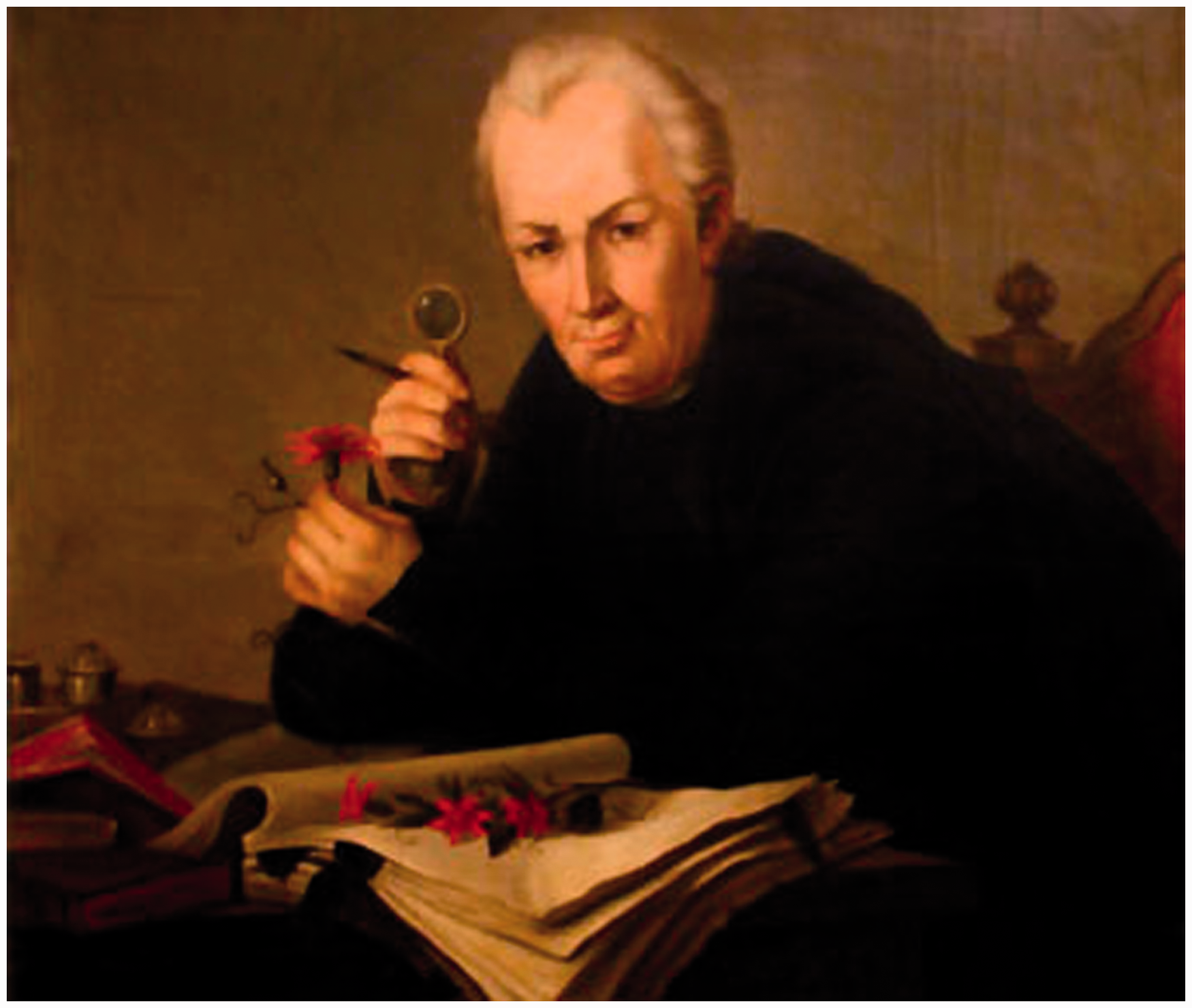
In 1748 Mutis, one of the eight sons of a local bookstore owner, began his studies in Medicine at the University of Seville. However, when King Ferdinand VI inaugurated the Royal College of Surgery of Cadiz, Mutis decided to come back to his hometown next year and there, in Cadiz, he approached the modern Medicine that relied on advances and discoveries in physics, chemistry, botanic and anatomy. However, the Cadiz College of Surgery was not authorized to issue the title of Bachelor in Philosophy which was a mandatory prerequisite to obtain the title of Bachelor in Medicine. For that reason Mutis moved again to Seville where he graduated Bachelor in Philosophy and later ibidem in Medicine in 1755. After a brief stay back in Cadiz at the Royal Hospital where he combined clinical assistance with anatomical study and practice, Mutis travelled to Madrid to be examined by the Real Protomedicado, fulfilling his status as a medical doctor in 1757.
It was at the Spanish capital where the young graduate entered the academic world and was appointed a junior doctor to the Chairman of Anatomy at the Hospital General. However, Mutis did not practise exclusively in clinics. When living in Madrid he delved into mathematics, astronomy, theology and the natural sciences, assisting Miguel de Bernades (?–1771) who held the Chair of Botanic at the Royal Botanic Garden. In 1760 Mutis was appointed Personal Physician to the new Viceroy of New Granada, Pedro Mesía (1700–1783). Consequently it became necessary to accompany his employer to Santa Fe – now Bogota – and he started writing his Diary of Observations in which he compiled reasons behind the scientific projects he undertook.
After his arrival in Santa Fe on 13 March 1762, Mutis was invited to the establishment of the Chair of Mathematics at Rosario College in Bogota. As a young European physician and scientist, his dissertation focused on the newest aspects of astronomy, mathematics and the natural sciences. He received the latest knowledge of contemporary mathematicians in Europe and elaborated upon the Copernican System. Mutis wrote on how Newton revolutionized knowledge of the laws that ruled the Earth and, by extension, the whole Universe. In fact, his labour oriented to update the academic atmosphere of the New World. In that era the New World was still anchored in scholasticism.
Very soon after he arrived in New Granada Mutis planned to seek cinchona and create a herbarium, but he still needed to collect samples of the flora and fauna. The Arcane of Cinchona is Mutis’ only completed scientific work. This book, published entirely in 1828, long after his death, was born after a thorough research of the distinct variants and properties of cinchona – which he considered the universal panacea. He also promoted its commercialization in stores and apothecaries’ shops.
In 1763 Mutis wrote to King Charles III asking permission to create a Royal Botanic Expedition around the limits of New Granada which at that time comprised the territories of today’s Colombia, Venezuela and Ecuador, with some extent northwards to Panama. Mutis’ aim was to study the territory’s wildlife and to search for alternative economic resources. While awaiting the King’s reply, which arrived eventually in 1782, Mutis also contributed to the development of those territories by study and the application of new methods for the exploitation both of mineral resources and of the distillation of rum. He contributed to the widespread influence of pre-Hispanic culture heritage. He organised the compilation of aboriginal South American languages in a series of dictionaries, grammar books and catechisms. This project, ordered by the Spanish Crown, had been suggested by Tsarina Catherine the Great who wanted to publish a dictionary of all the languages existing in the world. He also decided to take the sacerdotal votes and he did this in 1772.
In 1782 a smallpox epidemic developed and Mutis, despite the reluctance of the authorities, launched numerous Public Health measures in Santa Fe, including a vaccination campaign. At the request of an old priest from a nearby city, he used weakened strains of the disease in healthy citizens and inoculated them. Despite general disbelief, Mutis took a step forward and undertook the experiment on himself, inoculating by a small cut and instilling a purulent vesicle. Then he inoculated some of his students and several dozen sick children at an orphanage. After a few days neither he nor his disciples had become ill and the children began to improve. This test convinced several thousand people who then survived inoculation. Furthermore, the most important consequence of this successful campaign was that he also convinced the Viceroy who then established systematic vaccination decrees for future outbreaks.
On 1 April 1783 the anticipated Expedition finally was approved. It was the second of these enterprises created by the Spanish Crown in America, yet the only one that had been planned on American soil. Mutis led the Expedition for 25 years; it covered nearly 5000 miles (about 8000 kilometres), a longitudinal axis along and around the Magdalena River. It was to cover a wide range of climates and regions. The expedition set out in 1783–1808 under Mutis’ leadership but after he died in 1808 and thereafter it continued until 1816. It encountered many important personalities in science, politics and culture who belonged to the creole intellectual elite of the future United Provinces of New Granada: Eloy Valenzuela (1757–1834), Francisco Antonio Zea (1776–1822), Jorge Tadeo Lozano (1771–1816), José Manuel Restrepo (1781–1863) and Francisco José de Caldas (1768–1816). Years later, the German naturalist Alexander von Humboldt would praise the labour undertaken by Mutis when he travelled to South America and met some of the members of the Expedition.
Mutis developed a meticulous methodology that included collecting botanical samples in the field together with detailed descriptions, including data on the surroundings of each species and its utility. Hundreds of plants were discovered and described. More than 8000 plates, maps, correspondence, notes and manuscripts were sent to Spain. His museum consisted of 24,000 dried plants, 5000 drawings of plants by his pupils, and a collection of woods, shells, resins and minerals. Commercial and medicinal applications were found for products including oil of Mary, Tolu balsam, beeswax and cinnamon of the Andaqui people, guaco, ipecac and guaiacum. Oil was also found but was then used as pitch for waterproofing boats. These treasures arrived safely at Madrid, a hundred boxes or more, and the plants, manuscripts and drawings (Figure 2) were sent to the botanical gardens. Mutis’ herbarium finally was set up in Bogota to host the richness of the South American wildlife he was studying.
Detail of one of the illustrations from the Expedition (original paper sheet of Mutisia clematis). Note the M shape of the drawing. Collection of the Royal Botanic Garden, Madrid. Painters and drawers’ work was vital for obtaining excellent graphic records from the new findings.
In 1784 Mutis was elected an Honorary Member of the Swedish Academy of Sciences thanks to his friend Carl Von Linné (1707–1778), a friendship that would later be acknowledged by Von Linné the Younger (1741–1783) in the assignation of the terms Mutisioideae family and Mutisia genre to the specimens discovered by Mutis. This friendship with the great medical botanist was born when Mutis lived in Cadiz in 1760 before sailing to New Granada, when he met the Swedish consul in the Andalusian city. It happened that Miguel de Bernades had previously given Mutis some seeds in order to contact the Swedish diplomats who would be on a mission there and asked them to deliver the seeds to von Linné for further study. This was the start of a fructiferous pen friendship between both botanic physicians, with mutual reward and learning.
Towards the end of his life, Mutis established the Medical School within Rosario College and was appointed Director. In the context of his former dedication to Mathematics and Astronomy, Mutis established an observatory in Santa Fe, the first to be built in the New World, inaugurated in 1803 and still in use today.
Mutis died on 11 September 1808, aged 76. He did not leave direct descendants. His nephew Sinforoso Mutis (1773–1822) collated his uncle’s work and, together with other members, carried on with the Botanic Expedition.
This physician and scientist understood the needs of his society, summarized in welfare, knowledge and progress. Highly respected and considered in his homeland of Spain and almost worshiped in his adoptive Colombia, José Celestino Mutis was honoured in the appellation given him by Colombians, The Wise.1–8