




Abstract
Catalan surgeon Moisès Broggi entered medical practice in 1931 as Spain was modernizing rapidly. Five years later, however, an attempted military coup sparked a nationwide civil war. Broggi offered his services to the embattled Republic and joined the Medical Service of the International Brigades. He served alongside colleagues from many countries, helping to develop advances in military medicine and especially trauma surgery. Broggi chose to remain working in Barcelona as Franco’s Nationalist forces entered the city, in spite of the risk of reprisal he faced as a former officer of the International Brigades. Although forced from his leading position in the public health service, he developed a distinguished private practice. In the year of Franco’s death he became President of Barcelona’s Royal Academy of Medicine and he received many other honours. Just months before his death at the remarkable age of 104, Dr Moisès Broggi continued to discuss and write about the concerns that had directed the course of his life – advances in medical science and the intellectual and political repression that had hindered delivery of those advances. In an article titled Exile and Silence he noted the groundbreaking work carried out under the auspices of the prestigious scientific institutions founded during Spain’s Second Republic and the subsequent dark decades of exile suffered by many of their prominent scientists, some of them his close friends.
Education and training
Broggi was born in Barcelona in 1908, into an era that initially appeared fortunate. From the 1920s Spain seemed poised to overcome historical backwardness and take its place in the scholarly vanguard of Europe. Impressive secular educational and cultural institutions were founded, including La Residencia de Estudiantes in Madrid whose students included Federico García Lorca, Salvador Dalí and Luis Buñuel. Here Dr Juan Negrín (1892–1956), a renowned Professor of Physiology and future Republican Prime Minister during the civil war, taught at his famous laboratory and international scientific figures including Albert Einstein and Marie Curie attended lectures. Broggi made lifelong friends among this academic community (Figure 1).1
Broggi as a young man.
Broggi studied medicine at Barcelona University under Professor Joaquín Trías y Pujol (1888–1964) with whom he formed an enduring professional and personal relationship. He specialized in surgery, a field that would prove vital in the tragic years ahead. Many children were admitted to his hospital suffering from diphtheria and Broggi became adept at performing tracheostomies, a procedure he employed later to deal with facial injuries inflicted in the civil war.
Broggi graduated in 1931, the year when the Second Spanish Republic was proclaimed, bringing hopes for further social progress. His first professional experience was as surgical assistant at a private trauma clinic, the Hospital Clínic, created by his former lecturer Professor Trías together with Trías’ brother Antoni (1892–1970). Another colleague was the young haematologist Frederico Durán-Jordá (1905–1957), later to set up a blood transfusion service during the war. At the same time the young surgeon was finishing his PhD at the recently created Universitat Autònoma de Barcelona, another of the new academic institutions that promised to transform Spain’s traditional insularity.
The Broggi family, like much of the long-established population of Barcelona, was passionately Catalan in their language and loyalties. They welcomed the election of the Second Republic not only because of its broader intellectual horizons but because, with the 1932 Statute of Autonomy, the Republic accepted an incipient form of self-government for Catalonia in some political and cultural matters. This concession, however, greatly disturbed the Spanish right and the military. In Broggi’s view, the spark that finally ignited his country’s civil war in July 1936 was the Republic’s readiness to consider the economic implications of Catalan self-government.
Outbreak of civil war
At the time of the attempted military coup d’etat and the subsequent outbreak of war in the summer of 1936, Broggi was head of the Emergency Department at the Hospital Clínic de Barcelona. In the immediate aftermath of the uprising, heavy fighting broke out in the nearby Plaza de Cataluña and elsewhere in the city, with overwhelming numbers of casualties and trucks full of corpses arriving at the hospital. Broggi had no hesitation in offering his services to the Republic, as the legal and democratic authority in his country, despite his abhorrence of the atrocities then being committed by both sides and especially by anarchists in his own region of northeast Spain. In the town of Barbastro he witnessed show trials of local rightists held before frenzied crowds, a scene he found reminiscent of the French Revolution.
‘Extreme bloodthirstiness’, he wrote later was a common denominator in all the places and episodes of our Civil War, making apparent the high rate of criminal behaviour in our country. We all know of the horrible excesses of which people were capable when freed from controlling authority, above all when this period of time gave the murderers time to organise themselves into armed gangs dedicated to killing, pillage and arson, which is what happened in our territory… such senseless cruelty transformed the militia into absolute wild animals, which prolonged the war unnecessarily.
2
To the end of his life Broggi continued to defend both the Republican and Catalan Governments for their actions against anarchist elements in Barcelona in May 1937 which he witnessed while on leave from the Front.
3
This ‘civil war within the civil war’ was the subject of British combatant George Orwell’s book Homage to Catalonia and gravely damaged the image of the Republican cause among potential supporters overseas. Broggi, however, was convinced that the fragile Republican government lacked sufficient resources to prevent the internecine violence from spiralling out of control: Our government… had very few military assets, and it was at the mercy of the anarchists who had hoarded large quantities of arms during an uprising prior to the Civil War, in October 1934. The economic situation was also desperate. Unemployment was enormous because work on building the underground railway in Barcelona had come to an end. Lots of people had been made redundant.
4
Even at this early stage of the conflict, Broggi was personally convinced that the Republic was militarily doomed for want of international support: Allied non-interventionism during the Civil War… was a disaster for us. The rebellion of the generals in 1936 brought havoc on our country, and left us without law and order. At the outbreak of the war, extremists won the day on both sides. And it was then, thanks to Franco’s coup, that the more radical factions – the FAI [Federación Anarquista Ibérica – the Spanish Anarchist Federation] in Republican areas and the Falangists in Franco-controlled zones – took over completely. That was disastrous for us because Franco continued to enjoy the support of Hitler and Mussolini, whereas the negative image created by the FAI led the democratic nations to abandon us, hoodwinked as they were by the propaganda put around by the conservative and Catholic press in Europe.’
With the International Brigades
Notwithstanding his pessimism for the survival of the Republic, Broggi moved to Madrid in March 1937 and was incorporated into the Medical Service of the International Brigades. In the holiday resort of Torrelodones, where a spa hotel had been converted into a base hospital, he met several of his British medical colleagues. These included Reginald Saxton (1911–2004), Leonard Crome (1909–2001), Archibald Cochrane (1909–1988) and Kenneth Sinclair-Loutit (1919–2003), and also Alexander Tudor Hart (1901–1992) whom Broggi recalled as a London surgeon who had come with the first English volunteers… We were impressed by the order and discipline that reigned there, above all because of the contrast it provided in comparison with the disorganization of the other troops
Thora Silverthorne (1910–1999), the daughter of a Welsh miner, became Broggi’s theatre nurse. ‘Thora, like the good Englishwoman [sic] that she was, always managed to serve us a great mug of tea at the right moment, so that we wouldn't fall asleep.’ Broggi retained lifelong friendships with these and other foreign volunteer doctors and nurses with whom he served throughout the civil war (Figure 2).
Broggi, in the uniform of the Republican Army, stands in the middle of this group of doctors and nurses during the Spanish Civil War.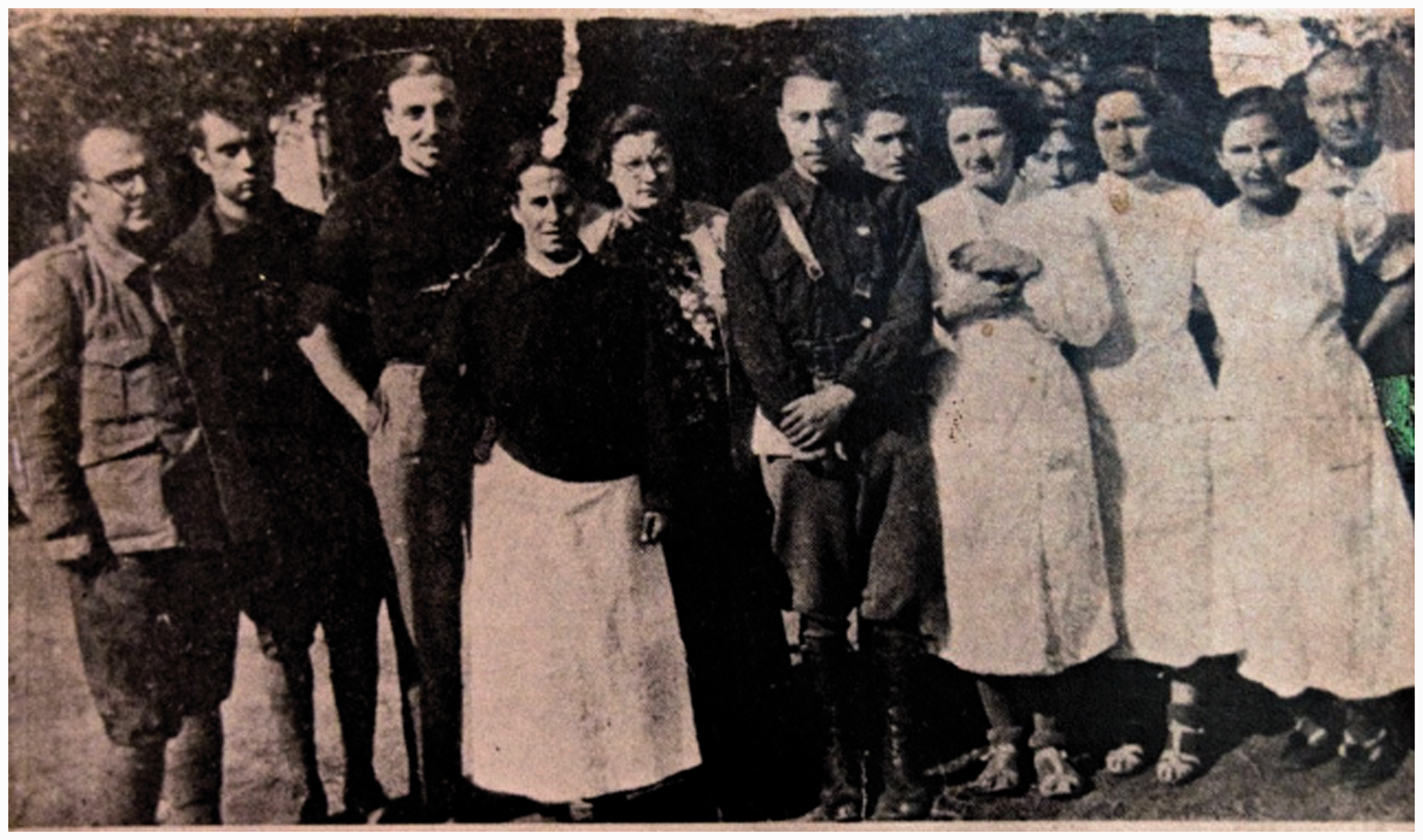
As a Medical Captain to the XIV and XV International Brigades, Broggi was lodged initially at Madrid’s Hotel Florida, together with many well-known brigadistas. Here he first met the US journalist and adventurer Ernest Hemingway (1899–1961) whom he remembered as a hard-drinking, energetic propagator of the legend of the ‘defence of Madrid’. At the hotel Dr Broggi also met a fellow physician with whom he would later collaborate closely – the Canadian doctor Norman Bethune (1890–1939), the great innovator of blood transfusion techniques, first in Spain and later in China during the Second Sino-Japanese War (where his work was primarily, however, administrative and educational).
Soon afterwards Broggi met George Nathan, the famous commander of the British Battalion of the International Brigades, on the Plaza de Cervantes in the historic town of Alcalá de Henares. ‘His serenity and his extraordinary bravery in the face of danger, together with his distinguished air, inspired trust and great admiration. All the troops of his unit adored him’. This picturesque hero of the Battle of Jarama would die a few months later in the front line of Brunete.
During the horrendously bloody Battle of Jarama (January–February 1937) Broggi was stationed at a newly formed mobile Republican field hospital at Villarejo, near the Jarama River. There he treated a seemingly endless flow of casualties from the battle to prevent Nationalist forces from cutting the vital road link between Valencia and Madrid.
New treatment methods
The following month, March 1937, saw a decisive advance in the development of the Medical Services of the Republican army. While skirmishes continued around the Madrid road, Broggi rejoined the British medical team at the base hospital at Torrelodones. Here the team was visited by the Bulgarian doctor Zvetan Kristanov (1898–1972), known in Spain as Oskar Telge, the head of Medical Services of the International Brigades.
Broggi wrote that Telge confessed to us that he was very worried by the poor results obtained in the treatment of the wounded in general, by the almost total mortality rate of those with abdominal wounds or open fractures, and by the frequent infections of the wounds, many of them fatal due to the presence of anaerobic germs that cause gangrene. He considered the situation as dreadful, he did not think it was normal and thought that changes in the medical organization were, perhaps, necessary. We had been recommended very highly to him and he counted on our collaboration. It was undoubtedly the first case in the history of military medicine in which a senior officer had consulted over a problem of this importance with subordinates who were not members of the military.
For the Republican Army’s Medical Services the consequences of this meeting were profound. The degree of co-operation between medical staff and military command, correctly characterized by Broggi as historically unprecedented, stimulated major advances in military medicine, and especially trauma surgery, that later would prove of enormous value in both war and peacetime. 5
Overwhelmingly, these medical innovations were developed by the Republicans and their allies – few, if any, were made by their Nationalist opponents despite the latter’s clear superiority in arms, training and foreign military support. 6 Broggi always regretted especially this aspect of the Spanish Civil War – that the eventual ‘losers’ were far superior to the ‘winners’ in terms of scientific knowledge. Perhaps the principal reasons for this disparity were, first, the Republican army’s urgent need to develop medical responses to new types of military casualty such as those produced by Nationalist air raids. The civil war was probably the first in which civilian casualties exceeded those of combatants and this posed entirely new problems of medical organization as well as treatment.
A second key reason why medical advances can be attributed disproportionately to the Republican side was the influx of new medical personnel to their forces and a consequent break with traditional systems and lines of authority. In the intensely demanding circumstances of early 1937 any distinction between military and civilian medicine became blurred. This combination of demand and opportunity for medical innovation proved immensely productive as idealistic doctors from many countries shared and developed new principles for treatment without regard to earlier protocols of tradition and seniority.
One of those principles, and one adamantly asserted by Broggi in particular, was to reduce as much as possible the time between injury and treatment. This was achieved by using mobile operating theatres, known by their French abbreviation of ‘autochir’, a term combining abbreviations of ‘automobile’ and ‘chirurgía’, the Spanish word for surgery. 7 The autochirs were specially equipped trucks, many made in Switzerland by Mercedes-Benz, used to carry Medical Services and surgical supplies to the troops and to act as operating rooms. They enabled small surgical teams quickly to deploy to any part of the ever-shifting front where they were most needed. Each unit was staffed by a surgeon and nursing personnel who could carry out surgical procedures under ether anaesthesia to stabilize surgical patients and to debride and plaster wounded extremities. The introduction of autochirs near the front lines allowed for a much speedier recovery process for the wounded and saved countless lives, both in Spain and in later armed conflicts.
Patience Darton (1911–1996), who served alongside Broggi as a nurse, has pointed out that the concerns that Telge expressed earlier regarding the infection rate of wounds were now effectively addressed: This was before the invention of penicillin and the sulphanilamides never got to Spain. Nevertheless, there was very little post-surgical cross-infection. The surgeons invented a method whereby they did a tremendous debridement, that is the complete removal of any foreign substances (shrapnel and so on) and injured tissue from a traumatic wound. They cut away all the tissue that might possibly carry infection then left the wound open, instead of doing the minimum and sewing it up. This reduced the risk of gas gangrene… Even tremendous wounds were plastered, open, and left to heal.
In an account of the Republican Medical Services published late in his life, Dr Broggi described further innovations that he regarded as equally significant in improving the treatment of battlefield injuries. One was the blood transfusion service developed by his former colleague at Barcelona’s Hospital Clínic, Dr Durán-Jordá. Another was the system for early immobilization of broken bones developed by another former colleague, Dr Josep Trueta i Raspall (1897–1977). Within six hours of injury, fractures were encased in plaster and the patient then transported to a base hospital. If the position of the fracture was found to be good, this plaster might remain without further treatment for some days or weeks.
During the intense fighting of 1938, Trueta’s system was employed almost universally. In that year over 20,000 cases were treated by the closed plaster method with a death rate of less than 1%. Broggi used Trueta’s plaster-cast method in his mobile hospitals and found that it gave excellent results. Trueta himself said later ‘I sincerely believe that no other treatment could have enabled us to alleviate for so many victims the horrors of war and air raids’. 8
A further vital principle of the system developed by Broggi and his colleagues was triage – assessing and allocating patients according to the nature and severity of their injuries as soon as they arrived at an emergency hospital. Republican medical units found that triage must be carried out by the most experienced doctor available since incorrect classification resulted in delayed treatment, increased infection and higher mortality.
Three points forward
Treatment facilities were organized into a hierarchy named the ‘three points forward’ system. The first point was the casualty first aid post, right at the front lines. The wounded were then sent to a field surgical hospital, as near to the front as safety permitted. 9 This was the type of hospital that Broggi often headed. Finally, as soon as it was safe to do so, the wounded were evacuated to a base hospital in a safe area but still as close as possible. Collectively, these innovations delivered a far higher standard of wartime medical care than had ever before been attained.
The Battle of La Granja in May 1937 was the first battle at which the field surgical hospitals were tested, an initiative led by Broggi himself. In preparation for a Republican offensive in the Sierra de Guadarrama, he worked with other members of the British medical team to convert a ski resort in the mountains outside Madrid into a casualty clearing hospital. Its former bar became the operating theatre. Three operating tables were arranged radially with a former London medical student, Dr Kenneth Sinclair-Loutit, administering anaesthetic at the centre.
This battle provided the central material for Hemingway’s novel of the civil war, For Whom the Bell Tolls. Notwithstanding the potent myth created by Hemingway, Broggi always maintained that the fighting around La Granja was of little real importance for the war and that the trialling of innovations, including the field hospitals, was of far greater significance.
In the subsequent Battle of Brunete in July 1937, Broggi moved to a large frontline hospital established in a former monastery at El Escorial, 40 km northwest of Madrid. In the first few days of the battle his team received some 3000 wounded as Franco’s Luftwaffe allies bombed trenches, roads and ambulances without discrimination. One casualty was the ambulance driver Julian Bell (1908–1937), a nephew of Virginia Woolf, who received a massive chest wound from flying shrapnel. He was given a blood transfusion by Reginald Saxton and Broggi made desperate but unavailing attempts to repair his shattered lungs. Saxton recalled ‘all Broggi could really do was really to clean off the surface and to pick out bits and pieces that wouldn’t actually open up the air breathing parts. And he took out pieces of the wallet and other pieces that were accessible from the surface and closed him up again… There was really nothing more we could do for him’.
For almost a month Broggi and his team worked day and night. The day the battle ended, we felt like the world had stopped, as we no longer heard that infernal noise, until then uninterrupted, of the explosion of bombs and cannons, and of the aeroplanes that swept over that great plain.
During the following days of relative calm the medical personnel had time to reflect upon the advantages of innovations such as the autochirs and the blood transfusion service, and recognized that ‘here, considerable and transcendental improvements were being made in war surgery’.
As the war progressed, the number of Nationalist air raids increased and the ‘three points forward’ system was adapted to protect the field hospitals against bomb attacks. In some areas railway wagons were converted into hospital trains that could be moved to tunnels or other locations to avoid the air raids. Typically, each hospital train had four operating rooms and eight to 12 hospital-convalescent cars with three stretcher tiers on each side. This system was used during the battle of Teruel in the winter of December 1937. Surrounded by heavy snow, Broggi and the outstanding New Zealand surgeon Doug Jolly (1904–1983) operated in a cottage near the front. Broggi remembers they lived on beans, chickpeas and dried codfish and slept on the wooden floor. Their patients were evacuated to a hospital train at the railway station, which could back into a tunnel when bombers appeared.
Despite all the calamities of the war, Broggi always remembered fondly his experience with the International Brigades. He saw many of the brigadistas as genuine Don Quixotes, fighting for justice and a better world: All those days of battle, and those afterwards, the fact that we had lived together through such dramatic moments, and with so many problems that we had to solve together, served to establish and consolidate fraternal relationships between us that have stood the test of time. They have lasted forever, as though we all form part of a great and loving family.
The Republican surrender
Broggi’s mentor, Dr Joaquín Trías, had escaped to the south of France by January 1939 when Franco’s Nationalist forces entered Barcelona. Before leaving, Trías had entrusted Broggi with responsibility for the Military Hospital. When the victors arrived, Broggi was cautious not to speak a word of Catalan. The Head of the Northern Army’s Medical Corps asked him to continue working at the hospital but Broggi declined, choosing to return to the Hospital Clínic, to resume his duties in the emergency service. At the end of 1939, however, he was removed from this position after a decision by a ‘Comité de Depuración’ (expurgating committee).
These committees were established within every major public institution, with the aim of identifying and expurgating former combatants or supporters of the Republic. Serious cases were referred to the military courts and frequently shot after a brief trial. More than 3000 people died in this way in the four years following the Nationalist victory.
Several of Broggi’s British friends tried to convince him to leave Spain, as many of his colleagues had done. Although well aware of the risks he faced in a Catalonia ruled by Franco, where mass executions were routine and his first language of Catalan was now banned, Broggi chose not to follow into exile his colleagues, including the brothers Trías. His family and future wife Angelina were living in Barcelona and he was determined to remain with them. He was court-martialled for his Medical Service with the International Brigades, an action that might have brought a death sentence. However, he was treated relatively leniently and later learned this was because a woman he had helped to free from prison in 1937 was the sister-in-law of a member of his tribunal. 10
Life under Franco
Broggi made the most of opportunities to travel outside Francoist Spain but was prevented from speaking out within his own country. In effect, he was sentenced to an internal exile, fused with the general mantle of silence that covered his country for almost four decades. As he foresaw in the early years of the Franco regime, ‘The peace that was coming upon us didn’t leave any chance for reconciliation. On the contrary, it was a military occupation that imposed a new order driven by the idea of punishment and repression’.
11
Yet, he also observed Not everything was triumphalism, treason, punishment and prosecution. Together with the dark official world in which we were immersed, there was a civil society which continued to act in accordance with the traditional values of friendship, loyalty and gratitude, and a certain spirit of justice that we carry within us.
A notable innovator in the field of surgery, Broggi pioneered the introduction of portocaval shunting into Spain. In 1966 he was named a fellow of the Royal Academy of Medicine of Barcelona and he became its President in 1980, the year of Franco’s death. In that year he was also elected to the Commission on Medical Ethics of the College of Medicine. Several universities conferred upon him honoris causa degrees and he was awarded the Creu de Sant Jordi, the highest honour bestowed by the Catalonian Government. Many of Broggi’s awards acknowledged not only his skill and dedication as a surgeon but also his ethical and social commitment. He was a founding member of International Physicians for the Prevention of Nuclear War (Figure 3).
Broggi (left) spoke movingly in 2008, at this celebration of his hundredth birthday, organized by Catalonia’s Royal Academy of Medicine. (Photo – Reial Acadèmia de Medicina de Catalunya, Arxiu Iconogràfic Històric de la Sanitat Catalana ‘Gaspar Sentiñon’.)
In 2010, at the age of 102 he attended the inauguration of a new public hospital at Sant Joan Despí, just outside Barcelona, which was named Hospital Moisès Broggi, an honour that greatly pleased this venerable figurehead of Catalan surgery. He also published a brief memoir, Sobre el camino de la vida (Upon the Road of Life), based on interviews with one of his grandsons, Carles Brasó, to accompany an earlier memoir of 2001. 12
Although prohibited from holding public office under the Franco dictatorship, Broggi never shrank from asserting the legitimacy of Spain’s Second Republic and its role in opposing the advance of international fascism. In his final years he chose to resume his political activism for the cause of Catalan self-determination. For some seven decades he had lived with his wife Angelina in a tranquil house in the neighbourhood of Sant Gervasi, uphill from the centre of Barcelona. In 2011 he sat in the garden and gave interviews to the world’s press on his appointment as a candidate for election to his country’s senate. As a revered and universally familiar figure throughout Catalonia, he was selected to represent a coalition led by the Catalan Republican Left (ERC) Party and including local socialists and Greens. His decision to stand as an independent on the coalition list came as his beloved Catalonia faced sweeping cuts to public health spending as part of the regional government’s forced austerity programme. Although almost immobile, he campaigned vigorously on the related platforms of resisting austerity and advancing Catalan autonomy.
Dr Moisès Broggi died on 31 December 2012 in Barcelona, aged 104. His funeral was attended by the current and two former Catalan Presidents and the head of its leading cultural organization, Muriel Casals. The Mayor of Barcelona announced that the city planned to remember its revered doctor by naming a street or special place in his honour, a tribute expected to be realised on 14 April 2014, the anniversary of the proclamation of Spain's Second Republic.
To the end of his life Broggi remained deeply concerned with the state of the world, particularly what he saw as a triumph of materialism over the human spirit. He was also worried about the consequences of overpopulation which he saw as one of the greatest threats facing humanity in the 21st century. Having seen Spain’s average life expectancy double in his lifetime, he was well aware that advances in his own field, medicine, had increased human longevity and contributed to the inversion of the demographic pyramid. This trend, he believed, could only be fought by rethinking the global system, starting with the eradication of extreme poverty in countries with high population growth. He also believed that a global government was the only instrument capable of solving global problems. At the same time, he was convinced that certain local problems could only be solved by local governments with a strong local presence and connection. It was from this practical consideration that he framed his support of Catalan nationalism. A confirmed pacifist, he never stopped fearing the threat of nuclear weapons and their unlimited powers of destruction. In his final years he felt as though he were living a state of eerie déjà vu, facing a European financial crisis alarmingly similar to the one he had experienced in his youth, in the dark decade of the 1930s.