



Abstract
Lady Brilliana Harley was the redoubtable chatelaine of Brampton Bryan Castle in Herefordshire during the mid-seventeenth century. Her many letters reveal much about the medications which she dispensed to her family and about the family’s medical attendants. Whenever possible the Harleys preferred to consult university-educated physicians rather than the local apothecary or surgeon. These physicians are all known from other sources but Brilliana’s letters add to what is known of their provincial practices. In particular, they reveal their willingness to undertake blood-letting, often thought to be the province of the more lowly surgeon, and they emphasise the great distances travelled by these practitioners and the difficulties faced by two of them during the Civil War.
Keywords
Lady Brilliana Harley
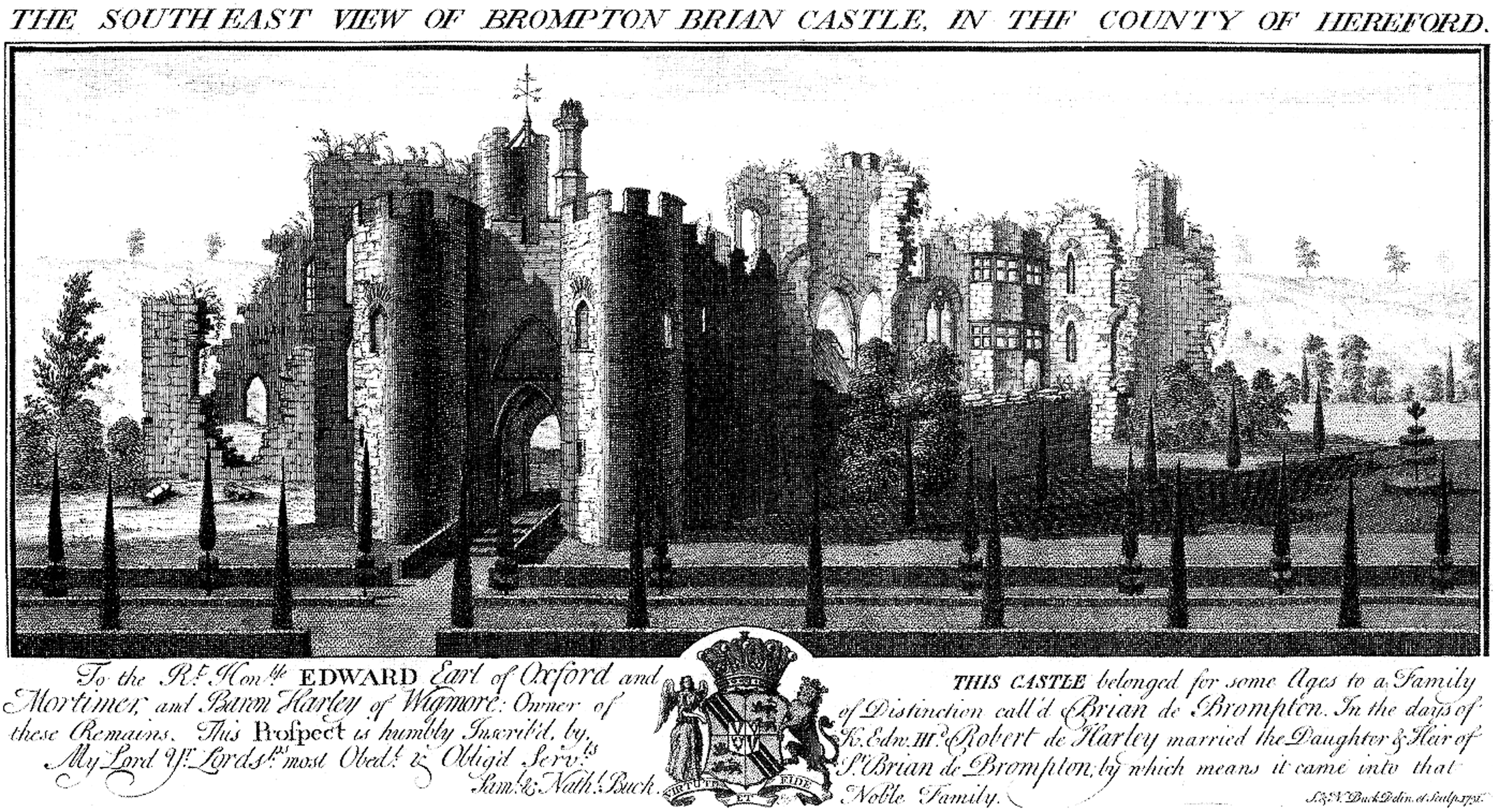
Lady Brilliana Harley (bap.1598, d.1643) (Figure 1) was the third wife of Sir Robert Harley (bap.1579, d.1656) of Brampton Bryan Castle in Herefordshire (Figure 2), whom she married in July 1623 and whose puritan and Calvinist beliefs she shared.
1
Sir Robert was a lawyer and at the time of the Civil War (1640–1651), was one of four Members of Parliament for Herefordshire.
2
Most of the landed gentry in Herefordshire supported the Royalist cause at this time. Although there were some who supported Parliament, the Harley family was probably unique in the county for its wholehearted Puritanism.
3
As Sir Robert was in London on Parliamentary business throughout most of the early 1640s, it fell to Brilliana to maintain the family home. She mounted a spirited defence of the castle when it was besieged by Royalists in 1643. This first siege was lifted after six weeks because the Royalist troops were needed elsewhere. Brilliana then destroyed the Royalist earthworks, re-provisioned the castle and sent out her own raiding party to attack a nearby Royalist stronghold. She died a few weeks later in October 1643. She is remembered now for her defence of the property and for approximately 375 letters written mainly to her husband and to her eldest son, Edward. These provide a graphic illustration of her difficulties during the war and of her active involvement in the political and religious debates of the time. The letters also refer to the illnesses suffered by her family, her friends and herself. They describe some of the household remedies used by Brilliana and they mention the family’s medical attendants.
4
Lady Brilliana Harley by permission of Edward Harley, Esq. The ruins of Brampton Bryan Castle in 1731 by permission of Edward Harley, Esq. Brampton Bryan Castle Ruins. Brilliana wrote her letters is the upper chamber on the left.

Household remedies
Like many ladies of the house at this time, Brilliana took responsibility for treating those minor illnesses, which did not require the attention of a medical practitioner. As an educated lady she would not have relied solely on folklore but would have had access to expert written advice. In 1615 Gervase Markham had published The English Housewife: containing the inward and outward virtues which ought to be in a complete woman. This comprehensive manual encompassed ‘skill in physic, cookery, banqueting-stuff, distillation, perfumes, wool, hemp, flax, dairies, brewing, baking, and all other things belonging to a household’. 5 Brilliana may well have had access to the more recent editions published in 1631 and 1637. The library at Brampton Bryan might also have contained copies of the herbal published by John Gerard (ca. 1545–1612) in 1597 and updated by Thomas Johnson (1600–1644) in 1633. 6 Indeed, some ladies had their own personal copies of Gerard which contained sections that were specifically addressed to women. 7 She might also have had the herbal written by Rembert Dodoens (1517–1585) which had been translated into English by Henry Lyte in 1619 and which was the source for some of Gerard’s information. 8
Among the treatments mentioned in her letters are angelica root, liquorice and scurvy grass. 4 Brilliana advised her son Edward to carry angelica root in his pocket and to ‘bite sometimes of it’. Markham, Dodoens and Gerard all advised chewing angelica as a preservative against plague and Nicholas Culpeper (1616–1654), writing 10 years after Brilliana’s death, also recommended it for this purpose. 9
Brilliana told her son that beer boiled with liquorice was good for the kidneys. Gerard recommended liquorice with wine of raisins in disease of the kidneys, as did Culpeper though without either the beer or the wine of raisins.6,9 She advised him to take scurvy grass, pounded and mixed with beer, as ‘a most excellent thing to purge the blood’. Culpeper also recommended scurvy grass for cleansing the blood, the liver and the spleen, 9 though Gerard recommended it only for scurvy, mouth ulcers and ‘blemishes of the face’. 6
Brilliana sent Edward ‘2 graines of orampotabely [Aurum potabile] which I would have you take in 2 spounefulls of cordus watter, when you finde yourself not well’. 4 Apparently his cousin Frances thought ‘it will doo miracells’. When properly prepared it was probably a colloidal suspension of fine particles of gold chloride. 10 In his herbal Culpeper wrote that Aurum potabile cured all diseases by fortifying the heart. 9 His subsequent treatise on Aurum potabile was published posthumously in 1656. 11
One of Brilliana’s own remedies is preserved in a collection of medical and culinary recipes which was owned at one time by her granddaughter, also Brilliana. Described as Grandmother Harley’s Wound Drink for the King’s Evil, and Cansers [sic] and Phystelas [?fistulas], it contained ‘a handful’ of leaves or roots from each of 27 different plants, boiled in a gallon of water until the liquid had been reduced by half. This was then boiled again with a pint of water and a pint of white wine, and sweetened with honey as required. The patient was to take three spoonfuls twice daily until a total of a quart had been consumed. Any external wound was to be dressed with a plaster of wax and honey. 12
Brilliana also sent Edward a ‘bessor’ or ‘beasor stone’ which he was to take at night. 4 Bezoars are retained concretions of undigested material that accumulate and coalesce within the gastrointestinal tract, especially the stomach. The name probably originates from Arabic (bāzahr or bādizahr) or Persian (pād-zahr) words that mean a counter-poison or antidote. 13 Their antidotal properties were believed to be so potent that other medicines with similar properties became known as bezoardics, and bezoars themselves fetched up to 10 times their weight in gold. Counterfeits were produced and various tests were devised to detect them. 14 They were taken internally as a powder or worn around the neck as preservatives against contagion.
Brilliana reprimanded her son when he took medicine on the recommendation of a friend, writing ‘I belieue ye sneezing powder did you noe good, and let it teach you ye wisdome not to take medecines out of a strange hand’. 4 One wonders whether Edward passed on to his mother the words of his Oxford friend Richard Owen who wrote ‘Remember me to your lady mother, whose medicines however my London doctor has forbidden me to take’. 15
Medical attendants
Doctor William Barker
The first mention of a doctor was in 1625 when Brilliana’s sister had been put on a course of ‘ientell [gentle] fisek’ by Doctor Barker. 4 He had been sent by Sir Robert Harley who was in London but it is unlikely Dr Barker ever practised in the city because he is not listed in William Munk’s Lives of the Fellows of the Royal College of Physicians of London. Over the next 13 years he treated Brilliana at least three times, on one occasion when she had a cold during pregnancy and once bleeding her for a ‘heat’. In 1640 she wrote ‘Good doctor Barker is, as they say, sike to death’ and his name does not appear again. He was probably William Barker who graduated from St Mary Hall, Oxford, which was incorporated with Oriel College in 1902. He was licensed to practise medicine in 1601 but did not proceed B Med and D Med until 1607. Foster described him as ‘a learned physician’. 16 He incorporated his degree at Cambridge in 1609 and his entry in the list of Cambridge alumni describes him as ‘In Shropshire 1623’. 17
Doctor Theodore Diodati (1573–1651)
The first mention of Dr Theodore Diodati, usually spelt as Deodate by Brilliana, is in a letter dated 1 February 1638 from which it is clear that he already knew the Harley family. 4 Diodati’s visit on this occasion appears to have been a social one when he was in the neighbourhood to treat a patient who was ‘lately come out of the low countries’ with ‘great fever’. Brilliana wrote that he ‘is very well and merrier than ever I sawe him; his man toold Pheebe, that his mistris was with chillde; if it be so, shure that is the ground of his meerth’. However, Dorian suggests that Diodati’s hopes may have been disappointed as there is no record of him having a child by this, his second wife. 18
Diodati had matriculated in medicine at Leiden in 1594, wrote a thesis on smallpox and measles in 1596 and remained in Leiden until 1598 when he returned to England as tutor to the young son of Sir John Harington. Attendance on the Haringtons brought Diodati into contact with King James I and he became both tutor and physician to the royal children in 1609. Despite these royalist connections, Diodati’s political allegiances would have been much closer to those of the Harleys than to the king’s. His family originated at Lucca in northern Italy but his father converted to Protestantism and settled in Calvinist Geneva where Theodore was born. 19 His Calvinist upbringing would certainly have been in accord with the Harley family’s Puritan beliefs.
Diodati built a large medical practice in England but in 1612 he was reported to the Royal College of Physicians of London for unlicensed practice in the city. In 1615 he returned briefly to Leiden where he finally proceeded MD, thereby enabling him to apply for the Licentiateship of the Royal College of Physicians which was awarded in 1617. 18 He remained a Licentiate in good standing for the remainder of his life but his relationships with other College members were sometimes fraught and on one occasion he was severely reprimanded for his disrespectful behaviour towards Fellows and Officers of the College. 19 This may explain why his entry in Munk’s Roll is exceptionally brief for such a distinguished member. 20 He remained in London until at least 1630 after which he seems to have provided medical services over a wide area between Herefordshire and Lancashire. It would have been at this time that he became physician to Brilliana though he may well have known Sir Robert in London. It seems probable that his provincial practice was based in Chester where his son lived at this time. 19 However, Dorian implies that he continued to practise in London from where he made an annual progress around the midlands and the north-west, either following a fixed schedule and itinerary or sending word ahead so that his patients would know when to expect him. 18 It is certainly the case that, with the exception of his last visit to Brampton in July 1640, all his recorded visits were between late January and early April. However, it would be surprising if he chose these winter months, when travel was most difficult, to make a planned round of his provincial patients. Moreover, most of the visits were in response to acute illnesses. It is more likely the timing reflects the greater prevalence of such illnesses during these months.
In January 1639 Sir Robert sent for Diodati after Brilliana suffered a miscarriage and became very weak. In February she knew that she needed cordials and took those of Dr Diodati and not those of Dr Wright. This is the first mention of Dr Wright who, as described below, was to feature prominently at a later date but who had already attended Brilliana while she was also consulting Diodati. When Diodati was called to see Sir Robert at Brampton Castle in April 1639, it was at least four days before he arrived. By the time he came, Brilliana was also unwell but, according to her letter, she was not in a condition to take physic so she could not be bled. Diodati is mentioned again in July 1640 when he came to Brampton to see Sir Robert. He gave him some physic and bled him ‘under the tongue which agreed very well with him’. He was confident that Sir Robert’s illness ‘proceeds from the spleen, and is no indication to a palsy’. 4
Like Brilliana, Dr Diodati was also an advocate of polypharmacy as were many physicians at this time. His receipt for a Purging Ale comprised both garden and sea scurvy-grass, brook lyme, sage, wormwood, spearmint, fumitory, nettles or hops, succory [Chicory] root, parsley root, dock root, Monk’s rhubarb [Rumex alpinus], horseradish root, quarter pound of peach blossoms, an ounce of rhubarb, coriander seeds, fennel seeds and two dozen cloves; these 18 ingredients all to be added to four gallons of scalding hot ale which was then to stand for four or five days before use. 21 Two more of Diodati’s prescriptions have also survived. 12 The final mention of Dr Diodati is in a letter of June 1641 when Brilliana writes that she is ‘sorry that Dr Deodat has left the country’. 4 By this she probably meant that he had left the provincial countryside because he had in fact returned to London where he resided in the parish of St Bartholomew-by-the-Exschange. 18 His return to London at this time may reflect support for the parliamentary cause. However, he cannot have provided any significant financial support because in 1643 he was assessed for £100 by the Committee for the Advance of Money for the Service of the Parliament. 19 This was a committee established for ‘assessing all such as have not contributed upon the Propositions of both Houses of Parliament for the raising of money, plate, horse and horsemen, etc.’ 22 Diodati’s assessment was much lower than those applied to some other London physicians 18 which may imply that he was in good standing with the Parliamentary authorities. Like many others he settled for a lesser sum in 1644. In fact, he could have easily afforded the original amount because after his death a loan of £1008, which he had made to the Earl of Clevedon, was repaid to his nephew. The nephew was the principal beneficiary of Diodati’s will because Diodati had become estranged from his own children after he re-married. 19
Dr Nathaniel Wright (-c1686)
Wright’s date of birth is unknown but he came from Wrightsbridge in Essex. He was admitted as a pensioner at Emmanuel College, Cambridge in 1619 and died in or by 1686. He proceeded BA in 1623–1624 and MA in 1627 before obtaining his MD at Bourges, incorporated at Oxford in 1638. He later became physician to Oliver Cromwell in Scotland, presumably during Cromwell’s Scottish campaign in 1650.23,24
Wright’s name spread across the Atlantic because he had recommended several prescriptions to John Winthrop (1587/8–1649), a Puritan English lawyer who became one of the leading figures in the founding of the Massachusetts Bay Colony, the second major settlement in New England. 25 His son John also became a colonial governor and was an alchemist who also practised medicine. 26
Winthrop advised one of his colleagues to take Doctor Wright’s Electuariu lenitivu. 27 This appears to have been an earlier name for the laxative preparation Confectio sennae, one version of which contained senna, figs, tamarind, coriander and liquorice root. 28 A prescription for Dr Wright’s ‘spraine plaisters’ has also survived. 12
As noted above, Wright is first mentioned in Brilliana’s letters in February 1639 29 but evidently had already attended her before this date. On this occasion he observed that she neglected herself and urged her to eat. In 1640 he was often at Brampton treating members of the Harley family and others in the neighbourhood. Brilliana thought him ‘a very good doctor’ who ‘dealt very kindly’ with his patients and who, on one occasion, ‘tooke but halfe his feese’. 4 Altogether, there are some 17 occasions on which Wright was at Brampton to see patients in 1640–1642. At this time he appears to have been based in Hereford which is 27 miles distant, so clearly he spent much of his time on the road. On one occasion he went direct from seeing a patient in Worcestershire and on another occasion he had been consulting in Gloucestershire. 4 Like Diodati, therefore, his provincial practice covered a very wide geographical area.
By 1641 Wright was not only the Harley family’s physician but also a close friend and political ally. Several of Brilliana’s letters in April 1641 and thereafter refer to Wright’s support for her own ambition to see her son Edward elected as a Member of Parliament for Hereford. Hereford was a predominantly Royalist city and Brilliana recorded that in the city ‘They hate him [Wright] as much as any’ for his political activities. Wright campaigned on behalf of Edward Harley following the death of Richard Weaver, a former mayor of Hereford and one of its Members of Parliament, in 1642. According to Brilliana’s letters, Wright thought there was much support for Edward but, unsurprisingly, Weaver was succeeded by the Royalist James Scudamore, and Wright was threatened for having supported Edward. A Mr Yates, who features several times in the letters, urged Wright to move to Shrewsbury, which he seems to have done at some point. 4
Meanwhile Wright and his wife had been at Brampton Bryan when the castle came under siege from the royalists. In March 1642 Brilliana wrote ‘I am very much behoolding to docter Wright, for he will not goo from Brompton tell he sees me out of my trubell’. 4 Wright’s wife was injured during the siege. 30 After the siege had ended, Wright attended Brilliana during her last illness. According to Samuel Moore, Sir Robert’s steward, this began with ‘a fit of the stone’ which was dissolved ‘by the Doctor’s careful and effectual means’. She then developed a troublesome cough and ‘fell into a fit and was seized with apoplexy, lethargy and convulsions’. 31 The cause of death was said to be ‘an apoplexy, with a defluxion of the lungs’. 30
After her death, Dr Wright and Samuel Moore were made guardians of the Brampton estate and of the young Harley children, 31 and Parliament appointed Wright to be Governor of Brampton Bryan Castle. He was therefore in command when the castle came under renewed siege in April 1644. 3 This was a more determined attack with much damage caused by the Royalist heavy artillery. Nevertheless, Wright and his men put up a strong defence. They made a determined sally in which they killed several attackers and foiled an attempt to set fire to the castle. After the attacking force had been reinforced, and probably aware that the attackers were tunnelling under the moat, Wright was finally obliged to discuss terms of surrender. The talks would have been held under a cloud of apprehension and insincerity. Only the previous month the defenders of nearby Hopton Castle, an outpost of Brampton Bryan, had been maltreated and then slaughtered after their commander had surrendered to Colonel Woodhouse, the same man who was now besieging Brampton Bryan. Although the rules of war did permit the killing of prisoners taken after a ‘no quarter warning’ had been issued, the events at Hopton were widely regarded as an atrocity. When further reassurances about the safety of those in Brampton Bryan Castle had finally been received, Wright agreed to an unconditional surrender. One of the defenders, Captain Priamus Davies, wrote later that the attackers had then received orders from Prince Rupert ‘to put us all to the sword, especially Doctor Wright our Lieutenant-Colonel’. However, the senior Royalist commander at the siege insisted that Prince Rupert’s order be ignored and all were spared. The prisoners were taken to Ludlow where the townsfolk ‘baited us like bears and demanded where our God was’. 30
What happened to Wright thereafter is not known but in September 1644 he was writing from Shropshire to Edward Harley, then a colonel in the Parliamentary stronghold at Gloucester, regarding the arrangements for his release in an exchange of prisoners. 31 In November 1645, apparently, he was facing some financial hardship because he wrote, again from Shropshire, to Sir Robert Harley to ask him whether he could conveniently spare it for ‘the remainder of that money which I disbursed for our Brampton soldiers in distress’. 32 Subsequently he returned to Hereford where in 1646 he was, with Edward Harley, a member of the committee that assisted Colonel Birch who governed the city under martial law. 3 It is probable that Wright’s membership of this committee served to increase the antagonism shown towards him by those who had harangued him for his support of Edward Harley’s candidature as a Member of Parliament. In late September 1646 he was certainly in Shropshire because he wrote from there to Edward Harley in support of Mr Benghy, a clergyman in Herefordshire who ‘has a good benefice in this country’ but ‘knows not how fast he sits in it’, 31 an uncertainty faced by many clergy at this time.
In 1652 Wright was in Ludlow attending Sir Robert Harley who was suffering from a bladder stone. Through Edward he sent his service to Brilliana’s daughter, also Brilliana who was now aged 23 and who had recently married. Dr Wright wished her, ‘as soon as may be, a boy or a girl, which you like best; and with as much ease as ladyes use to spit’. 31 As ladies did not spit, he was presumably wishing her an effortless labour.
He was still in Shrewsbury by 1680 33 and it was probably there that he died in 1686. 34
Other medical practitioners
In March 1640 Brilliana sent for Dr Wright or Dr Bauer to attend her son Tom who was ill with an ague. In the event, Dr Wright arrived promptly and no more is heard of Dr Bauer in Brilliana’s letters although Dorian suggests that he had attended Brilliana in 1635 and he certainly came to Brampton to treat a visitor, Domina Pansfoote, in 1637. 18 Bauer is identified by Dorian 18 and, in a different context, by Fawcett 35 as being Dr Samuel Bave, né Bauf (1578–1668), who was born in Cologne and qualified in medicine in Paris. 36 He came to England as tutor to the son of Sir Thomas Edmund, ambassador from James I to France. Subsequently he obtained an Oxford D Med in 1628, practising first in Gloucester and then, from about 1640, in Bath. 37 In 1664 he treated Sir Robert Harley, brother of Sir Edward, at Bath. Sir Robert wrote that Bave ‘according to his profession and nation is not wanting in giving hopes of perfect recovery’. 31
The only other medical men named by Brilliana are Morgan the apothecary and Woodowes (also given as Wodowes) who was probably a barber-surgeon. They appear to have been local men and, when mentioned in a medical context, are spoken of in disparaging terms. Thus when Mr Ballam, the tutor to the younger Harley children, is ill with an ague, ‘he will take nothinge of Wodowes, nor Morgan … ’. On one occasion Brilliana was visited by Dr Diodati but had been so weak ‘that I could not bee let blood, which I did desire and doo still; but I dare not venture upon Woodowes’. Sir Robert was more adventurous. After Dr Diodati had prescribed for him he was seen by Woodowes who ‘deceaued your father, so that he would not take this which the doctor would haue had him take, while he was with him’. Mrs Stevenson, the wife of an impoverished vicar who lived four miles away, had been ill ‘under the chrugens [sic] hands’ for four months before her husband finally decided that he must send for Dr Diodati. After Brilliana had been bled successfully by Dr Barker, she sent to Bishop’s Castle, 16 miles away, for an un-named surgeon to come to Brampton to bleed her again but, after he had made two unsuccessful attempts, she would not allow him a third. 4
Discussion
Travel in the seventeenth century was often fraught with difficulties but these provincial physicians covered immense distances. It is evident from Brilliana’s letters that Wright, when based in Hereford, had patients in the neighbouring counties of Worcestershire to the east and Gloucestershire to the south-east. Brampton Bryan was 27 miles from his home and 40 miles from the nearest point on the Gloucestershire border from which at least one of his visits to Brilliana was made. Diodati’s practice stretched from at least as far south as Brampton Bryan to at least as far north as Worsley near Manchester, 18 a journey of about 110 miles and one which Diodati certainly made in response to urgent requests in April 1639. 4 Journeys of 100 miles in one day were occasionally recorded in the seventeenth century but 60 miles in a day was more agreeable and 30–40 miles was commoner in a journey extending over any length. Rather than riding his own horses, which would have had to be rested at intervals, Diodati would probably have used post horses. If he had ridden these at a speed of more than seven miles per hour he would have been liable to be detained and fined. 38 Bearing in mind that Diodati was aged 66 in 1639, the journey would have taken at least two days and probably three. The messenger would have taken at least as long, possibly longer if he had been re-directed after first visiting the physician’s home. Even when found, the physician might not feel able to leave his patient. Meanwhile, the requesting patient would be in ignorance of when, or even if, the doctor would arrive. It is not surprising that, when one of her children was ill, Brilliana sent for either Dr Wright in Hereford or, in case he was not available, for Dr Bauer in Gloucester. 4
What is not clear is why the Harleys never sent for the other physician who lived in Hereford at this time. Dr Bridstock Harford (1607–1695) matriculated five years after Wright, had obtained his Oxford BMed in 1628 and DMed in 1639, 16 and was described as ‘violently in favour of Parliament’. 39 It is strange that he should have been overlooked in favour of Bauer whose home was 27 miles beyond Hereford and one can only suppose that there must have been some earlier contretemps.
Travel became more difficult and uncertain after the Civil War had begun. Even when military passes could be obtained, there was always the possibility they might not be honoured or that the traveller might be mistreated by unruly soldiers or have his horses seized. 38 When Dr Wright was summoned to see Mrs Tomkins, an existing patient who was probably a member of the staunchly Royalist Tomkins family, Brilliana wrote that he ‘durst not go’ even though he was offered safe passage through Royalist held territory. 31
It is evident that the Harleys often preferred to wait days on end to see a university-educated physician rather than to trust to the ministrations of local practitioners who had, at best, served an apprenticeship with another local man. They could choose to do so because they could afford the physician’s fees. Like them the family’s tutor, Mr Ballam, was reluctant to see the local practitioners but agonised over whether he could afford to see Dr Wright. Expense was probably the reason why an impoverished local vicar, with seven children to support, delayed calling a physician until his wife had been unwell for four months under the care of the local surgeon. 4
Dorian believed there was also a medical hierarchy among the physicians themselves and that those physicians who practised solely in the provinces deferred to Dr Diodati who had not only metropolitan but also royal connections. To support his case, Dorian cited a statement by Brilliana that she had taken Diodati’s cordials in preference to Wright’s and correspondence showing that Bauer had humbly accepted an admonishment from Diodati over his management of Domina Pansfoot’s case in 1637. 18
There may, of course, have been any number of reasons why Brilliana preferred Diodati’s cordials on that particular occasion. Bauer may have been aware of Diodati’s cantankerous relationships with his London colleagues 19 and, as the younger and less experienced man, might have thought it prudent to be placatory from the outset while privately he might have thought himself quite the equal of his overbearing colleague with his metropolitan pretensions. He would probably not have been the first, and would certainly not have been the last, to hold such an opinion.