



Abstract
James Hill was apprenticed to the formidable Edinburgh surgeon, physician and philosopher George Young from whom he learned the value of careful observation and scepticism in medicine. As a surgeon in Dumfries he was able to take advantage of newly established medical journals to publish case reports. His book Cases in Surgery summarised three aspects of his life’s work as a surgeon. In it he provides a classical description of the features and transmission of sibbens (endemic syphilis) and suggests from careful clinical observation that sibbens and venereal syphilis were the same disease. His success with treatment of cancer led him to advocate curative rather than palliative excision, a view that ran counter to accepted contemporary practice. Hill’s ability to diagnose cerebral compression caused by bleeding following head injury enabled him to treat this successfully by directed trephine and drainage. His results on the treatment of head injury were the best to be published in their day and an important addition to the increasing understanding of the basis of the management of head injury.
The family roots of James Hill can be traced back for many generations in the south of Scotland. His father, Reverend James Hill (1676-1743), who descended from the Hill family of Lilliesleaf in Roxburghshire, graduated MA from Edinburgh University in 1691 and was ordained as minister of the parish church of Kirkpatrick-Durham in Kirkcudbrightshire in 1699, remaining there until his death in 1743. 1 On 29 April 1701 he married Agnes Muirhead (1678-1742), daughter of the Dumfries merchant Baillie James Muirhead, 2 and the couple had 13 children of whom James was the eldest. 1 Although Reverend Hill and his wife lived in Kirkcudbrightshire, their eldest child James Hill was born in the village of Kirkliston, West Lothian, some seven miles from the centre of Edinburgh, on 30 October 1703 and was baptised there the following day. 3 This may have been while his parents were on a visit to other family members since the baptismal record is witnessed by his father James and a John Hill. Little is known about his childhood in Kirkpatrick-Durham or his early education.
Surgical apprenticeship
On 17 May 1723, James Hill was apprenticed to the Edinburgh surgeon George Young (1692-1757) 4 who made his mark in ways unusual for surgeons of the day. 5 He was the only surgical member of the Rankenian Club, a group of young intellectuals, many of whom were to promote the ideas of the Scottish Enlightenment, and play a leading role in that movement. 5 Young was a Freeman (or Fellow) of the Incorporation of Surgeons of Edinburgh and, in the years after Hill’s apprenticeship, he gave lectures on medicine and surgery in the Edinburgh extramural school. These lectures show that Young was well read in contemporary medical and surgical literature and he was an innovative thinker who critically analysed the various theories of the day concerning nerve and muscle function. He was a passionate advocate of observation, experiment and scepticism in medicine. 6 Indeed one of his pupils, Robert Whytt (1714-66), described him as ‘a sceptic in medicine (and emperick) as well as in every other thing.’ 7 He went on to receive the degree of MD from St Andrews University, Fellowship of the Royal College of Physicians of Edinburgh, and he now merits an entry in The Dictionary of Eighteenth-century British Philosophers. 8
To his youthful apprentice, Young must have been a powerfully influential figure, associated as he was with some of the most influential thinkers of his generation. Under this formidable master, Hill’s would have been a demanding apprenticeship but it ingrained in him the disciplines of careful observation, of scepticism and of questioning established dogma, qualities that were to become evident throughout his lifetime.
According to an account of his life in The Literary History of Galloway, 9 Hill, like many Edinburgh surgical apprentices, attended lectures at Surgeons’ Hall, and obtained his diploma as a surgeon, although there is no record of this in the archive of the Royal College of Surgeons of Edinburgh (RCSEd). Indeed this was at a time before the Incorporation of Surgeons began to issue formal diplomas in surgery, a qualification that originated in 1757. 10 Only 17% of the apprentices of the period went on to achieve the status of ‘freeman’ 10 so it is not surprising that Hill’s name does not appear. Similarly his name is not on the list of students matriculating at the University of Edinburgh between 1720 and 1730. 11 It is likely that any diploma related to the successful completion of his five-year apprenticeship, the only medical qualification he attained.
Hill’s apprenticeship was served in the years leading up to the foundation of the medical school in the University of Edinburgh. Until 1726 the control of medical education and the licensing of local practitioners rested solely with the Incorporation of Surgeons and the Royal College of Physicians. The university had appointed Alexander Monro primus (1697–1767) as ‘Professor of Anatomy in this City and College’ in 1720 and, along with the botanist Charles Alston (1683–1760) and James Crawford (1682–1831), Professor of chemistry, he gave lectures in Surgeons’ Hall.12,13 Hill refers in his writings to attending the lectures of Dr Monro 14 and it seems likely these were the lectures at Surgeons’ Hall. The Incorporation of Surgeons was concerned at this new threat from the University since their minutes in 1723 record the ruling that ‘no Apprentice for five years shall for the first three years go to any of the Professors of Medicine, Chimie [chemistry], Anatomy, Surgery or Materia Medica but with his master’s consent.’ 15
The attack on Surgeons’ Hall in 1725, by a mob incensed by stories of graves being robbed of corpses for anatomical teaching, prompted Monro to move anatomy teaching into the relative security of the University. The following year four appointments to University chairs saw the Edinburgh medical school established. 16 The fact that Hill did not matriculate or graduate makes it likely he was a so-called ‘occasional auditor.’ As the son of a country minister he would not have been wealthy and like many others would have attended lectures without matriculating so as to avoid the cost of graduation.
During Hill’s apprenticeship there was no teaching hospital in Edinburgh. He later wrote ‘There was no infirmary in Edinburgh when I served my apprenticeship there, so that I never had an opportunity of seeing a cancerous breast extirpated or any other capital operation performed till I performed them myself’. 14 The first teaching hospital (the ‘Little House’) opened opposite the head of Robertson’s close on 6 July 1729. 17
Murray records that he entered the Royal Navy as a surgeon in 1730 9 and Hill himself states that he served for two years. 18 At this time naval surgeons were certified for the purpose after an examination by the Court of Examiners of the London Company of Barber-Surgeons and many naval surgeons of the day lacked other formal qualifications. 19 Hill’s name does not appear on the list of certificates to naval Surgeons (1709–1744) held by the London Company of Barbers, perhaps because his apprenticeship had been completed in Scotland. (Personal communication; Joy Thomas, archivist, the Worshipful Company of Barbers).
Surgical practice in Dumfries
In 1732, aged 29 years, Hill returned to Dumfries where he set up in surgical practice. On 28 January 1733 he married Anne McCartney whose father, John, owned the Blacket (or Blaiket) estate in the Parish of Urr and it was there that they established the family home. 20 They had no fewer than eleven children of whom eight predeceased their parents. 9
It appears that his practice flourished, enabling him to purchase a town house in the burgh of Dumfries. A sasine dated 1748 shows that he owned a house, Amisfield’s Lodging, in the Fleshmarket, Dumfries, and it seems likely that it was from here that he conducted his surgical practice. 21 Many of his surgical procedures would have been performed here or in patients’ homes as Dumfries Infirmary did not open until 1778.
There is no known portrait of Hill but Murray provides this description: ‘ … his height being about five feet eleven inches. He continued till his death to prefer that fashion of dress that had prevailed in his youth. He wore a full wig; and used a large staff. He was a man of dignity both of appearance and manners.’ 9
The minutes of the Dumfries Town Council for the period Hill was in practice (1732–1776) mention no fewer than eleven surgeons,
22
serving a population, in Webster’s 1755 census, of more than 4500 in the town but more than 60,000 in Dumfriesshire and Kirkcudbrightshire.
23
Hill was clearly a popular trainer of young surgeons for, between 1742 and 1775, he had indentured to him no fewer than sixteen surgical apprentices.
4
One of these, Benjamin Bell (1749–1806), moved to Edinburgh where his became the most sought-after surgical opinion in Scotland and he achieved international fame through the popularity of his best-selling textbook A System of Surgery first published in 178324,25 (Figure 1).
Hill's most famous pupil Benjamin Bell by Sir Henry Raeburn. c1790. Image courtesy of Bourne Fine Art, Edinburgh.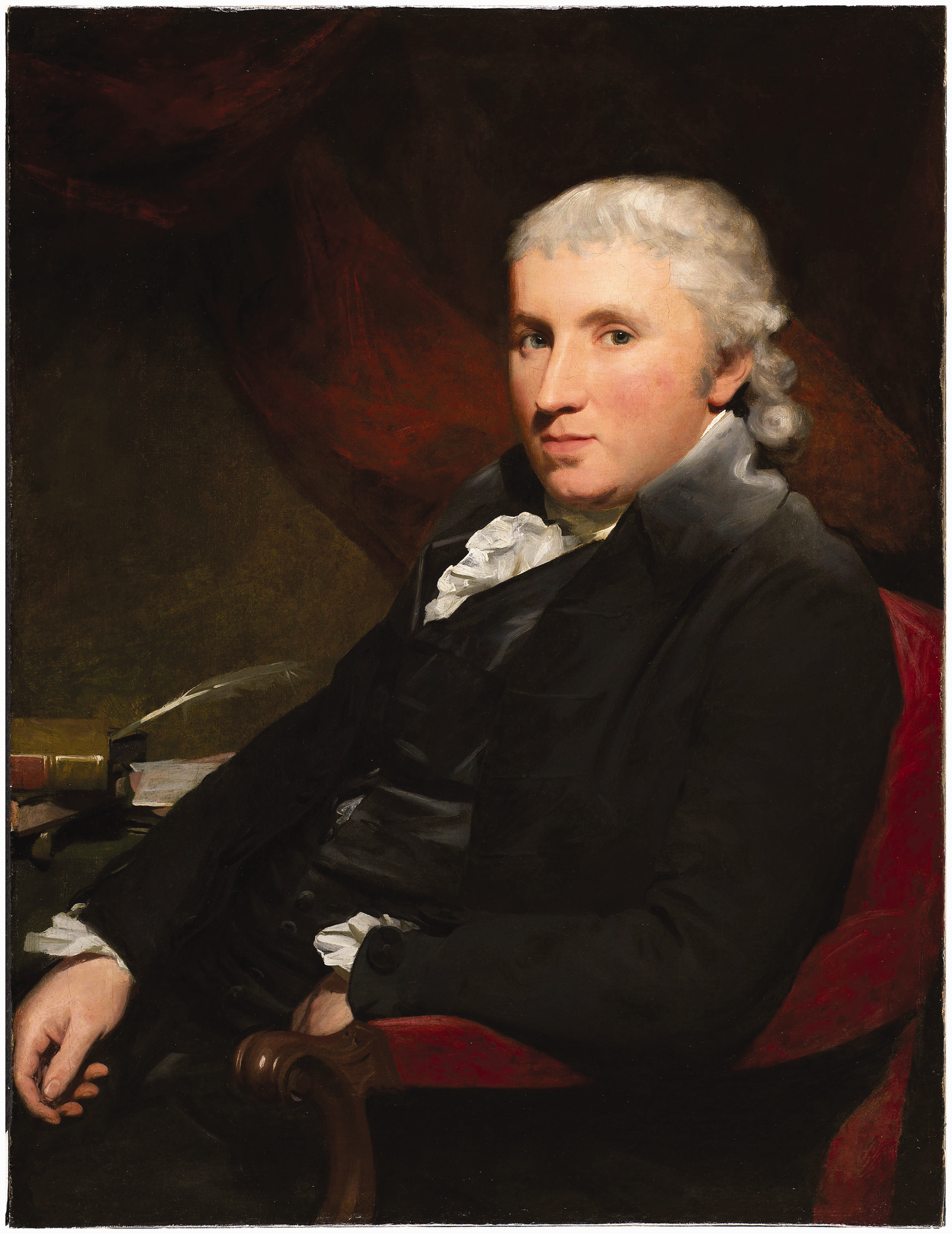
Hill’s papers
Hill was fortunate that shortly after he set up in practice in Dumfries the first regular medical journal was established in Edinburgh where he had served his apprenticeship. Medical Essays and Observations was launched in 1733 by ‘a society in Edinburgh,’ in reality the Society for the Improvement of Medical Knowledge. 26 Alexander Monro primus was the secretary of the society, the driving force behind the journal and its most frequent contributor. It provided a vehicle for case reports, for medical essays, for accounts of epidemics and reviews of recently published books. This was published in five volumes between 1733 and 1744 and in three later editions in 1747, 1752 and 1771. 27 During his years of practice Hill contributed several papers on a range of topics to the new medical journal and to its successor, Medical and Philosophical Commentaries, started by the Edinburgh physician Andrew Duncan (1744–1828) in 1773.
Hill’s willingness to try innovative remedies is demonstrated by the case report, which he contributed in 1747 about a patient who was temporarily ‘cured’ of syphilis by a ‘mercurial suffumigation.’ 28 This involved burning synthetic cinnabar (mercuric sulphide) to give off mercury vapour which the patient inhaled, a treatment since shown to be highly toxic and, on occasion, lethal. In the case which Hill reported, the female patient presented with features of an acute exacerbation of syphilis including headache, sore throat, weight loss, skin crusting and ‘fluttering’ of the pulse. After various therapies including laudanum, tonics, claret and Dr Plummer’s pills all proved unsuccessful, Hill resorted to a more extreme treatment. Mercury was a recognised therapy for syphilis and, although hazardous, the fumes represented the fastest mode of delivery and so the inhalation was tried as a last resort. Although the patient came close to death, her acute symptoms eventually resolved and she survived for more than a year. This case demonstrates that, although he frequently saw cases with his physician colleague Dr Ebenezer Gilchrist (bap 1708–74), 29 Hill, like most Scottish surgeons of the period, practised as a surgeon-apothecary.
Hill made a useful contribution to our understanding of the natural history of hydatid disease, showing in a paper published in 1774 that spontaneous recovery was possible.
30
Recognised since the time of Hippocrates, hydatid disease is caused by ingesting the eggs of the tapeworm Echinococcus and characteristically results in cysts, commonly in liver and lung, which contain scolices (the worm precursor) and daughter cysts. It was recognised that rupture of such cysts into the peritoneal cavity could be fatal. Hill described two cases of hydatid disease who survived. In one, a 10-year-old girl fell from a horse and developed a swelling in the upper abdomen which ruptured onto the skin discharging hydatid cysts, some ‘as large as a goose egg.’ The discharge stopped after nine months and she remained well for 14 years when further discharges containing hydatid cysts recurred then resolved spontaneously leaving her in good health. The second patient developed a cough and expectorated ‘bags resembling the skins of gooseberries’ for some months after which he was restored to ‘perfect health’ (Figure 2).
Hydatic cysts. This image conforms to Hill's description of ‘bags resembling the skins of gooseberries’.
Hill published case reports of vesico-colic fistula in 1774, clearly describing faecaluria and pneumaturia 31 and a case of complete prolapse of the uterus in 1776. 32 His most important literary contribution, however, was his book Cases in Surgery, which made significant contributions to three areas of eighteenth century surgery.
Cases in surgery
Published in 1772 and running to 263 pages, Cases in Surgery is in effect a summary of what he regarded the most significant aspects of his life’s work as a surgeon in a Scottish market town. 14 Cases is divided into three sections, the first concerned with cancers, the second with ‘disorders of the head from external violence’ and the third with the infectious disease sibbens that seems to have been particularly common in his part of southern Scotland.
Sibbens
From eighteenth century descriptions of the clinical features it has been established that sibbens (or sivvens) was a manifestation of what is now termed endemic syphilis, an infectious disease spread by non-venereal social contact. It is caused by the spirochete Treponema pallidum which also causes venereal syphilis. Other organisms in the genus Treponema cause the related and similar conditions yaws (framboesia), seen in tropical regions, and pinta. Endemic syphilis (bejel) was once prevalent throughout Europe, called button scurvy in Ireland and radesyken (“the wicked disease”) 33 in Norway. It was (and is) seen most commonly in deprived communities associated with conditions of overcrowding and poor hygiene. 34 So similar are these treponemal diseases that a major review in 1991 concluded that ‘The disease [yaws] cannot always be differentiated from venereal syphilis, pinta and endemic syphilis’ and that even with modern techniques ‘it is not possible to distinguish between the causative agents of different treponemal diseases on serological, morphological or biochemical grounds.’35,36
It is now established that despite these similarities venereal and endemic syphilis have different natural histories - endemic syphilis is not transmitted to the foetus in-utero and does not affect the central nervous system - and they are caused by different substrains of T pallidum. 37
The similarity between the characteristic skin eruptions of these diseases is confirmed by the names by which they were described in Scotland. ‘Suibhean’ in Scots Gaelic means raspberry, the aspirated ‘b’ pronounced as ‘v’, and ‘sivven’ came into Scots as a word for raspberry.
38
It is likely that sibbens came as a mispronunciation of this word. The alternative name for yaws is framboesia (frambesia), a term whose derivatives mean raspberry in several European languages (Figure 3).
Typical facial lesion of endemic syphilis.
Hill’s chapter on sibbens was in response to what he called ‘a very good thesis’ on syphilis venerea submitted to Edinburgh University in 1767 by Adam Freer (d 1811) for his MD degree. 39 In the belief that Freer had never seen a case of sibbens, Hill set out to ‘rectify his mistakes.’
As it transpired Freer’s analysis was in many respects remarkably accurate and ahead of its time. He believed that sibbens was ‘a species’ of the venereal form of the disease that could be transmitted by close social contact such as ‘smoking the same pipe or drinking from the same vessel.’ Freer concluded that the condition was caused by ‘animalcula’ and could be cured by killing these with mercury. Hill disagreed with Freer’s theory about the cause but subsequent discoveries were to prove Freer was closer to the truth. Freer’s belief that it was a new disease and not seen in England was corrected by Hill who quoted descriptions by European writers including William Harvey (1578–1657), Richard Wiseman (c1620–76), Gerard van Swieten (1700–1772, Herman Boerhaave (1668–1738) and Joseph Plenck (1735–1807) to show that sibbens was widespread throughout Europe. He was also able to disprove Freer’s assertion that sibbens only occurred in the presence of ‘the itch’ (scabies) although both were often seen together in deprived communities. Hill believed that sibbens was more easily cured in country dwellers because, unlike townspeople, they enjoyed ‘temperance, milk and vegetable diet and healthy constitution.’
Hill concluded that syphilis and sibbens were the same disease and that sibbens, having been introduced into a family by sexual means, could then be transmitted around the family by close non-sexual contacts, giving his own family as an example of this mode of transmission. His apprentice Benjamin Bell, who was the first to show that syphilis and gonorrhoea were different diseases, also subscribed to this mode of transmission. 40 Hill, like Freer before him and Bell after him, believed that the most successful treatment was mercury, supplemented on occasion by Peruvian bark. Hill was clear that sibbens and what he termed West Indian yaws were distinct diseases.
Subsequent writers credited Hill and his physician colleague and friend Dr Gilchrist with providing the most precise description of the clinical features and natural history of the disease in Scotland.34,41,42 Hill and Gilchrist also appreciated that the condition could be prevented by improving personal hygiene and avoiding contact with sufferers, and both men advocated these and similar preventive measures.43,44
Cancers
The chapter on cancers was written as a response to the recommendations of three respected surgeons that surgeons should not attempt to cure cancers by excision but should merely palliate symptoms. Alexander Monro primus of Edinburgh, Samuel Sharp (c1709–1778) of London 45 and Henri François Le Dran (1685–1770) of Paris 46 were all influential surgeons but had reported poor outcomes from excision of cancers. Monro’s experience seems typical. Of 60 cancers excised, only four patients were free of the disease after 2 years. 14 Hill contrasts this with his own experience over 30 years which, in the manner of the Enlightenment, seems to have been well documented to enable follow-up. Of his 88 patients, 86 recovered from the procedure. When he analysed his first 45 patients, only five had developed local recurrence or metastatic disease, while of the next 33 only six developed recurrence. In 1764 Hill audited the long-term survival of his first 63 patients and found 39 of these were alive and four of them were aged between 80 and 90 years. Of the remaining 25 patients who had been operated within 2 years of the date of his audit, 22 were alive and disease-free. He concluded that 77 of his 88 patients enjoyed a normal expectation of life ‘according to the bills of mortality.’
Hill does not analyse the nature of the cancers but from his descriptions of illustrative cases these appear to be mainly skin cancers and a few breast cancers. He acknowledges the difficulty in differentiating some cancers from florid granulations or an inflammatory phlegmon, but in the absence of histological examination his account relies solely on clinical diagnosis. He concludes that his results justify his recommendation that tumours, including ‘the most trifling,’ should be ‘cut entirely out.’
His second recommendation is equally clear. Hemlock was widely used to treat cancers at that time. ‘I never observed the smallest benefit from hemlock in the cure of cancers’ he writes ‘but on the contrary… have seen much mischief done by it’. That ‘mischief’ included loss of appetite, nausea, vomiting and delay in seeking surgical treatment.
Head injuries
It is Hill’s chapter entitled ‘Disorders of the head from external violence’ that marks him out as a careful clinician and an innovative surgeon able to achieve remarkable outcomes by the standards of the day.
Hill recorded 18 cases of head injury (including one major scalp laceration) which he had treated over his 40 years in Dumfries. He described in detail the cause of the injury, the clinical features, his treatment and the outcome in each case. Head injuries, he asserts, have been treated in ‘a much more rational manner’ in the previous 15 years as a result of discoveries and ‘valuable publications’ over that period. More important, he described the rationale for his treatment and how this changed over time as his knowledge and understanding of the problems progressively increased. Thus he sets out to give ‘a historical view of the gradual progress of the improvements made by others as well as by myself.’
His first patient, a five-year-old boy, sustained a depressed frontal fracture associated with an epidural haematoma (EDH). When the fracture was elevated and the haematoma drained after trepanning the skull, he ‘immediately recovered his senses’ but after some days ‘the ‘stupor’ returned, indicating that some matter was’ lodged under the meninges’. Hill made a cruciate incision in the meninges to drain the haematoma with beneficial effect. Case 4 was that of a young woman who fell from her horse, walked home, felt well but then ‘forgot everything she had done that day’. Symptoms including headache and vomiting developed, but her parents refused to agree to trepanation until 5 weeks after the accident. When Hill incised the dura some 8-9 oz.(240-270 ml) of dark blood was drained to good effect. Ganz 47 regards this the first ever description of a lucid interval associated with a subdural haematoma.
These cases also demonstrates Hill’s understanding of the clinical features of cerebral compression: ‘The smallest compression brought on a stupor, a low intermittent pulse, nausea, vomiting and sometimes convulsive twitches.’ From case 3 onwards he avoided dressings which compressed the trepanned area.
In case 3 he again relieved the features of cerebral compression by a trepan with drainage of an EDH. In case 5 drainage of a large EDH resulted in restoration of consciousness and resolution of a right hemiparesis. His account of this case also shows that he appreciated the concept of lateralising neurological deficits. Because of the right hemiparesis he planned to trepan on the left side but was persuaded to trepan and drain an EDH on the right side because of greater local trauma there. In the end he drained bilateral EDHs to good effect. This patient, who crucially did not have a fracture, demonstrates Hill’s appreciation that it was injury to the brain that caused symptoms rather than the fracture itself. Percival Pott (1714–1788) by contrast would only operate if a fracture were present (Figure 4).
Operation of trepan. From Great Operations in Surgery by Charles Bell.
Hill’s understanding of concepts of cerebral compression is demonstrated further by his use of the word ‘compression’ and by his recording of cerebral pulsation or tension in all but one of the operations described. Both of his patients who exhibited poor or absent cerebral pulsation had sustained primary cerebral damage and both died. Hill more than any other eighteenth century writer apart from Abernethy appreciated the importance of cerebral pulsation as an indicator of cerebral health. 48
Further evidence of his understanding of the need to decompress where possible is shown by his use of the technique of relieving pressure by shaving off cerebral hernias caused by raised intracranial pressure, a technique he learned from the writing of Henri François Le Dran (1685–1770). Like Le Dran he incorrectly believed that brain regenerated.
Hill’s outcomes in treating patients with head injury compares favourably with those of his contemporaries. Ganz has analysed six series on head injury published in the eighteenth century and concluded that the overall mortality in Hill’s series of head injuries was 25% (2 of his 8 trepanned cases died) a much lower mortality than that of le Dran (57%) or Percival Pott (51%). Ganz 48 argues that this was the result of Hill’s appreciation of the concept of cerebral compression and his better understanding of the indication for and location of the trephine.
Hill clearly was familiar with recent literature on the topic, citing the works of Richard Wiseman (c1620–1676), Daniel Turner (1667–1740), Le Dran and Percival Pott.
The importance of Hill’s work was recognised in the years after his death and was cited by influential authors at the start of the nineteenth century. These included John Abercrombie (1780–1844), the Edinburgh physician who wrote what was effectively the first textbook of neuropathology in English, 49 the Edinburgh surgeon John Bell (1763–1820) 50 and John Abernethy (1764–1831) 51 of London, and he was still being quoted a century after his death by Jacobsen in the first monograph devoted to epidural bleeding. 52 Yet, perhaps surprisingly, his most famous apprentice Benjamin Bell did not cite his former master at all in his popular book A System of Surgery. 24 This may have been because relations between eighteen century masters and apprentices were not always the most cordial.
Hill’s legacy
James Hill died on 18 October 1776
53
and is buried in St Michael’s churchyard in Dumfries (Figure 5). He made significant contributions in the three areas covered in Cases. One contemporary and highly favourable review published posthumously was written by Tobias Smollett (1721–71), a Scottish surgeon who found fame as a novelist. Smollett, who had served in the Royal Navy some 10 years after Hill and would thus have felt some empathy, quoted extensively from Cases and recommended it as ‘worthy of attention.’
54
Detail from Hill's tombstone in St Michael’s churchyard, Dumfries attests to his surgical skill, his knowledge of science and his benevolence toward the poor.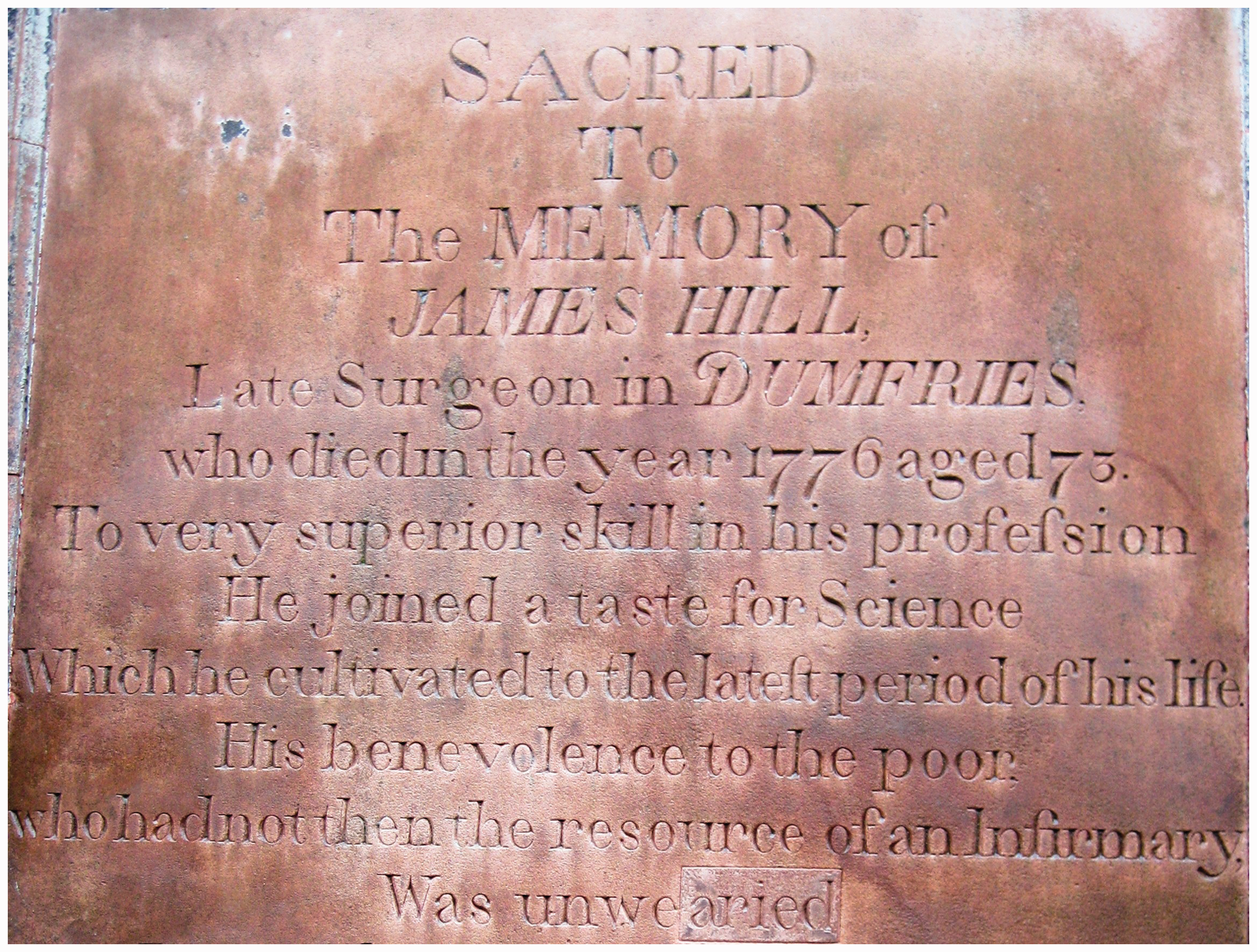
Hill’s description of the features of sibbens remains, along with that of his close colleague Gilchrist, the clearest and most detailed of its era. His ideas on modes of transmission were ahead of their time. His view that sibbens and syphilis were the same disease was reasonable given that even in the 21st century they can be impossible to distinguish clinically. 37
Hill’s advice that surgeons should where possible aim to treat cancers by curative excision ran counter to mainstream opinion. Here again his surgical philosophy was eventually to become accepted. It was a principle advocated by his apprentice Benjamin Bell who recommended in his influential System of Surgery that for even the smallest breast tumour the entire breast should be excised. 24
But it was in the management of head injuries that Hill demonstrated that his understanding of the concepts involved was greater than that of his contemporaries. While Le Dran clearly appreciated that extravasation of blood around the brain could produce neurological symptoms, Hill took that understanding a stage further. He showed that epidural and subdural haematoma could be recognized from clinical features and successfully treated by trepan and surgical drainage to relieve compression. Indeed his results were the best published in the eighteenth century and advanced the increasing understanding of these concepts. Ganz, 48 an authority on the history of epidural bleeding, concluded that Hill achieved the best results published in the eighteenth century because he had the clearest understanding of the underlying principles of treatment.
Why then did his name and his contributions remain relatively obscure? It is likely that, despite his writing, prolific for a provincial surgeon by the standards of the day, Hill's work was less widely publicised because he was based in a small market town rather than a major teaching centre. Moreover, as knowledge advanced his contribution was progressively superseded. His description of sibbens remains a classical one yet became less relevant as the disease disappeared from Britain, the last case being recorded in Banff in 1851. 34
His writing on cancer was similarly overshadowed by views of more famous names including John Hunter and Benjamin Bell who both stressed that the ‘whole disease’ should be excised. Hill’s view that cancers should be treated by early and radical excision was to become accepted practice and his understanding of the mechanisms and treatment of post-traumatic cerebral compression and its treatment was to become a milestone in the surgical treatment of head injury.
Footnotes
Acknowledgements
I am grateful to Jeremy Ganz for initially suggesting the article, for many helpful suggestions and for invaluable guidance on neurosurgical aspects. My thanks also to Iain Milne and Estela Dukan at the RCPE Library and Marianne Smith and Steve Kerr at the RCSEd Library. David Hamilton kindly read the manuscript and made several helpful comments.