



Abstract
Two famous medical scientists are described whose major advances were made largely from laboratory-based research. Karl Landsteiner, who received the Nobel Prize in 1930, was the discoverer or co-discoverer of the blood groups and the Rhesus factor. He contributed to the understanding of poliomyelitis, syphilis and typhus. He made major contributions to immunology, inter alia by isolating haptens. After World War I, he left Austria and continued his work initially in the Netherlands and then at the Rockefeller Institute in the USA. Otto Loewi, a pharmacologist, received his Nobel Prize (jointly with his life-long friend, Sir Henry Dale) in 1936 for his discovery that acetylcholine was the chemical agent for the stimulation of autonomic nerves to transmit to the organs they govern. He also made numerous other contributions including the demonstration that amino acids could be converted by animals to proteins. He left Austria after the Anschluss and settled in the USA.
Introduction
In a previous paper, three surgeons in Vienna 1 were discussed, including Robert Bárány, the first Austro-Hungarian to be awarded in 1914 the Nobel Prize for Physiology or Medicine, indeed only the second overall Nobel Laureate from this country, having been preceded only by Bertha von Suttner (1843–1914), the first woman to receive the Prize for Peace in 1905. 2 Three physicians 3 were considered in another paper. Here, the lives and work of Karl Landsteiner and Otto Loewi, medical scientists, whose contributions to medicine are largely due to laboratory-based research, are considered and compared to the surgeons and physicians portrayed in the earlier papers.
Karl Landsteiner
Landsteiner was born on 14 June 1868 in Baden bei Wien and died on 26 June 1943 in New York
4
(Figure 1). He was the son of Leopold Landsteiner (1818–1875), a well-known newspaper editor and journalist, who had a Doctor of Laws degree; he had been a correspondent in Paris for several newspapers, had founded his own newspaper, Presse, died of a massive heart attack when Karl was aged 6 (his guardian became a family friend, Josef Hesky, a paper industrialist) and was brought up by his mother Fanny (née Hess) to whom he remained greatly devoted – he displayed her death mask in his bedroom throughout his life. On 4 December 1890 Karl, aged 22 years and a medical student, and his mother converted from Judaism to Roman Catholicism in the Schottenkirche.
5
Karl Landsteiner in University of Vienna Arcade
His secondary education took place in several different grammar schools (Gymnasia) in Vienna and in Linz. In 1885 he started his study of medicine at the University of Vienna, taught among others by Billroth (1829–1894), and he graduated in 1891. He did his military service as an Einjährig-Freiwilliger (a shortened service for the more educated recruits) in the medical corps.
He had started already research as a student and published a paper on the composition of blood ash. His interest in chemistry was first sparked by his inspiring teacher Ernst Ludwig (1842–1915) in Vienna. To improve his knowledge of chemistry further, he spent several more years working with eminent chemists: Arthur Rudolf Hantzsch (1857–1935) in Zürich, Hermann Emil Fischer (1852–1919), Nobel Laureate 1902, in Würzburg and Eugen von Bamberger (1858–1921) in Munich. Armed with a great deal of chemical knowledge and numerous publications, some jointly with his distinguished mentors,6,7 Landsteiner returned to Vienna, initially to the Hygiene Institute of Vienna University (1896–1897) where he was an assistant under Max von Gruber (1853–1927), a bacteriologist, and then to the Institute of Anatomical Pathology (1897–1908) under the pathologist and bacteriologist Anton Weichselbaum (1845–1920), best remembered for his work on the isolation of the causative agent of cerebrospinal meningitis8,9 and on tuberculosis. 9 In this institute Landsteiner carried out some 3500 autopsies and published some 75 papers. He continued his investigations into blood and immunology.
In 1900 in a footnote to a paper 10 he mentioned the agglutination that occurred between blood serum and blood cells from different humans. The next year he followed this up with a full paper Über Agglutinationsercheinungen normalen menschlichen Blutes (On the agglutination of normal human blood) where he divided human blood into three groups: A, B and O. 11 His clinical co-workers, Alfred von Decastello-Rechtwehr (1872–1960) and Adriano Sturli (1873–1964), added a fourth, AB. 12
Before this work, attempts at blood transfusion from animals and other humans had often led to shock and sometimes death due to coagulation of the blood. Landsteiner demonstrated inter alia that blood transfusions between persons both containing blood group A were safe, as were those between carriers of blood group B, while both groups A and B could tolerate blood from group O. Other combinations led to agglutinations and disaster. The grouping of blood types was achieved by mixing anti-A and anti-B test sera with suspensions of red blood cells and observing in which cases agglutination occurred. We now know that these agglutinations are due to complex polysaccharides on the surface of the blood cells. 13
Landsteiner had thought that blood groups could produce serological fingerprints and this was later confirmed. However, at that time Mendel’s (1822–1884) work on heredity 14 was only just beginning to be rediscovered by the geneticists Carl Erich Correns (1863–1933), 15 Hugo de Vries (1848–1935) and the botanist Erich Tschermak von Seysenegg (1871–1962).
Guided by Landsteiner’s findings, the first successful blood transfusions were carried out by Reuben Ottenberg (1882–1959) 16 at the Mount Sinai Hospital in New York in 1907. This breakthrough proved a boon during the bloody slaughter of World War I, just as later penicillin was to be in World War II. In 1902, with Max Richter (1867–1932) Landsteiner introduced the use of dried blood stains into forensic medicine. 17
In 1903 he qualified as a Privatdozent. In 1911 he was promoted to a.o. Professor of Pathological Anatomy though without the salary. From 1908 until 1920 he was in charge of Pathology in the Wilhelmina Hospital in Vienna where he was the prosector. There he produced an astonishing number of papers, 52 on Serological Immunity, 33 on Bacteriology and six on Pathological Anatomy. He was able to separate antigens from antibodies and to purify antibodies. In 1917 he received the title of Regierungsrat, an honorific title somewhat below Hofrat, since he was not a full Professor!
In another collaboration, in 1905 with Ernest Finger (1856–1939) 18 he managed to transfer syphilis to apes, thus producing an animal model for work on this scourge. In 1906, this time with Viktor Mucha (1845–1919) [Muchagasse (Neustift am Walde) was named in 1978 after him], a scientist at Finger’s clinic, Landsteiner developed dark-field microscopy 19 to identify and study the microorganisms that cause syphilis. Experimentation with Spirochaeta Pallida, the agent of infection, thus became feasible. Additionally, with yet other colleagues, Rudolf Müller (1877–1934) and Otto Pötzl (1877–1962), he was able to elucidate the mechanism of the Wassermann (1866–1925) Reaction. 20
Another of Landsteiner’s collaborations, this time with Wolfgang Joseph Pauli (formerly Wolf Pascheles) (1869–1955), a medically qualified scientist practising chemistry, led to Elektrische Wanderung der Immunstoffe (Electric migration of Immune substances). 21 This Pauli was the father of the better known Wolfgang Ernst Friedrich Pauli (1900–1958) (Nobel Laureate Physics 1945), unforgettable to students of Physics and Chemistry from the Pauli Exclusion Principle. 22 Pauli’s second forename, Ernst, is a tribute to his godfather, Ernst Mach (1838–1916), the well-known physicist who had also contributed to the understanding of the balancing function of the inner ear. 1
Landsteiner discovered also in 1908, this time in co-operation with Erwin Popper (1879–1955), 23 the infectious character of poliomyelitis and he isolated the polio virus. In recognition of this groundbreaking discovery, which proved to be the basis for the fight against polio, in 1958 he was inducted posthumously into the Polio Hall of Fame at Warm Springs, Georgia, USA. 24 As conditions for further poliomyelitis research were more favourable in Paris, during 1909–1912 Landsteiner collaborated with the Romanian bacteriologist Constantin Levaditi (1874–1953) at the Pasteur Institute. 25 Landsteiner also collaborated with Wagner-Jauregg (1857–1940) and Schlagenhaufer (1866–1930) in a study on goitre in 1914 26 as well as with the former on struma, a rare ovarian cancer.
While serving in a war hospital in 1916, at the age of 48 Landsteiner married Leopoldine Helene Wlasto (1880–1943) on 4 November 1916 in the Schottenkirche in Vienna. She belonged to the Greek-Oriental church and converted in 1918 to Roman Catholicism to please her husband, a Roman Catholic convert. Their only child, a son, Ernst Karl (1917–2007) was born on 8 April 1917 and later become a urologist in Providence, Rhode Island. Landsteiner took his fatherhood seriously and, because of the food shortages experienced during the war, bought a goat to give good milk to his son and collected herbs to supplement their vegetables.
In post-World War I Vienna, under the terrible economic conditions prevailing, Landsteiner could not see any possibility of carrying on with his research work and so in 1919 he left for a small Roman Catholic hospital, RK Ziekenhuis at The Hague. There he developed the concept of haptens, small molecules that determined the specificity of antigen–antibody reactions and in 1921 he demonstrated the specificity of antigens. 27
In 1923 he accepted an invitation from Dr Simon Flexner (1863–1946), the distinguished physician and the first Director of the Rockefeller Institute for Medical Research in New York, to join him at the Institute where he remained until his retirement in 1939. With his colleague Philip A Levine (1900–1987), in 1927 Lansteiner blood groups M, N and P; 28 these types soon began to be used in paternity suits. In 1929 he became an American citizen. In the period 1930–1932, in conjunction with Clara Nigg (1897–1986), he succeeded in culturing Rickettsia prowazekii, the causative agent of typhus, on living media. 29 He continued working on immunology in his retirement. He had listened to lectures on protein structures at Cornell University by Linus Pauling (1901–1994), the Nobel Laureate chemist, had intensive discussions about this theme with him and formed a warm friendship. Pauling even contributed a chapter to the revised edition of Landsteiner’s book The Specificity of Serological Reactions. 30
In 1934, this time with colleagues WR Strutton and Merril W Chase (1905–2004), he described a blood factor peculiar to Afro-Americans which is now called the Hunter-Henshaw system. 31
In 1940 with Alexander Salomon Wiener (1907–1976) and Philip A Levine he discovered the Rhesus-factor (Rh). 32 This helped save the lives of those second and subsequent babies who did not share the same Rh-factor as their mothers. Levine had realised the connection between the Rhesus factor and jaundice in the newborn. The Rh-factor is also important in blood transfusion in sickle cell anaemia, thalassaemia and haemophilia.
Landsteiner continued working in his retirement, publishing 28 papers. He died in 1943 of a heart attack at the age of 75 while still working at his laboratory bench – an enviable parting for a life dedicated to science. He had worried greatly about his wife’s malignant thyroid; she died about six months after him. He is buried, together with his wife, in Nantucket, Massachusetts. He was considered a modest, widely read, rather timid man who was also an excellent musician, in his case a pianist. Apart from this, he was dedicated to scientific research and lacked the distraction of radio, telephone and car.
He was awarded the Nobel Prize for Medicine in 1930, having received 18 nominations including one in 1929 by Wagner-Jauregg. He was awarded posthumously a Lasker Award (popularly known as America’s Nobels) in 1946. Landsteiner’s honours also include Dr h.c.s from the Universities of Chicago (1927), Cambridge (1934) and Harvard (1936), as well as from the Free University of Brussels (1934). He received the Cameron Prize from the University of Edinburgh in 1936. He was elected FRS in 1941. 33 He is commemorated on the reverse of the Austrian 1000-schilling note in 1997, which shows Landsteiner working in his laboratory. He shared this distinction with Erwin Schrödinger (1887–1961), Nobel Laureate for Physics 1933. 34 This remarkable man’s scientific career spans half a century and showed marked versatility.
Otto Loewi
Otto Loewi was born on 3 June 1873 in Frankfurt am Main and died on 25 December 1961 in New York35,36 (Figure 2). Otto was the first child and only son of Jacob, a wealthy wine merchant, and his second wife Anna [née Willstaetter, possibly a distant relation of the chemistry Nobel Laureate 1915 Richard Willstaetter
37
(1872–1942)]. Otto attended the Humanistic Gymnasium (grammar school) 1882–1890 in his home town of Frankfurt. Although his initial interests lay more on the humanities side, Loewi was persuaded to study medicine by family and friends and started at the University of Strasbourg in 1891 which, since the Franco-Prussian war in 1870, had become part of Germany. Due to this new German status, the university had received privileges that enabled it to attract many famous men of medicine. Thus Loewi met, inter alia, the Scottish pharmacologist Arthur Robertson Cushny (1866–1926). Loewi graduated in 1896. He continued his studies in chemistry, biochemistry and medicine at the Universities of Frankfurt and Strasbourg. There he came under the influence of Oswald Schmiedeberg (1838–1921), the renowned pharmacologist, and wrote his dissertation on the effects of drugs on the isolated heart of frogs. Loewi wrote that in retrospect his interest in basic science was aroused by reading WH Gaskell’s (1847–1914) Croonian Lecture of 1882.
38
Otto Loewi’s photograph inscribed to his son Guido.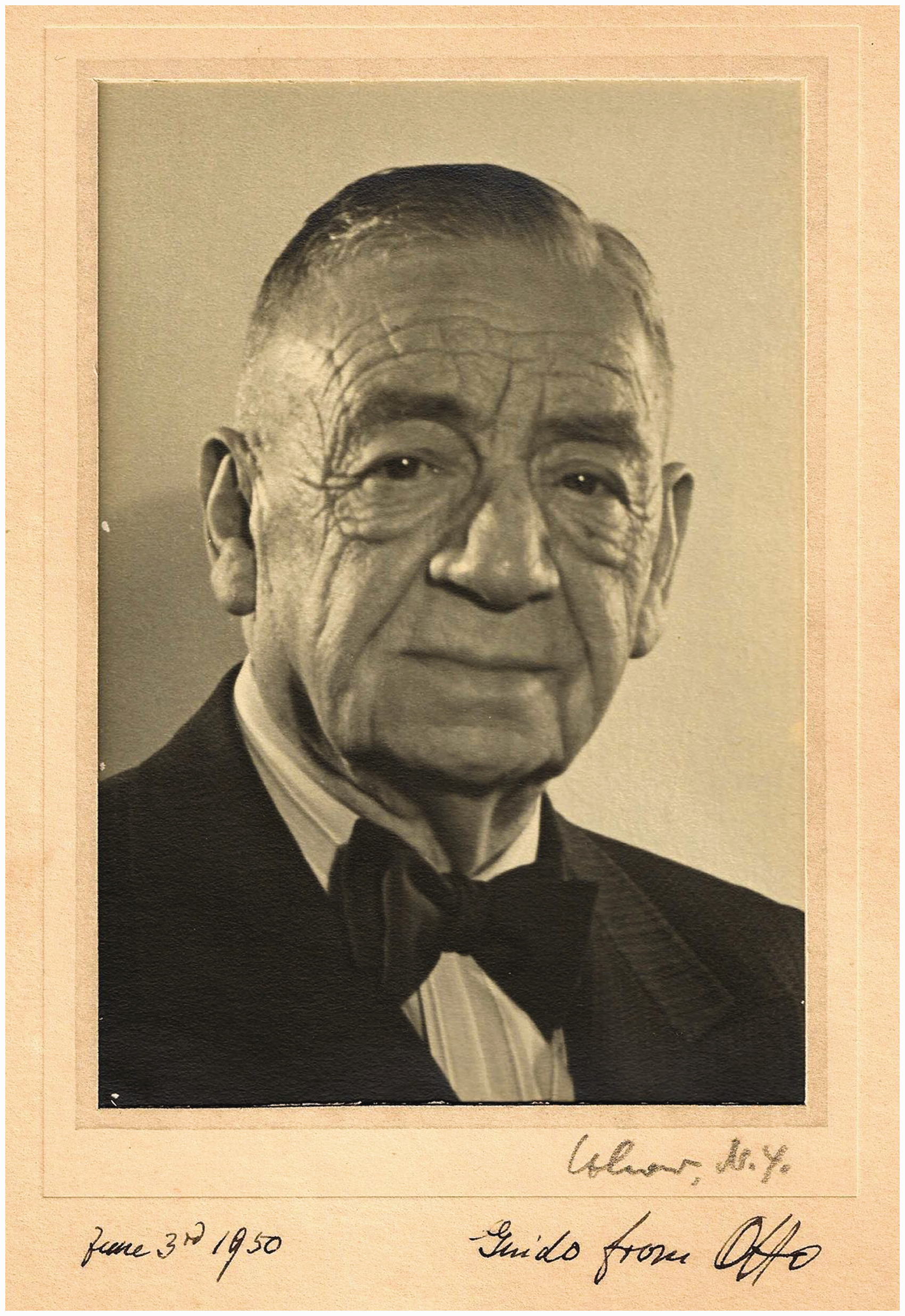
In 1897 and 1898 he spent time as an assistant in internal medicine in the wards of a Frankfurt hospital, devoted mainly to patients with pneumonia and tuberculosis. His later decision to devote himself to research in pharmacology rather than to clinical practice was precipitated by his observations on the absence of viable therapies and the resultant high mortality for these illnesses.
In 1898 he became an assistant to Professor Hans Horst Meyer (1853–1939) in Pharmacology at the University of Marburg. This was a most fortunate move since Meyer became his mentor and supporter over the next 11 years of his career. Loewi became a Privatdozent in 1900. In 1904 he was promoted to Extraordinarius Professor.
He had a brief interlude in 1902 studying in EH Starling’s (1866–1927) laboratory at University College London where he also met Henry Dale (1875–1968) who became his life-long friend. Loewi also briefly visited Cambridge where he met Gaskell. Loewi believed England had overtaken Germany as the leading centre for physiology. He also met the later Nobel Laureate (1929), Frederick Gowland Hopkins (1861–1947), who had received his early scientific training at Birkbeck College. 39 Loewi became sufficiently impressed by Starling to nominate him, unsuccessfully, for the Nobel Prize in 1913. 40
Meyer liked and valued Loewi and in 1905 took him to the University of Vienna where Loewi stayed until 1909. Loewi taught Pharmacology, becoming an Extraordinarius Professor in Vienna as well in 1905 and in the same year he became an Austrian citizen. His mentor, Meyer, sponsored him for the Chair in Graz and in 1909 he was appointed Professor of Pharmacology at the University of Graz (he was the last Jewish academic to be appointed by the University of Graz between 1909 and the end of World War II) where he stayed until 1938. Graz University had a flowering in this period; several distinguished scientists mentioned in this essay worked and taught there. In addition to Loewi, there were Wagner-Jauregg, 41 Schrödinger, 34 Hess 42 (1883–1964) and Fritz Pregl (1869–1930), a medically qualified doctor well-known for his contributions to micro-analysis in chemistry (Nobel Prize for Chemistry 1923). 43 This scientific prestige attracted research workers from abroad, one of whom was a young English woman biochemist, Janet Warden Brown (1901–1983). She was a graduate of Bedford College for Ladies. Following a PhD in 1928 at the Royal College of Science, now Imperial College, London, Dr Brown became interested in the then new techniques of micro-analysis and moved to Austria to work with Professor Fritz Pregl at the University of Graz. 44 She also met Professor Fritz Feigl (1891–1971), another distinguished chemical analyst, in Vienna and later translated several volumes of his writings under her married name of Janet W Matthews. 45 During weekend trips to Vienna and on climbing excursions to the Alps, she made many friends among whom was Otto Loewi. 44 Feigl, who was Jewish, also had to flee Austria and eventually found refuge in Brazil where he became a Professor of Chemistry at the University of Brazil. 46
In 1908 Loewi married Guida (née Goldschmiedt) (1888–1958), the daughter of Guido Goldschmiedt (1850–1915) who had been a Professor of Chemistry in Prague and later in Vienna. He had met her with her parents, during the previous year in Pontresina, Switzerland. 35 They had four children: three sons, Hans, Victor and Guido, and a daughter, Anna.
In 1923 Loewi received the title of Hofrat which at this period was given only to full professors of exceptional merit. In 1936 he was awarded the Nobel Prize for Physiology or Medicine together with his long-standing friend Sir Henry Dale.35,36 In 1937 and 1938 he nominated Freud (1856–1939) for the Nobel Prize. 40 After the Anschluss, Loewi’s life became impossible in Austria. He was arrested at pistol-point on the night of the German invasion of Austria on 12 March 1938 and taken into ‘Protective Custody’ along with two of his younger sons (his daughter and his eldest son fortunately were abroad). Loewi was released some months later on condition that he ‘voluntarily’ relinquish all his possessions to the Nazis. This included the transfer of his Nobel Prize money from a bank in Stockholm to a bank account under Nazi control. In addition his wife, Guida, was also detained so that her possessions in Italy could be similarly ‘legally’ dispossessed. The Nazis were sticklers for such ‘legalities’. It took more than a year before Guida was allowed to join her husband abroad. Families persecuted by the Nazis desperately tried to get visas to leave the country. Otto Loewi appealed to Janet Warden Matthews (née Brown) to accept his youngest son Guido. He duly arrived in England and stayed with the Matthews family. They remained friends for life and were still in contact with him until his death aged 97 in his retirement in Thailand. 35
Otto Loewi had brief spells as a visiting Professor at the Université Libre, Brussels, and at the Nuffield Institute in Oxford, which had followed. In 1940 he became Research Professor of Pharmacology at the College of Medicine at New York University until his retirement in 1955. He became a US citizen in 1946. He enjoyed greatly the summer months he spent at the Marine Biological Station at Woods Hole where he felt much at home and encouraged younger scientists.
Otto Loewi suffered from severe asthma and died in 1961 after several heart attacks. He is buried with his wife, who had predeceased him, at Woods Hole near to Albert von Szent-Györgyi (1893–1986) who received the same Nobel Prize as Loewi the following year in 1937 for his studies on vitamin C. 47
After Loewi’s death, his youngest son gifted the gold Nobel medal and the Nobel diploma to the Royal Society in London. John Gee, brother of one of the earliest PhD students, Wilfred Gee (1938–1998), of one of us, told us an interesting anecdote prior to this event, conveyed to him by Geoffrey Low (AKA Guido Loewi). Guido was travelling by train to London to present his father’s Nobel medal and diploma to the Royal Society when he noticed that a lady sitting opposite to him was reading a book about Nobel Laureates. He thought that perhaps that she too was going to the handing over ceremony at the Royal Society and enquired as to her interest in the book. It turned that it was quite general and unconnected with the ceremony. He then proceeded to show her to her great and delighted surprise his father’s Nobel memorabilia.
Throughout his life, Loewi showed a keen appreciation of the humanities and, like many other scholars described in this article, was also very fond of music. He also had a sense of humour. One of his quotations will appeal to many research workers – ‘A drug is a substance, which, if injected into a rabbit, produces a paper’. 48
During his early work in Marburg between 1902 and 1905, in collaboration with a group of visiting British scientists WM Fletcher, 49 (1873–1933), VE Henderson49,50 (1877–1945) and NH Alcock 51 (1871–1913), he studied the functions of the kidneys and the effect of diuretics. Eventually his and Arthur Cushny’s views coincided closely. Loewi also investigated the effects of adrenaline and noradrenaline on blood pressure and diabetes.
In Marburg, Loewi had read a recent publication by the biochemist, Professor Friedrich Kutscher (1866–1942), in which the complete degradation of proteins into their constituent amino-acids had been demonstrated. Loewi was so desperately keen to show that animals could utilise these degradation products to form their own proteins that he went past midnight to Kutscher to ask him, whether he intended to carry out this experiment before trying it out himself. He thus acted in the true academic tradition but Kutscher did not appreciate being woken up at this time of the night for this. As Kutscher was not interested in these further experiments, Loewi thus felt free to do these himself and succeeded in coaxing the dogs to eat these rather unappetising meals. The result was a ground-breaking publication on Über die Eiweisssynthese im Thierkörper (Protein Synthesis in the Animal Body) published in 1902. 52
In Vienna Loewi refocused his attentions on the effects of adrenaline and noradrenaline on diabetes and blood pressure. His investigations also included the response of the heart to stimulation of the vagus nerve.
While in Graz, Loewi produced proof that the effects of stimulation of autonomic nerves is chemically transmitted to the organs they govern. This was considered to be his greatest discovery. He demonstrated that the active substance was acetylcholine.
Otto Loewi gave a delightful description of how he had a dream one night on how to solve this problem, woke up and made scribbled notes and went back to sleep again. The next day, he could not read his scribbling. Fortunately, Loewi had the same dream the next night and then got up immediately, went to his laboratory and performed the crucial experiment with the hearts of two frogs.
53
Loewi’s detailed description of this momentous event (Figure 3) is quoted in a biographical study Otto Loewi – Ein Lebensbild in Dokumenten
54
(A life story in documents). Whether this tale is true or apocryphal, a distant relation of Loewi has assured us that it is true,
55
it is an interesting anecdote and one is reminded of others including Kekulé’s (1829–1896) story on his discovery of the cyclic structure of benzene while falling asleep on a London bus and dreaming of a snake biting its own tail,
56
and that about Mendeleyev (1834–1907) falling asleep after playing patience and dreaming that the cards had arranged themselves into the Periodic Table of the Elements.
57
Whatever its exact antecedents, the discovery that neurons transmit information by chemical messengers was a momentous one and worthy of the Nobel Prize. One cannot help wondering how Freud would have interpreted Loewi’s dream.
58
They knew each other, as Loewi had taken Dale to visit Freud in London.
35
A handwritten description by Otto Loewi of his Nobel Prize-winning discovery, received from Otto Loewi’s youngest son, Guido Loewi (now Geoffrey Low), through the good offices of Mr Stephen Matthews.
Loewi received numerous international honours including the Cameron Prize from the University of Edinburgh in 1944. In 1954 he was elected a foreign member of the Royal Society 59 which he highly valued and, in a letter to his son, compared this prestigious honour to that of the Nobel Prize. 36 He was the recipient of numerous honorary degrees, inter alia from the Universities of Yale, New York, Frankfurt and Graz, as well as membership of learned societies including Honorary Membership of the Physiological Society (London) and of the British Pharmacological Society where an obituary 36 expressed great pride in him having been an Honorary Member of the Società Italiana di Biologia Sperimentale and of the Harvey Society (New York). He was a member of the Deutsche Akademie der Naturforscher Leopoldina, in Halle.
In addition to these public honours, there was also a tribute from Albert Einstein (1879–1955) in a handwritten letter in German dated 1953, congratulating Loewi on his birthday and mentioning their interesting discussion about Loewi’s Nobel Prize winning discovery (Figure 4). An English translation of this letter reads:
Letter from Albert Einstein to Otto Loewi 1953.
Princeton 2. VI. 53
Dear Dr Loewi,
The waves, which had spread from your birthday feast had entered also my hermitage. I thus remember the beautiful hour, in which you had told me the story of your wonderful discovery.
Today, I wish that you will spend this day joyously and with peace of mind and the same for your future days. Because one learns over the years to avoid getting upset by the follies of others and to treat the own, proud and with humour.
Cordial greetings
Yours
A Einstein
Summary and conclusions
Several of the eight doctors and scientists about whom we have written lost a parent when young. Many were keen and talented musicians [Pace CP Snow (1905–1980)]. Several were concerned with reducing infections. At least a couple, Billroth and Wagner-Jauregg, tried, unsuccessfully, to set up private medical practices. All of them studied, as was the Continental custom, at several universities, frequently in other countries. Three were foreign by birth: Billroth (German), Wenckebach (1864–1940) (Dutch) and Loewi (German) and became automatically Austrian citizens on their appointments to Chairs in the Habsburg Monarchy.
What features have they in common to make such major advances in their subjects? Hollingsworth 60 made some interesting observations in his essay ‘High Cognitive Complexity and the Making of Major Scientific Discoveries’ in which he analyses 291 major discoveries in the basic biomedical sciences. He uses the term High Cognitive Complexity for what might in more general parlance be called creativity or genius. We quote from his essay: ‘… internalizing multiple cultures and being highly engaged in mentally intense activities outside of science increase the likelihood that individuals will make major discoveries…’. Among examples of multiple cultures, he frequently uses examples of Jewish scientists in gentile environments, but also shows that different ethnicities in the family background can also be effective. He also emphasises intellectual activities outside science as being very important and he stresses music. Many of our chosen eight fit such categorisations. We would like to add another common feature observed in some great scientists: mountaineering – the desire for a challenge (e.g. Sir Robert Robinson (1886–1975) (Nobel Prize Chemistry 1947), 61 Ernst Otto Fischer (1918–2007) Nobel Prize Chemistry 1973), 62 Georg Wittig (Nobel Prize Chemistry 1979). 63
Several of the luminaries had connections with the UK and were honoured by Universities and learned bodies there. Three, Freud, Landsteiner and Loewi, became Foreign Members of the Royal Society. Three, Wagner-Jauregg, Landsteiner and Loewi, received the Cameron Prize from the University of Edinburgh.
During our researches, we had the good fortune to discover very helpful relatives and friends of two of our subjects: Robert Bárány’s grandson, Anders Bárány, an Emeritus Professor of Physics in Sweden and Otto Loewi’s youngest son Guido Loewi (now deceased) in Thailand and Margarete Stern in London, the granddaughter of Bettina Uffenheimer (née Loewi) (1863–1955), Otto’s first cousin. Bettina’s and Otto’s fathers were brothers. 55
This summary of some distinguished members (undoubtedly there are others who have been left out) of a great medical centre demonstrates the enormous damage political extremism, coupled with racial and religious intolerance and persecutions, can cause. Four of the eight left Vienna more or less forcibly. Of the nine Nobel Laureates (four of these were medical practitioners described here) associated with the University of Vienna, six left the country. This ought to serve as a warning that racial, religious and political extremism are the enemies of research and scholarship. 64 The reasons why we have mentioned the religious affiliations of these luminaries are that their religions, as well as religious animosities, created the climate in which they were living and working. Such considerations played a great part in whether they could achieve professional advancement. Being Jewish and, to a lesser extent Protestant, it was a handicap, often a decisive one. The Empress Maria Theresa (1717–1780) called Jews and Protestants enemies of her domains.
Two of our luminaries have been charged with anti-Semitism, Billroth 1 and Wagner-Jauregg. 3 Buklijas and Boyer consider Billroth’s prejudices to be more class-based than anti-Semitic.1 His admired mentor, Traube (1818–1876), was Jewish. We have mentioned and discussed 1 the possible reasons why later on his life he may have mellowed his anti-Semitism.
The evidence against Wagner-Jauregg 3 is much more formidable. His Nazi sympathies are not only mirrored in his anti-Semitism but also in his views on eugenic policies. On the other hand, he had worked under the Jewish Salomon Stricker (1834–1998) and had been sponsored by him for a full professorship. In turn, Wagner-Jauregg had worked with Landsteiner and had tried to further his career. His first marriage had been to a lady who had been born into the Jewish faith. His Jewish step-daughter, Melanie Frumkin, had stayed with him when her mother and her daughter Julia by Julius Wagner-Jauregg had moved out. In his last Will, written after the Anschluss, he bequeathed to his half-Jewish daughter Julie (who had married a French military surgeon – a strange son-in-law for Julius, as his political sympathies were with parties supporting a Greater Germany!) a part of his estate. He even made bequests to the sons of Melanie, his Jewish stepdaughter! Hence, his attitude to Jews seemed to have been ambivalent. Neither Wagner-Jauregg nor Billroth had exhibited the extremes of hatred and intolerance eventually shown by the true followers of Adolf Hitler’s (1889–1945) racial theories including Adolf Eichmann (1906–1962) and Ernst Kaltenbrunner (1903–1946).
The Nobel awards span a period of 113 years from 1901 when the awards started until the present, as a measure of the intellectual climate in a society (and not everyone may agree with this definition). For the sake of the present discussion, this can be divided into three approximately equal periods of 37 years. The first third, from 1901 until 1938, the time of the Anschluss, has an obvious end line, whilst the second, finishing in 1975, is a mathematical construct. Let us now turn to the Nobel productivity of scholars associated with the University of Vienna in these three periods of approximate equal lengths. We can observe the following. In the first, Vienna-associated laureates numbered seven, four of these in Physiology or Medicine. In the second there were two, Friedrich August von Hayek (1899–1992) (Nobel Prize 1974 for Economics), who had done much of his work in the first period, and Konrad Lorenz (1903–1989), (Nobel Prize 1973 in Physiology or Medicine), but even he had received his initial education and training during the first period. In the third period, there were none! Mathematicians would conclude an argument like this with QED (Quod erat demonstrandum).
Many believe that the anti-Semitic outrages were worse in Vienna than anywhere else in the Greater German Reich. It was therefore very pleasant to note that the National Library of Vienna (Figure 5) was hosting an exhibition ‘Jews, Christians and Muslims – Intercultural dialogue in old writings’ in its magnificent main hall, the Prunksaal. Using papyri, vellum codices, printed books and globes from ancient times and the medieval period written in Greek, Latin, Hebrew and Arabic, it showed how these treatises written in different languages mutually fertilised each other and knowledge in general. A beautiful book, Juden, Christen und Muslime – Interkultureller Dialog in alten Schriften,
65
lavishly illustrated, accompanies this exhibition and describes in some detail the preparation of these transmission materials and then concentrates on two main topics of knowledge: Medicine and Astronomy/Astrology. Alas, it is only available in German and what with the sad neglect of foreign languages, both modern and classical, in the UK, its content will be more difficult to access.
Exhibition in the National Library of Vienna ‘Jews, Christians and Muslims – Intercultural dialogue in old writings’.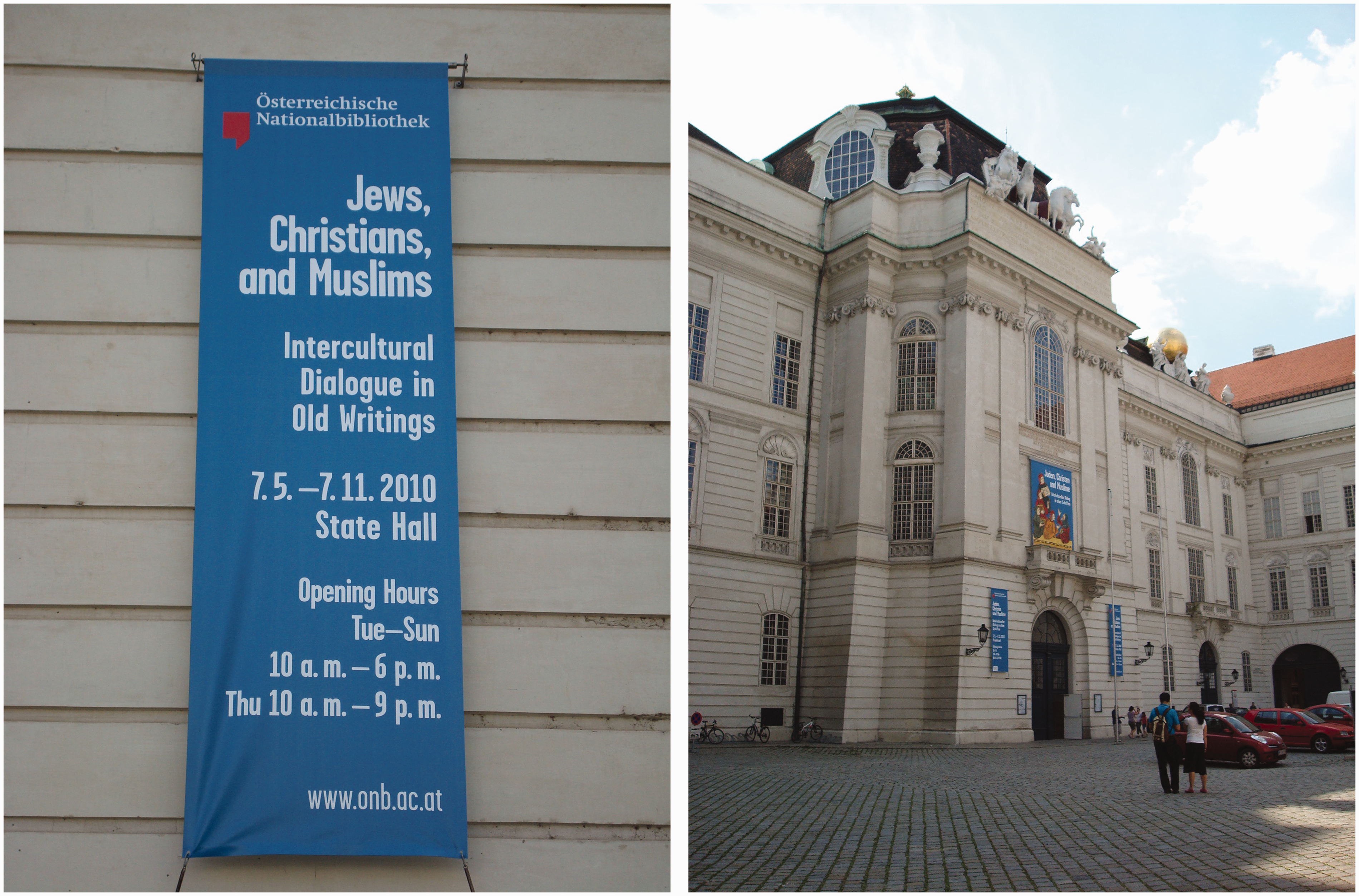
We hear a great deal nowadays about the absence of sufficient social mobility in today’s societies. There are surely several factors involved and many of these such as poor schooling and financial deprivations have been widely aired. We feel that poverty of aspirations and a lack of suitable role models have not been sufficiently stressed. The influence of successful and strong-minded role models within the family and in their circle of friends, be it inherited from their ancestors and/or passed on to their descendants, be it in the same field or in different ones, is demonstrated in at least three of our examples: Sigmund Freud, Karel Wenckebach and Robert Bárány.
In a more general framework, one can cite the Thomsons [Joseph John (1856–1940, George Paget (1892–1975) and John; Physics and Diplomatic Service], the Braggs [William Henry (1862–1942) and William Lawrence (1890–1971); Crystallography], the Curies [Marie (1867–1934), Pierre (1859–1906) and Irene (1897–1956); Physics], the Rothschilds (Finance), the Williams sisters (Venus and Serena, Tennis), Daley (Tom; Diving), Murray (Andy, Tennis), McIlroy (Rory, Golf), Johansson (Scarlett, Acting) and many, many others. In every one of our examples there were role models and unswerving support and encouragement in their families to achieve their greatest potential. One has only to read the obituaries in The Times to see how ambitious the so-called pushy parents, frequently mothers (those lambasted by Billroth in his book), and often poor immigrants to the USA, forged a road to success for their offspring. Perhaps we could all learn something from this.
Finally, a word of regret. With the rapid advances in all branches of knowledge, one notes with sadness that the histories of subjects and of its pioneers are being squeezed out. We thus lose the human dimensions on how knowledge evolves. Even the greatest pioneers have acknowledged that they stood on the shoulders of others who went before them!
Footnotes
Acknowledgements
The authors wish to acknowledge their indebtedness to the following (listed in alphabetical order) for their helpful comments, as well as for their help in tracking down many quite difficult to access and obscure sources of information: Professor Anders Bárány, Professor Peter M Braunwarth, Dr Tatjana Buklijas, Mr Boonserm Kruaphalang (known as Daeng), Mrs Emma Davidson, Magister Wolf-Erich Eckstein, Mr John Gee, Mr Geoffrey Low (formerly Guido Loewi, Otto Loewi’s youngest son), Mr Stephen Matthews, Dr Peter Schwarz, Dr Anna L Staudacher, Mrs Margarete Stern. The photograph of Otto Loewi was presented by his son, the late Geoffrey Low, through the good offices of Mr Stephen Matthews and Mr Boonserm Kruaphalang. Other materials on Otto Loewi, including the Einstein letter, were presented by his son Geoffrey Low, through the good offices of Mr John Gee. Regarding academic grades, see note. 1