



Abstract
Sir William Turner, a Lancastrian, was renowned as a scientist, anatomist and a great reformer of medical education. His students became anatomists at various international institutions, which consequently shaped the future of anatomy as a subject matter both in the United Kingdom and in South Africa. Although Turner’s accomplishments have been documented, little is known about the details that determined his career path and the individuals that shaped his future. Here the authors aim to highlight some aspects of Turner’s academic achievements and his personal life as well as how he crossed paths with other great minds of the Victorian era including Richard Owen, Charles Darwin, James Paget and Joseph Lister.
Introduction
Sir William Turner was known as a distinguished teacher of anatomy, a reformer of medical education and a scientist with an extensive list of publications.1,2 His outlook on the importance of science in medical education was captured during his address at Oxford in 1893:
‘The fullness of medical education is the due preservation of the balance between the scientific and the practical’.
William Turner was born on 7 January 1832 at number 7 Friar Street, Lancaster, Lancashire.2–4 He was born 28 years after another a remarkable anatomist, palaeontologist and Lancastrian, Sir Richard Owen (1804–1892). 5 Turner revered Owen and regarded him as the Nestor of British Anatomists. 3 Owen is best known for coining the term Dinosauria and for his work that led to the establishment of the Natural History Museum in South Kensington, London. Owen’s medical education led him from Edinburgh, where he matriculated, to St Bartholomew’s where he earned his diploma. He later (1829) became a lecturer on comparative anatomy at St Bartholomew’s Medical School – the same school that Turner would later choose. 3 Turner was the second of four children and the second son of William Turner, a cabinet maker and upholsterer, and Margaret Aldren. William shared his name with his eldest brother, born in 1830, who died shortly after birth. Tragically, William was the only child to live to adulthood, outliving his younger siblings Mary Ellen and Robert who both died of diphtheria and erysipelas before reaching their teens. 3
Anatomy dominated premedical curricula in Scotland until the late 19th century. It was believed that the reputation of any medical school depended largely upon its anatomy professor. This view changed with the emergence of the exciting field of experimental physiology in the late 19th century and, before this, physiology traditionally was taught by anatomists. 6 During his time in Edinburgh, Sir William Turner was regarded as a physiological anatomist. 7 Scientific research at the University of Edinburgh, in particular anatomical research, evolved over time and the tone was set by the Alexander Monro’s (primus and secundus) and then later by John Goodsir (1814–1867) who succeeded Alexander Monro (tertius) (1773–1859) in 1846 but tragically died at the age of 53.6,8 In 1862, Turner followed in Goodsir’s footsteps and he became fascinated with the structure of whales. This led to his extensive and well-illustrated catalogue on The Marine Mammals in the Anatomical Museum of the University of Edinburgh. 7 During the same period, Turner explored the rudimentary structures in man and this led to his acquaintance with Charles Darwin (1809–1882). 3 The turn of the 19th century was marked by changes in medical education at Edinburgh and more full-time basic science lectures were presented for the premedical aspect. 6 It was during this period that Turner served on the General Medical Council (GMC) and later became the principal at Edinburgh. Various publications successfully capture Turner’s accomplishments, but very little is known about the factors that determined his chosen career path, his involvement in the reform of medical education through his contribution towards the Medical Acts (1858 and 1886) and his interaction with other giants of the Victorian era.1–3,6
Medical training and Edinburgh career
Turner’s character developed from his own exertions and out of necessity as a result of growing up without paternal guidance and under strenuous economic conditions. His self-reliance and an early recognition of the value of untiring hard work contributed towards shaping his future. In addition, he was known to be an avid reader of art, architecture, history and biographical material. The latter served to aid his judgement and develop a broad outlook on life. However, three men left an indelible impression on Turner’s continuing academic life as he acknowledged later: Christopher Johnson (junior), James Paget and John Goodsir. 3
‘ … a small lamp of science burning in Lancaster … and those who lit it were the Johnsons’.
A chronology of events associated with the life of Sir William Turner.1,3,7,15,24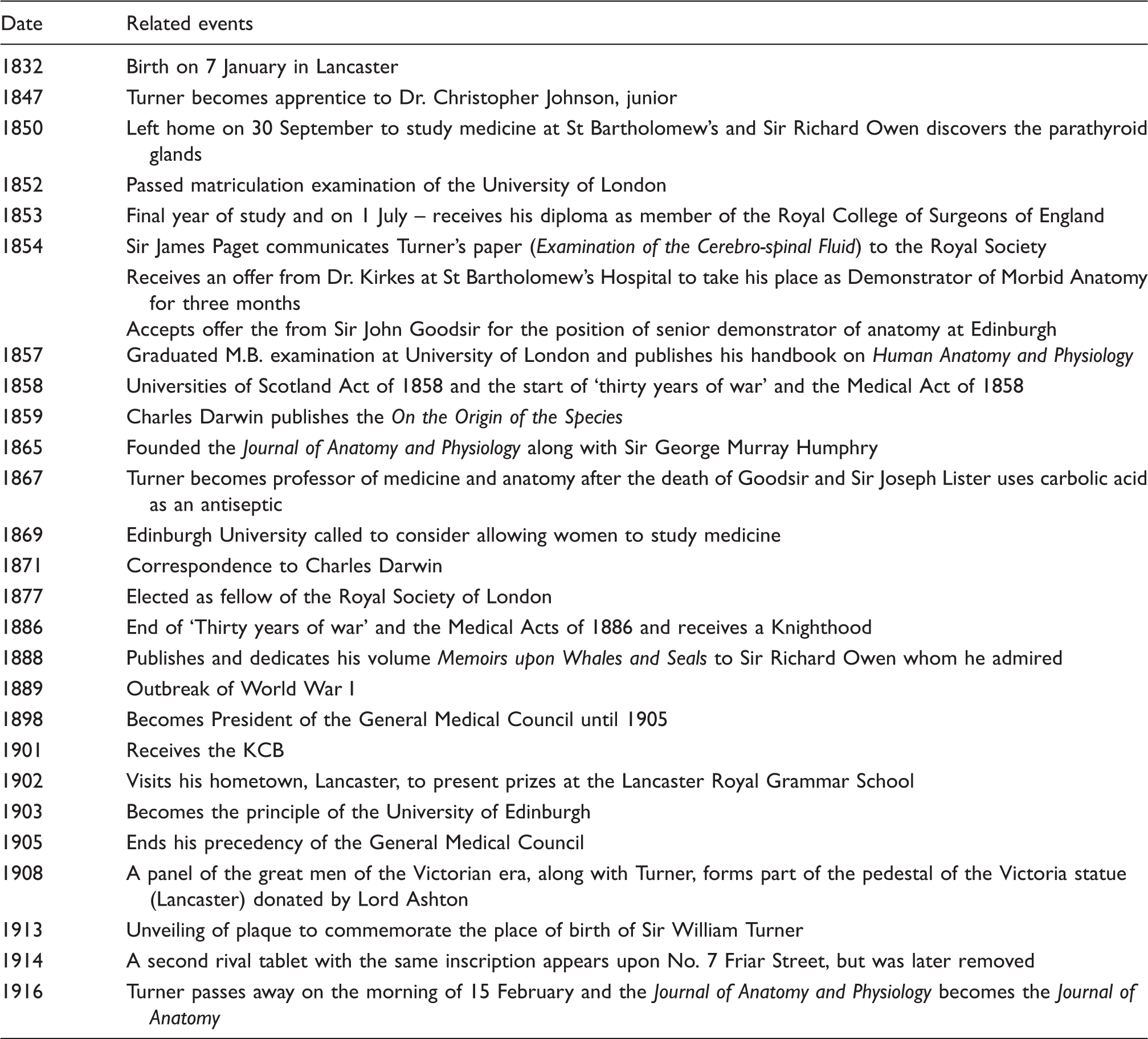
‘Paget’s lectures to his students were much more than verbal expositions. He recognised the importance of appealing to the eye as well as to the ear, and of cultivating and stimulating the power of observation of the class. He exhibited numerous diagrams, and as he expounded his subject he utilised his skill as a draughtsman by drawing freely on the slate … ’.
Turner excelled in his study of scientific subjects rather than the contemporary medical disciplines of his apprenticeship and his time at St Bartholomew’s. It is believed that his natural aptitude for the sciences and associated critical thinking aided him in his pursuit of anatomy and applying his mind to various anatomical challenges. 3 Turner matriculated in July 1852 (Table 1) at the University of London and decided to enrol for the Honours Examination with the subjects of chemistry and botany as targets. His efforts proved fruitful and in 1853 he received a first and second prize, respectively, for these subjects. Interestingly, Turner’s name appeared on the same Roll as that of Sir Joseph Lister (1827–1912). 3 Lister and Turner later collaborated during their academic careers and together authored a series of manuscripts on the structure of nerve fibres. 12
Sir John Goodsir took up the position of Chair of Anatomy in 1865 after obtaining the positions of curator and demonstrator in anatomy at the University of Edinburgh in 1843. Goodsir interrupted his duties in 1853 due to ill-health, but returned to Edinburgh in 1854.
3
Goodsir’s pursuit of demonstrators in anatomy, after his return, led to various communications with Paget at St Bartholomew’s. Arthur Logan Turner (1865–1939), Turner’s son, has made available the detailed account of the monthlong correspondence between Goodsir and Paget. One of the candidates who Paget recommended was Mr Henry Gray (1827–1861) who later resumed duties as an anatomist at St George’s Hospital and produced his popular textbook on anatomy. Paget finally recommended Turner to Goodsir for the position of senior demonstrator, a position he held for 13 years, and Turner wrote his letter of acceptance on 24 October 1854 (Table 1):
3
I willingly agree to all the propositions specified in your letter of 18th inst. I shall endeavour to the best of my ability to render myself properly qualified for the several duties required of me.
Turner’s years at Edinburgh saw many publications from his own hand. He is best known for his work on the subperitoneal arterial plexus, described in the middle of the 19th century, and his independent description of the intraparietal sulcus in chimpanzees and humans as proposed by Daniel John Cunningham (1850–1909).13–15 Cunningham was a student of Turner during his earlier days at Edinburgh and a great friendship later developed between them. It was during this period too that Turner befriended another of his students, John Murray (1841–1914), who later edited the 50 volumes of the reports from the Challenger Project.
3
Cunningham assisted Turner and served under him as demonstrator for eight years until he took up the Chair of Anatomy at the Royal College of Surgeons of Ireland, in Dublin in 1882. He transferred to Trinity College in the following year where he served as Chair of Anatomy for 20 years.
16
Turner’s interests included comparative morphological studies on the placenta of various species including lemurs, whales, elephants and humans.
2
It is also worth noting that 11 sections of Cunningham’s Textbook of Anatomy were written by 11 of Sir William’s former demonstrators.
17
Turner, unlike his seniors and mentors Goodsir and Owen, in time became a follower of Darwin’s theory and a series of corresponding letters followed as a result of Darwin’s questions on the undeveloped structures in humans, including the coccyx, breast tissue in men and the supra-chondyloid foramen of the humerus.2,3 Darwin relied on Turner’s knowledge during his work on The Descent of Man and The Variation of Animals and Plants under Domestication as illustrated in his correspondence from Downe, in the County of Kent:
3
‘I am much obliged for your kind note and especially for your offer of sometimes sending me corrections, for which I shall be very grateful. I know that there are many mistakes to which I am very liable. That is a terrible one confusing the supra-condyloid foramen with another one. This, however, I have corrected in all the copies struck off after the first lot of 2500. I daresay there will be a new edition in the course of nine months or a year, and I will correct as well as I can. As yet the publisher has kept up type and grumbles dreadfully if I make any corrections. I am very far from surprised that you have not committed yourself to full acceptation of the evolution of man. Difficulties and objections there undoubtedly are, enough and to spare, to stagger any cautious man who has much knowledge like yourself’.
Thus, Turner’s career at the University of Edinburgh started in 1854 (Figure 1). Yet, despite his lack of teaching experience at that time, he succeeded Sir John Goodsir in 1867 as professor of anatomy after strong competition from John Struthers (1823–1899) and James Bell Pettigrew (1832–1908).
3
Goodsir, known for his pioneering work on the study of the cell, favoured the inclusion of histology as an integral component of the anatomy course at Edinburgh. He used many of his own scientific findings to reinforce his lectures. Turner was invigorated by Goodsir’s scientific spirit and methods of instruction and he fondly remembered his first introduction as Demonstrator of Anatomy:
3
Daguerreotype (1854) of William Turner as demonstrator of anatomy at the University of Edinburgh. ‘I have never forgotten the kind words which Goodsir spoke, when introducing me to the Demonstration class, nor the hearty welcome with which the students received me – a stranger from another school – nor the patience which they displayed in listening to my prelections, often imperfect and hesitating’.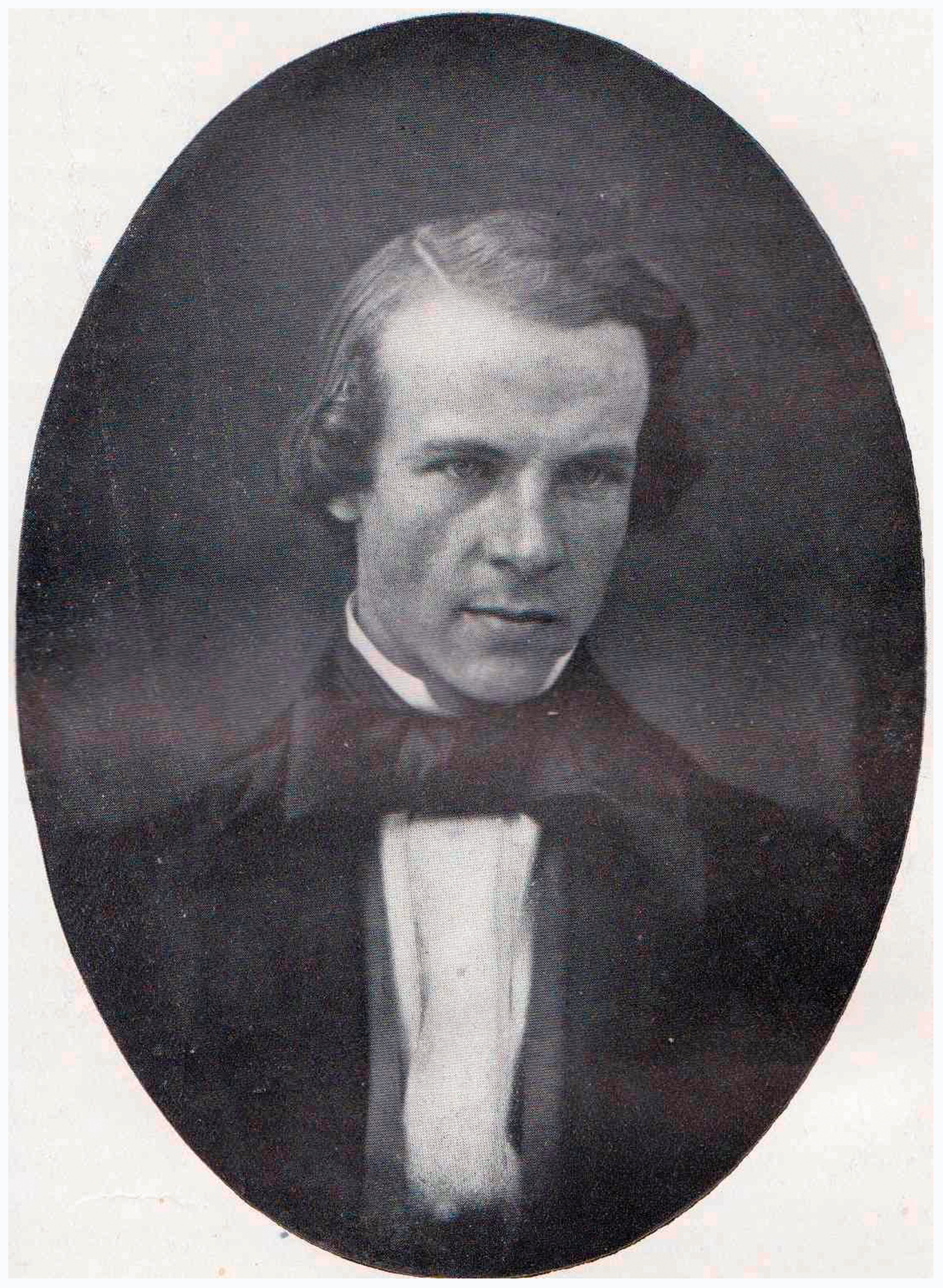
The following year saw Turner become one of the founding editors of the Journal of Anatomy and Physiology along with George Murray Humphry (1820–1896) who he befriended at St Bartholomew’s. 7 The Anatomical Society of Great Britain later assumed responsibility for the journal and its name changed to The Journal of Anatomy. In 1903, Turner was appointed Principal of the University of Edinburgh and only then did he give up his position of professor of anatomy after serving for 36 years.1,3,17 Cunningham returned to Edinburgh in the same year to become Turner’s successor. 16
Turner’s time at Edinburgh was also marked by the struggle of a small group of women who wished to study medicine at Edinburgh. The efforts of these pioneers, led by Sophia Jex–Blake (1840–1912), have been well documented.3,18,19 Most middle-class women were restricted to the traditional roles of wife and mother during the Victorian era. Turner’s views during this period were not favourable and he reasoned that the teaching of anatomy would be impaired, male students would be offended, the teacher would be restricted in the subject matter and the discipline of the students would be affected. As he reflected later, he still maintained these views despite the fact that Jex-Blake’s efforts paid off. Five women matriculated in November 1869 to become the first female undergraduates accepted to study medicine in the United Kingdom.3,19
Medical Acts and the GMC
Scottish medical schools allowed students to be trained in both medicine and surgery and allowed them to obtain the degree of MD. This was contrary to the system in England during the 19th century. England had a system that qualified physicians and surgeons who were trained under an apprenticeship.6,20 Turner was educated during this period of a dual system. Furthermore, the Medical Licensing Bodies were not governed by any central body, and therefore each taught and examined their candidates to their own accord, as Turner experienced. However, the Medical Act of 1858 named the GMC as the central organisation of control. 21 The Act aimed to distinguish between qualified and unqualified practitioners.21,22 The 1858 Medical Act did not result in the rapid unification of medical professionals, but was marked by resistance and a gradual acceptance over time. 21 Various legislative controversies followed for 30 years, the so-called ‘thirty years of war’, where Scottish graduates had to struggle for the same rights as their English trained doctors. This period was concluded by the Medical Act of 1886 that consequently abolished the geographical limits of medical practice.3,20,21 This was the same year in which Turner was knighted (Table 1). 17 Turner was believed to be at the forefront of these developments and he served later as President of the GMC from 1898 until 1905 (Table 1). 3 His familiarity with medical legislation and administrative authority ensured his strong position within the Council. Many of the decisions that shaped the future of medical education during his Presidency were taken on his initiative. 23
Turner’s legacy
Turner’s influence reverberates across the globe and of particular interest is the Challenger Project that climaxed as the Terry Osteology Collection at St Louis, Missouri, and the Dart Collection in Johannesburg. 23 In 1888 (Table 1), Turner published Memoirs upon Whales and Seals based on the material collected during the voyage of the HMS Challenger. He dedicated his work to Sir Richard Owen. 3 Scottish medical men reached all parts of the world. 19 Many of these were Turner’s students who became anatomists in America, Australia and the rest of the United Kingdom.4,17,25 He was not only an instructor of students but future professors of Anatomy including Alexander Primrose (1861–1944) in Toronto, Richard Berry (1867–1962) in Melbourne, David Hepburn (1859–1931) in Cardiff, Andrew Melville Paterson (1862–1919) in Liverpool and Johnson Symington (1851–1924) in Belfast, to name a few. 26 Recent evidence points towards his far-reaching educational influence through Turner’s students, both directly and indirectly, in South Africa and Australia.4,25 In South Africa, it was through Robert Black Thomson (1880–1937) 24 who became the first professor of anatomy in 1911 and established the first department of anatomy at the South African College, known today as the University of Cape Town. 24 Thomson graduated from Edinburgh in 1905 and was a student of Turner and Cunningham. The Edinburgh model of teaching human anatomy thus reached the shores of South Africa at the onset of the 20th century.24,25 Thomas Anderson Stuart (1856–1920) and James Thomas Wilson (1861–1945) became professors of anatomy at the University of Sydney 4 and it was under the guidance of these two of Turner students that Raymond Dart’s (1893–1988) future was shaped before he moved to South Africa in 1922 to succeed Edward Philip Stibbe (1884–1943). Dart became the Chair of Anatomy at the South African School of Mines and Technology (known today as the University of the Witwatersrand).24,25 Turner’s subtle influence has been demonstrated through the Dart Collection of human skeletons in Johannesburg, South Africa. The collection came into existence after Dart’s exposure to similar collections at Washington University and Case Western Reserve University in Cleveland. Of these collections, of particular interest was that of Robert James Terry (1895–1966) at the Anatomy Department of Washington University. 27 Terry was a former student of Turner and Dart visited the department in 1921 after receiving a Rockefeller Fellowship. Dart appreciated the value of this large collection of skeletal remains and this inspired him to start a similar collection at the University of the Witwatersrand. 24
Turner’s origin in Lancaster is commemorated by a plaque in Friar Street, Lancaster (Figure 2(a)). Mr HL Storey led the proceedings on 7 August 1913 when the plaque was unveiled; he was the eldest son of Thomas Storey who was best known as an oilcloth and baize entrepreneur (Table 1).3,28 Turner has also been placed among the intellectuals of the Victorian era and features on the pedestal of the Victorian statue, between the virtues of Justice and Wisdom, in Dalton Square, Lancaster (Figure 2(b) and (c)). The statue, completed in 1907, was a gift to the city by Lord Ashton; formerly Mr James Williamson.
3
The panel depicts Turner surrounded by Richard Owen, Edward Frankland, Charles Darwin and Joseph Lister (Figure 2(c)).
(a) The plaque to commemorate the place of birth of Sir William Turner in Friar Street, Lancaster. (b) A photograph of the Victorian statue in Dalton Square, Lancaster, three years after its completion in 1908 less than a kilometre from the house where Turner grew up. (c) The champions of the Victorian era have been honoured in a series of panels upon the pedestal of the Victorian statue in Lancaster. The panels boast of prominent figures that distinguished themselves in literature and science. Turner can be seen surrounded by Richard Owen, Charles Darwin and Joseph Lister.
Turner passed away on the morning of 15 February 1916. Noteworthy, that same year was marked by the end of a 50-year struggle to allow women to study medicine, the Anatomical Society of Great Britain assumed responsibility over the Journal of Anatomy and Physiology and the journal became The Journal of Anatomy. 1
Footnotes
Conclusions
Lancaster is a historic city in the county of Lancashire and is situated on the River Lune. The history of Lancaster is based on its port, canal and medieval castle. The Victorian era, the period from 20 June 1837 until Queen Victoria’s death on 22 January 1901, was marked by advances in engineering and medicine – Lancaster played its part during this period. The city nurtured a generation of revolutionary scientific minds including Sir Richard Owen, Sir Edward Frankland and Sir William Turner to name but few. The life of Sir William Turner was eventful and, like his predecessors before him, he boasts a substantial contribution to anatomy. His legacy extends beyond his scientific research and administrative achievements to the various corners of the globe as a result of the British Empire’s expansion at the turn of the 19th century. Turner’s students became professors of anatomy in South Africa, Australia, the United Kingdom and Canada. He can indeed be considered one of the intellectuals of the Victorian era.