




Abstract
The most enduring archive of medical biography is that composed of coins and medals. More than 20,000 commemorative and tribute medals comprise the domain of medical numismatics. Several thousand of these portray individual doctors whose lives and work are thus recorded in gold, silver, bronze and the alloys of medallic art. Such enduring records range from the names and images of the most famous and significant of doctors in international perspective, to those held in local or parochial esteem by their peers. The medical numismatic archive includes medals and coins which portray the gods of medicine; founders of the profession such as Hippocrates and Galen; and those who have been held in local esteem, all such that the record of their service to medicine might not be forgotten.
Keywords
Introduction
Almost all the archival records of medical biography are ephemeral, or potentially so. There is one repository of biographical heritage that has proved to be particularly enduring. That is the numismatic record – an extensive chronology of great detail, encapsulated on the faces of coins and medals. These artefacts preserve, in immutable form, records of the past not preserved in any other medium. This enduring archive of the history of medicine and healthcare is of particular significance in the domain of medical biography.
Unique heritage
Every significant event in the history of medicine, indeed that in all domains of healthcare, has been preserved in medallic form. In some instances, the numismatic record is the only surviving evidence, the only archive, of significant doctors and of medical events of ages past.
An example is the 50-cent Australian coin commemorating the apothecary-surgeon, George Bass (1771–1803). He is one, like many, whose only physical memorial is his image on coins and medals. George Bass was born in Aswarby in Lincolnshire. He graduated (1789) as an apothecary-surgeon in Boston, and became a naval surgeon. He emigrated to Sydney in 1795 and explored in the hitherto unmapped bush. In 1798, he discovered Bass Strait, confirmed later that year by his circumnavigation of Van Diemen’s Land with Lieutenant Matthew Flinders RN (1774–1814), the latter also a former surgical apprentice. In 1799, Bass published scientific works on the anatomy of the wombat, the feeding habits of the black swan, and the nesting behaviour of the white-capped albatross. George Bass was elected a Fellow of Linnean Society in April 1799.
1
He was lost without trace on a trading voyage, in command of his brig, Venus, sailing from Sydney to South America in 1803. His physical memorials are the coins and medals which commemorate his life and work (Figure 1).
Bronze commemorative medallion as tribute to the life and work of the Lincolnshire Royal Navy surgeon, George Bass (1771–1803). [The birth dates on the medallion are incorrect]. One (51 mm, 62 g) of the 150 struck in 1998 by K.G. Luke, medallist of Melbourne, for the Numismatic Society of Victoria.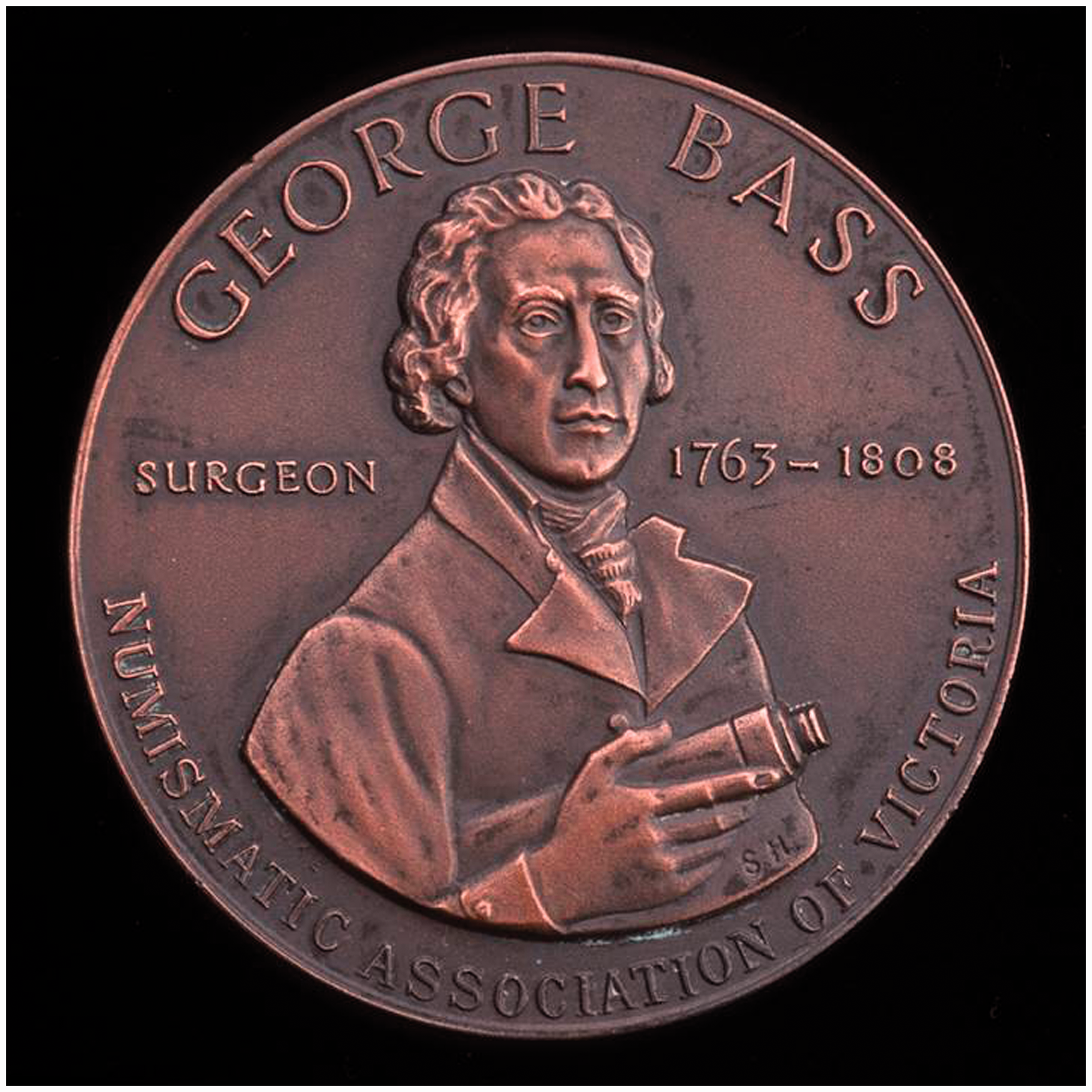
Art and science
The entire suite of medical symbols and metaphors is to be found in the numismatic record. The numismatic “cabinet” is also a chronology of medicine. Tribute medals record all the doctors of international significance in the history of medicine; and also the locally popular. In some narcissistic cases, the medallic record also includes those doctors who themselves have commissioned medals.
I estimate that more than 20,000 different “medical” medals have been struck. The details of most have never been published. 2 In Australia alone, more than 800 different medals, all encompassing healthcare themes, have been struck. In Hungary, more than 1600 medals encompassing medical themes were struck in the 20-year period from 1974 to 1994, 3 more than 300 of which portray doctors. 4 Tribute and laudatory medals, rare and usually bestowed parsimoniously (and never more frequently than annually), confer historical identity on the recipient; and almost always include images or metaphors of significance in the chronology of medical history. Most medical medals are beautiful works of fine art, crafted by medallic sculptors working in one of the most demanding of creative domains, that of a small biface disc or metallic ovoid.
One exceptional example of this fine art is the Nobel Prize Medal for Medicine or Physiology. This beautiful gold medal portrays, on the Reverse, a tableau comprising Hygieia, the Goddess of Health and daughter of Asklepios, supporting a sick patient. The Goddess is collecting water from a healing spring. A healing Asklepian serpent, drinking from a patera, completes the scene. The Nobel Prize Medal for Medicine was designed by the Swedish artist, Erik Lindberg. Struck in 23 carat gold, the Reverse of the medal has, as an encompassing circlet, a line (Verse 663) from Virgil’s Aeneid: Inventas vitam iuvat excoluisse per artes.
The Nobel Prize for Medicine or Physiology which is illustrated is the 1966 Award to Professor Peyton Rous (1879–1970), the ‘founding father of cancer virology’
6
(Figure 2). Rous discovered the first tumour virus in 1911, known since that era as the Rous sarcoma virus.
7
Nobel Prize Medal for Physiology or Medicine.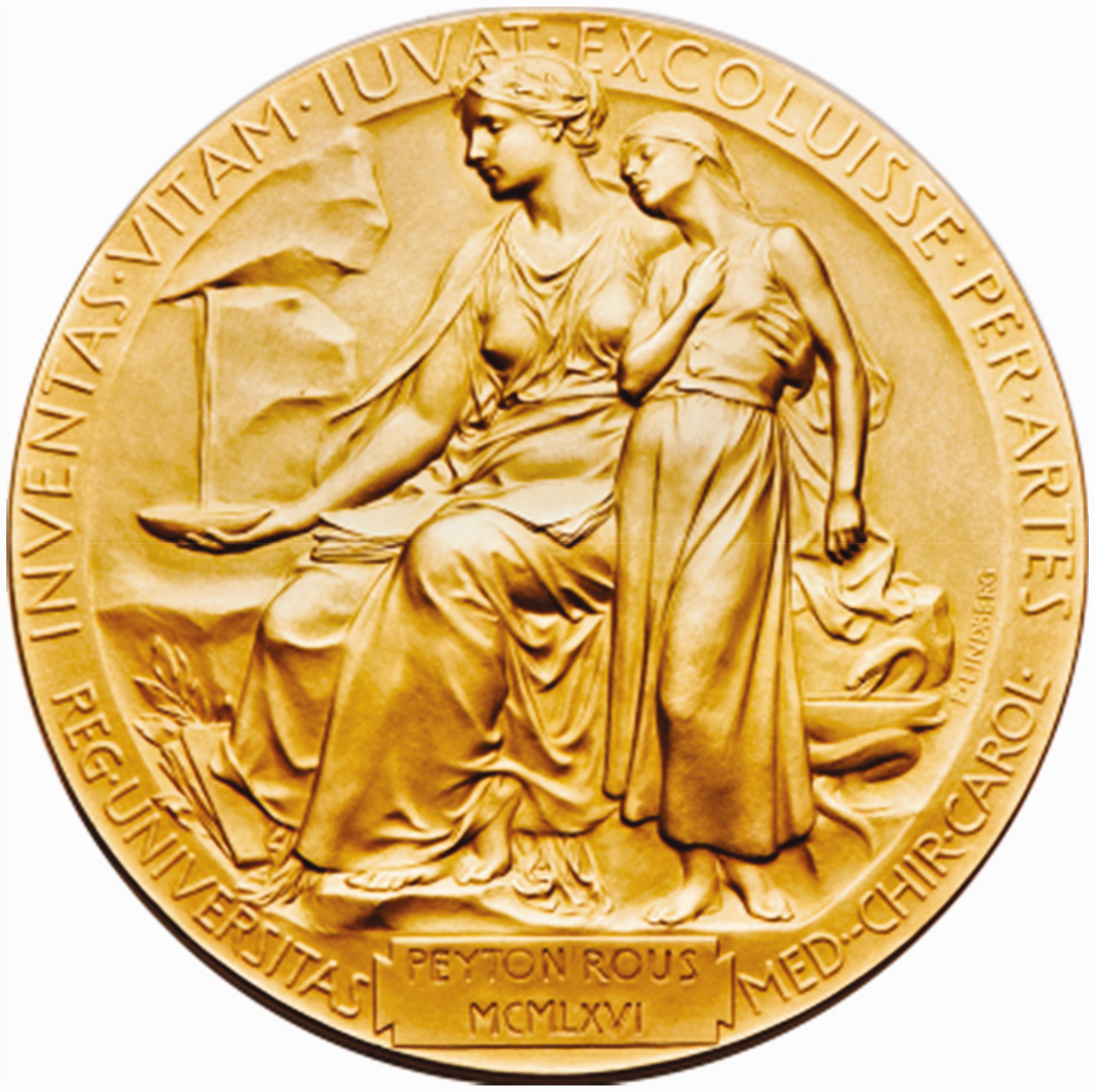
The Nobel Prize Medal for Medicine or Physiology is not, as popularly thought, the world’s highest tribute award for medicine. Whereas there are five Nobel Prize Medals awarded annually, each for specific professions, there is but one Copley Medal, that of The Royal Society of London. The Copley Medal is awarded for primacy in the entire field of scientific endeavour, worldwide. The ‘Copley’ was first awarded in 1736, the result of a bequest by a wealthy English landowner, Sir Godfrey Copley (1653–1709), of Doncaster in Yorkshire. The motto of The Royal Society, included on the Obverse of the Copley Medal, is ‘Nullius in Verba’, a phrase taken from Horace’s Epistles. In the corridor vernacular of the Royal Society, the translation is freely given as ‘take nothing for granted, and accept nothing simply from the word of others’. 8
The Copley Medal is only occasionally (20% of awards) bestowed on recipients whose towering contributions are to the advancement of medical science; and whose discoveries or inventions are deemed greater than discoveries in all other fields of human endeavour. Of the 258 Copley medals awarded since 1736, 47 have been awarded to medical men and women. One notable recipient, the Yorkshire navigator and hydrographer, Captain James Cook (1728–1779), was awarded the Copley Medal in 1776 – not for bringing the knowledge of the existence of New Zealand and Australia to the western world, but: For his paper giving an account of the method he had taken to preserve the health of the crew of H.M. Ship The Resolution, during her late voyage round the world. Whose communication to the Society was of such importance to the public.
9
Another Copley medallist, Lord Florey (1898–1968), appears on an Australian one-dollar coin. Illustrated is the 1798 Copley Medal awarded to Sir George Shuckburgh (1751–1804), for his work on thermometry, physics and astronomy (Figure 3).
14
Shuckburgh showed that the boiling point of pure water, used as the upper reference point of both Centigrade (100°) and Fahrenheit (212°) thermometers, had to be corrected for changes in barometric pressure. Following his research, thermometers have always been calibrated taking into account both height above sea level and the prevailing atmospheric (meteorological) pressure of the moment, both measured at the site of manufacture. Sir Godfrey Shuckburgh’s research made possible the accuracy of clinical thermometry on which patient care depends.
The Copley Medal of The Royal Society, London, the Society’s highest annual award for scientific discovery, including medicine. It was endowed by Sir Godfrey Copley (1653–1709) and first awarded in 1736. Obverse, the 1798 Medal.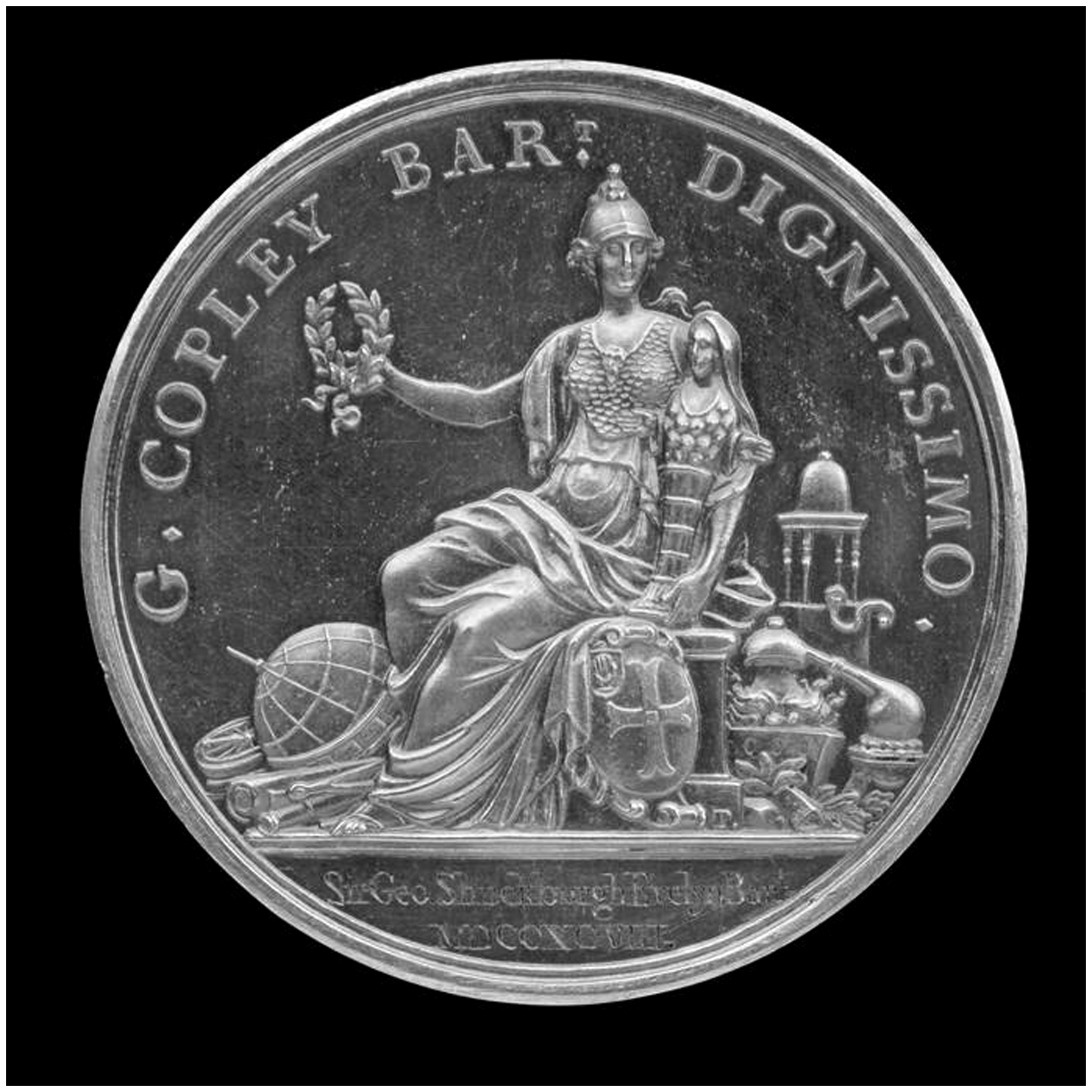
Symbols and metaphors
The heritage of medicine, indeed that of all healthcare, is contained in a myriad of symbols, metaphors and often cryptic designs which date from the earliest of literate times. Following the invention of coinage in 610 BC, Greek coins portrayed healing deities – Apollo, Asklepios and Hygieia; and later Roman coins depicted the transpersonalisation of Asklepios to Aesculapius and of Hygieia to Salus; and popularised earlier Greek medical deities such as Telesphorus, the God of Rehabilitation and Convalescence.
Greek and Roman coins
The Asklepian Staff with its entwined serpent was a common theme on Greek coins. By the second century BC, so well-known was this representation of medicine, that a single serpent became the synecdoche of the healing arts. A coin of Kos (145–88 BC) featured Asklepios on the Obverse; and on the Reverse was portrayed a simple coiled Asklepian serpent, by that era the recognised symbol of curative medicine. 15 The Asklepian serpent, as the metonymic code for healthcare in all its forms, is used on thousands of medals.
A chronology of medicine
The first commemorative medallions were struck by Roman emperors in Imperial times. The dies were engraved to resemble coins and it is believed that several Roman Emperors used these as personal gifts. The first medallion which incorporated a medical theme was a large (37 mm) bronze medallion struck by the Emperor Antoninus Pius (ruled 138–161 AD). 16 On the Reverse is a scene portraying a ship carrying an Aesculapian serpent to Rome, the craft and snake being greeted by the River God, Tiber. The scene commemorates the legend when Aesculapius was brought to Rome following the devastating plague of 293 BC; and recounts in medallic form how the Aesculapian serpent chose the Tiber Island (Isola Tiburina) as the home for the healing God. The plague abated. 17 The Reverse of the coin portrays the head of Antoninus Pius.
Renaissance medical medals
In the early Renaissance flowering of art, artists experimented with medallic sculpture; and through this medium contributed to the heritage of healthcare. For the first, individual doctors were portrayed on medals. One fine example of a Renaissance medical medal was one sculpted and cast in Italy in 1472 by Sperandio Savelli, the son of a goldsmith, who was born in 1425 at Mantua. He cast a number of medals in the period from 1477 to 1490, at Ferrara. The medal illustrated was cast to commemorate one of the leading physicians of Ferrara, one Dr Pietro Bono Avogario (1425–1506)
18
(Figure 4). The Reverse of the medal depicts the standing figure of Asklepios, holding aloft a flask of urine, depicting the best-practice uroscopy principles of the day. The standing figure of Urania portrays the Muse standing on a globe with an astrolabe attached to her girdle, and holding aloft a book of divinatory knowledge. The tableau is a striking example of the core themes of contemporary Quattrocento medicine in Europe.
The Avogario Medal of 1472, Reverse. At left is Asklepios, holding aloft a matula of urine, depicting best-practice uroscopy of Renaissance times. At right is the standing figure of Urania, the Goddess of the Heavens and the Muse of Astronomy, holding aloft a book of divinatory reference.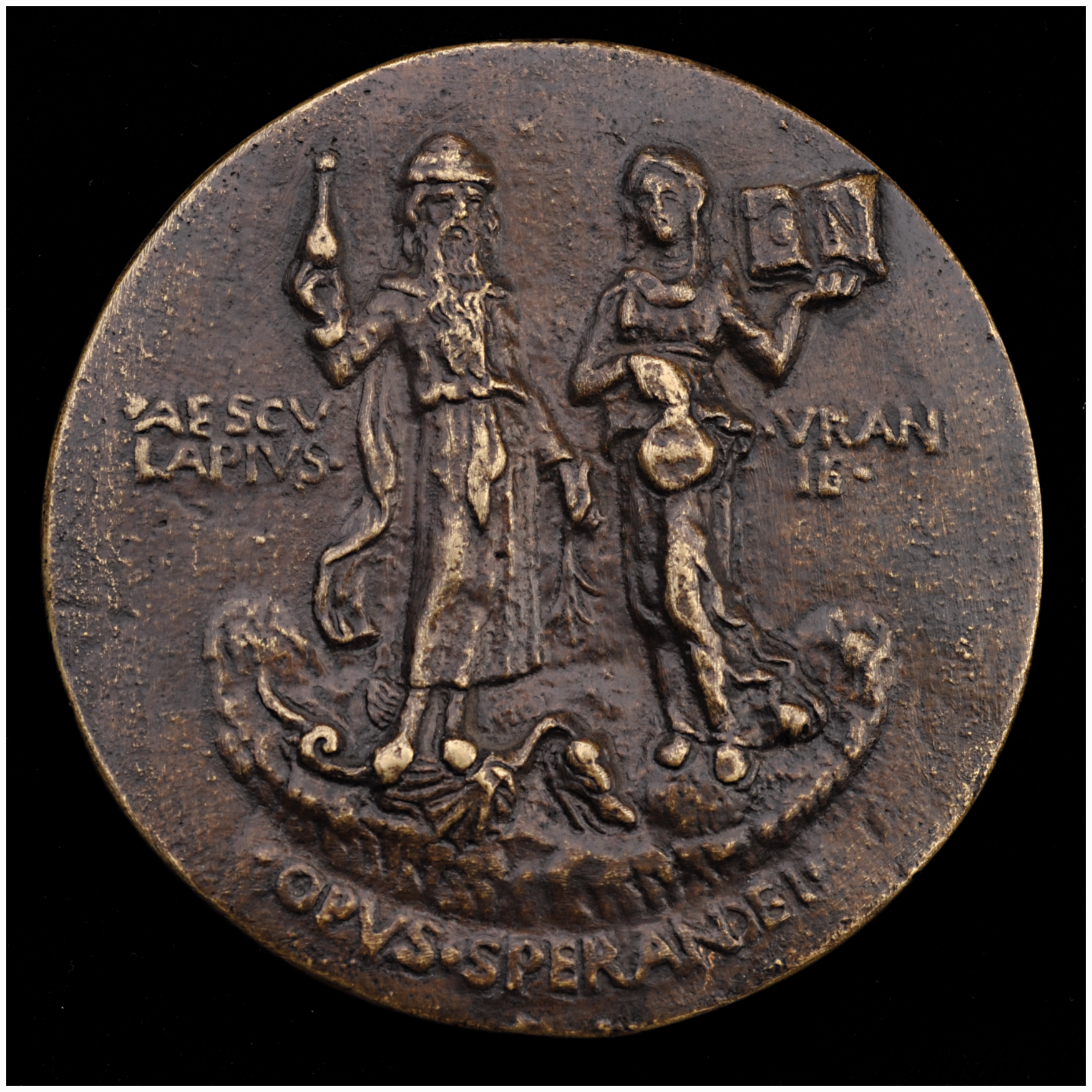
Throughout the millennium from 600 to 1600 AD, pulse-taking and uroscopy comprised the two most important diagnostic tests in clinical medicine. It was said that: no other test of medical study was subjected to the same extensive sophistication that characterised uroscopy.
19
Tribute medals
The many thousands of medical tribute medals comprise those honouring doctors, healthcare institutions and commemorative events of medical significance. Perhaps the most significant person in the history of medicine was Galen (129–c. 199 AD) whose doctrines and teaching were the dominant influence in western medicine for 1500 years. The Galen Medal is bestowed by the Worshipful Society of Apothecaries of London for exceptional contributions to ‘the whole spectrum of the art of healing…’ 21 Noted recipients have included Professor Walter Dixon (1870–1931), the first recipient, in 1926; Sir Alexander Fleming (1881–1955); Lord Florey (1898–1968); and Sir Ernst Chain (1906–1979).
The Obverse portrays the profile of Galen. The Reverse portrays: The allegorical female figure of Scientia, instructing a seated youth in the properties of plants, with a vase containing herbs and flowers to the right and an apothecary’s furnace to the left and, in the exergue, the emblems of Aesculapius, after Wyon (and more recently the Society’s Coat of Arms and ‘W Wyon RA’).
21
In the Presbyterian Church Hall in Woolwich, on the south bank of the Thames in London, in 1878 Shepherd and a colleague taught the first civilian classes of first aid. Women were students in classes held on Tuesdays and men on Wednesdays. The Kentish Independent reported the popularity of those classes. The concept of this new invention, first aid for all, spread like wildfire. By 1880, hundreds of thousands of St John Ambulance first aid courses had been conducted and certificates of competence issued. Volunteers were taught first aid in St John classes throughout England and Scotland; and in areas as far apart as Bermuda in the North Atlantic Ocean and at Dunedin in New Zealand. 23
In late 1878, Shepherd was deployed urgently for service in the Second Anglo-Zulu War. He was serving with the 1300 troops at Isandlwana when, on 22 January 1879, the entire British force was cut to pieces by the 25,000 Zulus defending their territory. The slaughter lasted for only 2 h. Only six British and African soldiers escaped the carnage and the total annihilation of Lord Chelmsford’s Force. The remains of the bodies remained unburied in that appalling scene for several months. All that remains today is a simple white cairn, erected years after the battle. Peter Shepherd had no children and almost no material heritage remains of his life, save the Shepherd Gold Medal commissioned by his colleagues to honour his service.
The Shepherd Memorial Medal (22 ct gold; 21 g; 38 mm × 2 mm) was awarded annually by the University of Aberdeen, Shepherd’s alma mater, for primacy in the undergraduate surgical examinations conducted at the conclusion of the final year of medical course. The reverse inscription is encircled by a tribute wreath of Scottish heather (Calluna vulgaris).
Some medical tribute medals are, in a sense, self-bestowed. The Beaney Gold Medal is one such, a beautiful medal portraying Asklepios, bestowed by Dr James George Beaney (1828–1891) to medical students who showed the most enthusiasm for attending his surgical operations at the Melbourne Hospital from 1876 (Figure 5). Those who visit Canterbury will know the Beaney Institute in the High Street, a philanthropic endowment which he made to the citizens of Kent as a free library and resource centre initially for working men. The largest personal memorial in Canterbury Cathedral is also that to James Beaney, who contributed magnificently to the repairs of the Cathedral.
The James George Beaney Medal. This gold medal was bestowed by Dr James Beaney (1828–1891), senior surgeon at the Melbourne Hospital, for excellence in ‘the demonstration of operative surgery’ at that Hospital. Illustrated is the 1877 Beaney Medal, awarded to Charles John Trood, courtesy of the Medical History Museum, the University of Melbourne, with acknowledgements.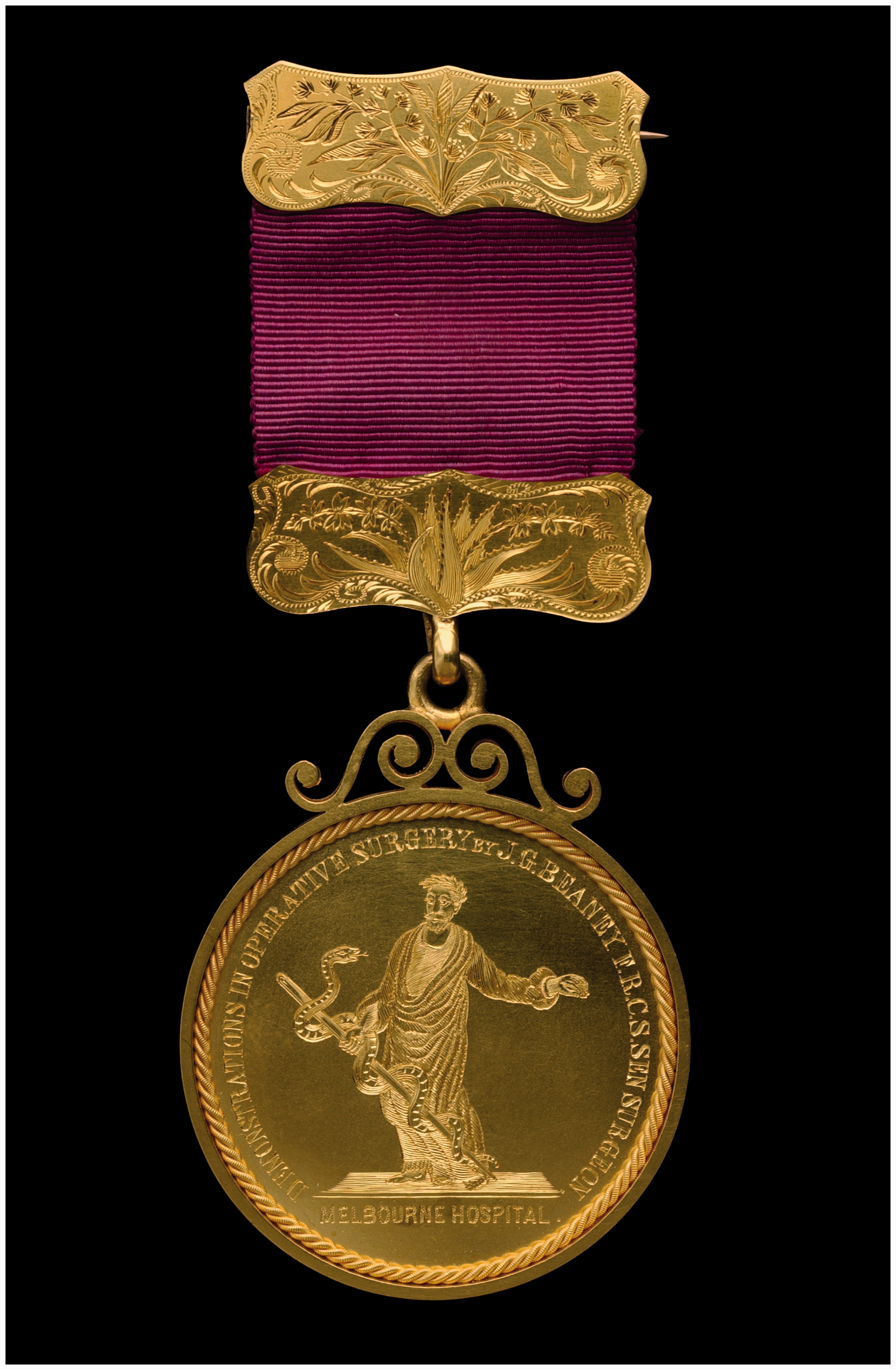
James Beaney was born in Canterbury where he completed his indentures as a surgical apprentice. He studied surgery in Edinburgh under Professor James Syme. 24 After graduation, Beaney joined the army and served as a military surgeon with the 3rd Lancashire Regiment on deployment to Gibraltar. At Gibraltar in 1854 he supervised the transport of sick and injured troops to Portsmouth in the steamer Europa. 25
In 1857, Dr Beaney emigrated to Melbourne in the Shooting Star. He became the richest doctor in Australia. His public display of gold and jewels earned him the sobriquet, ‘Diamond Jim’. His flamboyant dress, and his indomitable personality and resilience enmeshed him in fierce battles. He published pioneering books on contraception, family planning and sexuality. These were popular with the lay public, but in conservative Melbourne of the mid-nineteenth century, Beaney’s texts were condemned by his medical colleagues ‘as that class of literature which honourable medical men shun’. 26
Dr James Beaney was the first in Australia, in 1859, to publish a medical textbook; and the first, in 1873, to publish a paediatric text, Children: their treatment in health and disease. An analysis of four of his published works relating to paediatrics and paediatric surgery establishes his place as a true pioneer in the chronology of children’s medicine and welfare in his adopted land. He undertook heroic yet conservative surgery on children and was the first to write in detail about paediatric anaesthesia. He was an international pioneer of family planning. In Children: their treatment in health and disease, he described in detail the supreme importance of breastfeeding; promoted clear practical concepts for the weaning of infants; and discussed the diagnosis and management of diseases of the mouth, ears, eyes and teeth of infants.
In spite of these pioneering contributions, Beaney was shunned by much of the established medical profession because of his self-promoting flamboyance and his egotism. 27 He died in Melbourne, but left much of his fortune to institutions in the City of Canterbury in Kent. Of his several memorials, the Beaney Gold Medal of the Melbourne Hospital is the rarest and most beautiful.
Some of the thousands of medical tribute medals carry enigmatic and hidden messages. One example is the Jamieson Medal bestowed by the Neurosurgical Society of Australasia. It portrays on the Obverse the profile portrait of Dr Kenneth Grant Jamieson (1925–1976), an esteemed neurosurgeon of Brisbane, who pioneered much research on the prevention of road trauma, including the introduction of seatbelts. 28 The Reverse of the Jamieson Medal shows two lizards, the New Zealand tuatara and the Australian stumpy-tailed skink. These lizards have a “third eye”, a proto-pineal structure composed of a retinal cup with photoreceptors behind a translucent scale in the centre-front of the reptile’s skull. The cryptic metonym on the Jamieson Medal relates to a humorous after-dinner speech that Dr Jamieson gave at the inauguration of the Neurosurgical Society, in which he said that the most valuable instrument possessed by neurosurgeons was ‘the vision of hindsight’.
Another example of a cryptic medical message is one on the Ophthalmology Heritage Medal of the former Royal Children’s Hospital in Brisbane, struck in 2014. The Reverse portrays the images of the Roman goddess Lucina and the Christian saint, Saint Lucy, flanked by two floral species whose pharmacological properties led to the establishment of modern ophthalmology. Lucina was the Roman Goddess of Newborn Children, one ‘who brought them forth into the light’. It is believed that her persona was later absorbed into that of the Sicilian saint, Saint Lucia, or Saint Lucy (283–304 AD). Saint Lucy is the Patron Saint of the Blind and of those suffering from diseases of the eyes. The encircling exhortation, ‘Colatur ars ut liberorum visus servetur’ is a metaphor freely translated as ‘May the science and art of ophthalmology be promoted that children’s sight might be preserved’. In the exergue, in braille, is the motto of the Royal Australian and New Zealand College of Ophthalmologists, ‘That they may see’. 29
The numismatic heritage of medicine is a domain of vibrant contemporary interest. This biographic archive will continue to be enriched in the future.
Footnotes
Acknowledgements
The author thanks Dr Christopher Gardner-Thorpe, Consultant Neurologist of Exeter; and Ms Emily Milburn of the Lady Cilento Children’s Hospital, Brisbane for much help and encouragement.
Declaration of Conflicting Interests
The author(s) declared no potential conflicts of interest with respect to the research, authorship, and/or publication of this article.
Funding
The author(s) received no financial support for the research, authorship, and/or publication of this article.