



Abstract
This study concentrates on two monumental Ottoman pious endowments, each with a major component devoted to healing. The first is the hospital of the Haseki Mosque Complex built by the wife of Sultan Suleyman the Magnificent. An examination of the deed and the modus operandi of this endowment will impart a sense of the role that women of the ruling class played in Ottoman society as builders and healers in the sixteenth century. The analysis of the Haseki Hospital will be followed by an examination of the hospital that is part of the Suleymaniye Mosque Complex built by Sultan Suleyman. The differences between the two perspectives in the promotion of public health will be emphasized, arguing that the Sultan’s approach to healthcare was academic and research-oriented, whereas his wife’s was holistic and devoted to rehabilitation. The endowment deeds and the physical layouts of the two hospitals shed light upon a dual approach to healthcare with gender-specific roles affirmed and shaped by Hurrem and Suleyman the Magnificent, who each built hospitals of their own in Istanbul, the Ottoman capital city.
Keywords
Women had a considerable share in the total number of charitable endowments (waqfs) in Ottoman society. This figure ranged from 20% in fifteenth and sixteenth-century Edirne to 25% in eighteenth-century Cairo. 1 This record is indicative not only of the fact that Ottoman women were property holders, but also that they played a greater role in the economy of the Ottoman Empire than has generally been believed. The most conspicuous group of women endowers in Ottoman society was the female members of the imperial household. A particular field in which royal women lavishly allocated endowments was in the construction of healing institutions—hospitals, nursing schools, medical schools, asylums, and birthing centers. Some of these female patrons were simultaneously involved in promoting women’s health, such as distributing contraceptives, nutritious foods, and mesir majunu, a paste believed to have healing and strengthening powers. This observation naturally gives rise to the hypothesis that royal women took on an important role as health-care providers in Ottoman society. An investigation into the roles that Ottoman women played in the provision of health-care seems worthwhile since it necessarily involves an examination of Ottoman history of medicine, an area of scholarship that, despite the vast amount of information available in the archives, remains under-represented in Ottoman studies.
I will concentrate on two monumental endowments, each with a major component devoted to healing built in Istanbul, the Ottoman capital, between the years 1538 and 1551. The first is the hospital of Haseki Hurrem Sultan, the wife of Sultan Suleyman the Magnificent. An examination of the endowment deed and the modus operandi of this hospital will impart a sense of the role Hurrem played in Ottoman society as a builder and healer. This will be followed by an examination of the imperial endowment deed of Suleyman the Magnificent to emphasize the differences between the two perspectives in the promotion of public health.
The Haseki Mosque Complex (1538–1540 and 1550–1551) was built in two phases. The first phase was completed in 1540, in which the Friday Mosque, Madrasa, elementary school and soup kitchen were completed. The hospital was completed in the year 1551, as attested to by the fact that the hospital is listed only in the second endowment deed drawn up in 1551. The Haseki hospital was thus added to the Haseki Complex during the construction of the Suleymaniye Mosque Complex. The stipulations concerning the establishment of Sultana Hurrem’s hospital impart her frame of mind with regard to her role as a builder and healer. She starts with specifying in great detail the professional qualifications she is looking for in the two physicians intended to run the hospital. Hurrem requires that these physicians possess not only extensive experience and high levels of proficiency in the arts of medicine and pharmacology, but also problem-solving and what we might now term patient psychology. In addition, she expects her doctors to possess an impressive inventory of assets that, according to her, are more conducive to the healing process than mere professional expertise. With this objective in mind, she seeks out doctors who possess such humanistic qualities as: ‘munificence of conduct, considerate disposition, serenity, diligence, one with a sensitive heart, conciliatory nature, appreciated by relatives and as well as strangers, one with soft words, pleasant discourse, cheerful, and accommodating’.
2
Sultana Hurrem further requires that the physicians of her hospital: Treats each and every patient of his as clemently as a close friend, never receives them with a sulky face, never utters a word that reflects any measure of gloom and disgust, … talks to them in a most considerate manner, chooses the most compassionate manner in asking questions and receiving answers, … always girds upon them the arches of grace and support.
3
Each of these two physicians promptly reports to work every morning [even if he spent] the previous evening at the hospital. He checks the conditions of his patients and other people with sickness. He follows the development of diseases and discomforts, checks his patients’ pulses, examines their urine, and scrutinizes the symptoms of any or all diseases. He listens to the complaints of all patients, young or old, and would not miss even the smallest detail. Subsequently, he administers to each patient the most appropriate medicine. If a patient’s condition requires the physician’s immediate attention, he runs to the hospital right away. Each of these two physicians complies with these written conditions and maintains these rules exactly as they are established. It is mandatory that they not neglect or violate any or all of these conditions, each and every year, month or day, and fully comply with [these stipulations]. Any physician who violates any listed condition or neglects any of his duties is misusing his position and gaining unlawful benefit.
4
The organization and coordination of a total number of 28 employees was conceived in accordance with the strictest principles of division of work. Care was expressed to make sure that each employee was cognizant of his job requirements and that he did not violate any of these provisions. In addition, many professionals and personnel were employed to make sure that the hospital was fully staffed and well maintained. The hospital’s personnel included the above-mentioned physicians and pharmacists, in addition to a clerk, an accountant, a pantry attendant, two cooks, two medicine grinders, four nurses, two assistant nurses, two laundrymen, a sweeper/garbage man, a gatekeeper, a gardener, a cleaner of toilets, and a bath attendant. The first physician, who was simultaneously the chief administrator, received a daily compensation of 30 akçe. 8 The second physician received 15 akçe, whereas the first surgeon and oculist got five, and the second surgeon and oculist got three akçe a day. Including the payments to the rest of the personnel, the daily budget for salaries was 113 akçe in total, 78 for medical, and 35 for auxiliary personnel. This amounts to 40,680 on a yearly basis. In addition, each employee was entitled to free food. The daily allowance for the preparation of food for the patients and hospital staff was 150 akçe. This expense was separate from that of the food prepared by the cooks of the soup kitchen, since the endowment deed stipulated that special, healthful food be prepared for the patients in the hospital’s own kitchen. Thus, the expenses for salaries and food amounted to 263 akçe per day or 94,680 per year. This accounted for 40% of the foundation’s total yearly budget, which amounted to 232,700 akçe according to a document dated 1557. 9
The site on which the Haseki Complex was built is referred to as Avrat Pazari (Women’s Market). The choice of location was certainly important to the endower. It was a marketplace in which women slaves were bought and sold, and was therefore particularly chosen by Hurrem to symbolize “her concern for her female subjects.” 10 Eremya Çelebi, a contemporaneous historian, for one, mentions in his Istanbul Tarihi that “every Sunday women were bought and sold at the bazaar under the Column of Arcadius”. 11 Hurrem’s choosing of this particular spot could well have been affected by her slave origins. 12 If this explanation has merit, it may shed some light on the Ottoman court historian Peçevi’s cryptic remark regarding Suleyman’s “delicate gesture” in choosing this particular site for his wife’s charitable endowment. 13 Another possibility is that the designation “Avrat Pazarı” followed, rather than preceded, the construction of the charitable complex. Indeed, at the time the endowment deed was drawn, the area was known as Bagci Haci Mahmut Mahallesi, and it is this denomination that persists throughout the endowment deed. 14 One can extrapolate that a bazaar frequented by women eventually burgeoned in the area due to the large number of women coming to the hospital, either as visitors or as outpatients themselves.
The Haseki was a self-contained healing institution, independent of the resources of the cognate units of the charitable complex. That is, it was expressly devoted to healing, without any supplemental contribution from the personnel of the contiguous soup kitchen and religious school. The architectural features of this hospital were also designed with this purpose in mind. To start with, the spacious octagonal central yard provided plenty of light to the surrounding chambers. To maximize this function, two-tiered windows opened up to the central yard. The upper tier of these windows conceivably served no other function than letting in as much sunlight as possible. The two porticos that gave access to the chambers were designed radically differently from those of older hospitals. In the way that they were designed and executed, the Haseki’s porticos not only provided entry and exit to the different architectural units, but also facilitated the control of movement, as the only access to and from these units were through these porticos. In accordance with its deed, the hospital originally served both inpatients and outpatients. The inpatients were most likely men. This is substantiated by the fact that the hospital had only a single bath tended by a male attendant. The row of toilets was also tended by a male employee and was directly accessible from the central yard (Figure 1).
15
This indicates that women could only be treated as outpatients. In fact, both men and women outpatients came for visits on Mondays and Thursdays when clinics were open to the general public.
16
The hospital’s floor plan shows that Hurrem expressly constructed two separate waiting rooms, situated on the opposite sides of the octagonal central yard (Figure 1, at (5)), evidently one for men and the other for women.
Floor Plan of the Haseki Mosque Complex.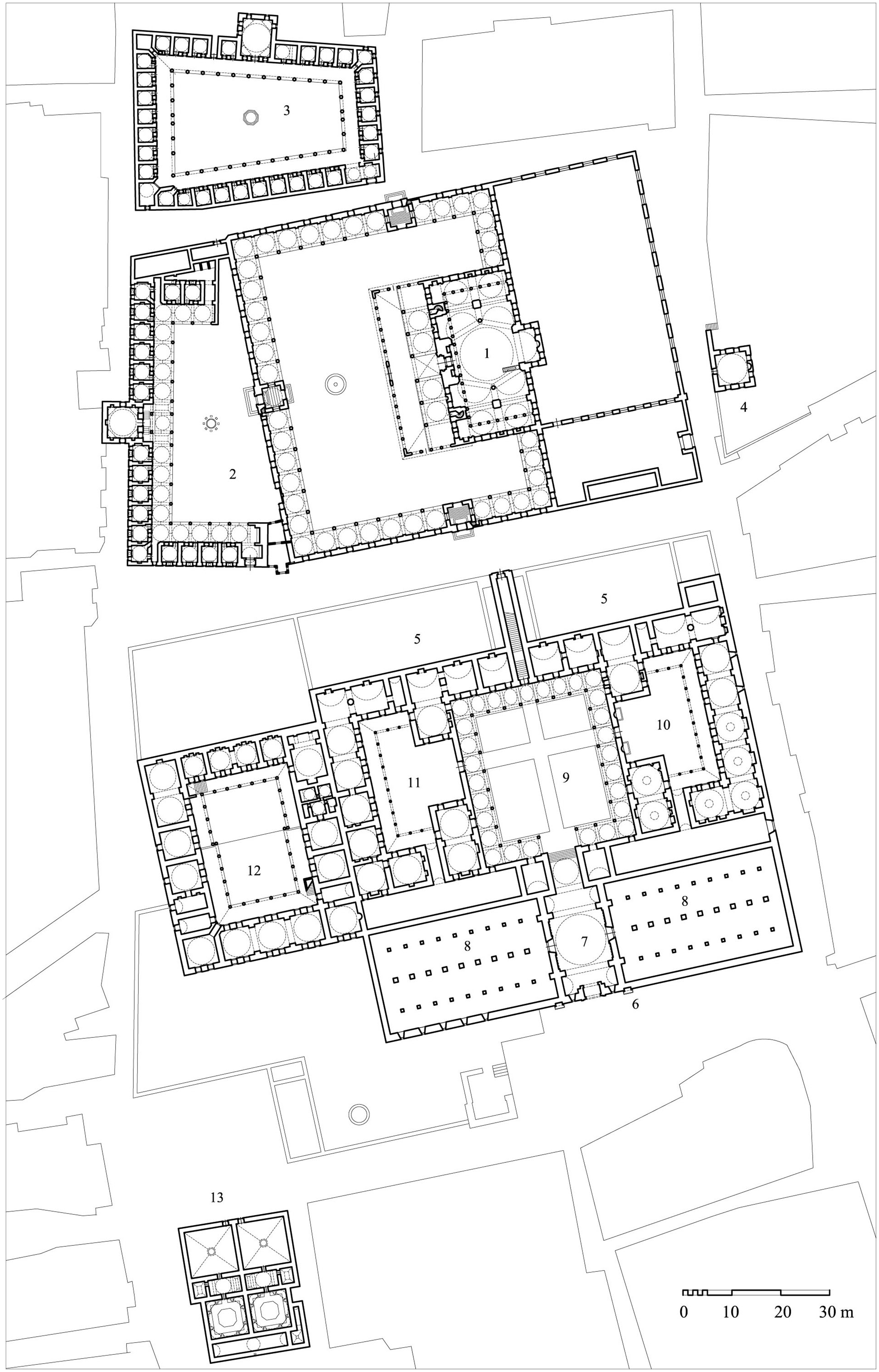
The Suleymaniye Mosque Complex (1548–1549) was designed as a grand center of higher learning dominated by five madrasas, and one medical school (Figure 2). The geographer Mehmed Aşık compares the five madrasas to the five pillars of the Islamic religion.
17
In the endowment deed, it is stipulated that the madrasas were built for “strengthening the right religion and the upright Shari’a.” After its completion, the Suleymaniye became the most competitive center of Islamic learning, ranking even higher than Mehmed the Conqueror’s eight madrasas.
Floor Plan of the Suleymaniye Mosque Complex.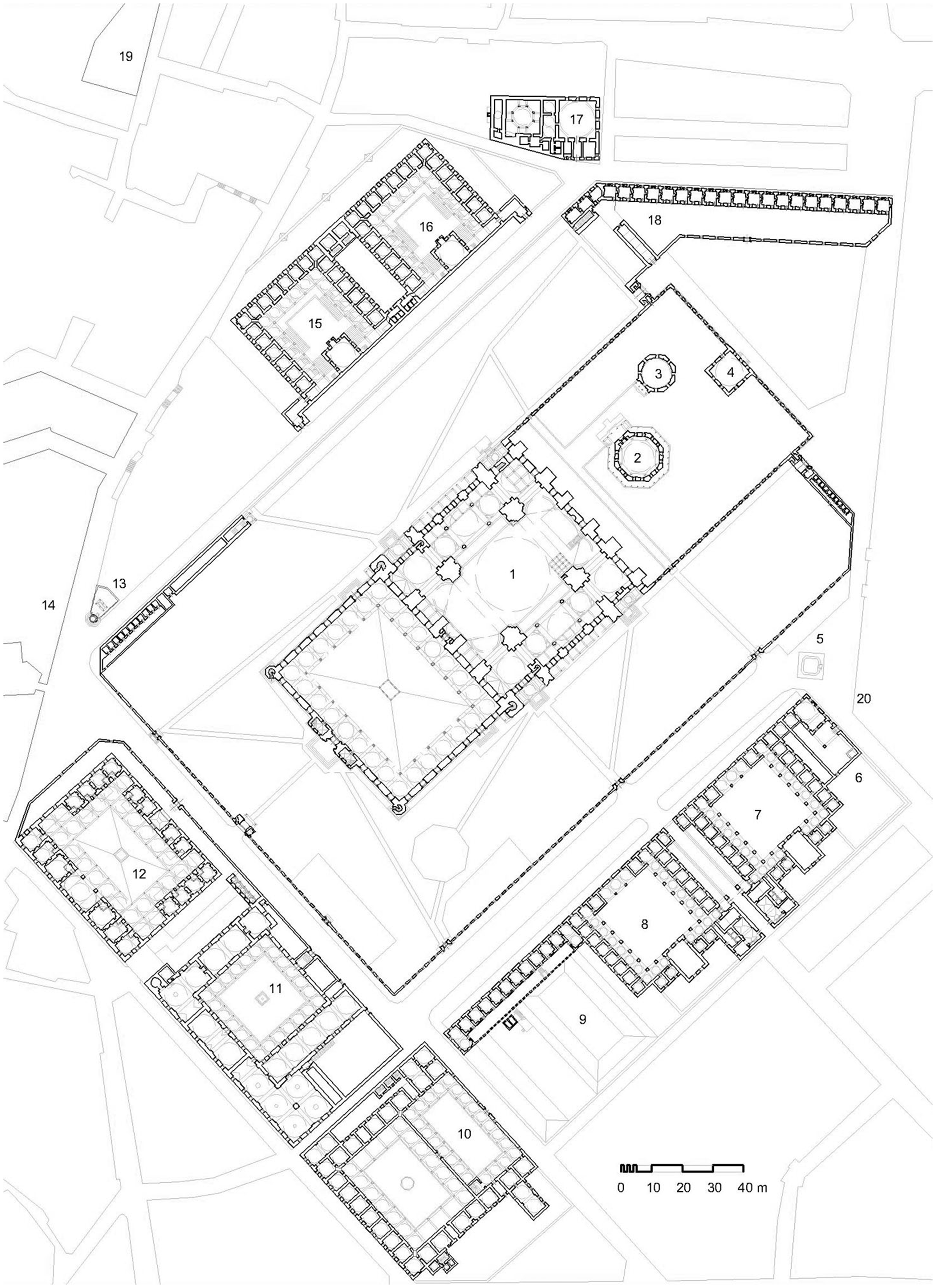
The charitable complex of Suleyman is perhaps the most monumental work of Ottoman beneficence. The Suleymaniye Complex’s annual income was a dizzying 894,576 akçe. 18 However, the percentage of income dedicated to the hospital was only 13% of this figure, amounting to 116,295 akçe. By contrast, Hurrem allocated a full 40% of the income of her foundation to the upkeep of her hospital. This amounted to 94,680 akçe, which is quite comparable to that of Suleyman. Evidently, Suleyman was more interested in establishing a medical school rather than a general hospital. The Suleymaniye’s endowment deed is replete with the conditions concerning the establishment of a splendid institution of higher learning. The building displayed considerable grandeur. 19 As for its faculty, it was to be chosen from the most qualified medical scientists, duly imbued with “the wisdom of Plato, Aristotle, and Galen.” 20 These professors had to be proficient “not only in the field of teaching but also in the requisites of healing.” 21 They were expected to choose and train the best students and assistants and instill in these young minds the highest level of effort to master “the practice of medicine and grasp the wisdom of science.” 22 To make sure that the medical students and assistants did not slack off in their studies, Suleyman instituted the position of Noktaci, a staff member whose duty it was to oversee the students in their scholarly pursuits.
Suleyman’s main concern clearly was to promote the science of medicine rather than the art of healing, which, in turn, was Hurrem’s primary interest. According to Peçevi, the Sultan appointed as the head of the medical school the renowned Tabib Ahmet Çelebi at a daily compensation of 60 akçe, a fabulous salary.
23
By contrast, the head of the three-tiered hierarchy at the hospital, the head doctor received 30 akçe while the second and third doctors received 15 and 10 akçe, respectively. The stipulations in Suleyman’s endowment deed with regard to the qualifications of these medical professionals were expressed strictly in terms of technical proficiency. More specifically, the endower required only that the doctors be: … superior in the theory and practice of the science of medicine; competent in making diagnoses, in administering medicine, and recognizing and improving patients’ conditions; skillful in patient management; capable of handling emergencies as well as ordinary cases; high ranking in matters concerning the benefits, uses and preparation of medication; highly cognizant in various kinds of pain, types of illness, severe bone breaks, and any kind of symptoms; expert in counting the pulse, reading urine, and treating crises; proficient in total and partial anatomy; qualified in intellect and keen in the five senses; renowned in prowess of perception, insight, experience, and circumspection.
24
Sultan Suleyman seems more interested in providing the empire with physicians competent in the science of medicine. Perhaps he was looking for a cure for his illness and even to find a way to reverse the clock. His focus on scientific and medical education is more research-oriented. Suleyman wanted his hospital to be a center for cutting-edge medical techniques, and breakthrough scientific discoveries. His patients were usually the least likely to recover, and thus gave themselves, voluntarily or not, to the pursuit of medical knowledge. That Suleyman does not specify any of the humanitarian qualities sought by Hurrem does not mean that his hospital was a cruel place. It merely suggests that he was more interested in supporting cutting edge science and experimental research. Most of the patients who turned themselves into the Suleymaniye hospital must have known that their condition was grave. In contrast, Hurrem’s hospital served as an outpatient medical center devoted to healing above research. Patients who came to the Haseki hospital believed they had a real chance for survival and recovery. Hurrem chose to focus her attention on holistic treatment. In contrast to the Suleymaniye, the Haseki was a light-filled, airy space where patients were treated with impeccable bedside manners, personalized medicines and fortifying foods.
In sum, Ottoman subjects had two separate but equally complimentary and necessary options in receiving medical attention. They were able to choose between the Haseki and the Suleymaniye hospitals, each devoted to its own approach in the promotion of healthcare.
Footnotes
Declaration of Conflicting Interests
The author(s) declared no potential conflicts of interest with respect to the research, authorship, and/or publication of this article.
Funding
The author(s) received no financial support for the research, authorship, and/or publication of this article.