




Abstract
In 1905, William Osler was the pre-eminent physician in American medical circles but was unknown to the general public. The latter suddenly learned of him through damning newspaper accounts of his address announcing his retirement from the Johns Hopkins Medical School. In it Osler mentioned two “fixed ideas” he held—(1) that most major advances in civilization have been made by men under age 40 (the “fixed period”) and (2) that those over 60 should retire because they create little of significance and sometimes stifled the initiatives of younger colleagues. He highlighted the second idea with a Victorian novel describing a mythical society which chloroformed men at age 60. He never imagined that this literary allusion would be taken as a serious solution for his second idea. However, countless newspaper articles ridiculed the first and condemned him for the second. Scurrilous press attacks on him continued for several months and resurfaced occasionally thereafter. The extent of the public approbation can also be found in poems and stories linking him with euthanasia. Also discussed here are the sources of Osler’s equanimity in the face of such public derision and the inner drives which accounted for over 1300 publications by him—nearly half of which were composed after age 40.
Introduction 1
In February of 1905, William Osler (1849–1919) announced his retirement as Chief Physician from the Johns Hopkins Hospital in Baltimore to become the Regius Professor of Medicine at Oxford. In his valedictory address he mentioned two ideas which were reported in American newspapers the next day and which provoked an immediate public outcry and a personal crisis for him. 2 The first idea was that most great advances in civilization are made by men under the age of 40, who afterwards added little to “the sum of human achievement”. The second idea concerned “the uselessness of men above the age of 60”. 2 Osler argued that old men should retire (or be retired) and cited a fictional society that chloroformed the elderly at 60. He was then age 56 and may have included the latter idea in jest to help soften his departure from his many Hopkins friends.
Osler was raised and educated in Canada and gained medical renown in the English-speaking medical world while a professor in Montreal, Philadelphia, Baltimore, and later Oxford.3,4 He wrote broadly on clinical and humanistic topics, as evidenced by over 1300 entries in his bibliography. 5 However, when he died in 1919 at age 70, an obituary in The Literary Digest stated that he “was practically unknown to Americans at large until 1905”. 6 His valedictory address made him widely famous overnight.
The address
Osler announced his decision to leave Baltimore for Oxford on Wednesday, 22 February, during the annual founding day celebration of Johns Hopkins University. 7 A procession of 700 dignitaries and a standing audience filled McCoy Hall at the Homewood Campus, North Baltimore. He was awarded an honorary doctor of law degree, and the occasion was declared “Osler Day”.
In his address he confessed to “mingled feelings of gratitude and sorrow” for leaving the Hopkins after 16 years of an “exceptionally happy life” in Baltimore to take up new work in Oxford. 2 He maintained that professors should never stay too long at any one school to avoid becoming “stale and thin mentally” and suggested that a “teacher’s life should have three periods—study until 25, investigation until 40, profession until 60 [and then retirement] on a double allowance”. Osler commented that recently he had “felt the need of more leisure”.
Early in his talk he mentioned the “two fixed ideas” he held—one being that the major achievements in science, the arts, and literature were made mainly by men younger than age 40. In 1900, he had previously written, “Men above 40 are rarely pioneers, rarely the creators in science or in literature”. 8 In the Homewood address he reiterated that “the real work of life is done before the fortieth year”, i.e. during “the fixed period”.
His second idea was that men over 60 make few significant contributions to civilization. Because of their set ways and notions, they may unconsciously hinder the initiatives of younger colleagues. Thus it would be of “incalculable benefit” if most men stopped work at age 60. 2 He noted that in ancient Rome, men of this age were not admitted to suffrage (could not vote) and that in certain “wise states” they were “precipitated from a bridge”—i.e., killed.
Here, he also had in mind a short novel by the Victorian author Anthony Trollope (1815–1882), entitled The Fixed Period (1881)
9
(Figure 1). Its story was set in a mythical country whose leaders were concerned about the elderly who could not or would not work and needed to be saved from “the horrors of poverty”. Upon reaching their 67th birthday, all citizens entered upon a year of restful reflection in a college campus-like setting and at age 68 were euthanized by venesection in a warm bath, eased by morphine. Osler did not recall the exact details of the novel and wrote instead of a peaceful departure of men with chloroform at age 60.
Anthony Trollope: The Fixed Period. 1881.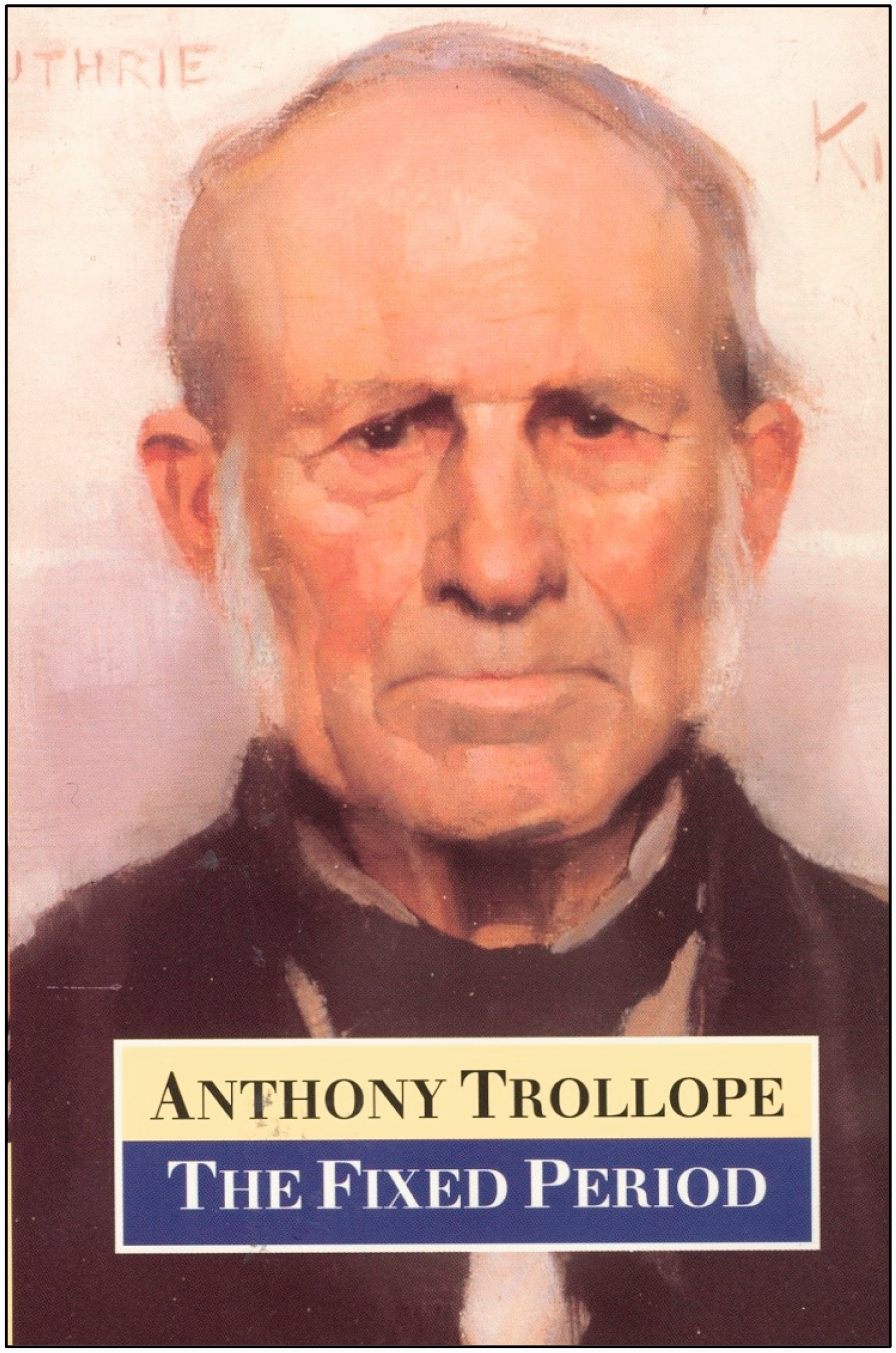
He never imagined that this literary aside could be considered a practical solution for his second concern about sexagenarian professors. But some members of the audience focused on these two ideas over the rest of the address. Newspaper headlines declared that Dr. Osler regards “Men Useless After Forty” and that “Osler Recommends Chloroform at Sixty”. Almost daily for the ensuing several weeks he was reviled in the press throughout the country.
Osler’s prominence in the medical world of Baltimore made his pending move to Oxford of special interest to the local press, which covered the ceremony. A summary of the talk was dispatched to newspapers throughout the country and Canada but was edited to provide arresting headlines and text. Most articles challenged his view about the waning creative potential of men over 40, highlighted his allusion from Trollope’s novel about chloroforming the elderly, and covered little else in the 19-page address.
Early press reports
The text of Osler’s address was published in full in the Baltimore Daily News on 22 February 22. 10 On the 23rd, The Baltimore Sun printed a four-column spread entitled “Hopkins Honors Osler” but buried on page 4 a short article asking, “Are Old Men Useless?” 11 On its front page, The New York Times (NYT) of 24 February reported the reaction of a Hopkins scholar to the idea of chloroforming elderly men. Basil Lanneau Gildersleeve (1831–1924), a renowned Professor of Greek and then age 73, had attended Osler’s address and declared to a reporter, “I am very glad nobody thought to chloroform me 13 years ago”. 12 On page 6 was an article entitled “Old Men at Forty”, which summarized Osler’s two fixed ideas. It listed the half dozen medical greats cited by Osler to support his notion that “the moving vitalizing work of the world” is done by men before the age of 40. But the NYT writer found the list “too slender a basis” for such a generalization and instead touted the achievements after age 50 of Cromwell, Columbus, and Mohammed. 12
During that first week, damning articles and letters to the editor continued to appear frequently in The Baltimore Sun [25–28 February] and The New York Times [24 February–2 March].13,14 Associated Press dispatches linking Osler and euthanasia by chloroform appeared on the front page of newspapers in St. Louis, Minneapolis, Los Angeles, San Francisco, and scores of cities elsewhere. The article which quoted Professor Gildersleeve seeded the specter of being forced to inhale chloroform at age 60 into the minds of gullible readers.
The NYT of 26 Feb. noted that a 71 year old Confederate veteran had shot himself and among his papers was found a clipping of Osler’s address. 15 And on 1 March, the NYT reported that on 28 February an aged scientist in St. Louis “chloroformed himself to death … after reading Dr. Osler’s lecture on the inferiority of old men”. 16 For a time, “to Oslerize” became a byword in the popular press meaning to euthanize aged persons. The acronym SPCA (Society for the Prevention of Cruelty to Animals) was jokingly referred to as the “Society for Prevention of the Chloroforming the Aged”. 17
The NYT of 2 March contained a lugubrious poem entitled “Usefulness”, which began, Suppose my hair is brown and yours’s gray; Suppose my powers grow and yours decline; What solemn sciolist* shall dare to say That your avail in life is less than mine.
18
* (one of superficial learning) We are chloroforming Grandpa / In our laboratory snug,
Cartoon… Life (1883–1936), 9 March 1905, p. 287. Cartoon… Life (1883–1936), 9 March 1905, p. 287. For we’ve been to Dr. Osler, / Who has furnished us the drug. Grandpa hates asphyxiation / And is kicking up a roar; Though he ought to die contented, / Since his useful days or o’er.
20
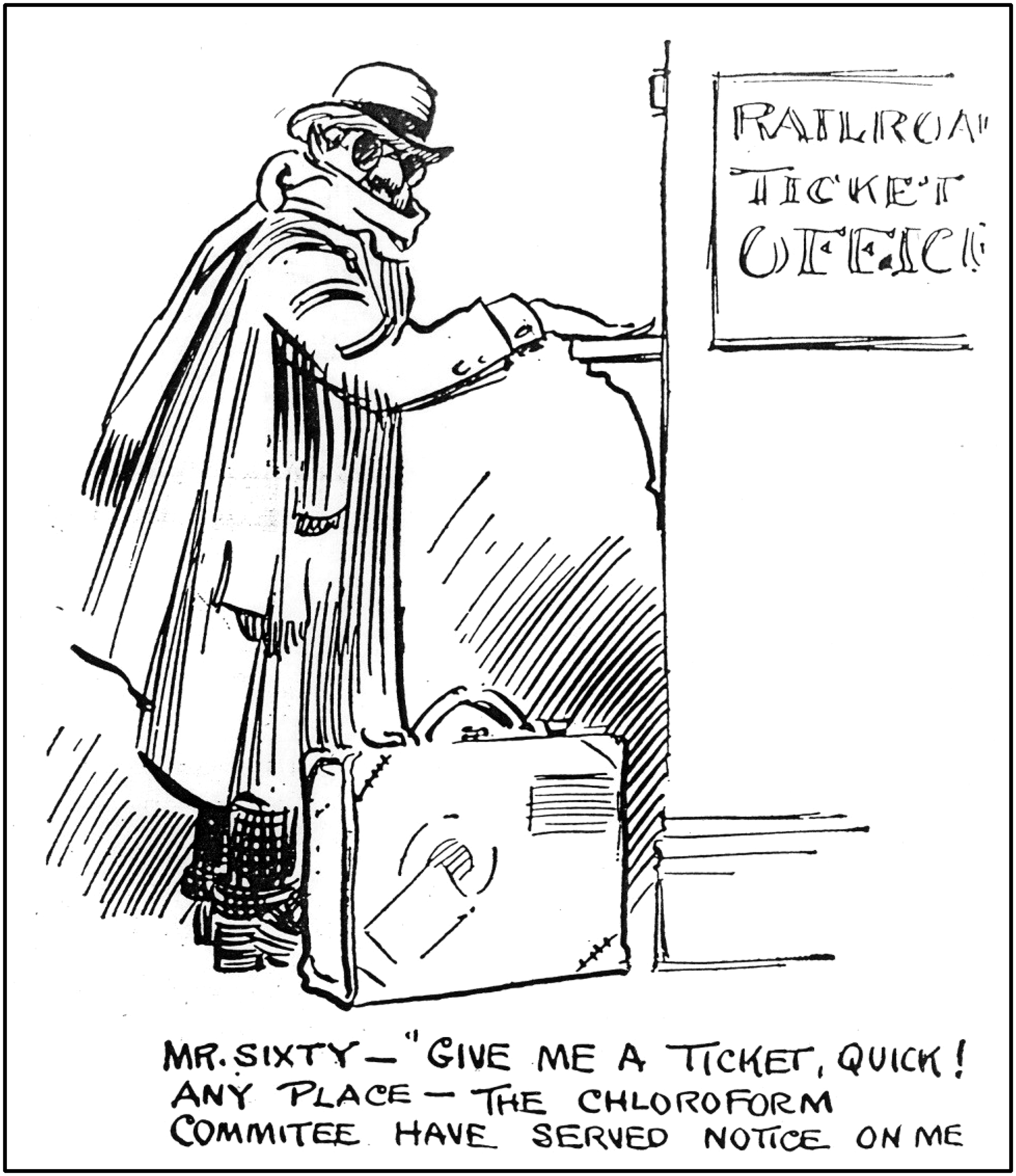

The aftermath and later press reports
In Baltimore through the spring of 1905, Mrs Osler had kept hostile letters and telegrams from her husband but could not prevent him encountering scurrilous newspaper articles. There was “no question but that he was sorely hurt”. 21 In mid-March, while suffering supposedly from influenza, Osler went to recuperate in Atlantic City, registering under an assumed name at an obscure hotel and perhaps seeking solitude and strength to revive his spirits. 22 Months later, he reflected on his encounters with the American press, “It is not pleasant to awake in the morning and find yourself, not famous, but infamous”. 23
Osler and his family arrived in Oxford in May 1905. There he escaped the scandal-seeking American newspapers, which never seemed to forget the controversial part of his February address. For example, when his mother died in 1907, a few months after her 100th birthday, “One tasteless American Newspaper obituary observed that she had survived to a hundred because her son had not chloroformed her”. 24
In 1909, the Osler-chloroform connection appeared in a report about a curious happening in the prairie dog enclosure at the Bronx Park Zoo. For years the colony had maintained a stable population of around 50. These animals generally live for about five years. Each year 12 broods of 3–5 pups were raised. Yet the keepers never found a dead prairie dog there. Old and enfeebled ones simply disappeared, presumably done away with by younger ones in the colony and buried at night out of sight of the keepers. One morning a large crowd of visitors had gathered around the enclosure, watching a group of prairie dogs attacking an older one, while others were digging a hole in the corner of the corral. In time the old dog stopped resisting and “pulled himself over the ground toward the hole,” into which it tumbled and where it lay quietly. Those above began filling in the hole, and soon the old one was covered with two feet of dirt. The article describing the burial ended with “The principle attributed to Prof. Osler that old age had better be avoided by chloroform, is put into practice by the prairie dogs”. 25
The association of chloroform with Osler reappeared in US newspaper articles when he was elevated to a baronetcy in 1911 and upon his death in late December 1919.26,27
Osler’s Rebuttal and Defense
In a short note to the NYT of 25 Feb, Osler reaffirmed his views about the waning usefulness of men after age forty and found “disgraceful, this fuss that the newspapers are making about it. I know there are exceptions, but they only serve to illustrate the rule”. “After forty a man can lead a useful life as a citizen and he can make money, but making money is not the great work that tells.… The work that counts is the essential, fermentative, vitalizing creations of the mind, and history shows that men under forty have done the best and the largest part….” 28
Osler bolstered his contention that new ideas were rarely advanced by men over the age of 40 by quoting William Harvey (1578–1657), who “did not think any man above 40 years of age had accepted ‘the new truth’ about the circulation of blood”. 29 But William A.N. Dorland (1864–1956), famous for his medical dictionary, wrote a critique in 22 densely packed columns, which listed the many major discoveries and creations of 400 famous men well over the age of 40. 30
Osler’s second fixed idea that men should stop working at age 60—at least those in the sciences—had support from several in these fields. Charles Darwin (1809–1882) was troubled by “the opposition of old school geologists to his new views” and once remarked, “What a good thing it would be, if every scientific man was to die when sixty year old, as afterwards he would be sure to oppose all new doctrine” 31 When Thomas H. Huxley (1825–1895) was obliged to retire from his professorship at age sixty, he was reminded that several years before he had declared “men of science ought to be strangled” at that age. 32
Osler was also likely mindful that older men with professional stature sometimes make dogmatic pronouncements which might deter young men from exploring new avenues. For example, in 1902 at age 78, Lord Kelvin (William Thomson, 1824–1907) asserted that “no balloon and no aeroplane will ever be practically successful”. 33 Rudolph Virchow (1821–1902), the founder of cellular pathology, opposed all specificity in disease and walked out of the 1882 meeting of the Berlin Physiological Society, where Koch’s first presented his discovery of the tubercle bacillus. 34 Years later, in the face of considerable contrary evidence, Robert Koch (1843–1910) insisted that bovine tuberculosis was of negligible danger for people. 35 There are countless similar examples of erroneous notions held by senior leaders in their fields.
The driven Osler
While Osler made no major advances in medicine, during his 20s he worked on several important biological phenomena relevant to it. He speculated that platelets were involved in clotting and was among the first to describe phagocytosis (before Metchnikoff) and to postulate its significance in protecting the body from outside agents. 36 Many of his bedside observations advanced clinical medicine. When confronted with having completed Principles and Practice of Medicine (1892) at age 42 (after the “fixed period”), Osler explained that the research and reflection for it had been done in the several decades before. Apart from the successive editions of this popular text, he published about 1345 articles, essays, and short treaties—almost all of them being single-authored. Around 661 works (49%) were written when he was past age 40, and of these 149 (11%) were composed after age 60. This analysis was derived from his publications listed in Golden and Roland: Sir William Osler - An Annotated Biography. 5
During his final 14 years at Oxford, Osler continued as a spokesman for modern medicine and medical education. He cautioned the public about tuberculosis and venereal diseases and challenged the anti-visectionists and anti-vaccinationists. He regarded teaching as “the most useful and important work” he had done. 37 It was through his students and in his many essays that he spread a humanistic approach to caring for the sick. Finally, he promoted medical history and libraries and amassed an immense collection of ancient and seminal medical works (c. 8000 volumes) which now resides in the Osler Library at McGill University. 38
Osler’s philosophy of life
In 1898, when Osler had moved from the University of Pennsylvania to Johns Hopkins Hospital and Medical School, in Philadelphia he had delivered an earlier valedictory address in which he recommended the philosophy of aequanimitas, or fortitude in the face of petty annoyances, disappointments, misfortunes, or sorrows. 39 He experienced only two such major instances that we know of. The newspaper attacks in the spring of 1905 were blows to his self-image, but more searing to his whole being was the death of his only son, killed at the Battle of Ypres (W. Flanders) in Oct 1917. During Osler’s final illness in 1919, he reflected, “Except in one particular I have had nothing but butter and honey”—referring to Edward Revere Osler’s death while forgetting the 1905 fracas in the press. 40
Osler’s equanimity in the face of these several major emotional trials has invited speculation about his religious beliefs, personal philosophy, and literary drives. 41 He wrote that three ideals guided his daily life: (1) “to act on the Golden Rule towards his professional brethren and patients”, (2) “to cultivate a measure of equanimity to enable him to bear success with humility, affection of his friends without pride, and when the day of sorrow and grief came to meet it with the courage befitting a man”, and (3) “to do the day’s work well and not bother about tomorrow”. 42
Osler’s early religious outlook stemmed from his childhood teachers and the Bible but also from a deviant work he had discovered in his late teens. Religio Medici (1643) was written by Sir Thomas Browne (1605–1682), an English polymath and critic of medicine. This pocket-size book (3.5 × 5.5 inches) of 297 pages ranges widely over hell, purgatory, the planets, snails, toadstools, and many other things (Figure 4). It was a best seller in the 17th-century Europe, perhaps because it sought to “to combine daring skepticism with humble faith”.
43
His first copy of Browne’s work was a prized possession and lay on his coffin during his funeral.
Th. Browne. Religio Medici, 5th edn, 1659.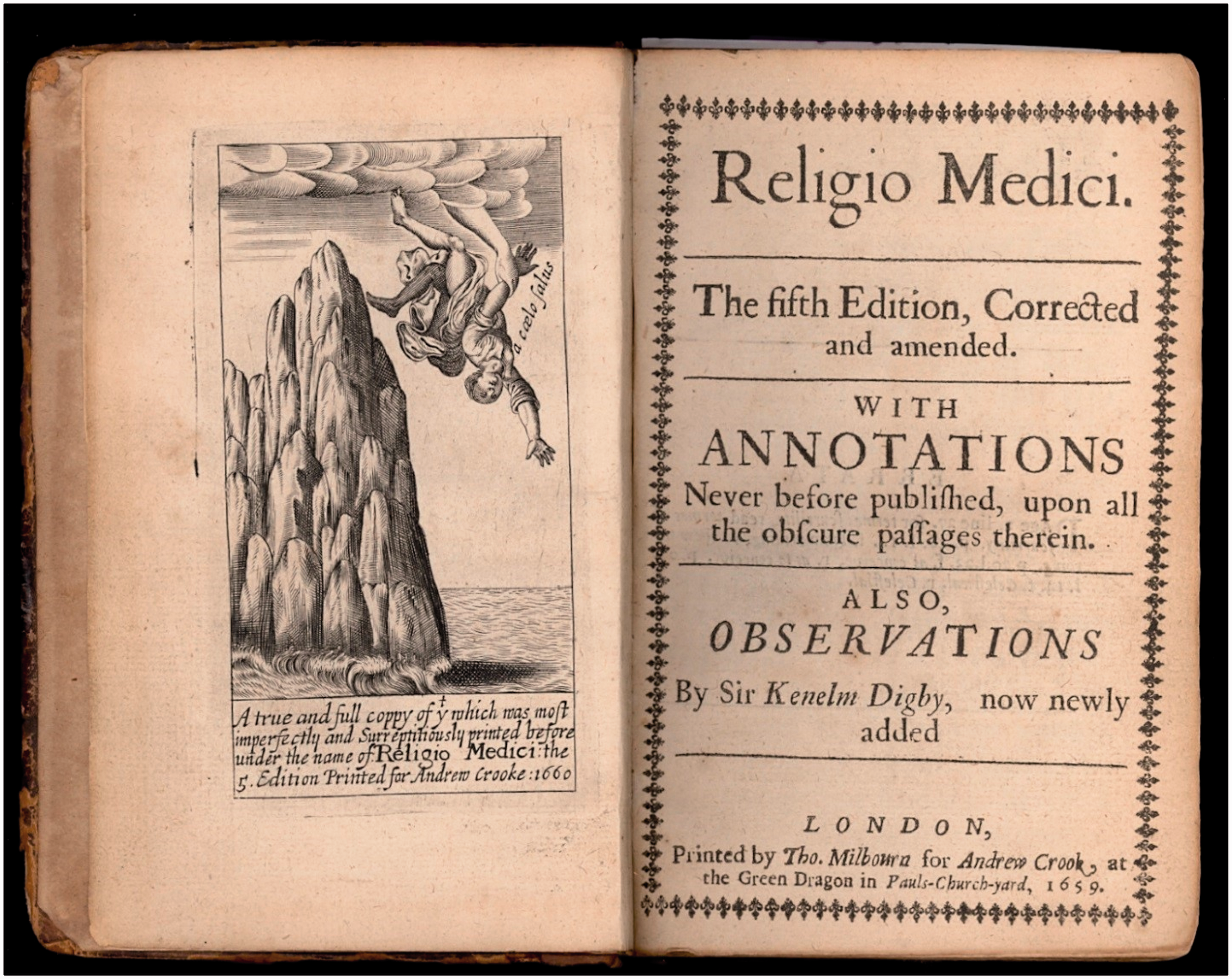
While the sources of Osler’s later religious beliefs can only be surmised, those of his productive career can be more firmly inferred. His commitment to medicine, as reflected in his prodigious writings, may have been spurred by a trio of ideas or influences—the first being that “master-word is Work”. 44 This expresses the philosophy of Thomas Carlyle (1795–1881), a Scottish historian and essayist, which Osler paraphrased elsewhere as “Your business is not to see what lies dimly at a distance, but to do what lies clearly at hand”. 45 Osler eschewed religious and philosophical musings and focused on the immediate task. He advised cultivating “the habit of a life of Day-Tight Compartments”. 46
A second influence may have been Jamesian pragmatism—a middle ground between the two extreme approaches of European philosophy—idealistic–dogmatic vs. materialistic-skeptical. 47 Osler is reported to have confided to William James (1842–1910) that he was “fearfully conscious of time” and wished “he could buy more of [it]”. Michael Bliss, Osler’s most recent biographer, speculated that an “undertone of sadness … flowed from Osler’s understanding that there is no final escape from the oblivion of the grave….” 48
Finally, intimates of Osler also sensed in him a “melancholy disposition” and presumed it derived from his late-life interest in another 17th-century book—The Anatomy of Melancholy (1621), written by Robert Burton (1577–1640).
49
Burton was a cynic and don at Christ Church College. His rooms there may have been occupied by Osler 250 years later, or so he liked to believe.
50
The Anatomy—an octavo (7 × 11 inches) volume of 731 pages—is a medical treatise on the causes, symptoms, and prognoses of many of the 88 varieties of melancholy—including amorous and religious (Figure 5). Osler’s work ethics may have been influenced by a particular section of The Anatomy where Burton railed against inactivity.
Robert Burton: The Anatomy of Melancholy, 4th edn, 1632.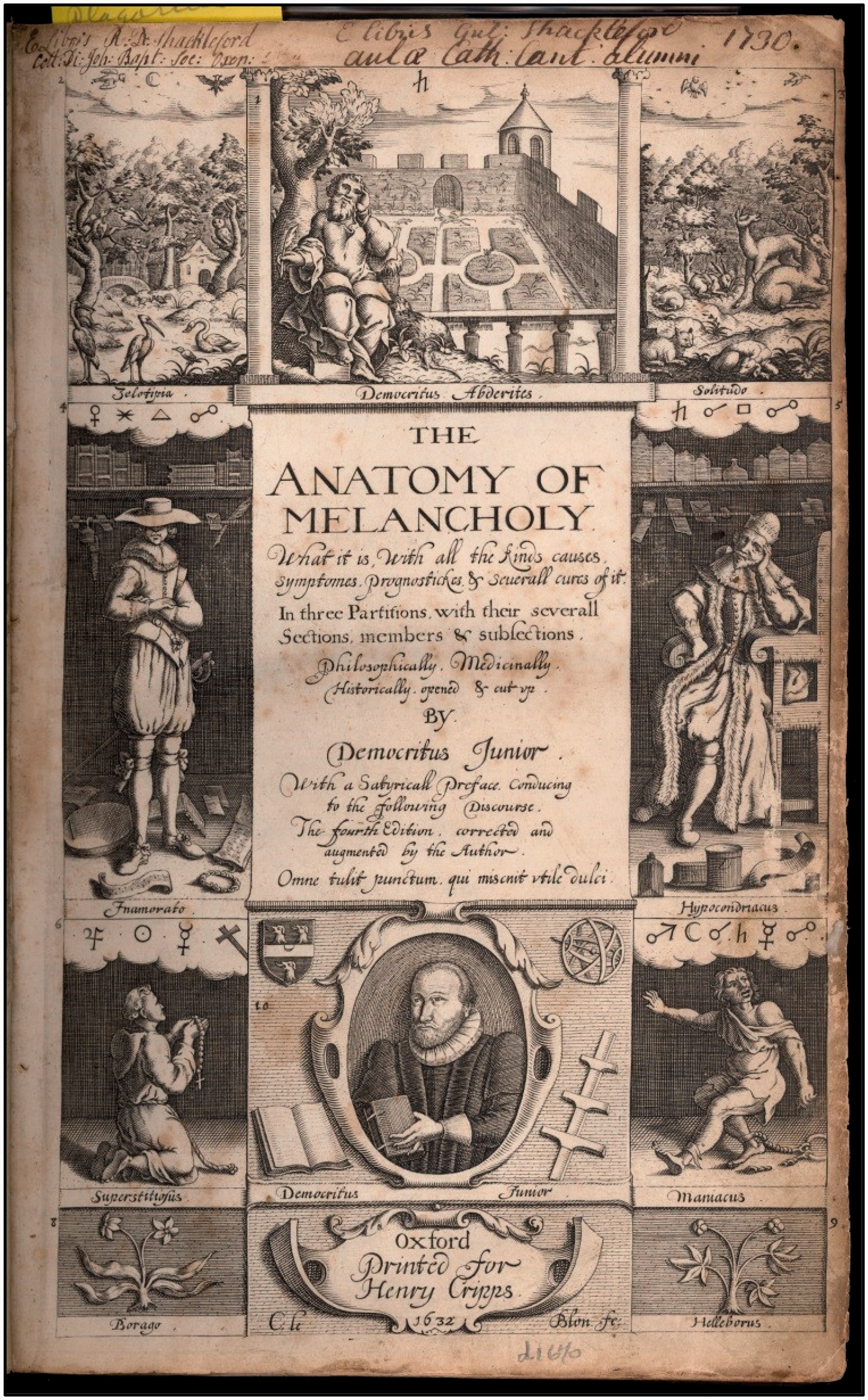
Conclusions
Osler’s outward equanimity came from his being fully occupied with family, friends, students, his medical practice, writing, and books. His inner life followed the cautious advice on the final page of Burton’s long treatise on melancholy: “…observe this short precept, give not way to solitarinesse and idlenesse. Be not solitary, be not idle. Sperate Miseri, Cavete Felices”.
Footnotes
Acknowledgements
I am greatly indebted for the extensive bibliographic help by Mrs Amanda Williams, staff librarian of the Medical Center Library, University of Kentucky. Finally, I acknowledge the continued support of I.S. Tray II.
Declaration of Conflicting Interests
The author(s) declared no potential conflicts of interest with respect to the research, authorship, and/or publication of this article.
Funding
The author(s) received no financial support for the research, authorship, and/or publication of this article.