



Abstract
Hans Emmanuel Enoch (1896–1991) was born in Hamburg, the son of a manufacturer of sera and vaccines. Upon his father’s death, he took charge of the Hamburg Serum Werke. Following the rise of Hitler, he came to be pilloried in the Nazi press for allegedly having poisoned the population of Hamburg and was imprisoned for a time. He immigrated to England in 1935 where he had secured a position with the International Serum Company in Norwich. Following the outbreak of war, he was interned as an enemy alien, eventually ending up in Canada. In 1941, he was permitted to return to England, but wartime conditions prevented him from continuing to manufacture sera. At about this time, penicillin was making the headlines, and coupled with accounts of its miraculous properties, was the news that all production was reserved exclusively for the armed forces. Enoch decided to meet the public clamour for penicillin by producing a crude version which he termed ‘vivicillin.’ News of this spread globally, and he came to incur the disdain of Howard Florey for the attendant publicity. Notwithstanding this, vivicillin was to prove itself effective and its use led to the saving of lives.
Early life, military service and career
Hans Enoch was born on 5 August 1896 in Hamburg. At first he attended the Wilhelm Gymnasium there but later, at the age of 13, was sent to the Gymnasium in Cuxhaven. Following the award of his abitur in February 1915, he was called up for active service with the 5th Guards Field Artillery Regiment. In November of the same year, his regiment left for the Eastern front where he was assigned to the telephone and observation service. This comprised having to establish and maintain an observation post in the foremost trench and connecting it with the battery position by means of a telephone wire. These lines were frequently destroyed through shelling, and under such circumstances, it fell to Enoch to conduct repairs. To do this required having to crawl out into open country, usually at night time, but occasionally in daylight when he would come within sight of the enemy. During one expedition to repair telephone wires, a comrade of Enoch’s was hit by gunfire. Enoch crawled over to him and dressed his wounds before returning to his own lines to request a stretcher party to recover him. He accompanied the stretcher bearers and successfully recovered the wounded man. For this feat, Enoch received the Iron Cross. In May of that year, Enoch himself came to be badly wounded by artillery fire and he narrowly avoided having his right leg amputated. Following his recovery, he was transferred to a reserve unit of his regiment before being discharged from military service in June 1918. It was then that he was awarded the Iron Cross, First Class, for service with his regiment.
It is fitting to mention here that Hans Enoch’s obituary 1 spoke of his having ‘led a charmed life.’ In addition to surviving the events described above, once on a flight from Frankfurt to Hamburg in 1928, the aeroplane he was on crashed shortly after take-off, breaking into two and catching fire; he escaped with only minor injuries.
Having been discharged from military service, he had resolved to study Medicine and Chemistry at Heidelberg University. He passed his pre-medical examination in May 1919 and then took the decision to undertake the clinical part of his medical studies in Hamburg, obtaining his MD in June 1921. He then went on to receive specialised training in bacteriology under Professor Hans Much who had himself served as assistant to Emil von Behring. At the beginning of 1922, Enoch started working at the Paul Ehrlich Institute in Frankfurt where he was assigned to Professor Heinrich Hetsch who was in charge of the government’s procedures for testing sera and vaccines.
In April 1922, shortly after the death of his father, Carl, Hans took charge of the running of the Ruete-Enoch Serum Laboratory which had been jointly established by his father and Adolf Ruete for the manufacture of sera and vaccines in 1894. The company was set up following the publication by Emil von Behring of a method for the production of diphtheria antitoxin serum, and for which he was subsequently awarded the Nobel Prize for Physiology or Medicine in 1901.
Hüntelman 2 has described the background in Germany leading to the imposition of strict regulations relating to the manufacture of diphtheria antitoxin serum to prevent sub-standard or even harmful products being dispensed to the public. State regulations came to be applied to all sera and vaccines. These involved securing batches of products with special seals and stencils to prevent their distribution until they had been assayed at approved institutes. Once they had met the required standards, an official was dispatched to remove the seals and allow the serum to be dispensed into ampoules for sale. These procedures came to be suspended during the First World War owing to a shortage of control officials. All of the equipment (i.e. stencils and pliers) used for the process described above were handed over to licensed producers for them to continue manufacture and dispensing during the period of hostilities.
The rise of the Nazis
The following constitutes what Hans Enoch refers to as ‘the darkest chapter of [his] life.’ 3 In November, 1932 Professor Glage who was in charge of the state control of veterinary products enquired of Enoch whether it was the case that he himself had been conducting the sealing of the various products which his company had been manufacturing. Enoch responded that he had, and that this was in accordance with a licence to do so that had been issued to his father’s company. In fact in 1919, Carl Enoch had been awarded the Iron Cross for supplying the German army with sera and vaccines. He was advised by Glage to obtain a copy of the licence so that this could be verified. On applying to the Public Health Department for it, they informed him that they had no record whatsoever of such a licence.
It emerges that the instigator of the original enquiry was an employee of Enoch’s, one Paul Glück. Glück had started working at the company under Carl Enoch who dismissed him when he discovered that Glück had been stealing oats intended for the horses used to produce sera so that he could sell them on the black market. On assuming control of the company, Enoch reemployed him on the understanding that he would conduct himself properly. However, Enoch discovered him deliberately presenting laboratory mice to a cat in order to derive sadistic pleasure from the inevitable outcome of this act, and he was once again dismissed. Glück had become a fanatical Nazi, and had sought revenge by approaching editors of Nazi newspapers.
An article appeared in the Hamburger Tageblatt on 25 November 1932 demanding Hans Enoch’s immediate arrest for forging the stencils used to seal ‘bad sera and vaccines’ which were subsequently sold, and which had caused numerous deaths both in Germany and in other countries. It was further alleged that he had sold contaminated meat from horses used to produce sera for human consumption and, in addition, that he had poisoned the water supply of Hamburg.
An even more virulent denunciation of Enoch appeared on the front cover of Der Stürmer, bearing the headline ‘Dr Hans Enoch, the poison mixer of Hamburg’ (Figure 1). Enoch served as a target for Julius Streicher, the editor of Der Stürmer, on two counts. Firstly, he was a Jew, and secondly he belonged to the medical profession. Streicher was opposed to modern medicine and the head of one of Germany’s most prominent organic health movements.
4
Moreover, serum production was, of course, centred on blood which would have evoked in Streicher’s mind connections to the long-standing blood libel accusation against the Jews.
The front page of Der Stürmer, December 1932.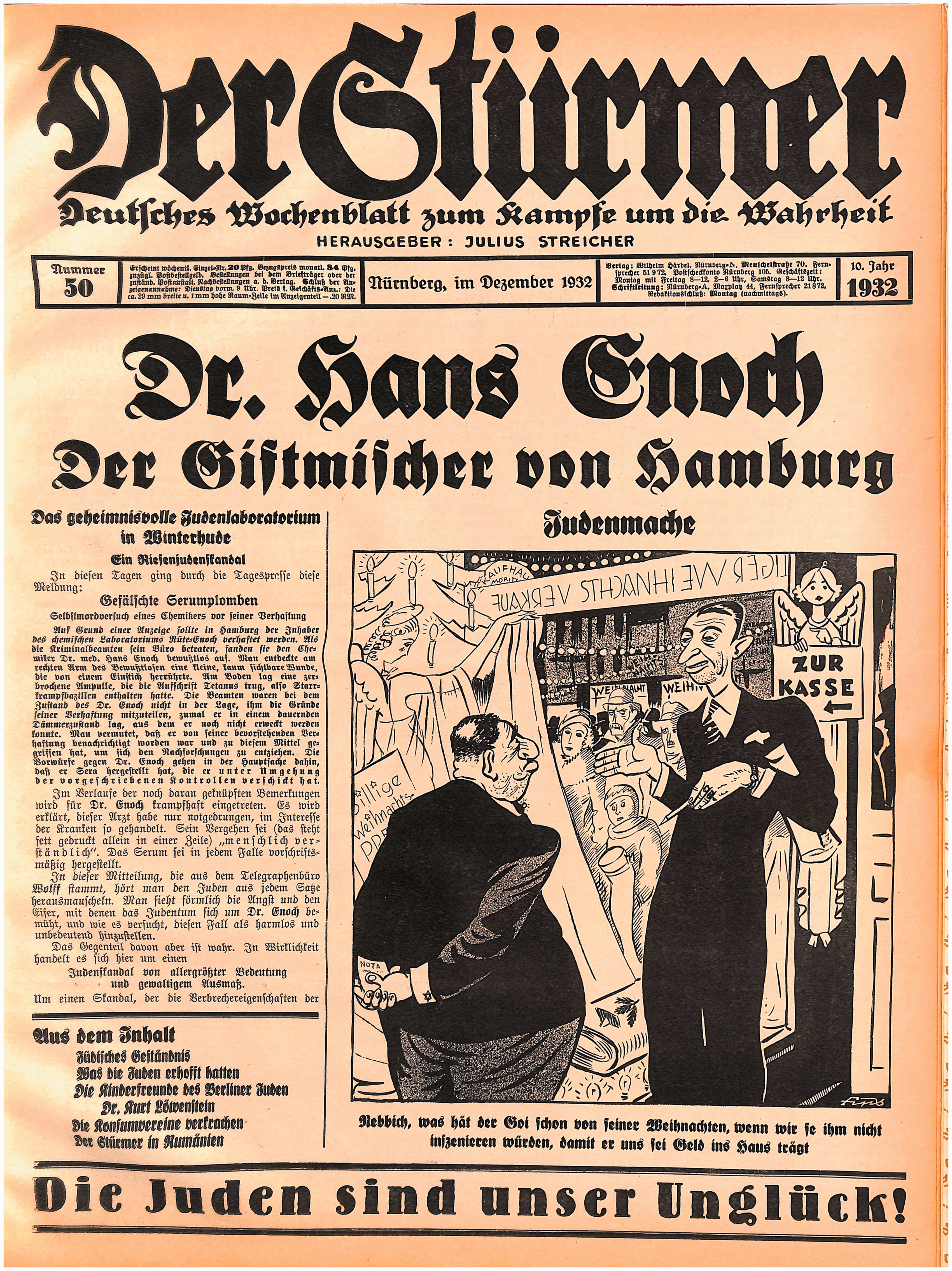
Following the appearance of these articles, two detectives appeared at the laboratory to arrest him. Enoch became highly agitated, and in his desperation broke a small glass vessel containing tetanus toxin receiving a cut to his hand from a shard of glass. Enoch assured the detectives that they were not in danger, and he was subsequently escorted to the police station. Once there he declared that he had tried to commit suicide and refused to disclose the nature of the toxin. Various attempts from friends of his to persuade him to reveal its identity were made but he steadfastly refused to do so. His worsening condition led to his being transferred to hospital. Further investigations at the scene of the incident led to the discovery of a label bearing the word ‘tetanus’ on one of the pieces of broken glass. Enoch was then given a massive dose of tetanus anti-toxin of his own manufacture. His mother turned up at the hospital bearing with her a copy of the licence from the Public Health Department permitting his company to seal ampoules of sera which had been located at the premises of a pharmacist who had worked with the company during the war. However, the licence to conduct the testing, etc. had been issued in 1917 for a period of 10 years, and therefore Enoch was technically in breach of the agreement. The existence of the licence essentially disproved the charge that he had forged seals and the case was dismissed but he continued to undergo harassment. Now the imputations against him centred on his continued sealing of sera after the expiry of the licence. He was even again briefly re-arrested.
In January 1934, the case against him was brought to court, the charge being that he had forged seals so that he could pass off sub-standard sera for sale. Differences had been discovered between the type of seal which Enoch had used and the one that was currently being applied. In his diary, Enoch reproaches himself for not having sought out the licence to acquaint himself with its provisions. He accepts that he had breached the terms regarding the date of expiry but asserts that the design of the seals had been changed by the control authorities since his father had been officially provided with the sealing equipment. Glück claimed that he had seen letters from the Charité Hospital in Berlin to the effect that deaths had resulted from the use of his sera. However, the medical superintendent at the Charité refuted these allegations. As regards the quality of his sera, a number of professors, including Professor Hetsch, testified that the methods Enoch used were entirely sound and in keeping with officially approved methods.
Notwithstanding these refutations, and given the prevailing climate of the times, Enoch was convicted for ‘sustained forgery of documents.’ He was sentenced to seven months imprisonment; the term having been decided upon because as an ex-serviceman sentences of six months and below were automatically subject to an amnesty. Enoch describes the trial as ‘fair but the sentence as not.’ As he was not immediately imprisoned, he was able to visit old colleagues at the Paul Ehrlich Institute who advised him to serve out his sentence and then to leave Germany. During his time in prison, he came to be visited by a certain Major Delss who had informed him of an opportunity in England for him with the International Serum Company based in Norwich and formed by William Howes. Howes had originally trained as a veterinary surgeon but subsequently decided to establish a business for producing sera, vaccines and other pharmaceutical products for treating the diseases of animals.
Arrival in England
Following his release from prison, Enoch travelled to Norwich in November of 1934 to pay a visit to Howes. He was put off both by the heavy fog which hung over the town and by the primitive state of the production facilities he saw at the company’s premises. In his mind, he initially decided against joining them, but when he was apprised of the terms under which he was to be employed, which included a monthly salary of £40, the opportunity to purchase a significant portion of the company’s shares, the offer of a directorship in the company after 12 months and the provision of accommodation in Norwich, he accepted the position. Notwithstanding this, it was with ‘a heavy heart’ that he decided to leave Hamburg for England. It was on March 31 1935 that he, along with his mother and his aunt arrived, in England.
He quickly established himself in his new environment and took on the manufacture of a wide range of products including those which the company had previously had to source from abroad, and became in his own words his ‘own lab assistant and cleaner.’ He was prevented from producing sera because he was unable at that time to purchase the horses needed to do so. In addition to producing vaccines from standard cultures, Enoch commenced the production of autogenous vaccines, using bacteria isolated from samples sent to him by veterinary surgeons.
He felt impeded in his endeavours by the fact that most of the laboratory supplies he depended on had to be obtained from London. One of the practices he instigated was that of promptly dispatching products on receipt of orders. He frequently took them to the railway station at Norwich himself – this included late at night and Sundays and Bank Holidays. The company’s reputation rose as a result and this led to an increased turnover. While in Enoch’s opinion, the success the company was enjoying should have been welcomed by Howes, the latter began to feel that his position as Managing Director was at risk. Enoch learnt from the chief clerk that Howes had forbidden him from discussing the company’s finances with him. Enoch foresaw that his association with Howes was not destined to last for very much longer. Enoch started thinking about setting up a laboratory in London. He eventually found a suitable property in Hendon that could provide both living quarters, laboratory space and stabling for horses. Critically, the property was within easy reach of the railway network on which the efficient despatch of products was critically reliant. It was on 1 July 1937 that Enoch began production of sera in London. However, he did not break ties with Howes, and continued to supply the Norwich offices with various products.
Internment
Following the declaration of war with Germany, conditions for refugees in England steadily worsened. Enoch recounts how people whom he had formed acquaintanceships with would now turn their faces away if he encountered them in the street. Having installed two skylights in the roof of his property in Hendon, Enoch was visited by detectives from Scotland Yard investigating claims made by neighbours that he had been signalling to German planes during air-raids. On another occasion, he had to appear before a tribunal to provide assurances that he posed no threat to the water supply by discharging pathogenic bacteria into the drains as part of his sera and vaccine manufacturing activities. Then in June 1940, he was taken to Hampstead Police Station in what was to mark the beginning of his time as an internee. He was first transferred to Kempton Park Racecourse and from there to the Isle of Man where, he writes, that he felt himself in ‘a mousetrap’ in view of what was widely felt to be the prospects of a Nazi invasion of the British Isles. However, he contrived to change places with a fellow inmate who was to be transferred to an internment camp on the outskirts of Quebec, Canada. He experienced many of the tensions that existed between Nazis and Jews, all of whom were at this stage classified as ‘enemy aliens’ and were interned together, and which have been notably recounted by Peter and Leni Gillman. 5 There he was permitted to conduct prophylactic immunisations of fellow inmates. He was on one occasion summoned to appear before the Camp Commander regarding an outbreak of Malta fever that had broken out in Southern England among cattle that had received vaccines produced by him. He was also informed that a search of his laboratories had been undertaken by Scotland Yard but cultures of the causative agent of Malta fever, Brucella melitensis, had not been found, and the assumption was made that he had destroyed them to cover up the evidence. He was obviously able to convince his interrogators of his innocence, for he was treated to a meal in what he describes as an ‘elegant restaurant in town.’ Later in October 1940, a division was conducted of internees into two groups, ‘Gentiles’ and ‘non-Gentiles’ who were placed in separate camps. He ended up in a camp located in between Montreal and Sherbrooke. With time and as a more informed understanding of the true status and circumstances of internees was formed, he came to be categorised as Category C – i.e. those aliens considered harmless. Enoch made an application to be allowed to be released on the basis of his work on the production of vaccines and sera, and was interviewed by officials from the Home Office. He secured support for his case from the Society for the Protection of Science and Learning in Cambridge, and it was on 28 February 1941 that he found himself back on British soil.
Return to England and manufacture of vivicillin
Of his time in Norwich, Enoch wrote that he felt that ‘[his] work for human beings which was [his] true profession and [his] love had come to an end.’ His instincts were to resume the manufacture of sera for the treatment of human diseases. However, wartime conditions prevented him from doing so, as he found it impossible to purchase horses, or, indeed, even the fodder with which to feed them. But a fundamental change in the approach to treating diseases caused by pathogenic bacteria had occurred: the introduction of penicillin. News about penicillin first appeared in the press in 1942, and grew at an exponential rate throughout 1943. As a result of these reports, penicillin began to take on in the mind of the public the status of a panacea, but coupled to this was the news that all production was to be reserved for the armed forces. 6 It was at this point that Enoch decided to undertake its manufacture. He had received instructions on fungal cultivation from the distinguished mycologist, Hugo Plaut, 7 and managed to obtain the Fleming strain of P. notatum. How he did so is not made clear, but he had had contacts with the National Collection of Type Cultures in Colindale as a result of his serum and vaccine manufacturing activities, and it may be assumed that he obtained the culture through his contacts there. He produced two different products. The first he termed ‘vivicillin’ as it contained living hyphae of the fungus, and the second ‘pennotin.’ He provided these products to an acquaintance of his, Dr von Lustig-Lendva, a veterinary surgeon. Encouraging results were obtained in a variety of animals with vivicillin given parenterally and for pennotin applied topically.
The publicity surrounding vivicillin
Following the encouraging results obtained with animals, Enoch’s instincts were to extend trials to humans. He approached Major Delss who recommended that he consult with a certain Dr Kurt Wallersteiner. Wallersteiner proposed that they should jointly submit a manuscript on vivicillin to Nature, they did so and it duly appeared in print. 8
In late April 1944, Enoch received a call from the Press Association informing him of the imminent appearance of newspaper reports on vivicillin. It emerged that Wallersteiner had supplied them with information about it and had described himself as its co-discoverer. Enoch tried to persuade his caller to withhold publication but was informed that it was too late to do so. He was therefore prepared for press coverage but not for ‘the tidal wave’ of publicity that was to follow. He awoke the following morning to queues of cars parked outside his house, from which teams of reporters and photographers emerged. Enoch was averse to publicity but states that Lustig-Lendva, who had turned up at his premises, revelled in it.
It emerges that Howard Florey had been contacted by the press for his views on vivicillin. Florey’s attitude to the press was one of mistrust, and his avoidance of reporters was legendary.
9
He described vivicillin as an ‘absolute racket’ and went on to state that ‘in the state of communications existing at present this story will be round the world.’
10
In a letter to Professor Garrod, who held the post of City Bacteriologist for London Florey wrote that it reminded him of a scandal he encountered in Beirut where French technicians were selling ampoules of what they alleged was penicillin at £5 per ampoule.
11
Florey was to be proved correct in his prediction of the extent of media coverage of news about vivicillin. In addition to accounts in the national presses were those that reached the most remote corners of primarily – but not exclusively – the English-speaking world through the medium of local newspapers. Merely setting down a selection of American titles illustrates the point; Moorhead Daily News, Tucson Daily Citizen and the Naugatuck Daily News, the latter appearing between May 10 and 11 1944. It is remarkable how in an age before the internet news about vivicillin came to be spread with such alacrity! The image shown in Figure 2 came to be reproduced in scores of newspaper articles.
Hans Enoch engaged in the manufacture of vivicillin (Image courtesy of Charles Enoch).
Lustig-Lendva 12 went on to publish a paper on the results he had achieved in treating animals with vivicillin. Lustig-Lendva is the sole author but an acknowledgement of Enoch’s distaste concerning the ‘premature publicity given to Vivicillin … without his knowledge’ appears at the end of the article. Amongst the animal cases mentioned in the article is that of a ‘Pathologist, aged 47’ who had contracted swine erysipelas: this was in fact Hans Enoch. The stories that came to appear in the press were that Enoch had made himself a ‘human guinea pig’ 13 by deliberately infecting himself with a culture of the causitive agent. The fact was that he had accidentally infected himself in the course of his work. His condition was completely cured by treatment with vivicillin. Also included in these reports was the case of a boy suffering from haemophilia and who had contracted peritonitis and lay dying in hospital but who was cured by vivicillin. The surgeon who treated him, Dr Seager of the Wellhouse Hopsital in Barnet, issued a statement that while ‘encouraging results’ had been obtained with vivicillin it was not ‘a cure-all.’ 14 Despite these comments, Enoch felt irritated that treatment outcomes were being reported in the national press rather than in medical journals. He had a notice printed in one such journal deploring the ‘misleading statements’ that had appeared in the press. 15
At the General Penicillin Committee Meeting held in May 1944, it was reported that two members of the committee had visited Hans Enoch and that they had formed the opinion that it was ‘worthy of investigation.’ 16 Florey was absent from the meeting. Shortly after this meeting, trials of vivicillin were conducted at an undisclosed military hospital. 17 None of the dozen cases treated showed any amelioration. It emerges that the vivicillin was supplied not by Enoch but by a company called the Watford Chemical Co. which had been recently established by Wallersteiner. Whether the material was sub-standard or had deteriorated in transit, it is not possible to establish. However, these outcomes are in complete contrast to the treatment of scores of cases treated by some half dozen doctors, whose identities were coded on the grounds of wartime security, and published in a booklet, presumably compiled by Enoch, in which the vast majority of those treated showed improvement. 18
Wallersteiner is variously referred to in the diaries both as ‘a friend’ and as ‘a kind of genius but most erratic and unreliable.’ In fact, long after the war, he came to be convicted for various fraudulent activities. They subsequently had a falling out after which Wallersteiner produced a competitive product which he called ‘hypholin’ and which came to be referred to in the press and as ‘a sort of chemical cousin’ of penicillin. 19 It should be pointed out that while Wallersteiner did posses credible academic credentials, having studied Natural Sciences at Fitzwilliam House (now Fitzwilliam College), Cambridge and had even published work on counteracting sulphonamide inhibition, 20 on the basis of post war revelations about him, it seems likely that he was primarily driven by a desire for publicity coupled with the prospects of financial gain.
The scientific basis for the efficacy of vivicillin
A number of articles were published by respected researchers immediately after the war showing that impure penicillin was more potent than the purified material. It was concluded that the purification methods then in use resulted either in the removal or destruction of unknown compounds whose actions potentiated that of penicillin. 21 It is possible that vivicillin which was an unpurified preparation retained some of these compounds which led to its efficacy. More recent studies have revealed that a class of polysaccharide known as β-glucans present in the cell wall of fungi offers protection against pathogenic bacteria. 22 The presence of fungal hyphae along with penicillin might therefore have acted as an ‘adjuvant’ to the antibiotic – a field of research in which there is keen interest in today owing to the low rate at which new antibiotic classes are being discovered.
Pennotin was made with two spoonfulls of tea per pint of medium – a practice which Enoch had picked up from Hugo Plaut. Interestingly, the polyphenolics present in tea have subsequently been shown to have antimicrobial properties. 23
Appraisal of life and work
Hans Enoch had been raised in an environment that centred on curing diseases and saving lives. That this instinct was passed down to him from his father is attested to by his saving the life of a comrade wounded in battle, and taking over the production of sera when his father passed away. His experiences at the hands of the Nazi press and what was to follow it must surely have left deep psychological scars on Enoch, and must have created within him a deep and life-long aversion to any form of publicity. That this is so is borne out by notices repudiating the publicity given to vivicillin that he had printed in journal articles. However, the same cannot be said of those with whom he became professionally associated.
Footnotes
Acknowledgements
I wish to offer my heartfelt thanks to Hans Enoch’s son, Charles Enoch, and to Charles’ daughter Abby for kindly making available to me the diaries and other papers of their forebear. I owe a debt of gratitude to Professor Robert Root-Bernstein of Michigan State University for alerting me to the concept of adjuvants.
Declaration of Conflicting Interests
The author(s) declared no potential conflicts of interest with respect to the research, authorship, and/or publication of this article.
Funding
The author(s) received no financial support for the research, authorship, and/or publication of this article.