



Abstract

Paolo Mascagni (born Pomarance, Pisa, 1755 – died Castelletto di Chiusdino, Siena, 1815) owes his fame to his studies on the lymphatic system in the human body.
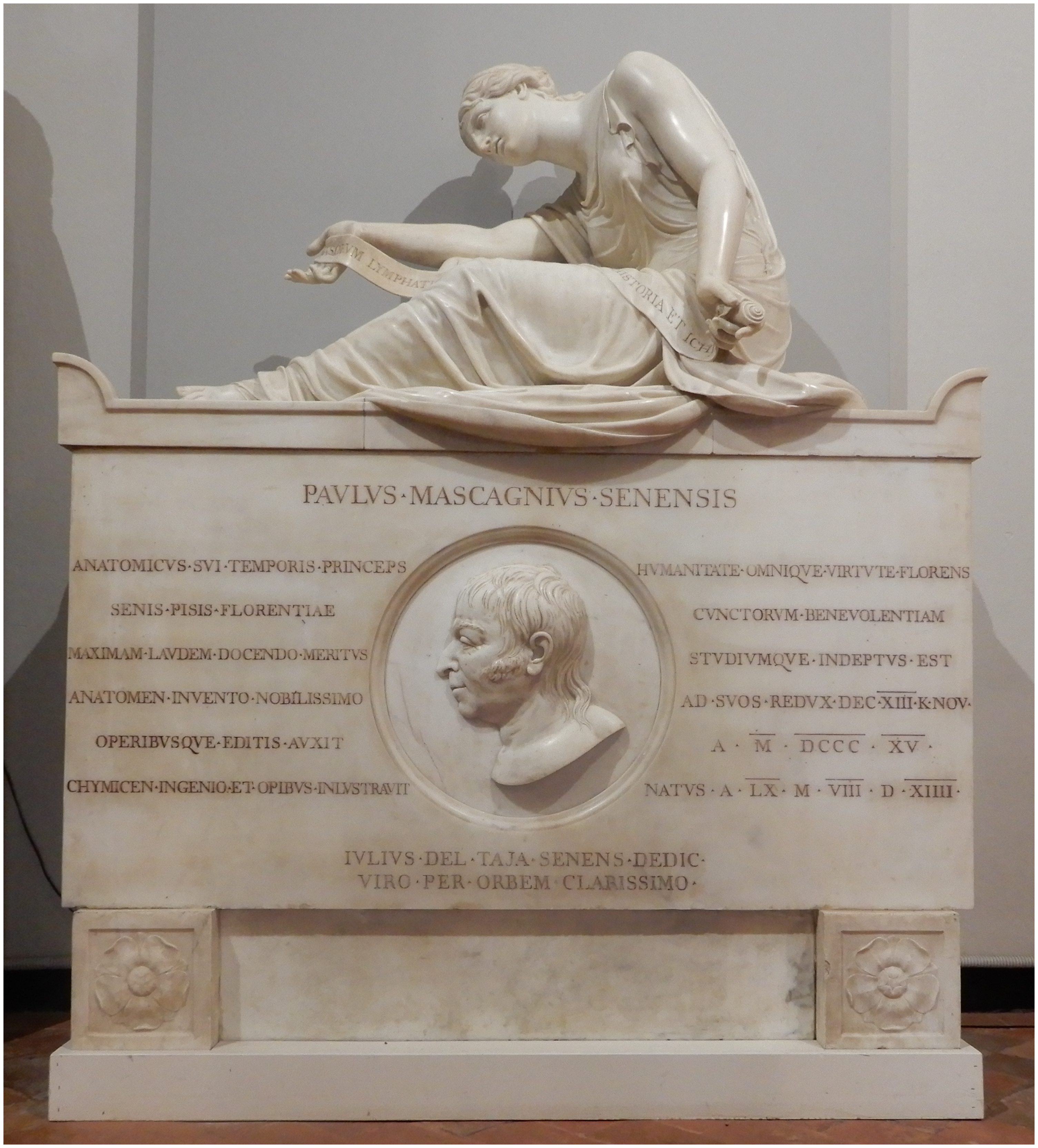
Marble mausoleum (cenotafio) for Paolo Mascagni, with the personification of Anatomy that mourns the loss of her teacher.
Mascagni graduated in medicine in 1778 at the University of Siena and became the assistant of Pietro Tabarrani in the same year. At his suggestion, Mascagni started conducting studies on the system of lymphatic vessels, and thanks to his talent, he succeeded in highlighting them using mercury. He published his studies in Vasorum lymphaticorum corporis humani historia et ichnographia (1787). This work brought him great fame and the title of “Prince of the Anatomists.”
Mascagni devoted the rest of his life to studying and teaching the anatomy of the human body. He completed another vast work titled Anatomia Universa. This volume is accompanied by 44 anatomical charts, introduced as innovative educational tools, thanks to the description of the lymphatic system. For the first time, the human body was represented in natural life-size charts, both front and rear perspectives, with stratigraphical criteria, that is from the most superficial muscular layer down to the skeleton. Mascagni wanted to create an innovative and accurate didactic tool for the benefit of medical students and for those who did not have the opportunity to study on human corpses directly. Mascagni also produced another anatomical atlas for Art Institute students, that was simpler: only 15 cards with sketches of models in posing positions like in a life drawing lesson.
At Mascagni’s death, the noble Sienese Giulio del Taia commissioned a marble mausoleum from the artist Stefano Ricci, which today is in the Academy of Fisiocritici. Mascagni’s greatness in anatomical studies is testified in his cenotaph by the personification of Anatomy mourning the loss of her teacher.
