



Abstract
In 1940 during the early phase of the Nazi aerial assault on Britain, the English neurophysiologist, C.S. Sherrington, age 83 years, had just published a philosophical work, Man on His Nature, and was researching the writings of Jean Fernel, a 16th century French physician. Sherrington’s study of Fernel stemmed from a common interest they shared in the association between the mind and the brain. This essay was prompted by a short letter penned by Sherrington in December 1940 and bound years later in his biography, The Endeavour of Jean Fernel, published in 1946. The letter requested information about a particular medical work by Fernel but also mentioned in passing Sherrington’s recent forced evacuation from his home in Ipswich, threatened by German bombing and invasion. The letter in the book invited a reprise of his remarkable career and a study of his last neurological concern – the mind–brain mystery.
Introduction
Twenty years ago (August 1998) while exploring the used book stores in Hay-on-Wye (Wales, UK), I came across a biography entitled The Endeavour of Jean Fernel by Sir Charles S. Sherrington, O.M. (1857–1952). At that time I had a distant recollection from medical school that Sherrington had helped found the field of neurophysiology. Jean Fernel (1497–1558) was a 16th century French physician and a contemporary of Ambroise Paré and Andreas Vesalius. Several months earlier I had acquired a 1551 work by Fernel with the intriguing title De Abditis Rerum Causis (The Hidden Causes of Things) and became familiar with the Renaissance author.
Upon leafing through the Hay-on-Wye book, I discovered two sheets of stationery bound between pages. It was a letter penned by Sherrington on 12 December 1940 and addressed to “My dear Graham.” See endnote on the letter. 1 I purchased the book mainly for the autograph and only recently have come to realize the letter’s full significance. It concerned two subjects. One was an academic inquiry about the exact title of another work by Fernel. The second was a short paragraph mentioning Sherrington’s forced removal from his home in Ipswich under threat of bombing during World War II.
The letter is of historical value because it offers a brief glimpse of life in Britain during the perilous early 1940s. Sherrington’s small book addresses a metaphysical issue which led him to the works of Fernel. The connection of the mind with the brain is unclear and a puzzle which both authors pursued in their writings – Fernel in De Abditis Rerum Causis, 1548 and Sherrington in his philosophical essay, Man on His Nature, 1940. The mind is often equated to the soul – hence the synonymous issue of the soul-body connection, which famously engaged René Descartes (1596–1560). Below is a transcript of the Sherrington letter (Figure 1).
Sherrington letter, 12 December 1940.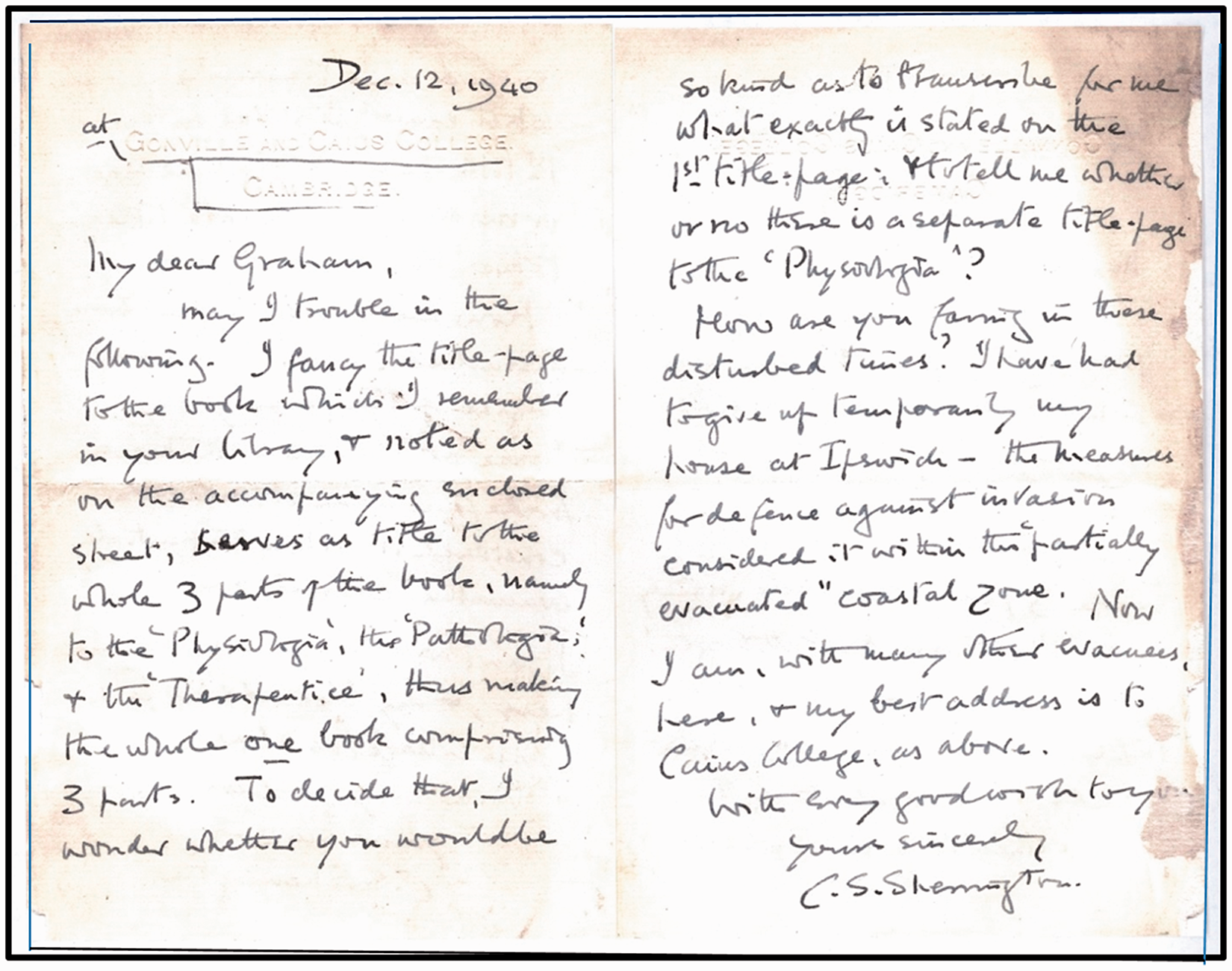
The Sherrington letter
First sheet, recto–verso:
at Gonville and Caius College, Cambridge Dec. 12, 1940
My dear Graham,
May I trouble you in the following. I fancy the title-page to the book which I remember in your library, & noted as on the accompanying enclosed sheet, serves as title to the whole 3 parts of the book, namely to the ‘Physiologia’, the ‘Pathologia’, and the ‘Therapeutice’, thus making the whole one book comprising 3 parts. To decide that, I wonder whether you would be // so kind as to transcribe for me what exactly is stated on the 1st title-page; & to tell me whether or no there is a separate title-page to the ‘Physiologia’?
How are you faring in these disturbed times? I have had to give up temporarily my house at Ipswich – the measures for defence against invasion considered it within the partially evacuated coastal zone. Now I am with many other evacuees here, & my best address is to Caius College, as above.
With every good wish to you,
Yours sincerely
C.S. Sherrington
‘Enclosed sheet’, one side:
Fernel, Jean
Medicina, Venice, 1555. 8°
apud Balthas[s]arem Constantinum, ad Signum divi Georgii
Printer’s device on title-page on AEsculapian Caduceus erect held by 2 hands coming from clouds; 2 serpents twine the caduceus; to either side is “Nulla sine labore est Virtus” set vertically
Sherrington during the war years
The letter was dated 12 December 1940 and sent from Gonville and Caius College, Cambridge University. Sherrington was then age 83, having resigned from an Oxford professorship four years before and having retired to his boyhood town, Ipswich. This is an important shipping port on the eastern coast of England, which was subject to frequent Luftwaffe air raids during the early phase of the Second World War (1939–1945). A map recovered from a Nazi library in Austria in 1946 showed the Ipswich docks and surrounding area targeted for bombing. 2 Before the end of the war, 80 civilians in the area were killed during air raids. 3 Ipswich (East Anglia) was also considered to be a likely route for “Operation Sea Lion,” the German plan for invading Britain. 2
In an earlier communication in July 1940 to a former student (John Fulton), Sherrington related that “his household had spent five nights in the past week in his garden trench” during aerial attacks. 4 In the December letter to Graham, Sherrington wrote that he had been obliged “ “to give up temporarily” his house at Ipswich “along with many other evacuees” as “a defense against invasion.” ” His home had been appropriated by the local militia.
A short stay with his brother in North London during the fall of 1940 proved more risky because of the frequent air attacks. 5 The two-month long London Blitz of September–October 1940 caused some 300 civilian deaths there. By the end of the war, about 30,000 British civilians had died from bombing raids. 6
A more secure home for Sherrington was arranged by Archibald V. Hill (1886–1977), a Cambridge University professor of physiology and biophysics. During the rest of the war, Sherrington lived at the residence of the master of Gonville and Caius College (J.F. Cameron). Cambridge is 63 miles north of London and 60 miles west of Ipswich and was expected to be safer than these larger cities. Still, this university town suffered around 24 deaths from incendiary bombing raids during 1940–1942. 7 These attacks sought to disrupt troop movement in the area and were focused on local railway yards and largely missed university buildings. 8
In summary, intensive bombing of airfields and factories in England began in May 1940 and affected many cities. While living in Ipswich and Cambridge during the early years of the war, Sherrington completed Man on His Nature, 1940 and explored Renaissance medicine for his biography, The Endeavour of Jean Fernel.
Sherrington, the neurophysiologist (1857–1952)
Sherrington trained in medicine at Cambridge University and St. Thomas Hospital in London (1876–1880). Over the next 50 years, his extensive studies on animal reflexes laid the foundation of neurophysiology.9,10 His early venture into neurological research followed a sectional meeting of physiologists at the 1881 International Medical Congress, where the cortical localization of motor function was a controversial issue. 11 David Ferrier (1843–1928), then at King’s College London, reported that lesions in what now is designated the motor cortical area caused localized paralysis in a monkey, while in contrast F.L. Goltz (1834–1902, Strasbourg) stated that such lesions made in various areas of the dog’s brain produced little motor deficit. During the next several years under the guidance of J.N. Langley (1852–1925), his Cambridge tutor, Sherrington made a detailed microscopic study of tissue sections of the medulla oblongata and spinal cord from Goltz’s dog. He identified corticospinal tracts by neuronal degeneration and found many areas to be normal, thus explaining Goltz’s claim of the dog’s near normal motor function. 12
Sherrington was advised by one of his Cambridge teachers, Walter Gaskell (1847–1914), to concentrate on the neurophysiology of the spinal cord, because such a study would be simpler than that of the complex cerebral cortex. 13 Sherrington followed this suggestion when in 1891 he became superintendent of a veterinary hospital – the Brown Institution of the University of London – while also holding a lectureship at St. Thomas Hospital. Experiments on cats and other animals led to his discovery that muscles are the source of sensory signals initiating many reflexes. For example, he explained the patellar reflex as involving an afferent/sensory signal from the quadriceps femoris muscle when stretched by a reflex hammer tap on the patellar tendon. This signal is sent to the spinal cord (at L3), evokes an efferent/motor response to that muscle, triggers its contraction, and also elicits a relaxation signal to the antagonistic flexor hamstring muscle. He generalized about other reflexes from work involving decerebrate animals, where no control is exerted by the brain.
In 1892 Sherrington published a 150-page “note” in the Journal of Physiology on the distribution of motor and sensory functions of the spinal nerves, the latter being represented on the skin as dermatomes. 14 In 1893 he proposed that signals sent from muscles to the brain represent a “sixth sense” (“proprioception”), which via reflexes helps maintain posture and balance and coordinates locomotion and other movements. 15 In 1895 he assumed the chair of physiology at University College, Liverpool. His findings to date were reported in the Royal Society Croonian Lecture in 1897. He later mapped the motor cortex of the chimpanzee, orangutan, and gorilla16 with the surgical assistance of Harvey Cushing (1869-1939), who worked in the laboratory during the month of July 1901. 17
In 1904 Sherrington delivered the Silliman Lectures at Yale. Here he advanced the concept that neurons are physically separate structures and not contiguous as in a web. However, they are functionally linked at the axon-dendrite junctions across a narrow, microscopic space, which he termed a “synapse.” 18 He proposed that animals act as a unified whole because of central integration of the body’s multiple reflexes, beginning at the spinal level and being linked at synapses in the cerebral cortex.19,20 The Yale lectures were published in 1906 as The Integrative Action of the Nervous System, which is Sherrington’s most acclaimed work.
In 1913 he was appointed the Waynflete Professor of Physiology at Oxford University. His neurophysiological studies during the years of the Great War were limited because of reduced resources and students. Notable among the few was an American Rhodes scholar, Wilder Penfield (1891–1976), who, like Cushing, would later become a celebrated neurosurgeon. During the war period, Sherrington compiled a manual entitled Mammalian Physiology: A Course of Practical Exercises, 1919, which taught the surgical skills needed by neurophysiologists. 21 Sherrington resumed work on reflexes and the cerebral cortex with a succession of outstanding young collaborators – John Fulton, H. Florey, J.C. Eccles, D.I. Denny-Brown, E.G.T. Liddell, R. Granit, R.S. Creed, W.C. Gibson, and others – all of whom later had distinguished academic careers.
Sherrington was elected Fellow of the Royal Society in 1893 and in 1920 assumed the five-year long presidency of the Society with its myriad responsibilities. He received a knighthood in 1922, the Order of Merit in 1924, the Copley Medal in 1927 and in 1932 the Nobel Prize in Physiology or Medicine with E.D. Adrian for their basic studies on “neuron function.” His growing fame led to many other awards, honorary degrees (22), speaking invitations, and increased correspondence – all of which, however, made him “an infrequent visitor to the laboratory.” 22 In spite of these many distractions from experimental work, during the Oxford period Sherrington developed the concept of the motor unit, i.e. a motor neuron and the skeletal muscle fibers it innervates. Groups of motor units work together to contract a muscle. 23 He was one of five co-authors of the 1932 monograph, Reflex Activity of the Spinal Cord, which summarized the elementary features of reflex mechanisms, discovered notably by the Sherrington school. 24
A less tangible topic was the connection between the mind and the brain, which was raised by Sherrington in several later talks. The first was his 1933 Rede Lecture at Cambridge University, published in a short monograph, The Brain and its Mechanism.
25
Another was the 1933 Vicary Lecture at the Royal College of Surgeons, London. Sherrington ceased laboratory work in 1931, was widowed in 1933, and retired from Oxford in 1936. He moved to a house “at the top of a hill” in Ipswich, where among other retirement activities he studied Fernel’s works in Latin and reflected on the mind-brain mystery
26
(Figure 2).
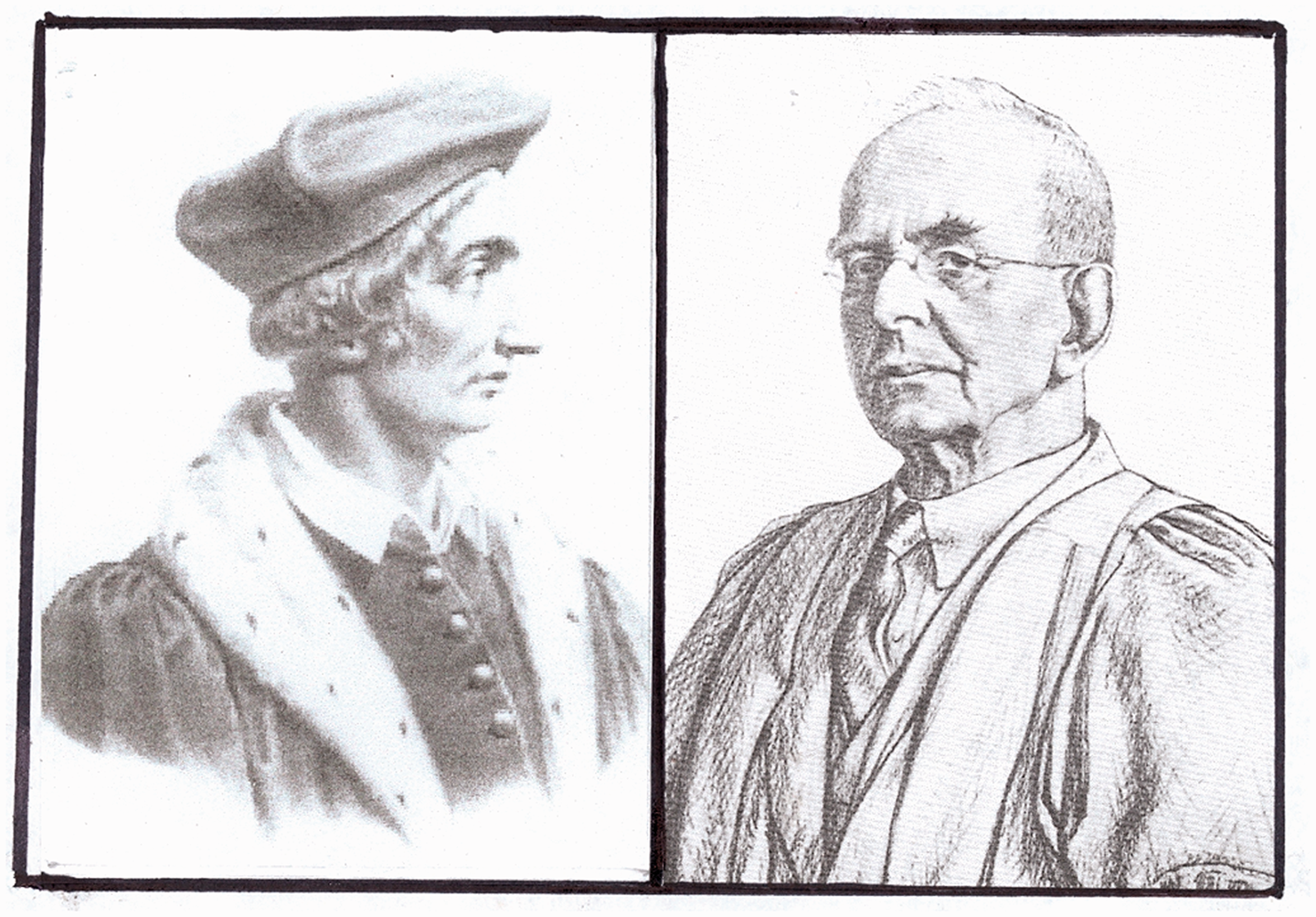
Title page of De Abditis Rerum Causis, 1551, Paris. Jean Fernel (1497–1558) and Sir Charles Scott Sherringrton (1857–1952).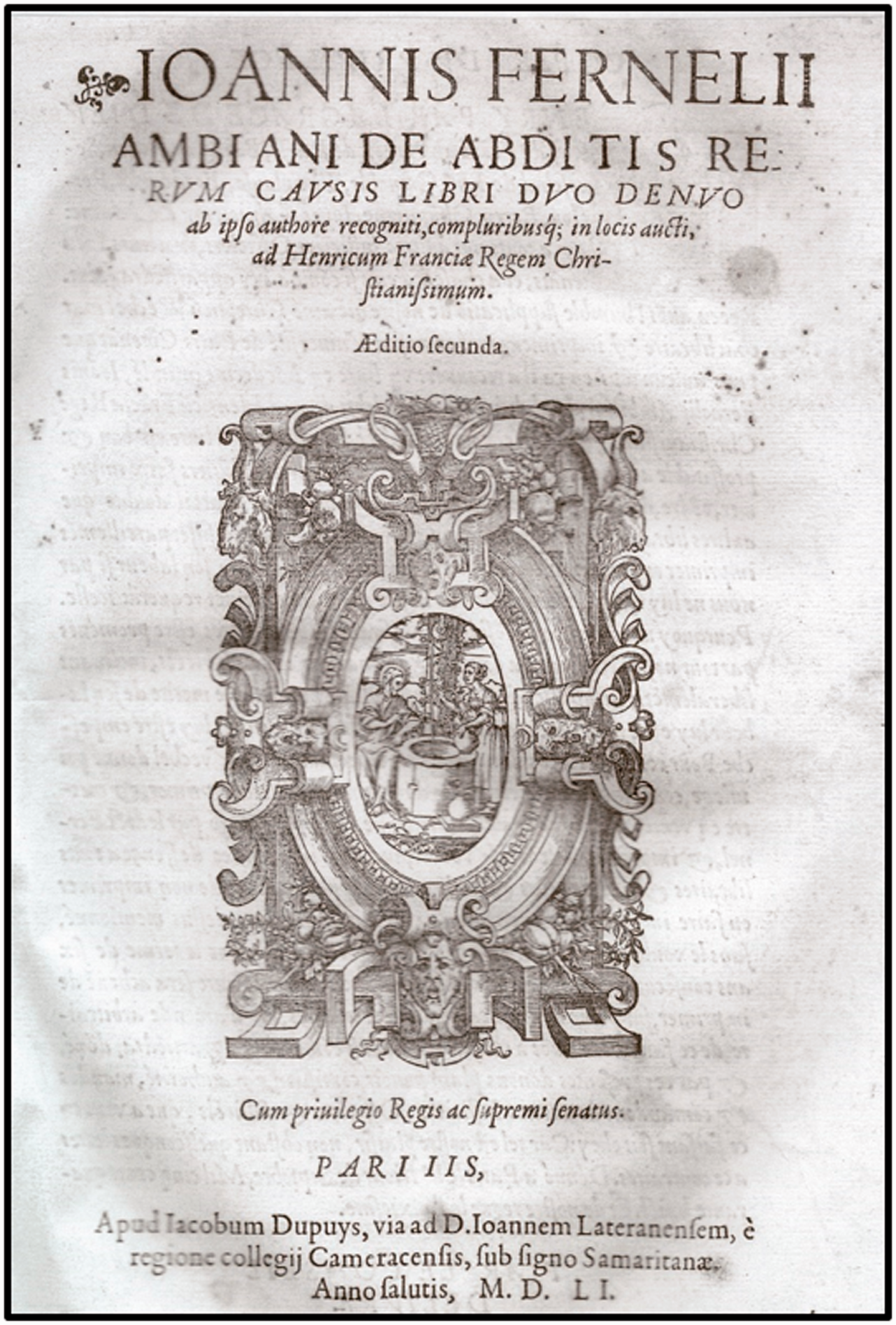
Jean Fernel (1497–1558) and His Medical Writings
Historians of the French Renaissance are familiar with Jean Fernel (1497–1558) because of his medical services to Henri II (1519–1559), king of France from 1547 to 1559. Fernel reportedly saved the life of Henri’s elderly mistress, Diane de Poitiers, and prescribed a “desperate remedy” for his young wife, Queen Catherine de Medici, enabling her to conceive after 10 barren years of marriage.27–29
Fernel attended the College of Sainte-Barbe in Paris and at age 33 earned a doctorate in medicine around 1530. Instead of practicing medicine immediately, during the next five years he studied mathematics and astronomy, and published several books on these subjects. When he finally began a medical practice, he became a popular lecturer at the University of Paris and a prolific medical author. Initially, the faculty dismissed his writings because they sought to replace the Galenic style medicine then practiced with an approach based on new clinical observations added to the best of the old. Fernel’s works of particular interest to Sherrington included four treatises: De Abditis Causis, Physiologiae, Pathologiae, and Therapeutice. These were published separately or in combination and are listed chronologically here along with a small work on venesection. The latter three treatises were mentioned in Sherrington’s war-time letter; those numbered 1–5 below are discussed later.
De Naturali Parte Medicinae, 1542 … later renamed Physiologiae De Vacuandi Ratione, 1545 … a treatise on venesection De Abditis Rerum Causis, 1548, 1551 … first to suggest other causes for some diseases than an imbalance of humors (see Figure 2). Pathologiae, 1554 … based in part on autopsies Medicina, 1554 (Paris) … folio containing Physiologiae, Pathologiae, & Therapeutice
Medicina, 1555 (Venice) … 8° containing the above three works (Sherrington’s inquiry) Opera Medicinalia, 1565 … Physiologiae, Pathologiae, Therapeutice, & De Abditis Causis Universa Medicina, 1567 … also the above four works.
1) De Naturali, 1542. This was a comprehensive medical work consisting of seven parts: anatomy, elements, temperament, spirits and innate heat, soul, humours, and procreation. The text included the Galenic system of medicine and a 90-page introduction on anatomy. Fernel had begun the anatomy part in 1538, where can be found the original description of the channel running inside the spinal cord. 30 De Naturali was later retitled Physiologiae and as such was reissued 39 times over the next century. 31 Fernel is credited with introducing the term physiology to 16th century medicine as physiologiae in this work, but the comparable word in Greek had been used by Galen in On the Natural Faculties. 32 During antiquity the term meant the study of nature.
2) De Vacuandi Ratione, 1545. In this short monograph on bloodletting, Fernel recommended moderation. Venesection was preferably performed during “favorable” phases of the moon. Since it clearly determined ocean tides on earth, so the moon was believed to influence the course of human illnesses. However, during his astronomy studies, Fernel found no such correlation and later cautioned against predictive astrology in medicine.
3) De Abditis Rerum Causis, 1548. This work ranges over myriad metaphysical concerns: the soul, vital spirit, innate heat, occult qualities, natural magic, angels and demons, etc. Fernel believed the body to be composed of the four elements plus a fifth one, which is “innate, vital” heat – i.e. the soul. After death, the four elements persist in the decaying corpse for some time, but the vital heat immediately disappears and returns to the stars in heaven. 33 The neologism and prolixity in De Abditis render it vague and ambiguous with the exception of one part treating three clinical conditions discussed below.
De Abditis was composed during the decade before De Naturali but was withheld from publication because Fernel felt that a new idea in it would be rejected by the Paris medical faculty and his reputation disparaged. At issue was his novel idea that three conditions – poisons, contagions, and pestilences – represent illnesses which are not explained by an imbalance of humours but are due instead to “hidden causes” – much as the ineffable soul influences all aspects of the body. 34 This notion of other causes challenged the prevailing medical dogma that a humoral imbalance explains each and every illness. Fernel found some support for his deviant idea in a sentence from the Hippocratic book on epilepsy, The Sacred Disease. The passage in English reads, “the oracle Hippocrates … asserts that there is a divine something dwelling in all diseases.”35,36
De Abditis finally appeared in print in 1548, two years after that of a book by Girolamo Fracastoro (1483–1553). In his De Contagione, 1546 Fracastoro proposed that contagions are spread by “imperceptible particles” (in particulis insensibilibus) via three sources – contact with affected persons, from fomites, or via air. 37 This proposition was printed support for Fernel’s ideas about hidden causes and is believed to have prompted publication of De Abditis Rerum Causis. 38 According to Sherrington, Fernel advanced medicine by advancing other causes for some illnesses and breaching the rigid Galenic dogma of humours as sole causes. Guy Patin (1601–1672), later dean of the University of Paris, wrote that Fernel “rescued our learning from decay … [and] gave the profession a new lease of life.” 39
4) Pathologiae, 1554. The term pathologiae in Latin appeared first in Fernel’s Medicina, but the word in Greek had been coined by Galen. 40 This work treats human morbidity in six parts: the causes of various diseases, their signs and symptoms, the pulse and urine, and fevers. 41 Autopsies gave him new insights into various clinical conditions; for example, localized paralyses may be due to pressure on nerves or luxation of the spine. Nearly a century after its initial publication, Guy Patin advised students to read carefully the Pathologiae of Fernel. 42
5) Medicina, 1554 – 1555. Sherrington’s 1940 letter sought details about the title page of Medicina, which was Fernel’s most widely read book. It contains his four primary works and went through 30 editions and reissues during the ensuing century. 43 William Osler owned a 1577 edition, then titled Universa Medicina.
Sherrington and Fernel
Sherrington never mentioned when or how he became acquainted with Fernel (Figure 3). 44 As a young student reading neurology, he may have learned that Fernel was the first to describe the fluid-filled canal running within the spinal cord. 45 Or he may have become aware of Fernel because of the enticing title of his early work – On the Hidden Causes of Things – and may have chanced upon it while exploring a bookstall or examining a private library of antiquarian books.46–40
Of greater interest is what led Sherrington to research the writings of this 16th century French physician so avidly over so many decades. In the Preface to The Endeavour of Jean Fernel, Sherrington described him as condemning “the self-complacency of the orthodox Medicine of the time” and “rejecting appeals to magic and the occult.”51 Yet more relevant to Sherrington’s later focus on the mind–brain association were Fernel’s abstruse ruminations about the mind being linked to the body through a spirit (the soul, anima) whose energy comes from the stars. 52
Sherrington’s pursuit of Fernel’ works represented a shift from experimental physiology to the mind–brain mystery. 53 More puzzling than spinal cord reflexes and cerebral responses to sensory stimuli are the mental functions of the brain, such as thought and memory. Neither has been fully explained by the available tools of neurophysiology in the context of modern deterministic neuroscience.
As mentioned earlier, Sherrington had first raised the mind-brain puzzle in the Rede Lecture of 1933. Here he introduced the idea of two types of responses occurring in brain – non-mental (unconscious: reflexes) and mental (conscious: feelings, thought). He noted that consciousness is associated with only some regions of the brain but added that the relationship is unclear.
Sherrington first spoke about Fernel in the Thomas Vicary Lecture, 1933 and later in the Gifford Lectures at the University of Edinburgh, 1937 and 1938. The latter lectureship promoted Natural Theology, a belief explaining God’s existence by reason and the laws of nature and not by invoking divine revelations. Sherrington’s discourse was expected to acknowledge this point of view. His 12 lectures were delivered in two sets during 1937 and 1938 to an audience mainly of clergymen. He worried that any reference to the mind–brain puzzle would raise unanswerable questions ad infinitum and thus leave the pious audience with a sense of “spiritual bleakness” or “cosmic loneliness.” 54 And so he sought to soften this unsettling subject by introducing a 16th century French physician who had also pondered the “mind–brain” puzzle, rephrased then as the “soul–body” problem. 55
Sherrington expanded on the mind–brain question in Man on his Nature. In it he proposed that areas of the brain responsible for mind/consciousness involve neurons and synaptic bridges linking sensory input with muscle responses. He suggested that this linkage requires energy. 56 This is not “elemental heat” from the environment nor “physiological heat” produced in the heart but perhaps is the innate, vital heat, which Fernel had proposed comes from a heavenly source. 57
The mystical notions mentioned above clashed with the evidentiary proof required by most neurophysiologists, who reject ideas outside of science to explain aspects of the human mind. As early as 1934, Sherrington’s dualistic view was criticized by Ivan Pavlov (1849–1936), famous for studies conditioning dogs’ salivary response to various stimuli. He attributed Sherrington’s dualistic notion in his old age to senility. 58 Shortly before his death, Sherrington acknowledged the dissenting assessment by others but “ignored it.” “The more he pondered on the mystery of man, the more sure he became of the essential duality of man’s nature.” 59 This view had some support from others. Sir Frances R. Walshe, a prominent London neurologist, and John C. Eccles, a colleague of Sherrington, thought similarly but “feared academic disdain” for speculating publicly about the soul. 60 Also Lord Russell Brain (1895–1966), an editor of the journal Brain, concluded that “the mind cannot be explained by physiology,” thus opening the door wider to a non-physical interpretation. 61
The Physical Basis of Mind
The mind–brain question was the subject of a series of BBC television programmes in 1950 entitled The Physical Basis of Mind. It was introduced by Sherrington, who equivocated then about his dualistic view. Ten professors (two anatomy, two physiology, one neurology, one neurosurgery, one psychiatry, and three philosophers) gave their opinions about whether the mind is an integral aspect of the brain or is non-physical and separate from it. Four speakers (including Sherrington) took “a wait and see” stance. Four believed that the mind is “probably” or is “definitely” functionally linked to the brain and is not a metaphysical entity. In contrast, one speaker thought the mind is “probably” non-physical and separate from the brain, while another believed “strongly” that the mind is an unknowable entity distinct from the brain. 62,63
The last opinion was held by Wilder Penfield (1891–1976), the American-Canadian neurosurgeon, who, as noted earlier, had been a student with Sherrington during the Great War. Penfield had a special perspective for discussing the mind–brain puzzle because he had operated on the brains of over 750 patients with epileptic seizures. Such attacks are caused by a transient focal electric discharge originating from a trigger site in the brain. Excising the area may prevent future episodes. It can often be located by probing the cortical surface with a mild electrical stimulus to elicit an attack or some aura (visual, auditory, or olfactory) which sometimes precedes a seizure. Penfield performed such operations under local anesthesia which allowed the subject to describe what he/she experienced as the brain’s surface was being tested. In 520 patients whose temporal lobes were extensively explored, 53 (10%) reported a dream-like memory of past experiences. 64 The fragmentary memories could also be reproduced with later electrical stimulation at the same area. 65 In spite of these surgical examples linking mental auras and mind-based memories to particular areas of the human brain, Penfield maintained a dualistic view and professed his Presbyterian Church belief in the soul as an entity separate from the brain. 66
Conclusion
As the BBC programme revealed, Sherrington had misgivings about offering a dogmatic, dualistic answer to the mind–brain question. Earlier, he had prefaced Chapter 9 of Man on His Nature with a quotation from a British “idealist philosopher”, F.H. Bradley (1846–1924) – “I cannot admit that the connection of soul and body is really either intelligible or explicable.” 67
Four centuries before, Fernel held a similar notion when he asserted hidden causes for all actions of the human body, including those of the mind. But such a view was of little concern to him, for he wrote that Aristotle and Galen agreed that things which have hidden and obscure causes admit of no explanation and are “beyond the grasp of the human mind”. 68 He also quoted Theophrastus (d. 287 BC), a disciple of Aristotle: “Those who hunt for a reason for everything … are after a reason for things which do not have one and never did.” 69 And in De Abditis Rerum Causis, Fernel expressed the sentiment that “Nature has certain secrets which she likes us to marvel at, but not to probe.” 70
Sherrington published nothing further on the mind–brain puzzle after the BBC programme in 1950. He died two years later. The most authoritative obituary is that written by E.G.T. Liddell for the Royal Society. 71 Because of severe arthritis, Sherrington spent his later years not in his house on a hill in Ipswich but apart from family and friends in several nursing establishments. The last was in Eastbourne, a small resort town 19 miles east of Brighton on the southeast coast of England. 72 Few former associates came to see him there. A.V. Hill, his long time friend, visited him a year or so before his death in 1952. He recalled how Sherrington sought to prolong their conversation and later looked “wistfully” at him as he descended the stairs to leave.73 Perhaps Sherrington had hoped to glean from Hill something beyond physiology to explain the mystery of the mind.
Footnotes
Acknowledgements
I acknowledge the exceptional assistance of Mrs. Amanda Williams, Medical Center Library, University of Kentucky and also the continued support of I.S. Tray II. No animal or human subjects were involved in this work.
Declaration of conflicting interests
The author declared no potential conflicts of interest with respect to the research, authorship, and/or publication of this article.
Funding
The author received no financial support for the research, authorship, and/or publication of this article.
