



Abstract

Four hundred years ago, in September 1620, the Mayflower sailed from Plymouth, England, and anchored at Cape Cod Bay, New England, in November. During the perilous voyage sick passengers were cared for by the ship’s surgeon, Giles Heale (d. 1653), who returned to England after a few months. Samuel Fuller was then chosen to replace him. As deacon and doctor to the new colony, Fuller was highly respected: he had negotiated and organised the voyage and he was related to William Bradford (1588–1657, Governor of the colony 31 times). Other physicians had preceded Fuller to the New World but he was the first Pilgrim doctor to settle in the American colonies and his presence marked the dawn of medicine in Massachusetts. For a start, he supervised a hospital in the first building to be erected at New Plymouth. Scurvy, malnutrition, smallpox, tuberculosis and pneumonia were the major challenges, compounded by the lack of drugs and equipment.
Samuel Fuller was a butcher’s son from Norfolk. He was drawn into a local Puritan congregation by Pastor John Robinson (1576–1625), John Carver (1584–1621), William Brewster (c. 1566–1644) and Bradford, all of whom emigrated to Leiden in the Netherlands which offered religious liberty, a renowned university and opportunities in the textile and printing industries. Fuller was at Leiden by 1610; after the death of his first wife, Alice Glasscock, he married Agnes Carpenter (c. 1589–1615) and after her death, Bridget Lee (d. 1667). Bridget followed Samuel to the Plymouth colony where she practised midwifery and administered physic. Fuller had received no formal medical training although while at Leiden he had access to the anatomy theatre, lectures, libraries and the botanic garden. The attractions of Leiden notwithstanding, the English Puritans found life there difficult, so plans were laid for an expedition to New England. Negotiations with the Virginia Company of London were initiated and Fuller was the first signatory to a letter of June 1620 demanding better terms for the Pilgrims than the London company proposed. Meanwhile, two ships were chartered for the Atlantic crossing. The Speedwell proved unseaworthy, so 102 passengers with about 40 crew crowded aboard the Mayflower.
Despite sickness, primitive conditions and poor nutrition there were only two deaths during the 66 days at sea (Fuller’s servant and a seaman). Once land was sighted on 9 November, settlement was slow. First and foremost, the leaders of the Pilgrims drew up the Mayflower Compact, the prototype of American democracy; Samuel Fuller was the eighth out of 41 settlers who signed the document (Figure 1). With the principles of government established, exploration began, hampered by the winter and disease. Fuller’s brother and sister-in-law died early in 1621 and only 47 Mayflower passengers survived to see the spring. Their surgeon, Heale, left in April 1621, whereupon Samuel Fuller was elected medical practitioner to the colony.
Jean Leon Gerome Ferris, ‘Signing the Mayflower Compact, 1620’ (1899). The signatories portrayed are (left to right): Myles Standish seated and wearing a helmet; he was captain of the militia. Standing behind him, Isaac Allerton in a large hat. William Bradford (second Governor of the colony) wears a black hat. John Howland aged 21, servant to John Carver, turns towards Bradford. John Alden (the ship’s cooper) signs his name. Samuel Fuller is seated in the background. Edward Winslow (Governor 1633, 1636, 1644) holds the ink horn. John Carver (first Governor of New Plymouth) sits beside the chest. The seated figure behind him, wearing a helmet and smoking, may be the surveyor Francis Cooke. Standing (far right) is Mary Chilton, the first woman to step ashore, ‘a representative of the sex that did most of the real work of the colony’ (according to the artist). US Library of Congress Prints and Photographs.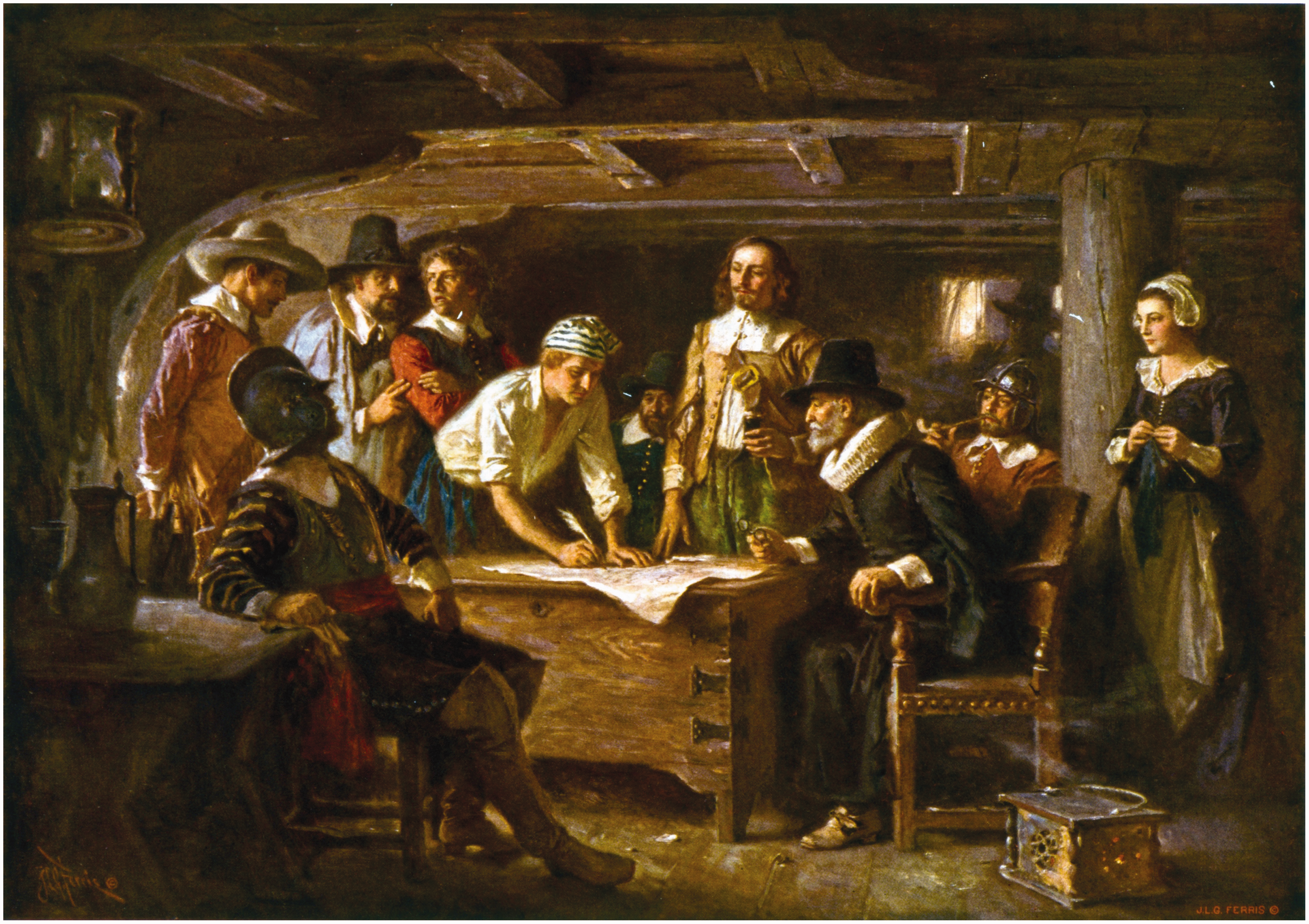
Fuller’s medical and surgical skills were widely appreciated. When the ruthless merchant Thomas Weston (1584–1647) arrived at Cape Cod Bay in 1622 with passengers crammed into two ships, the sick were deposited with Fuller. By 1630 Fuller’s reputation was such that Reverend John Warham (1595–1670) summoned him to attend the colonists at Mattapan (Dorchester) where Fuller eased the suffering of some 20 patients by venesection. That same summer, at the request of Governor John Winthrop (1588–1649), Fuller was at Charlestown where settlers were infected with the plague. His efforts were frustrated by the lack of medical supplies and equipment: ‘I can do them no good for want of drugs and things fitting to work with’. Similarly, Governor John Endecott (c. 1600–1665) who founded the settlement at Salem, Massachusetts, persuaded Governor Bradford to send Fuller to Salem where scurvy and fevers were rife. Endecott’s heartfelt letter to Bradford thanked him for sparing Fuller, who was rewarded with 4p. a month, a surgeon’s chest and the title physician general of Salem. While there, Fuller also assumed a diplomatic role, massaging the relationship between the two governors.
An epidemic, possibly smallpox, struck the New Plymouth colony in 1633. Fuller was himself infected and died during the summer. He had much helped others, and was a comfort to them; he was their surgeon and physician, and did much good in his place, being not only useful in his faculty but otherwise, as he was a godly man … and was much missed after God had removed him out of this world.
At the time of his death aged 53, Samuel Fuller owned a ‘town’ house, a country house, land, cattle, a surgeon’s chest and a library which included medical books. His reputation as deacon, doctor and diplomat survived Morton’s insults and it was nearly 100 years before the Massachusetts colonists were served by such a hero.
Footnotes
Declaration of conflicting interests
The author(s) declared no potential conflicts of interest with respect to the research, authorship, and/or publication of this article.
Funding
The author(s) received no financial support for the research, authorship, and/or publication of this article.
Note
The best source for the voyage of the Mayflower and the foundation of the Plymouth colony was written by William Bradford, Of Plymouth Plantation 1620–1647, a manuscript first published in 1881. Quotations are from this.