




Abstract
Eugene Botkin was Nicholas II’s court physician from 1908 until the abolition of the monarchy. He accompanied the royal family into exile and shared their fate at Ekaterinburg in 1918. The son of a prominent St. Petersburg physician, he trained at the Universities of St. Petersburg, Berlin, and Heidelberg. As court physician, he participated in the management of the Tsarevich Alexei’s hemophilia, but most of his time was spent taking care of the Tsarina’s multiple psychosomatic ailments. A deep sense of duty, rendered him unable to part from the royal family during the difficult months of exile and imprisonment. During this period there were several episodes of imminent threat to his life, where despite having the opportunity to leave, he voluntarily decided to stay with the Romanovs. In up to three occasions he said his goodbyes to his children, only to find out the next day that the threat had been contained. Ironically, the last time he spoke to them he did not think they would be separated for long. In this study, we will analyze his life, in particular the events of his last days, and will explore the reasoning behind his selfless actions.
Keywords
Introduction
On July 17, 1918, The Tsar of All Russias, Nicholas II, was viciously executed along with his wife, Tsarina Alexandra, his daughters the Grand Duchesses Olga, Tatiana, Maria and Anastasia, and his son and heir, the Tsarevich Alexei, in the cellar of the Ipatiev House, in Ekaterinburg. Sharing their fate that night, were four servants of the family, Ivan Kharitonov- a cook, Anna Demidova - a maid, Alexei Trupp - a footman, and the family’s physician, Dr. Eugene Botkin. Dr. Botkin’s presence that night in that cellar was not a serendipitous occurrence. It was the culmination of a pattern of loyalty and devotion that the physician demonstrated throughout his life to his sovereign, his patients, and his duty as a physician.
Early life
Dr. Yevgeny (Eugene) Sergeyevich Botkin was born in Saint Petersburg in 1865. He was one of four sons of Sergei Botkin, at that time the court physician to Tsar Alexander II, a post he would continue into Alexander III’s reign. Dr. Sergei Botkin is perhaps the most famous physician in Russia, being considered the “father of modern medicine” in that country. His contributions to physiology and medicine are multiple and varied, but his description and proposed pathophysiology of viral hepatitis resulted in the eponym “Botkin’s disease”. 1 Like two of his brothers, Eugene decided to follow his father’s footsteps into medicine and entered the University of St. Petersburg Academy of Medicine.
After his graduation in 1889, he declined a post as the personal physician to then Czarevich George Aleksandrovich in order to pursue additional studies in Berlin and Heidelberg. Once completed, he returned to St. Petersburg where he was appointed as Chief Physician at St. George’s Hospital and lecturer at the Academy of Medicine. His duties, however, were interrupted in 1904 with the eruption of the Russian-Japanese war, for which he volunteered to serve on the frontlines at a hospital train. For his distinguished efforts during the conflict, he was awarded the Grand Cordon of the Order of St. Anna, and appointed as Chief Commissioner of the Russian Red Cross. 2 –4
Dr. Botkin entered the court of Tsar Nicholas II in 1907, when upon the death of the tsarina’s physician, he was called upon to fulfill the post (Figure 1). Having first-hand knowledge of the difficulties associated with being the court physician, he expressed “that he felt a great burden, a responsibility towards not only the family, but the whole country.” 2

Dr. Eugene Botkin became the court physician to Tsar Nicholas II in 1908.
By then Dr. Botkin and his young wife Olga had 4 children, Yuri, Dimitri, Gleb, and Tatiana, who began feeling the burden of his new duties, frequently resenting the amount of time he would spend at the palace and his extreme dedication to the imperial family.
Medical duties
As the primary physician of the family, most of his time was spent attending the Tsarina. A chronically ill lady, she had inherited her mother’s fragile health. She suffered from multiple ailments including sciatica, fatigue, shortness of breath, headaches, and acute otitis. She continuously consulted physicians. In 1898, with only 26 years of age, she saw a court physician over 200 times. 5 Her sister in law would describe her as “indeed a sick woman. Her breath often came in quick, obviously painful gasps. I often saw her lips turn blue.” 6 Botkin himself, would say that the Empress “inherited a family weakness of the blood vessels,” which led to “progressive hysteria.” 6 In a letter to his brother, he described: “I am very pained about the malady of the Empress; it is a nervousness of the heart related to the cardiac muscles. This is confirmed by physicians here who I have consulted … I like to let my imagination free to search for different names for the Empress’s condition.” 5 He would visit and examine her twice a day, at 9 am and 5 pm. Caring for the Tsarina was not an easy task. The Empress was rather stubborn and had strong opinions on what her ailments were, opinions with which Dr. Botkin frequently disagreed. In order to prevent her developing a “hysterical” crisis, he would concede to her requests, which frequently required treatment with Veronal and other opiates. 7 Not everyone approved of his handling of the Empress. People at court complained that he told the Tsaritsa only what she wanted to hear, and that she was using him to hide from her official duties. Frustrated by these rumors, he complained to his brother: “You would need to have a mind as perverted as theirs and a disordered soul to defeat all of their unbelievable plots. I have decided that I am old enough to dare to by myself. I will do the things which I believe right, and I am ready to stand up and defend my actions because they are really my own…” 8
Dr. Botkin’s medical duties included the regular care of the pediatric issues of the four Grand Duchesses and the Tsarevich. However, by the time Dr. Botkin arrived in court, Tsarevich Alexei’s hemophilia had been already diagnosed. Knowing of the complexity in the management of this disease, Dr. Botkin recommended having a single physician dedicated to this issue and brought in Dr. Vladimir Derevenko for the post (Figure 2). They would be assisted periodically by Dr. Sergei Fyodorov, a urologist and surgeon, and S. Ostrogorsky, a pediatrician. All of them were present in Spala on October 1912, when Alexei suffered one of the most dramatic and nearly fatal hemophilic crisis, and which served as the opportunity for Rasputin to enter the court of Nicholas II, with the infamous consequences. 6
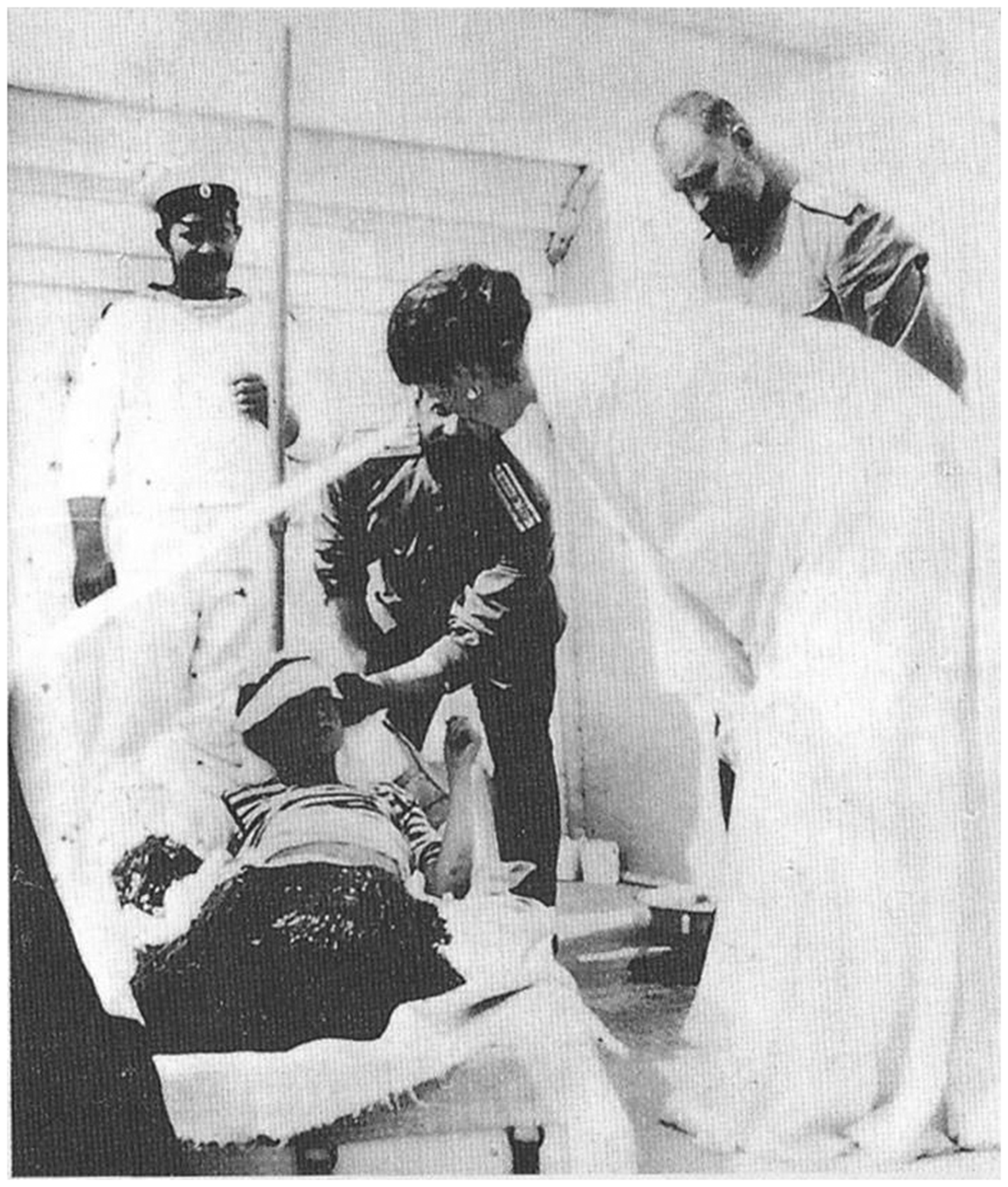
Dr. Derevenko administers a plaster to Alexei during one of his hemophiliac crises, while Dr. Botkin and the Empress observe.
As could be expected, there was significant friction between Dr. Botkin and Rasputin, as for the former it was quite clear that the cleric was overstepping his role and exerting a detrimental influence in the royal family. His son Gleb describes an incident in which Rasputin sought Dr. Botkin’s medical opinion. After examining him, he bluntly expressed: “As a physician I cannot refuse to receive any person who claims to be sick, and therefore I have had to receive you. But I see that you are as healthy as a bull and need no medical help. I, on my part, do not want to become acquainted with you. So please go away, and do not call on me again.” 3 While Botkin navigated a fine line in order to not antagonize with the Empress with regards to Rasputin’s role in court, 7 according to his son he showed his opinion clearly enough by the attitude he maintained towards him. 3 Exasperated by the situation, one day he confided to his daughter: “As a physician, I can certify that Her Majesty is not normal.” 9
Dr. Botkin’s functions as a family physician, however, went beyond his medical duties. According to his daughter Tatiana, the daily visits to Her Majesty were always delayed as they would always transition to a social visit with inquiries about his family and daily activities. 9 He became a true friend of the family, in particular of the Emperor, who related as such to his brother Peter. 5 Dr. Botkin became a fixture in the family’s pictures, being present in all sort of settings, from the gardens of Tsarkoe Selo, to trips in the family yacht, to the streets of St. Petersburg, walking along with the children (Figure 3). His devotion to the family was complete and total, to the point that it would have a detrimental effect on his own family. His son Gleb remembers how his mother “reproached him once that the Emperor’s children became to him dearer than his own.” 3 Once, during a trip to Crimea with the Royal Family in 1909, his family accompanied him. But the family was barely able to see Dr. Botkin at all, and thus Olga took her kids and left after three weeks. 8 Olga eventually engaged in an affair with the children’s German tutor, filing for divorce, to which Botkin reluctantly agreed, while retaining custody of their children. 7 World War I brought the death of his son Dmitry, who was killed in action on the eastern front. This had a major impact in Dr. Botkin’s live, according to his son, as he became increasingly spiritual and more orthodox in his religious faith. 3
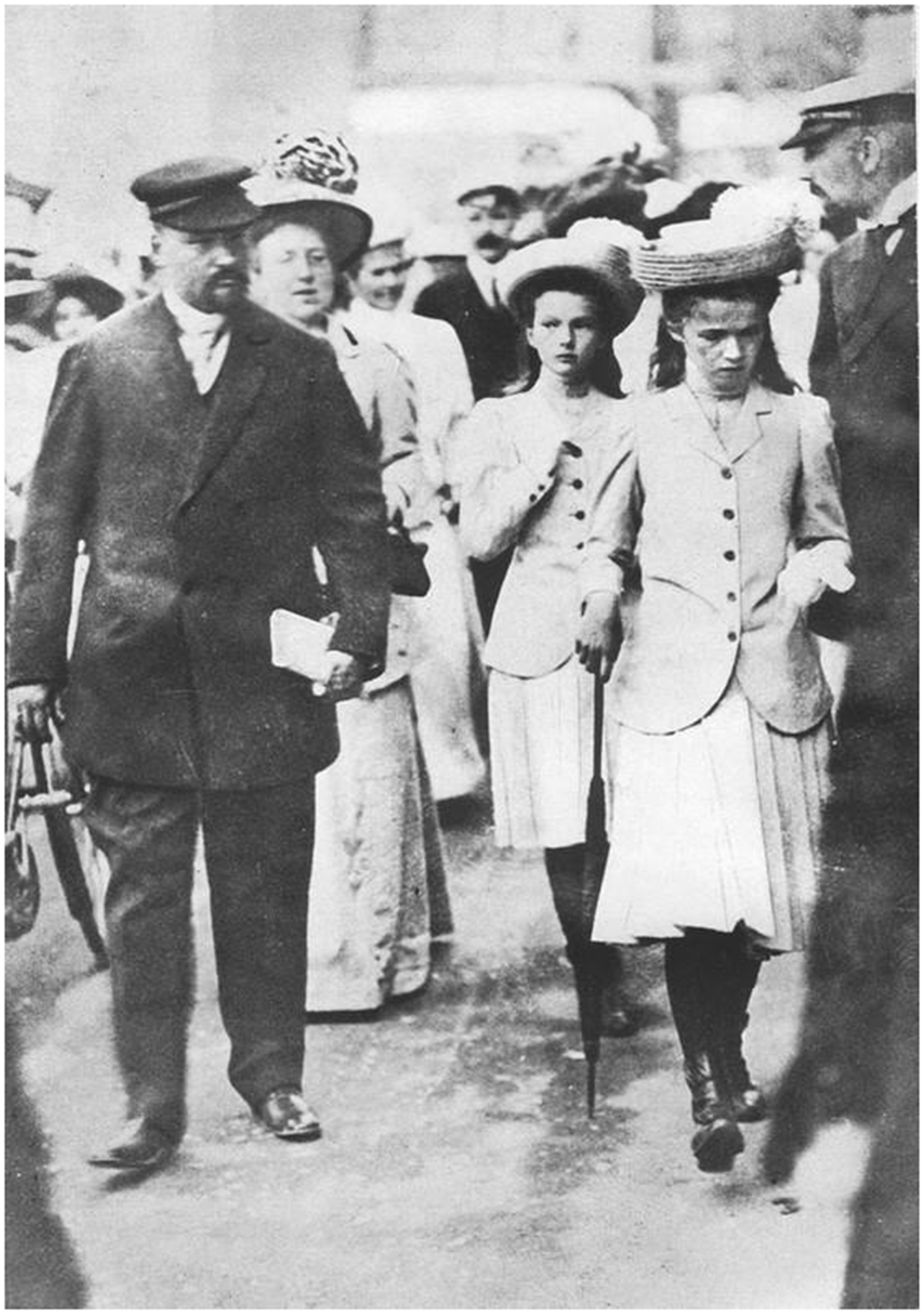
Dr. Botkin walking with the royal family through the streets of St. Petersburg. His duties went beyond strictly medical. He became a constant companion of the royal family, in detriment to the relationship with his own family.
Abdication and captivity
On March 15, 1917 Nicholas II abdicated his title as Emperor of Russia in a military train wagon, while visiting the front troops during World War I. In the days before, the situation in St. Petersburg had turned unsustainable, triggered by food shortages, and resulting in civil unrest and eventual military mutinies. A provisional government was immediately formed, which required the forced abdication of the Tsar. Eight-hundred kilometers away, in a train stationed in Pskov, with his family in the hands of the Provisional Government, the Tsar had no choice but to comply. 6 After consulting with Dr. Fedorov on the long-term prognosis and expected lifestyle of his son, he decided to abdicate in Alexei’s name as well and transfer power to his brother, Michael. Michael Alexandrovich’s refusal of the throne resulted in the fall of the Romanov’s dynasty of more than 300 years, and the abolition of the monarchy.
In the days leading up to this, Nicholas’ family was confined in Tsarkoe Selo, more preoccupied about an outbreak of measles in the palace than with the possibility of an overthrow of the government. 3 Alexis had started showing symptoms, and soon Olga and Tatiana followed. As civil unrest started to unfold in St. Petersburg, Tatiana and Marie began to show symptoms too. It was thus, under these tense circumstances that the Empress learned about the deteriorating situation in St. Petersburg and eventually of her husband’s abdication. Meanwhile, Dr. Botkin diligently looked after the sick children. In contrast, Dr. Ostrogorsky, their pediatrician, politely declined the request to visit, alleging that the “roads were too dirty”. Derevenko, in an accusatory tone, complained to Botkin “Some job you’ve found for me, I’m telling you”. 3
In these days, news was received that a mob of revolutionaries were heading towards Tsarkoe Selo and the palace. Dr. Botkin assembled his children in his house and told them: “I cannot, under the circumstances, leaver Her Majesty alone”. After finding accommodations for his children (he wouldn’t let them stay at their home), he “arose and kissed and blessed each of us in turn. It was possible to realize, yet impossible to ignore, that perhaps he was saying farewell to us for the last time in his life”. 3 A mob did arrive that night but in a collective state of drunkenness, and were swayed from attacking the palace by the few remaining loyal troops. The next day, to the relief of his children, Dr. Botkin came back to inform them about the possibility of an escape of the Empress and her children to Finland. For the second time in 24 hours, he bid farewell to his children: “Don’t be alarmed in case you should hear of our sudden disappearance. I may not be able to communicate with you again. If we succeed in escaping abroad, you shall of course follow us at the first opportunity.” 3 Alas, the escape would never materialize, the Empress and her children were placed in house arrest, and the Emperor -now “Citizen Romanov”-, would join them upon his return to Tsarkoe Selo, defeated and humiliated, on March 22.
So began the Imperial family’s life in captivity. Without hesitation, Dr. Botkin immediately requested the president of the Provisional Government, Alexander Kerensky, to allow him to remain at the palace. 7 He continued caring for the sick children, who had their head shaved, as was customary at the time with febrile illnesses. Marie developed secondary pneumonia and was quite ill. Dr. Botkin was not able to see his own children for several days. When his son finally was allowed to visit him at the palace, he found that “he had aged terribly”, and his appearance made his “heart contract.” 3
The family would remain in Tsarkoe Selo for 5 months, in what would become their new normal. Long, uneventful days ensued, filled with walks, menial works, and uncertainty about their future. In August 15, by decision of the Provisional Government, who was finding the fate of the Romanovs more and more problematic, they were transferred to Tobolsk, in Siberia. Once again, Dr. Botkin volunteered to accompany the royal family. When the Tsar asked him how he could leave his own children, he replied that for him there was nothing higher than the fulfillment of his duty. 4
Life at Tobolsk was not that different from the norm at Tsarkoe Selo during captivity. The Royal Family were placed in the Governor’s house, while Dr. Botkin, along others in the entourage, was placed in a house across the street, where he was eventually joined by his two children Gleb and Tatiana (Figure 4). During the time at Tobolsk, Dr. Botkin would open a medical consultation service in the afternoons for local people in the town, even performing minor surgeries. As word spread, peasants and people from nearby villages would start arriving, while he would occasionally go out and perform house visits for people too sick to travel. He provided these services free, and expressed tremendous satisfaction for being able to perform them, being moved by their gratitude and their trust. 7
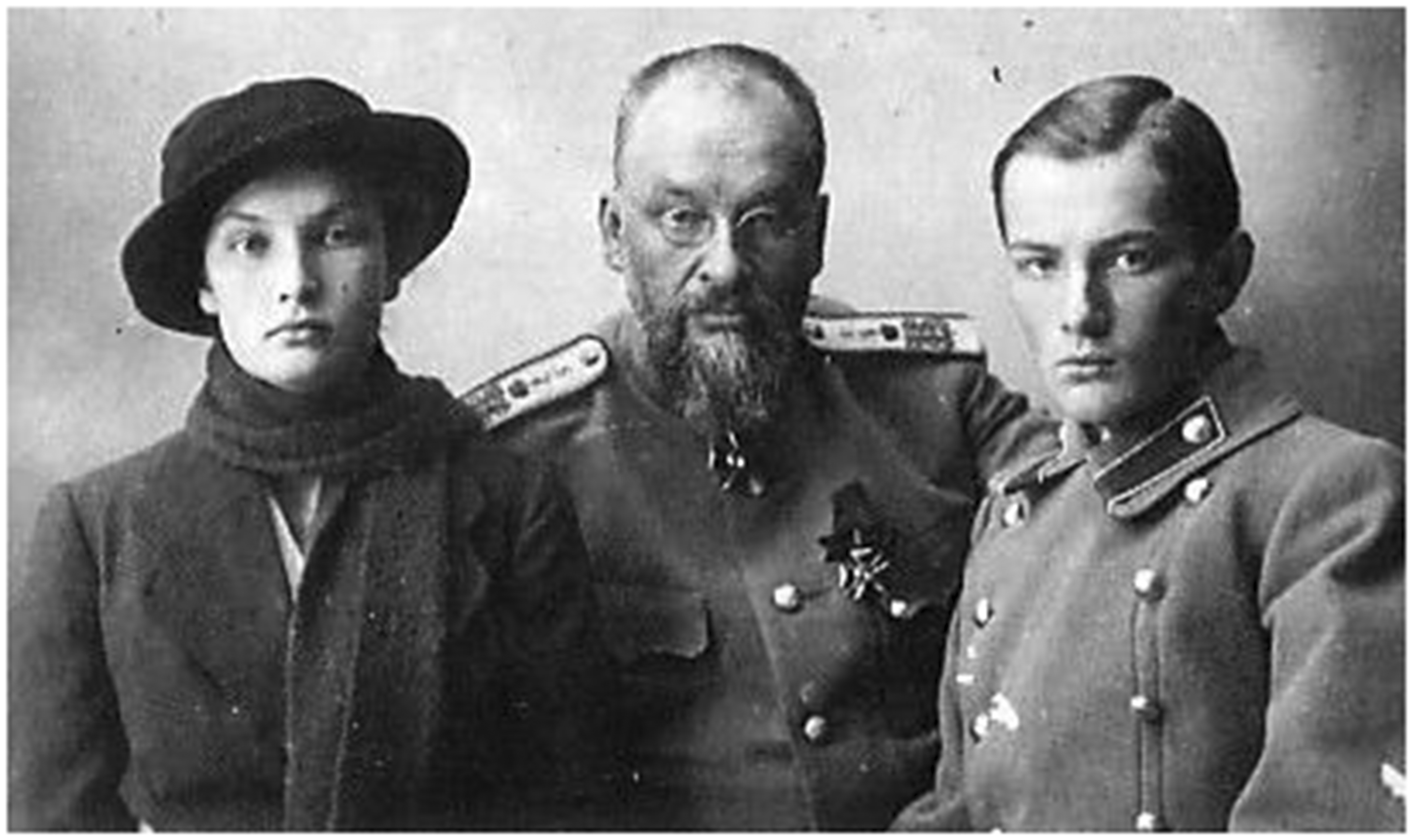
Dr. Eugene Botkin towards the end of his life with his two younger children, Tatiana and Gleb, shortly before departing into exile.
It was during their captivity at Tobolsk that the Provisional Government led by Kerensky fell to the Bolsheviks. In late March 1918, a Bolshevik regiment from Tieumen was planning on storming into Tobolsk and capturing the Imperial family. Dr. Botkin came from the Governor’s mansion and told their children: “I am going to the Imperial family. The detachment from Tieumen is expected hourly, and it is impossible to foresee how this will end. In an hour like this I must be with Their Majesties. We may not see one another again … God bless you my children.” 3 Once again, Dr. Botkin, despite awareness of the risks involved, chose voluntarily to stay with the royal family than spend his potential last hours with his children. Similar to what had happened a year before in Tsarkoe Selo, the menacing regiment did not make it to the royal household. Drunken and easily deterred by the local regiment, they turned back. However, it was starting to become obvious that the new rulers were becoming increasingly uncomfortable with the status of the Imperial family, and that radical factions within the Bolsheviks were starting to exert pressure on what should be the fate of them, especially in view of the persistence of loyalists groups across the nation which were become better organized. Constant rumors of escape attempts were circulated among the family and their captors, including a plan from England to rescue them across the Kara Sea, and an intense diplomatic pressure exerted by the Kayser’s government, after Russia’s capitulation to the Germans. 6,10
From the medical standpoint, the time at Tobolsk was relatively quiet. However, in March, the Tsarevich suffered another accident while playing in the house, sledding down the stairs. He fell and developed a large hematoma in his groin, the worst since the Spala incident a few years before. His conditioned worsened and became quite delicate, despite the care of Drs. Botkin and Derevenko. This brought significant angst to the family, particularly the Empress.
A few weeks later, the family received notice that they were being transferred to Moscow. They were told that after a brief trial in Moscow, they would be condemned to exile in Britain. Because time was of the essence, they would need to depart immediately, but given the Tsarevich’s condition, the group needed to split in two parties. Dr. Botkin immediately volunteered to travel with the Tsar, who would also be accompanied by the Empress -a hard decision for her to part from her convalescent son-, Grand Duchess Marie, Prince Dolgoruky -an aide-, a couple of valets, and the chambermaid Demidova. According to Dr. Botkin’s son Gleb, “how many times, since the beginning of the revolution had we taken leave of father, thinking that it might be the last time we should see him alive! But on that day … we had no such premonitions.” 3 The group left the next day, April 26, 1918, at 4 am. Just before leaving, the empress asked Dr. Botkin “What about your children?”. He replied: “My duty has always been with Your Majesties.” 11 The empress squeezed his hand in gratitude. According to his daughter Tatiana: “My father saw me, and turning around signed me repeatedly with the cross.” 9 It would be the last time she would see him.
Alas, the party would not make it to Moscow. They were detained in Ekaterinburg by the Ural soviet, who claimed they had the “right” to avenge their people for the Tsar’s crimes. Whether this “right” had been sanctioned by Moscow or not is still a matter of robust debate. Upon arrival they were placed in the largest house in town belonging to an engineer named Ipatiev. The Bolsheviks referred to it from the beginning as the “House of Special Purpose”.
The house of special purpose
As the party settled down in their new house, it became apparent that conditions at the Ipatiev house would be harsher than anything they had experienced so far. Immediately a large fence was built around the house and later all windows were nailed-shut and whitened to obstruct the view. Doors were removed from the rooms to preclude any privacy. Guards were present 24 hours a day both inside and outside the house. Their time outside was limited to half an hour a day in the small garden. Pornographic graffiti of the Empress with Rasputin were deliberately drawn in front of the toilet. 11 Later in May, once Alexei was able to travel, they were joined by the remaining members of the family, Trupp, Kharitonov, a kitchen boy, and a sailor by the name of Nagorny who had cared for the Tsarevich for years. (Prince Dolgoruky was arrested and executed a few days after arrival to Ekaterinburg, although the family never knew). 11
During the captivity at the Ipatiev house, Dr. Botkin played a central role in the defense of the rights of his fellow prisoners. He defended the family’s physical welfare, asking for more time outside the house, periodical visits by a priest, and insisting that Dr. Derevenko should be allowed to visit the Tsarevich, to which the Bolsheviks agreed. This allowed Dr. Derevenko to stay in Ekaterinburg, albeit not in the house. At one point, when Derevenko had not been allowed to visit in more than 5 days, Dr. Botkin wrote “a very strong letter” to the Ural Regional Soviet Executive Committee, not only requesting Derevenko’s presence, but also that of the boy’s tutors Gilliard and Gibbes, who were also lingering in Ekaterinburg. 7,12 The petition for the tutors was denied, although Derevenko was allowed on a more regular basis, a fortunate permission, as the Tsarevich’s pain had exacerbated after the long trip from Tobolsk.
The situation continued to deteriorate. One of the footmen fell ill and was transferred to the prison hospital, where miraculously was forgotten and managed to escape. A few days later, the other footman and the sailor Nagorny, for reasons still debated, were removed without explanation to prison and shot a few days later. Ominously, the night before the family’s execution, the kitchen boy was also sent away. As Peter Gilliard states “The number of those who had been left with the prisoners decreased rapidly.” 12 He adds: “Fortunately Dr. Botkin, whose devotion was splendid, was left…During these days of suffering the presence of Dr. Botkin was a great comfort to the prisoners; he did all he could for them, acted as intermediary between them and the commissaries, and did his best to protect them against the coarse insults of their guards.” 12
On June 23, Botkin suffered a biliary (or renal) colic episode, which required morphine. In an interesting twist of fate, it was Empress Alexandra who provided him care. 2,5
On July 16, close to midnight, commissary Yurovsky, who was placed in charge of the prisioners a few days earlier, knocked on Dr. Botkin’s door and told him that the White Army was approaching Ekaterinburg, and for that reason the Ural soviet had decided to transfer them immediately. He asked to wake the family and servants and bring them downstairs. Once there, they were informed that the Ural Regional Soviet had sentenced them to death. “So you are not taking us anywhere?” asked Dr. Botkin, those being his last words. 5 The details of the gruesome execution have been widely published. An ill-conceived, and worse executed plan resulted in a carnage performed by drunken executioners with unnecessary suffering from the victims. Dr. Botkin received two hits in the abdomen and one in the knee cap, and in a last act of devotion, attempted to protect the Tsar with his arm, before falling. The plaster dust and the gun smoke obligated the executioners to stop, open the doors, and exit for a few minutes. Upon return, Botkin, still alive, was leaning on his right arm, trying to raise himself. Yurovsky approached him and ended his suffering with a bullet to his head. 5
The disposal of the bodies was equally botched, and required removing the bodies from the first burial site after 24 hours, out of fear that the location had been ousted to the local people. They were finally placed in a grave dug in the middle of a muddy road in the Koptyaki forest, some 20 Km from Ekaterinburg, and would remain there until their excavation in 1991. 5,13,14
Discovery of the remains
In 1979, amateur archeologist Alexander Avdonin and investigator Geli Rhyabov, based on stories from oral tradition and commissary Yorovsky’s personal writings, located the site of the burial of the bodies. 14 Their discovery would have to wait until the 1990s to be made public, given the political situation at the then Soviet Union. Finally, in 1992, a forensic team excavated the site and located 9 of the 11 bodies in a common grave (the 2 remaining bodies were not found until 2007 at a nearby but separate grave). While the identification of the remains is a story on its own, Botkin’s body (skeleton #2 of the first grave) was easy to identify. His cranium had a distinctive flat, sloping forehead, and was the only one missing all upper jaw teeth, a fact well documented as his dental plate had been found in the first burial site after the White Army liberated Ekaterinburg. His skeleton had a portion of the torso intact, held together by a mass of adipocere. Within it, one bullet was found in the pelvic area, and another impacted in a vertebra. His skull had an entrance gunshot wound at the level of the left forehead.
Dr. Botkin’s remains were further identified by DNA analysis. His granddaughter Marina Schweitzer, Gleb’s daughter, donated a blood sample for the comparative analysis. Since she was not a descendent along maternal line, mitochondrial DNA analysis could not be performed (while Dr. Botkin did have a sister, her descendants -whose DNA would have allowed mitochondrial DNA analysis- have not been located). However, Marina happened to have a half-sister, unrelated to Dr. Botkin, who also donated a blood sample. This allowed to determine the “Botkin” DNA from Marina, which was used for the comparison. 13
Despite the controversy surrounding the remains of the Romanovs and their accompanying servants, they were eventually interred in St. Peter and Paul’s Cathedral, in St. Petersburg on July 17, 1998, on the 80th anniversary of the massacre. Dr. Botkin, along Demidova, Trupp, and Kharitonov are the only non-royal persons ever buried in the sacred grounds of the cathedral. His granddaughter and great-grandson attended the funeral.
Conclusion
Dr. Eugene Botkin’s ultimate fate was not an aleatory result of the political events of the times. It was a conscious voluntary decision on his part justified by his personal sense of duty. Once and again, as demonstrated by the repetitive farewells to his children, he would prioritize his obligations as a physician over his personal interests, despite multiple opportunities presented in which he could have walked away from the Imperial family. The last one of these presented upon arrival to Ekaterinburg. He was approached by the Bolsheviks and was told he could leave and choose a place to work. He answered: “You see, I gave the Tsar my word of honor to remain alongside him as long as he is alive. It is impossible not to hold to such promise for a man in my position. I also can’t leave the heir alone. How can I combine this with my conscience? You all must understand this.” 4 This provides not only justification for his actions, but it also allows us to infer that he was probably aware of the eventual execution. This awareness of his ultimate fate was foreshadowed time and again throughout his role as the family doctor. While in medical school, a group of classmates had gotten in disciplinary trouble and were expelled. As part of the group of “elders” in his class, Eugene sent a petition to Tsar Alexander III, on their behalf. Not only was the petition denied, but resulted in the expulsion of Botkin and the other four elders. The night of their expulsion they dined together, and would do so every year thereafter. When one and then another of the elders passed away, they would still meet and place a photograph of the missing ones in the table. While in Tobolsk, Botkin missed this reunion for the first time. The two remaining elders did meet and sent Botkin the picture of the reunion. In the table were not only the pictures of the two dead elders, but also Botkin’s. Deeply impressed, he was able to mutter to his son: “How strange! Am I already dead?” 3
But perhaps the most transparent window into his thoughts was the last letter he wrote, a few hours before his execution. Addressed to his brother Alexander (Sasha), and found by the White Army in his room a few days after the massacre, it read:
“I am making a last attempt to write a real letter - at least from here – although that qualification, I believe, is utterly superfluous. I do not think I was fated at any time to write to anyone from anywhere. My voluntary exile here is limited less by time than by my earthly existence. In essence, I’m dead - dead for my children, -dead for my work … I am dead but not yet buried, or buried alive- whichever, the consequences are nearly identical. My kids might hope that we will see each other again in this life, but personally I no longer believe it and I see the unadulterated truth straight in the eye. I will clarify my situation for you using small episodes. The day before yesterday while I was sitting peacefully and reading Saltykov-Shchedrin, which I really enjoy, I suddenly saw vaguely my son George’s face, but he was dead, lying horizontally, his eyes closed. Yesterday, while I was reading in the same manner, I suddenly heard the word “Papulya” (daddy). I almost started to sob. Again - this is no hallucination, because the word was expressed, the voice was similar, and I did not doubt for a moment that my daughter, who was supposed to be in Tobolsk, spoke to me … I’ll probably never hear again that dear voice, or feel that touch so dear, with which my little children spoiled me. … If “faith is dead without works”, then works can live without faith. If any of us combine faith and works it is only out of God’s special kindness. One such happy man -even through serious illness, and the loss of my first-born, six month-old Seryosha- was I. Since then, my role as a physician has significantly expanded and defined itself, and in every case I have also been concerned about the patient’s soul.
Dr. Botkin was canonized on February 2016 as a Righteous Passion-Bearer by the Council of Bishops of the Russian Orthodox Church. Churches in honor of St. Eugene Botkin the Physician have been built in Moscow, St. Petersburg, Novisibirsk, and Ekaterinburg. 16
Footnotes
Declaration of conflicting interests
The author(s) declared no potential conflicts of interest with respect to the research, authorship, and/or publication of this article.
Funding
The author(s) received no financial support for the research, authorship, and/or publication of this article.

Author biography