




Abstract
This paper reviews the career of Robert Kendell with emphasis on his contribution to diagnosis in psychiatry. His studies on the classification of depression showed that symptoms were distributed on a continuum and that division of depression into sub-types was not justified. Similarly he showed there was no clear-cut distinction between symptoms of schizophrenia and affective psychoses. He examined Scadding’s definition of disease as it applied to psychiatry and questioned whether some conditions such as neuroses and personality disorders would qualify as illnesses. He concluded that available evidence supported a dimensional rather than a categorical approach to diagnosis.
Introduction
Robert Evan Kendell, one of the leading British psychiatrists of the late 20th century, made important contributions to several areas of psychiatry, including post-natal mental illness, the management of alcohol abuse and the effectiveness of electroconvulsive therapy (ECT) but his main contribution was his attempt to define the concept of disease as it applied to psychiatry and thereby to refute the criticisms of those who sought to undermine the practice of psychiatric diagnosis. A major tenet of the anti-psychiatry movement which flourished in the 1960s was that there was no such thing as mental illness. The entire concept was considered to be a social construct. Thomas Szasz, the Hungarian born psychiatrist then working in United States, was the trailblazer for this viewpoint. His case was based on psychiatry’s failure to demonstrate consistent physical abnormality in those whom its practitioners regarded as mentally ill. Subsequent advances have shown this to be a spurious argument but Szasz’s paper, The Myth of Mental Illness, later expanded into a book, had considerable influence on the vociferous army of critics of psychiatric practice when it was first published in 1960. 1 The anti-psychiatry movement had been established in opposition to several reported scandals of abuses of psychiatry. It rejected the medical model of psychiatric practice. Most psychiatrists, although irritated by these attacks, got on with their work of treating their patients as best as they could but a few rose to the challenge thrown down by Szasz and attempted to define the concept of disease as it applies to psychiatry. Kendell was the most articulate advocate of the need for diagnosis while at the same time examining the concept of disease and the distinctions which psychiatrists make between different forms of mental illness.
Personal background
Kendell was born in Rotherham, Yorkshire in 1935. Both his parents were teachers. Three of his grandparents were Welsh and much of his childhood during the Second World War was spent in the North Wales village of Llanllechid, in the foothills of Snowdonia close to the slate-quarrying town of Bethesda. The surrounding landscape is mountainous, bleak and often rain-drenched but it is a major attraction for climbers and may well have provided the inspiration for Kendell’s later expertise as a mountaineer.
By the time of his secondary schooling the family had moved to Enfield, Middlesex and he spent two years at Enfield Grammar School before winning a scholarship to Mill Hill School under the Middlesex County Council scheme. Mill Hill, of nonconformist foundation, is now predominantly a co-educational day school but in the 1940s it was a typical English independent school, single sex and almost exclusively boarding. Kendell boarded at Winterstoke House even though the parental home in Enfield was only a few miles away. He obviously flourished in this environment, winning several school prizes and participating in sports teams, notably rugby, cricket and swimming. His school career was capped by his becoming senior monitor (Head boy), winning a state scholarship and then a major scholarship in natural sciences to read medicine at Peterhouse, Cambridge’s oldest and smallest college (Figure 1).
His academic success continued at Cambridge where he won several University prizes and was placed in the first class in both parts of the Natural Sciences Tripos, with biochemistry as his specialty subject for his final year. He played rugby for his college and was treasurer of the University Mountaineering Club.
Cambridge had no established clinical medical school at that time and like most of his Cambridge medical contemporaries he went to London for his clinical studies. Kendell’s choice was King’s College Hospital Medical School in south-east London. In his first term there he presented a paper to the Historical Society on Andreas Vesalius which was subsequently published in the King’s College Hospital Gazette. This is probably Kendell’s first published paper, showing an erudition which was to characterise his later publications and a precocious intellectual self-confidence. 2 It is essentially a sober appraisal of Vesalius’s monumental work De humani corporis fabrica. While recognising the enormous contribution to anatomical dissection and the brilliant illustrations by Titian’s pupil Van Calcar, Kendell was critical of Vesalius’s adherence to Galenic principles of physiology and accused him, together with his contemporary Copernicus, of showing ‘a rather disappointing lack of original thought’ on the conceptual side of his work. Vesalius’s fame did not rest, he claimed, on originality of challenging Galen’s authority or keenness of intellect but on the actual art and technique of dissection. He regarded Vesalius as a brilliant and outstanding craftsman but not to be compared in terms of original thought with some of his lesser known medical contemporaries in renaissance Italy among whom he included Realdo Colombo, Michael Serveto, Gabriello Fallopio and Jean Fernel.
Kendell accumulated more prizes at King’s and continued his involvement with several student sporting clubs. More importantly he met his future wife, Ann Whitfield, a fellow King’s student who was to go on to have her own successful career as a consultant anaesthetist and together they would raise four children. Among his teachers was Denis Hill, then a consultant in psychological medicine, to whose influence Kendell attributed his choice of psychiatry as a specialty. Hill was later appointed professor of psychiatry at the Middlesex Hospital Medical School and then at the Institute of Psychiatry.
Kendell qualified with the Cambridge MB, BChir degrees in 1959 and worked at King’s during his preregistration year. Other junior posts followed in London at the Brompton Hospital and the National Hospital for Nervous diseases. With this background and membership of the Royal College of Physicians under his belt Kendell would have been sought after by most medical specialties but he stuck to his decision to take up psychiatry and started his training at the Bethlem Royal and Maudsley Hospital and the associated Institute of Psychiatry, University of London. There he completed his junior training and like many of his contemporaries was much influenced by Aubrey Lewis. He took the Academic Diploma in Psychological Medicine of the University of London and won the prestigious Gaskell Gold Medal awarded by the Royal Medico-Psychological Association, the fore-runner of the Royal College of Psychiatrists.
Classification of depression
This was followed by a period of research at the Institute of Psychiatry into the classification of depressive illness. Most contemporary textbooks described two distinct forms of depression, neurotic (or reactive) and psychotic (or endogenous) which were considered to be separate categories. Reactive depression was regarded as a psychological response to adverse life events such as broken relationships, redundancy, financial hardship or bereavement whereas endogenous depression was considered to be largely independent of external factors but caused by constitutional, particularly genetic, factors. The two types were thought not only to have a different aetiology, but also a different symptom profile and a different response to treatment. Martin Roth and his Newcastle colleagues were the most persuasive advocates of this distinction and provided statistical evidence to support their viewpoint, albeit based on a highly selected population of patients admitted to hospital for ECT.
3
,
4
Kendell’s research, published as a Doctor of Medicine (MD) thesis, was based on a statistical analysis of case-notes of inpatients diagnosed with depression. It demonstrated that the aetiogical factors and symptoms of the depressed patients lay on a continuum. There was no clear division into reactive or endogenous categories. His thesis concluded: ‘The concept of a continuum preserves the most important tenets of both separatists and their opponents, yet avoids the weaknesses of their respective standpoints… … And, by virtue of being a compromise between two historical standpoints, it holds out some hope of bringing to an end what is becoming an increasingly sterile controversy.’
5
US-UK project
Kendell next worked on the US-UK Diagnostic Project, headed by John Cooper, based at the Institute of Psychiatry. This had been established to determine why the reported incidence of schizophrenia was much higher in the United States than in the United Kingdom. It was soon evident that American psychiatrists had a broader concept of schizophrenia and in some centres the term was used so loosely that it was meaningless. The Project’s patients were drawn from a series of consecutive admissions to mental hospitals in London and New York. When similar, agreed diagnostic criteria were used in both countries no substantial difference in the incidence of the condition was found. 6 This study had considerable influence on diagnostic practice and led to the introduction of operational definitions in an attempt to improve diagnostic reliability. In particular it influenced diagnostic practice through the American Psychiatric Association’s Diagnostic and Statistical Manual (DSM-III). Kendell became an advisor to some of the task forces preparing DSM-III and its subsequent versions as well as being a member of the World Health Organisation’s Expert Advisory Panel on Mental Health.
He took advantage of the US-UK Project data to re-examine the symptoms of psychotic and neurotic depression using the statistical technique of discriminant function analysis. The results were similar to those found in his MD study. There was no distinct separation in the symptoms of the two groups. Symptoms lay on a continuum, reinforcing the case for replacing the existing categorical classification with a dimensional one. 7 A similar exercise showed no clear distinction between the symptoms of schizophrenia and affective psychoses. 8
Following 18 months as visiting professor at the University of Vermont Kendell returned to the Institute of Psychiatry as reader in psychiatry and then, in 1974, he moved to a chair of psychiatry at the University of Edinburgh. Among his students he was renowned for the clarity of his teaching. He was popular with trainees and respected by colleagues. He led an active research department while maintaining a busy National Health Service clinical practice. He co-edited three editions of the popular postgraduate textbook, Companion to Psychiatric Studies. He served for two terms as dean of the faculty of medicine and then moved out of academic work to take on the post of chief medical officer for Scotland where skills of diplomacy, as much as intellect, were required. There he had to deal with an outbreak of E. coli infection and the crisis over bovine spongiform encephalopathy and its possible transmission to humans as Creutzfeld-Jakob disease. He led attempts to improve the health of the Scottish public by persuading them to modify their dietary habits and reduce their alcohol consumption. Some improvements were achieved but he rued the failure to reduce smoking among young people, to reduce alcohol consumption and to improve the Scots’ notoriously bad dental health. 9 His characteristic straight-talking and refusal to compromise his professional integrity did not always endear him to politicians. After retiring from this post he was elected to serve as president of the Royal College of Psychiatrists from 1996 to 1999 (Figure 2). He received further recognition through election to the Royal Society of Edinburgh and he was made a Commander of the British Empire (CBE). He maintained a high level of physical fitness, being a regular swimmer, hill walker and squash player. He was in apparent good health until his sudden death from an unsuspected cerebral tumour in 2002.
Definition of disease
Kendell’s interest in the classification of depression and the diagnostic process led naturally to an appraisal of the concept of disease as it applied to mental illness and of the validity of the classification of such illnesses. The central problem for psychiatric diagnosis was the absence of a demonstrable lesion which could account for the symptoms and signs of any particular diagnostic syndrome. This was the basis of Szasz’s argument that there was no such thing as mental illness. Although advances in brain imaging have long since removed this plank of Szasz’s argument it remains the case that clinical psychiatrists have to make a diagnosis on the basis of subjective symptoms and limited signs, with little help from laboratory investigations. In that sense psychiatry remains in the prescientific era of medicine before microbiology, histopathology and molecular genetics transformed our understanding of disease.
One clinician who tackled the problem of disease definition was John Guy Scadding, a chest physician at the Brompton Hospital whom Kendell knew from his time as a junior doctor there. Scadding had proposed the following definition: ‘A disease is the sum of the abnormal phenomena displayed by a group of living organisms in association with a specified common characteristic or set of characteristics by which they differ from the norm for their species in such a way as to place them at a biological disadvantage’.
10
Kendell attempted to apply Scadding’s definition to mental disorders in what he considered his most important book, The role of diagnosis in psychiatry 11 and in his inaugural lecture at the University of Edinburgh. 12 A major problem was that there had never been a robust definition of disease, either mental or physical. Scadding had not specified what he meant by biological disadvantage but Kendell believed it must embrace both increased mortality and reduced fertility. Whether other impairments should be included was less obvious. The issue of increased mortality was straightforward. There was abundant evidence of increased mortality in people diagnosed with schizophrenia, manic-depressive illness and several types of drug dependence, which therefore were to be justifiably regarded as illnesses. The inclusion of reduced fertility was more problematical and did not appear to be an appropriate criterion as it would include patterns of behaviour and life-style choices which were clearly not illnesses. Based on Scadding’s criteria Kendell thought it was uncertain whether neurotic disorders and personality disorders would qualify as illnesses. Consequently, he argued that psychiatrists should reconsider how their area of expertise should be defined. There were certain conditions which other therapists, presumably clinical psychologists, could treat more effectively and whose training and concepts were more appropriate than those of a psychiatrist.
Diagnostic practice in psychiatry underwent a profound change after 1980 with the introduction of operational diagnostic criteria by the American Psychiatric Association, published as the Diagnostic and Statistical Manual of Mental Disorders, Third Edition. 13 This project, led by Robert Spitzer, a psychoanalytically trained clinician who had become disillusioned with the effectiveness of psychoanalysis, specified clearly defined symptoms for each mental disorder which had to be present before a diagnosis could be made. It also specified which symptoms had to be excluded. There was no assumption that each mental disorder was a discrete entity with sharp boundaries between it and other mental disorders or between it and no mental disorder. The categories were descriptive and in the large majority were devoid of aetiological assumptions.
Categories or dimensions
Despite his well-argued support for the importance of diagnoses Kendell remained doubtful about their validity.
14
‘“Schizophrenia” and “manic-depressive illness”, and all our other diagnostic terms are simply concepts. They are products of the human imagination and they exist only in the realm of ideas. The only fundamental question we can ask about them, therefore, is whether they are useful concepts, and even that question has to be qualified further - useful to whom, and in what context? … … . All classifications of mental disorders are fundamentally models which we use to represent the variations in symptoms, in course, and in response to treatment which we observe in our patients. In choosing which model to use, the first decision we have to make is whether to use a typology (a set of categories) or a dimensional model (a set of continua).’
15
One of the earliest attempts to classify diseases was made by William Cullen, successively professor of chemistry then physic at Edinburgh. Cullen reduced disease classes to four, namely pyrexias, cachexias, neuroses and local disease. 16 His protégé, John Brown, with whom he subsequently fell out, recognised only two classes, sthenic and asthenic, depending on whether there was a greater or lesser degree of excitability of the tissues. 17
Medicine adopted a realist approach to classification following the publication of Thomas Sydenham’s Observationes medicae. Sydenham, like Cullen before him, had been influenced by the new taxonomy of plants developed by the Swedish scientist Carl Linnaeus. He was convinced that diseases were specific entities with unique natural histories. They could be reduced to definite species just as plants had been classified.
In practice most psychiatrists, like clinicians in other areas of medicine, use a categorical approach to diagnosis, one which is most useful in deciding on a course of treatment and enabling a prognosis to be given. This is also the view taken by the law and continues to have its supporters not least for the classification of psychotic disorders. 18 Kendell’s position however, as far as psychiatry is concerned, was decidedly nominalist. In retirement he continued to advocate the continuum model of symptoms, arguing that there was no clear-cut difference between mental illness and personality disorders. It was therefore impossible to decide whether personality disorders, a heterogeneous group, were mental disorders or not. 19 This debate is on-going. However the World Health Organisation and the American Psychiatric Association have always included personality disorders in their respective classifications without offering explanation or justification. Kendell also challenged the distinction between mental and physical illness maintaining that the distinction was ill-founded and not compatible with modern understanding of disease. 20 Thus he emphasised the arbitrary nature of the division between mental and physical ill-health and questioned the need to separate psychiatry from the rest of medicine.
Population surveys have confirmed that common mental symptoms are distributed on a continuum, an observation which has been described as a requiem for the categorization of mental disorder. 21 , 22 The threshold for separating mental disorders from normality is arbitrary, often defined by whether treatment is available. The threshold tends to be lowered as new effective treatments are introduced. 23 His last paper, written with Assen Jablensky and published posthumously, reiterated this message while acknowledging that the lack of validity did not negate the utility of psychiatric diagnoses to clinicians. By virtue of the important information they provide about outcome, response to treatment and likelihood of relapse diagnoses were invaluable in clinical practice. 24
Conclusions
Kendell’s contribution was to challenge the validity, but not the utility, of diagnostic categories by demonstrating that the distinction between mental illness and mental well-being is blurred, likewise the boundary between mental illness and personality disorder is blurred and the separation of physical and mental illness is fallacious. As a diagnostician he favoured a dimensional approach because that was what the available evidence suggested. It was not apparent how many dimensions were required and whether or not the dimensions were orthogonal. His preference for transitions or areas of grey rather than distinct black and white categories can be seen to have muddied the waters of psychiatric nosology but only because the waters were unnaturally clear beforehand.
The logical conclusion of his research suggests that everyone’s mental adjustment can be placed on a continuum, with no natural boundaries between different diagnostic categories of mental illness and no clear-cut separation between people considered mentally healthy and those considered mentally ill. This conclusion surely should help reduce the stigma which people labelled as mentally ill still have to endure.
This is an important legacy to have left to psychiatry. Kendell was endowed with considerable physical energy, intelligence and integrity. The tributes paid to him following his death described him as austere, courteous, imperturbable and, surprisingly, having a touch of diffidence. His manner and intellectual distinction could sometimes give the impression of chilly aloofness but in social gatherings he was relaxed, amiable and modest. The Scotsman’s obituarist described him as being never quite convinced of his own eminence. 25

Mill Hill School monitors 1953 (Kendell seated on headmaster’s right). Reproduced by courtesy of the School.
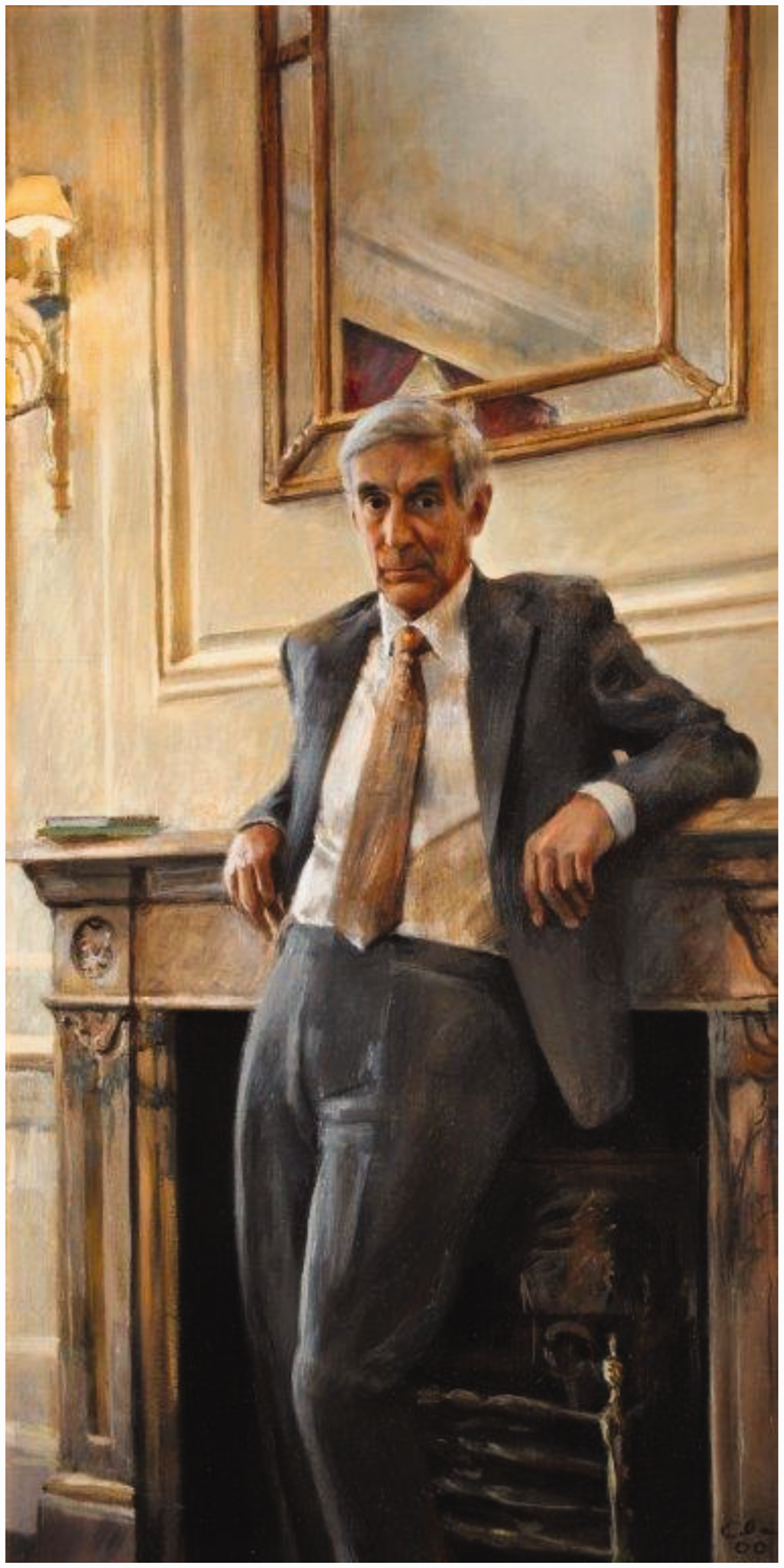
President of Royal College of Psychiatrists (Portrait by Christian Furr, reproduced by courtesy of the College).
Footnotes
Acknowledgements
I am grateful to Ann Kendell, Margaret Lloyd and Peter White for their comments on earlier drafts of this paper,
Declaration of conflicting interests
The author(s) declared no potential conflicts of interest with respect to the research, authorship, and/or publication of this article.
Funding
The author(s) received no financial support for the research, authorship, and/or publication of this article.
