



Abstract
Saim Erkun (1901–1949) was born in Manisa at Aegean region of Anatolia as an Ottoman citizen. While his early life was spent in late Ottoman times at military actions including military prison camp in British colony; India, his active professional productive period was in early Turkish republic period (Est. 1923, centenary). He had a good education period for medicine with the help of his good level of all main World scientific languages such as French, German, and English. Besides his main profession, he was also interested in Ottoman urological medicine around the conquer of Istanbul and allocated them a space in his books in 1930s. He was one of the earliest urology resident (1929–1933, Istanbul) of modern medicine in Turkey. He performed many urological procedures and published the outcomes following modern scientific algorithms, furthermore, there have been urological books including “history” partly referring to antique Ottoman literature among his publications. In this manuscript we focused on the magic word of Urology forever; “Prostate,” among his essays. Turkish medicine, particularly urology, renewed itself by some intelligent hard working young clinicians such as Saim Erkun, immediately after the short struggling by means of establishment process of modern Turkiye after World War I by the collapsing of old Ottoman Empire. Furthermore, we think that the stunning special word of urology, “prostate,” should especially be mentioned to emphasize the importance of this beginning.
Background
Saim Erkun (1901–1949) was born in the city of Manisa in Aegean region of Anatolia as an Ottoman citizen. While his early life was spent in late Ottoman times at military actions in Arabic Peninsula then a military prison camp in India as British colony, his active professional productive period was in early Turkish Republic period (est. 1923, centenary). 1 He had found an opportunity to get a good education basement for medicine with the help of his good level of all main world scientific languages such as French, German, and English due to his European-based high school in Istanbul and the life period at British military prison camp. Besides his main profession, he was also interested in Ottoman urological medicine around the conquest of Istanbul and allocated them a space in his book printed in 1930s. As he was one of the earliest medical historian of Turkish republic, he published an historical masterpiece in the name of “An overview of Turkish medical history” (1935) which has a reference part involving various widespread languages such as Turkish, Arabic, Persian, French, German, and English, that shows its academic value clearly.1,2 He was one of the earliest urology resident (1929–1933, Istanbul) of modern medicine in Turkiye.1,3 In his short life, he performed many urological procedures and published the outcomes following modern scientific algorithms, furthermore, there has been urological books including “history” partly referring to antique and modern times of Ottoman literature among his publications. In this manuscript, we focused on the magic word of urology forever; “Prostate,” among his essays.
Main text
Dr. Saim Erkun defined himself as “Urologist” in the title page of his publications as he was one of the founding member of Turkish Association of Urology in 1933.1,2,4 At the same year, author, as a urology resident, published a book named “Prostat dahamesi” [Prostate hyperplasia (BPH)] related with its basic knowledge of the time as in anatomy, physiology, and even embryology. 5 In the following years, unsurprisingly, he was also involved in the pioneer editorial board of “Turkish Journal of Urology” (1936) and published various unique examples of articles related to main topics such as BPH, hematuria, and stone disease of pediatric age.1,6 There are many scientific publications in modern manner that belongs to him which tried to review the pioneer progress of urological manuscripts in Europe and, as he was also a medical historian, he reproached about skip of Ottoman historical medical progress between Greek-Roman and Renaissance periods during the dark ages of Europe. In the introduction section of his complementary book titled “Prostat dahamesi, tarihçe ve anket” [Prostate hyperplasia (BPH), history and survey], (1938) Erkun S mentioned old Turkish writings in the year 1455 that was immediate after the conquest of Istanbul about the lower urinary tract symptoms due to the “excess” tissue that obstruct urinary passage. 7 He intended that this definition was surely related to BPH and added that Italian authors Ferri and Lacuna contribute this fact into Western literature only after 100 years in sixteenth century. Moreover, he claimed that metal tube instruments made of tin during Ottoman times aimed to extract the “excess tissue” permanently as in transurethral resection via application to urethra from thin to thick, which was already defined by Altuncuzade Şeyh Salih in his book Şakayıkı Numaniye at the same century.7,8 We think that Erkun S. had reviewed the information by the motivation of integration efforts of Turkish urology and its historical experience with modern Europe as parallel with all systems of the newly formed Turkish Republic after the old wide Ottoman heritage.
The author noted that first prostatectomy attempts in the early 1900s had been performed by Prof. Cemil Topuzlu (Figure 1), Zügurdiyoz and Orhan Apti Kurtaran at Gülhane Military Medical School Hospital (est. 1898), Balikli Greek hospital (est. 1753) and German hospital (est. 1852) in Istanbul, respectively.7,9 In addition, Erkun emphasized that before these initial prostatectomy attempts German surgeon Rieder Pasha (Robert Rieder [1861–1913], gained Ottoman highest military degree as “Pasha”—General as he served as a military surgeon at Ottoman army hospital) tried to heal prostatism by vasectomy in the year 1900 at Gülhane Military Hospital (Figure 2).7,10 There is also some evidence in the modern literature that vasectomy had some effect on diminish prostate adenomatous volume. 11 In Erkun's book on “BPH,” almost all previous published material about prostate was carefully reviewed and he even mentioned about minimal invasive procedures such as application of hot water via rectal delivery, transrectal electric stimulation, and even radioactive destruction with radium (His references; Minet and Desnos) besides the endoscopic resection of prostate. 7 The author specially reviewed experiences about prostate surgeries (1903–1908) of some pioneer Ottoman-Turkish Urologists depending on national congress notes. As an example, Prof. Topuzlu C. Pasha who pointed that postoperative care is the most important part of this special surgery (Freyer technique) due to the early postoperative patient loss caused by heavy hemorrhage-hematuria as his European counterpart Mariyon who was his master in some surgical teams when he had been in Europe (1901). Nevertheless, Erkun S., in his prostate book, claimed that Prof. Orhan Abdi Kurtaran should be the most successful urologist of this early Turkish period by his series in the years 1905–1906 with 74 prostatectomy patients with least reported mortality. 7 Earliest reported prostatectomy article titled “Prostatectomy with enucleation” with illustration—however, could not be confirmed whether it is original or not, or a replicate—was published in year 1914 at the Medical Faculty Journal in the second issue by Prof. Kerim Sebati.7,12 To the best of our knowledge, this illustration related with urologic procedure about the modernization attempt of Ottoman medicine has never been published at modern literature before (Figure 3). During the early 1900s, there were at least three hospitals; Medical Faculty, Gureba Hospital, and Cerrahpaşa Hospital that had separate urology bed units among the General Surgery departments. 7 Erkun S. reported that some of his operations had been performed under regional anesthesia via “dorsal parenteral” application of Stovain (Made in Romania—City of Yash), a local anesthethtic (stovain—hydrochloride of benzoyl ester) between the years 1912 and 1916, surely, this definition points the modern epidural/spinal anesthesia. 7 Interestingly, Stovain should be clinically very popular as a “new” anesthetic of initial period of previous century as we got unique four full-text original articles that report clinical usage of Stovain with its complication as reducing blood pressure between the years 1904 and 1921, however, then immediately it lost its scientific importance.13–16
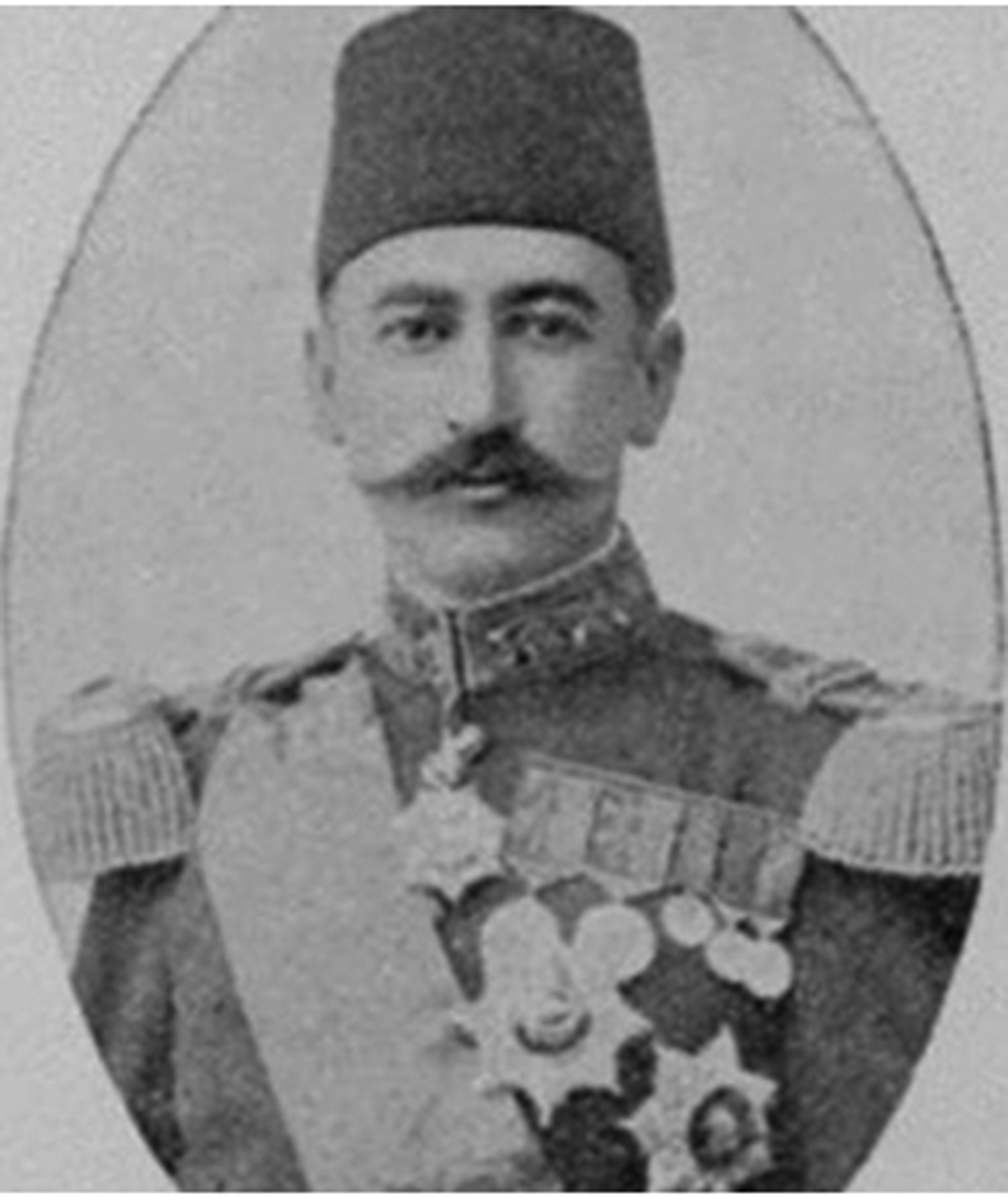
Prof. Cemil Topuzlu Pasha (1866–1958) Turkish-Ottoman Surgeon/Urologist who conducted pioneer prostatectomies in Istanbul, Ottoman capital, during the first years of twentieth century.
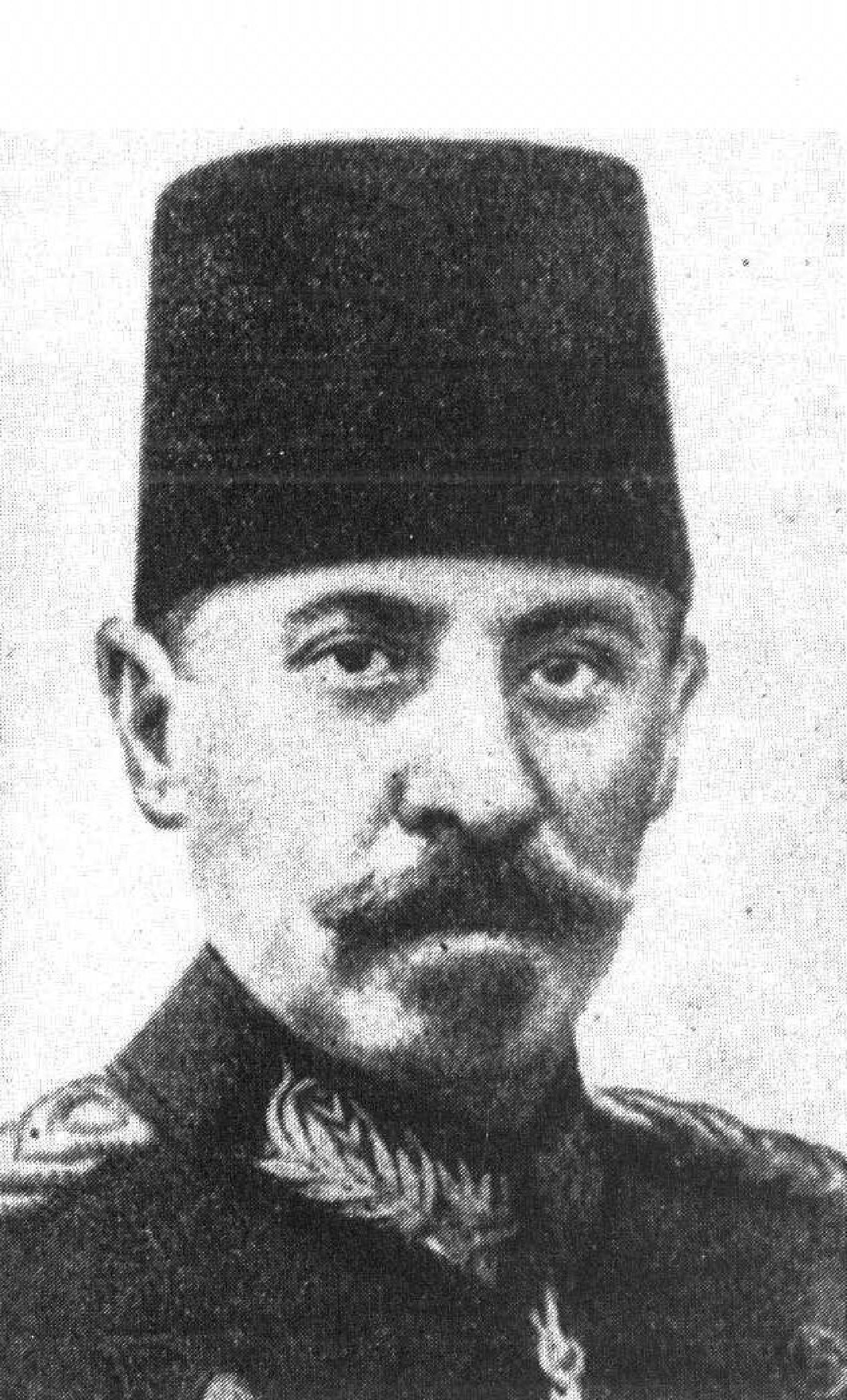
German surgeon, Robert Rieder Pasha [1861–1913], gained Ottoman highest military degree as “Pasha”—general official as he served as a military academic staff/surgeon at Ottoman army hospital.

The earliest illustration of enucleation of prostate at open surgery in the pioneer article at the initial periodic medical journal of Turkish-Ottoman medical history (1914). Notice the instruments that currently in use for open procedures. The illustration can be original or not, or a replicate.
He followed the European literature about prostate and reviewed the documented outcomes of prostate patients by several well-known European urologists at early twentieth century and reported his own BPH cases (n: 284) who attended the urology clinic between the years 1927 and 1932 in a similar way with his counterparts in Europe (Figure 4). In this study group, patients were divided into groups as outpatient and hospitalized ones then the second group was divided into groups as the ones who underwent operation and those who did not. For the unique exitus reported reason was “uremia” that was probably depending on their para-exitus clinical status as nausea, vomiting, gastrointestinal bleeding, dyspnea, and heart failure due to the renal acidosis resulted from chronic obstruction of BPH, however, it has been understood that urea could also be evaluated in blood samples that was confirmed by writings of a surgeon named Feridun Şevket located in Izmir province.7,17 Nevertheless Şevket F., interestingly, while reporting the reason of exitus (n:5, 30%) of his 17 patients who underwent prostatectomy in the similar years, mentioned about pneumonia and cardiac failure besides uremia, probably, due to reason that he could evaluate the urea at blood samples and exclude uremia clearly. On the other hand, a urologist from Ankara reported a low (12%) exitus rate in a similar series with 32 patients. 7 All these above-mentioned pioneer scientific clinical efforts appeared as simple data can be considered as the spring awakening of a newly formed urology branch in Turkiye.
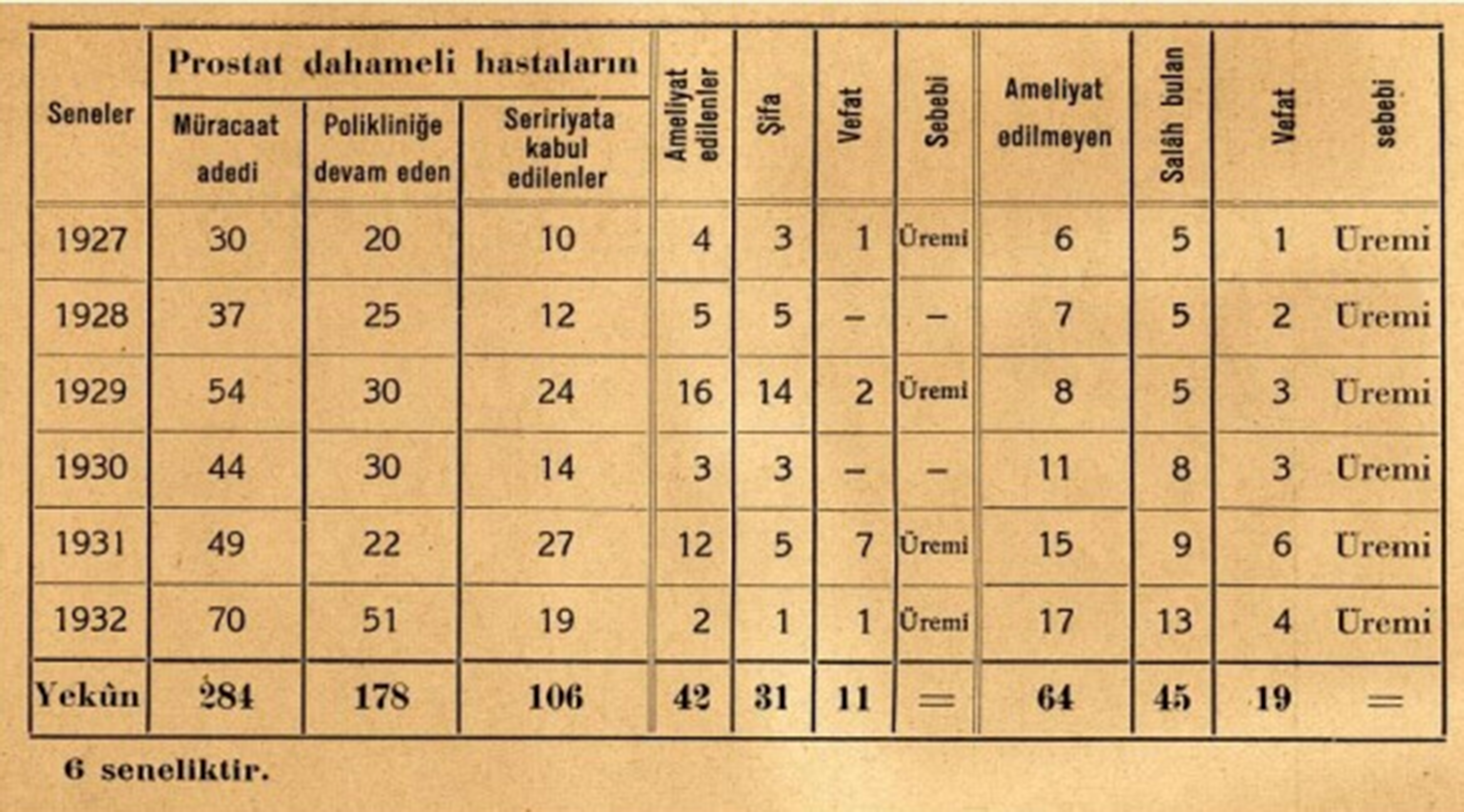
Data of BPH patients (n: 284) who followed between the years 1927 and 1932 by Saim Erkun, Istanbul.
Conclusion
Turkish medicine, particularly urology, renewed itself by some intelligent hard working young clinicians such as Saim Erkun, immediately after the short struggling by means of establishment process of modern Turkiye after World War I by the collapsing of old Ottoman Empire. Furthermore, we think that the stunning special word of urology, “prostate”, should especially be mentioned to emphasize the importance of this beginning.
Footnotes
Declaration of conflicting interests
The authors declared no potential conflicts of interest with respect to the research, authorship, and/or publication of this article.
Funding
The authors received no financial support for the research, authorship, and/or publication of this article.
