




Abstract

Anton von Eiselsberg (1860–1939) is considered the founder of Austrian neurosurgery. 1 He earned his MD degree from the University of Vienna in 1884 and trained under Theodor Billroth (1829–1894). After occupying posts in Utrecht and Königsberg, he returned to Vienna in 1901 to head the First Surgical Clinic until his retirement in 1931.
Eiselsberg conducted pioneering work on cleft lip and palate, injuries, burns, malignancies, abdominal, and neurosurgical operations. 2 In 1904, he was the first to successfully resect a glioma from the frontal lobe, and in 1907, he successfully removed a spinal cord tumour. Eiselsberg's modification of the Hermann Schloffer (1868–1937) transnasal transsphenoidal approach to the sella turcica was subsequently adopted by Harvey W. Cushing (1869–1939) in America. 3
In collaboration with Julius von Hochenegg (1859–1940), Eiselsberg created the world's first model emergency surgery stations in Vienna. During the First World War, Eiselsberg served as an admiral staff physician for the Austrian–Hungarian Navy and travelled across Europe, from the Balkan Peninsula to the Eastern Theatre, supervising field hospitals and performing surgical operations. He discussed the complications of skull shot wounds, including primary damage to the cerebral parenchyma, inflammation of the brain and meninges occasionally leading to cyst or scar tissue formation, and epilepsy (Gehirn– und Nervenschüsse, insbesondere Spätchirurgie, Lauss, Tübingen, 1916). Late into the war, Eiselsberg commissioned a medal (Figure 1) from the Austrian sculptor Andreas Kögler (1878–1956) to honour “My staff members and friends of the Surgical Clinic during 1914–1917.”
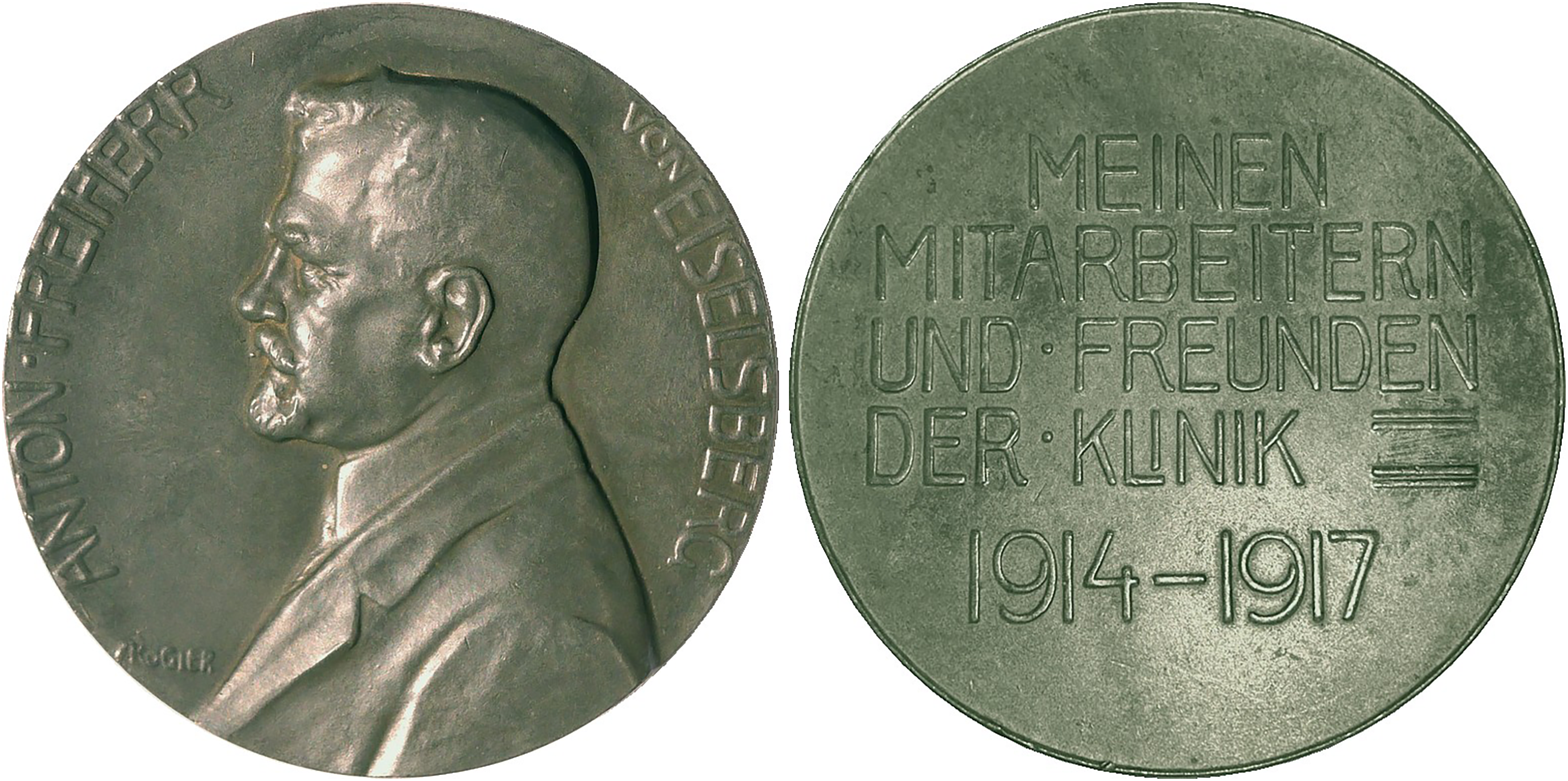
Zinc medal commissioned by Anton von Eiselsberg. Crafted by Andreas Kögler, a native of Graz. Actual diameter 64 mm; weight 89 g. Private collection.
Eiselsberg served as president of the Austrian Cancer Society and the Society of German Natural Scientists and Physicians and as chief physician for the Red Cross (Vortrag zur Eröffnung der Herbstsaison der Urania zu Gunsten des Roten Kreuzes, Braumüller, Vienna, 1914).
Although Eiselsberg is named the founder of Austrian neurosurgery, 1 he was mostly a general surgeon. Wilder G. Penfield (1891–1976), in his report to the Rockefeller Foundation dated 1928, visited Eiselsberg's Clinic in Vienna asking to look at his neurosurgery operations. Eiselsberg sent him to Cushing, adding that he avoided dealing with neurological cases and inviting Penfield to attend a gastrectomy operation instead. 4 Despite the resolute efforts by Constantin von Economo (1876–1931) and Ernst A. Spiegel (1895–1985) to establish neurosurgery as a separate specialty independent of general surgery, 5 Eiselsberg resisted, and the creation of a Department of Neurosurgery in Vienna had to wait until 1964. 2
Eiselsberg was twice nominated for the Nobel Prize in physiology or medicine in 1938, by Wolfgang Denk (1882–1970) 6 and Egon Ranzi (1875–1939), 7 “for work on the thyroid gland and brain surgery, especially the hypophysis.” Of the two nominators, Denk was a surgeon of high academic reputation, known to be a propagator of Nazi ideology, 8 although mostly associated with the clerical-conservative faction. 9 During Austrofascism Denk was a Viennese councillor and a member of the Fatherland Front. After the war he was one of five members of the medical faculty who were not affected by measures of denazification, and became rector of the University of Vienna in academic year 1948–1949. He was even a candidate for the office of Federal President of the Austrian Republic in 1957, 8 albeit unsuccessful, because of his ambiguous political positioning. 9
Furthermore, Ranzi was a member of the “Association of German Doctors in Austria” that enforced the “Aryan Paragraph” during his time in Innsbruck in the early 1920s. In 1932, he succeeded Eiselsberg, his father-in-law, as professor and chairman of the First Surgical Clinic in Vienna. From 1934 until 1938, Ranzi had a leading function in the Fatherland Front and chaired the Reich's Association of Austrian Doctors Organizations. Immediately after the Anschluss, Ranzi was interned in the Elisabethpromenade police prison as a “liberal Catholic,” only to be released 6 weeks later with the intervention of the medical dean's office and the rectorate of the University of Vienna. Ranzi was forced into retirement by the National Socialists as an adherent of the then chancellor of Austria, Kurt Schuschnigg (1897–1977). Eduard Pernkopf (1888–1955) replaced Ranzi as dean of the medical school. In April 1938, Ranzi was put “on leave until further notice” from the university and, in May 1938, he was sent into “temporary retirement.” When he passed away in June 1939, the Nazi authorities forbade anyone to commemorate his death in medical lectures. 10
The autobiography of Anton von Eiselsberg, Lebensweg eines Chirurgen, published by Alpenverlag in Innsbruck, appeared in print in early 1939. A little over a month into the Second World War, Eiselsberg was killed on 25 October 1939 in a railway accident, when an express train derailed near Sankt Valentin station in Lower Austria.
Footnotes
Declaration of conflicting interests
The author declares no potential conflicts of interest with respect to the research, authorship, and/or publication of this article.
Funding
The author received no financial support for the research, authorship, and/or publication of this article.
Ethical standards
This study was performed in accordance with ethical standards.

Correction (January 2025):
Article Type updated to correct the article type from Editorial to Short Article.