



Abstract
Treatment of castration-resistant prostate cancer is and has been a challenge. In 1957, the chemist Imre Könyves came to Sweden as a refugee from Hungary and started to work at AB Leo, a pharmaceutical company in Helsingborg. In 1961, he started to synthesize compounds where the oestrogens were linked to a mustard group by a carbamate. This resulted in estramustine phosphate, which was initially tested against mammary cancer with disappointing results. He then started a cooperation with urology professor Gösta Jönsson, Head of the Department of Urology at the Lund University Hospital, to test estramustine phosphate against prostate cancer. Jönsson started clinical estramustine phosphate tests in 1966. His studies were one-armed and consecutive, with a “favourable response” in 83% of previously untreated patients. These favourable results could not be reproduced in later randomized controlled studies suggesting that estramustine phosphate as primary treatment was not better than conventional estrogenic treatment.
Introduction
Charles Huggins (1901–1997) was awarded the Nobel Prize in 1966 for his discovery in 1940–1941 that oestrogens or orchidectomy could inhibit the growth of prostate cancer. This was the basis for the treatment available at that time but hormonal treatment was not curative. Sooner or later, the inhibition will fail, and the cancer becomes, in today's terminology, castration-resistant. This has motivated the search for more effective agents. The chemist Imre Könyves, who came to Sweden as a refugee from Hungary in 1956 and was employed by LEO Pharmaceutical AB in Helsingborg, started in 1961 to synthesize compounds where the oestrogens were linked to a mustard group by a carbamate. This resulted in estramustine phosphate (EMP), which was chosen for further evaluation. A short history of the preclinical development of EMP, later named EstracytR, was given by Fex et al. 1
When evaluating the effects of pharmacological agents, there is a risk that the studies suggest that the agents tested have properties they do not have or that they are not sensitive enough and miss valuable effects. In this article, we intend to follow the history of a specific drug against prostate cancer, EMP, from the initial non-randomized tests in the 1960s performed by Gösta Jönsson, professor of Urology in Lund, that suggested a favourable effect of this drug when conventional treatment (e.g. oestrogens or bilateral orchiectomy) failed. Later, when randomized trials were employed, EMP did not seem better than conventional oestrogenic treatment. How is this possible? Were the old consecutive one-armed studies too biased, or might modern studies be insensitive, hiding the desired effects of EMP that may be found in a limited subgroup of patients? The aim of the present study is to find answers to these questions. We will also analyze the role of Gösta Jönsson in this early phase of prostate cancer treatment, and provide a biographical background to his research. Did Gösta Jönsson influence the outcome of these studies with his powerful, charismatic personality?
Methods
A PubMed search on estramustine gave 1272 full papers. The articles were reviewed, and those of interest for the present study were selected and listed.
To test the reliability of the PubMed search, we also searched on Medline and found 1270 items. The difference between PubMed and Medline was thus limited. We present only numbers from PubMed.
We also reviewed articles found on PubMed when we used the search words estramustine and Gösta Jönsson or estramustine and randomized.
A review of the AB Leo archive in Helsingborg yielded a limited number of relevant documents concerning the contact between Gösta Jönsson and Imre Könyves.
Results
Scientific background of EMP
Since the early 1960s, it was known that radiolabeled oestrogens were taken up by carcinomatous mammary tissue. 2 It was also known that urethane, an early cytotoxic compound, lost its effect in the treatment of some mammary cancers. The induction of a urethane-splitting enzyme, carbamidase, in such tumour cells was put forward to explain this resistance to urethane. 3 Könyves hypothesized that if an oestrogen molecule were linked to an alkylating molecule (mustard gas) with a carbamate bond, the oestrogen molecule would function as a biological carrier into the cell. The carbamidase in the cell would then cleave the carbamate, and the alkylating agent would be liberated and kill it. Könyves synthesized EMP with these properties in mind and hoped it could be used to treat mammary cancer. However, a clinical test on 34 patients showed tumour regression in only two patients. 1 Since radiolabeled EMP was found to have a high uptake in the prostate of male rats, 1 the focus of further research became to test if EMP could be used to treat prostate cancer. EMP had a pronounced cytotoxic effect on prostate cells. According to its supposed both oestrogenic and cytotoxic effects, the primary purpose became to treat prostatic cancer patients no longer sensitive to primary treatment with oestrogens or bilateral orchiectomy.
In the early 1950s, the treatment of prostate cancer was usually a daily injection of an oestrogen compound, which decreased patient compliance. In 1957, the chemists at Leo succeeded in polymerizing oestradiol. A monthly injection of polyestradiol phosphate seemed sufficient for a good clinical effect. The trade name of the compound was EstradurinR. The clinical testing of EstradurinR was made in cooperation with Professor Gösta Jönsson (Figure 1). 4 The collaboration continued with the clinical development of EMP.
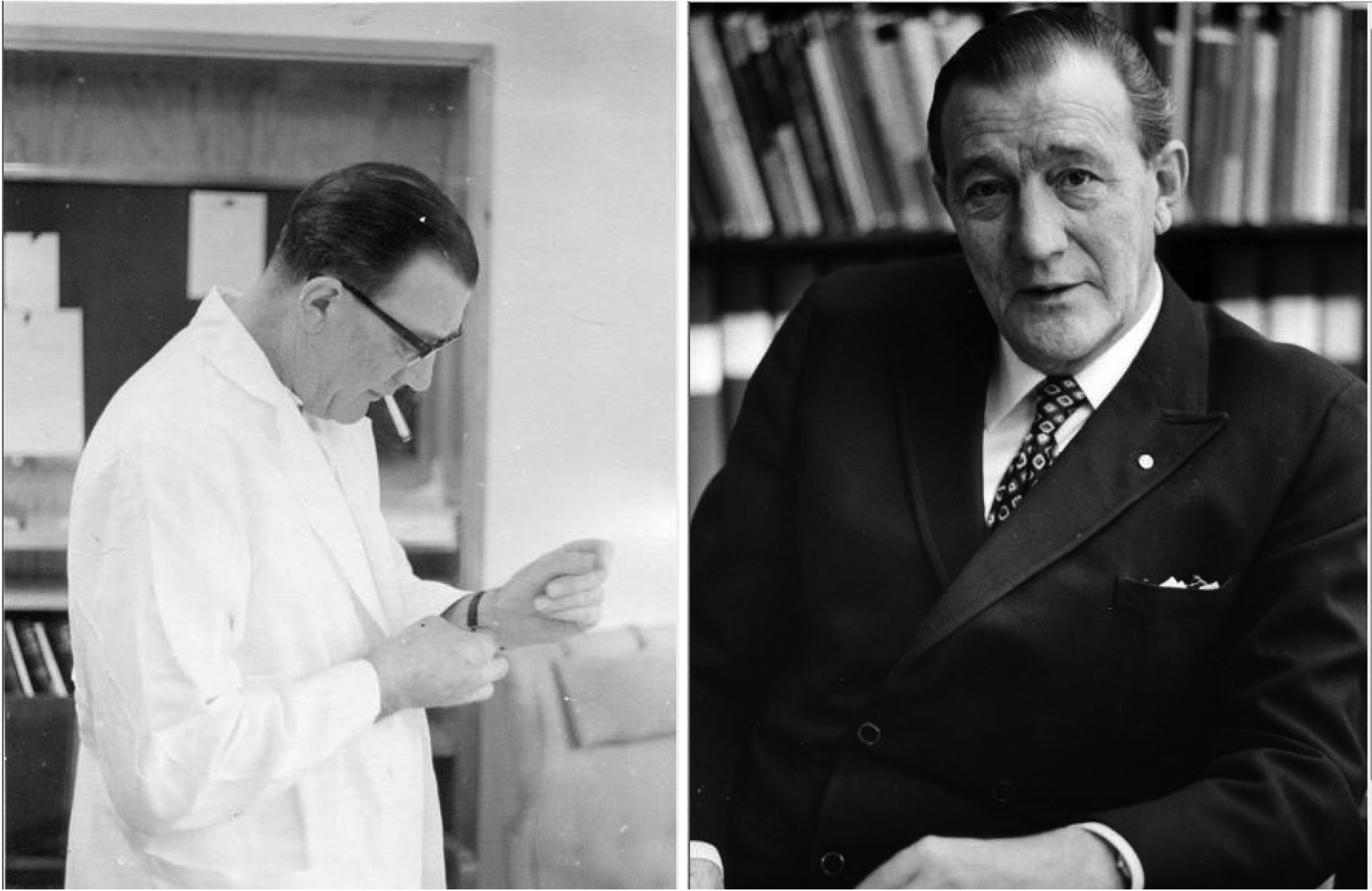
Gösta Jönsson. Left panel: Smoking in his office (before 1970). Right panel: Photo taken 1974.
Gösta Jönsson, some biographical information
It is not easy to write a biography of Gösta Jönsson. He did not write one himself, and very few letters have survived. There is only one publication with some biographical notes. 5 Few people today have any memory of him.
Gösta Christian Jönsson was born in 1909 and grew up in the village of Skurup, some 20 km from the town of Ystad, as far south as you can get in Sweden. His father was a farmer and a butcher, and his two brothers also became butchers. There was no academic tradition in the family. After the compulsory seven years at school, Gösta Jönsson travelled every weekday to the Gymnasium in Ystad and passed the examination in 1929. The same year, he began his Medical studies at the University of Lund, 70 km from Skurup. He became a Bachelor of Medical Sciences in 1933. 1940 he married Ellen whose father was a schoolteacher. We do not know Ellen’s profession. They had a daughter, born in 1943.
From 1937, Gösta Jönsson worked as a registrar at various hospitals in southern Sweden. He obtained his certificate to practise medicine in 1939. In 1946, he started at the Department of Surgery at Lund University Hospital, where he performed all types of surgery. One of the authors (BU) once met a patient who had been operated on in the early 1950s for gastro-esophageal reflux by Gösta Jönsson.
Gösta Jönsson became, however, more and more interested in urology and started, e.g., renal resections in patients who had renal tuberculosis. In 1957, he became a consultant in Urology, and at the same time, a Department of Urology, independent of the Department of Surgery, was formed. Urology was developing rapidly. In January 1968, he performed the first renal transplantation in southern Sweden (first in Sweden: 1965). On 1 January 1969, Gösta Jönsson was promoted to professor.
Gösta Jönsson belonged to the first generation of surgeons in Sweden who published their scientific papers in English. As late as 1942, German was the leading scientific language in surgery. Then, within a few years, German virtually disappeared, and English took over. 6 After 1945, there were no German articles in Acta Chirurgica Scandinavica. German was the first foreign language in the Gmnasium (in Sweden, English did not become the number one foreign language until after WW2). However, Bier, Braun, and Kümmel: Chirurgische Operationslehre (textbook of surgery) from 1933, in five volumes, always had a prominent position in his office.
The first scientific papers by Gösta Jönsson were published in 1947 (A new method of treating capillary haemangiomas. Acta Chir Scand 1947, 95:275–285 and Visualization of patent ductus arteriosus Botalli using thoracic aortography, Acta Radiol 1948, 30:81–90). He rapidly became interested in measuring blood flow using isotopes. In 1951, he presented his thesis, “Venous circulation in the lower half of the body.”
He changed direction and became increasingly interested in urological research. Judging from his publications, his interest in prostate cancer became more intense around 1955. This year, the pharmaceutical company AB, Leo, contacted him, wanting his help in clinically evaluating the recently synthesized EstradurinR, a long-lasting oestrogen compound against prostate cancer. EstradurinR became a clinical and commercial success.
Gösta Jönsson spent six months with Sir Eric Riches (1897–1987) in London. He was an honorary member of the German Urological Association and attended their yearly meetings regularly. He was one of the founders of the Swedish Urological Association in 1950.
Gösta Jönsson was politically active for the conservative party and was, for example, chairman from 1960 to 1965 of the Health and Medical Care Board of Malmöhus County. In this position, he had regular political battles with Nils Alwall (1904–1986), the nephrology professor, who was a social democrat.
Gösta Jönsson was extremely dedicated and had very high demands both on himself and on the staff of his department. He was a dominating but appreciated head of the department. He spoke the local dialect, and usually, he could remember not only the patient's disease but also which house he lived in, his relatives, and his occupation.
When estramustine phosphate was synthesized, Ab Leo and Imre Könyves once again turned to Gösta Jönsson, and a close and long-lasting cooperation, as described below, developed; this lasted till the death of Gösta Jönsson 1978 from prostate cancer.
One-armed non-randomized studies
Gösta Jönsson performed 1966 preliminary clinical studies on patients with advanced prostate cancer, also including those who had become resistant to oestrogen treatment (i.e. patients with castration-resistant prostate cancer). The initial results were promising, and he informed the 1967 annual meeting of the Swedish Medical Association of his ongoing project. A meeting abstract was published the following year. 7 Jönsson visited the hospitals in southern Sweden together with a representative of the Leo company to recruit patients. In 1969, he published the first multicentre study with patients from 10 hospitals. 8 A total of 39 out of 65 patients with advanced prostate cancer were improved. The improvement was mostly subjective (pain relief), but in nine patients, a decrease in the size of the metastases was found. The study does not state explicitly how many patients had undergone previous treatment. Gösta Jönssom had a dynamic personality and an excellent ability to connect and communicate with people. Through his confidence, passion, and enthusiasm, he inspired his collaborators and gave hope to the patients.
The same year, a Finnish study reported an objective improvement in three out of 15 patients with “terminal cancer” after previous treatment with oestrogens. 9 Jönsson and Högberg published a study in 1971 where 65 patients with advanced, castration-resistant prostate cancer, and 12 patients with advanced hormone naïve disease received EMP as the primary treatment. 10 They stated that “about half of the patients treated experienced good palliation” and that “the patients not previously treated responded very favorably to the treatment.” The following year (1972) Lindberg reported that out of the 22 patients with advanced cancer resistant to estrogen or orchidectomy that he had treated in a south Swedish hospital, six had shown an objective response consisting of regression of metastases or normalization of acid phosphatase. 11 Two of these patients and eight with no objective response, had a decreased skeletal pain.
The first non-Scandinavian studies were conducted in Switzerland, Austria, and Germany (Anderes et al., 12 Klein, 13 and Nagel and Kölln 14 ). The patient numbers were limited. For example, Klein treated 10 patients with hormone-resistant prostate cancer and reported a good effect of EMP in five. The first American studies were by Müntzing et al. 15 and Kjaer et al. 16 The studies were small, 10 to 11 patients, and reported improvement in more than 50%. A Hungarian (Szendröi et al. 17 ) article reported in 1974 that out of 50 patients with hormone-resistant prostate cancer, many were improved subjectively by EMP. However, only one out of 18 distant metastases shrank.
In 1975, Gösta Jönsson published two papers, one with co-workers in Lund and Stockholm (Jönsson et al. 18 ). A total of 128 patients had advanced prostate cancer. Ninety had received previous treatment and 38 had not. The improvement (objective or subjective) by EMP was 50% and 80%–90%, respectively. In a second paper, with Torgny Nilsson as co-author, EMP was given as a primary treatment in 38 patients with advanced prostate cancer. An objective response was found in 36 patients (Jönsson and Nilsson, 1975 19 ).
In 1976, EMP became the most income-generating product at the Leo company and held that position for almost 10 years.
In 1977, Gösta Jönsson published two additional papers. The first one included both patients with newly discovered prostate cancer and patients with cancers refractory to previous oestrogen treatment. 20 The study confirmed the results in the papers from 1975. The second study, with Gösta Jönsson's previous co-worker Lennart Andersson as the first author, presented data from 466 patients who had been treated with EMP from the start of 1966 until March 1975. A total of 55% of the 402 who were non-responsive to previous oestrogen therapy “had improved significantly.” 21 There was a “ favourable response” in 83% of the 64 previously untreated patients. In the abstract, the authors stated: “ A prospective randomized study comparing oral EMP and conventional estrogen therapy in carcinoma of the prostate is in progress.” This is the first time the need for randomized trials is mentioned in conjunction with EMP. We feel that this article is Gösta Jönsson's legacy to those pursuing his research in treating prostate cancer by EMP.
Randomized studies
It appears that Gösta Jönsson and his co-workers had become aware (see the abstract of Andersson et al. 21 ) of the scientific weakness in non-randomized studies. The first randomized study was a multicentre study published in 1980 by Lennart Andersson as the first author (Andersson et al. 22 ). One arm (94 patients) was treated with polyestradiol phosphate and ethinyl oestradiol, and the other (88 patients) was treated with EMP. The patients had previously untreated, highly, or moderately differentiated prostate cancer. There was no significant difference regarding the frequency or duration of tumour remission.
The same year, an interim report of an ongoing EORTC (European Organization for Research and Treatment of Cancer) study on patients with advanced, previously untreated prostatic carcinoma was presented. 23 The patients were randomized to diethylstilbestrol (DES) in one arm or EMP in the other. EMP “showed no superiority over DES.” A total of 186 patients would be needed for the final statistical evaluation.
In the study by Nickel and Morales 24 patients with previously untreated prostate cancer were randomized to stilboestrol or EMP as primary treatment. The authors found “no difference in objective stabilization and regression rates between the two groups or in therapeutic failure rates.”
In 1986, three superficially conflicting articles were published. Murphy et al. 25 randomized 319 patients with newly diagnosed metastatic prostate cancer into three arms: (1) diethylstilboestrol or orchidectomy, (2) EMP, and (3) cyclophosphamide plus diethylstilboestrol plus 5-fluorouracil. No difference was found in progression time or survival.
In the EORTC study by Smith et al., 26 248 patients with newly diagnosed advanced prostate cancer were randomized to diethylstilboestrol or EMP. There was no significant difference in outcome, but the dose of EMP was only half the normal dose (the dose Gösta Jönsson had given his patients).
In contrast, Benson and Gill 27 randomized 236 patients, of whom 170 were previously untreated, and 66 were castration-resistant, with metastatic cancer, into one arm with EMP and one arm with diethylstilboestrol. In the previously untreated group, EMP patients had significantly longer progression-free survival and significantly less pain. There was, however, no difference in overall survival.
The patients who responded favourably to EMP in Gösta Jönssons's previously presented studies were those with advanced cancer and treatment failure. EMP also had a good effect on his patients with no previous treatment, but so did oestrogen. This makes it difficult to obtain a significant difference between the two arms regarding remission time for this primary treatment group. Thus, the results in the three articles do not conflict with each other.
An EORTC study in 1990 by Newling et al. 28 was published with EMP in one arm and mitomycin in the other. The patients had “hormone escaped advanced progressive prostate cancer.” The medium progression-free survival (5 months) and the median overall survival (10 months) were equal in the two groups. Still, most patients in both groups stopped treatment because of side effects.
A slightly more encouraging study was published five years later by Lundgren et al. 29 A total of 285 patients with newly detected prostate cancer were randomized to four arms: (1) deferred treatment, (2) polyestradiol phosphate and oestradiol, (3) polyestradiol phosphate as a single treatment, and (4) EMP as a single treatment. A group was identified that had the lowest risk of metastases or death from prostatic cancer, namely patients with moderately well-differentiated cancer who received early treatment with EMP.
In 1997, the Scandinavian Prostate Cancer Group 1 (SPCG-1) reported that the patients with high-grade disseminated prostate cancer, randomized to DES as primary treatment, had a better outcome than those randomized to EMP (Hedlund et al. 30 ). There were, however, more patients with prognostic parameters indicating poor prognosis in the EMP group.
Discussion
The story of EMP shows that a new drug with a potential for clinical efficacy might still be developed despite an incorrect hypothesis of how this drug exerts its effect. As mentioned, Könyves assumed that EMP would be taken up in the prostate cancer cell by oestrogen-dependent mechanisms, activated in the cell by carbamidase and splitting the oestrogen and mustard units. The mustard would then kill the cell. Instead, as was later shown, EMP was taken up in the cell by an EMP-binding protein, and its toxic effect was exerted without the liberation of its mustard (Tew and Asp 31 and Könyves 32 ). The many randomized studies on hormone-naive prostate cancers showing comparable effects by EMP and oestrogen would suggest that the cytotoxic effect of EMP is limited. The study by Lundgren et al. 27 shows that such an effect might still be important in a subgroup of patients.
All of Gösta Jönsson's EMP studies from the start to 1987 were one-armed and consecutive, with mostly subjective improvement measures. It should be emphasized that this was an accepted study design at the time. Andersson et al. 21 stated that Gösta Jönsson and co-workers had treated a total of 402 patients resistant to oestrogen with EMP up to March 1975. It is unclear whether the same patient could appear in more than one article. All of Gösta Jönsson's EMP studies from the start to 1987 were one-armed and consecutive, with mostly subjective improvement measures. It is unclear whether the same patient could appear in more than one article. Interestingly, an approved ethical permit was first mentioned in the study by Caffo et al. 33 The words “informed consent” are not found in any paper. This means that almost no paper would be accepted for publication today.
Gösta Jönsson's papers present the treatment results as objective and subjective. The distinction between objective and subjective is not clear. If the radiologist measures the size of bone metastasis and knows if the patient has, for example, received active treatment or not, then the response cannot be considered fully objective. Furthermore, a local tumour size regression is almost impossible to evaluate without transrectal ultrasound, which was not available then. The measurements must be blinded. On the other hand, a subjective response such as decreased pain could be quantified by a visual analog scale, which was introduced as early as 1921. 34
We think that the lack of blinding in Gösta Jönsson's studies introduces a risk of exaggerating the response to treatment, both for “objective” and “subjective” data. However, the responses to EMP were so pronounced (“significant improvement” in 55%; Andersson et al. 21 ) that the studies may show the true effects of EMP on hormone-resistant patients.
Randomized studies were used before 1900 (Bhatt 35 ). They seem to have been a novelty to urologists during the years Jönsson was active. The earliest study found on PubMed using the search words prostate cancer and randomized trial was published as late as 1973 (Hurst and Byar 36 ).
The non-randomized consecutive studies by Jönsson and others before 1978 usually showed a significant positive effect of EMP. Still, most of the randomized studies after 1978 could not show any difference in treatment response between ostrogen and EMP. Is there an explanation for this difference? We think that in the one-armed studies, a sub-group has been selected, namely those that no longer respond to oestrogen. Most randomized studies are on hormone-naive patients, and the group of patients that will become hormone-resistant is not outlined yet. They are “diluted” by patients who continue to respond to oestrogens. In other words, one-armed studies and two-armed studies do not have the same group of patients in the EMP arm. The first study that we could find in which both arms contained castration-resistant patients was by Benson and Gill. 27
If the purpose is to study whether EMP affects patients with prostate cancer who are resistant to oestrogens, a one-arm consecutive study design ad modum Gösta Jönsson could be used, but with necessary improvements. To avoid bias, it is necessary to ensure that the quantitative objective parameters and the quantified subjective parameters are recorded blindly.
Today, with so many pharmacological agents available against prostate cancer, it would also be possible to conduct a two-armed study of patients who failed the initial treatment. However, the initial treatment would be a more modern drug than conventional oestrogens. Gösta Jönsson would have had difficulties performing such studies with a “good” active drug in the control arm, but Newling et al. published such a study in 1995, using mitomycin C in that arm (Newling et al. 28 ).
When you used the search word estramustine, 1272 full articles were found on PubMed. Almost all were about prostate cancer. The number of articles per year was highest from 1985 to 2005, with about 20 to 50 publications each year (see Figure 2). Then, the yearly number decreased rapidly, to just a few around 2022. Interestingly, the scientific interest in EMP continued unabated for several years despite the negative randomized trials after 1978. EMP was now used more as an extra drug to reinforce, with limited success, the effect of others rather than as a drug on its own. The interested reader is referred to several recent metaanalyses (e.g. Qi et al., 37 Zhang et al., 38 and Qin et al. 39 ).
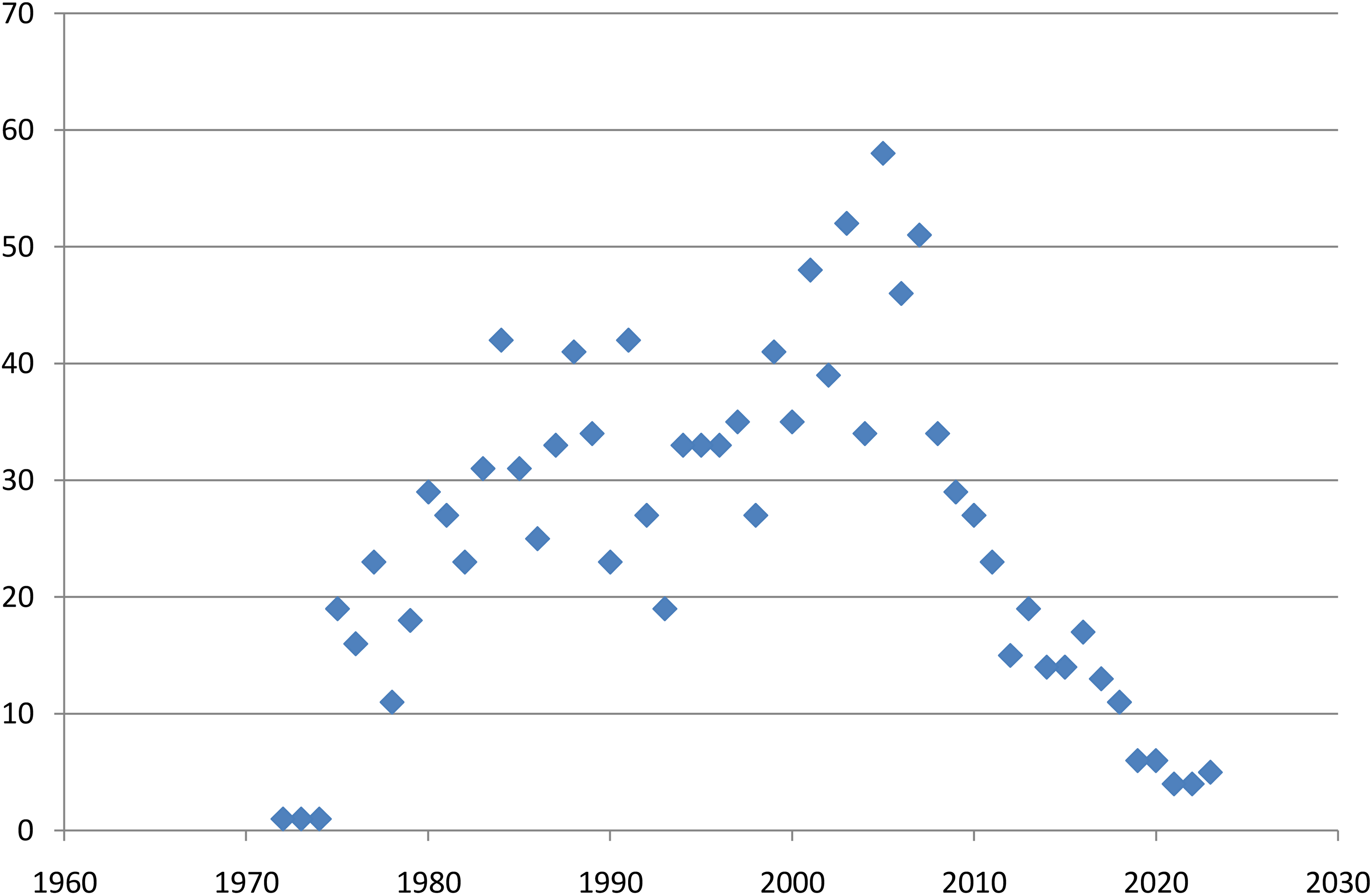
Yearly number of publications found on Pubmed, when using the search words estramustine and prostate. There were three phases. First a steady increase from around 1970 to about 1985, then a plateau lasting to 2005. The third phase is a rapid decrease to just a few articles per year.
There are many explanations for the decreased research and production of EMP. (1) We think that Gösta Jönsson’s studies were very important for LEO’s marketing of EMP. He could not be replaced by anyone else when he died in 1978. (2) An old substance such as EMP loses patent protection, and its marketing becomes a high-risk project. (3) There were new trends in the treatment of prostate cancer. Oestrogens (and EMP) with their side effects became obsolete, and new drugs (GnRH analogs, casodex, taxans, etc.) took over the market. (4) The owner history of LEO was complex and detrimental to the further development of EMP in Sweden. For example, cancer research was moved to Italy.
Gösta Jönsson was a worldwide authority regarding EMP and prostate cancer, today though he is forgotten. The oblivion seems directly coupled to the poor outcome of the randomized studies. His story illustrates that in order to be remembered as a pioneer, the effect of the drug you advocate needs to be convincingly good. If this is not the case and the drug becomes obsolete, those who advocated it will be forgotten.
Gösta Jönsson's old consecutive one-armed studies, even if they were biased, showed that EMP had an impressive, beneficial effect in a subgroup of patients with oestrogen-resistant prostate cancer. Furthermore, it cannot be excluded that the subsequent more modern studies performed, by their “dilution” effect, may hide the desired action of EMP in this subgroup. It is still to be clarrified whether Gösta Jönsson’s claim that EMP has a specific effect on a subgroup of patients with oestrogen-resistant prostate cancer is correct.
Footnotes
Acknowledgements

Declaration of conflicting interests
The author(s) declared no potential conflicts of interest with respect to the research, authorship, and/or publication of this article.
Funding
The author(s) received no financial support for the research, authorship, and/or publication of this article.