




Abstract
Jean-Nicolas Marjolin was a 19th century French anatomist and surgeon. Although not strictly speaking a pivotal figure in history of medicine, he deserves to be known for at least three reasons. He (more or less accurately) described a type of ulcer which is nowadays referred to as Marjolin's ulcer (1828); he had the privilege of operating on the world-famous Charles-Maurice de Talleyrand-Périgord for an anthrax (1838); and a rose has been named after him since 1860.
Jean-Nicolas Marjolin (Figure 1) was born on 6 December 1780 in Ray-sur-Saône, a small French commune in the Haute-Saône department. He began medicine in Commercy hospital and relocated then in Paris (1800) with a letter of recommendation for the surgeon Alexis Boyer (1757–1833). Marjolin became successively assistant in anatomy (1805) and prosector of anatomy (1806). On 27 August 1808, he received his MD at the Paris University with a 26-page dissertation on “various proposals on some surgical and medical points.” 1 In its preface, he apologized to the examiners for having only had a few days to write it. Four years later, he competed for the Chair of Operative Medicine with a 54-page thesis devoted to the surgical treatment of strangulated inguinal hernia 2 ; unfortunately this Chair went to the anatomist and military surgeon Guillaume Dupuytren (1777–1835) with whom Marjolin will sometimes have an antagonistic rerlationship. Marjolin became later second surgeon at the Hôtel-Dieu de Paris (1816), professor of external pathology (1818), member of the Académie de Médecine (1820), and consultant-surgeon to King Louis-Philippe (1830).
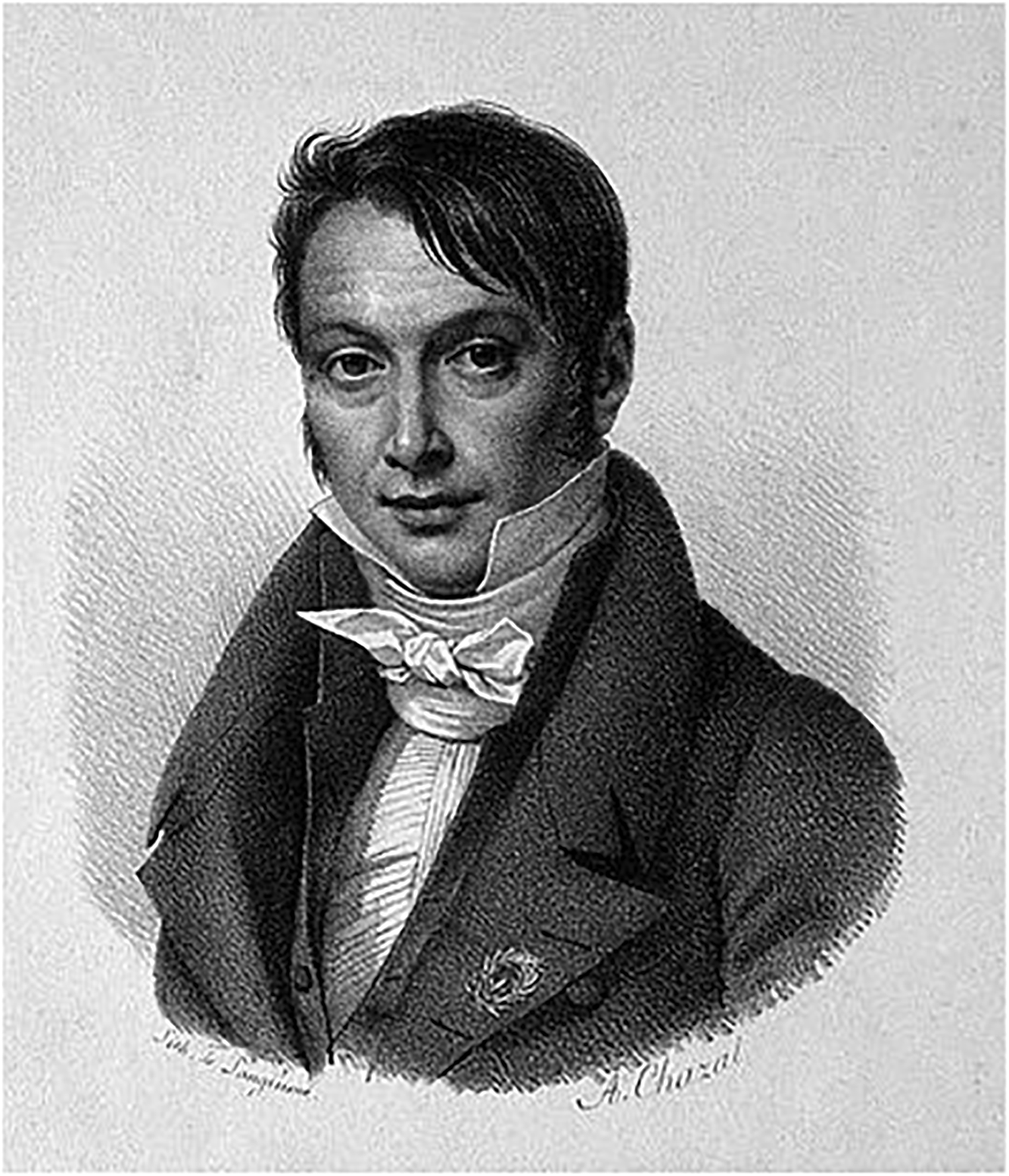
Jean-Nicolas Marjolin. Lithograph by Pierre Langlumé (1790–1830) after A. Chaza (Wikimedia Commons).
In 1810, Marjolin married Marie Marianne Françoise Duval (died 1885), a daughter of the famous 18th century dentist François Leroy de la Faudignêre. 3 René Marjolin (1812–1895), one of their two children, became a surgeon too and married Cornelia Scheffer (1830–1899), the daughter of the painter Ary Scheffer (1795–1858), in 1845.
Marjolin died in Paris on 4 March 1850.4–6 He was buried in the Père Lachaise cemetery (location of the tomb: 7th division, 1st ligne, AB, 25). The surgeon and anatomist Alfred Velpeau (1795–1867) delivered a 32-page funeral oration in praise of Marjolin on 4 December 1850. 7
In the early 1810s, Marjolin published a successful two-volume anatomy textbook 8 dedicated to professor Antoine Dubois (1756–1837). 9 However, he is not eponymously remembered as an anatomist: no anatomical structure is named after him.10,11 He also contributed 32 articles for the Dictionnaire de Médecine and published the first volume of his lectures on surgical pathologies (1837). 12
An ulcer
What is currently referred to as Marjolin ulcer can be defined as follows: an ulcer, seated upon the cicatrix of a benign chronic ulceration, which may degenerate into a carcinoma, most frequently of squamous cell type.13–15 The very first description of this potentially precancerous lesion of the skin is usually attributed to Jean-Nicolas Marjolin16–19 who actually wrote a 19-page article on different categories of ulcers in the Dictionnaire de Médecine.
20
But this article has often been misinterpreted. Here are some examples taken from medical literature from 1963 to 2020 and compared with Marjolin's 1828 article:
“[Marjolin described a type of] ulcer to which he gave the name ulcère verruqueux”
21
: among the eight categories of ulcers described by Marjolin, we think that the fungus ulcer is more likely the type nowadays referred to as Marjolin ulcer.
22
“Nowhere did Marjolin state that benign ulcers might become cancerous”
23
: Marjolin wrote that fungus ulcers may “dégénérer en cancer en les irritant fréquemment” (become cancerous by frequently irritating them).
24
“[Marjolin] did not specifically describe this [type of ulcer] as squamous cell carcinoma”
25
: to the best of our knowledge the squamous cell carcinoma was described by the American dermatologist John Templeton Bowen (1857–1940) only 84 years after Marjolin’a article.
26
Other references consider Marjolin ulcer as the “type of cancer of the lower lip developed on cigarette burn”
27
: Marjolin did not mention this location. “[Marjolin] described the ulcerative transformation of burn scars”
28
: Marjolin did not mention once the term burn scars in this 1828 article.
An anthrax
Many physicians and surgeons are remembered for having treated personalities in the entertainment business or key political figures. Undeniably the most famous pivotal figure of French history Jean-Nicolas Marjolin had to operate on was Charles-Maurice de Talleyrand Périgord.
On Saturday 12 May 1838—or Thursday 10 May according to some biographers 29 —Talleyrand had invited about 20 people to dinner, among which the Princess von Lieven, the Duke of Noailles, the diplomats Louis-Françaois Bertin de Veaux and François-Casimir Mouret de Montrond, and of course the Duchess Dorothée of Dino, “Talleyrand's last love.” 30 During the dinner, Talleyrand suddenly got the shivers and started to vomit. On 13 May, his doctor Jean Cruveilhier (1791–1874) was called urgently and diagnosed an anthrax in the lower back. He entrusted the surgical operation to his colleague Jean-Nicolas Marjolin. Talleyrand, impassive as usual, only said: “Mais savez-vous, monsieur, que vous me faites très mal? Mais si j’en suis quitte à ce prix, je vous remercie” (But do you know, sir, that you hurt me very much? But if I get off at this price, I thank you). 31 Talleyrand was unfortunately in a critical condition: he died on 17 May 1838 after having finally reconciled with the Church.32–34
A rose
In his old age, Dr Marjolin retired to his Clichy property where he devoted himself to his hobby: growing flowers. In 1860, rose growers Robert and Moreau bred a rose to which they gave the name Marjolin. 35 This rose is usually crimson, very large, almost thornless, with a light green foliage.
Some authors wondered if Marjolin was “destined to be forgotten?” 36 while others claimed he was “a name to remember.” 37 We think that Jean-Nicolas Marjolin deserves to be one of the great figures of the history of medicine.
Footnotes
Declaration of conflicting interests
The author declared no potential conflicts of interest with respect to the research, authorship, and/or publication of this article.
Funding
The author received no financial support for the research, authorship, and/or publication of this article.
