




Abstract
Annie Dodge Wauneka was an activist and public servant whose decades long career focused extensively on improving the welfare of the Navajo Community. She campaigned to increase education among those living on the Navajo Reservation through working on the Tribal Council, completing personal visits, and producing educational material to improve hygiene. Annie's biggest fight was against tuberculosis. By bridging old traditions with new medicine, Annie encouraged people to seek treatment from hospitals and remain there throughout treatment. This reduced mortality significantly while closing the health disparity that existed between Native populations and the United States collectively.
Introduction
Annie Dodge Wauneka (1910–1997) was a medical pioneer who educated the Navajo tribal community in matters of disease transmission and basic hygiene. She served as a cultural bridge between two very different worlds, that of the white physicians and that of the traditional Navajo people.1,2 Her work in public health and education saved thousands of lives over the course of her career. Annie used her knowledge of Navajo traditional culture and healing arts in addition to her understanding of allopathic medicine to treat her people. In doing so, she was a pioneer of culturally competent medical practice and encouraged thousands of her people to seek effective medical treatment. 3 She was one of the first women in Navajo tribal politics and was the longest serving one. Annie's lifelong commitment to service led to many accolades and awards, including the Presidential Medal of Freedom. After each of these she would respond with ‘I have to go and do more'. 4
Childhood and education
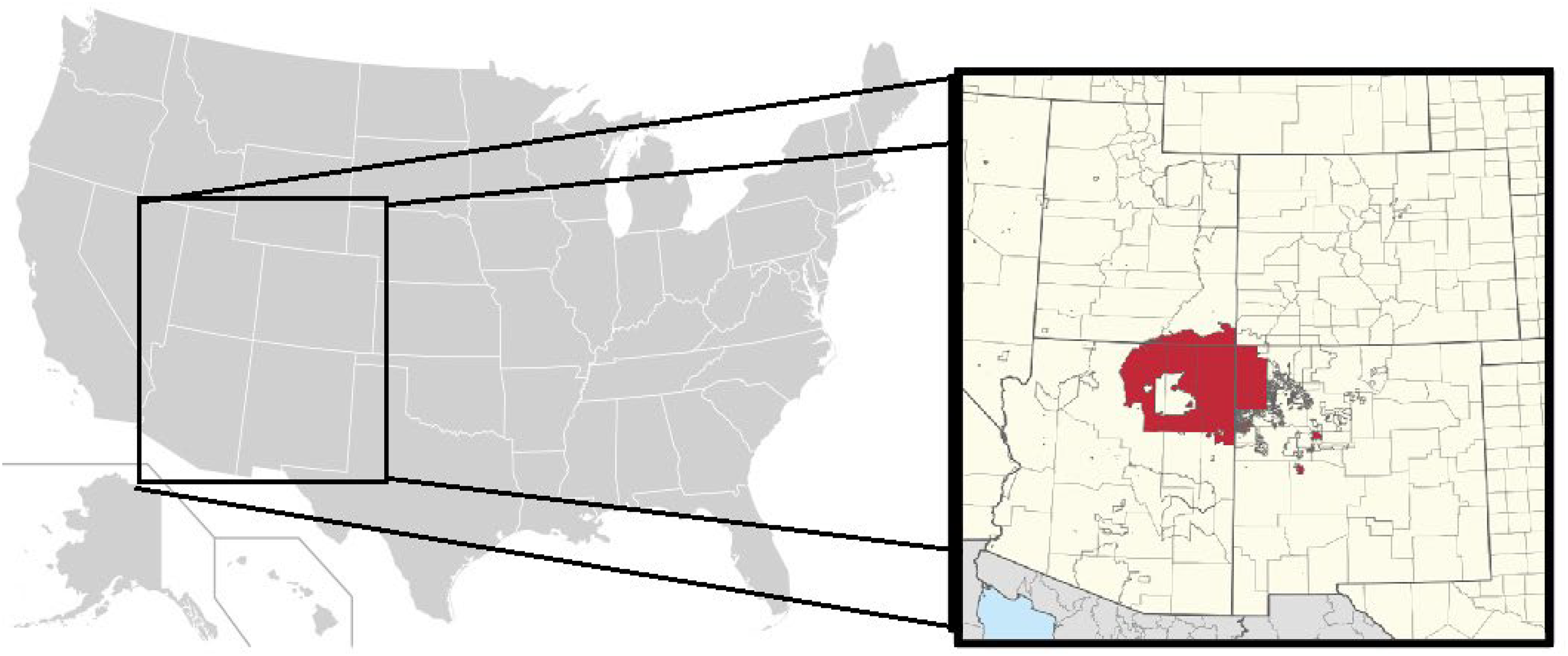
Annie Dodge was born on April 11, 1910 to Kee’hanabah, the third wife of a wealthy, ranch-owning businessman and tribal chairman of the Navajo Nation. The Navajo Nation is located in the states of Utah, Arizona, and New Mexico and includes more than 27,000 square miles (Figure 1). 5 By five years of age, Annie was helping to care for the expansive homestead along with its goats and sheep. 6 Annie was given her own small herd of sheep to take out every day to graze and drink water. 4 When she turned eight, her father sent her to attend the government boarding school at Fort Defiance.7–9
It was during her time at Fort Defiance that Annie first experienced the lasting impacts of contagious disease. In 1918, the influenza pandemic ravaged the Navajo lands, claiming the lives of thousands of individuals. Some estimates put the death rate as high as 18% of their population, 10 compared to 0.5% for the entirety of the United States. 11 Annie herself fell ill, but recovered 7 Once she was well again, she assisted the medical staff, a single nurse, Mrs. Showalter,at her school to feed and care for her sick classmates.4,12 Annie recalled that the sick students were ‘dying like flies' and she remembered wondering ‘what in the devil is goin’ on' as they continued to haemorrhage from their noses and die over the course of weeks. 4
Another epidemic that shaped her early life was that of trachoma. Trachoma is a disease of the eye that is caused by Chlamydia trachomatis. The bacteria, contagious via personal contact, can lead to conjunctival scarring,causing irritation and pain, and ultimately can cause corneal scarring and irreversible blindness after repeated infection. 13 In 1912, the United States Public Health Service sent a team to determine the prevalence of trachoma among tribal groups. The overall incidence among the Navajo Indians was 20% to 30%, and boarding schools were particularly affected with as many as 92% of children infected. 14 Due to frequent non-restricted touching of their eyes, children were often heavily affected. 4 Reservation prevalence is almost certainly an underestimation due to the distrust many on the reservations had against white physicians, which led them to refuse physical examination. 15 Trachoma forced Annie to leave Fort Defiance while the epidemic raged and she continued school at St. Michaels Catholic Mission School. 16 This was her first exposure to the health disparities between her people and the general population of the United States, although she was too young to recognize it at the time. By the 5th grade, Annie moved to yet another school, the Albuquerque Indian School, managed by the Bureau of Indian Affairs. Because the school's main goal was cultural assimilation of indigenous populations, Annie, already familiar with English, honed her skills. These would be paramount in her goal to bridge cultural differences between Navajo and Anglo-Americans. 4
Early career
During her time at school, Annie met a young athlete named George Wauneka (1903–1994). Annie married George in October 1929 and returned to her father's ranch, 16 where they took to managing one of her father's ranches, Tanner Springs. 4 During this time, she began attending Navajo Nation meetings with her politically important father, Henry Chee Dodge (1860–1947). Although her early roles included serving coffee to those in attendance, Annie picked up many of the nuances of the problems that plagued the community. 6 She began to question her father about the purposes of these meetings. He once told her that the Navajo people ‘need attention…they need care [and] to be educated'. 4 From here, her intrigue grew.
The solutions to a number of problems (political, social, and medical) required a bridging of European and Navajo cultures. 1 Her father, the first chairman of the Navajo Tribal Council, used his proficiency in English to settle disputes between his community and government officials. Annie, thanks to her excellent English skills, often assisted her father in these translations. 17 Her first Navajo council role came when she was elected to the Grazing Committee, tasked with overseeing livestock policies and settling disputes between landowners. 4 These skills would benefit her greatly as she encouraged her people to seek medical assistance from physicians and hospitals, in addition to seeking spiritual healing from their traditional healers.
The fight against tuberculosis
In 1951, Annie Wauneka was elected to the Navajo Tribal Council, where she was chair of the Health and Welfare subcommittee of the Community Services Committee. 16 The Navajo Tribal Council (known as the Navajo Nation Council since 1989) is the governing body of the Navajo Nation. Today, the council includes 24 Council delegates elected from districts and tasked with legislative responsibilities for the Navajo Nation. 18 The Health and Welfare subcommittee is now the Health, Education, and Human Services Committee which is tasked with the promoting public health. 19 Annie was only the second woman elected to the council. It was in this position that she began to fight against the tuberculosis infections that were prevalent across the reservation. 3
Tuberculosis has been a scourge for Native populations throughout 20th century. The Navajo people had traditionally used medicine men to treat the infection without success.3,20 It has been estimated that among the Navajo, infant mortality and tuberculosis were at a rate higher than anywhere else in the United States of America. 2 Previous treatment required long stays in sanitoria, but many left and went home prior to completion of the protocol. 21 Of the 300 Navajo patients sent off reservation for treatment, 63 had left prior to completing treatment. Even those that remained on the reservation for treatment did not always stay for the entire treatment course. Of 100 patients being treated at Fort Defiance Hospital, 33 left prior to completion. 4
In order to treat tuberculosis among the Navajo, research workers and doctors from Cornell University, New York, wished to test a newly developed drug, isoniazid. Although the treatment would benefit the group substantially, the researchers also benefited from having a group of previously untreated infected individuals. 2 To help establish the trust of Navajo families, these doctors relied on Annie to speak with them in their native language and help them understand the importance of “white man's medicine” to help treat this disease.20,21 She wrote that she ‘had to learn both the old and the new to be able to interpret to the Navajo'. 21
Wauneka herself spoke about being unsure of the explanation given to her by the doctors. Could a germ,a term which did not exist in the Navajo language at the time, cause the illness?21,22 It was only after Annie had observed the “bugs” herself under a microscope and had a thorough understanding of the process of infection did she feel she was equipped to handle the problem. 21 Annie studied with one of the Cornell doctors, Dr. Deuschle, for three months to get a better grasp of the disease. Kurt Deuschle (1923–2003) was a pioneer of community medicine and began his long medical career as the medical director at Fort Defiance in 1952. From here, he worked closely with the Navajo studying the efficacy of the antibiotic isoniazid on tuberculosis infection.2 Annie learned first hand from him about tuberculosis infection. 23 ‘To explain to other Navajos about tuberculosis, I had to find out all about it—what it could do to a human being, where it came from'. 4
When medicine men are asked about the cause of tuberculosis, their traditions explain that tuberculosis is caused by lightning.21,22 Wauneka admits that it was difficult to convince her people to believe that tuberculosis is caused by an infectious bacterium. She worked to approach patients with “courtesy and respect”; she built a strong relationship with both patients and family members before discussing the true cause of tuberculosis. 21 :89 Part of the instruction included visiting tuberculosis patients and doing with them the same things that Dr. Deuschle did with her, namely show them X-rays and microscope slides. 4 She was also one of the first people to identify and address a major reason that people refused to go to the hospital for treatment, particularly isolation and homesickness. To remove these barriers, she spoke to them in their language and began transporting letters and voice recordings between patients and their families. Her endeavours ultimately inspired the Cornell researchers to propose a project that studied how modern medicine could be presented across linguistic and cultural barriers to a variety of audiences to encourage medicine compliance among diverse communities. 4
This is not to say that the medicine men were no longer needed. They continued their role to protect the soul and spirit. 2 When a tree near the sanitorium in Tucson was struck by lightning, a medicine man had to come out from Fort Defiance to purify the site so the patients would stay to complete treatment. Thanks to this purification ritual, those being treated in the sanitorium were more inclined to remain to finish treatment. Annie worked tirelessly to highlight the benefit of traditional healers while also encouraging Navajo to seek healthcare from physicians. Annie encouraged the medicine men to be part of an allied healthcare team, though she recognized that medicine men could not effectively treat tuberculosis and would recommend that patients go to the hospital for treatment. 4 Annie taught the medicine men about tuberculosis and ensured that patients could receive blessing ceremonies before arriving at the hospital, assuming they were not acutely ill. When individuals were given bitter herb concoctions by these traditional practitioners, Annie convinced them to take the mixture along with modern medication. This was the Annie's way of bringing the old and the new together to give those who were sick a fighting chance. 4 When more respect and understanding was given to Indigenous perspectives, the usage of hospitals and physicians increased substantially. Both tuberculosis and infant mortality rates dropped by at least 50% by the year 1960. 3
Improving Navajo health
Tuberculosis was far from Annie's only crusade to improve the lives of the Navajo community. She worked to educate mothers about how to improve the hygiene of their children and assisted in the education of disease transmission. 16 Annie worked extensively to improve the unsanitary conditions many Navajo were living in. She delivered fresh produce while campaigning to replace dirt floors with wood and move lavatories further from living quarters. 17 During these visits, Annie would inspect the food stores and the water to ensure it was clean in order to reduce disease. 4
To get more women in labour to go to a hospital, she headed a project that provided these women with blankets and clothes if they came to the hospital. She also organized a “Better Baby” contest to encourage women to get their children assessed by physicians. The infant mortality rate further decreased by 25% in the 1960s, largely due to her efforts. 16 She continued her public health service by fighting alcoholism, a fight begun by her father pushing to ban alcohol sales on the reservation, improving water quality and improving education among the Navajo tribal members. She continued educating both by doing in-person visits but also hosting a radio programme that focused on health education. 17 During these shows, Annie would discuss a wide range of topics from pneumonia and other contagions to general hygiene and self-care. 4
She also focused on improving relationships between Navajo and non-Native physicians through the creation of an English/Navajo dictionary of medical terms. 17 This project took several years of working with doctors of the Indian Health Service. The Indian Health Service (HIS), created in 1955, is a federal agency housed within the United States Department of Health and Human Services. The agency’s mission is to ‘raise the physical, mental, social, and spiritual health of American Indians and Alaska Natives to the highest level. 24 With this mission in mind, the IHS utilized Annie’s expertise in the endeavor of improving indigenous health. The work required, in some instances, new words to be invented for concepts that did not previously exist in Navajo spaces.4 This project took several years of working with doctors of the Indian Health Service.
Lasting legacy
Annie's work led to her appointment to the Advisory Committee on Indian Health. In 1959, she was awarded the Indian Council Fire Achievement Award and named Arizona Woman of the Year. President Lyndon Johnson (1908–1973) awarded her the U.S. Presidential Medal of Freedom in 1963 (Figure 2).16,17 In order to encourage more Natives to pursue health careers she, along with members of the Tribal Council, established the Navajo Health Authority. She was awarded two honorary doctorate degrees from the University of Arizona, the highest award from the Society of Public Health Educators, and the Will Ross Medal from the International Lung Association Conference. 4
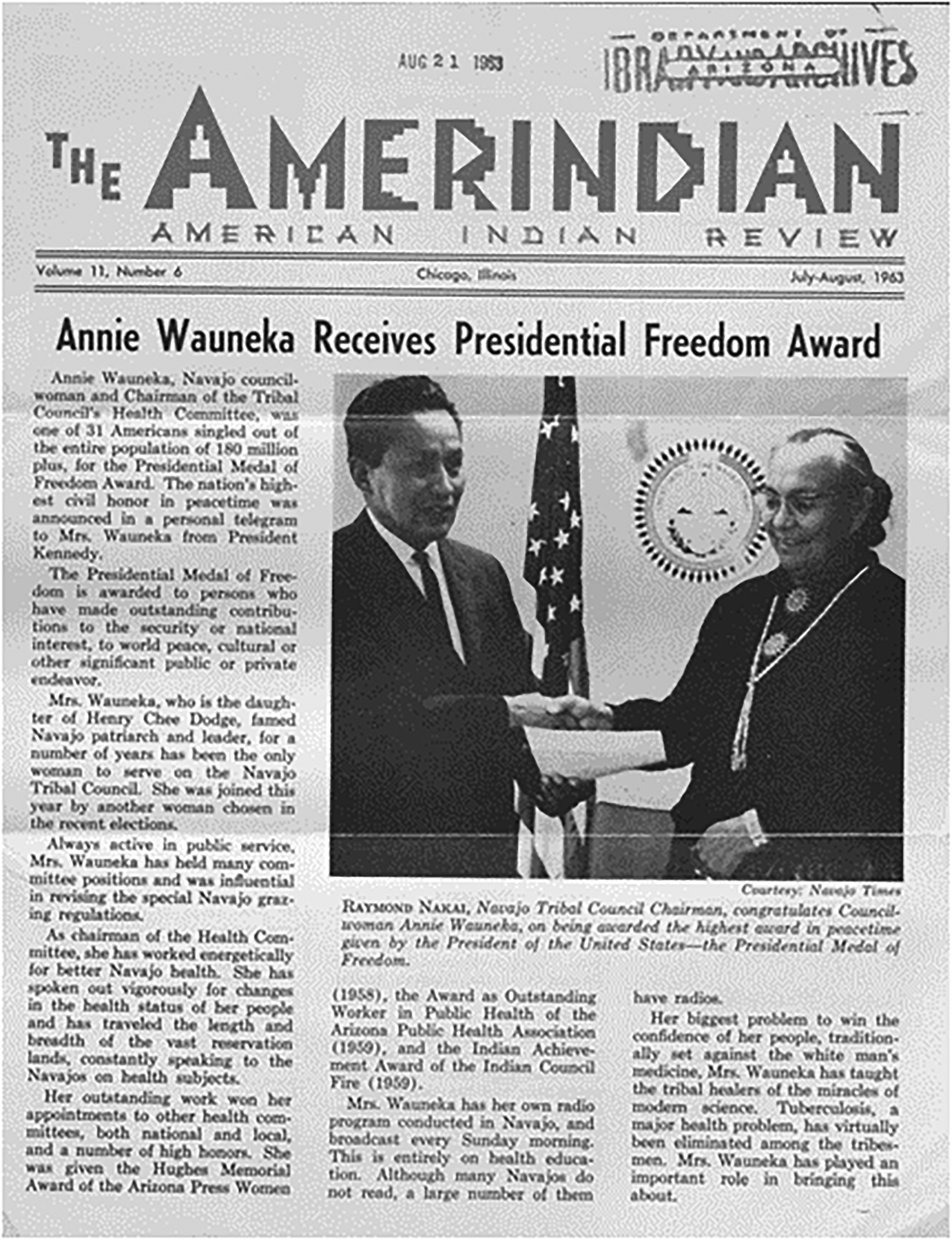
Newspaper article following Annie Wauneka's reception of the Presidential Freedom award. 25
In 1978, Annie lost her re-election for her Tribal Council seat, but remained on the Navajo Area Health Board and on the Navajo Health Authority Board of Directors. Under a new Tribal Chairman in 1982, she served again but this time as health ambassador to the Navajo Nation. 4 To celebrate her 74th birthday, a large party was held and “Annie Wauneka Day” was proclaimed. She was deemed “Our Legendary Mother” by the tribal council and she was awarded the Navajo Medal of Honor.
The strong-willed, dominant, outspoken medical pioneer began to show her age when she started to become forgetful and began wandering outside of her home in the early 1990s. She was diagnosed with Alzheimer's disease not long after. 4 She died on November 10th, 1997 in Toyei, Arizona after more than 50 years of fighting against the numerous health disparities among her people. To honour her role in improving Navajo lives through health education and infrastructure improvement, all public offices were closed for a day. 26 Annie, the Legendary Navajo Mother, medical pioneer, public health activist, leader, and educator, was a pioneering practitioner of cultural competence. Annie Wauneka's tireless efforts to merge cultural traditions with new medicine, substantially reduced mortality for Native communities and the population of United States more broadly.
Footnotes
Acknowledgments
The author thanks Jenna Dittmar and Krystiana Krupa for advice and constructive feedback throughout manuscript preparation.
Author contributions
The author confirms sole responsibility for the following: paper conception and design, resource collection, and manuscript preparation.
Declaration of conflicting interests
The author declared no potential conflicts of interest with respect to the research, authorship, and/or publication of this article.
Funding
The author received no financial support for the research, authorship, and/or publication of this article.
