




Abstract
The aim of this article is to investigate the professional, corporate and scientific career of the Girona surgeon José Pascual y Prats (1854–1931). His work at the Provincial Hospital of Santa Catalina in Girona and as dean of the provincial charitable medical corps should be highlighted, as should his presidency of the province's medical associations, and his creation and direction of the bulletins of both organisations, as well as his promotion of the Index Medicus Hispanus. Therefore, his biography allows us to consider three fundamental aspects of medical science during the Spain of the Restoration: associations, press and bibliography. At the same time, he maintained epistolary contacts with his family and friends, as well as with different representatives of the social elites of Girona and the Catalan and Spanish medical oligarchy. In short, Pascual was the most important physician of this period in the city and one of the most remarkable health professionals of contemporary Catalonia.
Introduction
This case study analyses the Girona surgeon José Pascual y Prats, focusing particularly on his role in medical associations, the press and medical literature in the context of Spain during the Bourbon Restoration (1874–1931).1,2 The province of Girona is an administrative territorial demarcation located on the periphery of Spain, bordering France. What happened in the municipality of the same name, capital of this district and where the main health services were located, had a major impact on the whole province. At the same time, Girona was connected to the rest of Catalonia and Spain. According to recent research on the circulation of scientific knowledge, this is not created in the centres of power and uncritically received by the peripheries, but is appropriated and reworked there.3,4
Biographies are a key historiographical genre in the history of medicine.5,6 Illustrative of this is the work The Great Doctors. A Biographical History of Medicine written in the 1930s by the French physician and intellectual Henry Ernest Sigerist (1891–1957). 7 The influence of Sigerist, who laid the foundations of the social history of medicine, went beyond his direct disciples, Erwin Heinz Ackerknecht (1906–1988) and George Rosen (1910–1977), to leave its mark on a large number of medical historians of later generations. 8
This article is divided into five parts. Firstly, it deals with José Pascual's social and family origins, the instruction he received and the studies he undertook, as well as his time in the military health service. Secondly, it discusses his work as a professional and his professional position and the nature of his practice. Thirdly, it examines his work within the medical associations in Girona (Medical Syndicate and the province's College of Physicians), as well as in the corporate press. Fourthly, it focuses on his scientific practice and on the Index Medicus Hispanus, his publications and his participation in regional, national and international congresses. Fifthly, it reviews how he was ousted from his position in the medical association, and his death. In the conclusion, some global reflections are presented. It should be noted that this paper does not consider Pascual's important cultural role in some of the main institutions of the province: resident member of the Girona Economic Society of Friends of the Country [Sociedad Económica Gerundense de Amigos del País] (1878), contributor to the Revista de Gerona (1878–1892), member and librarian of the Girona Casino [Casino Gerundense] (1894), regular spectator at the Municipal Theatre in a privileged seat (1896–1917), vice-president of the Literary Association of Girona [Asociación Literaria de Gerona] (1901), corresponding member of the Royal Academy of History [Real Academia de la Historia] (1918), member of the Provincial Commission of Historical and Artistic Monuments of the Province of Girona [Comisión Provincial de Monumentos Históricos y Artísticos de la Provincia de Gerona] (1918), curator of the Provincial Museum of Antiquities and Fine Arts [Museo Provincial de Antigüedades y Bellas Artes] (1918) and member of the board in charge of organising the ‘Gallery of illustrious Girona citizens’ [Galería de gerundenses ilustres] (1925) (Figure 1). 2
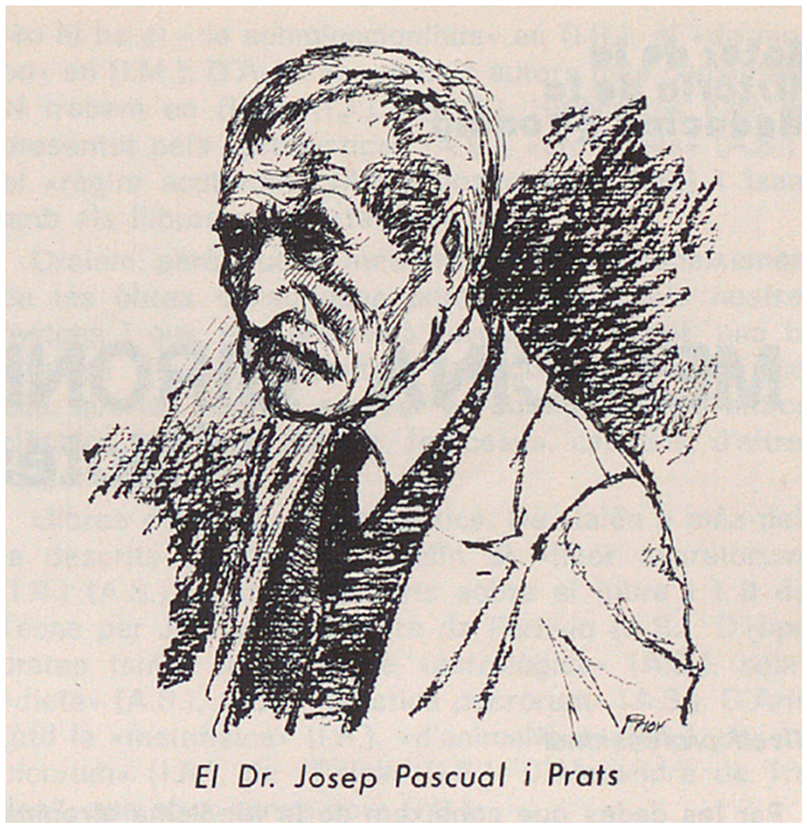
Portrait of José Pascual in the Butlletí del Col·legi Oficial de Metges de Girona of October 1980. Source: Archive of the Medical Association of the Province of Girona.
Family origins and education (1854–1877)
José Pascual y Prats was born on 1 February 1854 in Girona, son of a carpenter and merchant from the city and a dressmaker from Garrotxa (Girona region); he was the sole heir because his two sisters and two brothers died young. 9 Historiography has shown that the liberal professions at the turn of the century constituted a modest channel of social mobility and renewal. 10 In contrast to the above-mentioned dynamics, Pascual was a case of social ascent, since he was not part of the considerable professional inheritance rate of physicians, as he did not belong to a family line [saga] of health professionals, nor did his family come from higher social classes. However, although intermittently in the early years, the family had a maid from 1886 onwards. Domestic service was not a marginal sector or a remnant of the Ancien Régime in industrial societies, but was of great importance for the nineteenth-century working classes. 11 The profile of these women is in line with the general dynamics in the rest of Catalonia: young, single, literate women who migrated from rural areas to the city. 12 From 1915, and as evidence of the social mobility due to his degree, the family had two maids. He was a bachelor throughout his life, and in his will, he bequeathed his estate to Carmen Rovira y Costa, who took care of him and his parents from the 1880s until the day of his death. 2
Pascual studied baccalaureate at the Provincial Institute of Secondary Education [Instituto Provincial de Segunda Enseñanza] in Girona between the academic years 1864–1865 and 1868–1869. He obtained a High School [bachillerato] Diploma of Arts on 12 June 1869. His qualifications in secondary and higher education did not stand out from the average: at university he did not obtain ordinary subject prizes or the extraordinary prize for his degree. He took most of his subjects at the University of Barcelona but completed the final three subjects at the Central University of Madrid. His move to the Spanish capital was motivated by the formation of the battalion of liberal volunteers, in the context of the third Carlist war (1872–1876), according to the scholar Benet Julià. 13 This conflict was the last civil war of the nineteenth century in Spain that confronted Traditionalists—also known as Carlists—who were the followers of the Duke of Madrid and pretender to the throne, Carlos de Borbón y Austria-Este (1848–1909) and the Liberals who stood in favour of the ruling government of the time, loyal to Isabel II (1830–1904). It should be recalled that Traditionalists were defeated on the battlefield in all confrontations, uprisings and mobilisations of partisans. 14
On 26 May 1875, at the age of 21, he passed, on his second attempt, the examinations to obtain a degree in Medicine and Surgery (Figure 2). The degree accredited him as a physician and surgeon, given that their unification had been agreed in Spain in the first half of the nineteenth century.
15
As he told his parents: ‘From today I have a qualification to be considered in society. Your sacrifices have had the desired reward’.
16
The correspondence reveals the joviality and euphoria between Pascual and his relatives: obtaining his degree allowed him to rise socially. In fact, the exchange of letters with his parents was particularly intense during his stays in Barcelona and Madrid, and also, after his degree, in the Basque Country and Paris. These testimonies show his interpretations and feelings about his experiences. As Roger Chartier said: ‘Free and codified, intimate and public, tense between secrecy and sociability, the letter, better than any other expression, combines the social bond and subjectivity. Each group experiences and formulates this problematic balance between the intimate self and others in its own way’.
17
José Pascual's degree certificate in Medicine and Surgery from the Central University of Madrid (1875). Source: Municipal Archive of Girona [Arxiu Municipal de Girona (
In August 1875, in the context of the aforementioned war and with the qualifications necessary to practice the profession, he joined the liberal side against the Carlists as a provisional health physician. Pascual served in the Gipuzkoa division of the Army of the North, and as a result of his actions, he was awarded various decorations, in particular the Saint Ferdinand [San Fernando] pensioner's cross (1877). 18 One biographer noted: ‘[his] self-sacrifice in caring for the sick, both on one side and the other, as well as his ability to conceal fear, [for which] he was awarded the highest military reward’. 19 Moreover, as stated in the obituary published in the local press: ‘He held the laureate cross of Saint Ferdinand, […] being the only civilian in Spain to hold such a high award’. 20
Between the last half of 1876 and the end of 1877, he went to Paris to further his medical studies. It was common for physicians to spend time abroad as a means of furthering training in order to extend and intensify their knowledge of medicine. 21 As a result, his choice of the French city was not fortuitous. During his stay, he was enriched with a wealth of knowledge about medical practice. As he states unequivocally in a letter to his family: ‘I believe that I will come to know what I would never have known in Spain’. 22 At the same time, he gained new insights into the internal organisation of physicians, as well as knowledge of professional ethics. 13 According to Darina Martykánová, Ainhoa Gilarranz and Víctor M. Núñez, the French state was the world reference in terms of training health professionals, but also a model to follow for shaping the institutional health system in other territories. 23 Meanwhile, the material remoteness of Girona did not prevent him from keeping in touch with the Girona medical oligarchy: he bought books in Paris for the two leading physicians at the Provincial Hospital of Santa Catalina in Girona, José Porcalla y Diomer and José Ametller y Viñas (1832–1901), and sent these to them by mail. 2 It is no coincidence that the railway, the telegraph and the postal service represent the three most important vectors of the communication system of the liberal state; in Pascual's case, the first one being essential to move around and the third one for getting in touch with family, friends and colleagues. 24
Professional work
On 6 November 1877, he was appointed as a medical surgeon for the Provincial Hospital of Santa Catalina in Girona without salary. In September 1880, he won the competition to become forensic physician of the judicial district [partido judicial] of Girona, and on 17 July 1885, he won the position of physician of the Provincial Hospital by competitive examination. 2 This hospital was the highest ranking health institution in the Girona area. 25 At the same time, he practiced for the families with whom he had conducta: this system of conductas or igualas was a form of free practice of the profession which consisted of the fact that, in exchange for a certain amount of money per year, which varied depending on the families (in Pascual's case it could reach 25 pesetas per year), the physician guaranteed medical care for ordinary and more generalised illnesses throughout the year. 26 In the years that followed, he held various important positions in the provincial medical field, for example: physician of the provincial charitable establishments (1896), civilian physician of the Mixed Commission for Recruitment [Comisión Mixta de Reclutamiento] (1898), vice-president of the provincial health board [Junta Provincial de Sanidad] (1895), president of the Girona branch of the Catalan Academy of Hygiene [Academia de Higiene de Cataluña] (1905), dean of the Girona provincial charitable medical corps (1911) and municipal and provincial health inspector (1925). He was also a member of competitive examination boards between 1900 and 1920. 2
The transition from the nineteenth to the twentieth century saw the consolidation of the bacteriological paradigm in Spain, the crystallisation of scientific positivism and experimental medicine, as well as the considerable diversification of the discipline into medical specialities. 27 Although he was aware of the theoretical and empirical changes in medicine, he did not generally implement them. His knowledge and proselytising of scientific novelties is evident in the medical bulletin he edited: he advocated social medicine, hygiene, prophylaxis and physical education, as well as the innovations applied by the surgeon Joseph Lister (1827–1912) and the chemist Louis Pasteur (1822–1895), and transcribed news about the appearance of salvarsan. 2 However: ‘he was the only surgeon in Girona [who] at the end of the century did not use anaesthesia and did not take asepsis into account. His work as a surgeon was not portentous, he intervened on simple things without being daring at any time. Both medically and surgically, he trusted [that] nature would dictate the course of the disease’. 19 He was a physician who is part of the transition from the old health paradigm to the new scheme. In his theoretical writings of the 1890s, 1900s and the first half of the 1910s, he was in favour of the new scientific developments. 2 Nevertheless, Hippocratic and Galenic principles dominated his practice, according to information provided by physicians of later generations.19,28
Medical associations and professional press
He was a key figure in the configuration of the two most notable medical associations that were set up in the province: the Medical Syndicate (or Medical Union) of the Province of Girona [Sindicado Médico de la Provincia de Gerona] and the Medical Association (or College of Physicians) of the Province of Girona [Colegio de Médicos de la Provincia de Gerona]. Following the interpretative line of the historian Isabelle Renaudet, we can describe him as the manager [maître d’œuvre] of both corporative projects. 29 In a context that the physicians themselves described as a ‘professional crisis’, he capitalised on the ethical knowledge acquired during his stay in Paris to tackle new problems and provide tools for the organisation and defence against the threats posed by the so-called ‘intruders’, ‘quacks’ or ‘charlatans’.2,30 Since the creation of the College of Physicians of Madrid in 1893, various medical groups of the same nature had been founded throughout Spain. 31 In 1894, on the initiative of a few Girona physicians, the Medical Syndicate of the Province of Girona was set up. Its first president was Dr José Ametller. Pascual, the initiator and organiser of the institution's constituent meeting, drew up the statutes and regulations. Not surprisingly, at the annual assembly of 1896, Pascual was appointed president of the organisation. 32 In the same year, they began to publish the Monthly Bulletin of the Medical Syndicate of the Province of Girona [Boletín Mensual del Sindicado Médico de la Provincia de Gerona] (1896–1898), a body for the communication and socialisation of ideas with the associates of the Girona area, which Pascual promoted, directed and was the main editor. 2 Through the medical press, a professional discourse was created that contributed to redefining the role of the health professions in liberal society. 33
However, following the government decree of compulsory membership of medicine, pharmacy and veterinary in 1898, the aforementioned association was dissolved, and the Medical Association of the Province of Girona was formed. The professional associations reinforced the coherence and dignity of the group, regulated professional practices, fought against the illegal practice of medicine and were a mechanism for collective action to further influence the decisions of the political authorities. 34 Pascual was appointed president of the new corporation from 1898 until June 1922, as well as continuing to publish the monthly bulletin of the entity. 2 In addition to managing and coordinating the bulletin, Pascual was the main necrologist of Girona's physicians between the nineteenth and twentieth centuries: between 1898 and 1920, he wrote 35 obituaries of mainly rural physicians in the province. 21
Scientific practice
Josep Pascual's great bibliographical project was the six volumes that made up the Index Medicus Hispanus. Essay on the cataloguing of original works published by Spanish physicians [Ensayo de catalogación de trabajos originales publicados por médicos españoles] (1904–1906), an attempt at a repertoire of Spanish medical bibliography that he designed reflecting international standards, as studied by the historians of science Guillermo Olagüe, Alfredo Menéndez and Rosa María Pulgar.18,36 It was published at the instigation of the Zurich-based American documentary filmmaker Herbert Haviland Field (1868–1921), with whom he had exchanged correspondence. Despite this, and due to the unwillingness of the academic establishment, the initiative failed at the various stages in which it was launched. His knowledge of the state-of-the-art in world medical literature was undoubtedly high.
36
On the one hand, between 1914 and 1915, the Institute of Catalan Studies [Institut d’Estudis Catalans], through Eugenio d’Ors Rovira (1881–1954), encouraged Pascual to confine this work to Catalonia, a fact that did not materialise because the institute kept postponing it sine die. On the other hand, within the framework of the first Spanish National Congress of Medicine (1919), in collaboration with the university professor Augusto Pi y Suñer (1879–1965) and the provincial charity physician Gregorio Marañón y Posadillo (1887–1960), he presented the proposal for the whole of Spain, but despite having the backing of two doctors with prestige and power in the heart of the Hispanic community, it did not come to fruition either.
2
According to Olagüe, Menéndez and Pulgar: ‘the project did not come to fruition for unknown reasons, which could well be attributed to a lack of sensitivity of the Spanish medical society at that time towards the project and to a difficulty in financing it’ (Figure 3).
18
Cover of the first volume of the Index Medicus Hispanus (1904), José Pascual's great bibliographical project. Source: 
In terms of his publications, the subject of medical bibliography was one of the most prominent. It is not trivial that he is often described as a ‘consummate bibliophile’. 19 Among health professionals who could afford it, it was common to build up private libraries stocked with medical documents, and also other branches of knowledge. 21 In his research, Pascual also paid attention to health demography, hospital hygiene, medical hydrology, forensic medicine, clinical problems, recruitment for the armed services and professional deontology. These are all subjects that are in line with his professional and scientific practice. 2 However, not only did he produce works of notable importance, but he also promoted the translation of texts from other territories from the Girona medical groups. By way of illustration, the Medical Syndicate translated a text on medical deontology from the Gironde Medical Association [Association des médecins de la Gironde] (France) in 1898. 37 The usual publisher of his publications was the Printing and Bookshop of Paciano Torres in Girona.
He also took part in various international congresses, in some of which he held honorary positions. These agoras were spaces for the socialisation of knowledge and professional sociability of the first order. For example, he chaired the Spanish national committee of the first international congress on professional medicine and medical deontology held at the Universal Exhibition in Paris (1900). He also attended other transnational meetings representing the provincial college, such as the international medical congresses held in Moscow (1897), Paris (1900), Lisbon (1906), Budapest (1909) and London (1913). 2 As can be seen in the correspondence that Pascual received and sent, the lingua franca in medicine during this period was French; this fact agrees with the bibliography in the historiography of science, although the professor in the history of science at the University of Salamanca, Bertha María Gutiérrez, qualifies that in some areas the language of communication was German. 38 His professional and scientific practice as a whole led him to become a corresponding member of the Royal Academy of Medicine and Surgery of Barcelona [Real Academia de Medicina y Cirugía de Barcelona] in 1916. Ultimately, a high point in his career was his presidency of the organising board of the fourth Congress of Catalan-speaking Physicians [Congrés de Metges de Llengua Catalana] (1921), one of the greatest manifestations of ‘medical Catalanism’.2,39
In his long career, it is worth mentioning the epistolary exchange with figures from the Catalan and Spanish medical oligarchy, but also from the social elite of Girona. The close relationship with university professors such as the American surgeon Rudolph Matas Jordá (1860–1957), the Catalan physiologist Augusto Pi y Suñer and the Spanish anatomist Julián Calleja y Sánchez (1836–1913), as well as local elites such as the doctor José Ametller, the intellectual Carles Rahola i Llorens (1881–1939) and the jurist Emilio Saguer y Olivet (1865–1939). We have also recorded the exchange of letters with Santiago Ramón y Cajal (1852–1934). It is illustrative of his admiration for this Spanish scientist that in 1905 he sent a circular to the medical colleges of Spain, as president of the Girona medical association, to invite them to pay tribute to him on the occasion of the awarding of the gold medal of the Berlin Academy of Sciences: on 1 May they were to send him a postcard to show their admiration for the Spanish histologist. 40 In short, correspondence was a channel for the transmission of knowledge, but also a literary genre, with a key role in intellectual communication. 41
Marginalisation and death (1920–1931)
The political and trade union dynamics prior to Primo de Rivera's dictatorship were key to Pascual not being re-elected as president of the Medical Association of the Province of Girona. In fact, and paradoxically, it was sectors of ‘medical Catalanism’ that dethroned him. Pascual's political positions, close to the Liberal-Fusionist Party of Práxedes Mateo-Sagasta y Escolar (1825–1903), within the framework of the political turno of the Spanish Bourbon Restoration, were not those of the conservative regionalism of the Lliga Regionalista. The latter was the dominant perspective within the Catalan Medical Association [Sindicat de Metges de Catalunya], an organisation created in 1920 with the aim of defending the moral and material interests of Catalan physicians. In the same way, this organisation entered corporate areas where the collegiate institution had been predominant until then. 2 The political issue was the main reason, but it should also be noted that after more than 20 years in office, a generational changeover was appropriate. In any case, the replacement in the post was the surgeon Francesc Coll i Turbau (1886–1936), a physician at the Provincial Hospital and defender of the Sindicat. He belonged to regionalism and was one of the representatives of the Lliga, along with Agustí Riera i Pau (1876–1936), the party's strongman in Girona. Coll was mayor of the city three times (1914–1916, 1921–1923 and 1930–1931). 42 In his later years, Pascual tended to withdraw, although he continued to see patients. Diagnosed with pneumonia, he died on 6 May 1931. Carles Rahola, in the obituary he wrote for him, stated: ‘You wanted to leave in silence and solitude; you made […] that nobody, apart from a couple of friends and relatives, accompanied you to the last room; a very humble wooden box has closed your remains’. 43
Conclusion
As it has been shown in the preceding lines, José Pascual was the dean of the provincial charitable medical corps of Girona, the intellectual architect of the two most significant and long-lived platforms of professional sociability in the Girona area and of its organs of expression, and of an attempt at a repertoire of Spanish medical bibliography. On the Spanish and European periphery, Catalonia and Girona were not isolated from the centres of power, nor were they recipients of diluted versions of what had been created in the centres: knowledge was exchanged and circulated. 4 The letters, as well as the scientific and professional journals and books, were first-rate artefacts in making this a reality. Patrician of the Girona of the Restoration with notable links with the Girona social elites, as well as with the Catalan and Spanish medical oligarchy, along with transnational links, he was the most important surgeon in Girona at the end of the nineteenth century and the beginning of the twentieth century, and one of the most notable health professionals in contemporary Catalonia.
Documentary sources
Archive of the Medical Association of the Province of Girona [Arxiu del Col·legi Oficial de Metges de Girona].
Girona Provincial Council General Archive [Arxiu General de la Diputació de Girona].
National Historical Archive [Archivo Histórico Nacional].
Historical Archive of Girona [Arxiu Històric de Girona].
Municipal Archive of Girona [Arxiu Municipal de Girona].
Carles Rahola Public Library of Girona [Biblioteca Pública de Girona Carles Rahola].
Library of the University of Girona [Biblioteca de la Universitat de Girona].
University Union Catalogue of Catalonia [Catàleg Col·lectiu de les Universitats de Catalunya].
Footnotes

Funding
The author disclosed receipt of the following financial support for the research, authorship, and/or publication of this article: This research has been carried out within the framework of the project «Labour and social mobility in contemporary Catalonia (1836-1936)» (PID2021-122261NB-I00). It is also the result of a contract awarded by Girona City Council and the Documentary Management, Archives and Publications Service to produce a biography of José Pascual y Prats.
Declaration of conflicting interests
The author declared no potential conflicts of interest with respect to the research, authorship, and/or publication of this article.