



Abstract
Florence Matilda Saunders was a pioneer of the district nursing service in Peterborough and founded the Peterborough District Nursing Association in 1886. She was the first district nurse and lady superintendent of the Association. She was devoted to caring for the sick poor and relieving their pain and suffering. Although her work could be challenging at times, she was determined to make the service a success. She accepted no remuneration for the work that she did and was a generous benefactor of the Association. When she died in 1904, the Peterborough District Nursing Association became known as the Florence Saunders District Nursing Association in honour of her memory.
Introduction
District nursing was a health care service which developed in the second half of the nineteenth century. William Rathbone (1819−1902), a wealthy Liverpool merchant and a philanthropist, is remembered, in particular, for his pioneering role in the development of the district nursing service in England. 1 In 1859, he employed a nurse to care for his wife in her final illness. He was grateful for and impressed by the nursing care and support that she received. After the death of his wife, he formed the opinion that the sick poor in Liverpool would benefit from being cared for by a nurse in their own homes when needed. There was also the opportunity for a nurse to teach the poor how to help themselves and improve their health and quality of life. He persuaded the nurse who had cared for his wife to work for three months caring for the sick poor on a trial basis. This was a challenge for the nurse and a cause of some distress because of the poverty, misery and suffering that she encountered. Nevertheless, she was persuaded to continue in the post and her nursing care proved to be beneficial for the patients and the experiment was a success. 2
Rathbone decided that a district nursing service needed to be developed in Liverpool. However, the immediate problem that arose was the difficulty in recruiting suitably trained nurses. The district nursing service would not have been successful with nurses of the calibre of Sairey Gamp and Betsey Prig, so clearly described in the novel, Martin Chuzzlewit (1844) by Charles Dickens (1812–1870). It was therefore not surprising that Rathbone contacted Florence Nightingale (1820–1910), who had established St Thomas’ School of Nursing in 1860. Nightingale advised that a School of Nursing should be established in Liverpool. Rathbone undertook to do this at the Liverpool Infirmary and a nursing school was opened there in 1862 for the purpose of training district nurses, hospital nurses and private nurses. 3 The city of Liverpool was divided into districts, and a district nurse was appointed to work in each of these. Each district had a lady superintendent who was a voluntary worker. She was responsible for the administration of the district nursing service and organising the list of patients to be visited.
District nursing gradually spread to other towns and cities, including Manchester and Birmingham. However, the district nursing service in London was slower to develop and it was not until 1875 that the Metropolitan and National Nursing Association for Providing Trained Nurses for the Sick Poor was founded. 4 The Association established its headquarters and a nurses’ home at 23 Bloomsbury Square and nurses trained in hospitals were able to receive training in the work of district nurses.
Elizabeth Malleson (1828–1916) was a pioneer of rural district nursing. In 1881, the family moved from London to Dixton Manor near the village of Gotherington in Gloucestershire. Prior to moving, she worked as a schoolteacher from 1854 to 1857 and in 1864 had opened a College for Working Women in Bloomsbury, London. 5 When living in Gloucestershire, she soon became aware of the need for the provision of a district nursing service, including a midwifery service in rural communities. She raised funds that were used to establish a Village Nursing Association in Gotherington. A nurse trained in midwifery, from outside the area, was appointed in 1885. 6 When the funds ran out, the scheme ended, but Elizabeth considered that it had been a success.
The next important development in the district nursing service came in 1887 when Queen Victoria (1819–1901) was celebrating her Golden Jubilee. There was an excess of £70,000 from the Women's Jubilee Offering which the Queen agreed could be used to develop the district nursing service. This resulted in the establishment of Queen Victoria's Jubilee Institute for Nurses (QVJIN) which received its Royal Charter in 1889. The main purpose of this organisation was to improve the training of nurses who would work in district nursing associations affiliated to the Institute. 7 The Metropolitan and National Nursing Association in Bloomsbury became the central home and training school for QVJIN.
Elizabeth Malleson persisted with her attempts to establish village nursing and midwifery services and in 1890, established the National Rural Nursing Association. 8 In 1891–1892, this Association was affiliated to the QVJIN as its Rural District Branch and in 1897, it became amalgamated with the urban branch. In 1902, Amy Sarah Hughes (1856–1923) was appointed by the Institute as the superintendent of County Nursing Associations to support the establishment of nursing associations in rural areas. 9
The Liverpool district nursing service was the catalyst for the development of District Nursing Associations throughout England. Peterborough lagged behind other cities and towns in the development of a District Nursing Association. It was not until 1886 that Florence Saunders (Figure 1) undertook to develop a District Nursing Association in the city. She had been trained as a district nurse and recognised the need and the importance of skilled and appropriately trained nurses to care for the sick poor in their own homes. She was also a philanthropist and used a significant amount of her own money to resource the Association in caring for patients.

Florence Matilda Saunders. Source: British Library Collection, NEWS1185, Peterborough Citizen and Advertiser, 1931.
Family and childhood
Florence Matilda Saunders was born at the Deanery in Peterborough on 16th May 1855. Her father, Augustus Page Saunders (1801–1878), was the Dean at the Cathedral from 1853 to 1878. Dean Saunders had been the ‘Head Master’ of Charterhouse School in London before moving to Peterborough. 10 Florence grew up in the Deanery. She had three brothers and six sisters. The children would have had a strong Christian upbringing and they would have been regular attenders at the Cathedral. One brother and a sister died in childhood in 1861. 11 Her eldest sister Emma Isabella Saunders (1842–1900), like Florence, did not marry. Two sisters married clergymen. Caroline Louisa Saunders (1843–1924) married the Reverend Frederick Stopford (1831–1912), Rector of Tichmarsh in Northamptonshire. Mary Eliza Saunders (1846–1928) married Canon Charles Ball (1833–1918) of Peterborough Cathedral. Florence's brother, Oliver Augustus Saunders (1844–1928), was a Barrister at Law and her other brother, Alfred Robert Saunders (1853–1938), was an Assistant Railway Rating Agent for the Great Western Railway Company. 12
The Dean and his family were well-known in the City of Peterborough for their kindness and willingness to give assistance to those in distress or need. 13 Florence's mother, Emma Frances Saunders (née Walford) (1815–1882), devoted her time to relieving the distress of people living in the poorer districts of Peterborough. She was assisted in this work by her daughters. It was noted in a local newspaper after her death that the poor had ‘lost one of their best friends’. 14 The area of the city to the east of the Cathedral was known as Boongate. As a child, Florence was a frequent visitor to the poorer quarters of this area. 15 It is perhaps not surprising, given her parents’ desire to assist the poorer people in the community, that Florence was willing to become involved in philanthropic work.
Education and nurse training
It was not unusual for children to be educated at home in the late nineteenth century and Florence's education was initially undertaken by her father. However, she later attended the girls’ school at Laurel Court, an eighteenth-century building in the Cathedral precincts. There had been a girls’ school there since 1871 and it was run by Margaret Gibson (1837–1928) and her associate, Annette van Dissel (1841–1914).16,17
Margaret Gibson had the Freedom of the City of Peterborough conferred upon her in 1926, in recognition of the valuable service that she had provided for the education of girls in Peterborough. In an interview which she gave at the time to a Peterborough newspaper, she stated that, ‘if she should mention any pupil as having attained distinction it would be Florence Saunders whose devoted services had deservedly made her name an honoured one in Peterborough and the district’. 18
Following the death of her father, Florence decided to pursue a career in nursing at the age of 28. She started her hospital training at the Evelina Children's Hospital in Southwark, London. She remained there for twenty months from May 1883 to January 1885. 19 Here, she would have learnt the basic nursing skills and, in particular, caring for children. She undertook further training at the Radcliffe Infirmary in Oxford from March to September 1885. At the Radcliffe, she would have gained experience in nursing adult patients with acute and chronic medical conditions. From October 1885 to January 1886, she undertook her district nurse training at the Metropolitan and National Nursing Association in Bloomsbury. Her training as a district nurse would have equipped her with the skills to care for patients in their own homes. However, there is no evidence that she had formal training as a midwife. 19
The District Nursing Association
Having completed her district nurse training, Florence returned to Peterborough with the intention of establishing a District Nursing Association to provide care for the sick poor in their own homes. A district nursing service in Peterborough was much needed and in 1886, she founded the Peterborough District Nursing Association. She was supported by the Peterborough Infirmary doctors, Cathedral clergy and altruistic citizens. The Association had a list of patrons, a general and a managing committee, a secretary and a treasurer. 20 Dr Thomas James Walker (1835–1916), a surgeon and general practitioner, and Alderman Andrew Percival (1818–1907), a solicitor, were members of both committees.21,22 Florence was the first district nurse and superintendent of the Association. She initially provided the district nursing service with the help of an assistant lady nurse. One of the rules of the Association stated that a patient would not be eligible for nursing care if the head of the family earned twenty-five shillings or more a week. However, in 1903, this rule was amended. In exceptional circumstances, on the recommendation of a doctor and the approval of the managing committee, a nurse could attend a patient if a contribution was made to the Association funds. 23
The Association was a charitable organisation and relied on income from subscribers, donations, house-to-house collections, fundraising events and gifts such as clothing. Funds were used to purchase equipment and dressings and to pay the nurses’ wages. Subscribers paid five shillings per year to be able to recommend one person to receive the benefits of the Association. 24 When a subscriber recommended a patient, the attending doctor usually completed a card indicating what the patient's medical problem was and the nursing care that was needed. This was then given to Florence, who organised the daily visiting list and either attended herself or sent the assistant lady nurse. The patient received nursing care and attention was paid to their personal hygiene. The sick room was also kept clean and ventilated. The relatives and friends were taught how to care for the sick person by practical example. The development of the district nursing service meant that patients could receive nursing care in their own homes, including the changing of surgical dressings, without needing to go to hospital. In 1887, the nurses were caring for patients with conditions including heart, lung, joint and skin diseases, leg ulcers, injuries and burns. The doctors appreciated and recognised the value of the care provided by the district nursing service. Furthermore, they were aware that Florence did not receive any remuneration for the service that she was providing. 24
In May 1892, the Association applied for affiliation to the QVJIN and received a grant to help fund the appointment of another nurse. 25 Later that year, the management committee noted that the district nurses were providing a good service and further subscriptions had been received permitting the appointment of another nurse. 26 On 1 July 1892, Florence became a Queen's Nurse when she was appointed to the Queen's Roll of district nurses. 27 By 1894, with the success of the Association, the area covered by the district nurses had significantly increased. 28
The annual meetings of the Association were usually held at the Peterborough Infirmary. There was a discussion about income and expenditure including fund-raising, donations and subscriptions. Florence, as the ‘Head-Nurse’, would produce a report about the workload of the district nurses. For example, in May 1893, over the previous 12 months, 213 patients had been treated, and 5303 visits had been undertaken. Of these, there were still 14 patients on the books, 136 had been discharged as convalescent, 47 had died, five were admitted to hospital and two to the workhouse, and nine were removed for other reasons. Furthermore, 148 patients had been referred from subscribers, 49 from the Infirmary doctors, 12 by the Guardians of the Poor and four by the Cathedral Alms. In addition, Florence also indicated the items that she would be grateful to receive from the public to use in caring for patients, for example, clothing, sheets, old linen rags, water cushions and bed rests. 29
Florence was determined to improve the nursing care for the sick poor. She was not deterred by the possibility of meeting with a great deal of ignorance and prejudice from the poor people she was prepared to help. She proved that a district nursing service was needed and that she had the ability to organise it. She was regularly seen on her rounds wearing her nurse's uniform, cycling through the city on her tricycle. 30 This mode of transportation enabled her to carry a bag with the necessary dressings and equipment to provide care for the patients. 31 In a letter published in Nursing Notes, Florence wrote about the advantages of a bicycle as a means of transport for the district nurse, emphasizing the need for a ‘strong’ machine which ‘will stand hard work, rough weather, and bad roads’. 32 She discussed the ways in which the nurse's uniform had to be adapted in order to cycle safely in all weathers. In 1904, it was noted that it had been Florence's practice to visit new patients herself before delegating to an assistant nurse and advising about the nursing care that was needed. 33
Northamptonshire County Nursing Association
In 1902, Florence became involved in establishing and developing the Northamptonshire County Nursing Association which would cover the villages. Her experience working in Peterborough had convinced her that district nursing in rural areas was essential. However, she appreciated that it was more difficult to raise the necessary funds to provide the service and to recruit nurses to work in rural areas when compared with towns and cities. 34
At a meeting held in the Town Hall in Towcester in January 1903, Florence made the case for a County Nursing Association in Northamptonshire. She was accompanied and supported by Amy Hughes who was representing the QVJIN. Amy Hughes had the experience to advise on the formation of a County Nursing Association. It was reported that Florence considered that, ‘[T]he ignorance of the poor upon the simplest hygienic principles such as cleanliness, ventilation and the simple common-sense requirements of the patient was appalling: in fact, she believed that there was in consequence not only unnecessary suffering and permanent affliction, but even loss of life’. 35 She pointed out that it was important to have well-qualified nurses willing to care for patients who needed to be tactful in homes where ignorance prevailed. Amy Hughes explained that district nurses required special training in addition to hospital training, pointing out that nurses in rural areas would be working in very different conditions to those in a well-equipped hospital. She also pointed out that maternity training for any nurse who was appointed was essential as this was an important part of the village nurses’ work. 35 When it came to setting up the service, it was proposed that a County Nursing Association would need to employ nurses who had had six months' experience working in general district nursing and also held a certificate as a qualified midwife. 36 Florence became the first honorary secretary of the Association in 1902. However, because of her poor health in early 1904, she had to resign from the post. 37
Philanthropy
Florence funded the building of her own house at the periphery of the Cathedral precincts in 1897. 38 Her house was known as St Oswald's Close and still stands today. It was often referred to as St Oswald's as it was the only house in the close. It has been described as having been built in a mock Tudor or neo-gothic style (Figure 2). 39 It was built by John Thompson's company. John Thompson (1824–1898) was a well-known local builder involved in church building and church and cathedral restoration.39,40 Florence lived at St Oswald's and allowed the house to be used as the headquarters for the Nursing Association and to provide accommodation for district nurses free of charge. 41

St Oswald's (Martyn Thomas, 2024).
The work that Florence undertook for the district nursing service was entirely voluntary. She lived on the fortune that she had inherited from her parents and used it to care for the poor. Furthermore, her Christian upbringing and beliefs may have contributed to her desire to help those in need. The care she provided and the kindness that she showed was appreciated by the patients. On one occasion in 1903, she was involved in caring for a patient who could not be managed at home. To help the patient, she arranged for a pavilion to be built at her own expense in the grounds of her house so that the patient could be cared for. 42
Her final illness
Florence became unwell in the summer of 1903 and never fully recovered from this final illness. Her health gradually deteriorated and she became unable to undertake the work of visiting and caring for patients. 43 She died on 12 April 1904 at the age of 48 years. Her general practitioner, Dr T. J. Walker, recorded on her death certificate that she had suffered from a gastric ulcer for 18 years and the terminal event was a haemorrhage of 28 hours’ duration. 44 Presumably, the ulcer had eroded an artery, resulting in the haemorrhage.
After her death, it was noted that she had lived ‘an energetic and strenuous’ life in her work as a district nurse ‘ministering to the pains and ailments of others’. 45 However, it appears that she herself had a medical condition which she had to cope with. It is interesting to note that at the time, the diagnosis of a gastric ulcer would have been a clinical diagnosis. Her treatment would have been symptomatic and involved care with her diet and possibly treatment with bismuth and opium. 46 Opium could have been used for pain relief and sedation. Bismuth may have worked by creating a physical barrier and reducing the effect of acid irritation on the gastric ulcer.
At the annual general meeting of the Peterborough Board of Guardians, in April 1904, a tribute was paid to Florence. It was noted that she ‘never failed in her work, and never slackened in it from the day she took it up … It was a life of self-sacrifice, of love and sympathy for all who suffered, because she visited the middle and upper classes as well, but more especially the poor’. 47
As a mark of respect, and perhaps also because of her long association with the Cathedral, the bell was tolled when she died. There was a vigil beside her coffin in the Cathedral on the night before her funeral. The funeral service was well attended and included many people from the poor community of Peterborough who had been grateful for her help. The cortege passed through the poor area of Boongate on the way to Broadway cemetery and included ‘a company of uniformed nurses’ and the matrons from the Infirmary and the Workhouse. 48 Florence was laid to rest with her sister, Emma. She had asked that only a grassy mound should mark her grave. However, at some stage, a stone cross was erected with her name and that of her sister (Figure 3).
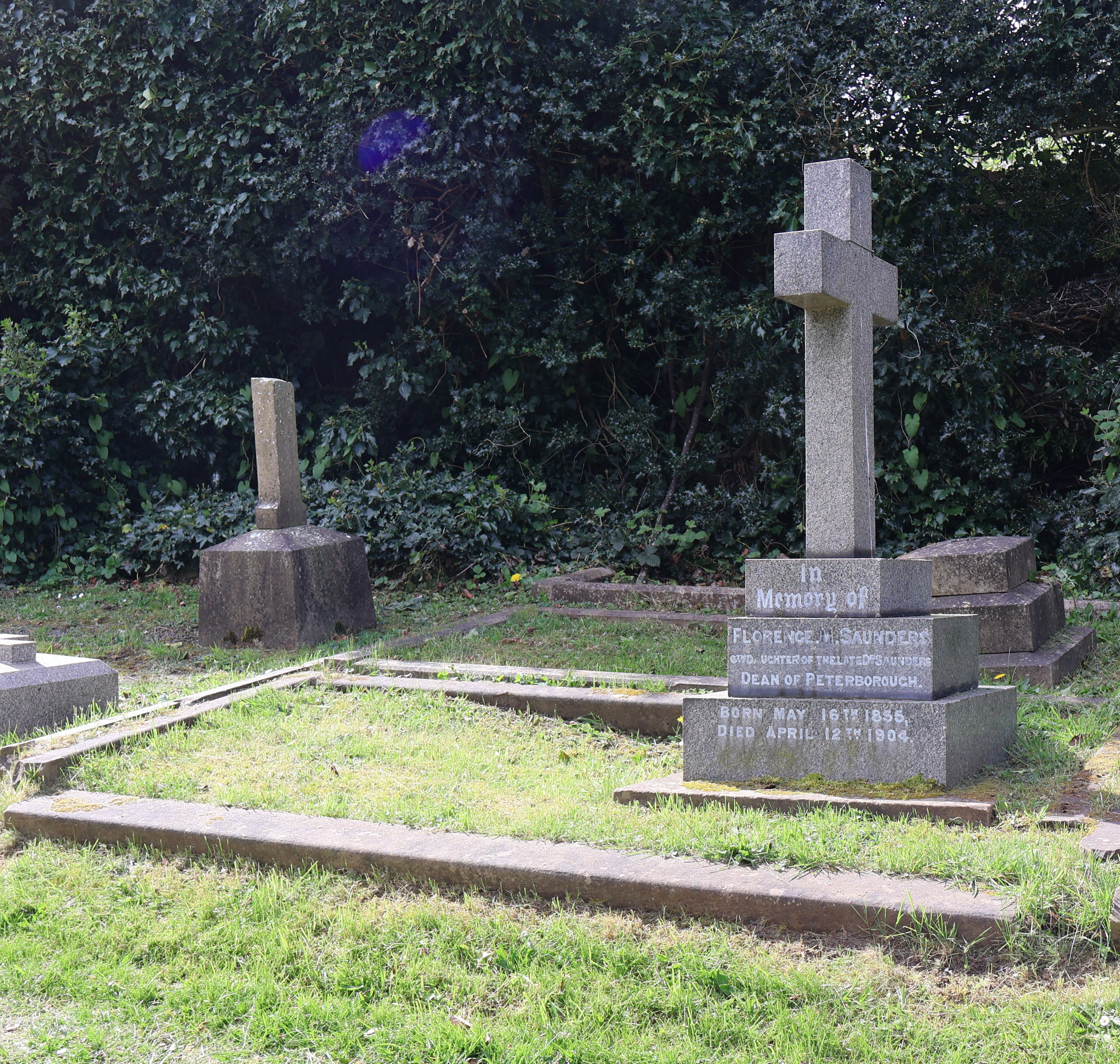
Grave of Florence Saunders, Broadway Cemetery, Peterborough (Martyn Thomas, 2024).
Legacy and memorial
In her will, Florence gave the management committee of the Peterborough District Nursing Association the option of buying her home within six months of her death. It was stipulated that the house should be used as a residence for the district nurses employed by the Association. 49 The will stated that the house would be sold for £1000. If the Association continued after her death, it would receive a legacy of £400. However, if the Association failed to purchase the house, the legacy would be increased to £600. At the annual meeting of the subscribers on 6 May 1904, it was agreed to proceed with the purchase of the house. Furthermore, it was also agreed that as a memorial, the name of the Association should be changed to the ‘Florence Saunders District Nursing Association for Peterborough’. 50 This drew attention to the fact that she had established the Association, worked within it and made a significant contribution in terms of her time and financial support.
Unfortunately, the Association did not have sufficient funds for the purchase and a fundraising collection had to be organised. Four and a half thousand circulars and appeals were sent out to the citizens concerning the purchase of the house for the District Nursing Association. People came forward to make donations and, with the assistance of the Red Cross workers in Peterborough, a house-to-house collection was undertaken which raised just over £1000 over a six-week period. Frank Loomes (1861–1936) played an important role in helping to raise the necessary funds. 51 The house was purchased for the Association and became the home for district nurses. The legacy of £400 was used for the maintenance costs of the building.
At a public function on 15 July 1905, St Oswald's was dedicated to the memory of Florence Saunders, the founder of the Peterborough District Nursing Association. A bronze tablet attached to the west front of the house was unveiled by Mr G. C. W. Fitzwilliam (1866–1935), the President of the Nursing Association. The inscription on the tablet is shown in Figure 4. Those present were addressed by Dr T. J. Walker, who explained how the funds had been raised and also the Suffragan Bishop of Leicester, Lewis Clayton (1838–1917), who spoke about the life and work of Florence Saunders.51,52
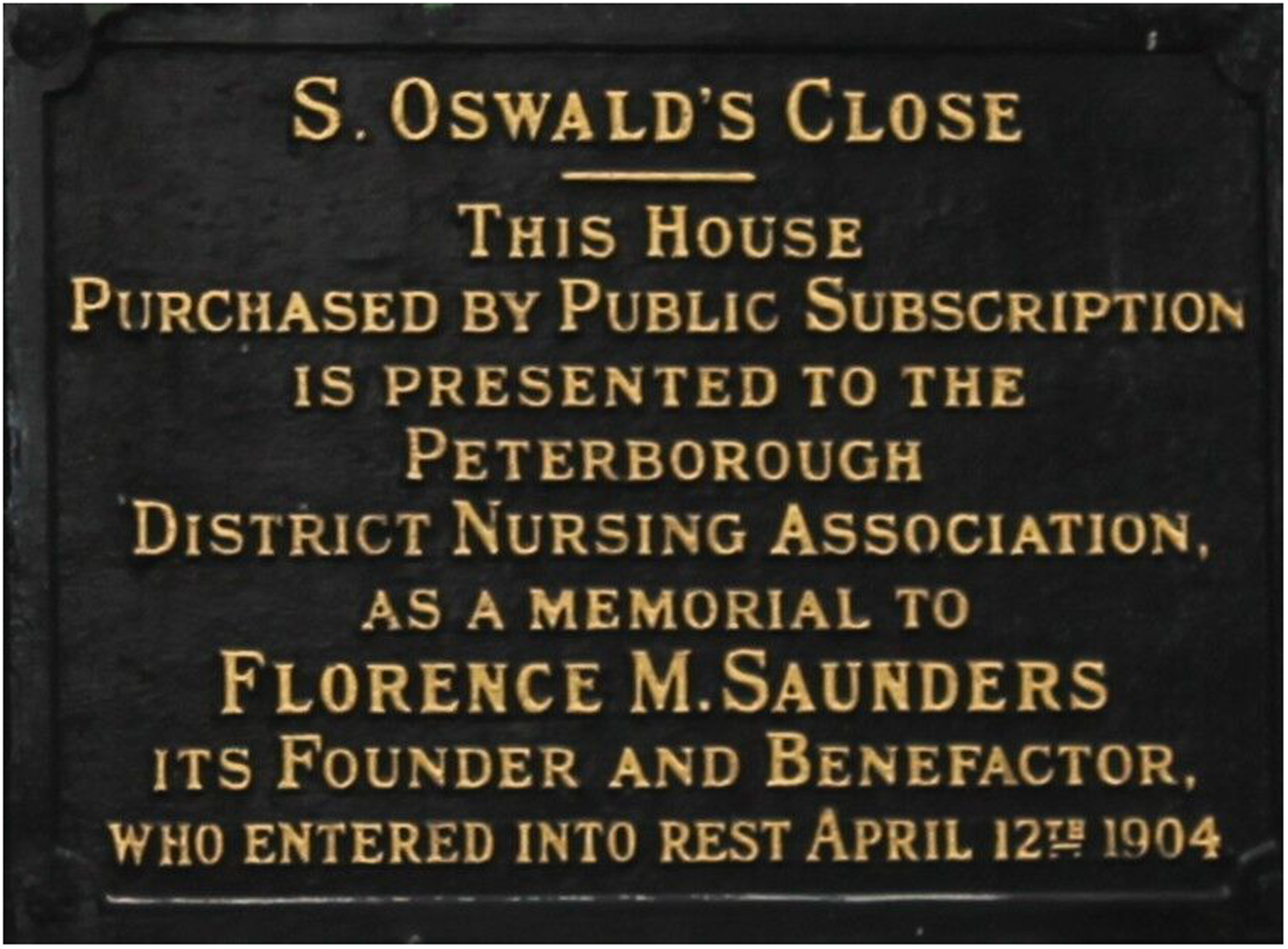
Tablet on the west front of St Oswald's (Martyn Thomas, 2024).
Florence Saunders has been referred to as the ‘Florence Nightingale’ of Peterborough because she established, organised and worked within the district nursing service and cared for the poor. 53 However, this comparison is not entirely appropriate because Florence Nightingale had minimal training as a nurse and was an administrator, statistician, hospital designer, and reformer of nursing care.
St Oswald
It is interesting to reflect on why Florence might have called her house, St Oswald's. In Peterborough Cathedral, there is a chapel dedicated to St Oswald. Oswald was the King of Northumbria and very generous to the poor. 54 In the chapel, there is a stained glass window which depicts the King giving silver pieces to the poor. It is likely that Florence would have known about this window when she was growing up. It is also possible that she was impressed by the story of St Oswald and identified with him in her care and generosity towards the poor.
The Association today
Prior to 1937, the Florence Saunders District Nursing Association was funded by public subscription. 55 In April 1937, a contributory scheme was introduced which required members to pay an annual subscription to receive the services of a district nurse when needed. 56 The sick poor and persons whose income did not exceed £5 a week were not charged. Those outside the scheme paid a fee per visit. In 1948, with the advent of the National Health Service, the Association continued as a voluntary organisation and acted as an agent for the council. 57 District nursing was now funded by the state. In 1954, St Oswald's was converted into six flats for district nurses. 58 In the early 1970s, it became clear that St Oswald's was no longer suitable as accommodation for nurses, and it was closed in 1974. The house was subsequently sold and converted into offices, which were opened in 1976.59,60 The building now houses a hair and beauty salon and a training academy and has been renumbered 1 Bishops Road.
In 1974, the Nursing Association became known as the Florence Saunders Relief in Sickness Charity and the Florence Saunders District Nursing Association ceased to exist. The aim of the charity was ‘to relieve persons who are sick, convalescent, disabled, handicapped and infirm by providing or paying for items, services or facilities which are calculated to alleviate suffering or assist the recovery of persons’. 61 The charity accepted referrals from general practitioners, social services and other organisations such as Age Concern for those with a health problem. In the 1980s, the charity was able to fund, for example, the installation of telephones for the elderly and infirm or a holiday break for those after an illness. 62 In 2021, the charitable status was withdrawn and the remaining funds transferred to the Sue Ryder Hospice in Peterborough. The charity now no longer exists. 63
Conclusion
Florence Saunders was a nurse committed to the development of a district nursing service in Peterborough for the benefit of the sick poor. She was a pioneer of district nursing in Peterborough. The District Nursing Association that she founded proved to be a success and was valued by the patients and their families as well as the local doctors. Although at times her work would have been challenging, she was a leading light in the Association. She expected no financial reward for the work that she undertook and was a generous benefactor to the patients and the Association. Towards the end of her life, she helped with the establishment of the Northamptonshire County Nursing Association for providing district nursing in rural areas. She is remembered in Peterborough for establishing the district nursing service, her devotion to nursing the sick poor and her philanthropy. The Florence Saunders Relief in Sickness Charity replaced the Association in 1974 and in 2021, this ceased to exist. Nevertheless, the commitment, dedication, benevolence and generosity of the first district nurse in Peterborough should not be forgotten.
Footnotes

Funding
The author received no financial support for the research, authorship, and/or publication of this article.
Declaration of conflicting interests
The author declared no potential conflicts of interest with respect to the research, authorship, and/or publication of this article.