



Abstract
Having gained his medical education at Glasgow University, McCune Smith returned to New York City to establish himself. Difficulties in his acceptance were evidenced by the New York Academy of Medicine's refusal of membership and the New York Medical and Surgical Society preventing him from presenting in person at a meeting. He can claim the first peer-reviewed publication and presentation by an African American physician and interacted with both the elite of New York's medical establishment and his unqualified fellow African American colleagues. Whilst writing and lecturing on a range of medical topics, his most memorable achievements lie in the essays on climate, longevity, racial equality and civilisation. In each, he showed a mastery of quantitative analysis, physiology, comparative anatomy and the medical textbooks of the time. It is not just as a physician and pharmacist that he should be remembered but also as the foremost black social scientist of his era with an enquiring analytical approach learnt from and revealed in his Glasgow years. This article will examine his medical practice and writings as well as those essays that displayed his scientific knowledge.
James McCune Smith was born and brought up in the deprived Five Points district of Lower Manhattan. His mother, a single parent of mixed race, had been raised in slavery; his paternity was unknown, and he owed his own freedom to the 1817 Emancipation Act of the State of New York. His excellence at the African Free School attracted support and sponsorship, and, following rejection from the Colleges of his homeland, he travelled to Glasgow University in Scotland to further his education.
Here, in the spring of 1837, he graduated as the first qualified African American doctor of medicine. In September of that year, he journeyed back to New York to practice medicine in the district of his birth. 1 His return and qualifications had been acclaimed by fellow-coloured citizens, but racism, absent whilst in exile, was to influence his practice, activism and future writings. Because of his lack of oratory skills, McCune Smith had become a peripheral figure in the abolitionist movement, and until recently, his career, achievements and struggle for acceptance had been overlooked.
Establishing a medical practice 1837–1839
Having established a medical practice at 93 Chapel Street, he supplemented his income by tutoring literacy, maths and geography for a fee of $3 per quarter and advertised in The Colored American.2,3 In the early years, the newspaper, which he was later to edit, served to promote his practice and lectures. The first lecture, entitled ‘fallacy of the pretentions upon which phrenology is founded’
His medical practice, open to all races, was offering conventional treatments, dental work, leeching and herbal remedies. 7 By 1839, he had moved premises to West Broadway and was residing close by. 8 Located in the Five Points district of his childhood, the area was described by Charles Dickens as ‘hideous tenements which take their name from robbery and murder; all that is loathsome, drooping and decayed is here’. 9 In 1832, the year McCune Smith left for Glasgow, the neighbourhood had been ravaged by cholera, possibly influencing him towards his chosen career. 10
The Colored Orphan Asylum
The Asylum, founded by the Quaker Women of the Association for the Benefit of Colored Orphans, had opened on 5th Avenue in 1836. 11 The 1839 Annual Report, by the Asylums’ white Superintendent Dr James MacDonald, drew conclusions that caught McCune Smith's attention and ire.
In an editorial in The Colored American, he castigated MacDonald for the ‘ruinous and erroneous sentiments’ that those of African descent were more susceptible to diseases and death than their white counterparts. Describing this as a ‘colonization opinion’ McCune Smith proposed that any increase in mortality could not be explained by racial vulnerability alone. 12 MacDonald, a member of the American Colonization Society, was implying that blacks would be best returned to Africa where the warm climate was more suitable for them. MacDonald responded that in the Asylum's first year, there had been no deaths but four in the first quarter of the second year and that this had prompted him to report and to add five who had subsequently died and on whom he performed post-mortems. 13
McCune Smith noted that, as no deaths had occurred in the first year, those in the second could not logically be ascribed to ‘a peculiarity in the constitution of colored people’. He analysed each of MacDonald's cases and compared this with the 1837 City Inspector's mortality data. Causes of death recorded in the Inspector's reports were compiled from the interment records of cemeteries and were likely inaccurate. 14 Adjusting for population size, he calculated teething white children had twice the mortality of their coloured counterparts. McCune Smith took each of Dr MacDonald's diagnoses: convulsion, consumption, whooping cough, brain inflammation, brain tumour, tuberculosis and accidental poisoning and then, by applying the City Inspector's data, showed the ‘peculiarity on the side of the whites’ with the coloured race being ‘best fitted by nature to endure the climate of New York’. Magnanimously, he concluded that there was no bad feeling towards Dr MacDonald, ‘who must be a benevolent man or he would not gratuitously perform duties at the asylum’. 15 With his meticulous analysis of data, McCune Smith had dismantled any argument, based on racial pre-disposition to disease, in support of colonisation.
In 1846, McCune Smith was appointed as the Colored Orphan Asylum's first salaried attending physician. This was a break from the gratuitous supervision of Dr MacDonald, a repudiation of the latter's support for colonisation and a cementing of ties between the Asylum, the black community and church. 16 In his first year, despite pre-admission health screening, mortality levels were high amongst the 144 residents, with 24 deaths and 60 cases of measles. 17 McCune Smith recognised the importance of early isolation for those with infectious diseases and sought funding for an isolation wing, which opened in 1850. 18 McCune Smith's annual reports documented individual case studies, provided statistics and quoted medical textbooks. The Twenty-Fourth Report (1861) noted that since opening in 1836, one thousand and eighty-six children had been admitted, with 211 remaining in residence. Of the 84 who had been ill that year, seven had died, three from tuberculous meningitis. He calculated the ratios of those sick as 1:3.6 and dying as 1:40 and detailed an epidemic of mumps. 19 In July 1863, fire and looting caused by New York's Draft Rioters destroyed the 5th Avenue building along with its records. Two years later, with the unwell McCune Smith helping fund-raise, it re-opened in Harlem. 20 Dr Fotheringham, his white successor, reverted to the anti-assimilation beliefs that illnesses such as tuberculosis were more prominent in mulattoes (those of mixed Race) because they were ‘genetically inferior to whites and pure Negroes’. 21
Early publications and practice
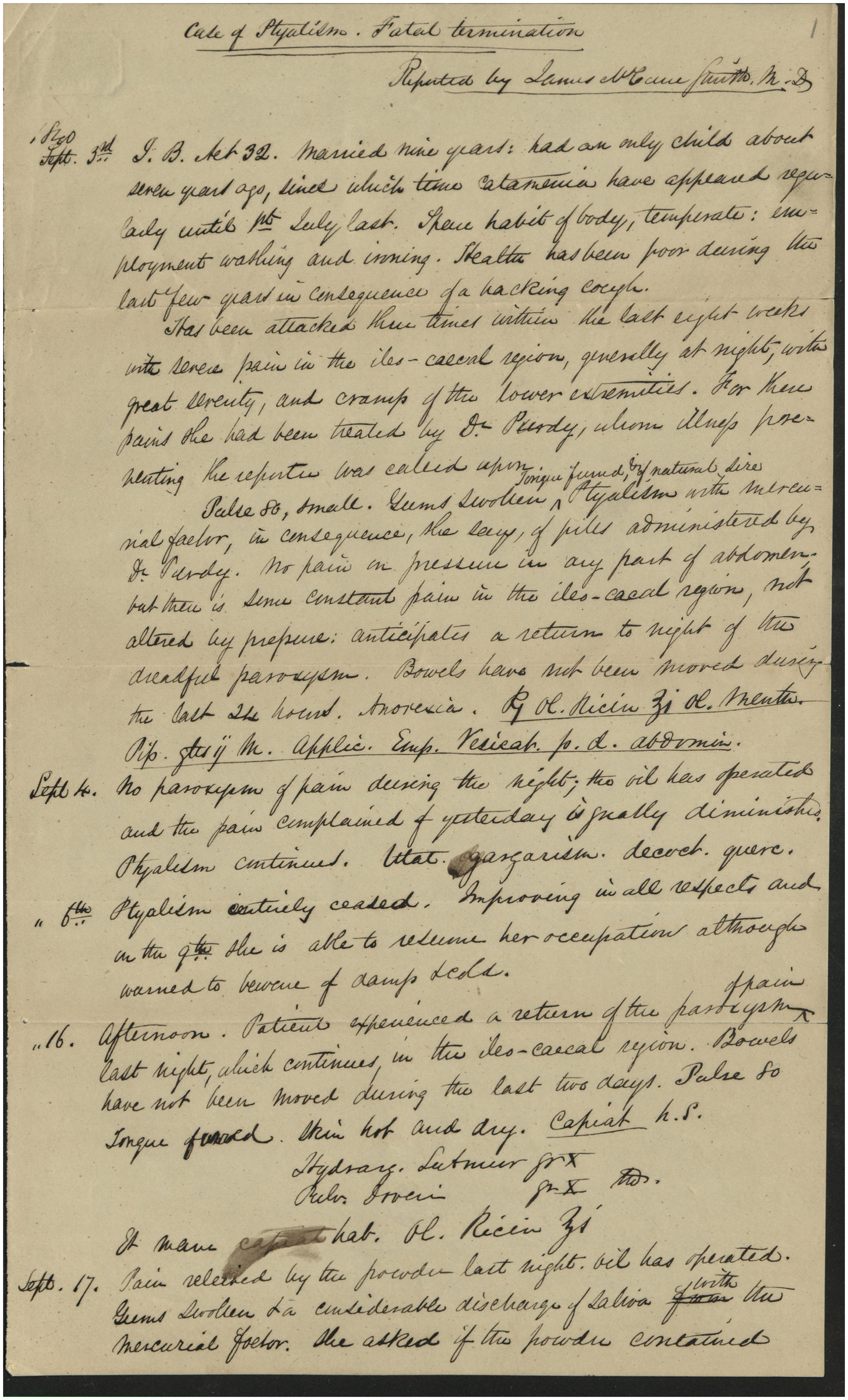
James McCune Smith's handwritten notes on a ‘Case of ptyalism with fatal termination’ (Page 1). September to October, 1840. New York Academy of Medicine Library. MS51. Courtesy of The New York Academy of Medicine Library.
By 1842,
McCune Smith consolidated his practice financially by opening a pharmacy in West Broadway. By the early nineteenth century relationship between pharmacists and physicians was at low ebb. Colleges of pharmacy had been established in Philadelphia (1821) and Massachusetts (1823) with qualified apothecaries diagnosing and treating patients and bypassing clinicians. In the face of the challenge, medical graduates, trained in compounding medicines, established their own pharmacies or ‘drug stores’ and employed apprentices to make up medicines whilst they practised in their surgeries. 27
McCune Smith attacked the methodological flaws in the Census. His article, in two parts, showed his grasp of statistical analysis.35,36 He argued against the proposition that the number of living centenarians in any given population, matched against recorded births, was a measure of the longevity. He highlighted the inaccuracies of birth registration and the confounding issue of population mobility. He demonstrated that the proportion of mortality within any population did not compute with longevity in that the ‘proportion of mortality is a statement of how many persons die in a population; this does not state the age at which those persons die’. From his statistical review, he concluded that, without correcting for age and climate, mortality figures alone could not be used to compare the health of southern slaves with their free northern counterparts. Both papers, rich in detail, were reasons for McCune Smith's acceptance into the American Geographical and Statistical Society. 37 His views, shared on insanity by Edward Jarvis, 33 had been earlier expressed in The New York Tribune. Here McCune Smith memorably wrote, ‘freedom has not made us mad; it has strengthened our minds by throwing us upon our resources’. 38 McCune Smith continued to lecture on the subject for some years and to dismiss the Census in future writings.39,40
McCune Smith responded in The Annalist confining himself to data from one of the participating orphanages (Protestant Half Orphan Asylum), which had provided 800 children to the study. Over a 10-year period, he found the death rate on homoeopathic treatment higher and the numbers prescribed it lower than quoted in the overall study. He questioned the accuracy of death rates noting the itinerant nature of orphanage populations with data on death after discharge missing. Comparing a study of typhus deaths on allopathic medicine, published in the ‘British and Foreign Medical-Chirurgical Review’, with those in the orphanages on homoeopathic treatment, he calculated that the former ‘saves seven times more patients than homeopathy’. He concluded wishing that ‘as against the murderer and the assassin may the regular practitioner do battle against the most deadly quackery that curses the nineteenth century, in the form of homeopathy’. 41
The Annalist published an editorial describing McCune Smith as a ‘friend’ and the NYHDA as ‘a body of non-professional persons quitting their proper sphere of action, to express an opinion, for or against, a particular system of medicine, in an attempt, extra-professional, to bias the public mind’. 42
The New York Academy of Medicine
Declined the Academy Fellowship in 1847 McCune Smith received the award posthumously in 2018. 43 He described his rejection in an article on chess thanking those of the Chess Congress who ‘with nobler instincts than the New York Academy of Medicine did not hesitate or refuse to admit a Negro’ adding that his refusal was ‘lest it might interfere with the harmony of the young institution’. 44 That same year, the American Medical Association (AMA) opposed social and professional interactions with black physicians. 45 Despite the AMA's Code of Conduct, prominent white doctors, such as John Watson and William Roberts, associated with McCune Smith and latterly he collaborated with the renowned surgeon Lewis A Sayre (1820–1900). 46 Sayre, a founder of Bellevue Hospital Medical College and Professor at New York University, published a case of croup with fatal outcome that McCune Smith had invited him to consult on. Sayre wrote that ‘the history of the following case, with the exception of the post mortem, is from the notes of Dr J. McCune Smith, who had charge of it before I saw her’. The patient was a deteriorating 10-year-old girl on whom Sayre had, as a last resort, performed a tracheostomy. McCune Smith detailed the insertion of a tracheal tube with fatal haemorrhage and assisted at the post mortem. Sayre illustrated the procedure and cited a further case concluding that the insertion of the tube had caused the fatal bleed in both and that perhaps with vigorous steam inhalation alone, avoiding tracheostomy, the outcomes could have been less disastrous. 47
The application of medical science to the pursuit of equality
McCune Smith's writings in pursuit of abolition, freedom and emancipation were substantial, beyond the scope of this paper, and have been detailed by others.48–51 In some essays, his application of medical science and statistical analysis was central to his argument. Whilst these works are few within the canon of some 100 or more publications, they are significant and account in part for his prominence in shaping nineteenth-century black social science. 52 In 1859, McCune Smith became co-editor of the short-lived ‘Anglo-African Magazine’ and, in its first volume, despite failing health, penned five essays, of which Civilization: its Dependence on Physical Circumstances and On the Fourteenth query of Thomas Jefferson's Notes on the State of Virginia were the most remarkable.
Applying this timeline, McCune Smith argued that in regions of extreme temperature, development would be slowed though people from hot climates, when transported to a temperate one, could adapt and gain in development. In support, he observed that the enslaved and free populations of Maryland, removed from the African Coast many years earlier, had become the physical equals of their white counterparts who had always resided in a temperate climate. He postulated that the relationship between physical strength and intelligence, as suggested by Quetelet, 55 explained civilisation's advancement. In addressing the role of geography in civilisation he cited the writings of the German geographer Carl Ritter (1779–1859) and James Prichard (1779–1859) the English physician and ethnologist. Ritter claimed in Earth Science in Relation to Nature and the History of Man (1822) that civilisation was more advanced in countries with large coastal planes as did Prichard, in his Researches into the physical history of man (1836).
McCune Smith dismissed the notion that racial superiority or inferiority, rather than location and physiology, explained regional differences in human advancement and, in pursuing this argument, returned to the theme of adaptation, adding that being able to adapt physically to a new location was clear evidence that racial characteristics were inter-changeable and that all humans were part of the same stock. The essay's message was that diligence, physical strength, innate talent and diversity combined to enrich and advance civilisation. He had outlined the importance of climate and geographical position in promoting civilisation, dismissed the notion of racial superiority, noted the ability for persons to adapt physically and mentally to new locations, made claim that all races originated from a common source and exposed the negative effect of discrimination on the advancement of mankind.
He believed studies claiming black inferiority were based upon the selective use of evidence and illustrated this by citing the claims of the New York surgeon and anatomist John Augustine Smith (1782–1865) that the skulls of Negros were similar to those of apes and with an acute facial angle different from Caucasians. The angle was defined as the intersection of two lines, drawn from ear to nostril (horizontal) and from nostril to forehead (vertical) with intellect being ‘in proportion to the obtuseness of the angle’. 59 Accusing Augustine Smith of presenting extreme examples in support of his case, McCune Smith selected profiles of prominent white Americans and those from French and Spanish coins to demonstrate that the angle's acuteness was highly variable. The Dutch physician and anatomist Pieter Camper (1722–1789) claimed the facial angle, measured from lip to forehead, was greatest in ancient Greco-Roman statues and Europeans and less so in blacks and apes 60 (Figure 2). McCune Smith reviewed Camper's data, noting a wide overlap between races and that the comparisons with apes were invalidated by studying young rather than mature primates. To McCune Smith the notion that skull measurements related to intelligence and differences between races were indicative of Caucasian superiority was without scientific foundation.

The facial angle measured from lip to forehead. Petrus Camper, The Works of the late Professor Camper on the connection between Science and Anatomy and the Arts of Drawing Painting and Statuary. London: C. Dilly, 1794 Table 1. p.176 Creative Commons. In the Public Domain.
He referred to the observation of Richard Owen (1804–1892), the English palaeontologist, that the different positions of the zygomatic arch and foramen magnum in primates, when comparing skulls of whites and blacks, confirmed that ‘there exist in reality a uniform resemblance’ amongst the races. Questioning differences in brain anatomy he quoted the work of the Heidelberg anatomist and physiologist Friedrich Tiedemann (1781–1861) who, having studied the brains and skulls of Caucasians, Negros, Europeans and Mongolians, concluded that ‘the brain of the Negro, is, that neither anatomy nor physiology can justify our placing them beneath the Europeans in a moral or intellectual point of view’. 61
In Types of Man (1854), the Alabama physician Josiah Nott (1804–1873) cited hair texture as proof that ‘races are distinct species’. 62 McCune Smith countered with the observation of Samuel Forty (1811–1844) that ‘among the white races every gradation from the fair to the dark is accompanied by a corresponding alteration in the tint of the hair. This remark applies equally to the colored varieties of men’. 63 McCune Smith speculated that the crispness and tight texture of hair was climate dependent re-iterating the theme of adaptation in observing that the hair of those transported from Africa is ‘growing more and more straight’.
In referring to skin colour, Jefferson wrote that ‘this unfortunate difference of colour, and perhaps of faculty, is a powerful obstacle to the emancipation of these people’. 64 McCune Smith noted that ‘Mr Jefferson himself has left living testimony against his own expressions’ with a coloured grand-daughter, the result of a liaison with a mulatto slave, colonised to Liberia; subsequently confirmed by DNA studies. 65 McCune Smith considered the terms white and black as arbitrary, preferring Leucos (white), Melanic (black) and Xanthic (yellow) arguing that ‘black comprises no special variety of the human race, no distinctive species of mankind’ in keeping with Prichard's contention that races shared the same mental and physical attributes with the original complexion being dark or melanic. 66 The advent of microscopy had advanced the understanding of skin with the English dermatologist William Wilson (1808–1884) to the forefront. McCune Smith noted in On Diseases of the Skin (1857) Wilson described pigment granules arising from primitive cells deep within the skin with the proportion of coloured to uncoloured granules accounting for variations in complexion. 67 McCune Smith viewed colour as a variable rather than a constant, being a changeable characteristic resulting from extraneous factors of climate and location rather than race-defining.
McCune Smith believed the question ‘what further is to be done with them’ should never have been asked had Jefferson been acquainted with ‘the human process’ and rejected the alleged physical differences that ‘constitute a bar in the way of incorporating the black man into the American State’. Whilst 50 years earlier Jefferson and others used the words ‘black’ and ‘negro’, McCune Smith emphasised that this class were now dignified as ‘colored people’ and no longer regarded as ‘blacks, bordering on bestiality’. He promised an article devoted to Jefferson's claims on moral and mental difference, but there is no record of this. 68
Personal life
In the early 1840s, McCune Smith married Malvina Barnett, a free woman of colour and a daughter of one of New York's most esteemed black families. 69 The couple had 11 children, of whom five survived into adulthood. With the success of the medical and pharmacy practices and property investments, the family moved often and by 1860 to a newly constructed mansion on Leonard Street in a mainly white neighbourhood.
In the year of his death, an unattributed article in ‘The Liberator’ described him as ‘the wealthiest colored man in New York City being worth about $100,000’. 70 McCune Smith's health from cardiac hypertrophy had declined over several years with him making his last house-call in late 1863. Thereafter, he regarded himself ‘in the light of a confirmed invalid’. 71 In 1864 he was offered a professorship in anthropology at Ohio's Wilberforce University but poor health intervened. 72,73 He died on 17 November 1865 aged 52, days before the ratification of the Thirteenth Amendment abolishing slavery. (Figure 3) Survived by his widow, four sons and a daughter, he was buried at Cypress Hills Cemetery in Brooklyn. The 1860 Census classified his family as white, an error likely made by the census enumerator on the basis of them now residing in a predominantly white district.
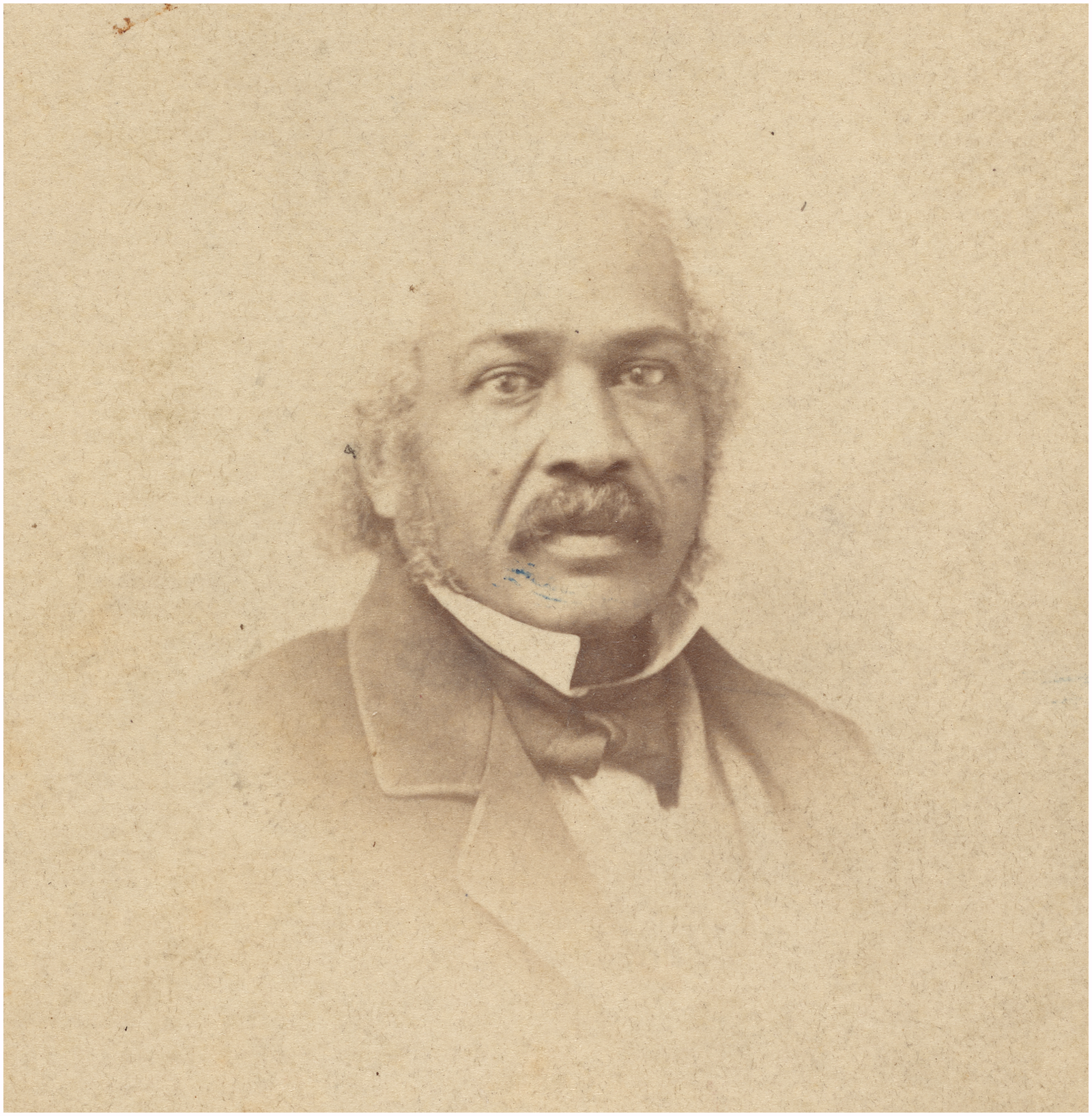
James McCune Smith in the year of his death aged 52 years: 1865. Photographer: Johnson, Williams & Co. (New York, N.Y). Schomburg Center for Research in Black Culture, Photographs and Prints Division. The New York Public Library. https://digitalcollections.nypl.org/items/c02c2e30-54ed-0139-12f3-0242ac110003. In the Public Domain.
Conclusion
McCune Smith made a significant contribution to the arguments of the time on species and race. Like James Prichard, he was a monogenist believing that the different races that made up the human species originated from one family and that their characteristics were climate and environment-dependent and changeable. His views on adaptation were expressed earlier in the same year as those of Darwin. 74 He opposed the polygenists who promoted the notion that races arose from separate stocks and that intelligence, disease susceptibility and civilisations could be ranked accordingly. He relentlessly and courageously challenged scientific racism as an illogical justification for slavery and an unmoveable bar to integration. Whilst lacking skills as an orator, his writings revealed a mind that could mobilise wit, scorn, argument, logic and a medical education in championing causes. His scientific knowledge allowed him to question orthodoxy, call out inaccuracy and challenge hierarchy. His medical practice revealed him as a caring and widely respected physician who contributed generously to his community. It is not only as a free-thinking intellectual and abolitionist that he should be remembered but also a ground-breaking physician, pharmacist and pioneering social scientist who carried and valued his Glasgow education throughout his days. The message he left in his medical and wider writings, which remains prescient, was that all are one race.
Footnotes
Acknowledgements
Thanks to the following for help and support: Claire Daniel, Archivist, Archives and Special Collections, University of Glasgow; Clare Harrison, Library and Heritage Manager, Royal College of Physicians and Surgeons of Glasgow; Moira Rankin, Senior Archivist, Archives and Special Collections, University of Glasgow; Arlene Shaner, Historical Collections Librarian, The New York Academy of Medicine; Crystal Toscano, Patricia D. Klingenstein Library, The New York Historical.

Funding
The author received no financial support for the research, authorship, and/or publication of this article.
Declaration of conflicting interests
The author declared no potential conflicts of interest with respect to the research, authorship, and/or publication of this article.
Inclusive language
Author Biography
Ian Bone is an Honorary Senior Research Fellow at the University of Glasgow and a retired Consultant and Honorary Clinical Professor in Neurology. He is the author of Sacred Lives an account of the history, cultural associations and social impact of epilepsy. Recent papers include those on the history of the neurosciences, spirituality and epilepsy and clinical practice. He is a board member of the charity "Hidden Truths" which aims to enhance the understanding of epilepsy through the arts.