




Abstract
Our article aims to understand the participation of the ‘backpacking neighbourhood’ Phạm Ngũ Lão in the current metropolization process of Hồ Chí Minh City. This neighbourhood is representative of Vietnamese ‘glocalization’. By this term, we mean the abilities of local stakeholders to benefit from the opportunities created by an increasingly global economy. These skills are reflected not only in innovations and landscape transformations to attract tourists, but also in ‘reactivations’ based on older urban practices. We question not only the production of specific urban territories through backpacking activities, but also the spatial and social inequalities they generate. By doing so, our intention is to combine tourism studies and urban studies to ‘unpack’ the figure of the backpacking neighbourhood and to go beyond the idea of urban enclaves.
Keywords
Introduction
For international tourists leaving Tân Sơn Nhất airport (Hồ Chí Minh City) for the first time, the experience can be tough: the heat, the noisy atmosphere, together with the horde of taxi drivers working for various companies and hotels, can be puzzling. But, in this confusion, one name resonates more strongly than the others: ‘Phạm Ngũ Lão!’. This name is supposed to get the attention of backpackers, who do not have any grand hotel drivers waiting for them with a name board.
‘Phạm Ngũ Lão’ is one of the main arteries of the historical centre in Hồ Chí Minh City. It is also an administrative ward within the central district 1 (Figure 1). Nowadays, however, this name is closely associated with the Hồ Chí Minh City ‘backpackers’ area’ (the Tây ba lô area in Vietnamese – literally, the ‘Westerners with backpacks’ area). This neighbourhood is characterized by a specific urban landscape, made of rows of mini-hostels, bars, travel agencies and cheap restaurants. The distinct local identity of this well-known neighbourhood is deeply connected with the development of a ‘budget tourism’ economy.
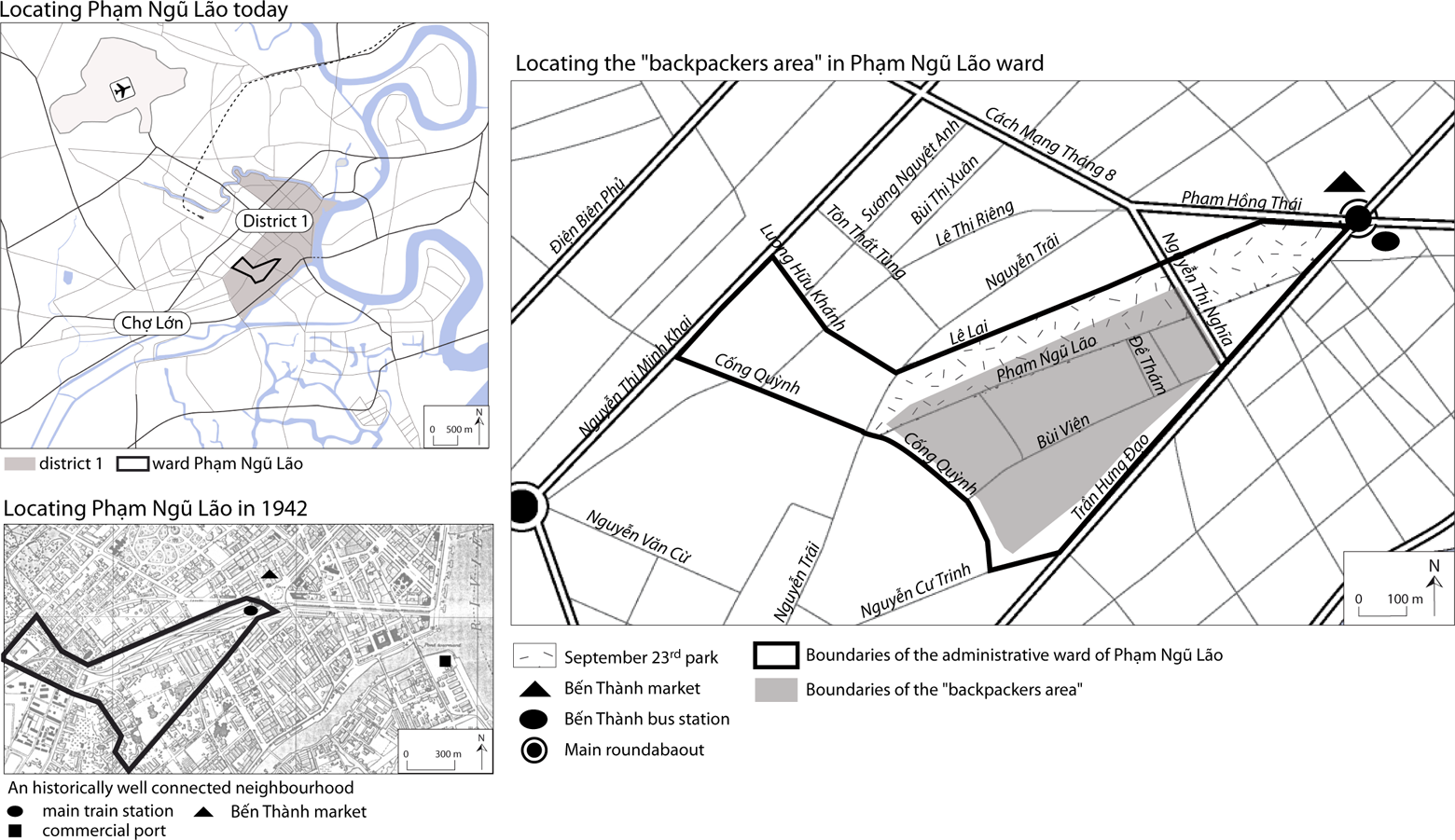
Locating Phạm Ngũ Lão at different periods and city scales.
Since the pioneering works of Erik Cohen in the 1970s on what was then called ‘independent travelling’, or even ‘drifting tourism’, many efforts have been made to explore backpacking practices (Cohen, 1973; Hampton, 2013; Hannam and Diekmann, 2010; Richards and Wilson, 2004). Despite the lack of a single academic definition of backpacking, most authors concur on these criteria: young people (mainly under 40), travelling on a budget for long periods and aiming to experience local culture without any rigid itinerary (Howard, 2005: 357; Pearce et al., 2009: 10).
Together with India and Nepal, South East Asia is among the oldest backpacker trails and remains the most popular area as a backpacker destination (Hampton and Amran, 2010: 3). This historical development explains the numerous specialized neighbourhoods of the region dedicated to backpackers, beginning with Khao San Road in Bangkok, Jalan Jaksa in Jakarta, Jalan Sosrowijayan in Jogyakarta or Boeng Kak in Phnom Penh (Howard, 2007; Hampton, 2013). In this regional context, Việt Nam emerged as a prime new backpacking destination in the 1990s, soon after the opening up of its economy (Đổi Mới) (Lloyd, 2006). The growing popularity of Việt Nam also converged with the rise of many low-cost carriers in South East Asia (Hampton, 2013: 24).
If the specificity of backpacking is now well acknowledged in the literature on tourism, most studies continue to focus on the backpackers themselves, on their motivations and to go beyond the study of the ‘impact’ made by tourists. One of our central arguments is that local stakeholders, in their great variety, participate fully in the construction of backpacking neighbourhoods. We will build this argument on a spatial approach to backpacking in the urban context of Hồ Chí Minh City.
Cities currently dominate the field of tourism studies, but few studies effectively engage with morphological, architectural and landscape analyses. Besides, backpacking neighbourhoods have earned very little attention from urban studies scholars. This has resulted in the systematic – and yet under-questioned – use of the concept of the ‘urban enclave’ or ‘bubble’ to characterize backpacking neighbourhoods (Edensor, 2010; Hottola, 2005; Howard, 2005, 2007; Judd, 1999; Lloyd, 2006; Hampton, 2013). By producing an original spatial and ethnographic study of Phạm Ngũ Lão, we want to challenge this consensus and to highlight the strong heterogeneity that characterizes this neighbourhood.
The urban ‘production’ (Lefebvre, 1991) of Phạm Ngũ Lão has to be understood in terms of a complex interplay between local stakeholders – whether they are local private entrepreneurs or representatives of the district public authorities – and within the geography of their social inequalities. These inequalities differentiate the access to touristic resources between them, according to gender, age, race, income, education or network capacity; and they condition their social and spatial positioning in the neighbourhood.
In this article, we also consider backpacking as an influential factor in the metropolization of Hồ Chí Minh City. Phạm Ngũ Lão can be considered as a symbol of the globalization of the country, following a well-known process of hybridization of local and global apparatuses (Appadurai, 1996; Bhabha, 1994), also called ‘glocalization’. Beyond its backpacking specificity, Phạm Ngũ Lão allows us to examine the trajectory of a central neighbourhood in the course of the city’s metropolization and the unequal competition between its different stakeholders.
The new perspectives we want to offer on the backpacking neighbourhood are made possible by crossing the input and methodology of tourism studies with the tools and research questions of urban studies. This essay is co-written by a geographer specializing in tourism in Việt Nam (Peyvel, 2009) and an urban geographer who is a specialist of the contemporary development of Hồ Chí Minh City (Gibert, 2014). Therefore, our article engages in breaking down barriers to an understanding of the structuring and functioning of backpacking neighbourhoods.
Based on land registers and mapping surveys, we probed into the local spatial apparatus at the neighbourhood level itself and at that of the blocks and individual buildings. Typo-morphological surveys were completed with over 30 local actors, residents and backpackers. These enquiries were conducted in the interviewees’ preferred language, mainly in Vietnamese, more rarely English and French. Participant observations were also conducted during a three-week period of fieldwork based at a local guesthouse in August 2014, and completed in October 2014. Previous fieldwork surveys in the neighbourhood had been carried out in April and July 2007, and also in July 2010.
The structure of our article is as follows: the first part engages with the literature on backpacking neighbourhoods and discusses the necessity to go beyond the concept of the urban enclave. Drawing from metropolitan and postcolonial studies, we therefore claim the study of Phạm Ngũ Lão as one of an ‘ordinary’ neighbourhood (Robinson, 2006). Then, in the second part, we explain why Phạm Ngũ Lão can be considered as an archetypal backpacking neighbourhood. Informed by grounded observations and mapping surveys, the third part argues that Phạm Ngũ Lão cannot be considered as an enclave, despite its strong economic specialization. Based on this previous analysis, the next part engages with the growing heterogeneity of this neighbourhood in the course of Hồ Chí Minh City’s metropolization. The fifth part explores the ‘dark side’ of Phạm Ngũ Lão in terms of its highly unequal development process. Then, the final part discusses the future of Phạm Ngũ Lão at a time of growing institutionalization and normalization.
Beyond the enclave: Engaging with the literature on backpacking neighbourhoods
The figure of the ‘enclave’ promptly became a classic analytical tool in tourism studies (Pearce, 1989), especially in works dealing with tourism in developing countries, which mainly focus on international tourism. This image borrows from the figure of trading posts (comptoirs) in a colonial context, by underlining the isolation and the extraterritorial status of delimited places of encounter between local societies and foreigners. While didactic and visually strong, this image remains problematic because it legitimizes the idea of insurmountable differences between tourists and local societies (Jenkins, 1982; Munt, 1994) and it also acknowledges ‘an effective isolation from the host local community and economy’ (Hampton, 2013: 69). Historically applied to touristic small islands and all-inclusive resorts, the concept of the enclave has become a leitmotiv in backpacking studies, together with the ‘backpackers’ ghetto’ or ‘touristic bubble’ (Judd, 1999). Howard defines the backpackers’ enclave as follows: [an area containing] at least 10 relatively closely-spaced and relatively inexpensive guesthouses/hotels/hostels, of any size, patronized partly by backpackers. An archetypal backpacker enclave would have only drifters customers, would be predominantly tourist-orientated, with clear boundaries, and a definite character, and self-contained with all traveller activities there. (Howard, 2007: 77)
By applying this theoretical framework to Hồ Chí Minh City backpackers’ neighbourhood, we also want to engage with Vietnam’s tourism economy (Gillen, 2016; Lloyd, 2006 and Lloyd, 2003). Kate Lloyd studied the development of backpacking in Việt Nam ‘through a study of the development of small-scale tour operators who run traveller cafés’ in Hà Nội and Hồ Chí Minh City (Lloyd, 2006: 66), a theme that is representative of Đổi Mới economy. Thirty years after the Doi Moi reforms, Vietnam now hosts the rise of global stakeholders in the tourism economy. Our study takes in consideration this new metropolitan situation.
Phạm Ngũ Lão, the archetype of the backpacking neighbourhood
Phạm Ngũ Lão meets the three main criteria for it to be considered as a typical backpacking neighbourhood: it is well identified by international guides; its landscape is shaped by the tourist specialization; and it is easily accessible, thanks to its central location and the concentration of various means of transport.
A look at different travel guides – including the Australian Lonely Planet, the French Routard, the English Rough Guide, the Japanese Arukikata and the guide edited by the Chinese National Tourism Administration – shows that Phạm Ngũ Lão is undoubtedly a key site in Hồ Chí Minh City’s contemporary touristic landscape. All these guides map the area with approximately the same boundaries: a trapezium shape of around five hectares, delimited by two main boulevards – Phạm Ngũ Lão and Trần Hưng Đạo – and two other main streets – Cống Quỳnh and Nguyễn Thái Học. The backpacking neighbourhood itself only occupies a small part of the administrative ward with which it shares the name (Figure 1). Its beating heart is made up of Đề Thám and Bùi Viện Streets, which gather most of the hostels, shops and restaurants recommended in international guides. Our own mapping survey confirms that the most specialized place in the neighbourhood is the square block made of two main alleyways between Phạm Ngũ Lão, Đề Thám, Bùi Viện and Nguyễn Thái Học Streets (Figure 2). Trần Hưng Đạo, Cống Quỳnh and Nguyễn Thái Học Streets can be considered as margins in the structuring of the backpacking area.
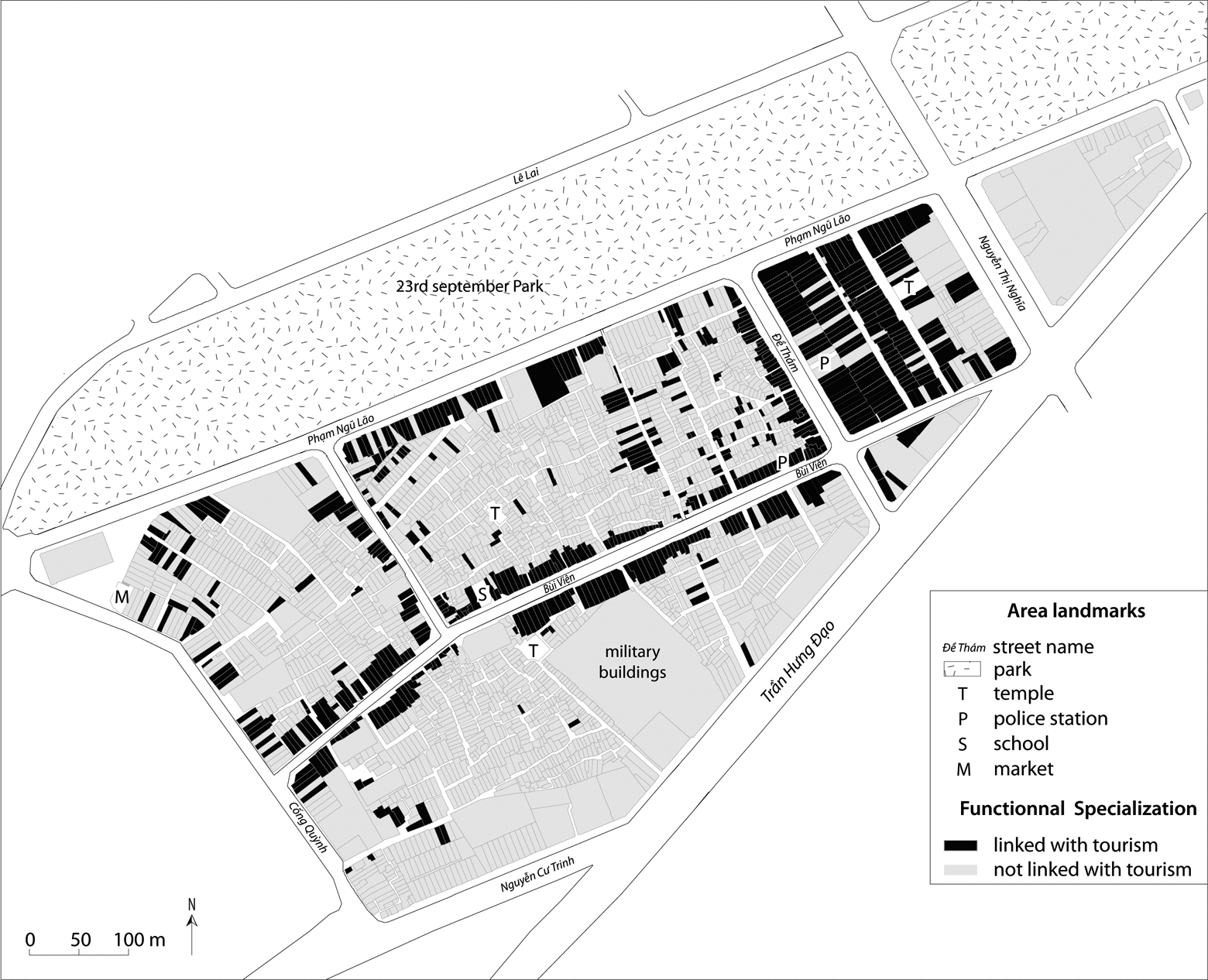
Localizing the touristic economic sector in Phạm Ngũ Lão.
Touristic activities have generated a specific type of landscape in Phạm Ngũ Lão. The neighbourhood offers backpackers the expected services to organize their travels, but also provides amenities that allow them to negotiate their daily lives in a more or less autonomous manner (O’Reagan, 2010). Its economy is fundamentally in tension between the mobility and the anchoring of backpackers. The neighbourhood provides a concentration of travel agencies and transport services, but also mini-hotels and guesthouses, cheap restaurants and bars, grocery stores, laundries and abundant day and night entertainment (souvenir shops, tailors, DVD shops, spas and massage salons, nightclubs, the sex and drug trades) (Figure 3). These specialized services provide backpackers with all they need in a contained and accessible area.
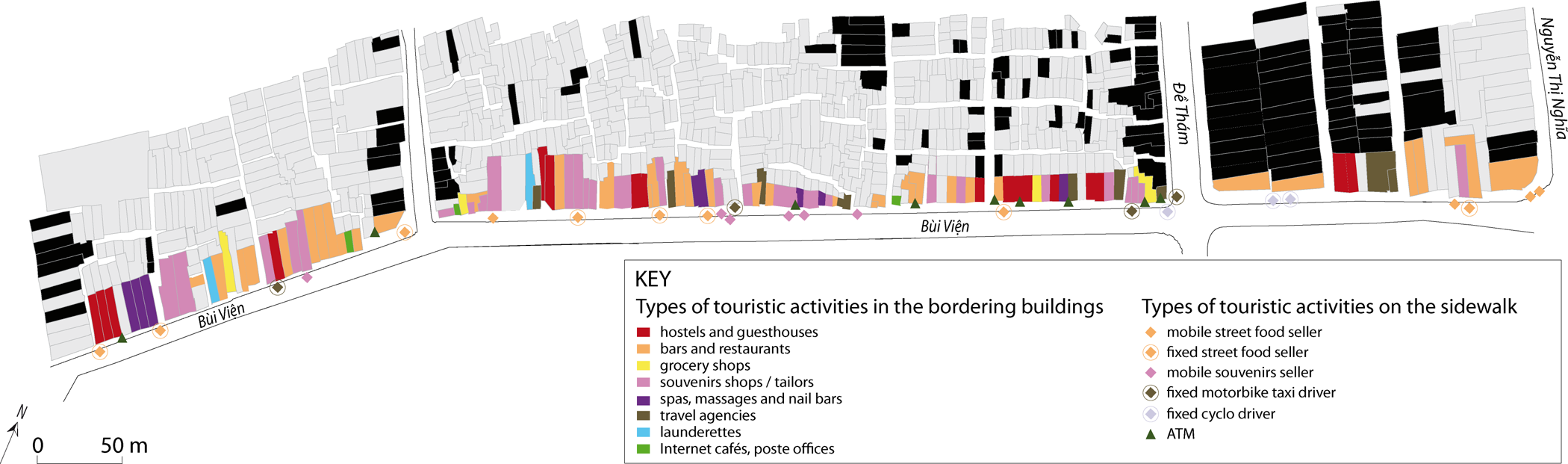
Towards a typology of touristic activities along Bùi Viện Street.
This economic organization provides a compellingly strong visual landscape. Signboards that are almost systematically translated into English have become a landmark. Chinese, Korean and Japanese translations have now appeared, echoing the more recent composition of international backpacking tourists. A few French references recall the existence of colonial Indochina. The neighbourhood is also filled with global tourism labels: storefronts display quotations from famous travel guides, or websites such as TripAdvisor. Logos for credit cards are also notably present. The Phạm Ngũ Lão landscape is particularly recognizable at night: the sidewalks, bars and terraces are busy and lit by numerous signboards, flashy neon lights or red lanterns, indicating the erotic dimension of the neighbourhood (Figure 4). This use of neon lights at night is very much characteristic of this neighbourhood of Hồ Chí Minh City, but it undoubtedly plays on the evocation of other famous Asian metropolises, such as Tokyo, Hong Kong, Seoul or Bangkok, all well-known for their lit-up urban landscapes. Phạm Ngũ Lão has also acquired great visibility at the metropolitan level due to its social, racial and gendered attendance. White people are over-represented compared to other neighbourhoods. The presence of beer bars (bia hơi) and the economy of prostitution and drugs also lead to a high masculine ratio.
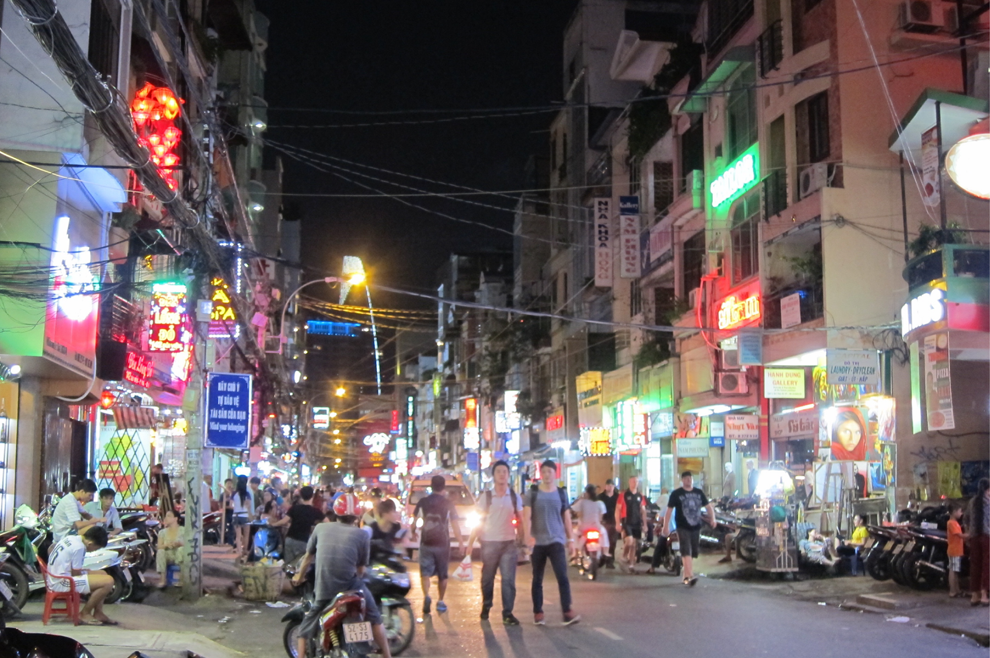
The vibrant urban landscape of Phạm Ngũ Lão at night.
The last typical criterion for characterizing Phạm Ngũ Lão as a backpacking neighbourhood is its central location and high connectivity, from the local to the national level. During the colonial period, the area was surrounded by the main train station, the harbour and the iconic Bến Thành market (Figure 1) – key places for what can be considered the ‘first globalization’ of Việt Nam through colonial trading posts and transnational city connections. This also explains the success of the zone during the Việt Nam War: Phạm Ngũ Lão was much appreciated by American soldiers on leave. This period prefigured the current globalization of the neighbourhood. The increase in the number of cheap rooms to rent to American soldiers heralded the budget tourism specialization that came with the economic openings of the next decades.
Today, international backpackers use Phạm Ngũ Lão as a base from which they can explore the rest of the city and the country. It role as a node is facilitated by the strategic location of the neighbourhood, close to the historical city, in the heart of the transport network. From the historical centre, many tourists join their Phạm Ngũ Lão hostel on foot or by taxi (car or motorbike). This indicates the permeability of the zone and its inscription within a wider touristic landscape. At the national and international level, Phạm Ngũ Lão provides backpackers with extensive transport (Figure 5), including a low-cost open ticket that grants access to a night bus that stops at the main national touristic sites, distributed by many travel agencies. More generally, these agencies facilitate the logistics of tourist mobility, in particular the administrative and linguistic aspects, such as obtaining a visa or finding a guide.
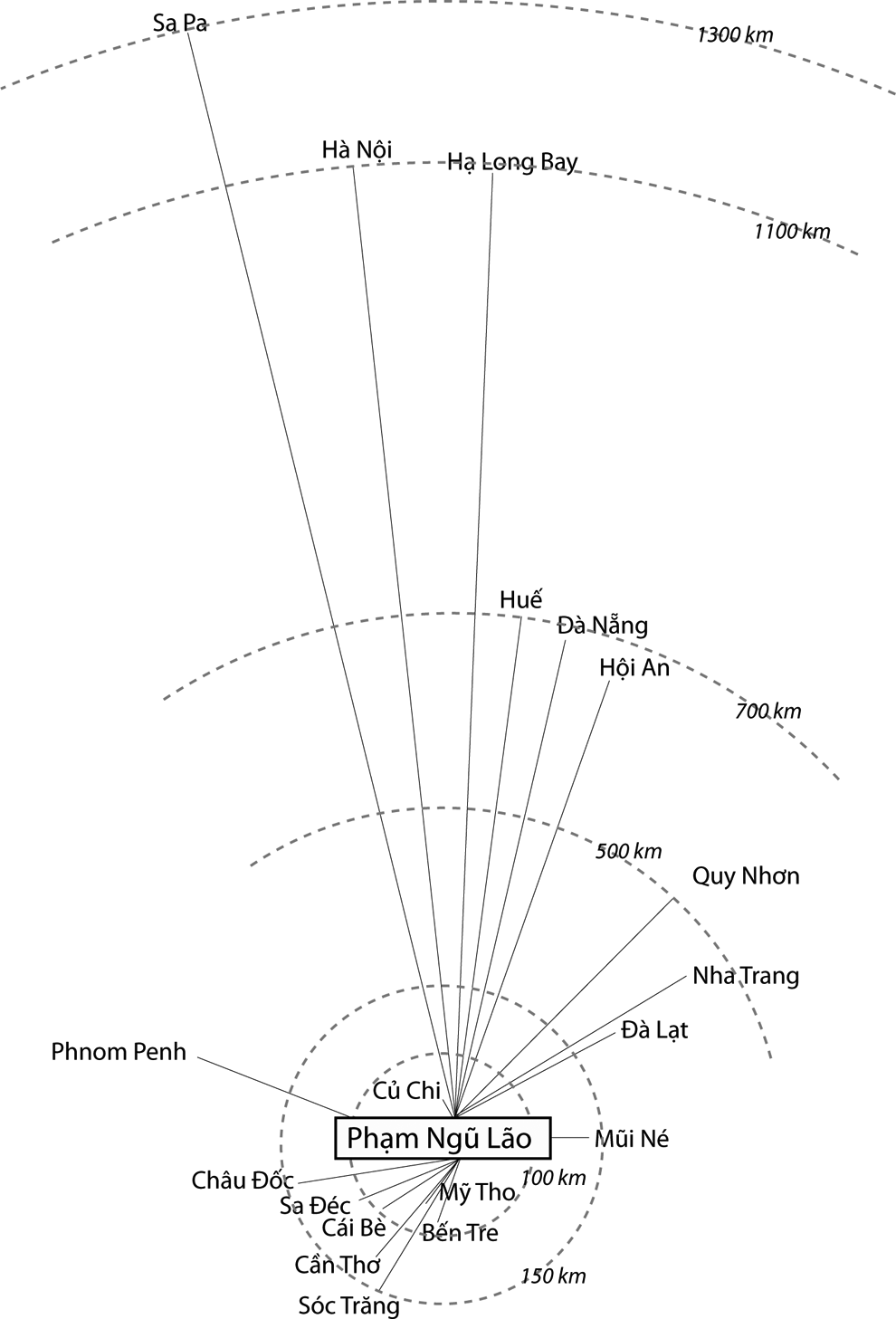
Phạm Ngũ Lão, a node in the regional and national tourist mobility system.
A functional specialization within an ordinary Vietnamese neighbourhood
The production of a specialized neighbourhood
If Phạm Ngũ Lão appears to be a typical backpacking area, it is because local stakeholders have been successful in adapting to the needs of backpackers and their diverse habits. This adaptation can be read as a form of ‘glocalization’, a hybridization of both Vietnamese services and the global tourism apparatus (Appadurai, 1996; Bhabha, 1994). Accommodation and catering services are organized according to this logic. Nhà nghỉ (literally ‘houses for sleeping’) are run in parallel to guesthouses, that provide single rooms with or without breakfast. Bia hơi are cheap beer bars, popular with both Vietnamese men and tourists. Cơm bình dân, cheap take-away street food popular in Vietnamese cities, is particularly attractive to backpackers. Grocery stores also adapt to demand by including shelves for specific food and hygiene brands. Laundry services are also provided, ranging from hand-washing by a nhà nghỉ resident or a guesthouse employee, to shared washing machines belonging to landlords or their relatives, and formal launderettes in boutiques offering fixed prices and rules.
This innovative way by which local practices appropriate the global tourist economy is also notable in the communications sector. Tourism entrepreneurs have understood the crucial role of the Internet for backpackers in resolving the tension between mobility and stasis: social networks, emails, etc. allow them to keep contact with family and friends, while blogs and Internet forums help them to plan the rest of their trip. Therefore, they are extending wifi coverage and opening Internet cafés. In order to further facilitate communications, some telephone shops allow customers to unlock foreign mobile phones and they sell cheap local SIM cards with telephone credit. These services are also provided in small grocery stores, news-stands and cafés, or simply on the sidewalk, where Vietnamese people are themselves used to buying them.
Means of transportation are also representative of this process of glocalization. In Phạm Ngũ Lão, there are three types available to backpackers: Xe ôm (taxi motorbikes), a typical Vietnamese means of transportation that offers quick and cheap rides; regular taxis that are more comfortable and safer, but also more expensive and slower; and finally, motorbike rentals that offer the use of the most popular vehicle of the city and registration documents. The location of these services is governed by a visibility gradient: while xe ôm are preferably stationed on the sidewalk and at crossroads – so long as they can negotiate their presence with their colleagues and the police – taxis (most often employed by big companies like Vinasun, Mai Linh or VinaTaxi) can be found on major streets. The location of motorbike rentals is more complex, depending on their degree of formality: if it is a service provided by a well-known travel agency, it will be very visible on large streets. However, many motorbike rentals are owned individually. For instance, a family motorbike can be periodically rented to tourists. These ones are not declared and are found along alleyways, displaying a ‘motorbike rental’ sign, or sometimes simply ‘thuê một xe máy’. This principle of visibility has led to certain consequences: while most xe ôm, taxis and formal motorbike renters in travel agencies are men, informal motorbike renters tend to be women, since family motorbike rentals are part of the household economy.
Even travel agencies result from this glocalization process. Phạm Ngũ Lão is where Sinh Café first appeared, a touristic innovation that now serves as a model in the country. First named Sinh Ba Lo, this low-cost travel agency was created in 1991–1992 by a couple of Vietnamese restaurant managers. Six years after Đổi Mới, moving around in Việt Nam was still a challenge. 1 With their backpacking clientele desperately seeking advice and assistance, restaurant owners progressively moved to touristic activities as a source of income. In 1994, Sinh Café offered tours in the South and Centre of the country. In 1995, they opened an office in Hà Nội. Their success relies on a low-cost open ticket that grants access to comfortable night buses. Many travel agencies based on that model flourished, like Kim Café, founded by a former Sinh Café employee. 2
These combined activities show that in less than 25 years, tourism has flourished into a durable aspect of the economy that has deeply transformed the urban landscape. Phạm Ngũ Lão demonstrates the profitability of backpacking, although it is solely based on low-cost practices (Hampton, 1998; Scheyvens, 2002). However, that does not mean that all local stakeholders benefit from it equally.
Phạm Ngũ Lão as an ‘ordinary’ Vietnamese neighbourhood
Despite its instantly recognizable landscape, the specificity of Phạm Ngũ Lão has to be qualified. Its historical development, for instance, is very representative of the historical urbanization process of Hồ Chí Minh City.
The Phạm Ngũ Lão area was first designed and divided into plots during the colonial period, at the end of the 19th century. The place was formerly known as the ‘Boresse swamp’. At that time, the urbanization process had begun with the planning of main arteries, such as Phạm Ngũ Lão Street and Trần Hưng Đạo Boulevard. These arteries were supposed to guide urban development. But the turbulent urban history of Hồ Chí Minh City, together with the high demographic pressure from the 1940s onwards, explain the emergence of an uncontrolled densification process along – and, increasingly, behind – the main planned axes. This process came alongside an increase in vast urban blocks served only by narrow alleyways, along which shophouses are aligned perpendicularly to the street (Gibert, 2014; Gibert and Pham Tai, 2016). This urban morphology allows very high-density rates 3 and is still the prevalent pattern in the city today. Nowadays, Phạm Ngũ Lão still follows this dominant development model of the city. The specialization in backpacking activities has not resulted in any morphological change. On the contrary, the concentration of activities on main streets’ frontages is also a classical pattern in the urban functioning of Hồ Chí Minh City.
If the urban fabric of Phạm Ngũ Lão is not outstanding, neither is its functional specialization. The economic specialization of the neighbourhood reminds us of the corporation model, inherited from the Chinese classical trading city (Chow, 2015). In Hồ Chí Minh City, many alleyways’ neighbourhoods are characterized by the weight of a trade community (Quỳnh Trân and Nguyễn Trọng, 2007). This model allows the inhabitants to share their tools and skills while benefiting from a professional reputation at the metropolitan level. This is, for example, the case with the ‘jam producers’’’ neighbourhood in ward 1 of district 3; but also as far as the lanterns production in ward 9 of Tân Bình district. Thus, Phạm Ngũ Lão’s specialization in international tourism activities shows the reactivation of an ancient city model, taking advantage of the new economic opportunities offered by the Đổi Mới.
Phạm Ngũ Lão from inside: Inequalities, competition and discrimination
Phạm Ngũ Lão is not a homogeneous neighbourhood. Not all the inhabitants are involved in tourist-related activities and among those who are, there are many different ways of getting involved. In order to study the neighbourhood in terms of the diversity and depth of its local urban fabric, we conducted surveys and produced plans of the sector at different levels.
The spatial inequalities of touristic investments
Our first survey (Figure 2) was led in the whole neighbourhood: it clearly shows its boundaries and the contrast between the main streets and the inner blocks and their alleyways. This binary distribution recalls the importance of the binaries of in front/behind, as well as inside/outside (nội/ngoại), in the Vietnamese spatial representations (Harms, 2011).
Furthermore, crossroads – especially those of Đề Thám/Bùi Viện and Phạm Ngũ Lão/Đề Thám – are core elements of the touristic landscape. They host the most famous bars and nightclubs, such as the ‘Crazy Buffalo’ and ‘Allez Boo’, and are particularly visible due to their massive advertising billboards. Many street sellers also occupy the sidewalks on a regular basis (Figure 3). Their centrality is even more visible at night, when adjacent bars set up tables and chairs along the sidewalk. This centrality is another core characteristic of the urban fabric of Hồ Chí Minh City: in a city with very few plazas and open spaces, they are the most popular and busiest public places (Gibert, 2014).
This exploratory survey was complemented by a more sophisticated one, of a smaller block of about 600 plots of land and houses, at the corner of Đề Thám and Bùi Viện Streets (Figure 6). Its goal was to specify the level of investment in tourism for each building. To do so, we defined different criteria, which we examined visually. The first criterion was the display and advertising of the touristic service: were there any advertising billboards? If so, in which languages? Were there any international labels on display? Were there any touts soliciting for clients? Were there any orienting maps ahead of the shop? Another criterion that we considered was investment in materials and spatial arrangements from a tourist perspective. Did tourist activity account for the whole building or only a part of it? Was any specific furniture displayed or any effort made on decoration or on outfits for employees? The combination of these criteria enabled us to make distinctions between four different classes, from no tourist activity at all to a total dedication of the building to this function, and in between, minor and significant investment.
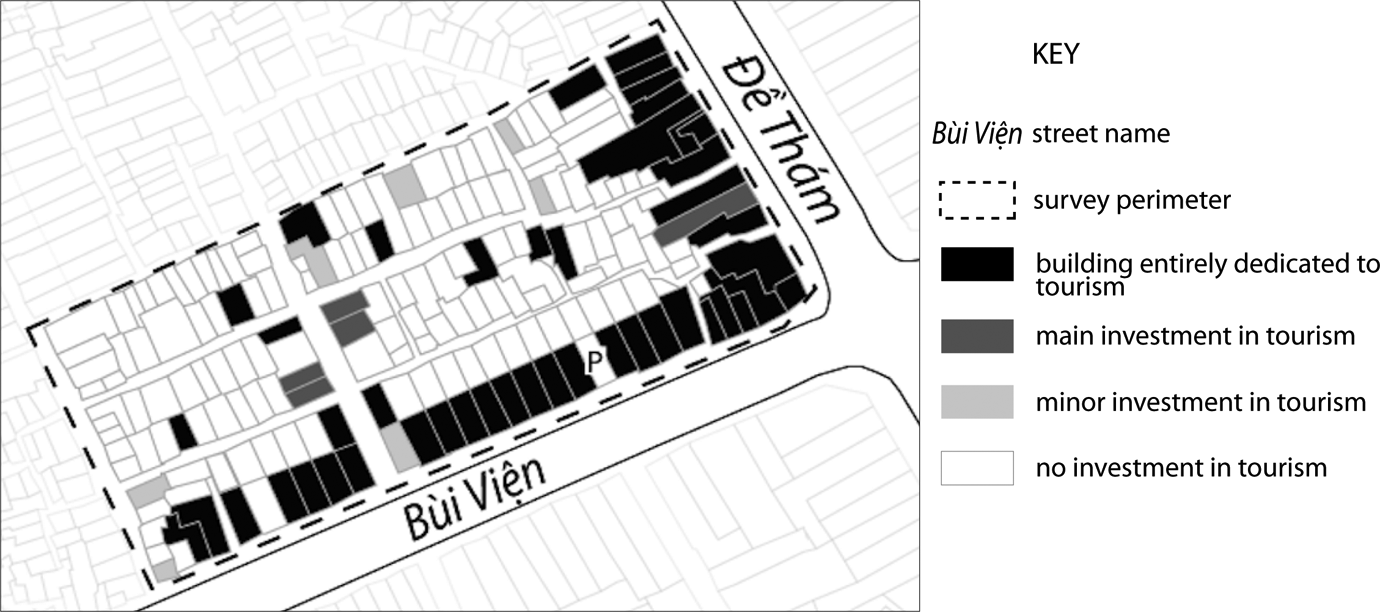
Highlighting the level of investment in tourism between the streets and alleyways of Phạm Ngũ Lão.
Figure 6 helps specify the internal/external level of investment in tourism. Inside the block, the larger the alleyway was, the more likely it was to welcome tourist services. In Vietnamese cities, the value of the land is directly connected to the commercial potential of the street that the house opens onto. The Vietnamese expression ‘nha mặt tiền’ designates a house localized on a frontage street. Interestingly, the word ‘tiền’ also means ‘money’ in Vietnamese.
At the building scale itself, a gradient of investment can also be observed. Tourist activities are more likely to occupy the front room on the ground floor, while rooms situated at the back and upstairs often remain dedicated to private and ‘back office’ activities. In Vietnamese spatial practices, buildings are structured according to the street: the distance to the street commands the layout and the functions associated with each room in the house, through a succession of thresholds. The entrance room constitutes the pivot of this spatial apparatus: it creates an interface between the public and the private, commercial and domestic activities. It is also considered as the showcase of the residents’ offerings. Many residents involved in the tourist economy only invest in the front room, while the back and upstairs rooms remain unmodified. Generally, only main hotels, shops and restaurants located on main streets are entirely dedicated to the tourist economy: the landlords sometimes live in more suburban areas to maximize profit from their valuable land.
This contrast between front/behind, as well as in/out is even more visible at night: while touristic buildings are very well lit, private houses remain in the dark. Even on a Saturday night, when Đề Thám and Bùi Viện are very colourful and noisy, the inner alleyways of the block remain very quiet.
From transnational investors to hawkers: Unpacking the hierarchy of the backpacking economy
Spatial inequalities are inherently social inequalities. This can be observed at three levels. Firstly, at the neighbourhood level, there is an opposition between front office stakeholders in main streets and back office stakeholders in alleyways. While shops situated on the busiest streets act as showrooms, back-office activities remain in alleyways. The latter includes cooking and washing-up activities for bars and restaurants, but also laundry and tailoring. In that sense, large streets and adjacent small alleyways are complementary, but also unequal: money, owners and orders come from large streets, while subalterns are relegated. It is also revealing that Allez Boo, Crazy Buffalo and Go2, the biggest bars and most famous landmarks of the neighbourhood, all belong to the same Vietnamese owner. 4
Furthermore, since the property is cheaper on alleyways, it is used for cheaper services: freak hotels, small restaurants and popular entertainments, all of which are less clearly signposted. In contrast, large street services are consistently more internationalized and expensive. This mechanism explains why subaltern services are sent further back. This is particularly true for women, who occupy most subaltern positions, as exemplified by a 34-year-old tailor who opened a shop in an alleyway next to Bùi Viện. On the wall was a simple sheet of paper on which was written ‘laundry, repair, clothes’. She informed us that: I have been renting here for three months, I live above the workshop. I worked 10 years in a better situated shop, directly on Đề Thám, but my business partner went to Australia and it became too expensive for me to pay the rent.
5
Secondly, at the international level, social inequalities have been linked to the globalization of the actors of tourism since Đổi Mới, particularly connections with Vietnamese Overseas. Surveys revealed a strong link between the success of a business and its personal ties with foreigners. Some foreigners invest directly in the neighbourhoods to create a brand. In 2007, Gingko, an ethical clothing brand managed by a French-Vietnamese couple, opened its first shop in Phạm Ngũ Lão. There are now nine shops across the country.
Beyond the most famous success stories, some family-run micro-businesses based on mixed marriages have also turned their experiences of diaspora into a resource for tourism. The case of Miss T, whom we met in her alleyway, is instructive. Miss T overheard our foreign language and came to offer us a room. We took the opportunity to discuss her activities and learned that she had been living in the neighbourhood for over 28 years and owns three houses in alleyways, in which she rents 15-dollar rooms. She grew up in Vientiane in Laos, where she studied at a French high school. She lived in Paris for a year, and still has a nephew there. She is also married to a Canadian and has family in the United States. This explains her fluent French and English and also her better understanding of backpackers’ needs, lifestyles and expectations of Việt Nam. The trajectories of other respondents confirm the ability to make profitable use of international ties. These testimonies show how cosmopolitan family businesses have an edge in the tourist economy.
Some stakeholders of the backpacking economy remain subalterns. Hawkers, for instance, are condemned to roam the streets because their activities are informal, and possibly illegal. Street vendors walk the neighbourhood to sell cigarettes, paper tissues, souvenirs and newspapers, biscuits and candies. Their work is tedious and they carry heavy loads all day under the scorching sun. The right to settle in front of a house or on the sidewalk has to be negotiated with owners and the police, and only a few are granted access, such as a candy vendor we met, who was authorized to stay only two days per week. The rest of the time, she worked in districts 1 and 3 and lived in the Gò Vấp District. 6 Gender and age are relevant to understanding the subaltern position of stakeholders: most of them are women, sometimes very young with little formal education; others are older women desperately searching for a salary. A 60-year-old vendor – selling cigarettes and tissues – that we met at the entrance of an alleyway on Bùi Viện Street explained that she had been working there for four years, since she retired and lost her husband. 7
The poorest are beggars. They often include young girls, sometimes carrying babies and asking tourists for money in the evening. This risky business exposes them to violence. Besides this, they are subject to police harassment, since begging is prohibited. It is therefore extremely difficult to interact with them, but a study carried out in 2005 showed that they often come not only from broken families, but also from the floating population of migrants, who are not officially registered and who are marginalized from the urban economy (Duong and Kenichi, 2005). In the backpacking economy of Phạm Ngũ Lão, subalternity and spatial marginalization go hand in hand.
Shadow workers in the light of Phạm Ngũ Lão: Revealing the informal production of the metropolis
Phạm Ngũ Lão is representative of the production of the city in the global South (Parnell and Oldfield, 2014). Local stakeholders, whatever their administrative statuses and official recognition, participate actively in the metropolization of the city through their connections to transnational networks, even though these connections can be informal, and sometimes illegal.
The spatial inequalities between Phạm Ngũ Lão’s stakeholders reveal complex spatial contrasts, from formal to informal, legal to illegal, visible to invisible. Even legal activities are sometimes processed informally: laundry, for instance, can be an undeclared backyard trade or a well-recognized agency service providing multiple machines. The same goes for souvenirs, sold by both shopkeepers and hawkers alike. The legal dimensions of these activities are complex. Most activities are perfectly legal (catering, accommodation, souvenir trade, etc.) while others mix the legal with the illegal (a souvenir boutique providing pirate DVD copies), and others are totally illegal, such as those engaging in the trade of sex or drugs. The result is a complex play to gain visibility for tourists and to generate income, while at the same time remaining invisible to police surveillance.
Prostitution is not advertised explicitly, as is the case for instance in the Patpong neighbourhood in Bangkok, but solicitations from touts and sex workers signal this activity in places such as bars, massage parlours, karaoke bars and hairdressers. Some landmarks help to identify the red light district: shaded storefronts with dubious names such as Me and You, red lanterns, slogans like ‘no money no honey’ or ‘ugly but good’, etc.
This ambivalence also sheds light on the construction of the city and the way in which tourist activities are presented, selected and regulated according to a notion of invisibility. Illegal activities are made invisible by avoidances and camouflage tactics. Semi-structured interviews with tourists demonstrate that drugs are sold during faux motorcycle taxi rides: A guy comes to you when you’re on the sidewalk, he offers marijuana mostly, but it can also be opium or cocaine. If you’re willing to, he shows you the xe ôm working with him, if it’s not directly him. Once you’re at the rear of the motorbike, he fakes a taxi ride, often just going around the park, and then he gives you a sample, so you can try it. When he drops you, instead of paying the ride, you pay for the drugs. Or else, the xe ôm goes a bit further, calls one of his friends who handles the merchandise at a crossroad. (S, 35 years old)
Prostitution and drugs are considered as ‘social evils’ (tệ nạn xã hội) and are officially prohibited by the socialist regime. This explains why Phạm Ngũ Lão is regularly in the headlines of local newspapers, accusing the neighbourhood of being a den of violence. Fights are relatively frequent, particularly between tourists and professionals working in tourism, and between tourism stakeholders. This violence is proof of power relations according to race, gender and social position. The regulation of drugs and prostitution activities is closely linked with organized crime. For example, henchmen ensure prompt payment of services and intervene when tourists do not want to pay Vietnamese sex workers. Those violent interventions are not free: girls pay both to gain access to tourists and also to be protected (Kay Hoang, 2015). Struggles for the control of territories also place city authorities at odds with those engaged in illegal activities, but in a very ambivalent way: this economy is a key development factor of tourism, and a source of personal enrichment through corruption (Kay Hoang, 2015; Koh, 2001). This difficult balance between regulation and a hands-off approach has to be settled to maintain the security and reputation of the neighbourhoods, which is vital for any tourist activity, whether it be legal or illegal.
‘Same same, but different’: Towards a mainstream backpacking neighbourhood
Today, Phạm Ngũ Lão is becoming less and less a neighbourhood for drifters, and more and more a mainstream cosmopolitan area of Hồ Chí Minh City. This situation results from the convergence of three urban dynamics: an increased competition between tourism operators leading to a quality upgrade; the increasing mutation of the backpacking neighbourhood into a cosmopolitan leisure area; and the recent reinvestment of the municipal authorities.
The formalization of backpacking by local stakeholders: Unequal skills in the upgrading
Phạm Ngũ Lão is currently upgrading its overall quality: the number of freak hotels is diminishing in favour of modest but well maintained hotels and guesthouses. The same goes for all tourist services.
There are many reasons to explain this quality upgrade. Firstly, competition in a restricted area between many actors tends to favour the highest quality. A growing preoccupation among shopkeepers is to reassure customers about the quality and authenticity of their products. Some of them display billboards on their storefronts, stating ‘nhắp khảu an toân, chắt lượng cao’ (secured importations, high quality). Secondly, backpackers are skilled travellers who share their opinions on websites, such as TripAdvisor. This forces local stakeholders to offer competitive deals, because their reputation can be easily broken. Finally, the neighbourhood is now relatively well established. The euphoric period that followed the opening up of the country in 1986, and after the end of the American embargo in 1994, has ended. The overall standards of living are now higher and the same is true for the prices of tourist services. Therefore, tourists have grown more demanding and tolerate less improvisation.
This increased quality is also a testimony to the skills of the local actors and their flexibility in meeting the changing market of backpacking. The challenge is to communicate with backpackers in order to better understand their mindset and requirements in terms of comfort and services, which involves linguistic, digital and marketing skills. Those skills and know-how are acquired not only at school, but also empirically, in the field.
This quality upgrade reveals and deepens the inequalities between the actors in the backpacking economy, making it always more discriminating. The influx of foreign investors, in particular globalized food franchise operators, such as Burger King or Starbucks, have introduced delivery services and products that are increasingly difficult to compete with, especially for micro-entrepreneurs and family businesses. The employees of these new establishments receive training in foreign languages, allowing them to adopt appropriate welcoming behaviour, following international standards. This dynamic is not specific to Phạm Ngũ Lão. From the case study of the Town 1770 in Australia, Peter Welk established a link between the normalization of a backpacking neighbourhood and the normalization of the backpacking activity itself, which is increasingly managed with norms coming from the corporate world. This phenomenon blurs the line between conventional and backpacking tourism, which becomes simply a distinctive brand in the tourism market (Welk, 2010).
The semi-directive interviews we conducted show the growing difficulties met by the smallest and least experienced entrepreneurs such as Phú, aged 23. Phú lives alone with his mother who owns a house that has been transformed into a modest guesthouse at the back of an alleyway: - My mother worked as teacher in a primary school. In order to supplement her pension, she wanted to get into the tourism business because of the neighbourhood, but it doesn’t work so well. She rents a few motorbikes and a friend helped us improved the house to open some rooms for guests, but it is not really working. - Would you have done things differently? - My mother has her own project, but I wouldn’t have done it like that. She doesn’t speak English, me a little bit. I learnt at school, I don’t speak very well, but I try to speak with tourists, they explain things to me. The furniture is too basic, there’s just a bed. I saw websites of the others, I know how it is. We don’t have a website. And she’s not very friendly. I would like to offer rides with my motorbike and maybe include the price of breakfast in the price of the room, but she doesn’t agree with all that.
8
- What did you know about tourism when you began? How did you start? - I studied at the Saì Gòn Economic Business School, where I quickly chose hotel management as a speciality. My father worked for a Japanese tourism company. During my first year at the university, we demolished our house and built our first hotel, in 2009. Today, I am the owner. Business has been good, we identify customer’s expectations and we are well referenced, especially on TripAdvisor. Today, we have 14 employees in four hotels [built in 2011, 2013 and 2014]. - Did your personal savings pay for those new constructions? - For the first one, yes, but today, we have a bank loan. The previous hotel pays for the next one. - And now, where do you live? - We don’t live on site anymore. We are in district 4. But I work here every day, it is what makes the quality of the service: follow-up. I speak with tourists, I oversee the work. - Do you often travel? - I have already travelled in Việt Nam, Thailand, Singapore, Korea and Malaysia. It gave me some ideas for my own business.
9
From a backpacking neighbourhood to an entertainment district: Towards a cosmopolitan urban area
Observations show that in the evenings, especially during weekends, a fringe group of young and affluent Vietnamese people, male and female, enjoy the neighbourhood. They socialize with Western people, try to speak English or simply have a drink in a place they consider to be fashionable. The mix between foreign tourist practices and local leisure practices shows that the figure of the backpacker itself is normalized as positive (O’Reilly, 2006): backpackers are less considered as drifters, and more seen as trendy travellers. Our interviewees did not consider the sulphurous reputation of Phạm Ngũ Lão as repellent: it is either minimized (‘You just have to pay attention to your belongings or to certain persons, ‘specially when they are drunk’ says Thuy, aged 24) or seen positively, the neighbourhood becoming a good place for amusement – alcohol, sex, drugs and a more lenient attitude towards the body make the otherness of the neighbourhood pleasant for a night out. The existence of these local practices of leisure also demonstrates that backpacking is not only an economic resource, it also defines its social character and its reputation as a festive, tolerant and cosmopolitan city.
However, if the growing quality of Phạm Ngũ Lão allows distinct social and urban practices, it is not specific to this neighbourhood only. For example, globalized food franchises, such as Burger King, Starbucks or McDonald’s, are still quite unusual in Saì Gòn, but they are present in high-income neighbourhoods like Phú Mỹ Hưng, where they contribute to a distinctive urban way of life (Drummond and Thomas, 2003; Nguyen-Marshall et al., 2012). Festivities and decorations for Christmas and New Year are representative of this phenomenon. During those special days, Phạm Ngũ Lão is closed to traffic and Christmas decorations and songs fill the space, while local stakeholders launch special offers and convene parties. These temporary festivities are not only appreciated by Western backpackers missing home, but also by young urban and educated Vietnamese people. To a lesser extent, Halloween and Valentine’s Day can also be an occasion to go out in Phạm Ngũ Lão. While these Western festivities were confined to specific places only 20 years ago, growing consumerism and globalization in Hồ Chí Minh City has meant that they are now more widely celebrated by urban Vietnamese in entertainment places such as malls, cafés or karaoke bars (Peyvel and Gibert, 2012).
The normalization of Phạm Ngũ Lão can also be explained by growing security concerns, both from the top and the bottom. Residents and shopkeepers display posters on walls inviting tourists not to urinate or to leave rubbish. At the same time, authorities put up billboards with official socialist slogans such as ‘Let’s build a civilized urban lifestyle’, prohibiting certain practices such as smoking, and encouraging the use of zebra crossings or taking care of one’s belongings. The convergence of views between urban authorities and owners can be explained both by the will of the authorities to control recent urban development more strictly, after decades of laissez-faire, and by the growing concern of middle class people to protect and mark out the boundaries of their newly-acquired properties (Harms, 2009).
From social control to a progressive institutionalized and planned urban fabric in Phạm Ngũ Lão
Current mutations of the area are also linked with its privileged location in the metropolis. The very first metro line of Hồ Chí Minh City, currently under construction, will have a station a stone’s throw from Phạm Ngũ Lão. As a result, the price of land in the area has increased tremendously over the last decade. This uncontrolled increase has been acknowledged by the municipal urban authorities themselves, who classified strategic plots of land under the name of ‘golden land plots’ (đất vàng). These plots are first and foremost dedicated to the implementation of mega-projects – such as high-rise buildings, welcoming offices or international luxury hotels.
In this competitive context, even the biggest actors of the backpacking economy of Phạm Ngũ Lão are seen as minor investors and cannot compete. This shift in the city production at a time of metropolization is to affect greatly the local game in Phạm Ngũ Lão. Even though the neighbourhood has been fostering a vivid tourist economy for decades, this specialization is about to be overtaken by new international and upscale urban projects, at least as far as the main intersections and arteries of the area are concerned.
Furthermore, Phạm Ngũ Lão has also been integrated into the Hồ Chí Minh City historical centre renewal project, won by the Japanese consultant Nikken Seikkei in 2007. The area has further been included in different urban upgrading projects, such as the ‘Landscaping and Aerial Arrangement of the Walking Area within the City Centre of Hồ Chí Minh City’, conducted under the supervision of the department of planning and architecture, the Spanish ministry of tourism and trade and the Idom consulting group, since 2011. Even though all these projects tend to be kept as such for now, they provide an enlightening vision of what Phạm Ngũ Lão is supposed to look like in the near future. Such projects question the current functioning of the backpackers’ neighbourhood in many ways. Not surprisingly, the informal use of sidewalks by hawkers is the first element to be challenged: this has been part of the wishes of the metropolitan authorities for many years now, even though it is still a failure (Harms, 2009). These projects also call for the normalization and a move upmarket of every commercial activity.
Sketches of this project provide an idea of what Phạm Ngũ Lão might look like in the near future (Figure 7). They show the use of standardized urban design elements, such as pedestrian walkways, green space and wooden benches. We can also see the call for organic shops, with English language signs. The materials too are very representative of a globalized image of a central metropolitan public space. With these standardized projects, mainly coming from foreign consulting companies, Hồ Chí Minh City is voluntarily building the image of a globalized metropolis, aligned with international standards.
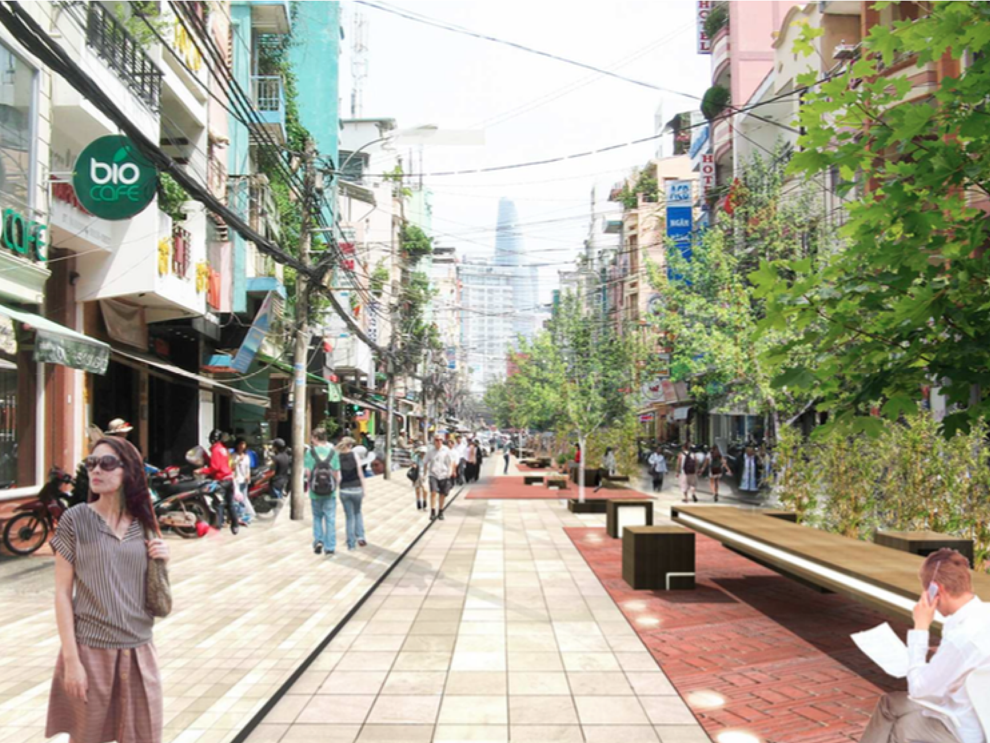
Conceptual design for a more standardized Bùi Viện Street.
Due to its strategic location, Phạm Ngũ Lão neighbourhood might embody the classical trajectory of a central location within the metropolization process in the near future. This last point might also constitute a good reason to continue to pay attention to this ‘urban laboratory’ neighbourhood, in order to assess the capacity of its local actors to adapt – and even to take advantage – or not, to this coming new deal in an expanding metropolis.
Conclusion
Moving beyond the classical picture of the enclave, our article sheds new light on the understanding of backpacking neighbourhoods in the context of metropolization in South East Asia. By linking together tourism and urban studies – through the production of original typo-morphological mapping surveys and comprehensive interviews – our essay engages with morphological, architectural and landscape analyses and probes the local spatial apparatus of the Phạm Ngũ Lão neighbourhood in Hồ Chí Minh City.
It shows that Phạm Ngũ Lão is an ‘ordinary’ neighbourhood. Its economic specialization, typical of a Vietnamese city structure, has become the theatre for a competitive and responsive productive system. The focus we proposed on local stakeholders’ negotiations to benefit from this backpacking economy reveals the strong ‘glocalization’ of the neighbourhood, with both urban innovations and the reactivation of previous urban forms and economic practices. Hybridizations are then one of the things that fuel Phạm Ngũ Lão’s daily production. The wealth accumulated through the development of the backpacking economy contributes directly to the metropolization process of Hồ Chí Minh City: Phạm Ngũ Lão benefits from profits from a globalized service activity.
Nevertheless, this activity remains highly unequal and discriminatory among the local stakeholders, in accordance with spatial, social, gender, racial and age criteria. Our essay shows the current diversification of strategies among local stakeholders and entrepreneurs. This flourishing economy is regulated by complex power relations that polarize rivalry, between private entrepreneurs – both legal and illegal – and with the people’s committee of the city. This wealth and the strategic location of the area are sharpening the appetites of urban authorities, leading to the institutionalization of the neighbourhood. Thus, new urban dynamics tend to lead to the integration of this historically backpacking neighbourhood to a broader cosmopolitan leisure area.
Footnotes
Declaration of Conflicting Interests
The author(s) declared no potential conflicts of interest with respect to the research, authorship, and/or publication of this article.
Funding
The author(s) received no financial support for the research, authorship, and/or publication of this article.