



Abstract
This article discusses the nature of Islamic philanthropy and social services in the context of the plurality of Indonesian society by looking at the early development of Muhammadiyah’s charitable activities, known as Penolong Kesengsaraan Umum or by the acronym PKU (Assistance for the Relief of Public Suffering). This article asserts that PKU took an inclusive approach to humanitarian issues in providing social services to underprivileged groups and that this was claimed as being ‘without discrimination of religion and race or group.’ It analyses the ‘bridging’ and ‘bonding’ aspects of faith-based philanthropy as social capital and questions how it was that PKU could formulate inclusive ideas that underpin its vision and activities and that bolster Muhammadiyah’s label as a civil society organisation. Even though the ideas were overtaken at the end of the Dutch colonial period, the potential for an inclusive principle remained in place.
Introduction
Muhammadiyah’s charitable and humanitarian services are known as Penolong Kesengsaraan Umum (Assistance for the Relief of Public Suffering) and by the acronym PKU. In its early days and during the Dutch Colonial period, PKU had formulated inclusive ideas with the intention that its assistance be ‘without discrimination as to race/group and religion’ (tidak dengan memandang bangsa dan agama) (Fauzia, 2013: 152–153). This principle is found in various documents of PKU (or PKO as it was known with the old spelling Penoeloeng Kesangsaraan Oemoem). These underline the claim that PKU provided its assistance ‘to everybody without considering race/group or religion,’ and that ‘anyone could be its donor irrespective of religion and race/group.’ For most international (secular) humanitarian and charitable organisations, this phrase is not unique but is part of their principal stance in providing assistance. 1 However, in the context of religious charities, which in some instances have been more focused on promoting confessional interests (Benthall and Bellion-Jourdan, 2003), this inclusive principle is exceptional and forces us to re-evaluate Muhammadiyah which, as an organisation, has been labelled both puritan, Wahhabi and anti-Christian as well as pluralist, moderate and tolerant. The birth of the Muhammadiyah organisation was somehow a response against traditionalist Muslim attitudes as well as against the process of Christianisation that Muslims felt and feared was taking place in Indonesia (Jainuri, 1992; Nakamura, 2012; Shihab, 1995). The question that then arises is how did it come to take an inclusive approach to social services, giving its assistance without discrimination with regard to religion?
While there are abundant studies on Muhammadiyah as an organisation, including studies on its charitable activities (Barton, 2014; Latief, 2010a, 2010b, 2016; Njoto-Feillard, 2014), specific studies on the PKU, especially during the Dutch colonial period, remain limited in number. Scholars have studied some of the charitable enterprises managed by PKU, such as hospitals (Latief, 2010b; Sciortino et al., 2010) and orphanages (Sudarman, 2003), but its philosophical vision has not become a focus of discussion. Somehow the works and also studies of PKU have become amalgamated with those of Muhammadiyah. In many cases the projects of PKU itself, such as on charity stamps which is a subject of discussion in this article, have been run by its central board and the whole of the Muhammadiyah organisation.
This article is a continuation of a brief discussion about PKU (Fauzia, 2013: 151–153) but with a different analysis and additional data. It focuses on PKU during the colonial period in an attempt to answer the above questions on the formation of a programme of inclusive activism, and in a few instances it goes beyond the colonial period and explains PKU’s mother organisation.
The article opens with an overview of humanitarian activism in the Dutch colonial context and a discussion on the formation of PKU, its figures and its regulations, and goes over two cases of PKU’s charitable projects by using Robert Putnam’s concept of the ‘bonding’ (inward looking) and ‘bridging’ (inclusive) aspects of social capital (Putnam, 2000: 22). Later it discusses what made inclusivity prevail and what made PKU shift into a more exclusive tendency. Three factors that have contributed to the inclusivity principle of PKU are the influence of Western secular values supporting religious pluralism, the modernist as well as pragmatic socio-political stance of Muhammadiyah and a progressive theological interpretation of Islamic teachings. The article concludes with a discussion on humanitarian activism and the idea and reality of an inclusive Muslim civil society.
Faith-based charitable activism in the colonial context
Before the birth of Muslim modernist organisations in the 20th century, charitable activism had played a role in the provision of social welfare in the Dutch East Indies (present-day Indonesia). The major role was played by faith-based organisations, specifically Protestant and Catholic missions, with their schools, orphanages, poorhouses and hospitals either directly under the churches or under separate orders or organisations. The activities of church social services have been recorded since the 17th century and have been prevalent in the wake of poverty and many social problems such as in Batavia (Heuken, 2003: 84–90). Indigenous Muslim social services were there but were traditional in nature and included endowments (waqf) and almsgiving (zakat) but these were not well established in a modern sense. Beginning in the 19th century, mosque funds were relatively well organised and this indirectly endorsed the creation of Islamic charitable committees (Fauzia, 2013). Examples of non-faith-based activism were scattered in the early half of the 20th century, such as for famine relief in 1901–1904 (Tetteroo, 2014) and during the economic crisis in the 1930s (Ingleson, 2015).
Modernisation and the later Ethical Policy of the 20th century gave more space for Muslim communities to obtain an education and be involved in associational life, including the work of charitable and humanitarian committees. Famines, disasters and social problems may boost the growth of social services, humanitarian committees and organisations that are somehow inclusive in providing their assistance with no concern as to the religious and racial background of the beneficiaries. This inclusive culture also became embedded in the work of faith-based organisations and became a universally accepted value among the elites and educated classes in the colony. The value may have been supported by the religious pluralism of the Dutch government and by Dutch missionary efforts, whether part of evangelisation or not, to provide assistance to the indigenous population. Even the mosque funds donated by Muslims were distributed to various ‘public’ needs and to the poor, irrespective of their religious background, and this included poor Europeans (Fauzia, 2013: 127–137). Mojowarno missionary hospital received regular donations from the mosque funds of Rembang, Surabaya and Kediri, something that Snouck Hurgronje was against (Snouck Hurgronje, 1991: 862).
In Yogyakarta, the city where Muhammadiyah was born, faith-based charitable organisations proliferated, supporting schools, orphanages, poorhouses and hospitals. For example, a Protestant hospital, Petronella (later renamed Bethesda), was established in 1896 (Aritonang and Steenbrink, 2008: 679; de Jong, 1997). Five sisters of Carolus Barromeus also established Onder de Bogen hospital (later renamed Panti Rapih) in Yogyakarta in 1929, in addition to its hospital projects in a number of cities (Steenbrink, 2007: 583), and the two hospitals also provided free medical services for the poor. 2 The growth of faith-based charitable organisations was viable due to the government subsidies they enjoyed for health, education and social welfare services but, with the conferment of subsidies and the extensive services that resulted, the government was criticised for ‘commissioning’ faith-based organisations to do its duties.
Penolong Kesengsaraan Umum Muhammadiyah
The Muhammadiyah organisation was created in 1912 in Yogyakarta, mainly by Muslim aristocrats and bureaucrats. Kyai Ahmad Dahlan (1868–1923), an educated and pious (santri) Muslim who was also an aristocrat from the Yogyakarta kingdom, is the principal figure in the creation, shaping and development of the organisation. With his broad knowledge, extensive experience of social organisations, administrative talent and zealous spirit, Muhammadiyah quickly grew beyond many other Islamic organisations in terms of members as well as in its social and educational activities, and Dahlan directed Muhammadiyah to have strong social services in helping the needy based on his understanding of the chapter Al-Maun of the Qur’an (QS 107). Muhammadiyah’s puritan spirit gives it a militant and action-orientated attitude towards the implementation of Islamic teachings, whilst its modernist-reformist character has allowed it to manage philanthropic activities in a relatively modern, organised manner (Fauzia, 2013: 149).
PKU formally became part of Muhammadiyah on 17 June 1920, together with three other divisions, namely education, religious dissemination (tabligh) and publication (Syuja’, 2009: 102–104). Previously, these three were smaller, semi-independent organisations created by students of Ahmad Dahlan, that arose from the activities of religious gatherings (pengajian) held every Thursday night from the middle of 1917 onwards (Darban, 2000; Sudarman, 2003, 71–77; Syuja’, 2009: 89–101). As the pengajian grew and the organisations developed, the students running them proposed incorporating their activities under the Muhammadiyah banner, a proposal supported by Dahlan.
H Syuja’ (1882–1962), one of Dahlan’s very close students, was strongly inclined in favour of charitable activities and was the person behind PKU’s initial foundation. Once, when the night’s pengajian was short of chairs, the idea of fundraising arose and Syuja’ was the person who collected the money, and that night Syuja’ managed to collect f. 39 for 12 chairs (one chair cost f. 3.25) (Syuja’, 2009: 89–101). He also initiated a relief committee for the victims of the Mount Kelud eruption in 1918, an occasion which led to the creation of PKU (Noer, 1973: 78). This committee attracted public attention when it collected f. 5067.13 (Oetoesan Hindia, 1919), a large amount at the time, which indicates that from the beginning PKU was very concerned about, and worked for, the relief of public suffering on an inclusive basis.
Syuja’, who came from a pious family, 3 had knowledge of and an inclusive vision for, the charitable activities of the time and Dahlan introduced him and his friends to Budi Utomo meetings to learn about organisations (Syuja’, 2009). 4 It may be that his knowledge of western charities came from his interaction with various organisations at that time, although he was less likely to have attended western education. His philosophical outlook embraced humanitarian values in addition to the implementation of religious duties and in large part was based on the verses of Surah Al-Maun.
When Dahlan asked Syuja’ on the night of PKU’s inauguration about the programmes of the organisation, he stated that he wanted to build hospitals, armenhuis (poorhouses) and weeshuis (orphanages). Most members of the audience were reported to have burst out laughing (even louder when they were told the meaning of the Dutch words armenhuis and weeshuis), for it seems that they thought his programmes were impossible to deliver. Before the meeting ended he tried once again to explain what his programmes were about and why they could be implemented by explaining that Muslims had read verses Al-Ma’un for centuries yet despite that there had been little or no implementation of these Qur’anic verses in society: Meanwhile, many non-Muslims had operated poorhouses, orphanages to take care of the poor and orphans in the best possible way, driven by the value of humanity only, not because of responsibility to society and to God in the hereafter. If non-Muslims could do all this for the sake of humanity, I wonder why could Muslims not do it? In fact, Islam is a religion for human beings, not for something else. Aren’t we humans? If they can do it, why can’t we? Hum rijalun wa nahnu rijalun (they are human so are we). (Syuja’, 2009: 108)
The ideas and principles introduced by Syuja’ succeeded in leading to the creation of PKU, whose activities were similar to those practiced by Christian and other non-faith-based charities during the colonial period, thereby managing to prove his words. Starting from 1923, PKU established houses for the poor, orphanages, medical clinics and other services (Abdoellah, 1929: 120; Reglement Moehammadijah, n.d.). In 1926 PKU also established clinics in Surabaya, Malang and Surakarta (Yusuf, 2005: 102) and the organisation has survived to the present time as part of the story of Muhammadiyah. It is only its name and functions that have changed many times as a result of the internal dynamics of Muhammadiyah and as a consequence of wider socio-political changes.
PKU’s regulations: Religious but inclusive
In 1929, PKU released its guidelines as to the establishment of its branches. Along with technicalities, it set out the core principles of what PKU was and what its works were meant to be. Some of the excerpts include the following: Muhammadiyah’s PKU works for and assists the alleviation of public suffering without looking at the work of other parties and without serving other people who want to obtain public influence. It works solely because of the instruction of Islamic teachings brought by our Prophet Muhammad, peace be upon him, and following his tradition. So, the basis for assistance of Muhammadiyah’s PKU is like an oasis that is pure (jernih) and clean, located in a place accessible to everyone no matter what race/group and religion they have [oleh segala orang tidak dengan memandang bangsa dan agama].
5
It is for whoever can get the water as long as they do not deliberately destroy the stream and close the oasis. Assistance for Muhammadiyah’s PKU is not a dragnet to attract people to become Muslim or to join Muhammadiyah, but it solely fulfills the Islamic obligations for all races, irrespective of religion [terhadap segala bangsa, tidak memandang Agama]. It does not intend to defend any self-interest or group, so as to remain superior to those who are assisted. Its aim is not to keep the poor under constant assistance, but to keep all danger of suffering and baseness away from each individual as well as from their respective communities. (Abdoellah, 1929: 120–121; cf. Fauzia, 2013: 152)
PKU’s benevolence in providing assistance saw all beneficiaries as human beings and this understanding was not limited to beneficiaries but was also extended donors and could ease the work of PKU in the context of multi-ethnicity, perhaps nationality and even religion. It is possible that in the first half of the 20th-century colonial period in Indonesia, no Islamic organisation except PKU (and also Muhammadiyah) explicitly maintained such a non-discriminatory principle. In this respect, PKU put in place the same charitable and humanitarian culture as other organisations, especially those that are faith-based, stressing a thought that religion and race or group were not categories to be strictly applied in providing assistance to beneficiaries. PKU’s guidelines and regulations show an attitude of toleration and pluralism and a consciousness of the need to promote a sense of humanity beyond various social and political differences. However, the principles were contested, especially after the end of the 1930s when social and political divisions increased.
Inclusiveness: Supported and contested
The inclusive vision of PKU was not just ‘internal’ – i.e. within the unit itself – but had been supported by the central board of Muhammadiyah, and we may presume that it was sustained from about 1917 to 1939. From then onwards, the principle started to decline in importance until it finally disappeared, although that does not mean that the very considerable work of Muhammadiyah did not have inclusivity at all. The decline is seen in the use of the PKU name and in the texts of Muhammadiyah’s Statutes.
The name ‘Penolong Kesengsaraan Umum’ (assistance for the relief of public suffering) implies that Muhammadiyah provided help to anyone who suffered, regardless of religion, race or group. The name was apparently proposed by Syuja’, the individual in Muhammadiyah with the best knowledge of charitable activities at that time (Syuja’, 2009: 102–110), and it reflected the secular and modern intellectual currents at the time that stressed a universal concern with humanity as espoused by an Islamic organisation like Muhammadiyah.
At the 1933 Congress of Muhammadiyah in Semarang, there was an effort to prioritise using Indonesian and Islamic terms rather than Dutch ones. As a result, several Dutch names were replaced with new ones such as ‘Dienst Kliniek dan Polikliniek’ which became ‘Urusan Balai Kesehatan Muhammadiyah,’ and ‘Kweek schools Putri’ (Girls’ training college) which became ‘Madrasah Mu’allimat Muhammadiyah.’ Then, at the 1936 congress in Batavia, Muhammadiyah created a new council for Relief and Health (Majlis Pertolongan dan Kesehatan Muhammadiyah – MPKM). This change of name was more clearly seen later on, especially after the independence of Indonesia, with the abbreviation PKU changed into Carer for the Welfare of Ummat (Pembina Kesejahteraan Ummat). Although this change might not have influenced the function of Muhammadiyah’s clinics and hospitals, which remained open to the general public, it nevertheless foregrounded another set of concerns, namely those centring on the umma (Muslim community) as being paramount. As a consequence, when considering its beneficiaries, Muslims might be prioritised.
The trend towards exclusivity is also attested in the Statutes of Muhammadiyah and its by-laws. In the 1933 congress, the organisation’s Statutes and by-laws were slightly revised, though the principles of neutrality and inclusivity remained present. Muhammadiyah’s statute of 1933 (Article 4) explicitly states that besides regular members who are Muslims residing in the Netherlands Indies, ‘anyone could be a donor regardless of their religion or race/group; including associations and corporations who may also become donors.’ Similarly, Muhammadiyah’s by-law (Article 1) stated that: ‘those who can be regular members are Muslims from any race/group, mature men and women, living in the Netherlands Indies.’ Article 2 (1) stated that ‘the so-called donors are people, regardless of race/group and religion, who donated at least f. 0.50 per month. (2) Associations may also become donors’ (Setiawan and Budiman, 2007, 45-48).
This 1933 statute was revised in 1939, at which point the explicit elements relating to different religions, races or nationalities disappeared (Setiawan and Budiman, 2007: 105), and from then until the end of the Dutch era in 1942 no further changes were recorded. Later, after Indonesian independence, none of the values relating to non-discrimination were explicitly mentioned in the Statutes and by-laws of Muhammadiyah. The Muhammadiyah statute versions of 1952 and 1969 and their associated by-laws (PB Muhammadiyah Jogyakarta 1952, 1977) did not reinstate or make reference to the principle of inclusivity and neither did such values appear in the PKU regulations and documents (such as in Pimpinan Pusat Muhammadiyah Majlis PKU, 1981, 1990a, 1990b), including in the two extended councils related to PKU, namely the Council for Public Health (MPKU) and the Council for Social Service (MPS). 6
The recent Muhammadiyah Statute and By-law (2005) and the above two Councils show no reference to the old inclusive vision. However, the small consideration of giving beyond groups and beyond the Muslim religious background started to be practiced from the time of the disaster relief after the 2004 tsunami. This was by the Muhammadiyah Zakat Collecting Body called LAZISMU and a newly-created Muhammadiyah Disaster Management Centre, referred to by the acronym MDMC (Bush, 2015; Husein, 2012; Latief, 2016).
Bonding and bridging dimensions of PKU charitable activities
Faith-based charitable activities (exercised by PKU) are directly related to two indicators of social capital and civic engagement (in analysing social life), namely religious participation and philanthropy (Putnam, 2000). While this article considers the more positive aspect of social capital, it does acknowledge the existence of its dark side in which social networks are being used in activities such as criminal acts. To understand how inclusivity works within PKU, we have used the concept of social capital, with its dimensions of ‘bonding’ (inward-looking) and ‘bridging’ (inclusivity). It should be stressed that ‘bonding’ and ‘bridging’ do not refer to ‘either-or’ characteristics, but underpin attitudes which can be ‘more or less’ prevalent. Despite the inclusive value which bridges social differences, faith-based charity also has an exclusive, inward-looking value that speaks to the bonds of loyalties of a certain group. Here I consider the establishment of a polyclinic at Surabaya (1924), and fundraising via charity stamps (1941).
Inclusive and ‘bridging’ values can be seen from the activities of the PKU clinic in Surabaya. This clinic was supported by both native and European medical doctors who worked there as volunteers. Amongst them was Dr R Soetomo, a teacher at the medical school in Surabaya, who had made a contribution in the building of the clinic. Soetomo was an important figure in shaping the Indonesian national movement, through his role in forming Budi Utomo, Perhimpunan Indonesia and Indonesian Study Clubs (van Niel, 1960: 58–59, 224–228) and was later honoured and appointed as Health Advisor for Muhammadiyah in the Congress of Muhammadiyah in Yogyakarta (Pemboekaan Polikliniek Moehammadijah, 1924: 168). At that time, the central figures in the leadership of Muhammadiyah were H Ibrahim and Anies. Another person who also contributed to the clinic was the young Mas Mansur, a leading member of Muhammadiyah’s Surabaya Branch, who was later regarded as bringing Muhammadiyah into the adoption of a more puritan direction. At the time of the launching of the clinic, Syuja’ and Hadikusumo, representing the central board, were very impressed with its facilities and the proficiency of Soetomo in eliciting many donations and enlisting large numbers of volunteers. This clinic was described as lavish and had been established with the help of doctors, both native and European, and with the support of the Dutch local government (Pemboekaan Polikliniek Moehammadijah, 1924: 168).
On the occasion of the opening of the clinic on 14 September 1924, Soetomo gave a speech in front of about 40 guests consisting of a large group of Europeans, some native Indonesians and others including of Chinese and Arab origin. He stated that although Muhammadiyah as an organisation is based on Islamic values, its aim is humanity: So does our organisation [Muhammadiyah]. Our most advanced thinking is LOVE and this is what we present the whole humanity with. By this LOVE and our sacrifices may we achieve a noble life…Tomorrow morning we will open this clinic. Anyone, whether European, Javanese (orang Boemi), Chinese or Arab, may come here and will get free [medical] assistance, as long as they are poor. (Pemboekaan Polikliniek Moehammadijah, 1924: 168, capitalisation in original)
The policies and activities of Muhammadiyah received strong criticism from traditionalist Muslim groups and the ‘ulama, due to its inclusive stance, including in its clinics (Alfian, 2010: 180). For their part, PKU and Muhammadiyah did not take notice of this criticism, and the use of Dutch doctors continued alongside native doctors. In 1928, four years after the opening of the clinic in Surabaya, in the overview speech of the opening of Muhammadiyah’s Congress in Solo, MJ Anies, secretary of the central board, explained the use of Dutch doctors. He said that, ‘it is true that Muhammadiyah is using some doctors of Dutch nationality, but this does not mean to humiliate our native people,’ and further explained his position by using a proverb which can be translated in the following way: ‘if there are no rattans available, roots can be used instead. There are some Dutch doctors who like to help, why should they be rejected?’ (Pengoeroes besar Moehammadijah bahagian Taman Poestaka Djokjakarta, 1928: 21–22).
Anies’ answer does not refer to any religious or theological reasoning and there is no clue as to whether he intentionally downplayed the issue of religion as a strategy in order to focus on the common humanitarian aspect. No matter the answer to this question, in fact PKU and Muhammadiyah persisted with its policy of inclusivity regardless of the criticism and controversy generated. The above sparse information on PKU shows that Muhammadiyah’s charitable activities had a ‘bridging’ character of a social network which became a significant tool for gaining and supporting inclusivity. This character differs from the second case (the charity stamp), where religion is used as a bonding aspect of social capital to support PKU’s charitable cause.
One of the fundraising efforts carried out by PKU and Muhammadiyah to support their hospitals, orphanages and poor houses was to create and sell charity stamps (perangko amal). These were special stamps that were printed by the government and were sold for 1–5 cents more than their regular price, with the extra money being donated to Muhammadiyah’s social and health infrastructure, in this respect under PKU (Soeara Moehammadijah, 1941; Soebagijo, 1972: 42–43). PKU was behind the idea of the charity stamps and was heavily involved in the work with regard to their issue and sale. The stamps were put on sale in September–October 1941 and were valid until July 1942.
This was the largest national fundraising event launched by Muhammadiyah in the colonial period, and as such it makes clear Muhammadiyah’s advanced fundraising methods as well as its openness to collaboration with third parties including the government. This fundraising was also supported by the rulers of Yogyakarta (Hamengkubowono IX) and Surakarta (Pakubowono XI), and both rulers, together with Husein Djayadiningrat (government advisor for native affairs and member of the Netherlands Indies Council), sat on the board overseeing and regulating the charity stamps (see Figure 1).
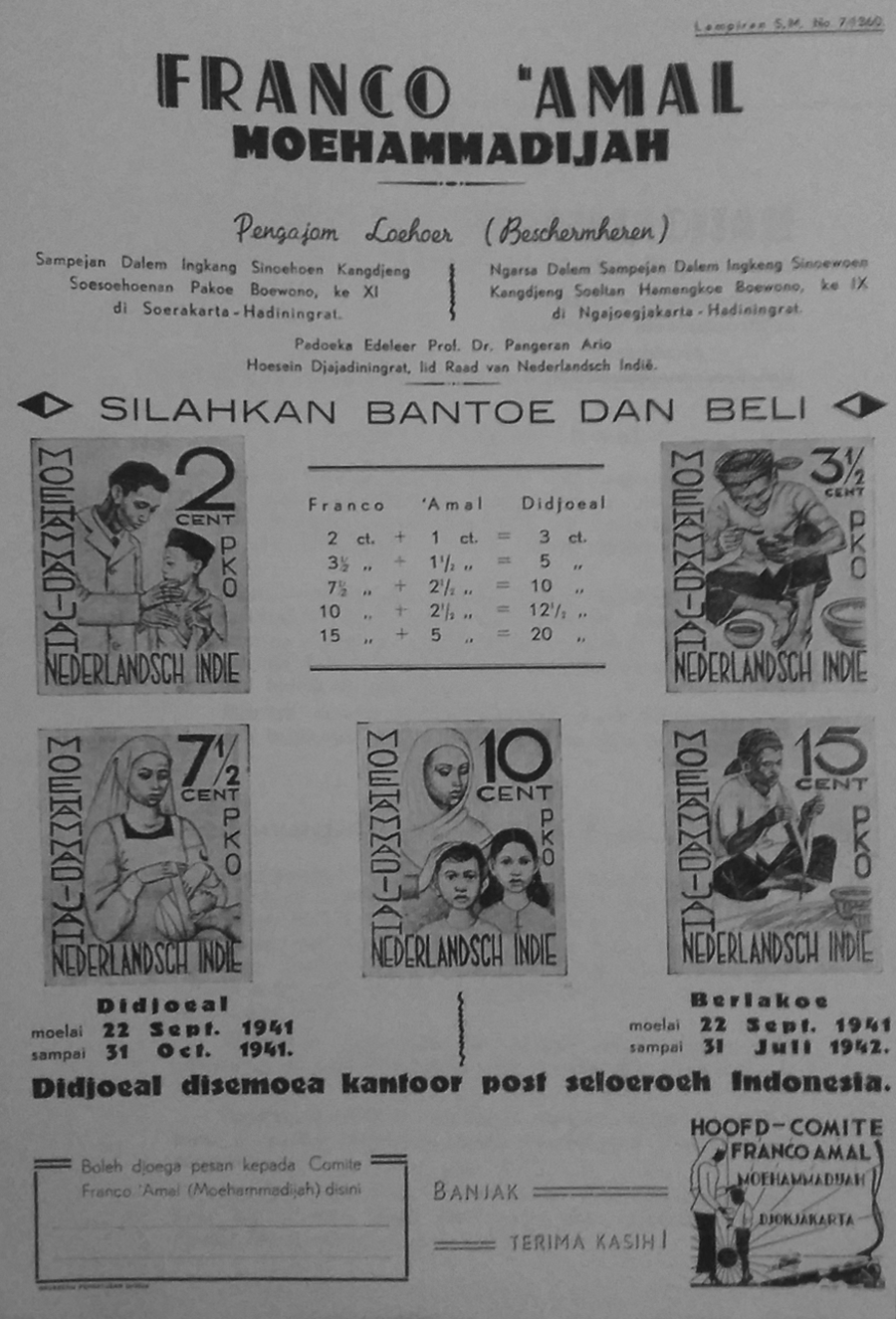
Fundraising leaflet for Muhammadiyah charity stamps.
The issue of the charity stamps reveals a certain ambivalence towards Christianity – on the one hand, this charity stamp programme was inspired by Christian missions (both Catholics and Protestant), while on the other there was a strong sense of competition against these missions. This spirit of competition is apparent in the formal text of the speech on charity stamps issued from the central board of Muhammadiyah and published in Soeara Muhammadiyah (1941). The text, which was six pages long, should have been read on the occasion of the charity stamps reaching all Muhammadiyah’s branches in 1941. It reads: …if we recall, Muslim leaders have long and repeatedly requested the Government to provide an opportunity to sell charity stamps, as has been given to Christian missionaries…These charity stamps, organized by Christian missions, spread the spirit of Christianity in all places in Indonesia and beyond. Do you gentlemen know how much profit is derived from charity stamps? It is not small, indeed. The charity stamps accrue moral and material benefits… If Christian missions and others could gain double benefits, both moral and material, why are we going to lose those and be unable to handle more than that? Followers of Muhammadiyah and Muslims are more in quantity compared to the number of Christians, are we not? (Soeara Moehammadijah, 1941: 21)
The above text is informed by the Islamic spirit of fastabiqu-l-khairat (which follows the Qur’anic exhortation to ‘compete with one another in good works’), namely to gain more money from the charity stamps and to spread Islamic values across the nation through their distribution and use. The spirit of competition, especially against Catholic and Protestant charities, was very strong and was addressed to Muhammadiyah members who in turn had an obligation to invite other Muslims to support.
In this context, Muhammadiyah is using a religious identity as a way of ‘bonding’ social capital network, in order to gain support from Muslims for its charitable activities. The principles of inclusivity, tolerance and non-discrimination of PKU were covered by the spirit of competition endorsed by its mother organisation, Muhammadiyah, which used Islamic identities and networks to sell the stamps. Images in the stamps showed the concern and work of PKU in helping to alleviate public suffering, but the central board under the leadership of Mas Mansur put greater focus on ‘winning the fundraising race’ rather than on humanitarian causes. Mas Mansur was the person who had supported the polyclinic of PKU in 1924, but in 1941 he was supporting PKU by touching on the issue of competition with Christian missions. In this one can only assume that he was using the concept of fastabiqu-l-khairat.
These two cases stand quite differently and show a contestation between aspects of inclusivity and exclusivity within a faith-based charity organisation. The following section seeks to determine the situations in which inclusivity might prevail against the exclusive tendency in Indonesian pluralist society.
‘A religion for human beings’: Islam, inclusivity and humanitarianism
Petersen (2015) shows that socio-cultural backgrounds do matter in forming ‘aid cultures’ and finds that Muslim transnational NGOs, which are formed by those with European and Middle Eastern backgrounds, differ in their strategies between a concern for umma and a concern for humanity – between taking a direction towards being sacralised or secularised. The PKU case offers an example of a different ‘aid culture’ arising in a 20th century Muslim community living in a plural Indonesian context under Dutch colonial power. Here we see the paradox of a majority Muslim society displaying the sense of being a minority and trying to adapt Islamic teachings within that context. Tensions between aims for umma or humanity did exist but PKU, specifically, Syuja’ stood differently and insisted that ‘Islam is a religion for human beings.’ As a result, ‘inclusive’ efforts through humanitarian activism within the PKU prevailed during the Dutch colonial period and three factors serve to explain how PKU sustained having an inclusive vision underpin its humanitarian activism.
Firstly, there was the socio-political context of the Dutch colonial government that brought western humanitarian values that were impartial and inclusive. These inclusive humanitarian values might have been indirectly endorsed by the government in its support of a policy of religious neutrality (Kernkamp, 1945), though that does not mean they could avoid favouritism. This inclusive tune became internalised through western-educated Indonesian elites and activists from organisations such as Budi Utomo (Kahin, 2003: 78) with which Syuja’ was involved, and could gain momentum through their response to famine and other misfortunes. There was also a movement for equality and collaboration between different racial (and one might include different religious) backgrounds, such as the establishment of the Indonesian Eurasian political party in 1912 (National Indies Party) that was advocating ‘racial equality, socio-economic justice and ultimate independence’ with the motto ‘the Indies for those who make their home there.’ This attempt was made by Douwes Dekker and Cipto Mangunkusumo; although it failed, it attracted 1300 Indonesians and 6000 Eurasians, showing that the idea of racial equity was on the rise. The idea of equality and non-discrimination was also promoted by the socialist movement, whose sympathisers came from various nationalities and ethnic and religious backgrounds including Muslim members of Sarekat Islam, some of whom later moved to Muhammadiyah (Kahin, 2003: 70–105).
PKU was a product of humanitarian activities flowering during what Shiraisi (1999) called the ‘age in motion’ that were carried out by various organisations and societies in a relatively tolerant public sphere in terms of religion. Together with others, PKU addressed a variety of social problems, including working for the benefit of the victims of floods, famines, epidemics and volcanic eruptions, and then transformed the activism into organised charitable institutions such as orphanages, hospitals and poorhouses. Although other organisations emerged with a stronger Islamic identity, such as Sarekat Islam, the values of non-discrimination, equality and justice remained vigorous due to support from the second factor, as described below.
PKU based its inclusive activities on a progressive theological interpretation of the teachings of Islam, which can be seen from the way it used the injunctions ‘fastabiqu-l-khairat’ (compete with one another in good works) and ‘lakum dinukum waliya din’ (unto you your religion, and unto me my religion) (Burhani, 2011: 329–342). Both are quotes from Qur’anic verses that Muhammadiyah frequently used and that PKU tended to use to support its decision to involve Christian and Dutch doctors in its work. The first verse was supportive of the desire to teach and motivate members of Muhammadiyah to do better than the Christian missions, and this stance may be seen in the case of the examples chosen for the charity stamps. The second verse was to assure Muslims that having a friendship with, and getting help from, non-Muslims was licit in the sense that it was endorsed by the Qur’an. In addition to this, PKU and its leaders seemed to regard their fellow Christians as neighbours, a position that finds support in several theological texts including the Al-Ma’un chapter.
Based on this, PKU did not face theological problems for its inclusive activities. This practice of interpretation was not peculiar among Muslim reformists in emerging modern Muslim states in the 19th and 20th centuries (Nasr, n.d.: 2), and Muhammadiyah was one of those reformist organisations who made such interpretations in a creative way. To add to this, it can be said that social conditions indirectly endorsed the practice because other religious groups also did the same (as, for example, in the case of Dr Soetomo who worked at a missionary hospital as well as at Muhammadiyah).
Thirdly, Muhammadiyah’s modernist and pragmatic socio-political stance in dealing with other parties increased its receptivity to the tolerance of differences in terms of religion and race and to group or nationality. PKU’s experience in fundraising to help the victims of the 1919 Mount Kelud eruption tells us that it targeted Muslims and non-Muslims alike. This was common at the time and was undertaken in the name of humanity, and it is safe to say that the inclusivism of Syuja’ and PKU was also supported by Dahlan, who was known to be friendly with non-Muslims (Alfian, 2010: 180). PKU indirectly benefited from the pragmatism or ambiguity of Dahlan’s politics (Burhani, 2006), and thus it freely sought help and donations from the colonial government and from native and Dutch bureaucrats. While most Islamic organisations refused government subsidies, Muhammadiyah sought and received quite substantial funds in support of its schools and orphanages (Fauzia, 2013: 154; Njoto-Feillard, 2014: 26–35), and their pragmatic approach and PKU’s inclusivism became positive sources for fundraising. PKU also received funds from the lottery (f. 8018.17) for building its clinics. For example, in 1939 it received government subsidies of f. 9103.97 and lottery funds of f. 2403.78, and its education division received f. 77,034.41 in government subsidies (Verantwoording Hoofdbestuur Moehammadijah, 1939: attachment).
Based on the above three factors, the idea of non-discrimination in charitable and humanitarian action could function well in the work of PKU and Muhammadiyah, and differences in ethnicity, race, nationality and religious background were downplayed against the notion of humanitarianism, concerns about which had potentially contributed to the bridging element or inclusive attitude of social capital. The religious activities of PKU expressed a more down-to-earth and human interest than a ‘pie-in-the-sky’ interest, as Syuja’ expressed it in the quote above.
However, when the call for nationalism and nation-building meant the independence of Indonesia from Dutch control, and when the concept of an Islamic community called an umma became more prevalent, then the stance of Muhammadiyah changed. With this came the ascendancy of a puritan tendency in Muhammadiyah in parallel with the rise of nationalism and political Islam. An example of this is in the role of Majlis Islam A’la Indonesia (MIAI) in 1937, a role in which Muhammadiyah was actively involved.
Indonesian independence brought the consciousness of the Muslim majority into the public sphere so that Islamic ideology was strengthened due to competition with Christianity, in that both had the same rights in the constitution in relation to religious freedom (Shihab, 1995: 291). Therefore, the principle of non-discrimination in terms of nationality and religion in PKU was no longer favoured at the elite levels of Muhammadiyah, and the western, secular humanitarian values in dealing with religious and ethnic identity had less influence or even disappeared in the early period of independence and into contemporary times.
The PKU did not explicitly intend to deny assistance to non-Muslims, but with the socio-political conditions in favour of political Islam after the country’s independence, the concept of umma began to rise in its social services. For example, the selection of beneficiaries, such as who could get free medical service in its hospitals, was made through mosques and through Muhammadiyah’s own institutions (such as orphanages and schools), all of whose members were Muslim (Latief, 2010b, 2016).
Concluding remarks
The theology of Islamic charities interpreted in the context of the Dutch colonial era had become a strong basis for PKU to formulate inclusive ideas and projects. This meant that its inclusive ideas were based on an Islamic framework and that it did not depart from the doctrines of Islamic teachings.
The rise of social, political and religious organisations during the Dutch colonial period saw the emergence of an inclusive Muslim civil society. In this regard, the bridging role played by PKU was supported by the inclusive character of its humanitarian and philanthropic activities. Its progressive interpretation of Islamic teachings tamed the excessive bonding role of religion, and since there is no explicit verse in the Qur’an saying that charity, including zakat, sedekah and waqf, should only be distributed for Muslims, PKU could adapt its policy to the prevailing national political policies of religious plurality of the time without breaking the Islamic principle. It could operate effectively with other faith-based charitable organisations to put aside differences of race and religion to insure inclusion and the participation of all members of society.
PKU provides an example of how civil society can originate from within a religious group, an example of what Hefner (2000) calls ‘civil Islam’. In this respect, civic action on the basis of religious identity can enhance civility in the entire society (Nakamura, 2012: 21–22) when there is a balance between the bonding and the bridging elements of social capital. The balance in this article is supported by the western socio-political milieu endorsed by the state. As the public sphere in the first half of the 20th century was relatively open with regard to religious plurality under the Dutch, PKU could underpin its activism with an inclusive vision alongside other faith-based charitable organisations.
This article has located a notion that is similar to Benthall’s (2005) observation on the structure of Islamic toleration in regard to the flexibility of Islam in accommodating differences in beliefs and practices. This also resembles Nejima’s (2016) findings on the flexibility of Muslim activists and the inspiration they get from religious messages to social services. PKU might be one progressive face of Muhammadiyah’s many different faces, which was extraordinary as it grew out of the dynamics of a Muslim majority country – living together with other ethnic, national and religious communities – under a non-Muslim ruler, and facing the humanitarian challenges that arose in the first half of the 20th century. These challenges created a shared aid culture that helped to create a progressive Muslim civil society, one that depended on the dynamics of its bridging and bonding elements. Flexibility in accommodating differences, as shown in this article, is imbedded in the heart of faith-based charities operating as civil society organisations. However, it needs a conducive ‘aid culture’ endorsed by a strong but good state to make civil society grow and become firm without depriving such organisations of their power. In this context, and given such a sphere in which to operate, an ideal balance between state and civil society organisations may be achievable.
Footnotes
Acknowledgements
The author would like to thank Prof. M.C. Ricklefs, two anonymous reviewers, Kostas Retsikas, and fellow researchers of the Religion and Globalisation Cluster at the Asia Research Institute, National University of Singapore for their constructive comments on this article. The original draft of this article was presented at the International Research Conference on Muhammadiyah, Malang, 29 Nov–3 Dec 2012, in regard to which the author would like to thank Prof. Mitsuo Nakamura.
Declaration of Conflicting Interests
The author(s) declared no potential conflicts of interest with respect to the research, authorship, and/or publication of this article.
Funding
The author(s) received no financial support for the research, authorship, and/or publication of this article.