



Abstract
This article interrogates one of the most important emerging bilateral relationships in East Asian international relations: Japan’s politico-economic relations with Burma/Myanmar (herein referred to as Burma). A long-time ally since the Second World War, Japan’s role in Burma came under increasing and eventually unbearable pressure with US sanctions from the 1990s. However, since 2011 Japan has rapidly extended its influence in Burma—influence understood multi-dimensionally as comprising institutional, ideational, and material power—and built upon those well-established historical ties. This rush to rejuvenate relations has been driven by more than historical amity. It has been due to various shifts in the forms of state in East Asia and changes in the regional power order—principally increasing competition with China—and has also been informed both by Burma’s desire to begin internationalizing and industrializing and Japan’s enthusiastic assistance in this process. The article interrogates three key questions associated with these post-2011 developments: What has been the nature of Japan’s rush to rejuvenate its relations with Burma? Why has this been such a priority for Japan at this time? And how has Japan been endeavoring to secure its foreign policy goals with Burma? It concludes that Burma is in the middle of a period of great tension, and despite its democratic transformation (or rather because of it) is not best placed to handle the forces bearing down upon it. Great caution and attention is needed towards Burma, the “final frontier” of Southeast Asia, as big changes are coming and with these come significant and potentially overwhelming challenges for the country, its leaders and its people.
Introduction: “New old friends”
The phrase “new old friends” is one used by Burma’s Tatmadaw and Japan’s Self Defence Forces (SDF) to describe the history of close relations between these two actors currently enjoying a rejuvenated relationship. 1 It could as easily be used to describe the many other levels of Japan-Burma relations that have, since 2011, seen a rush by Japan to rejuvenate their potency. In March 2018, Maruyama Ichiro took over from Higuchi Tateshi as Japan’s ambassador to Burma. Higuchi had been the figure largely responsible on the Burma side for that rejuvenation, helping to shepherd in Japan’s new relationship with a new Burma. It was a very successful period in office that fully reinvigorated Japan-Burma relations and avoided what could have been a difficult time for Japan, transitioning as it did from past military alliances to current democratic partnerships. So successful was it that, by 2016, Burma had become Japan’s second largest Official Development Assistance (ODA) recipient in Southeast Asia behind Vietnam. For Burma to have assumed the silver spot is remarkable given that, as late as 2012, it was at the bottom of Japan’s regional recipient list. From this ODA, and the private investment it leverages, has resulted a wave of differing types of projects, plans, and priorities for the new ‘democratic’ Burma. But why did Japan want to do this? Why is the relationship one of new old friends? And exactly how has Japan been so successful?
Burma is not a new foreign policy interest for Japan; the two countries have maintained a long and steadfast relationship, particularly after the Second World War but for a long time prior, 2 that has weathered many changes of people and priorities, in addition to shifting attitudes towards Burma from the West. 3 Throughout, and bearing a lot of criticism for doing so, Japan has remained locked-on to Burma as a major strategic regional priority. This is because Burma is a major strategic priority. The country has been so since the colonial period, when it was a rag to be gnarled between the teeth of Britain, France, and later Japan. In an increasingly inter-connected region, Burma’s position as a strategic priority has never been more significant.
However, despite this lineage of relations, in 2003, reluctantly bowing to international pressure, Japan reduced relations with Burma to a minimum, leaving all of the previous developed politico-economic relations severely affected. In that time, China filled the void and helped Burma to remain what it has usually been—the last ‘hermit kingdom’ of a post-Cold War Southeast Asia. Almost a decade later, with the acceptance of Burma by the West thanks to a series of democratic reforms, Japan was once again able to re-engage with its long-time identified foreign policy priority—and re-engage it did.
This article seeks to explore the nature of this rush to rejuvenate relations since 2011, its importance at this particular time, and the ways in which Japan has achieved this feat. It will do so by assuming a critical approach to political-economy within the foreign policy of Japan, that assumes a broad and multi-dimensional approach to power and influence. That is, states influence each other—especially in the post-Cold War world, and most especially in East Asia and as practiced in Japan’s foreign policy—simultaneously through both direct and structural approaches to power that emphasize economic power, institutional power, and ideational power, as much as military power. This is achieved with a top-down regional dimension constantly in mind, whereby the concept of regions is used as a foreign policy tool by Japan, as justification for transformations of the individual state, in addition to the bottom-up adjustment of policies within the institutions of individual states to accord with regional transformation agendas. It is not enough, as a lot of literature does on Japan’s foreign policy, simply to assert “country X provided Y amount of aid to country Z” and then conclude there to be some sort of influence having occurred. Rather, it is necessary instead to peer inside the black-box between input and output to discern why and how Japan’s political and economic actions translate into the forms they do, and by reflection, what those empirical realities tell us about Japan’s broader ambitions for Burma. In addition to the material power elements of Japan’s foreign policy, this requires examining the shifting forms of state in Burma and Japan, and the equally shifting world orders they are operating within. It also requires a survey of the various strands of Japan’s material power vis a vis Burma—a survey that goes beyond simply the economic to also include institutional and ideational power.
To achieve this, the following analysis assumes a simple approach to answering the puzzle of Japan’s rush to rejuvenate relations with Burma since 2011: three questions—what, why, and how. That is, what has been the nature of Japan’s flurry of relations with Burma from around 2011 (first section); why has this been such a priority for Japan at this time (second section); and how has Japan been endeavoring to secure its foreign policy goals with Burma (third section).
Post-2011 Japan-Burma relations: The rush to rejuvenate
Japan’s economic rush to rejuvenate
2011 is the year it is first possible statistically to observe Japan’s rush to rejuvenate relations with Burma economically (although politically these funds would have been allocated in 2010, and would have been negotiated into existence four or five years prior to this).
Japan’s public finances
Many foreign observers and news agencies make claims about aid from Japan “starting” and “stopping” in Burma. This is incorrect, as it has been maintained year on year; the only difference is the volume and form. 4 While Japan pulled back from its earlier open-ended support of Burma due to US sanctions, low-level aid such as technical assistance and training never stopped. 5 The purpose of maintaining the small trickle to which Japan had reduced its ODA in the face of US approbation was to satisfy the US while simultaneously keeping the door open in Burma. This was turned into an annually increasing flow of funds between 2011 and 2016. 6
Japan’s ODA is divided into three parts—technical assistance, grants, and loans which, in that order, represent three capital streams of increasing size but also increasing political sensitivity. The first and smallest, technical assistance, was maintained at a steady annual average between 1995 and 2011 of US$21 million. Small to middling grants for the same period represented a similarly steady average annual amount of US$34 million. Loans, by far the largest and politically sensitive ODA provision, were non-existent (the last loan had been in 1987 for a power plant in addition to a transmission line and distribution system).
After 2011 two changes occurred, as illustrated in Figures 1 and 2. First, there was a rapid annual increase in both technical assistance and grants. Technical assistance rose from US$23 million in 2011 to US$98 million in 2016; annual increases of 50–100%. Grants increased from US$20 million in 2011 to US$210 million in 2016; annual increases of 100%.
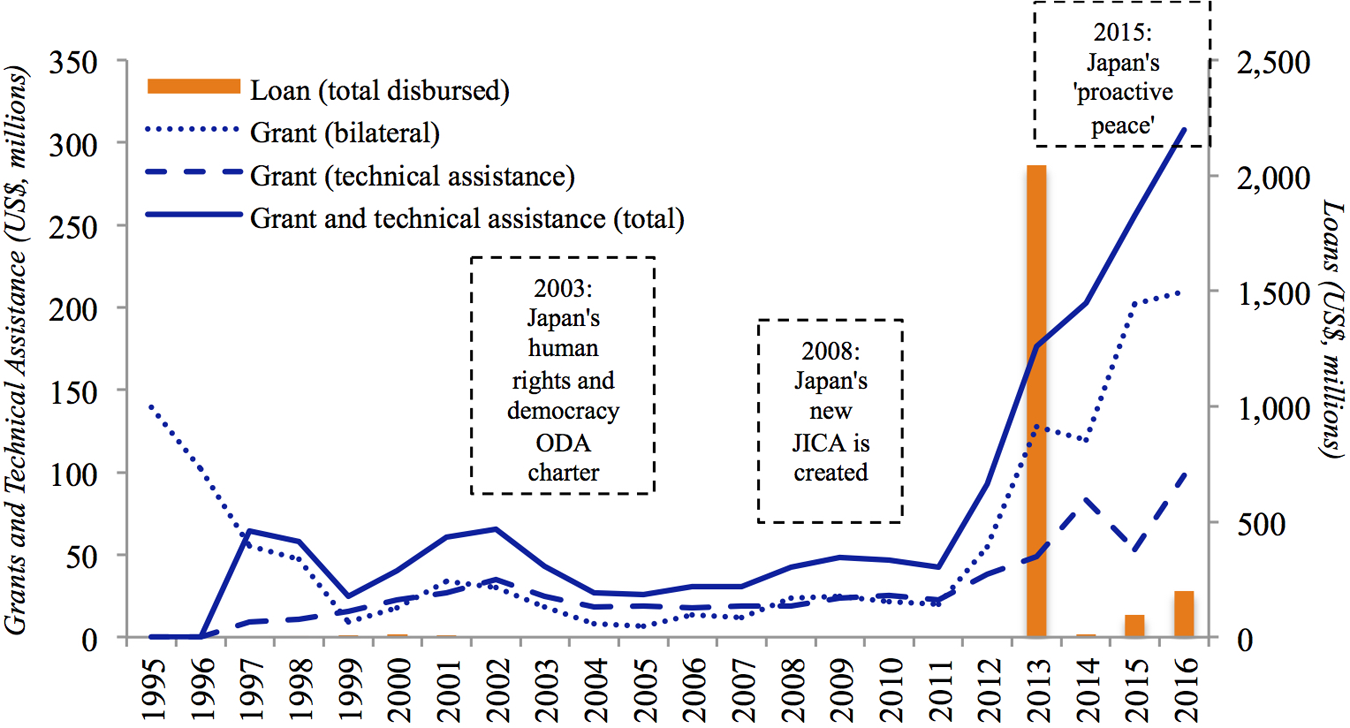
Japan’s ODA (Grant Technical Assistance, and Loans) to Burma, 1995–2016.
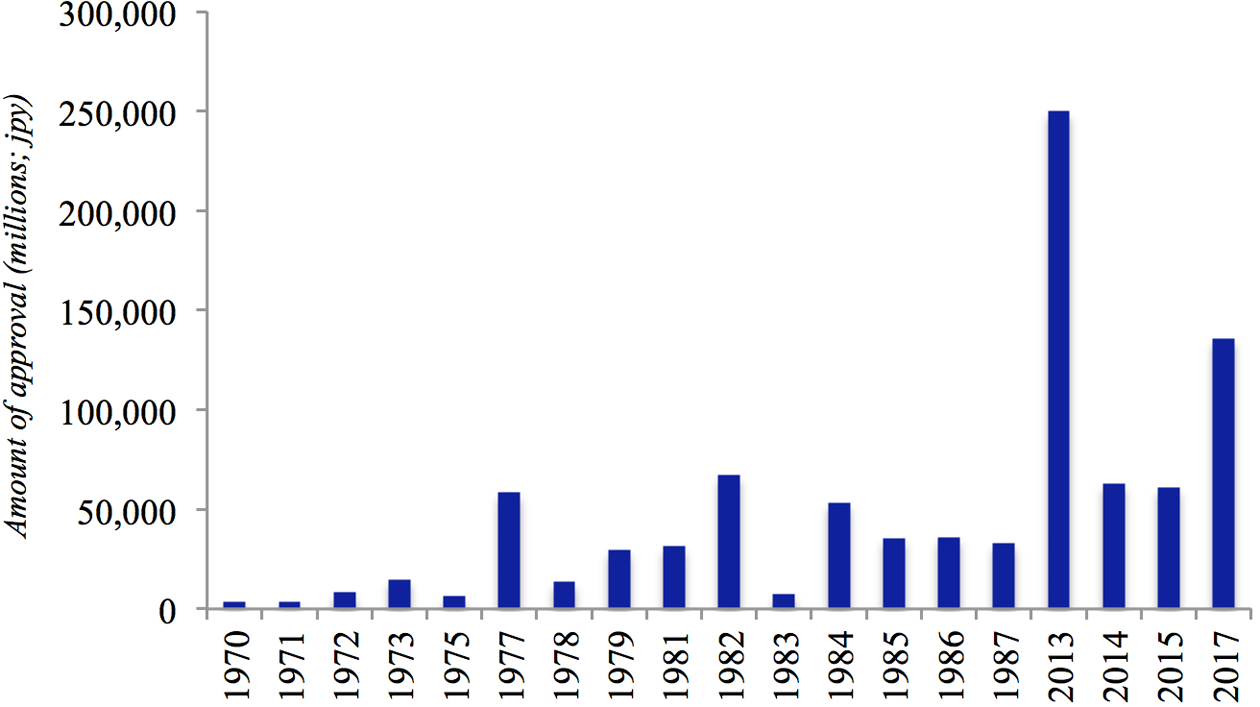
Japan’s yearly loan aid to Burma (1970–2015).
Second, also in 2011, Japan began to tackle Burma’s major hurdle for greater global integration—unpaid debts. US$15 billion of debt had not been repaid (despite Japan’s multiple ‘debt relief grants’ provided during the SPDC years), creating a political stumbling block in Japan. 7 This meant that no new lines of credit, either bilateral or multilateral, could be opened. Japan took the lead, and in March 2011 convened major donors such as the World Bank, ADB, and the Paris Club, to address the issue. Japan agreed to (1) forgo its own owed amounts in a huge debt relief program (represented by the 2013 debt-relief grant), and (2) provide additional loan capital—the first in 25 years—so that Burma could deal with its other debt obligations. In the final outcome joint statement concerning the measures necessary to achieve this, Japan’s then PM Yoshihiko Noda and Burma’s then President Thein Sein announced a three stage agreement: a loan to clear all debts accumulated prior to 2003, a debt cancellation (using a grant) for debts accumulated after 2003, and cancellation of 20 years’ worth of overdue charges. 8 At the Japan-Myanmar Summit Meeting in April 2012 the precise measures were agreed (announced May 2013), 9 culminating in 2013 in an enormous grant of US$3.3 billion for the purpose of debt-forgiveness (in order to create more loans). 10
This hugely significant step effectively unlocked not only Japan’s finances but also the wider international community’s finances to Burma. It also worked as a very large stick, as contingent on parts of this package were agreements to a large swathe of policy reforms. 11 This demonstrates a key element of Japan’s foreign policy, what Lindsay Black terms “bridge-building” or the kakehashi approach, 12 and showed Japan using multilateral mechanisms for bilateral benefits by supporting a liberal economic order that Burma could be attracted into. Japan had taken the same approach in the 1990s/2000s when it helped Vietnam, Cambodia, and—albeit less successfully—Laos to achieve similar results.
This tendency in Japan-Burma relations of Japan cyclically providing loans, then forgiving them once unpaid with grants in order to provide further loans, is an old game played between Tokyo and the junta in Yangon. The 2013 action opened the door for equally enormous anomalies of loans. The first such loan was in the same year as the grant of 2013, with a US$2 billion dollar loan. This made the total ODA to Burma in 2013 reach US$5.3 billion. To put that in context, that single year’s total ODA commitment is just a little under the US$5.7 billion of combined ODA provided to all of Burma’s neighbors—Thailand, Cambodia, and Laos—for the entire period of 1995–2016 (see Figure 3 and Table 1). It is again akin to the old days of Japan’s ODA to Burma when the 11 June 1989 edition of Japan’s Mainichi Shinbun newspaper described it as being tarenagashi (literally, “the discharge of effluent”, but in this context, open-ended and uncritically provided without care for outcomes). 13
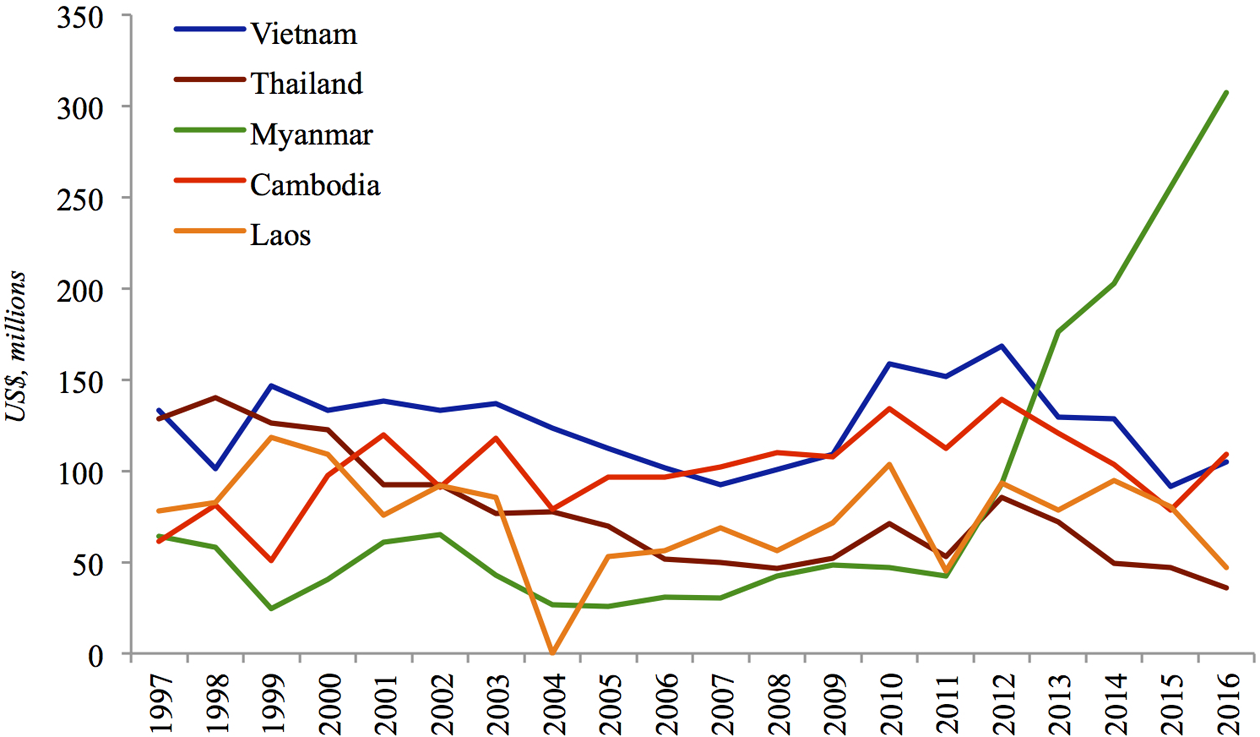
Japan’s grant ODA (Grant and Technical Assistance) to the Mekong countries, 1995–2016.
Japan’s ODA ASEAN countries in 2013 (unit: US$ million).
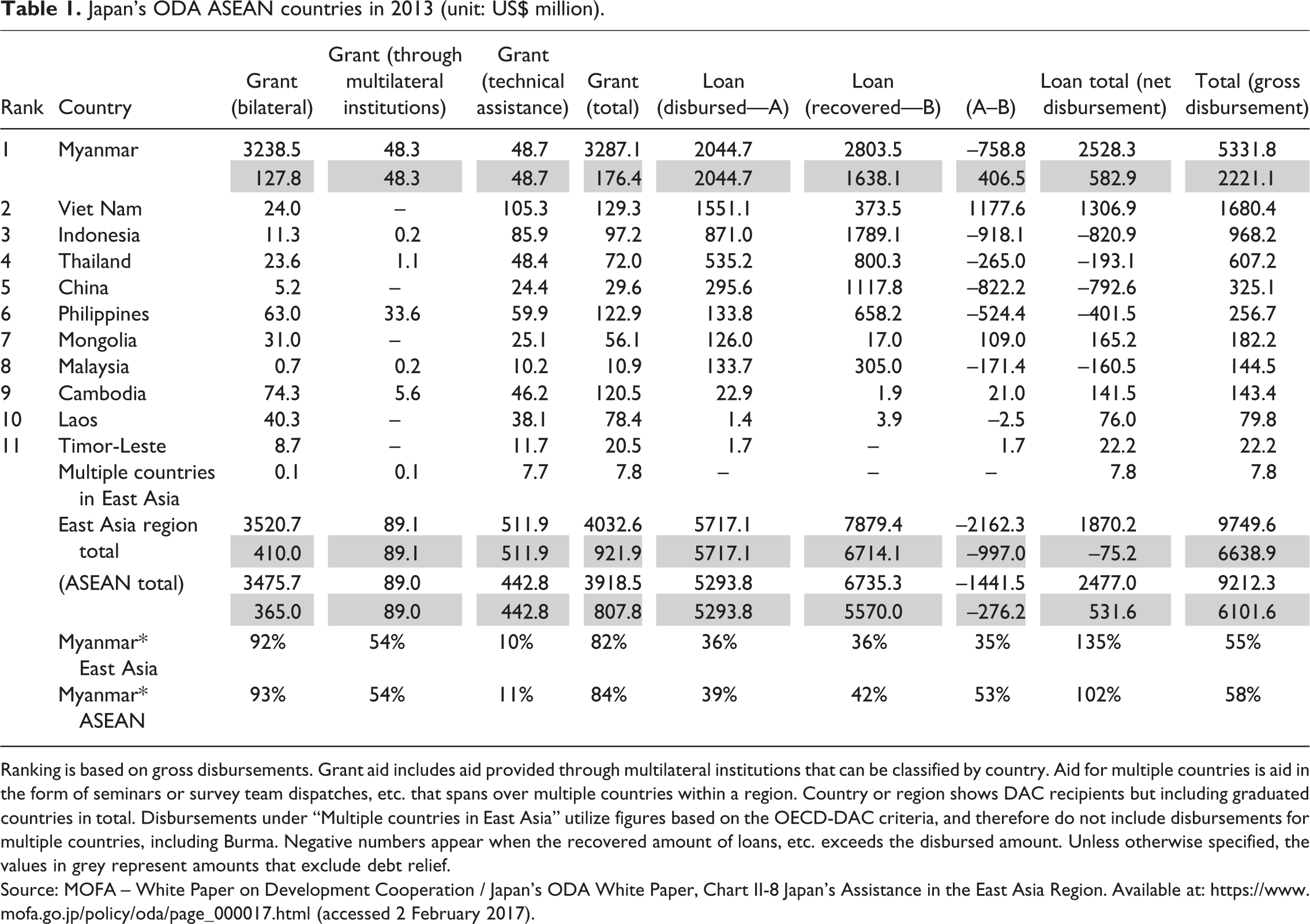
Ranking is based on gross disbursements. Grant aid includes aid provided through multilateral institutions that can be classified by country. Aid for multiple countries is aid in the form of seminars or survey team dispatches, etc. that spans over multiple countries within a region. Country or region shows DAC recipients but including graduated countries in total. Disbursements under “Multiple countries in East Asia” utilize figures based on the OECD-DAC criteria, and therefore do not include disbursements for multiple countries, including Burma. Negative numbers appear when the recovered amount of loans, etc. exceeds the disbursed amount. Unless otherwise specified, the values in grey represent amounts that exclude debt relief.
Source: MOFA – White Paper on Development Cooperation / Japan’s ODA White Paper, Chart II-8 Japan’s Assistance in the East Asia Region. Available at: https://www.mofa.go.jp/policy/oda/page_000017.html (accessed 2 February 2017).
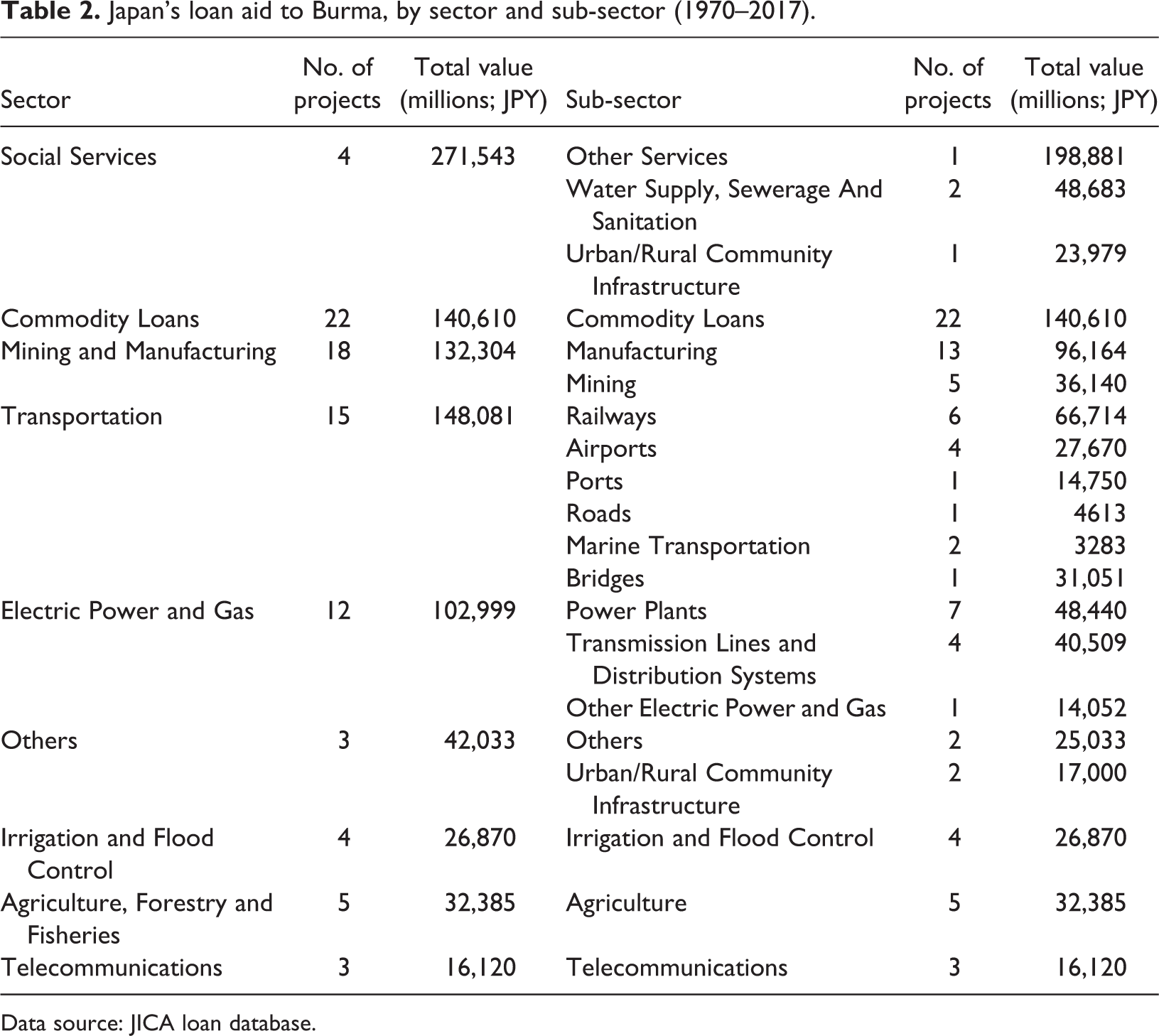
The nature of this interest is revealed through Japan’s loan aid to Burma since 1970. As summarized in Table 2, it is similar to Japan’s economic interventions in neighboring Mekong countries—Commodities, Mining And Manufacturing, Transportation, Electric Power And Gas; with Social services only being top of the table because of an extraordinary sized loan in 2013 (details below). Specific to Burma, however, the goal of this largesse from Japan was principally orientated towards developing Thilawa and Dawei Special Economic Zones (SEZs); a deal organized and fast-tracked by former long-time and multi-party Diet member and post-2010 chairperson of the Japan Myanmar Association, Watanabe Hideo, and his Burma counterpart President Thein Sein. 14
Japan’s loan aid to Burma, by sector and sub-sector (1970–2017).
Data source: JICA loan database.
This flurry of activity between 2011 and 2013, and Japan’s multi-dimensional (political and economic) and multi-tiered (multi-departmental, on both sides) rapid re-engagement with Burma, led in March 2013 to the first meeting of the Myanmar-Japan Joint Initiative. This was followed in October 2013 by the Myanmar-Japan Joint Initiative’s joint statement—a detailed blueprint of Japan’s desires for Burma’s politico-economic engagement and industrialization that has essentially been the roadmap for bilateral relations ever since. 15
On 2 November 2016, Japan bolstered the 2013 initiative by offering an enormous US$8 billion public-private ODA/investment package to be spread over five years until 2021 (the 2017 figure shown in Figure 2 is the first instalment of this US$8 billion package). This is all handled by long-time Burma based and interested Japanese banks: the Bank of Tokyo-Mitsubishi UFJ, Mizuho Corporate Bank, and Sumitomo Mitsui Banking Corporation (incidentally, the same actors involved with the construction of Thilawa SEZ. The focus was again to boost Japan’s SEZ infrastructure activities in Burma.
Japan’s private finances
Moving from public sector finance to private sector investment, this ODA boom also worked to pump-prime a short-lived private sector boom, as illustrated in Figure 4. Notably, however, there has been a sharp falling away of investment from Japan since Aung San Suu Kyi assumed office in 2015. In addition, as shown below in Figure 5, comparatively speaking, private sector investment from Japan is very low. For 2004–2017, Japan’s FDI totals US$489 million, while FDI from China totals US$18 billion.
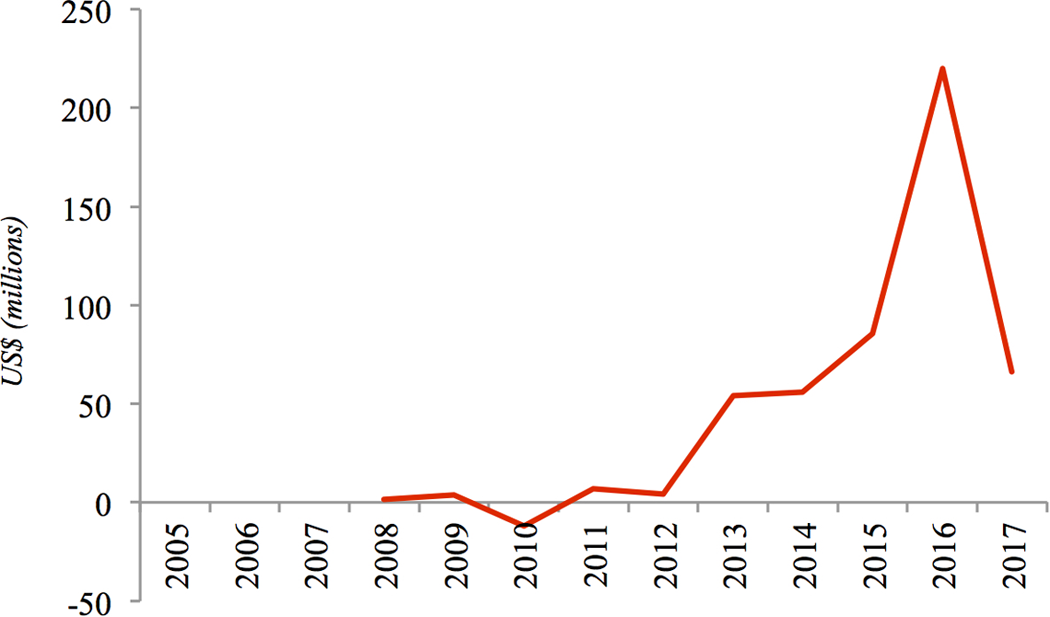
Foreign direct investment from Japan to Burma, 2004–2017.
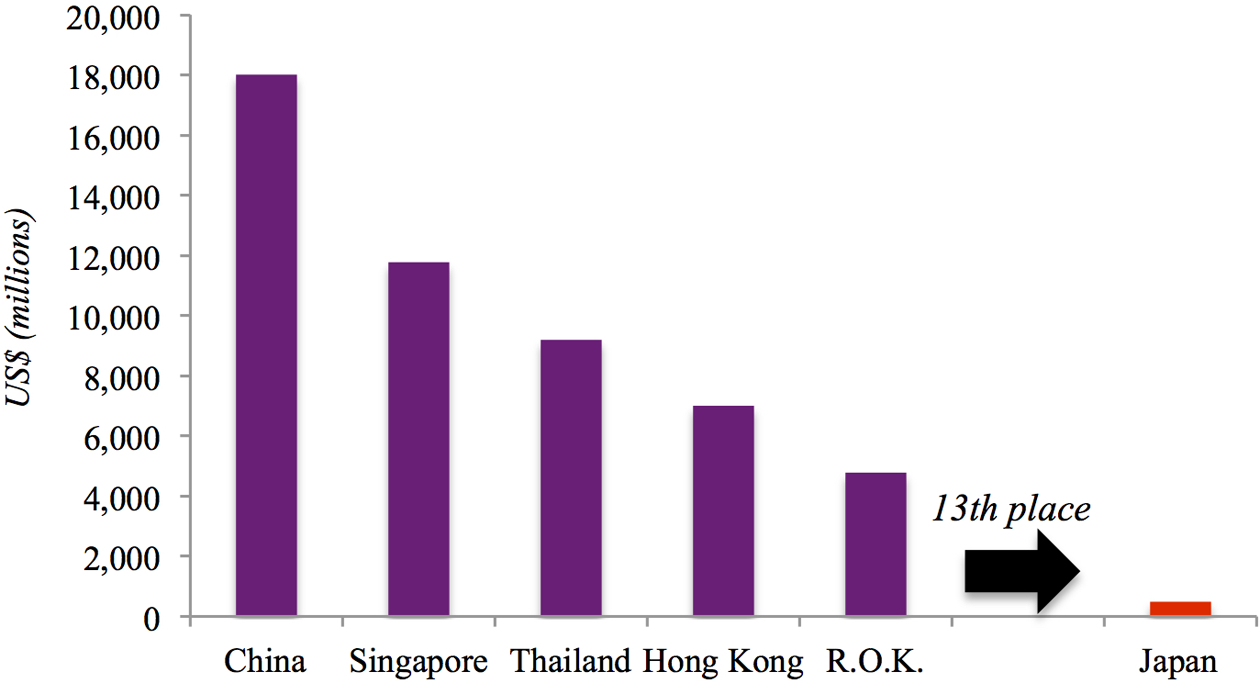
Top five FDI countries into Burma, 2004–2017.
However it is necessary to be cautious when reaching conclusions about these low levels due to three factors: the degree of investment that emerges from Japan’s dual-registered companies in Bangkok, the nature of the investment that emerges from Japan, and the crowdedness of the marketplace in Burma (or lack thereof).
In relation to the first, with Thailand being the third largest investor, a large proportion of that category’s investment is likely to be from Japan, due to the number of Thailand based Japanese companies or Thailand-Japan joint ventures.
In relation to the second, Japan’s investment historically and specifically in relation to Burma’s neighbours has rarely grabbed the headlines at first. The initial stages of investment are likely to be orientated towards the creation of economic structures rather than individual ventures; structures that can then be leveraged at a later point by Small and Medium sized Enterprise (SME) ventures (hence providing to them more “sticking power”). Examples of this include Japan’s construction of Thilawa SEZ (so as to lay the foundation for productive investment), support of the creation of the Yangon Stock Exchange and attending computing systems for Burma’s banking system (so as to lay the foundation for the generating of independent finance and financial reforms), or the creation of the training/cultural institute of the Myanmar-Japan Center for Human Resources Development (so as to educate and train staff and workers for future Japanese companies entering Burma).
Finally, in relation to the third, Western sanctions and their concomitant creation of a bad image of Burma mean that many Western companies are absent from the country. This leaves the market open for Japanese companies, ever supported by public Japanese funds, to develop their positions with largely only East Asian competitors to be concerned about. This, coupled with a long-time commitment by Japan and a not un-critical view among many Burmese that Western sanctions caused them to need to overly rely on China, mean that Japanese public and private actors are eager to capitalize on this “final frontier” opportunity (final frontier is a phrase used by Japanese and Korean actors in most of the post-Communist economies of the Mekong, including Burma; it is also found in the academic literature). 16
Japan’s political rush to rejuvenate
In order to obtain the political prize—a Japan-friendly, ASEAN-integrated Burma—there are a number of hurdles that Japan has had to focus on. First has been diplomacy and politics, referring to (a) re-connecting diplomatic relations, and (b) re-connecting within the context of Burma’s transition period towards democracy. Second has been Burma’s two-fold security/national reconciliation issue, referring to (a) the armed insurrection of ethnic groups, and (b) the humanitarian crisis involving the Rohingya. Third has been the general economic/industrialization framework, referring to Burma’s expressed need and desire to industrialize and develop. The following will detail these three dimensions in turn.
Multi-track Re-engagement 1: Diplomatic relations and Burma’s democratic transition
Japan has been dealing with this complex array of hurdles highly proactively with the creation of a multi-track state engagement from the Japan side, and doing so within the current confusingly diarchic state-society complex that is the modern military-democracy Burma. The general approach has been pragmatic, non-judgemental, but enthusiastic and flexible. We see evident and clear tracks of political engagement, all tailored specifically for Burma, in order to overcome these different political hurdles.
A series of ‘firsts’ began in 2011. In October of that year, Burma’s Foreign Minister Wunna Maung Lwin was in Tokyo meeting officials, the first such visit in 16 years. In December 2011, Japan’s Foreign Minister visited counterparts in Burma and President Thein Sein, the first visit by a Japanese Foreign Minister in nine years. In April 2013, Suu Kyi visited Japan for the first time in 27 years. And in May 2013, newly elected Prime Minister Shinzo Abe engaged in four lightning tours of Southeast Asia, visiting Burma on 24–25 May, the first such visit in 36 years (and accompanied by 40 elite business leaders).
With contact re-established, Tokyo had to engage in the difficult task of building relations with newly democratic Burma while hoping that the new regime would not remember that for decades Tokyo had been dealing with their military rivals. Japan’s answer was to go all in and be more pro-democracy than the purest Washingtonian democrat. In July 2011, Tokyo began laying the groundwork, and took the unusual step of inviting 20 young politicians to Japan from six of Burma’s leading political parties; it is always a good idea to place a bet on all the horses in the race. From 2012, Japan joined the international community to take an unusually active part in Burma’s democratization process. In March 2012, election observers were sent to monitor by-elections, and in November 2015 observers were sent to watch over the general election. Finally, in addition to these two behaviours was a third level of proactive engagement—a Ministry of Foreign Affairs in Japan that has been very vocal in its public statements of “welcoming” or “being concerned by” every twist and turn in Burma’s politics. 17
Multi-track re-engagement 2: Burma’s security/national reconciliation issue
Burma is in a state of open insurrection by an 11-group collection of ethnic groups in northern Burma, headquartered across the border in Thailand’s Chiang Mai, represented politically by the United Nationalities Federal Council (UNFC) and militarily by the Federal Union Army (FUA). Seeking a federal rather than a unitary state in Burma in order to protect their minority rights, this is a challenge to the further consolidation of Myanmar’s fledgling democracy, as the very definition of the nation-state itself is in question. In 2012, Japan took the highly unusual step of appointing a non-political/non-bureaucratic figure to deal with this situation, in the person of multi-millionaire NGO philanthropist Sasakawa Yohei. Simply having a dedicated foreign individual involved in the internal affairs of another state is unusual enough, but the choice of Sasakawa is doubly against the norm. Japan is a bureaucratic (rather than democratic) state, and these sorts of relations would usually be handled by ministry officials and then rubber-stamped by politicians.
The Democratic Party of Japan (DPJ)’s leader, Yoshihiko Noda, first appointed Sasakawa in 2012 with the title of “Ambassador for the Welfare of Ethnic Minorities in Myanmar”. This was then upgraded in February 2013 by newly elected Liberal Democratic Party (LDP) Prime Minister Shinzo Abe to “Special Envoy of the Government of Japan for National Reconciliation in Myanmar”. Sasakawa’s state position was created specifically for him and with an express purpose—to end the conflict in Burma and achieve ethnic reconciliation. Uniquely, Sasakawa has direct-to-premier contact with Burma’s military leaders and PM Abe, and is able to organize meetings between top leaders on both sides—another example of Japan’s kakehashi “bridge building” approach. 18
However, there is a double game element to this. On the one hand, Sasakawa appears to act as the honest broker of Burma’s internal conflict. Sasakawa is using his foundation’s many millions in funds to deliver food relief to Burma’s conflict zones, in addition to being able to organize large amounts of public funds from the state of Japan. He is also playing a diplomatic role in attempting to be a third-party peace broker (akin to George Mitchell in the Northern Ireland Peace Process). It is a role that he would seem to have achieved successfully, with ceasefires being reached in 2015, then broken, then reached again in 2018. He is permitted to speak for Japan, through the Ministry of Foreign Affairs, on any change in Burma. In this way, Japan is able to gain greater long-term influence by bridging the state of Burma with the various non-incorporated segments of its nation, and in the process generate goodwill for Japan. 19 Japan’s unity agenda also stands in contrast to accusations that China is stirring up ethnic conflict—accusations China denies, though it would benefit strategically from such conflict. 20
On the other hand, Sasakawa is also acting as bridge-builder between the militaries of Burma and Japan. In August 2017, Min Aung Hlaingm, Tatmadaw Commander-in-Chief Senior General, visited Tokyo—the first such visit since Ne Win visited Japan in the 1960s, when PM Abe’s grandfather Nobusuke Kishi knew and worked closely with Ne Win. While Europe froze all inter-military cooperation with the Tatmadaw due to their actions related to the Rohingya (travel and training drills between the Tatmadaw and Europe’s various forces), Japan increased such activities. Officially, the invitation to visit was made by Japan’s General Shigeru Iwasaki, Chief of Staff of Japan’s Self-Defence Forces. However, this sort of matchmaking would have resulted from the efforts of Sasakawa Yohei. In 2014, Sasakawa’s Nippon Foundation created the Japan–Myanmar Military Officials Exchange Programme in order “to facilitate exchanges between Japan’s Self Defence Forces and Myanmar’s military”. 21 Cooperation goes back further to 2009, when Japan’s SDF began aiding Burma’s navy with piracy issues around the Gulf of Aden, but since then and in large part due to Sasakawa’s bridge-building and Shinzo Abe’s Proactive Peace foreign policy, Japan’s SDF has increased cooperation with Burma’s military for the purpose of “capacity-building assistance”. As a result, in October 2013, the MSDF training ships, Kashima and Shirayuki, in addition to the destroyer Isoyuki, arrived at Thilawa Port.
Multi-track re-engagement 3: Burma’s economic/industrialization agenda
In January 2013, Japan took the similarly unusual step of appointing a Special Advisor to Burma in the form of Hiroto Izumi—one of only five such positions. The Special Advisor connects Burma’s economic development agenda directly to Japan’s Prime Minister. Izumi is a former official from the Ministry of Land, Infrastructure, Transport and Tourism and will be useful for dealing with Japan’s main interest in Burma, large infrastructure projects. In his keynote speech on 31 January 2017 to the Japan–Myanmar Seminar for Urban Development and Housing, Izumi was quite explicit about his and the Japan International Cooperation Agency (JICA)’s vision to take the lessons learnt from developing Tokyo and apply them wholesale to Yangon. 22 Like Sasakawa, but operating within a different policy brief, Izumi is afforded the highest of diplomatic relations with Burma, so that even when PM Abe is not directly meeting Aung San Suu Kyi, Izumi likely will be. Izumi also works closely in consort with—or perhaps in supervision of—JICA, though JICA’s relations with Burma are no less proactive.
In August 2013, JICA president Akihiko Tanaka’s Yangon Speech signalled Japan’s re-prioritization of Southeast Asia and particularly, given the location of the speech, Burma. Akihiko stated Japan’s three policy priorities for Burma: (1) improvement of people’s livelihoods, including assistance for ethnic minorities and people living under the poverty line, (2) capacity building and institutional development, and (3) development of infrastructure and related systems necessary for sustainable economic development. He also cited Thailand eight times (and no other Southeast Asian countries), hinting at the promise of what Japan can do if allowed to. 25 All of this was a political precursor to the economic big prize.
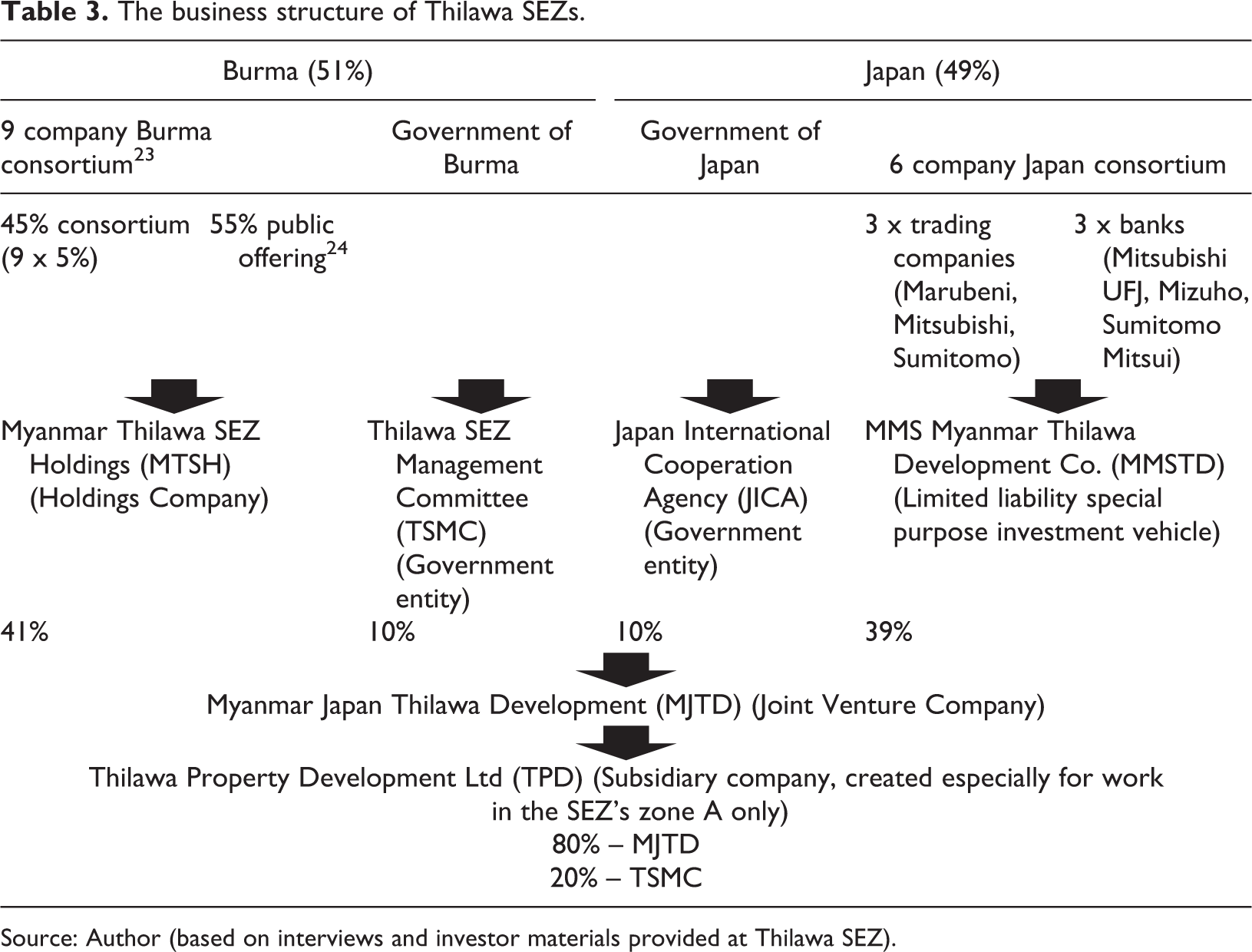
In December 2013, the Japan-Myanmar Investment Agreement was signed, paving the way in May 2014 for the signing of a Memorandum of Understanding (MoU) for Thilawa SEZ (see Table 3)— Myanmar’s first and currently only operational SEZ. This blossomed into an expression of Japan’s standard sanmi ittai (three in one) approach to economic relations: (ODA) the Japan-Myanmar Joint Initiative (2013); (FDI) Japan-Myanmar Bilateral Investment Treaty (BIT); and (Trade) ASEAN-Japan Comprehensive Economic Cooperation (AJCEP). Japan really was fast-tracking its engagements with Burma.
The business structure of Thilawa SEZs.
Source: Author (based on interviews and investor materials provided at Thilawa SEZ).
By July 2015, after various strands of the Japan-Myanmar (issue X) Dialogues, the Ministry of Economy, Trade and Industry (METI) rather ambitiously announced that it had developed the Myanmar Industrial Development Vision. 26 This blueprint for how Japan could reshape the economy of Burma was hand-delivered by Prime Minister Abe to the soon to be outgoing President of Burma Thein Sein.
At the business institutional level, in the form of Japan’s Keidanren business federation and their Japan-Myanmar Economic Conference, there has also been enthusiastic engagement with Burma and the rolling out of familiar policies found across Burma’s neighbours—infrastructure, SME expansion, human resource development, etc. 27
Multi-track re-engagement: Summary
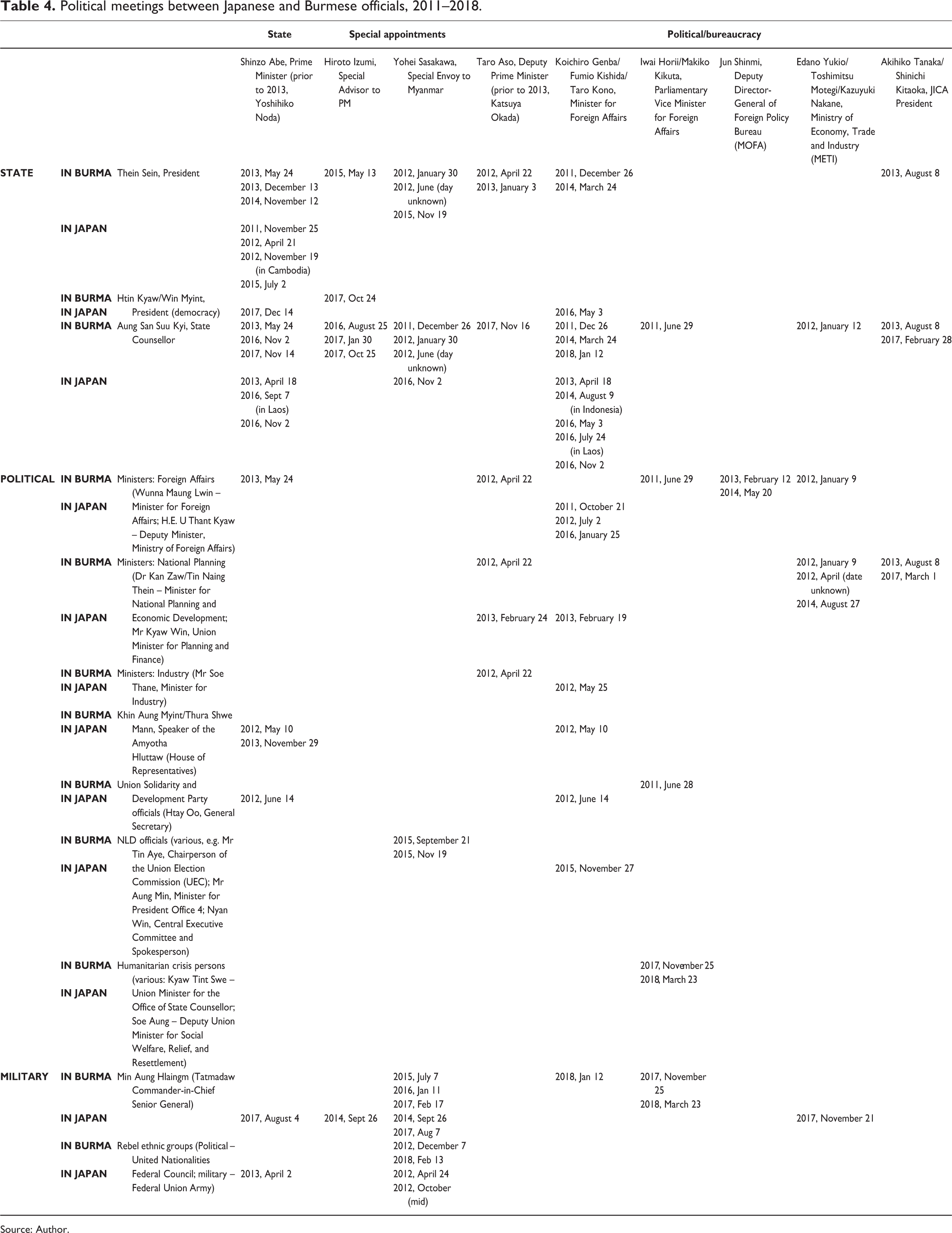
These varying (and voluminous) levels of state, political, and bureaucratic re-engagement are detailed in Table 4. From this “heat map” of political engagements, a series of patterns emerge.
Political meetings between Japanese and Burmese officials, 2011–2018.
Source: Author.
One, there is a clear interest at the highest levels of Japan in both the post-2011 military leader Thein Sein and the popular leader Suu Kyi; relations are not left to the Foreign Minister or lower tier bureaucratic officials—the Prime Minister will just as easily meet Burma’s shifting leadership either in Japan or Burma.
Two, on this last point of sites of meeting, there is a lot of running on the part of Japan. Meetings are often held in Burma with a major priority for Japan around the time of the 2015 NLD/Suu Kyi transition being to organize visits to Japan as soon as possible. Referring below to Figure 6 and Table 4 for more detail, roughly speaking, 28 between 2011 and 2018, at all levels of state, Japan and Burma frequently held public meetings. There was an average of one meeting per month in Japan and one per month in Burma—that is at least one meeting every fortnight. Considering the nature of Japan’s bureaucratic state and that public political meetings are usually little more than the rubber-stamping of under the shoreline work completed by Japan’s bureaucrats, these copious public meetings likely represent only a small portion of the interactions going on daily.
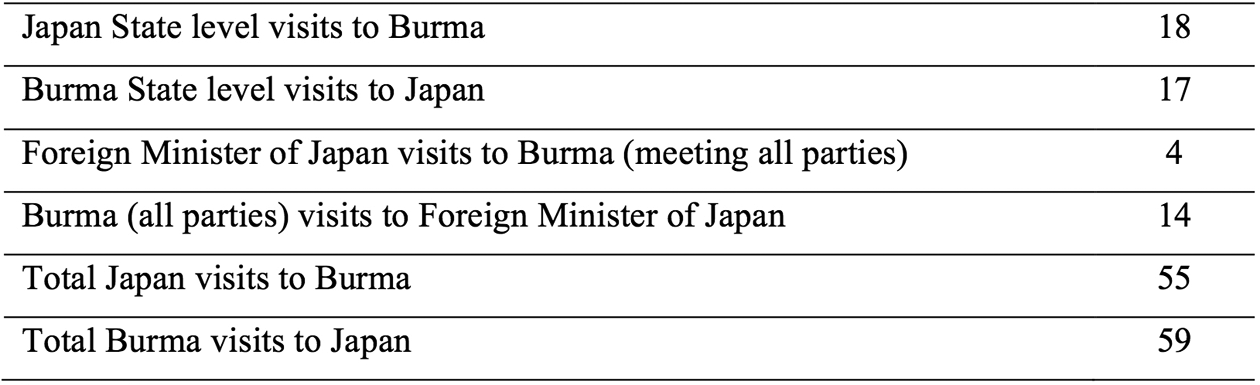
State and political/bureaucratic meetings between Japan and Burma representatives, 2011–2018.
Three, interactions are divided quite properly along democratic channels of communication: PM Abe manages the State (Thein Sein/Suu Kyi), Special Envoy Sasakawa manages the Tatmadaw military relations, Ministers Edano Yukio, Toshimitsu Motegi, or Kazuyuki Nakane from METI meet with the Burmese Ministers for National Planning, Dr Kan Zaw or Tin Naing Thein, and so forth. However, within this standard diplomatic division of labour there exist various anomalies.
First is that Aung San Suu Kyi’s four-part job profile is clearly burdensome. Whereas Japan diplomatically extends to Burma both the standard Prime Minister and Foreign Minister, in addition to a Special Advisor and Special Envoy, all of these channels on the Burma side are usually funnelled through Suu Kyi alone meaning. This means that she is incredibly busy, having to deal with the multiple layers of Japan’s relations with Burma. She also performs similar functions in dealings with all other countries, notably the equally multi-dimensional China.
Second, the other standout hard-worker is Sasakawa Yohei, whose copious meetings with Burma’s rebel leaders and the Tatmadaw rival the number of Japan’s Foreign Minister’s meetings and exceed those of Japan’s PM.
Third, and related, is the relative imbalance of prioritization between the ethnic conflict that Sasakawa is dealing with and the importance allocated to the Rohingya issue, with the former receiving frequent and high-level state interactions and the latter being dealt with rarely and by tier 3 and tier 4 ministers on the Japan side. The deployment of the Deputy Director-General of the Foreign Policy Bureau of Japan’s MOFA in the person of Jun Shinmi and the creation in February 2013 of the Japan-Myanmar Human Rights Dialogue channel, coupled with the use of the Parliamentary Vice-Minister for Foreign Affairs, Iwai Horii, shuttling back and forth between Bangladesh and Burma having tandem meetings about the Rohingya problem, runs a distant second to the activities of Sasakawa Yohei.
Shifting state-society complexes, shifting world orders: Understanding why Japan rushed to return to Burma
Having outlined Japan’s rapid re-engagement with Burma from 2011 to 2016, this section of the article seeks to interpret these developments, asking why Japan has been so keen to rejuvenate relations with Burma.
Japan’s decision to drastically reduce its activities in Burma from around 2003, largely due to the attack on Aung San Suu Kyi, was largely made reluctantly. The affinity for Burma barely waned in Japan’s politico-economic circles during those years and they would likely have preferred not to change their approach to Burma. However, the military state-society relations in Burma had begun to mismatch the US liberal condemnation agenda so starkly that Japan’s usually high bar for tolerating the criticism it received due its engagement with Burma could no longer bare the status quo. With this in mind, therefore, it must be seen that when these factors shifted and the hurdles were removed, Japan was released from its restrictions and rushed to rejuvenate old ties.
These restricting hurdles were: (1) Burma’s changing state-society relations in the form of its democratic transition, (2) state-society reforms in Japan that were, and still are, adapting to shifting international norms and domestic ideological changes, (3) an increasing awareness of the third-place position that Japan is playing to China in Burma and the need to catch-up, and (4) the salience of starkly differing world-order views for how the region that Burma begins transitioning into should be organized.
State-society transformations in Burma and Japan
Burma’s transition and form of state: Confusion, diarchic visions, and the authoritarian democratic model
Since 2010, Burma has been experiencing a rapid reversal of its non-democratic status (simultaneous to conditions in the country’s neighbour, Thailand, moving in the opposite direction). This is both a challenge for Japan, as its long-time support of Burma’s military junta will cloud these transitioning relations, but also an opportunity, as the following points will establish.
Following the National League for Democracy’s boycotted (and Western-condemned) 2010 elections (which, nonetheless, saw military generals exchanging their uniforms for longyis (sarongs) or business suits), multiple liberalizing steps came in quick succession that allowed for the expansion of Burma’s democratic political space. This ultimately led to three key developments. First, Aung San Suu Kyi’s complete release from house arrest and her eventual assumption in March 2016 of “state counsellor”—a position with duties designed specifically for Suu Kyi—with seeming de facto leadership status of Burma. Second, the holding of the first openly competed elections since 1990, with the result of a landslide for the NLD being repeated but this time not ignored. And finally, a range of other liberalizing measures that included the release, or acceptance of return, of political dissidents, coupled with relaxations on free media and free enterprise.
The military regime’s democratization agenda at home has also been matched by an equally thawed attitude to its external relations. Gone are the days of Burma being ASEAN’s embarrassing member. For example, highlighting the problems of the uncritical and consensus-based “ASEAN way”, such as when in 2006 Burma was encouraged not to assume chairship of ASEAN for that year for fear of the reaction from Western nations with regards to their participating in the ASEAN Regional Forum (ARF). When the Obama doctrine of rapprochement began to take effect and Hillary Clinton along with cabinet members from various European countries visited Burma in December 2011, Japan’s political elite immediately took it as the sign it needed to re-engage. Then-US President Obama was received by Burma in 2012 (the first serving US president to be so) and again in 2014; with former general and Burma President leader Thein Sein visiting the White House during the interim in 2013 (the first since Ne Win in 1966). Furthermore, Burma hosted the 27th Southeast Asian Games in 2013, and assumed the 24th chairship of the ASEAN Summit in 2014. This was all very good news for Japan, which—ever since encouraging the post-Communist latecomers of Vietnam, Cambodia, and Laos—has been attempting to foster greater sub-regional and regional integration; using such processes as levers through which to encourage various politico-economic changes in each country.
However, given all of these welcome changes, the political state of Burma is currently confused, diarchic in nature, and increasingly more akin to its authoritarian neighbour Thailand than a fledgling Washingtonian democracy. These features of the contemporary state of Burma need to be dwelt on.
Firstly, the state can be characterized as confused because there exists a de jure president (currently Win Myint) but also a de facto president in the person of State Counsellor Suu Kyi (who also holds the education, energy, and foreign minister briefs in addition to being the NLD chairperson). This is not only a philosophical problem of latent vs. actual power, but also an institutional and legacy issue. The problem with so much being focused on Suu Kyi is that the development of admittedly dull and mundane, but also strong and long-lasting, institutions is becoming less and less of a priority in comparison to the heaping of heavy hopes and expectations on Suu Kyi’s shoulders. When Japan’s first shogun, Tokugawa Ieyasu, was titled in 1603, he only kept the office for two years and then abdicated it to his son Tokugawa Hidetada. This had the benefit of securing a peaceful succession within the feudal system of the day, but more relevantly, bought the time to generate and consolidate institutions that lasted for more than a quarter of a millennium. By contrast, when Suu Kyi’s father, Aung San, was assassinated with all of the country’s hopes and dreams resting on him, institutions disintegrated, political infighting took hold, and the military filled the vacuum for the next half century. Finally, and related to the above, is the notion of legacy. Suu Kyi is 72 years old, and by visual account appears very healthy. However, with so much symbolic capital resting on her, what will happen when she passes away? The reforms she is attempting will likely take decades to embed, if they are embedded at all. This confused political state is a fragile one for the medium to long term future of Burma.
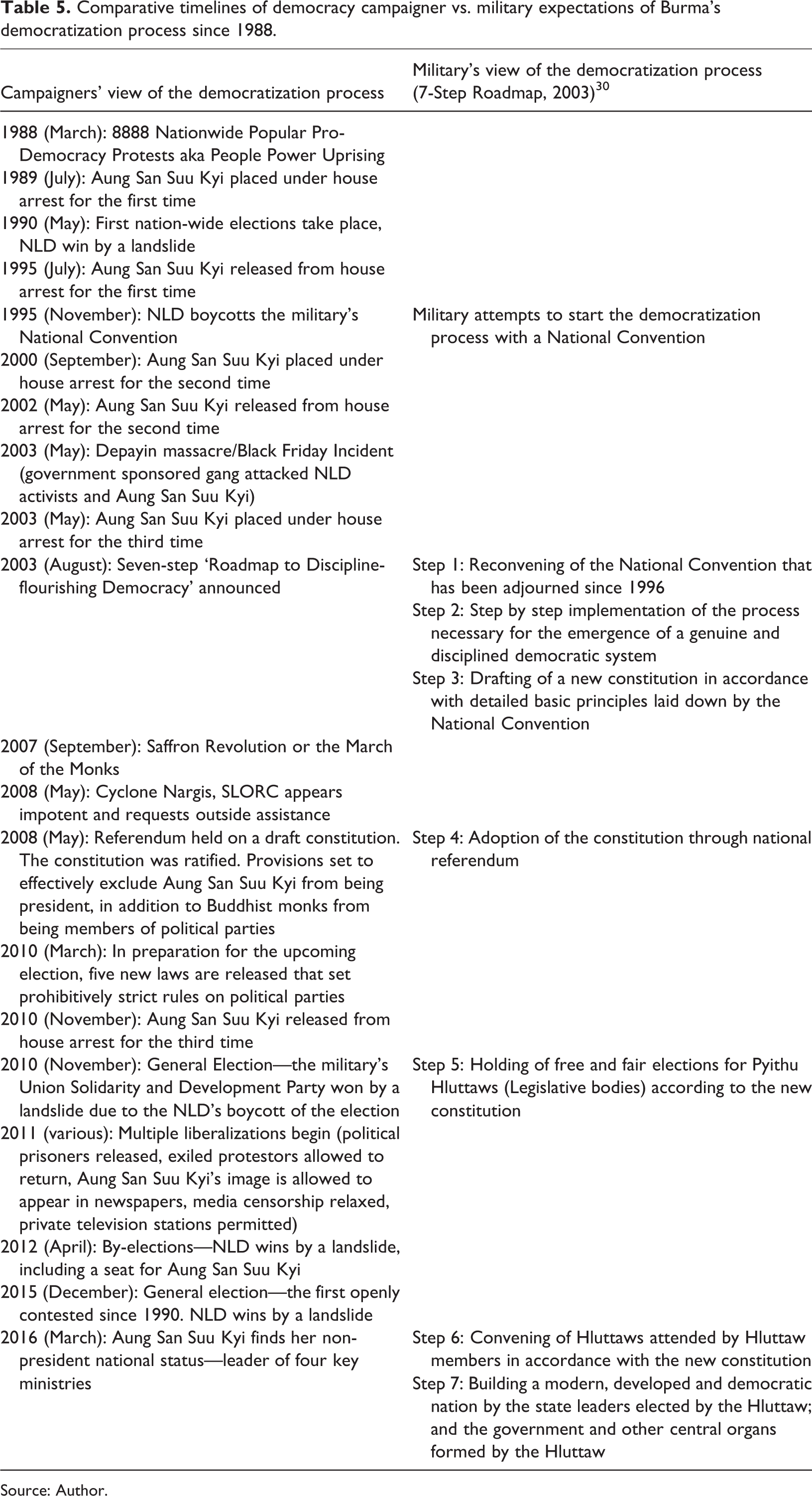
Just as Burma/Myanmar has a diarchic name it also has a diarchic state, worryingly divided between the military and the civilian. The current 2008 constitution is designed for continuity, not a radical break from the past. The military retains a leading role in national and regional politics. They appoint the three most important ministers—defense, home affairs, and border affairs—in addition to a quarter of parliament and local assembly members. Constitutional clause change requires a super majority of 75% and with 25% of members being guaranteed military—meaning that they have a veto on any changes—civilian control over the military has not been achieved and it exists largely autonomously. Furthermore, there exists not only a bifuraction of political actors but also a bifuraction of those actors’ visions. Table 5 presents a side-by-side timeline of Burma’s democratization process since 1988. Since 1995 there have been multiple attempts by the military (they can argue) to start the democratization process, which the NLD have prevented: once in 1995 with the National Convention, then again in 2003 with the reconvening of the National Convention and production of the Roadmap to Discipline-flourishing Democracy, then with the holding of fixed elections in 2010 and full open elections in 2015. There is a narrative, right or wrong, that the military—repackaged at a future date into a conservative Burmese ideological strand—can lay claim to being the progenitors of Burma’s democracy and that the NLD are simply following the framework of the 2003 military created roadmap. This is not an argument that could be convincingly used currently but, given a little more contact and inevitable frustration between the population and the NLD, as the realities of the politics of compromise begin to become more apparent, the diarchic nature of the state of Burma will likely become more problematic.
Comparative timelines of democracy campaigner vs. military expectations of Burma’s democratization process since 1988.
Source: Author.
Finally, there is the concern that Burma may begin to resemble Thailand rather than a liberal Western style democracy. That is, more akin to Thailand as it is, an authoritarian democracy with a military-monarchy deep state at its core. 29 Rather than regard Burma as converging upon the Washingtonian democratic model, it is more reasonable to expect the proximity model of relations to win out and that Burma and Thailand are converging from different points upon the same final destination—Burma, from military junta to authoritarian democracy; Thailand, from (populist) democracy to authoritarian democracy. This is even more likely given that the Burmese military seem to enjoy wearing both camouflage and business suits, i.e. that they seem equally adept at engaging with elections and big business as they are at fighting civil wars in Burma’s northern jungles. This “power behind the democratic throne” is precisely what Thailand has faced since the Second World War, with routine half-decade coup d’états and a facade democracy where the military intervene when politicians are “too corrupt”. A similar co-existence of these two state actors prevails in Burma, with the afore-outlined problem of the military having some (in their mind) claim to the democratization process, and Suu Kyi’s apparent desire to be pragmatic rather than confrontational with the military, meaning that the Burma-Thailand model of the state is a very real future prospect.
This last point is worth pausing on, because there is another factor that justifies the observation of a Burma-Thailand coalescence of state form—the promotion of Competition State style globally-orientated capitalism. 31 Upon assuming office, in March 2016, the NLD shrunk the state by reducing the number of ministries from 33 to 21. This is simultaneous to Burma’s engagement in a grand privatization experiment—another process initiated prior to the current government’s tenure but not halted—that has all the hallmarks of many of Southeast Asia’s other privatizations: the state capitalist tendency to incubate capitalism within the state, with the development of oligarchic rent-seeking behaviour and the selective privatization of state assets and SOEs (large = protect, small = privatize) so as to protect established interests and consolidate their wealth. 32 In July 2016 the Burma government proposed a vaguely defined 12-point economic agenda that prioritized national reconciliation and the fair distribution of wealth, explicitly highlighting natural resources. Little was said however about the issue of the military’s large land-holdings gained from seizure, and their proto-capitalist exploitation of them; and little likely will be said, given that national reconciliation rather than justice or re-distribution is a priority for Myanmar’s new ‘democratic’ regime. This is the cost of Suu Kyi’s position coupled with her intent to keep the military in their sarongs rather than fatigues—she will not make an issue of how much monopolistically gained wealth they have developed, and they in turn will allow her some democracy.
The over-riding objective of Aung San Suu Kyi’s NLD government is national reconciliation. Suu Kyi appears to be continuing the mission of her father—nationalism as the key to unifying a disparate Burma, with all other concerns flowing from that. For Japanese planners, this means that they need to support this agenda first, and then get on with their preferred goal of economic and industrial transformation. This is likely a major reason why Japan is taking the unusual step of sending Sasakawa Yohei, among other officials, into Burma to involve themselves directly in Burma’s difficult internal affairs. However, the term “national reconciliation” can refer to a variety of vaguely prioritized things:
Security: The ending of civil wars
With the insurgency by the Karen against the Burma state, Burma has experienced the longest civil war in East Asia. Indeed, it is harder to locate the states in Burma that do NOT feature some form of insurgency conflict. Conflicts in Kachin State (neighbouring China), Kayah State (neighbouring Thailand), Kayin State (neighbouring Thailand), Rakhine State (neighbouring Bangladesh), and Shan State (neighbouring China and Laos) make Burma’s periphery areas extremely hazardous no-go zones.
Politics: The integration of all of Burma’s many ethnic groups (135+) into the state of Burma
Resulting from the recognition that there is a majoritarian problem in Burma, whereby the ethnic Bamar majority tend to maintain all grips on power, there is an institutional goal to transition towards a de-centred, ethnic, federal state rather than the current unitary state.
Economics: The sharing of all citizens in the economic benefits resulting from increased economic growth and globalization
Understanding that Burma’s vast and untapped natural resources (hydropower, gems, timber, gas, oil, and more) have been an attraction for various outside interests for many decades, the new democratic regime desires to shift away from the military’s force based rent-seeking and towards a re-distribution of benefits for the populace at large.
Burma’s civil society features a highly fragmented ethnic make-up, the longest civil war of the 20th century history in the Karen conflict, and long and porous borders between China and Thailand for the movement of fighters and refugees. This is the starting point of not only the democratization process but also the nation-building process; a process that is, from the evidence of other case studies and historical examples, rarely peaceful and un-bloody. Will Burma be a unitary state and unitary nation or a federal state and multi-cultural nation? The creation of the Ethnic Affairs Ministry in 2016 was one step forward; while the prevalence of Buddhist/Bamar rooted nationalism has contributed to the 2016/2017 crisis of the Rohingya exodus and massacre.
In sum, in terms of the nature and direction of Burma’s democratic transition, the form of state that has developed, and the discordant nature of Burma’s nation, Burma is a complicated country to have relations with. However, this is very good for Japan. A confused state means that there are multiple channels of authority that can be interacted with—precisely the kind of multi-dimensional foreign policy environment that Japan’s preferred ishin denshin (see below) style of “close” interaction prefers. Furthermore, a diarchic state means that long-time gained connections between the military and Japanese elites have not been lost and remain important within the new state of Burma, meaning that the effect of Japan’s West-pleasing self-imposed absence is diminished and the rush to rejuvenate is made easier. Finally, a Burma that moves towards the Thai model of state practice is ideal for Japan because not only is there a long history of politico-economic Japan-Thailand relations that Japan often holds up as an example of a successful case of the “Japan model of development”, but also Thailand’s proximity to Burma means that all of Japan’s existing capacity in Bangkok, together with plans for sub-regional and regional East-West connectivity, can make the Bangkok-Yangon connection a fruitful one.
Japan’s Southeast Asia foreign policy: From mutual understanding, to human rights and democracy, to proactive peace
Not only has the state-society complex in Burma shifted to act as a major pull factor upon Japan, but a change has also taken place within Japan that behaves as an equally motivating push factor. Burma is transitioning during a period in which Japan has an acute interest in Southeast Asia. As the “final frontier” of the region, Burma is representative of the potential completion of a decades-long project Japan has had for the region. Japan’s 1977-initiated three-fold Fukuda Doctrine approach towards Southeast Asia of: (a) economic power rather than military power, (b) mutual confidence building through multi-dimensional engagement and “heart to heart understanding”, and (c) promoting ASEAN multi-lateralized integration, has become rather sharper of late.
Current PM Abe’s five principles of ASEAN diplomacy make for a more strategically defined, “proactive peace” agenda that clearly has China in mind:
Protect and promote together with ASEAN member states universal values, such as freedom, democracy, and basic human rights
Ensure in cooperation with ASEAN member states that the free and open seas, which are the most vital common asset, are governed by laws and rules and not by force, and to welcome the United States’ rebalancing to the Asia-Pacific region
Further promote trade and investment, including flows of goods, money, people, and services, through various economic partnership networks, for Japan’s economic revitalization and prosperity of both itself and ASEAN member states
Protect and nurture Asia’s diverse cultural heritages and traditions
Promote exchanges among the young generation to further foster mutual understanding.
The rejection of military power has been dropped, mutual confidence building has been converted to point C’s “promotion of Japan’s prosperity”, and tellingly, Japan is explicitly calling for the protection of the open seas with a US that actively intervenes. Japan’s foreign ministry might as well simply say it is China they are referring to. And Japan is now more than willing to become proactive with peace rather than to simply keep the peace.
PM Abe’s 2013 Proactive Peace foreign policy is entitled the National Security Strategy (NSS), now an explicitly linked ODA—Japan’s main instrument of intervention in foreign affairs—to security strategy (points 4 and 5). 33 This was followed in 2014 by the start of a revision process to the 2003 ODA charter, 34 producing the 2015 Development Cooperation Charter (DCC). 35
The 2003 ODA charter had been a response to general criticisms, but with particular reference to Japan-Burma relations, that Japan’s ODA programme was overly self-serving and did not concern itself enough with human rights and democracy. The 2003 charter addressed these issues, in addition to declaring the non-military affiliation of any kind for Japanese ODI. Indeed, Suu Kyi quoted the 2003 charter back at Japan in the hopes that the country would cease aiding the Burmese junta and live up to the promise of its own declared principles. Together with the newly restructured JICA in 2008, Japan’s overseas assistance programme was moving towards the OECD DAC norm and model of mixed purposes and joined up organizations. However, with the growing intervention of China in the region, Japan began to shift back to its previously self-interested position. The coincidental timing is unfortunate—that as Japan began to reform, alternative pressures simultaneously created the drive towards competition. Nevertheless, change has occurred.
The 2015 DCC still proclaims the need for non-military activities while simultaneously listing possible objectives such as “promoting peaceful, stable and secure societies”. 36 The 2015 DCC also calls for a more proactive and joined up approach, involving not just single agencies but defence, diplomacy, and development all being brought under the umbrella of the government, and for clear self-interest for Japan to be demonstrable. In addition, and in relation to ASEAN and Burma, due to the inclusion of strategic plans and self-interest (not just open-ended help), formerly economically graduated countries can now return if they are deemed strategically significant. The 2015 strategy is not something completely new; grand policy statements inevitably lag behind real-life developments. Instead it is legitimizing previously occurring activities, and Burma will increasingly be targeted for now legitimate interventions.
This is potentially a double boon for Burma, as Burmese assistance can be justified under the old rubric of “assistance as help” (to industrialize and develop) and the new rubric of “assistance as self-interest” (to serve Japan’s strategic priorities in the region in addition to contributing to anti-China orientated actions). It also makes Burma’s diarchic military/civilian government very attractive to deal with, as Japan is able to connect both of its foreign policy objectives—economic development and strategic priorities—with relevant sections of the state of Burma, which may not themselves agree with each other.
World orders shifts and the Japan-Burma relationship
Not only have transformed state-society relations in Burma and Japan facilitated a rush back into Burma in recent years, but world order transformations have also occurred, adding an extra level of urgency to Japan’s post-2011 drive to re-enter Burma. Although the lifting of US sanctions—and therefore the West’s opprobrium—has been a significant factor in the region, here we must focus on the activities of China. The importance of China in prompting the need for urgency in Japan’s return to Burma is two-fold. First is the direct bilateral competitive threat Japan feels from China’s long-term and large-scale impact in Burma. Second is the global order challenge China represents in offering an alternative image of the world that Burma could transition into; alternate in the sense of not being the liberal and ASEAN regional order that Japan has been encouraging for decades.
China and Japan
Data on China’s ODA activities is notoriously unreliable due to China’s non-membership of international ODA regimes that require international reporting, coupled with its non-release of official statistics related to ODA. However, the research lab AidData has compiled a dataset—the Global Chinese Official Finance Dataset, 2000–2014, Version 1.0—that uses publicly available statements to create a rough map of China’s aid activities. As can be noted below in Figure 7, Japan’s relations with Burma in the context of China’s rapid rise as an externally orientated international economic power actor were placed in a difficult position from the turn of the millennium. Japan’s leaders did not judge the trend well, and once again let their reliance on the US-Japan alliance, in addition to their acquiescence to liberal international norms, jeopardize decades of hard won gains in Burma.
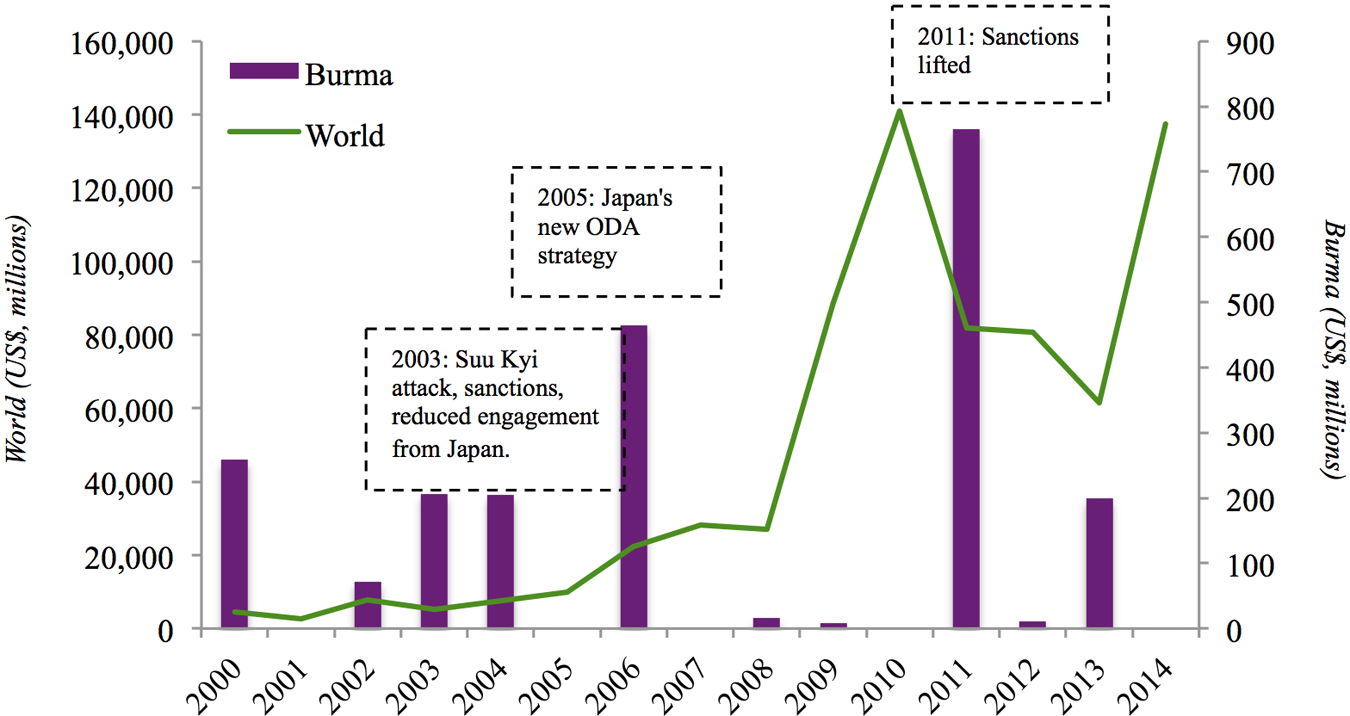
China’s aid and non-concessional official financing, total (world) and Burma, 2000–2014.
Having suffered decades of criticism from the West for its support of illiberal Burma, Japan finally relented to Western pressure to reduce its relations in 2003 after the attack on Suu Kyi. Simultaneously, Japan began to reform its long-criticized technocratic and self-serving foreign policy ODA machine to make human rights and democracy factors in the receipt (or removal) of assistance from Japan. In other words, Japan began slowly to move—in rhetoric at least—towards a more US/European liberal understanding of international economic assistance. However, the timing was inopportune. As Japan moved away, China moved in. A US$258 million loan from China to Burma in 2000 was followed by regular annual loans. 2011, once again, was a particularly special year, as not only did Japan begin offering billions of dollars worth of debt forgiveness and unusually large grants, but China also matched this with a US$758 million loan (and that is only what is known publicly).
During Japan’s absence, China had been gaining in Burma through cross-border trade in the north, in addition to increased Chinese infrastructure development, especially the construction of dams and pipelines (more below). With China’s entry into the aid agenda, pressure now developed for Japan to return to previously conceived strategic objectives rather than staying within the Western human rights and democracy aid regime. As such, China’s filling of the vacuum left by Japan (and the West) created a pull factor upon Japan to return and compete.
Furthermore, the politics of Japan’s reduction of support were poor, and badly timed. A lot of the criticism of Japan’s engagement with Burma’s military had not only come from the West but from Suu Kyi herself in the military years, and Japan had weathered it. Now, as Suu Kyi’s star was rising from the turn of the millennium, Japan finally bowed to Western pressure and reduced relations. This meant that when Suu Kyi came to power in 2015, she was surely going to remember (a) Japan’s long support of the military, (b) her own criticism of Japan, and (c) Japan helping to push Burma into the arms of China. Japan’s sclerotic policy towards Burma had won it the unenviable prize that is always achieved by any party taking the middle of the road position—getting hit from both sides.
That does not mean that China is by default lauded in Burma. The inevitable China relationship is a difficult one. The previous US sanctions against Burma, unlike within the West, are far from wholly agreed with or favourably appreciated by scholars, people in Burma, or even US officials in Yangon. 37 Whatever view may be taken, a conclusion that is often reached is that the sanctions did one thing beyond all else—they pushed Burma towards China, not only the military elites but also many Burmese people who became reliant on Chinese products passing across the country’s northern border. This latter fact of having to rely on inferior and dangerous Chinese products is quite visceral for Burmese people, even today. China’s exploitation of Burma’s large natural resources is also a source of popular complaint, generating considerable anti-Chinese feeling in Burma that is currently being diverted towards anti-Muslim feeling and the Rohingya people. China’s huge hydropower potential in the form of the Myitsone Dam was paused in 2011 due to large-scale local resistance, and overall China currently has an image problem in Burma (although Japan’s similar interest in dams, particularly in rehabilitating its 1960 built 168 MW Lawpita Hydropower Plant No.2, is of equal concern). 38
This present state of Japan-China rivalry is caused by (a) China’s above-outlined advantageously gained position, (b) China’s large and rising economic importance, and (c) China’s geographic proximity. It is also driven by another factor that Japan would prefer to downplay—Japan and China’s assistance to Burma bear more than a passing resemblance to each other. China’s currently claimed commercially orientated, self-interest only style (which may itself be an incorrect evaluation), 39 is precisely what was always claimed about Japan in the past and before Japan aligned in 2005 with a more human rights/democracy driven assistance agenda. Both have usually desired long-term, and maintained at all costs, relations; both have achieved this through quiet and uncritical diplomacy; both have desired to use economic power as their primary foreign policy tool of choice; and both have used their assistance regimes for similar purposes—industrialization largely through energy, communications, and transport infrastructure. There are also major differences of course, but the challenge faced by Japan in Burma with respect to China is not simply one of lost time; it is also one of lost sectorial advantage.
Thus, the post-2015 foreign policy re-focus by PM Abe on Japan’s desire to promote Proactive Peace, i.e. being more strategic and self-interest orientated with its assistance to other countries, is a general foreign policy shift that has been best exemplified in these outlined Japan-Burma-China relations. That is, on the one hand, support for authoritarian forces à la realpolitik (Japan’s relations with Burma’s military) causes criticism of Japan from the West, while on the other, conformity with the West’s liberal agenda causes Japan to lose advantages, hastened by the rise of China. This results in a third position—Proactive Peace—that attempts to promote Japan’s strategic advantage, while also supporting a multi-lateralized liberal order in Southeast Asia and the Mekong peninsula.
Hence we see Japan’s rush to rejuvenate multi-level relations in Burma, coupled with its support through Sasakawa Yohei of Suu Kyi’s national reconciliation agenda (because national unity is a bulwark against the dividing tendencies of some outside actors) and its attempts to further generate multilateral engagements for Burma through sub-regional (Mekong) and regional (ASEAN) integration—anything to keep Burma moving further towards China.
Japan-Burma relations between alternate world order views
There are clear differences between the Japanese and Chinese worldviews for Southeast Asia, and these are well understood by political elites on the ground. This differentiation stands as follows:
40
Japan’s worldview: a free-floating regional ASEAN, intra-regionally integrated, globally multilateral Buffered by—the Japan/US alliance, the Asian Development Bank (ADB), the Asian Highway (starting in Japan) China’s worldview: a China linked ASEAN, inter-regionally integrated, regionally bilateral Buffered by—an increasingly assertive China, China’s Asian Infrastructure Investment Bank (AIIB), the Belt and Road Initiative (starting from China).
Japan’s worldview is the prevailing orthodoxy and one that it has worked hard to maintain for the past half century. Since 1977, Japan’s Fukuda Doctrine has encouraged ASEAN integration, and has done so both bilaterally through specific interventions and multilaterally through the Japan dominated Asian Development Bank (ADB). This operated first through the ASEAN core members, then later in the 1990s with the former Indochina countries. Burma has always stood outside of these developments, which makes this such an opportune time for Japan to attempt the same process as it pursued with the countries of former Indochina, aka the CLV (Cambodia, Laos, Vietnam) growth area.
And yet, this multi-lateralized vision that Japan promotes may not be as close to the West’s vision for Burma or Southeast Asia as Japan likes to suggest. The Director of the First Southeast Asia Division of Japan’s Ministry of Foreign Affairs, Ms Taeko Takahashi, highlighted this succinctly back in December 2001:
41
The EU and the US can be considered one category. They refuse to compromise human rights, democracy, and such fundamental ideals. […] What I consider to be a second category is the ASEAN nations. Myanmar is already an established member of ASEAN, and as fellow members of ASEAN, they take a position of non-interference in each other’s internal affairs in regard to democracy and human rights. Rather, they consider it most realistic to promote democratization in Myanmar through expanding economic contacts and being actively involved in this way. […] The third category, also very general, are countries such as Japan and Australia. That is to say, this is a position which places importance on human rights and democracy as a matter of course, but on the other hand, together with our fellow Asian countries, we prefer not to use sanctions, but prefer to speak as friends.
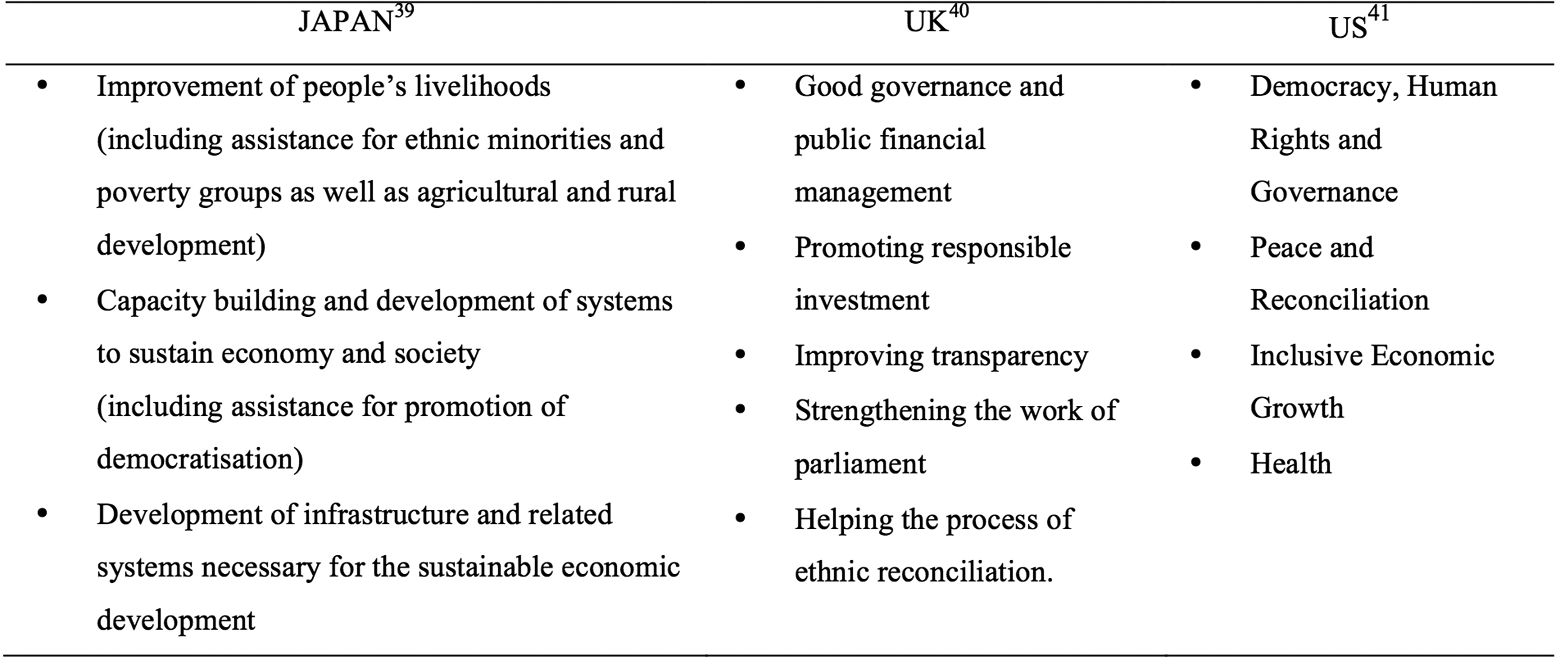
A comparison Ofiapan, UK, and US ODA based policy agendas towards Burma.
The China worldview is one that does not regard the liberal order buffered by the US and Japan as anything necessarily virtuous. China may have used it in order to power its own development, but it has now reached a developmental position where it is able to begin stepping out into the world and creating an alternative order. That alternative order is one that seeks China-centric rather than multilateral plans wherever possible; from Economic Partnership Agreements (EPAs) and Kunming-linked train lines, to China-created and -funded alternatives to the Asian Development Bank in the form of the Asian Infrastructure Investment Bank (AIIB). As the last piece of the ASEAN jigsaw, in addition to being geographically highly important for China’s access to another seaboard, Burma now represents a crucial chess piece in both countries’ strategic desires.
ASEAN, for its part, has often used this dynamic cleverly. ASEAN now serves a bridge-building role that has generated broader East Asian connectivity. Yamamoto Yoshinobu refers to this as a “reverse hubs-and-spokes” organizational model whereby ASEAN would bilaterally link with China, South Korea, and Japan (ASEAN+3). 42 This trend towards a reverse hubs and spokes organization-building approach was used again in 2005, when ASEAN+3 was broadened at the important East Asia Summit to ASEAN+6, which further includes India, Australia, and New Zealand. In other words, a globally orientated multilateral ASEAN is serving a central regional role that otherwise is very difficult to generate between the larger regional players. This is a role that ASEAN leaders enjoy, as it provides them with an asymmetric power advantage but is also supported by a “look-the-other way” acquiescing Japan. It is this ASEAN orientated Southeast Asia order that Japan would like Burma to move towards.
A major foreign policy agenda for Japan in the face of China’s self-connecting efforts, and being limited by being so distant geographically, is to promote multilateralism in the region. 43 This is usually focused on integrating ASEAN more deeply, while China has often been accused of using outlier states (in the past Burma, currently Cambodia) as proxies to sabotage certain ASEAN integration efforts. There is a question as to the degree to which Japan may in fact be continuing in the vein of its Cold War norm of being constrained by bilateralism and so using multilateralism for bilateral ends. 44 Another expression of this drive for multilateralism is Japan’s promotion of sub-regionalism and even micro-regionalism. In the former instance this refers to the Greater Mekong Region (GMS) growth zone, and in the latter it refers to the earlier CLV (now with Burma’s transition, CLMV – Cambodia, Laos, Myanmar, Vietnam) development triangle area (CLMV-DTA). It is no surprise that when new JICA president Kitaoka Shinichi assumed the position in 2017 and gave a keynote speech at a public seminar on the 50th Anniversary of ASEAN, titled Development of the ASEAN Community from the Japanese Perspective, he sang from the same song sheet as his predecessors, and in particular singled out Burma and the CLMV. 45
The GMS of the Mekong peninsula represents a sub-regional project that provides a multilateral policy framework for sub-regional and regional integration. Originating with then-ADB official Noritada Morita in 1984, Noritada saw the potential of turning hydropower in Laos and the excess of electricity generated into a political concept utilizable for sub-regional integration efforts. Since then the ideational components of the GMS sprouted to become, first, the establishment and consensus towards the conceptual creation of economic corridors; followed by the installing of physical connectivity along the economic corridors (infrastructure) (see Figure 9), the sub-national micro-linking of border towns through the creation of SEZs, coupled with their integration into sub-national mini growth triangles (CLMV-DTA), sub-regional production chains (Thailand Plus One, T+1) (see Figure 10), and wider regional ASEAN market integration (AEC). Within this multi-dimensional politico-economic framework, and with the understanding that Japan’s priorities are East-West and Southern Corridor connectivity (pink, yellow, and turquoise, Figure 9), rather than North-South or North-North connectivity (because North-North or North-South connectivity benefits China), it is possible to map out the reasoning for most of Japan’s desired individual projects in Burma. For example, the GMS/Mekong East-West connectivity agenda and the East-West/Southern Economic Corridors help us to understand Japan’s activities in Burma. Japan is thus now in a position to complete a vision for the sub-region that it began over two decades ago.
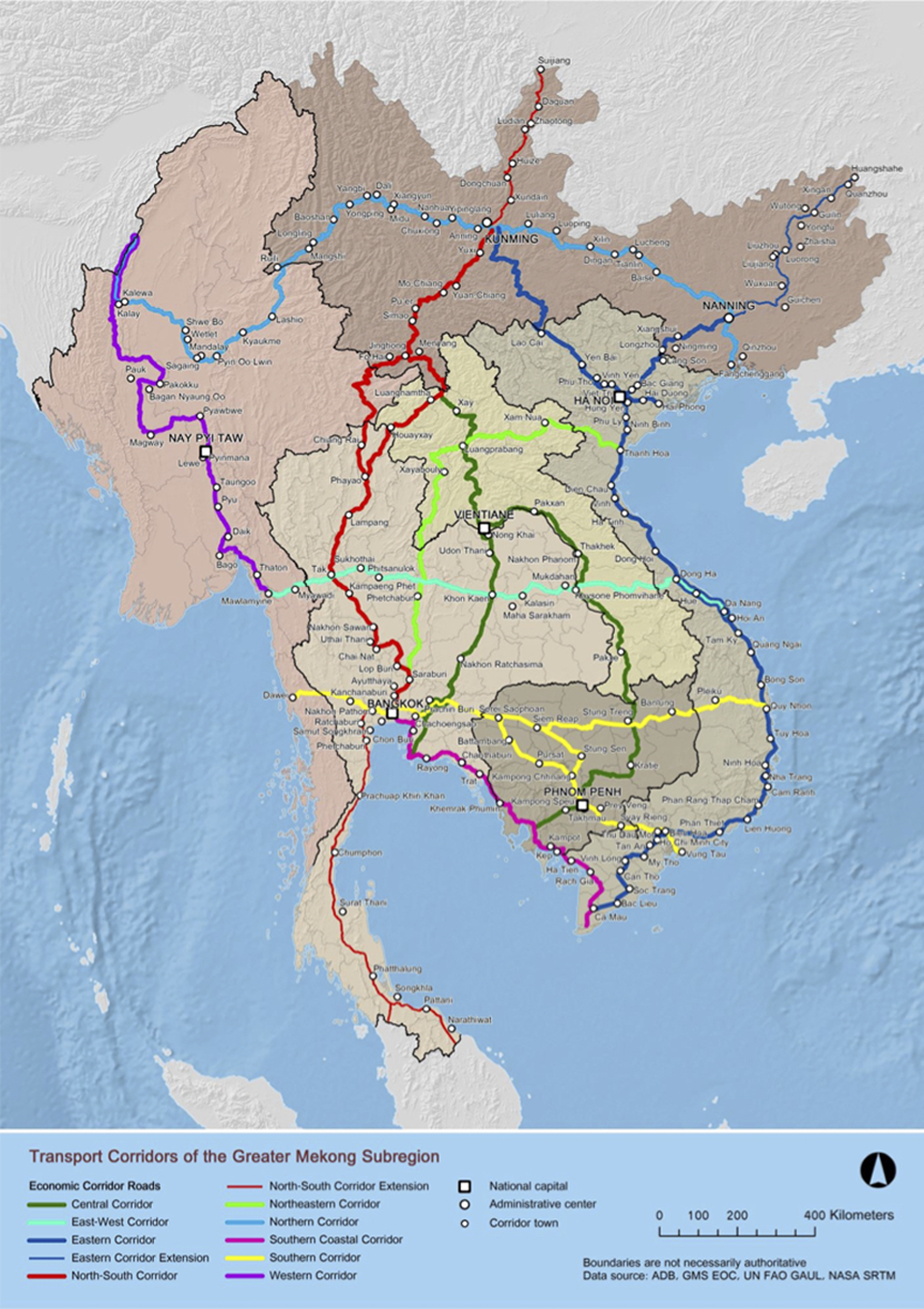
The greater Makong sub-region’s economic/transport corridors (envisioned by the ADB).
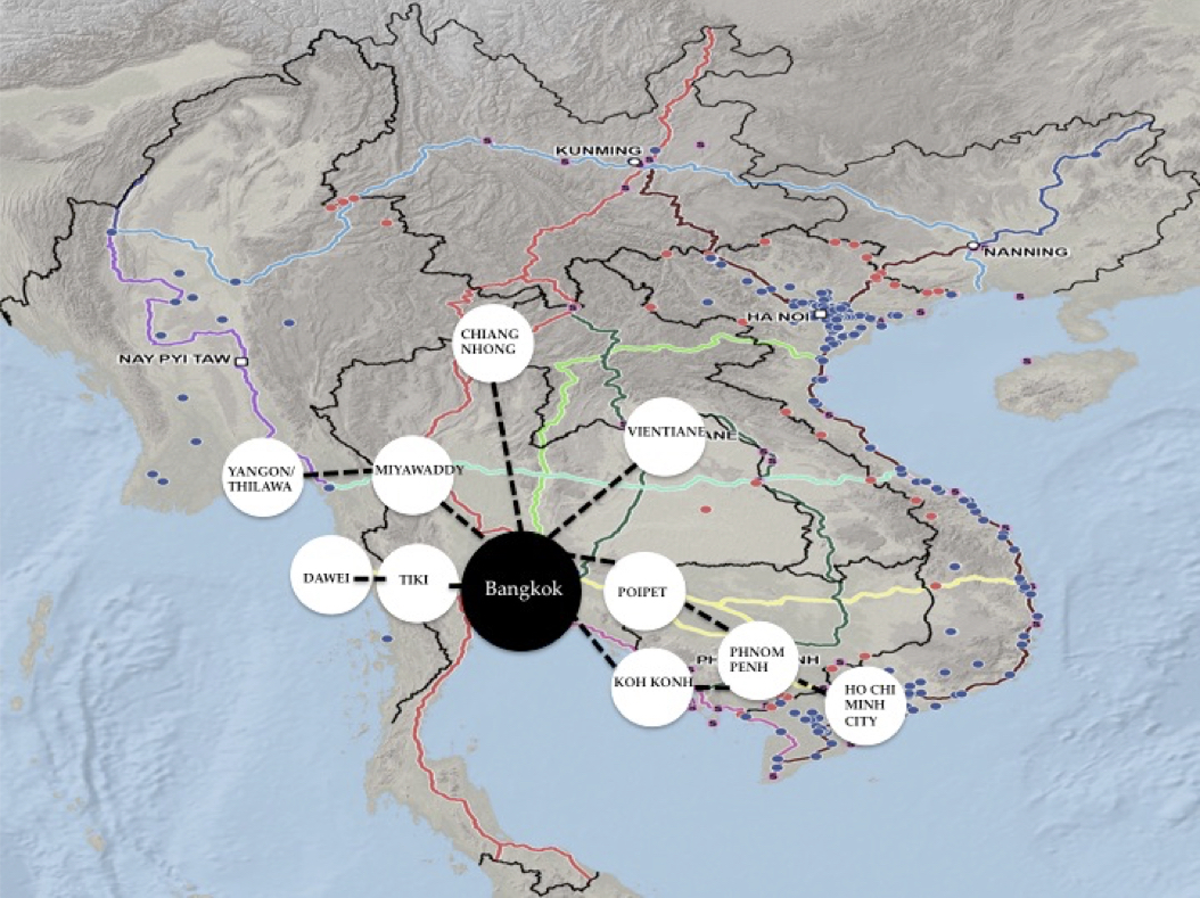
Thailand Plus One.
Social relations of production: Explaining how Japan managed its rush to return to Burma
In this section we move from the “what” and the “why” to the third of our pre-outlined questions—how is it that Japan has been so successful at rejuvenating relations with Burma? This involves an examination of Japan’s material power, institutional power, and ideational power.
Material power in the Japan-Burma relationship: Porting Burma into global capitalism
Production and special economic zones
Being able to assist in the creation of these new legal frameworks allows for first-mover advantages to be gained for projects that are desired. Bringing Burma into regional production and global trading systems means the creation of key geographic production bases through the connection of infrastructure and energy and the building of deep-water ports, all of which are centred on Special Economic Zones (SEZs). Burma has three planned SEZs (see Figure 11), but only the smallest of the three, Thilawa, is developed and currently taking clients. 46 Japan signed an agreement to develop Thilawa SEZ just south of Yangon with then-President Thein Sein in 2012 on his visit to Tokyo for a Mekong Summit (fast-tracked from the year before in a backroom deal by MJA Chair Hideo Watanabe). 47 This came simultaneous to the waiving of Burma’s debt to Japan—a major reason why Japan had previously severed relations—and the site went active in September 2015. In the words of then JICA president Tanaka Masahiko: “We haven’t had any project like this in at least 20 years”. 48 The most recent development, as of April 2018, has been a loan to build a four-lane bridge connecting Yangon to Thilawa directly—the Bago River Bridge (to be completed by 2021). The current journey, as experienced by the author, is very bumpy and uncomfortable. With the bridge, Thilawa could easily become a secondary port to Yangon’s existing port.
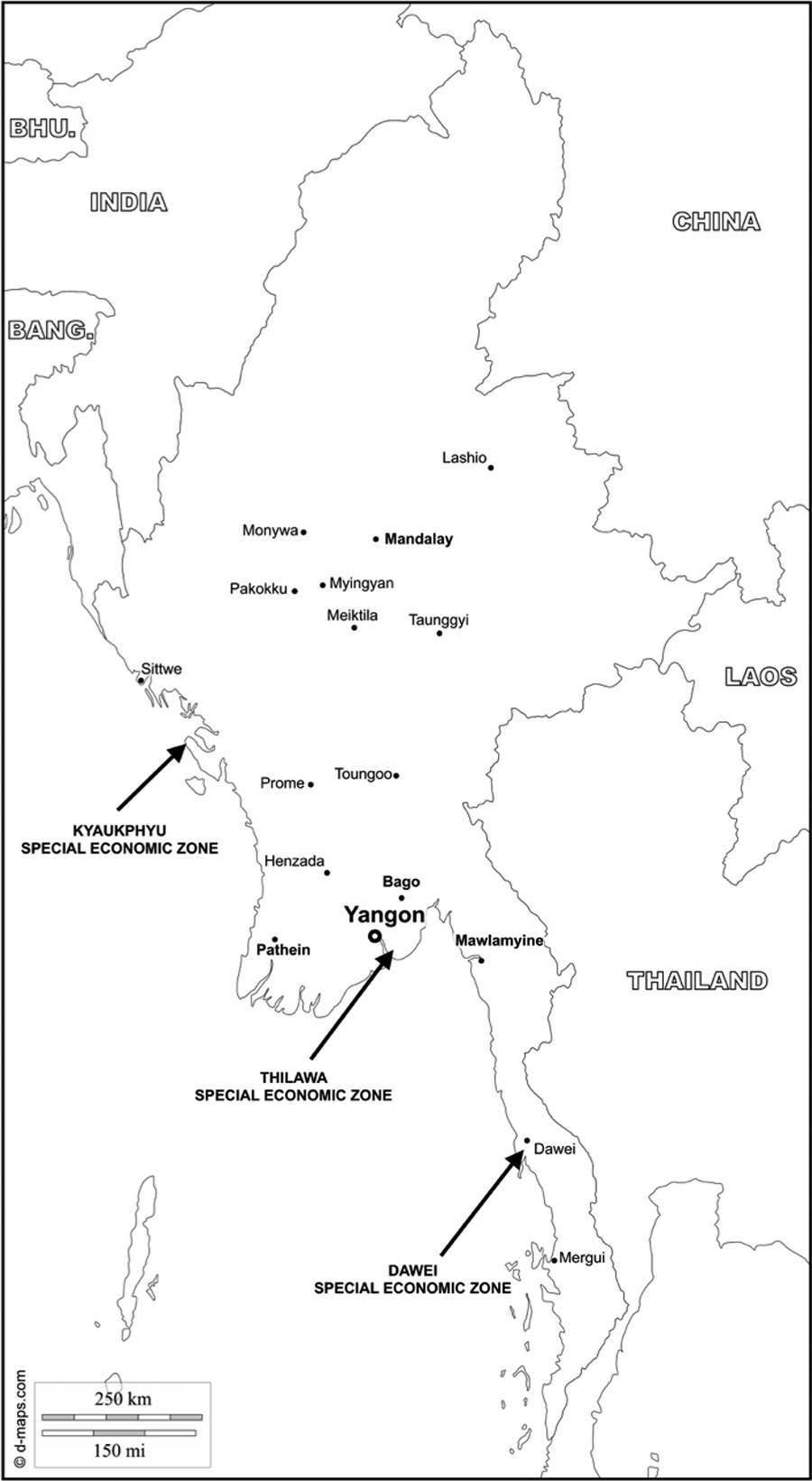
Burma’s three Special Economic Zones.
The echoes of history can be heard here, in addition to the logic of geographic determinism. All colonial invaders of Burma in centuries past knew that the country’s strategic soft spot was its south. The northern topography of the country is difficult, in addition to being perilously close to China. Any intervention into Burma must come from the ocean facing south. This means one of two places. The first is a place that in the British Empire period was Victoria Point and is now called Kawthaung. Not coincidently, the first target for Japan’s Fifteenth Army’s Uno detachment in Burma during the Second World War was Victoria Point, which fell on 15 December 1941. 49 Kawthaung is situated at the narrowest landmass of the Mekong peninsula, and as such has been the desired site for a Panama Canal style intersection—the Kra Canal or Thai canal project—ever since the 1980s. One version of the project would see Mitsubishi Corporation using nuclear weapons to clear a passage across Thailand’s Kra region peninsula. 50 The implications of such an idea would be hugely significant—it could replace the age old Malacca Problem. Second, another key strategic point for the Japanese army to capture in the Second World War was Tavoy, north of Victoria Point but still deep in Burma’s southern region; this fell in January 1942. Tavoy is the former name for what is now Dawei, which—after Thilawa’s integration with Yangon—would provide deep-water port connectivity into global production chains and potentially be Southeast Asia’s largest infrastructure project. Dawei sits in-line with Japan’s East-West/Southern economic corridor focus, in addition to the Thailand Plus One production model. The priorities of the British and Japanese empires were as much priorities at the start of the 20th century as they are now.
Developing SEZs are an important step in the development of a country’s economic industrialization. They are sites from which investment in production and thereby the beginning of trade relations can occur, and offer streamlined administrative advantages that allow for the greater leveraging of future investment thanks to the One Stop Service Centre located on-site. They are a major form of political ties between public and private actors, garnering to the investors almost direct lines to the leaders of the host SEZ. Furthermore, they are sites that through the complex nature of these public-private partnerships (PPPs) allow for multiple externalities to develop, e.g. differing company structures and legal requirements that form the seedlings of a developing awareness of capitalist forms and procedures. Thilawa SEZ is no exception, perhaps even more complex than typical, and is necessarily depicted in diagram form in Table 3. It is 51% owned by the Burma side (41% by a consortium of nine Burma companies, Myanmar Thilawa SEZ Holdings Public Ltd (MTSH), in addition to 10% by the government of Burma) and 49% by the Japan side (39% by a consortium of three keiretsu (a Japanese style consortium) and 10% by JICA representing the government of Japan). Each component of the consortium features a special business entity created to represent it, each component has big business backing, and each features close government relations on the relevant country side. To create one of these arrangements requires a great deal of government-to-government negotiation, an ability to “suggest” the reforming of laws with these forms of development in mind, and a deep set of ready and willing corporate investors.
Myanmar Thilawa SEZ Holdings Public Ltd (MTSH) is Burma’s main body in charge of not only Thilawa, but SEZs in general, and in 2018 they began hinting that they would like to expand the number of the country’s SEZs beyond Thilawa and even Kyaukphyu and Dawei. In other words, the MTSH-Japan relationship can become the main vehicle for the dispersion of SEZs as key nodes of industrialization.
Connectivity: Transport and energy infrastructure
SEZs require two essentials if they are to fulfil their production purpose: transport and energy infrastructure. On transport, JICA’s Myanmar National Transport Master Plan has been designed with corridor based transport infrastructure development in mind;
51
a plan, it should be added, that was drawn up before the NLD’s 2015 electoral victory. The plan has three goals in mind: RAILWAY—Yangon-Mandalay Railway Improvement Project (loan in 2014 for Phase I; loan in 2017 for Phase II) RIVERS—Inland water transport (aids in creating a smoother internal market in Burma) ROADS—East-West Corridor road connectivity (to Thailand’s border town Myawaddy).
Separate is the 2014-commenced, capital city focused, Yangon Urban Transport Master Plan—currently the Project for Comprehensive Urban Transport Plan of the Greater Yangon (YUTRA). In addition, Thilawa SEZ (more below) is a major cross-cutting priority that can be covered by all of the above, with Yangon-Thilawa connectivity, Thilawa-Thailand connectivity, and intra-Burma-Thilawa connectivity all being important in the coming years (Infrastructure Development Project in Thilawa Area—loan in 2013 for phase I; loan in 2014 for phase II). In the future, and given Japan’s co-interest with Thailand in Dawei SEZ, we will likely see similar road/railway projects that connect Burma’s southern regions with the Mekong’s Southern and Southern Coastal Corridors.
All of these Japanese projects are significantly different to China’s, which are focused largely on northeast orientated connectivity between Kyaupkyu, Mandalay, and China’s southern Kunming. These two transport assistance frameworks are thus operating within those broader politico-economic worldview differences outlined above: Japan wants Burma to be connected better with its centre (Yangon) and that centre to be connected with Thailand’s Bangkok, while China is pulling in the opposing northern direction towards its southern border and Kunming.
China’s connecting desires with Kunming are not limited to transport but also involve energy. China used the breathing space it gained from Burma’s sanctions to develop a northern Burma spanning pipeline that, after a number of challenges, not least of which is that the pipeline runs through most of Burma’s eastern and western conflict zones, went live in 2015 (see Figure 12). The Kyaukphyu pipeline allows the transport of gas from Burma’s energy-rich deep-water seas directly into China, while the SEZ also located there affords to China a southwestern border that is less conflict riddled than its southeastern seaboard and the associated South China Seas issue. The emergent property of this mingling of China’s energy needs and Burma’s minority group conflicts is a form of interdependence: China’s desire for a southwestern ocean linkage to the world requires Burmese cooperation, while for Burma to achieve its national reconciliation objective requires Chinese assistance. The two countries are vital to each other, which places Japan’s own high prioritization of Burma in a competitive state and is why Japan has developed its rather unique foreign policy of having a dedicated envoy in Sasakawa Yohei to deal with Burma’s internal conflict issue.
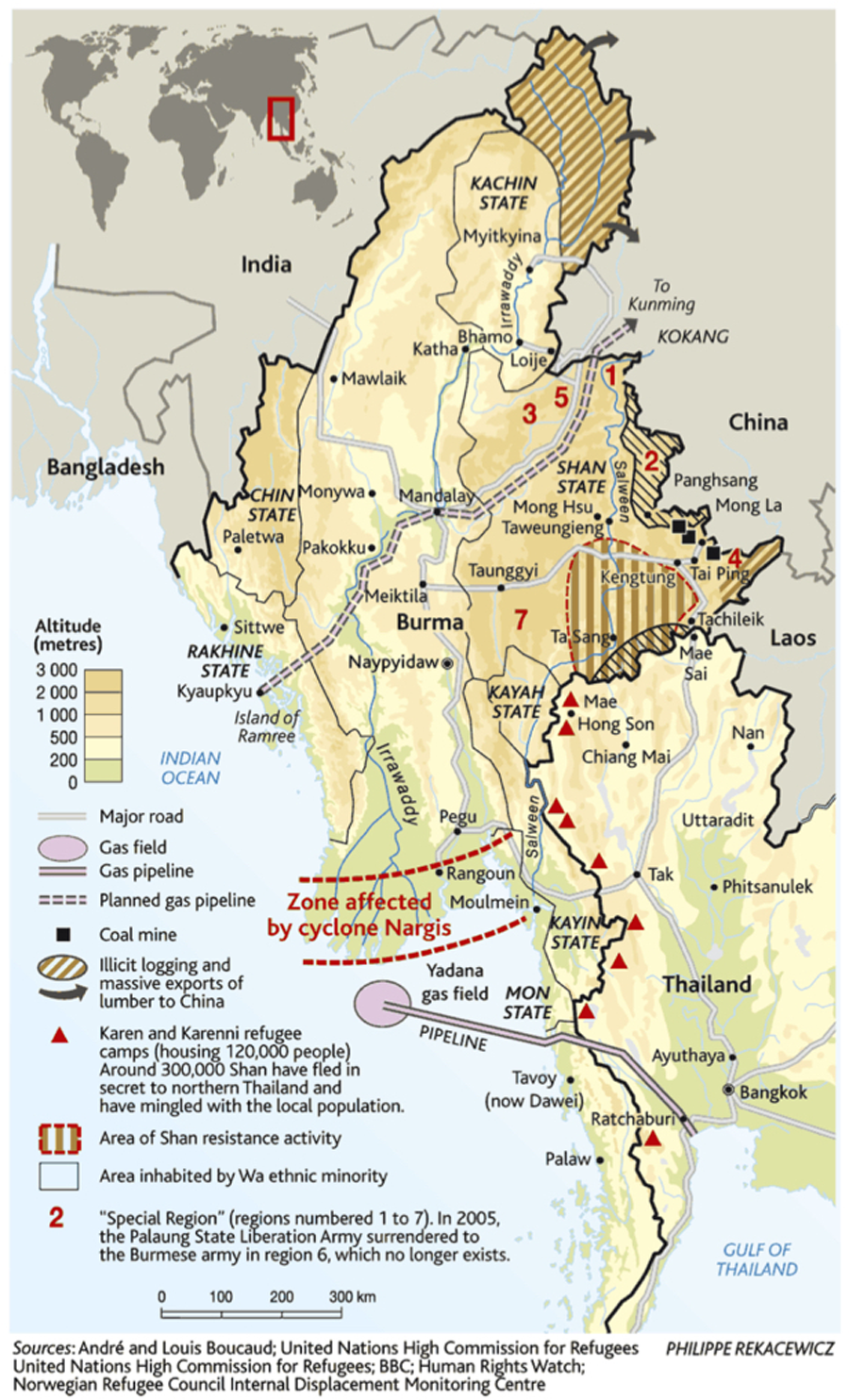
Burma’s two pipelines, north (Kyaupkyu) and south (Yadana), and the peoples affected.
Of more interest to Japan (and Thailand) is Burma’s Yadana gas field, conveniently located south of Yangon, within easy reach of Dawei, and which could easily be connected along the Southern Corridor through Thailand into Bangkok (Figure 11). Japan’s METI, together with Nippon Koei, Mitsui, and Tokyo Gas, is already planning such ventures. 52
Finally, these tug-of-wars are not limited to sub-regional and regional differences in worldviews; there is an inter-regional element also. With Burma opening up, there is the possibility for bridge-building between Southeast Asia and South Asia, in addition to Southeast Asia and Africa. Once full connectivity is established, three potential multi-lateralized strategic outcomes emerge for Japan (see Figure 13):
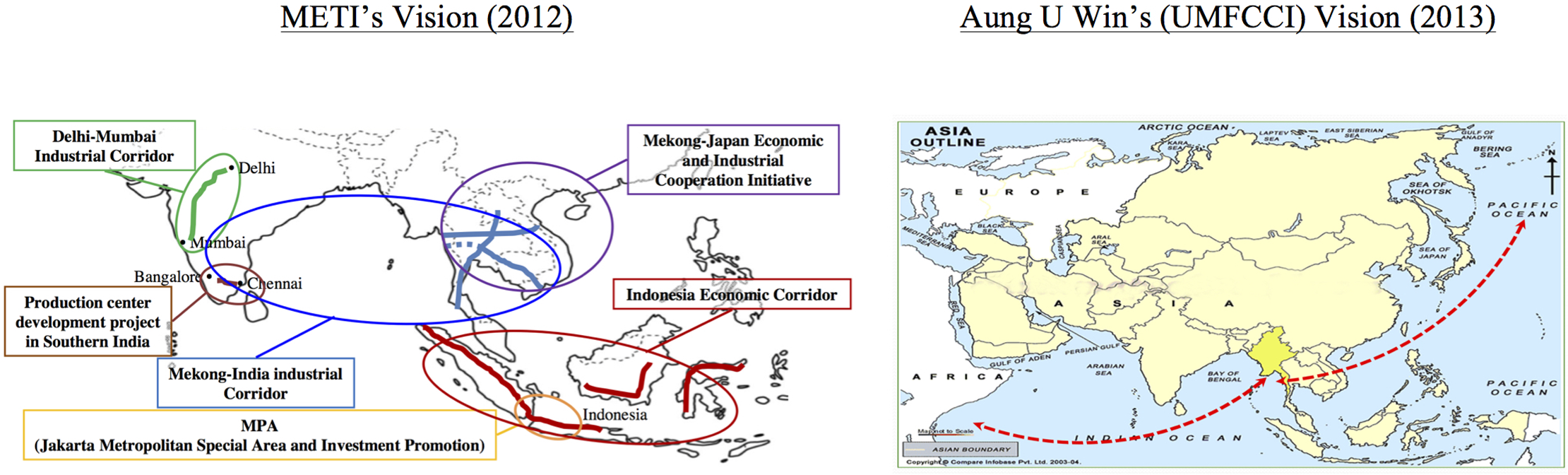
Aligned inter-regional visions between Japan and Burma.
The transport of goods across the Mekong Peninsula, bypassing the Malacca Strait
The development of cross-Mekong and inter-regional energy pipelines
The development of an inter-regional Janus faced production/trading system in the Mekong that allows for a Bangkok based centre, exporting eastwards from Vietnam and westwards from Burma, all centred upon Thailand Plus One.
When frequently Japan-friendly Aung U Win, President of the Union of Myanmar Federation of Chambers of Commerce and Industry (UMFCCI), spoke at a METI conference in 2013 on Japan’s role in Burma, it was little surprise that Burma’s strategic inter-regional location was mentioned. Aung’s presentation may as well have been written by METI itself, and such an inter-regional point was indeed already made by METI the year before (see Figure 13).
Finance and financial sector reform
Burma currently has some major financial issues to deal with, both legacy and potential in nature, and Japan is playing a large role in helping with them. There are four policy orientated financial efforts that Japan is making in Burma. The first is the use of large grants to clear away Burma’s debts, for the real purpose of facilitating Burma’s admittance to the Bretton Woods financial system, and hence greater multilateralization and global integration. The second, and a bi-product of the first, is the then gained ability for Japan to provide large loans (not possible while Burma is in debt to Japan) for the purpose of realizing the above industrialization plans involving SEZs, infrastructure, etc. The third and fourth purposes move more towards the structural rather than bilateral. The third is to allow Japan’s private sector, particularly Japan’s major banks and central bank, to enter Burma and not only to gain first-mover advantages for the inevitable day when Burma engages in fully-fledged privatization, but also for those banks and private actors to be the ones on the inside guiding the process, even acting as models for the various reforms within that process. Fourth, is that reforms of one nature often spill over into the need for broader reforms, and so once in, Japan is able to promote further changes not only to the financial sector but also to many other sectors; for example, from banking practice and currency reforms, to more general state enterprise privatization or business orientated legal changes. In other words, Japan is able to be a major player in the transition of Burma from a planned to a privatized market economy.
On point one, as already noted above, in March 2011 Japan took the lead in dealing with a major legacy issue of the military junta—unpaid debts, which were preventing future borrowing from multilateral and bilateral bodies. The scale of this “generosity” by Japan is impressive simply on face value, but even more startling when the context is considered. Burma did not need this grant to pay back its debts; it could already pay them itself. If, that is, the military’s foreign held funds could be repatriated. In 2013 an analyst at the Banking Information Center (BIC) claimed that Burma maintained US$11 billion in foreign exchange reserves (the government claims only US$7.6 billion), largely in Singapore; in effect running the national account from a foreign power, and causing hesitation for some international bodies in thinking about writing-off Burma’s debts. 53 Strangely, Burma’s Foreign Trade Bank is permitted to hold sometimes even more FOREX than the Central Bank. Furthermore, according to Earth Rights International, a large part of this siphoned-off, Singapore-based FOREX is the military’s—gained through deals done with Total and Chevron on the Yadana gas project (of which Japan’s Nippon Oil is a consortium member), utilizing the country’s then dual exchange rate system. 54 Not only is this an issue of fairness to the people of Burma, but the multiple consequences of this overseas wealth have an impact on Burma’s diplomacy (angering international lenders), politics (allowing the military to remain a financially independent actor), and economics (funds could be used for the payment of imports and the minimizing of commodity price rises). The new NLD government is trying to deal with the issue, and in December 2016 the Central Bank ordered that all bank accounts have to declare details of their overseas accounts. Japan’s 2013 grant/loan package to settle large parts of its debts with Burma was clearly based on an understanding that Burma is not as poor as it would seem and that these loans can be repaid (if Japan does not forgive them first).
On point two, Japan is both funding the construction of Thilawa and creating the local finance mechanisms that will utilize this free market capital funding it. This is the multiplier effect of Japan’s public-private economic power in action, a multiplier effect that affords first-mover advantages, and that was so successfully (from the Japanese perspective) achieved in Thailand with the Eastern Seaboard Development Program (ESDF) between 1982 and 1993—the momentum for Japanese aid in Thailand. 55 Such projects as Thilawa SEZ and the ODA that they justify help to insulate Japan’s sōgō shōsha or other large corporations from the often tumultuous financial realities of remaining in Burma. These actors create an infrastructure that provides for an industrial base, followed by Japan’s financial actors creating a financial base, followed by the ability to marshal the local capital required to expand on that industrial base. This is the only way that expensive foreign companies, and lots of them, can exist in a market as poor and high-risk as Burma; and in turn, the only way that the state of Japan can utilize them in its desire to achieve broader political objectives.
On point three, since 1990, Burma’s banking system has been structured by the SLORC created Financial Institutions of Myanmar Law, but in January 2016 the new Financial Institutions Law was created. Whereas the 1990 law was designed to deal with the transitioning period from state socialism while not changing the 1963 system of nationalized banking, the new law aims to regulate a privatized banking system along with aligning Burma with international best practice in the form of the Basel Core Principles. In addition, in 2013 the New Central Bank Law (replacing the 1990 Central Bank Law) separated the Central Bank from the Ministry of Finance in order to give it independent powers that in the past have not been the case due to an ever-intervening government. Thus it is the case that Burma has a very young set of banking institutions compared to its older system: Old—central bank and four SOE banks, all created in 1976 from a mono-bank New—seven SOE banks or quasi SOE banks, 11 private banks, six public banks.
56
Japanese actors are assuming a major lead in these reforms of Burma’s antiquated banking institutions. Japan is stepping in to help with modernization and in 2012 (completed 2015), Japan’s Daiwa Institute of Research, Fujitsu, and KDDI won a contract for the computerization of Burma’s central bank (seven months after a JICA funded project with the same companies). This means that Japan’s central bank, the Bank of Japan (BoJ), has in large part become the model for the new CBM, in addition to facilitating a more easily understood environment for newly entering private Japanese banks. In addition to central banks are private banks, and in 2014 Japan’s mega-banks of Bank of Tokyo-Mitsubishi UFJ (MUFG), Sumitomo Mitsui Banking Corp., and Mizuho Bank applied for licenses to operate in Burma, and in 2015 MUFG became the first foreign bank in decades to begin lending in Burma. Such foreign bank entries into the private banking sector create externality effects by pressuring state owned banks to further open up and reform. Furthermore, it is a boon for Japanese companies, especially those within MUFG rooted keiretsu groupings in Japan, which will possess pre-existing relationships and knowledge of working with MUFG and therefore gain significant advantages if they desire to enter the Burmese market.
Some are impatient that Burma is not moving fast enough with the reforms initiated in 1990, and that Burma should already be on similar rapid developmental tracks to China or Vietnam, as they experienced from the 1980s. 57 Nijathaworn et al., in their working paper for the ADB, put it succinctly in the opening sentence of their report: “Myanmar’s current macroeconomic policy framework, especially concerning the conduct of monetary policy, is not supportive of a modern market economy”. 58 However, Burma is not reforming its economic structures in a political vacuum. With both political and economic structures changing simultaneously, we are likely only now seeing a Burma on a par with, for example, Vietnam of the 1990s and at the early stages of the Ishikawa Project’s recommendations.
On point four, aside from the adaptation of laws and the creation of new economic entities is the development of new financing mechanisms and concomitantly the injection of capitalism into Burma. Further to central bank reforms, Japan is playing a major role in the creation of Burma’s stock market, injecting capitalism into this socialist economy. Japan’s Daiwa Institute of Research Ltd had formerly created Burma’s second but now dormant stock exchange—the Myanmar Securities Exchange Center—in 1994. Now that similar financial needs have arisen once more, Daiwa has again stepped in. The Yangon Stock Exchange (YSX) is the result of the following financial consortium, which has good ties with Burma: Japan Exchange Group Inc. which runs exchanges in Japan (e.g. the Tokyo Stock Exchange, Osaka Exchange, etc.) Daiwa Securities Group Inc. (Japan’s second largest securities brokerage investment bank) Daiwa Institute of Research Ltd (Daiwa Securities Group’s research arm).
On Friday 25 March 2016, the Japan funded and constructed YSX took its first public listings. It was busy as it was registration day for MTSH (to be listed on 20 May), which would go on to list on the YSX on 20 May. 59 Unsurprisingly, the first stocks traded were those of Burma’s largest and Japanese funded infrastructure project, Thilawa. The older Myanmar Securities Exchange Centre (MSEC) was itself created as a 50:50 joint venture between Myanmar Economic Bank (MEB) and the Daiwa Securities Group for over the counter share trades, and will now be replaced by the digitized Yangon Stock Exchange (YSX), also created by the MEB and Daiwa.
Soft infrastructure in the Japan-Burma relationship: Maintaining close relations
The Japan-Burma elite nébuleuse
Japan’s foreign policy demonstrates a soft power that is not American-style soft power of a popular culture manner. It is elite-orientated soft power. That is, the preference for a quiet, multi-dimensional, elite level impact that may in a trickle-down fashion at some point meet with popular appeal. Robert Cox has referred to this form of practice, and its output of the “unofficial and official transnational and international networks of state and corporate representatives and intellectuals who work towards the formulation of a policy consensus for global capitalism”, as the nébuleuse. 60
This is a cogent way of describing a particular foreign policy style preference amongst Japanese actors that is often little appreciated by foreign observers due to its subtleness. It involves a strategy called nemawashi (laying the groundwork) in Japanese, the goal of which is to produce ishin-denshin (“tacit” or “mutual, heart-to-heart” understanding). This is a normative first, rationalist second, approach to international policy. In practice it involves: (a) constant political engagement (even with unsavoury regimes), (b) constant and frequent institutional and person-to-person contact, and (c) soft power (developing favourable attitudes to Japan proposed reforms and policies). Of course, serious matters can be discussed at these meetings, but they are also chances to have meetings about meetings, meetings to confirm decisions from previous meetings, and meetings about the seemingly trivial. Any of these is fine, because the goal is simply to keep bringing people together to create good feeling and then broach a policy idea (which for the outside observer will appear to come from nowhere).
Despite Japan’s losing of the Second World War, it arguably won the ensuing peace due to its training of multiple Southeast Asian armies and political elites that often emerged as post-colonial leaderships. Joyce Lebra notes how this produced a number of endogenous elites who lasted decades. 61 This accurately describes the case of Burma, as many Second World War Japanese elites active in the country continued their relations with the country after the fighting stopped. At the state level, a so-called biru kichi (biruma kichigai, i.e. “crazy about Burma”) phenomenon developed amongst Japanese officials who administered war reparations during 1955–1967, supported at the societal level by smaller veterans groups, or senyu (war comrades) groups who desire among other things to repatriate fallen comrades’ bones. 62 This is a societal level of connectivity that can nonetheless also have state level interest uses, as was the case for a long time between the US and Vietnam regarding the identification of American war dead. This has blossomed into a pro-business Burma Lobby in Japan, a collective of representatives of Japan’s conservative elite, which maintained a strong interest in Burma over the 20th century. 63 This elite interest from Japan arguably enabled Ne Win to remain in power when he likely would have fallen in or soon after 1962 without economic support from Japan (simultaneously facilitating the entry of Japanese companies into the “closed” country). 64
This Burma Lobby includes: The Japan-Myanmar Association (nihon-biruma kyokai, now nihon-myanmā kyokai)
65
The Japan-Myanmar Parliamentarian Friendship League
66
The Japan-Myanmar Chamber of Commerce and Industry Business Cooperation Committee (nihon shōkō kaigaisho no nihon-myanmā kyōryoku īnkai) Sasakawa Foundation chairperson, Yohei Sasakawa (Special Envoy of the Government of Japan for National Reconciliation in Myanmar) Japanese Burma War veterans’ groups (various), amalgamated in 2004 into the All Burma Association of Japan (zen biruma kai) who commemorate at Tokyo’s Yasukuni Shrine.
The Burma Lobby in Japan was matched for decades after the Second World War by the most favourable of contacts on the Burma side—the country’s formidable leader in the form of Ne Win was one of the Thirty Comrades that Japan’s minami kikan (Minami Organ) had trained alongside Aung San. Furthermore, many of Ne Win’s surrounding officials had been trained by Japanese military and civilian officials and could speak Japanese, and during Ne Win’s 1962–1988 transformation of Burma only the Japanese Ambassador was permitted continual access to Ne Win amongst the wider diplomatic community. 67 During the 1960s–1990s, this historically informed, inter-country elite was able to construct an institutional architecture that continues to serve their purposes even after individual figures have changed position, retired, or died.
However, after Ne Win’s stepping down from—albeit not perhaps completely out of—national politics after 1988, a new generation of Tatmadaw military staff began emerging, whom Japan could not rely on as sharing the same romantic historical memory. Their persistent and even increased pressure on the democracy movement, coupled with increasing Burma-based activists in the West and especially the US (a Washington based Burma Lobby of Burmese expatriates, celebrities, and NGOs became close to the Clintons and the Bushes during the 1990s–2000s), combined to put Japan’s relations with the country and its military elite in a difficult position. Nevertheless, even without historical elite ties, Japan’s general foreign policy approach of seikei bunri (separation of politics and economics) and shizuka na gaiko (quiet diplomacy), combined with the provision of ODA for good behaviour (in the form of further liberal/democratic gestures on the part of Tatmadaw), was likely responsible for Japan’s brokering of the release of Aung San Suu Kyi from house arrest in 1995. 68
Whether Japan’s particular brand of quiet diplomacy has been effective or not is debatable. However, compared to the US’s megaphone diplomacy of the withdrawal of diplomatic relations, followed by eventual sanctions that simply pushed Burma towards China, the fact remains that when transitions occur, such as the events of 2010, Japanese actors Yangon and Tokyo, have ready pre-established relationships, plans, and projects gained from permanently engaged and uncritical relations. This is a significant factor to explain how and why Japan’s re-start in 2011 was so fast and so substantial.
Institutional connectivity in the Japan-Burma relationship
Prior to 2011, Japan’s standard panoply of politico-economic institutions was operating either within Burma or in Japan and acting between the two countries. JICA and JETRO—the former organization dealing with ODA and the latter dealing more with business related issues (but in reality working in close consort with and supported by the state of Japan)—both entered Burma in 1996. JICA’s predecessors before amalgamation, the Overseas Technical Cooperation Agency (OTCA) and the Overseas Economic Cooperation Fund (OECF), entered much earlier. These organizations usually act as the foundational bridging bodies that attract later waves of Japanese actors, and so it is possible to discern how embedded Japan’s public institutions have been in Burma for decades. The role of Japan’s seven major sōgō shōsha (general trading companies) in the area of business connectivity cannot be overstated. They have been in Burma from the beginning, and often play an important political role in relations between the countries. Within Japan these institutions are networked through the long established All Japan-Burma Veterans Association (AJBVA) (for maintaining the historical memory), the Japan-Burma (Myanmar) Parliamentarians’ Friendship League (for maintaining political connectivity), and the Japan-Burma Association (JBA) (for business/economic connectivity). 69
After 2011, however, institutional connectivity has expanded greatly (see Table 6 for a complete mapping). On political institutional connectivity, a Japan Desk in 2014 was created within the body currently responsible for granting permits and re-writing Burma’s legal investment frameworks, the Directorate of Investment and Company Administration (DICA). This is significant because DICA is a sub-division of the Myanmar Investment Commission (MIC), and both are based in Yangon, but MIC is a department of the Ministry of Planning and Finance based in Naypyidaw. Remembering that Burma’s traditional capital city of Yangon was displaced by a move to Naypyidaw in 2005, but that neither foreign embassies nor foreign companies wished to relocate, the military junta permitted the MIC and DICA to exist in Yangon as an outreaching institutional gateway for foreign actors while maintaining ultimate authority in far distant Naypyidaw. JICA traditionally maintained officials within most if not all government institutions in Burma—standard practice in all of Burma’s neighbours too—but with this outreach provided, in July 2014 it moved these from Naypyidaw to Yangon to create the Japan Desk. The Japan Desk is comprised of JICA and JETRO (JETRO’s function is to perform this matching from the Japan side, but these local institutions can provide matching from the local country’s side), and is the only site in the world where JICA and JETRO are located within the same office and within the same institution.
Japan-Burma institutional ties.
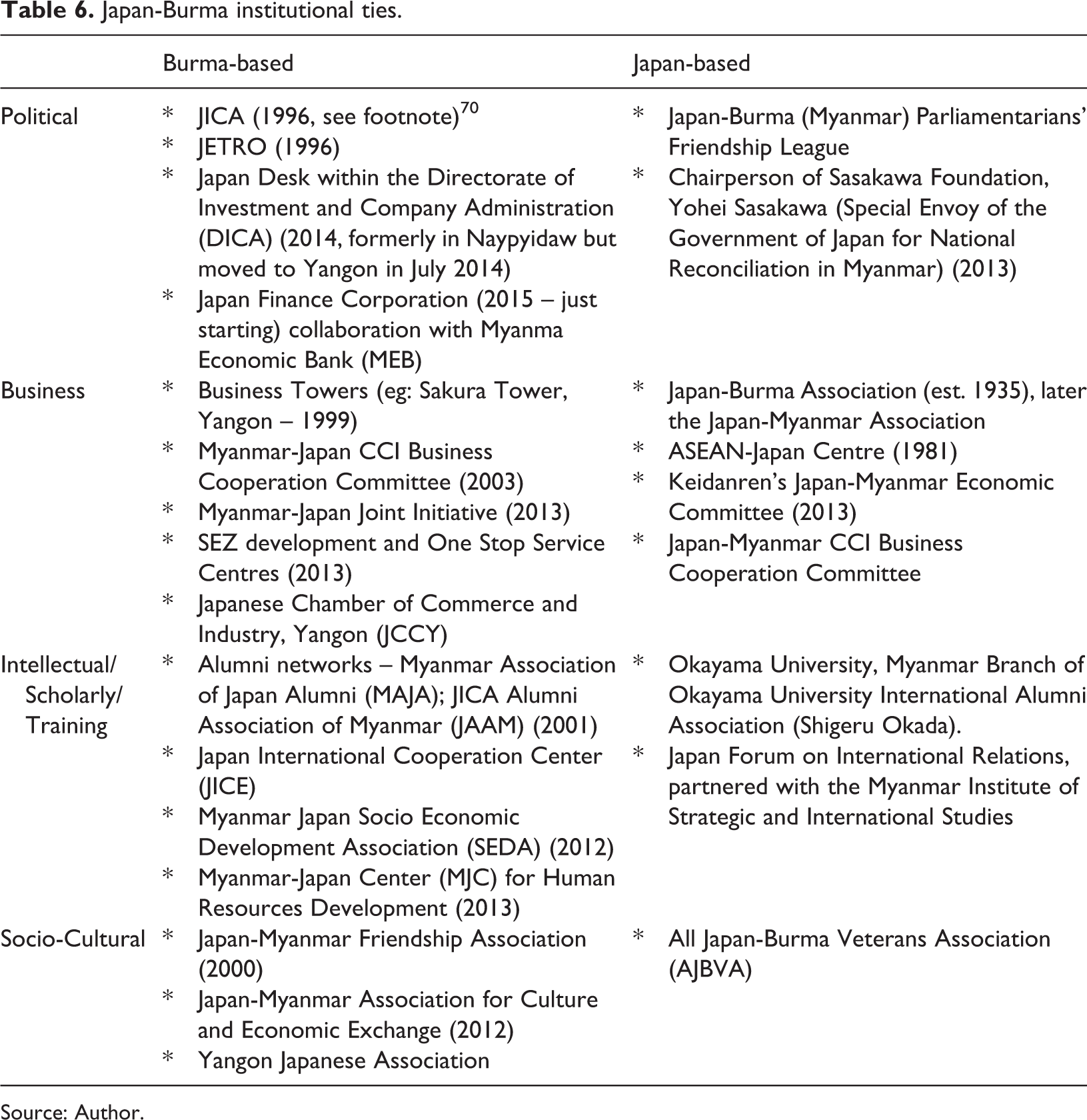
Source: Author.
Regarding business connectivity, one of the first things Japan’s ODA did in Burma was to create a central base of operations through the funding of Sakura Tower in Yangon. This is a premier business tower located in central Yangon and populated by many public and private actors from Japan (including the HQ of JICA), with a good set of restaurants and bars on the roof—important when attempting to network, considering the dubious state of the local cuisine in Yangon. Not only are they provided with reasonable rents but the infrastructure and central location of the tower is also superior to almost all others in Yangon. Next came the habitation of Japanese personnel away from Yangon’s expensive prices, instead locating Japanese staff working on Thilawa at Star City—a hotel/resort complex that is located to the Southeast of Yangon and 10 minutes away from Thilawa. These may seem like small measures but they are not. Burma is currently in the grip of a quiet property bubble. Since 2011, rents have tripled and the cost of living in Burma is comparable to Tokyo. People are not depositing and instead are investing in gold and especially real estate; including military members rich on natural asset exploitation. Bursting the bubble with a property tax is not feasible because many regime elites benefit from it, and in the next few years the NLD and Aung San Suu Kyi are likely going to face a major financial crisis. However, this is not only a capital problem but also a labour problem. High costs of living prevent tier-2 and tier-3 companies in Japan and other countries’ supply chains from investing in Burma; and SME expansion is a major element of Japan’s general current foreign policy. With Thilawa complete, then came the creation of the One Stop Service Centre at Thilawa SEZ which began in 2013. This is a common feature developed by Japan across Southeast Asian countries that allows for the circumvention of potential economic scandals that could occur by dealings with the central government, and instead outsourcing the contact of local country ministry contacts (and therefore the potential for corruption) to the SEZ itself rather than those operating in the SEZ.
On the Japan business side, it is very significant that the Tokyo based Keidanren—Japan’s powerful business federation—established the Japan-Myanmar Economic Conference in 2013. Amongst Burma’s Mekong neighbours, Thailand and Vietnam have dedicated committees within Keidanren which, given their development levels, is understandable. However, Cambodia and Laos do not, and given Burma’s current situation as essentially on a par with the two latter rather than the two former, it is telling that Burma is provided with such elite connectivity in Japan despite the country’s relatively impoverished condition.
Regarding intellectual/scholarly/training (i.e. what Japan refers to as “person-to-person connectivity”), in 2013 the Myanmar-Japan Center (MJC) for Human Resources Development began operations. The MJC is reflective of similar institutions that Japan establishes across the Mekong region called “cooperation centres”. These serve a number of functions including training in Japanese style management and business matching. It is not surprising to find that the MJC is located in the same building (the floor beneath) as Myanmar Thilawa SEZ Holdings Public Ltd (MTSH)—the nine company consortium representing the Burmese private sector portion of Burma’s majority share in Thilawa SEZ (see Table 5). The building they are both located in is significant in its own right, as it is the Union of Myanmar Federation of Chambers of Commerce & Industry (UMFCCI). This means that not only is the MJC one floor away from those dealing with Burma’s first and currently only functioning SEZ, they are also only a few floors away from every major business interest in Burma.
Ideational power in the Japan-Burma relationship: Policy transformation
Integration into sub-regional and regional multilateral agendas is for nought if Burma’s domestic structures lack the ideational capacity to handle the endeavour. Summarized in Table 7 is an outline of this endeavour in Burma, showing a step-by-step Japanese style development package that will develop Burma into an industrialized country. The actors who put this into action are the above institutions in addition to a series of country specialist “organic intellectuals” (usually hailing from Hitotsubashi University). In Burma’s case these key actors, along with JICA, are Odaka Konosuke and Kudo Toshihiro.
Japan’s transformation of Burma’s state-society complex.
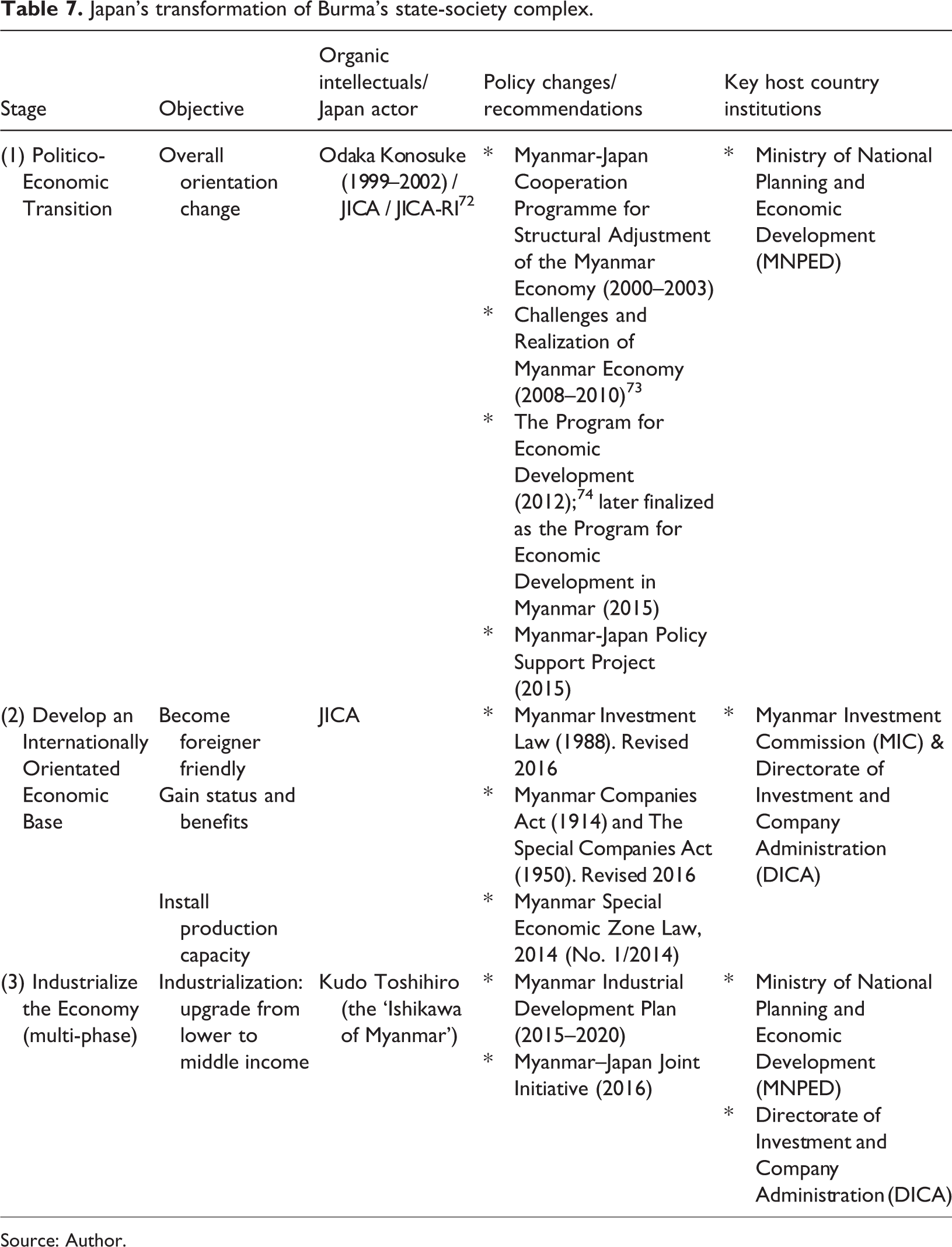
Source: Author.
The first step in this process is politico-economic re-orientation. To achieve this, the main target is the leadership in Burma and the Ministry of National Planning and Economic Development (MNPED). Spearheading this since 2000 (Japan’s 2010 rush to return is a rejuvenation of old plans rather than a creation of new ones) has been Hitotsubashi University’s Odaka Konosuke. Odaka led the bilateral research programme that would produce the goals and policies hoped to be adopted by the then military regime. The Myanmar-Japan Cooperation Programme for Structural Adjustment of the Myanmar Economy study was started in 2000 but stopped in 2003 when the junta detained Aung San Suu Kyi. The report, and subsequent reports, are not particularly unique and recommend what Hitotsubashi professors and Japanese state elites consistently recommend across Southeast Asia—a Japanese model of industrialization and development. Signalling how much Burma matters to Japan, work continued on the study anyway between 2008 and 2010 with the Issues and Challenges for Economic Development in Myanmar study, which was later published in English in 2015 as The Myanmar Economy – Its Past, Present and Prospects. 71 With tensions thawing around 2010, however, the original aims of the 2000 initiated countrywide survey could be reinvigorated, and in 2012 JICA launched the Program for Economic Development in Myanmar. Organized around 16 sectorial working groups, the final recommendations were presented by Odaka Konosuke on 29 July 2015 as the Program for Economic Development in Myanmar (Final Report). These reports by Japan and its intellectuals are incredibly thorough and specific. They can, and in other countries have, become the basis for the government’s own policymaking process.
The second step is the development of an internationally orientated economic base. Japan has worked together with the Asian Development Bank (in which Japan and the US have the dominant roles) to effect micro-level legal changes (with the help of the conveniently located Japan Desk in Burma’s DICA). The 1988 Myanmar Investment Law was revised in 2016 to allow many liberalizing changes. Britain’s colonial Burma Companies Act (1914) and later Special Companies Act (1950) were revised in 2016 (a draft was released for reaction in 2015). The Myanmar Special Economic Zone Law, 2014 (No. 1/2014) was created, which established the legal framework for SEZs; however, given how large they are—both in geographical and geo-political terms—SEZs are essentially a high-politics inter-state affair. Japan’s long-time partnerships with key members of the ruling junta no doubt facilitated the creation of Burma’s only, and therefore main, SEZ—Thilawa. It is therefore logical to assume that, given its creation of Thilawa, Japan would have played a very large part in the drafting of Burma’s first SEZ law.
With re-orientations and legal reforms made, creating the base upon which development can occur is the third step; with the goal being to industrialize Burma. At this point, the second of the previously mentioned Japanese organic intellectuals enters the frame—the IDE-JETRO based Kudo Toshihiro, nicknamed by some Japanese in Burma as the “Ishikawa of Myanmar” (referring to Ishikawa Shigeru, the creator of Vietnam’s post-doi moi Ishikawa Project industrialization plan in the 1980s and 1990s). He has aided Japan to rather audaciously formulate the Myanmar Industrial Development Vision (MIDV), a five-year plan (2015–2020). 75 This exists alongside the Myanmar-Japan Joint Initiative (2013), currently in phase two.
Conclusion
The Japan-Burma relationship is a long and highly prized one by both parties. Japan has weathered many storms and borne a great deal of criticism for the sake of maintaining that relationship and, to a large degree, has played a major role in how Burma has dealt with the churning power structures of the 20th century. However, after the turn of the millennium Japan could no longer bear Burma’s outlier status and the deflected criticism that came with it; relations were severely reduced for around a decade. Burma’s democratic transition—the reformulation of Burma’s state-society complex—has unlocked both the country’s own potential but also the international community to Burma. And so, from around 2011, Japan rushed in to maximize on this opportunity and re-capture all of the influence it had lost largely to China.
A perfect storm of world order state transformation in East Asian power relations has occurred, that has been coupled with shifts in the relations of production in Burma. An alignment has taken place between Burma’s own state transformation and the international context in which that transformation is occurring; an alignment that Japan has recognized and seized heavily upon. Largely driven by the impact of a rising China that regards Burma as just as much a priority as Japan does, Japan has been both pulled and pushed to rush back into Burma and has been facilitated in this by its own transformation of its general foreign policy towards a more strategic and hard-edged “proactive peace”.
This effort of Japan to rush to rejuvenate has been extremely successful. Old institutional and inter-elite ties have been refreshed; these ties have facilitated extreme levels of largesse targeted at Burma to resolve both direct and structural impediments; major policy efforts have been put into place to attempt to guide Burma quickly towards a position of multilateral engagement with the liberal order (rather than a unilateral one connected to China); and material power has been employed strategically to connect Burma through special economic zones, economic corridors, roads and bridges, and energy networks, into both sub-regional connectivity with its neighbours in the Mekong but also regional connectivity with ASEAN.
To answer the question posed at the outset: what has been the nature of Japan’s rush to rejuvenate its relations with Burma? This has been the enormous in size and multi-functional in use distribution of aid assistance from Japan to Burma, clearly to compete with similar levels of economic interventions by China. This has combined with a multi-issue political engagement strategy with unique features designed only for Burma, that have included: (a) a focus on frequent and highest level political engagement, (b) a security/national reconciliation agenda that has seen the state of Japan involving itself directly in the various internal and international conflicts of Burma, and (c) the generation and introduction of a whole raft of economic industrialization proposals for Burma that are both sectorially specific and country re-orienting in nature.
Why has this been such a priority for Japan at this time? A lost decade of influence, the rise of China in both general terms and in relation to Burma, Burma’s importance as the “final frontier” of Southeast Asia, the importance of further integrating ASEAN—all are hugely important factors. Burma is the grand prize of our times. There are few other East or Southeast Asian states that combine three key factors: strategically important, in possession of large and untapped natural resources, and, crucially, politically open to a range of options and a range of allegiances. Japan is attempting very hard to ensure that this land of great potential and horizon-wide range of options moves in the direction Japan wants.
How has Japan been endeavouring to secure its foreign policy goals with Burma? By doing what Japan always does and which has been attempted to varying degrees of success in Burma’s other Mekong peninsula neighbours: use large amounts of public funds to pump-prime private sector investment with priorities in energy and infrastructure, and in the process use economic connectivity to spill over into political connectivity through frequent, close, and multi-level (state, ministry, business) inter-elite and inter-institutional connectivity. This style of doing foreign relations is often lost on Western actors, dominated as they often are by notions of the separation between state and market, the rational rather than social nature of international relations, and the frequent assumption that Japan is a passive or reactive actor in international affairs. The reality is quite different; take Burma as a case study and it is possible to witness just how proactive, strategic, and heavy-handed Japan can be.
It is likely in the future, and is already being witnessed in other Mekong states, that a form of north-south micro-national divide will develop, with Japan focusing on Burma’s south and China focusing on Burma’s north. For Burma is in the midst of a power divide similar in nature to what drove the British and French Empires to draw their spheres of influence the way they did. Burma is simply too important in strategic and resource terms for any large power to ignore it or not want to influence it. It is doubtful whether Burma’s diarchic state has the ability to challenge or guide these overwhelming global forces. It is highly likely that the state of Burma is going to drift towards a formation akin to that of its neighbour Thailand: an authoritarian semi-democracy with the military always ready to take the helm. With Aung San Suu Kyi’s age against her but nonetheless with unattainably lofty goals being piled on her shoulders, there are going to be inevitable disappointments (already with the Rohingya crisis the sheen is rubbing off) in the short to medium term and an issue of succession in the long term. In that time, Burma’s future is going to be set down. And it is a future that is going to be heavily influenced by either Japan’s worldview or China’s. I predict it will be Japan’s, but there is going to be a lot of tension, if not the potential for dangerous conflict, along the way.
Footnotes
Acknowledgements
Grateful thanks are given to the anonymous reviewers who pushed this piece to be better than it was. I am also always thankful for the open access to Burmese and Japanese interviewees during field research in the country. Without such local help, this work could not be what it is.
Declaration of conflicting interests
The author(s) declared no potential conflicts of interest with respect to the research, authorship, and/or publication of this article.
Funding
The author(s) disclosed receipt of the following financial support for the research, authorship, and/or publication of this article: This research has been supported by funding from the Leverhulme Trust (UK).