



Abstract
This article assesses the transformation of warfare during the French Revolution as it relates to the battlefield. It uses as a case study the Army of the Sambre and Meuse during the 1794 conquest of Belgium. In particular, it explores the army’s performance in four battles fought during the year: First Fleurus, Second Fleurus, the Ourthe, and the Roer. Of the four, only Second Fleurus has received detailed scholarly examination to date. To sustain the revolutionary view of military change, the evidence must demonstrate the dominance of French innovations at the tactical and operational levels. In contrast, this article reveals the primacy of evolutionary changes on the battlefield. Overall, French military practices did not radically depart from Old Regime developments, nor did they clearly signal the unmitigated rise of French combat effectiveness.
Ever since Johann Wolfgang von Goethe’s famous proclamation following the 20 September 1792 battle of Valmy, historians have recognized the French Revolution as a turning point not only in political, social, and economic spheres, but also in military affairs. 1 A recent scholarly collaboration scrutinized this transformation in light of the ‘New Military History’, and prominent historians offered tentative theses asserting the evolutionary process of military change. 2 This article reconsiders the theme of military change during the Revolutionary Wars in relation to the battlefield, using as case studies four battles fought by the Army of the Sambre and Meuse in 1794. To sustain the revolutionary view of military change, the evidence must demonstrate the dominance of French innovations at the tactical and operational levels. In contrast, this article reveals the primacy of evolutionary changes on the battlefield. Overall, French military practices did not radically depart from Old Regime military developments, nor did they clearly signal the unmitigated rise of French combat effectiveness.
Since the nineteenth century, analysis of the French Revolutionary army has centred on the legacy of the ‘nation-in-arms’. By assuming that new social and political paradigms brokered military innovations, the ‘nation-in-arms’ school supports the theory of a revolution in military affairs. 3 Maximilien Robespierre himself attributed French success on the battlefield in the ‘year II’ to the elan and virtue of the ‘citizen-soldier’. 4 Moreover, no single image more closely interlocks with the ‘nation-in-arms’ than the arme blanche. 5 Following the Prussian victory in the 1866 Austro-Prussian War, a re-evaluation occurred in the French military. Rejecting the traditional army of the Restoration and early Second Empire, advocates for reform called for reviving the military spirit of the ‘nation-in-arms’, which had supposedly secured victory during the Revolution. 6 Nineteenth- and early twentieth-century historians such as Jules Michelet, Jean Jaurès, and Albert Mathiez supported this narrative and asserted the superiority of French ‘citizen-soldiers’ over Old Regime ‘slave-soldiers’. 7 Rather than constituting a simple product of nationalistic and ideologically committed historians, these views correspond to Revolutionary propaganda drawn directly from political and military sources. 8
The modern culmination of the ‘nation-in-arms’ school emerged with Albert Soboul’s overtly Marxist interpretation of the French Revolutionary soldiers. According to Soboul: In the year II the army of the Republic was a truly revolutionary army, intimately tied to the popular class of society and an instrument of defence for the social and political conquests of these classes. Its inflexible morale, supported by an enthusiasm emanating from the very depths of the people, allowed it to face up to the enemy in the most difficult conditions, and then to achieve victory.
9
For Soboul and earlier generations of French historians, the army succeeded through the rightness of its cause and the enthusiasm of its soldiers. Thus, the Revolutionary socio-political system provided the tools by which the French revolutionized warfare.
In contrast to the ‘nation-in-arms’ school, another group of historians – mainly professional military writers and military historians – emphasize the professionalism of the French Revolutionary army and the long-term evolution of French military practice. Following the disastrous Franco-Prussian War of 1870–1, Camille Rousset proffered a study on the volunteers of the 1790s. A proponent of a permanent and professional army, Rousset dismissed the ‘volunteer legend’, which explained success in terms familiar to advocates of the ‘nation-in-arms’ school. Instead, Rousset attributed French victory to organizational reforms following the amalgame of 1793 and the increasingly professional nature of the French army after 1794. 10 Alongside Rousset, Jean Colin rejected ideological explanations for French success rooted in enthusiasm and moral cause. Rather, he stressed the role of training and discipline in creating a viable combat force from an army of ‘citizen-soldiers’. Moreover, Colin emphasized evolutionary military changes, especially regarding tactics. After studying the Army of the Moselle, he concluded that the French usually attacked the enemy in the traditional line formation with firepower, rather than the famed shock columns of Revolutionary mythology. 11
The issue of French combat effectiveness clearly relates to the revolutionary versus evolutionary debate. Among anglophone historians, Spenser Wilkinson and Robert S. Quimby outline the gradual changes in the French army from the Old Regime through the Napoleonic period. According to Wilkinson, by abolishing social distinctions and forging an officer corps based on merit, the French achieved a level of combat effectiveness that provided clear superiority over socially hierarchical eighteenth-century armies. 12 Focusing on the issue of French tactical superiority, Quimby argues that the revolutionaries adopted tactical systems perfected during the Old Regime. 13 Yet, John Lynn’s pioneering study of the Army of the North asserts French tactical and moral superiority over Old Regime soldiers. According to Lynn, ‘on the battlefield, the combat effectiveness of the [French] rank and file – their tactics and their spirit – explain success’. 14 Despite recent work that propagates the traditional narrative, T.C.W. Blanning rejects notions of French tactical superiority – whether based on evolutionary or revolutionary changes – and argues that numerical superiority proved the key variable in French performance. 15 Most strongly, Paddy Griffith challenges both the revolutionary view and the tactical superiority of the ‘French combat model’ during the Revolutionary Wars. 16 Thus, the revolutionary/evolutionary debate and the issue of French combat effectiveness remain contested among modern historians and merit further analysis.
Excluding Lynn’s study, most historians confront these issues from a macro level, examining changes within the French army as a whole throughout the entire period. While such an approach is crucial, an analysis of the Sambre and Meuse Army in 1794 provides a useful micro-level perspective. 17 It fought four key battles in that year: First Fleurus, Second Fleurus, the Ourthe, and the Roer. Of the four, only Second Fleurus receives much attention. 18 After a discussion of these four battles, the evidence considered will be utilized to support the evolutionary nature of military change as it relates to tactics, organization, and discipline. In all three areas the French Revolution accelerated changes occurring prior to 1789. Regarding the controversial issue of combat effectiveness, despite the evolutionary changes employed by the Sambre and Meuse Army in 1794, the French did not achieve uncontested superiority over the armies of the Old Regime. Although it conquered the Low Countries and reached the Rhine River by the end of 1794, the Sambre and Meuse Army never gained a victory over its opponents sufficiently overwhelming to signal a revolution in military affairs on the battlefield.
I. The Battle of First Fleurus, 16 June 1794
After receiving command of the Army of the Sambre and Meuse on 8 June 1794, General Jean-Baptiste Jourdan, one of the new regime’s leading generals and the victor of the battle of Wattignies on 15–16 October 1793, attempted to execute the orders of the all-powerful Committee of Public Safety. Throughout the 1794 campaign the Committee ordered Jourdan to wage constant offensives against enemy armies and to avoid slowing his pace in siege operations. Yet, while advocating a general strategy of annihilation, the Committee specified geographic points for Jourdan to capture, including Liège, Namur, and Charleroi, presumably through a series of sieges. Confronted with the Committee’s multifarious directions, the commander chose to follow the letter of its orders and formally besiege the fortress of Charleroi, north of the Sambre river (Figure 1). In early June, Jourdan and the representatives on mission with the Sambre and Meuse Army, including Louis Antoine de Saint-Just, member of the Committee of Public Safety, determined to proceed with the operation against Charleroi and cover the siege force with a corps d’observation. Thus, rather than pursuing a revolutionary war of annihilation designed to destroy the enemy army in the field, Jourdan and the representatives conducted a more traditional operation familiar to eighteenth-century norms and representative of the army’s capability.

Map of Fleurus and Charleroi.
Following a period of reorganization, the French crossed the Sambre on 12 June. Jourdan formed his army into an effective force by employing semi-permanent wing commands – an evolution in organization spawned by increasing army size. General Jean-Baptiste Kléber received command of the army’s 30,000-man left wing, while General Francois-Séverin Marceau directed the right wing of 20,000 troops. Jourdan personally oversaw the army’s centre of four divisions: 40,000 men in total. 19 On the evening of the 12th, Jourdan’s force camped north of the Sambre, while General Joseph Hatry’s division besieged Charleroi. The 60,000-man corps d’observation established a 55-kilometre semicircle north of the fortress, with both wings anchored on the Sambre. While his army took position on the 12th, Jourdan informed the Committee of the discipline reigning among his men: ‘All orders were executed perfectly; the intelligence of my commanders and the good order of the troops did not cease.’ 20
On the night of 15 June, an unexpected allied attack repulsed the army’s advance posts. 21 The Dutch stadtholder, William V, Prince of Orange-Nassau, possessed nearly 55,000 Dutch and Austrian troops, which he divided into four large columns and concentrated for battle. 22 Jourdan dispatched orders for his wing commanders: Kléber would march several kilometres west of Courcelles towards Morlanwelz, while Marceau directed the right wing north-east in the direction of Sombreffe. 23 Jourdan instructed General Joseph Lefebvre to move his division further north towards Fleurus to serve as the army’s advance guard. General Jean Étienne Vachier Championnet would advance north to Les Bons Villers, while General Antoine Morlot proceeded north from Charleroi along the Brussels road. General Alexis Dubois formed the cavalry reserve in a second line behind the divisions of Championnet and Lefebvre. Responding to events, Jourdan sought first to attack the allied centre and to subsequently strike one of the enemy’s flanks if his initial assault succeeded. 24
The French conducted the battle in unfavourable circumstances. In addition to being caught off-guard, a heavy fog shrouded the field and made it impossible for either side to determine the enemy’s exact positions. Nonetheless, French organization, professionalism, and tactical proficiency allowed them to resist the allied attack in most sectors of the line, if not to achieve a victory against them. Soon after Lefebvre sustained artillery fire at 4.30 a.m. amid a heavy fog, his division rapidly found itself engaged in a general action against Latour’s column. 25 Although disgruntled and confused, Lefebvre’s division formed a solid line and held the position for several hours against a determined enemy through an effective production of firepower. In contrast to this successful demonstration of defensive tactics, Marceau’s troops collided with Beaulieu’s column shortly after the advance guard engaged the enemy at Fleurus and, though having sustained the first shock, hastily abandoned their position at Velaine. 26 Similarly, in the centre, Championnet’s division deployed to attack Quasdanovich’s column at Saint-Fiacre, yet the allied assault from Mellet turned his left flank. Attacked on three points, Championnet retreated south of Heppignies. Although his troops retreated in good order and formed a solid defensive line, this hardly mitigated the setback. 27
Meanwhile, on the left wing, Kléber ordered Duhesme’s division to Trazegnies, where it exchanged fire with Wartensleben’s troops. Further south, Muller’s division attacked enemy forces around Forchies-la-Marche and Piéton, aiming to outflank Wartensleben’s right. Rather than ordering an all-out attack by his entire wing, Kléber adroitly managed his reserves to good effect. After two hours of ‘a very lively cannonade and fusillade’, Kléber observed silence on his left flank. Realizing that Muller failed to turn Wartensleben’s flank, Kléber prepared a secondary force of infantry and cavalry, including his reserve led by General Joseph Boyer, to assist Muller. Dragoons from the 7th Regiment captured the road to Binche on Wartensleben’s line of retreat, while Boyer directed his cavalry and infantry against the enemy’s right flank. The French cavalry inspired a partial rout of Wartensleben’s troops and the allies lost several prisoners, ammunition wagons, and weapons to the French. Kléber’s recovery signalled the effectiveness of the French system of wing commands, which provided a higher level of organization and greater command and control on the battlefield. Moreover, the combat reveals the success of flexible tactics and the impressive utilization of infantry, cavalry, and artillery to achieve reciprocal affects. Having sufficiently defeated the enemy on his front, Kléber moved his wing north towards Nivelles in compliance with Jourdan’s stated intention of turning the allied right flank. 28
After nearly five hours of fighting, the fog mostly dissipated by 9 a.m. Finally able to observe the overall situation, Jourdan hoped to exploit the advantage gained by his left wing. Assuming that his right wing and centre could hold their positions, he determined to pivot on the divisions of Marceau, Lefebvre, and Championnet. Meanwhile, he ordered Kléber’s wing, Morlot’s division, and Dubois’s cavalry reserve to strike the right flank of the allied centre. 29 On the verge of executing his plan, Jourdan realized that the allies threatened to drive Morlot from Pont-à-Mignetoux. He ordered Dubois to charge Quasdanovich’s column with part of the cavalry reserve, which saved Morlot’s position. 30
Yet, just as Morlot reoccupied Pont-à-Mignetoux, Jourdan received devastating news from his right wing and centre. Marceau retreated from Velaine after the enemy’s second assault, exposing Lefebvre’s right flank to fire from an enemy artillery battery positioned to the east. Furthermore, Quasdanovich forced Championnet’s division to retreat to Ransart. Thus, Lefebvre found the advance guard threatened along its entire front and dangerously exposed on both flanks. 31 For seven and a half hours, Lefebvre’s division endured 14 enemy assaults. While suffering from an artillery bombardment, one battalion of French grenadiers holding Lefebvre’s right flank withstood two enemy cavalry charges. At another point, ten squadrons of enemy hussars charged one battalion from the 13th Demi-Brigade of Light Infantry. Rather than flee, the battalion formed square and vigorously resisted the cavalry charge. Lefebvre credited his division’s hardiness to the ‘sang-froid that characterized the French soldier’. 32 Such performance reveals an impressive professionalism that probably prevented the complete collapse of the French centre and a decisive allied victory. Nonetheless, shortly after midday Lefebvre informed Jourdan that the advance guard’s lack of munitions forced it to retreat towards the Sambre. Coupled with the retreat of Marceau and Championnet, these events unravelled Jourdan’s plan and led to the French defeat. 33
The battle cost the allies 2,196 men killed or wounded, 7 guns, and 600 prisoners, while the French lost around 3,000 killed or wounded and 8 cannon. Although it proved less than a decisive victory for the allies, First Fleurus marked a clear defeat for the French. Expectations of victory against demoralized ‘slave-soldiers’ proved illusory against reality on the battlefield. 34 Revolutionary doctrines of shock and enthusiasm played little role in the battle and could not secure a decisive triumph against the disciplined professionalism of the Old Regime. Although they failed to provide victory in this instance, several evolutionary changes in tactics, organization, and discipline allowed the French to survive the defeat and continue the campaign.
II. The Battle of Second Fleurus, 26 June 1794
After recovering from defeat, the French crossed the Sambre on 18 June and occupied their previous positions. 35 Throughout the following week Jourdan observed the siege of Charleroi, while covering forces established defensive entrenchments across the line. 36 The Army of the North sent Jourdan an entire brigade of 6,000 men commanded by General Charles Daurier, which he posted at Fontaine-l’Évêque. After a week-long siege, Charleroi fell to the French on the 25th. Hatry’s division moved alongside Dubois’s cavalry reserve at Ransart to support the line in a general engagement. 37
On the morning of 26 June, an allied army led by Feldmarschall Josias, Prince of Saxe-Coburg-Saalfeld, attacked the French. Coburg divided his army into five columns and planned to drive Jourdan’s troops across the Sambre by assaulting them along the entire front. Given the additional reinforcements and reserves of the French, Coburg’s 55,000 men faced a greater challenge in breaking Jourdan’s line than the stadtholder faced at First Fleurus. 38 Moreover, the French leadership seemed inspired by a new moral imperative. In the political climate of the Terror, Jourdan understood that his fate depended on the outcome of the battle. Desiring to maintain sufficient strength in his sector of the front, the commander overruled an order by Saint-Just to send 30,000 troops from the Sambre to reinforce the Army of the North. In response, Saint-Just announced that the commander’s head rested on the outcome of the impending battle. Certainly, this realization compelled Jourdan to defend his line to the extreme. 39
Despite continued exhortations from the Committee to fight offensive battles, Jourdan adopted a defensive approach, first to guard Charleroi and then to react to Coburg’s attack. The French left wing received the first allied assault at 2 a.m. between Trazegnies and Forchies-la-Marche. General Philibert Charles Montaigu’s division, occupying entrenchments in front of Trazegnies, sustained a violent artillery barrage. Yet, allied forces under the Prince of Waldeck attacked the heights of Trazegnies, forcing Montaigu’s beaten division to retreat south-east through the woods of Monceau to Marchienne-au-Pont. 40 Meanwhile, Dutch forces led by Prince Frederick of Orange easily repulsed the French from Fontaine-l’Évêque and advanced to the heights of Espinette and Wespes. 41 On the French right the situation proved even more perilous for Marceau’s troops. Around 2.30 a.m. Beaulieu led his column against Marceau’s forces at Velaine. Beaulieu’s attack turned Marceau’s right flank and the French redeployed at Lambusart. Following a sharp artillery cannonade, a cavalry charge of 3,000 allied troopers quickly turned the retreat into a rout. In panic, Marceau’s division fled across the Sambre at Châtelet. Fortuitously for the French, Marceau managed to regroup around 500 men to hold Lambusart. 42
From the Piéton stream to Fleurus, an allied bombardment hammered the French centre at 4 a.m. 43 Quasdanovich advanced south against Morlot’s division along the Brussels–Charleroi road, and eventually came under musket fire from French troops deployed in line behind entrenchments. Meanwhile, Kaunitz directed his column against Championnet’s advance posts formed to defend the position in line. Championnet’s troops maintained their positions throughout the first half of the day. 44 To Championnet’s right at Fleurus, Lefebvre’s division found itself in a delicate position. Receiving the attack of Archduke Charles’s column on his front, Marceau withdrew, which dangerously exposed Lefebvre’s right flank. 45 Thus, across the front, the French failed to achieve tactical breakthroughs during the start of the battle, but remained on the defensive in line formation. While allied forces gained the initial advantage on both French flanks, the French held firm in the centre. Fortunately for the French, organizational reforms, flexible tactics, and disciplined professionalism stemmed the allied attack and allowed them to eventually turn the tide.
Most crucially, Kléber recovered from Montaigu’s retreat and re-established the left wing along the Piéton. General Duhesme moved his fresh division west to recover Montaigu’s virtual rout. 46 General of Brigade Jean-Baptiste Bernadotte guarded the passages of the Piéton with the 71st Demi-Brigade. 47 Between Duhesme and Bernadotte, Kléber marched three fresh battalions, two squadrons, and several pieces of cannon west through the Monceau Woods. Following Kléber’s advance, Bernadotte gathered one brigade and advanced further north-west against Courcelles. Bernadotte launched two attacks with skirmishers sustained by a bataillon en masse against a superior Austrian battery, both of which failed. Although the French could not achieve a breakthrough in this sector, William V could not long resist the general attack across his column’s front. By 2 p.m. the French left wing reoccupied Courcelles and saved Marchienne-au-Pont, yet exhaustion inhibited further advance or pursuit of the enemy. 48 Once again, Kléber’s success was owed not to shock tactics or ideological enthusiasm but to organizational changes and other evolutionary factors such as discipline and flexible tactics. Bernadotte, for instance, noted the ‘discipline and courage’ of the 71st Demi-Brigade, indicating the overall professionalism prevailing in the ranks despite the earlier setback. 49
Although Kléber recovered the left wing, the battle hinged on the severely weakened right flank, which Marceau’s retreat exposed. Soult summarized the first hours of Second Fleurus in terms that capture the unease within the French camp: ‘Having become general from the beginning, the battle was disadvantageous to us for twelve hours; no person could know what the outcome would be.’ 50 Observing that if the allies overran his right flank at Lambusart the battle would be lost, Jourdan ordered his reserves to bolster that critical point. 51 Lefebvre sent Marceau three requested battalions and one company of light artillery to protect his own right flank, while troops from Hatry’s division arrived for further support. 52 With these reinforcements Marceau reorganized a cohesive right wing in the midst of the battle, and prevented Beaulieu from capturing Lambusart and debouching against the army’s flank and rear. Yet, the Austrian commander managed to insert several battalions into the eastern portion of the village, where his troops engaged the French in hand-to-hand street combat. Lambusart soon caught fire and Beaulieu saw that ‘a barrier of flames’ prevented his troops from advancing deeper into the village. 53
Meanwhile, Jourdan sent the rest of Hatry’s division and the cavalry reserve of Dubois from Ransart to Wangenies, where they supported Lefebvre’s division against Charles’s column. Between 1 and 6 p.m., Charles and Beaulieu directed their troops against French entrenchments between Fleurus and Lambusart. 54 Beaulieu formed his battalions into columns and attacked the French position with artillery support. Lefebvre’s men repulsed three Austrian assaults with superior musket and artillery fire, employing the same defensive tactics used effectively against the French by the Prussians at Kaiserslautern in November 1793. 55 After resisting the Austrian assaults, Lefebvre organized a counter-attack around 5 p.m. His riposte witnessed the utilization of attack columns supported by effective artillery fire. In addition to demonstrating discipline throughout the day, his troops provide the best example of French tactical flexibility, resisting the Austrians in line earlier in the day, while assailing them in column during the pursuit. 56
After the enemy retreated from the Lambusart sector, the French sent a small number of cavalry and light infantry forward. By nightfall these forces returned, too tired to pursue vigorously. 57 Although Lefebvre repulsed the attacks offered by Charles and Beaulieu, it seems the allied high command decided to conclude the battle earlier in the day, before the French counter-attack commenced. Around 4 p.m. Kaunitz’s column forced Championnet’s division to cede Heppignies. Championnet redirected his division and reinforcements sent by Jourdan against the town and repulsed the Austrians. Nonetheless, Kaunitz re-formed his troops and seemed capable of launching another assault. However, shortly before 5 p.m. the French observed Kaunitz’s column retreating north in good order. 58 Sometime around 4.15 p.m. Coburg received news of Charleroi’s capitulation. Combined with his army’s failure to break through Jourdan’s defensive line or to envelop either wing, this news convinced Coburg to terminate the battle. By 6 p.m. each of his columns ceased their attacks and retreated in near-perfect order. 59 The French were too exhausted to pursue, and spent the next day resting and cleaning debris and corpses from the field. 60
Thus, the French victory at Second Fleurus occurred in conditions that invalidate the triumphalist interpretation of the battle. The soldiers in the allied army had not been defeated, as much as poorly led. At the level of high command, the French Revolutionary socio-political system bore fruit: for French commanders during this year of the Revolution, victory often determined life and death. Yet, even a highly motivated officer corps could not secure the battle of annihilation that the Committee desired. Second Fleurus was a hard-fought battle for both sides, and the certainty of victory was lacking. Had Hatry’s corps been unavailable as at First Fleurus, or had Coburg not dispersed his numerically inferior army in a broad attack, it is entirely possible that the outcome would have been different.
Nonetheless, the Revolutionary explanations for French success – shock tactics and enthusiasm – appear unconvincing. In terms of tactics the French utilized a variety of tactical formations throughout the day. These exploited the advantages of both firepower and shock at appropriate moments. For instance, the divisions of the French centre relied on traditional defensive tactics and firepower to repulse the allied attacks during the early part of the battle. After the battle’s climax, Lefebvre formed his division into columns to assail the exhausted and retreating troops of Charles and Beaulieu. Moreover, the French demonstrated an increasing professionalism by effectively coordinating attacks with the three combat arms. Clearly, this allowed Kléber to defend Marchienne-au-Pont and prevented the allies from assailing the French lines of operation. Flexible tactics combined with an efficient system of higher-level organization and increasingly disciplined troops to give the French the chance of victory at Second Fleurus, yet the outcome proved far from inevitable.
III. The Battle of the Ourthe, 18 September 1794
The battle of the Ourthe remains a ‘forgotten battle’ in the literature on the Revolutionary Wars. Ramsey Weston Phipps, the only anglophone historian to examine the course of the battle, propagates the traditional narrative of French military dominance, depicting the combat as the triumph of patriotic citizen-soldiers over the demoralized and ‘enslaved’ Old Regime Austrian soldiers. 61 A new analysis of the battle of the Ourthe refutes Phipps’s argument and provides further evidence for the evolutionary nature of military change on the battlefield.
After defeating Coburg at Second Fleurus, the Army of the Sambre and Meuse marched to Brussels alongside the Army of the North. The two armies followed the operational plan devised by Lazare Carnot. 62 After entering Brussels in early July, Jourdan halted the army’s advance. At the Belgian capital he received orders to detach 40,000 men for the sieges of Les Quesnoy, Landrécies, Valenciennes, and Condé. 63 General Barthélemy Louis Joseph Schérer gained the final fortress by early September and returned to Jourdan’s headquarters around Namur. 64 Now commanded by Feldzeugmeister Franz Sebastian de la Croix, Graf von Clerfayt, the Austrian army sat east of the Meuse and Ourthe rivers on a line extending 48 kilometres from Maastricht to Sprimont (Figure 2). In total Clerfayt possessed 83,190 men, divided into several ad hoc columns and wings. 65 By September 1794 the Army of the Sambre and Meuse numbered 116,390 men on paper. 66 The French continued to develop the higher-level organization of wing commands, which they now termed corps d’armée. Kléber retained command of the 35,000-man left wing, while Schérer replaced Marceau in direction of the 30,000-man right wing. Jourdan personally led the army’s centre of 50,000 men. 67
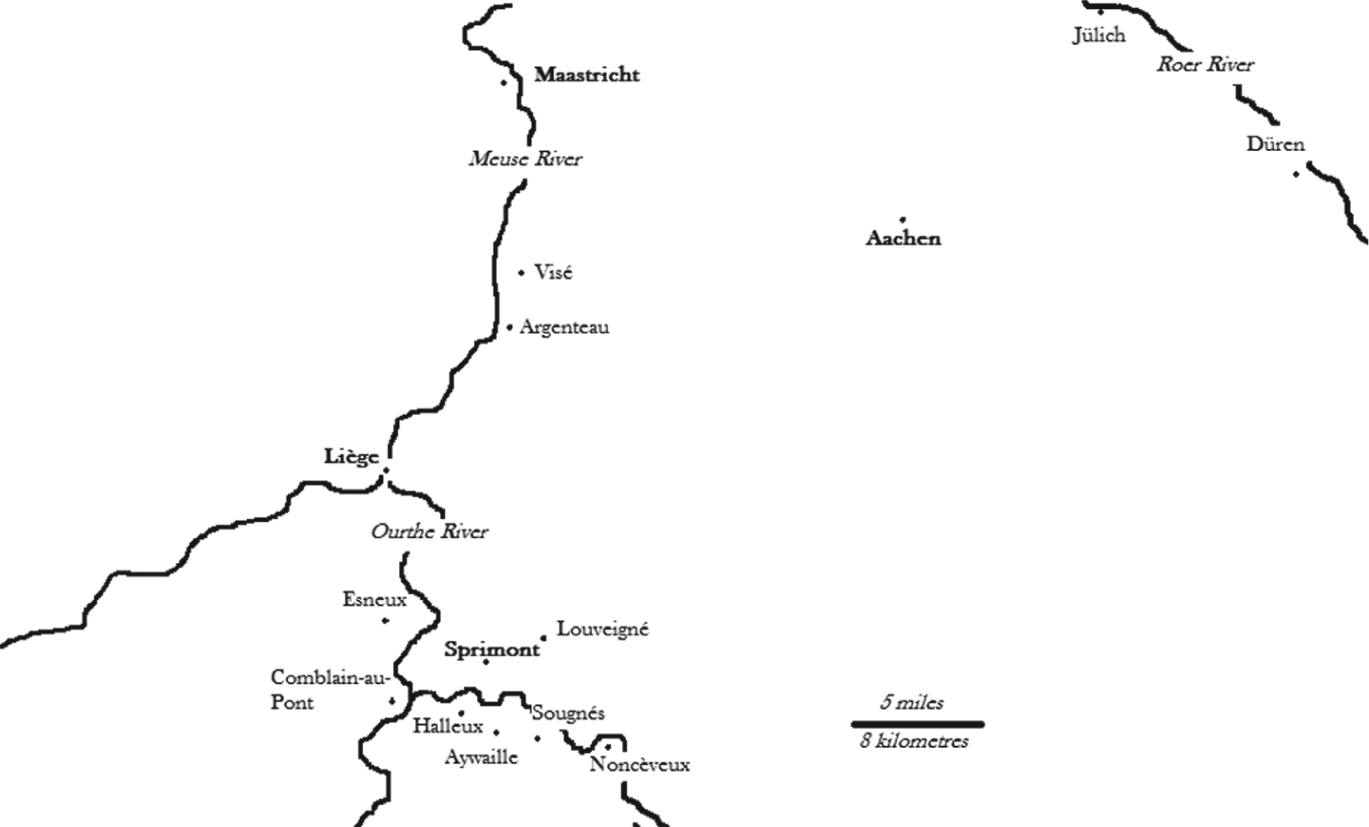
Map of Maastricht, Liège, Sprimont, and Aachen.
Although Jourdan continued to disperse his army across a broad front, he devised an effective operational plan that exploited deception and surprise. After surveying the Austrian position, Jourdan saw an opportunity to turn the enemy’s left flank by driving the bulk of his army to the south-east along the Ourthe. 68 He believed this assault would force Clerfayt to cede his line and enable his force to cross the Meuse at Liège. The key to Jourdan’s operational scheme involved a diversionary attack by Kléber against the Austrian’s right wing and centre on 17 September. 69 While Kléber would lead the feint attack against Clerfayt’s right, the divisions in the centre would demonstrate against the enemy at Liège to conceal the right wing’s concentration further south. 70 At 7 a.m. on the 17th, Kléber executed the diversionary assault. Clerfayt took the bait and sent several thousand reinforcements from his left flank at Sprimont north to Maastricht. 71
Commanding Clerfayt’s left wing, Latour remained ‘full of confidence in the excellence of his position’ between Sprimont and Esneux. 72 With the knowledge available to him, Latour had little reason to be worried in the event of an attack on 18 September. 73 Unfortunately for the Austrians, Latour expected to face fewer than 30,000 troops in the event of an attack the following day. 74 However, the French amassed around 40,000 men to attack the 25,000 Austrians dispersed along the Ourthe and the Amblève on the 18th. 75 Jourdan and Schérer determined to launch four attacks across the rivers, with the light infantry leading the crossing, followed by the infantry and cavalry. 76 Once across, the right wing would attempt to encircle Latour’s outnumbered troops. 77
In this instance, numerical superiority played a key role in achieving victory at the decisive point of attack. At 6 a.m. on 18 September, French artillery bombarded Latour’s positions to cover the advance of their light troops. Rather than sending their entire force over the Amblève in a rush of energy, the French devised a methodical scheme to facilitate the crossing. Marceau’s men crossed at Halleux and scaled the rocky heights on the right bank of the river. At Aywaille, Mayer’s troops passed over a bridge the Austrians defended with a formidable artillery battery. Although the Austrians offered an obstinate resistance and repulsed the French repeatedly, Mayer’s skirmishers eventually established a foothold on the left bank and began to ascend the heights on the right bank. 78 At Sougnés, General Honoré Alexandre Hacquin’s division crossed the Amblève and repulsed the enemy’s advance posts. Meanwhile, General Joseph Bonnet attacked across the Ourthe to the north at Esneux. 79
After the first wave of skirmishers secured the crossing points, the French advanced their infantry in disciplined march columns. With Marceau’s light infantry occupying the crest of the heights on the opposite side of Halleux, his infantry gained the Amblève against minimal resistance. A smokescreen from the burning village of Aywaille covered Mayer’s infantry as they scaled the heights leading to Sprimont. 80 Benefitting from artillery support and numerical superiority, Hacquin’s men took Sougnés and several pieces of Austrian cannon. However, with the limited troops available, Latour ordered a counter-attack against the French at Sougnés. The Austrians ejected Hacquin from Sougnés and forced his division to retire to the left bank of the Amblève. 81
Despite Hacquin’s setback, Marceau’s infantry finally overcame the Austrian defenders north of the Amblève after a two-hour engagement. Mayer’s infantry advanced in skirmishing order towards Sprimont, exploiting the advantage provided by the broken terrain. 82 Rather than directing another frontal assault on Sougnés, Hacquin moved the bulk of his division along the curve of the river towards Noncèveux, overrunning a weak Austrian post to gain the heights on the right bank of the Amblève. Marching rapidly on Louveigné, Hacquin’s division threatened the flank and rear of Latour’s position. 83 By combining the attack on the right bank of the Amblève with Bonnet’s crossing at Esneux, Schérer threatened to encircle Latour’s wing with superior numbers. 84 Accordingly, Latour hastily ordered the retreat. With his left wing withdrawing towards Aachen, Clerfayt abandoned the Meuse–Ourthe line.
Although this was an impressive victory, it would be an exaggeration to credit the battle of the Ourthe with a revolution in warfare. The reports indicate that the outnumbered Austrian troops fought obstinately, but that further resistance was largely futile given Clerfayt’s decision to reinforce his right flank. Considering the contested nature of the fighting, the French victory owed more to command failures in the allied army than to a breakdown in Old Regime warfare at the tactical and moral levels. Moreover, rather than shock tactics and enthusiasm, French success depended on effective organization, a flexible utilization of firepower and shock tactics, and the increasing professionalism of the troops. Most significantly, the divisions that led the attack at Sprimont – those of Marceau and Mayer – had redeemed their poor performance at First and Second Fleurus, suggesting a clear improvement in training and discipline. 85
IV. The Battle of the Roer, 2 October 1794
After ceding the Ourthe against his government’s orders, Clerfayt dispersed his army along a defensive line stretching nearly 80 kilometres from Roermond to Düren (Figure 3). Conforming to the Committee’s orders, Jourdan detached 15,000 men under Duhesme to besiege the Austrian garrison at Maastricht. 86 On 2 October, Jourdan positioned his army to assault Clerfayt across the entire front. After a day-long battle, the French captured several posts along the Roer river. 87 The battle of the Roer marked the culmination of evolutionary developments in the Sambre and Meuse Army that explicate its overall performance in the 1794 campaign. Yet, the failure of the French to achieve a truly decisive victory against a demoralized and outnumbered army also signals continuing parity on the battlefield.
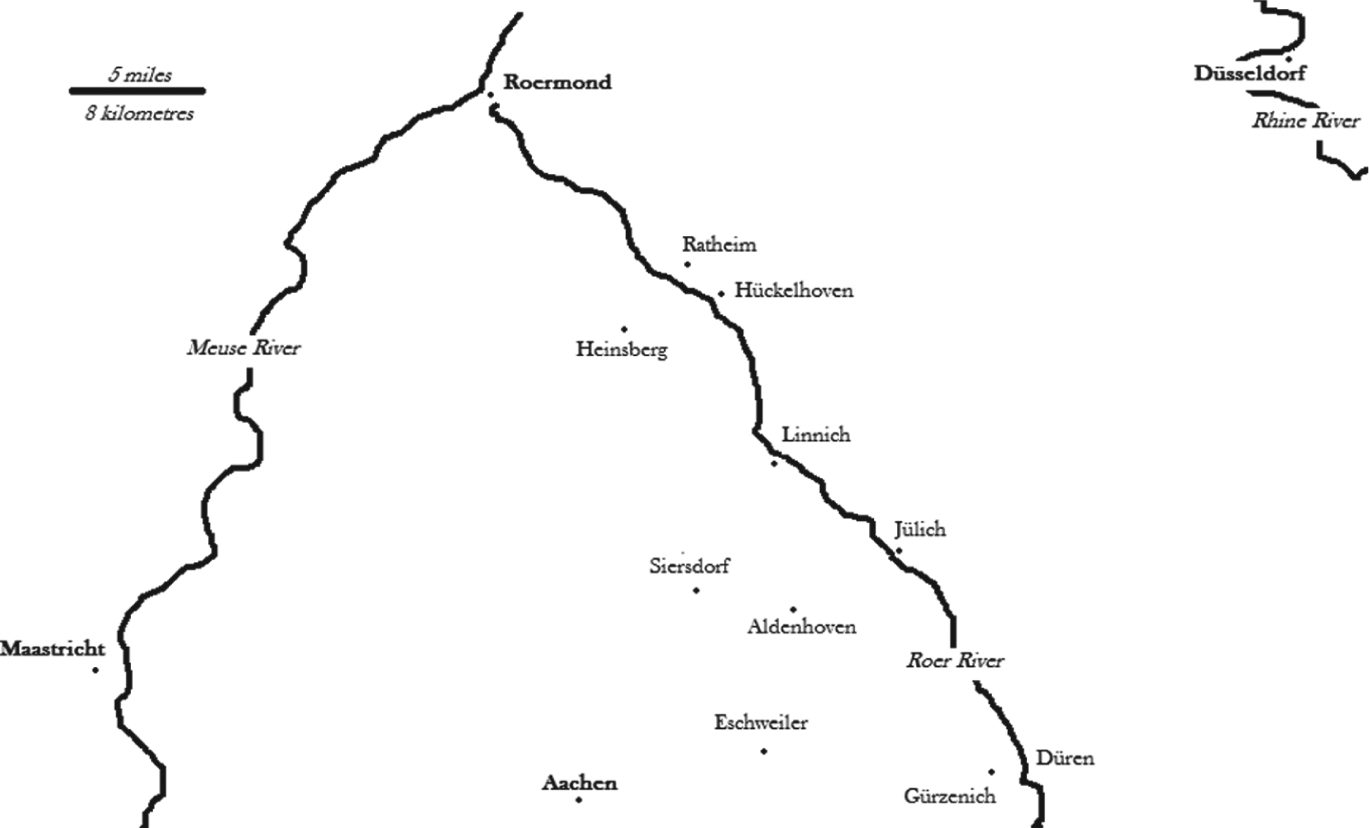
Map of Maastricht, Aachen, Roermond, and Düsseldorf.
Throughout the autumn campaign Kléber and Schérer retained command of the army’s left and right wings respectively, while Jourdan directed the centre. 88 By the end of September, Jourdan developed his dispositions for attacking Clerfayt on the Roer: Kléber would attack Ratheim, while Schérer moved the right wing against Düren. Meanwhile, the centre would capture Aldenhoven and Jülich. 89 Unfortunately for the French, Jourdan’s dispersed deployment achieved limited success but ultimately allowed the enemy to evade a decisive defeat – ensuring that the Austrians lived to regroup on the right bank of the Rhine and fight effectively the following year.
On 1 October, Kléber advanced the left wing to Heinsberg, where the French prepared to attack the enemy across the Roer at Ratheim and Hückelhoven the following day. 90 The Austrians prepared defensive entrenchments on the left and right banks of the Roer. 91 Bernadotte’s division advanced against Ratheim at 5 a.m. on the 2nd. The French continued to utilize a wide variety of tactical formations. As Bernadotte’s light infantry reached the bank of the Roer, they encountered heavy artillery and musket fire from the enemy’s batteries. After the French infantry advanced, they formed line and unleashed a fusillade against the enemy’s positions, forcing Werneck’s light troops to retire behind entrenchments. Bernadotte crossed the Roer just south of Ratheim with the 71st Demi-Brigade and four companies of grenadiers. A young Michel Ney led one cavalry regiment in a charge on the right bank. 92 Meanwhile, Kléber moved his artillery forward to support this movement, and Werneck eventually ordered the retreat across the Roer. Despite the impressive performance of Bernadotte’s cohort, the bulk of Kléber’s wing could not follow Bernadotte and did not cross until the following day. 93
On the French right, Schérer attacked Austrian forces commanded by Latour at Düren, nearly 60 kilometres south-east of Ratheim, but failed to inflict a decisive defeat on the enemy. At 4 a.m. Schérer ordered the divisions of Marceau, Mayer, and Hacquin to march from their camps at Eschweiler and Gürzenich, west of Düren. 94 Marceau’s division made effective progress against Düren through a combination of artillery fire and infantry charges, but could not continue the advance without further support from Hacquin and Mayer, both of whom stalled their approach. At 6 p.m. Mayer joined Marceau, advanced to the plateau of Düren, and met a terrible cannonade from a concealed artillery battery. Marceau’s troops momentarily panicked, but the general successfully recomposed his men. Hacquin’s delayed arrival from the Bergheim wood at 7 p.m. made little contribution to the French attack on Düren. Having failed to attain a complete victory, Schérer ordered his troops to bivouac on the field, and fully expected to engage the enemy at daybreak. 95
The French achieved the most success in the centre, where Jourdan oversaw the forward movement against Linnich and Aldenhoven. Lefebvre led the advance guard against Austrian forces positioned at Linnich. The French advanced against the town with their skirmishers in front, followed by infantry arrayed in line by battalion columns. 96 Lefebvre’s division captured Linnich and drove the enemy to Genevich on the right bank. 97 Although he was unable to cross the Roer, Lefebvre established a bridge and crossed the following morning. Further south, the divisions of Championnet, Morlot, and Hatry struck the town of Aldenhoven alongside Dubois’s cavalry reserve. Over the broken terrain west of Aldenhoven and Siersdorf, Championnet advanced his infantry in columns. Supported by his light artillery, he rapidly assaulted the enemy’s line. 98 After a two-hour combat, the French mastered the redoubts in front of the town. The Austrian defenders retired to Jülich, where they camped for the night. 99 While the French left and right wings experienced moderate success on 2 October, the French centre gained a clear victory.
After retiring from the Roer on the morning of 3 October, Clerfayt led the Austrian army across the Rhine at Köln three days later. Nevertheless, the Austrian army survived intact and sustained few losses from the battle. Thus, while the battle of the Roer deserves more recognition for its political results, attempting to place it in a revolutionary framework of military change exaggerates its decisiveness. Certainly, the Austrian troops displayed poor morale, yet this followed a year of poor leadership and defeat. For the French, the battle concluded a string of successes that could only boost their confidence. However, as with the three previous battles discussed in this article, politically charged explanations for French tactical success – patriotic elan and republican tactics – failed to provide a crushing victory and seemed largely irrelevant in the Sambre and Meuse Army. Rather, the more sobering evolutionary developments that occurred in the army throughout 1794 illuminate the major reasons for French combat effectiveness.
V. The Evolution of Military Affairs
T.C.W. Blanning proposes the unprecedentedly large armies the French fielded after the levée en masse as the most viable explanation for their military success in the 1790s. 100 Rather than representing a revolutionary break, these armies fit best within an evolutionary model of increasing army size throughout Europe in the early modern period. 101 Nonetheless, numbers alone fail to explain French battlefield success in 1794. Most important, the explanation subsumes the Revolutionary Wars in a deterministic model that fails to consider the complex variables pertaining to the outcome of each individual battle. Furthermore, it obscures other important factors that explain success on the battlefield. Three key developments explain the Sambre and Meuse Army’s performance in 1794: disciplined soldiers, flexible tactics, and organizational reforms. In addition, these factors demonstrate the evolutionary nature of military change at the end of the eighteenth century.
Although historians traditionally emphasize the superior elan and patriotism of the French, this article stresses the role of military discipline in ensuring tactical cohesion on the battlefield. According to John Lynn, ‘in many ways the army forged by the Revolution was unique, yet the trilogy of liberté, égalité, fraternité could not obscure the need for discipline and even coercion’. 102 Lynn partially attributes French tactical success to a disciplinary system that allowed the traits of individuality and enthusiasm to flourish. 103 Alan Forrest agrees that consent-based discipline appeared during the Revolution, but he argues that after 9 thermidor 1794 ‘political commitment played little part in the armies; obedience rather than militancy was what was expected of the soldiers of the Republic’. 104 Nonetheless, the campaigns of 1792–3 demonstrated to most observers that raw enthusiasm and willpower could not, on their own, replace traditional battlefield discipline. Even in 1793 General Adam Philippe de Custine famously enforced strict disciplinary standards after taking command of the Army of the North. 105 After assuming command of the Moselle Army in March 1794, Jourdan urged his soldiers to ‘submit themselves to discipline’, which he recognized as ‘the force of armies’. 106 Civilian authorities, most notably the representatives on mission, also realized the centrality of military discipline to effective performance in combat. 107
Indeed, the French clearly relied on discipline rather than elan to maintain their army’s cohesion in battle throughout the 1794 campaign. Nearly every commander, including Jourdan, commented on the army’s discipline during the Fleurus campaign. Although the French lost at First Fleurus, only the divisions of the right wing broke.
108
In the often-ignored battles of the Ourthe and Roer, the Army of the Sambre and Meuse demonstrated further progress in discipline and obedience.
109
Championnet provides the most vivid description of French performance on 2 October: This affair, cleverly combined, is one that provides the most honour to General Jourdan; the execution followed his instructions exactly: nothing was more majestic than to see, in an immense plain, the army advancing perfectly, in the best order, and without becoming entangled. The columns, arriving in the position where they had been placed in battle, were deployed tranquilly under the fire of the enemy’s batteries; the alignments were made according to the guidelines exactly as on a drill camp. Never had the manoeuvres of instruction been executed with as much precision as in this affair.
110
Only by subordinating enthusiasm and republican spirit to the necessity of discipline, training, and drill did the French reach parity with the disciplined professionalism of the often-scorned Old Regime ‘slave-soldier’.
As with the spirit of the army, the tactics employed by the French Revolutionary armies have been subjected to considerable historical analysis. The four battle narratives presented in this paper provide further evidence for the development of a flexible tactical system in 1794. 111 Rather than being a creation of the Revolution, flexible tactics appeared in French military writings during the Old Regime especially in the works of reformers such as Jacques-Antoine-Hippolyte de Guibert. In the regulations of 1791, the French embraced a tactical system that combined shock and firepower through mixed order tactics depending on the terrain and circumstances. 112 Because of their increasing professionalism, French armies proved capable of implementing these regulations in practice by 1794, yet the Sambre and Meuse Army’s tactics did not allow it to overwhelm the Old Regime Austrian army.
The final key area demonstrating the evolutionary nature of military change concerns organization. As armies increased in size during the eighteenth century, organizational reforms struggled to maintain pace. During the middle of the century, Frederick the Great rarely commanded more than 50,000 men in a single battle. 113 After the levée en masse, French armies swelled to an almost unprecedented size: Jourdan commanded approximately 100,000 troops at the Roer. In order to cope with these massive armies and the increasing scale of battle, the French continued organizational reforms initiated during the Old Regime. The combat division emerged in the French army in the Seven Years War. 114 French military writers such as Pierre-Joseph Bourcet proposed the permanent combat division as a necessary military unit above the regiment and brigade. 115 The divisional system greatly increased command and control in the Sambre and Meuse Army and proved a key evolution in military organization.
In addition to the divisional system, the French made further advancements to the idea of the army corps, which Napoleon Bonaparte subsequently perfected. 116 Throughout the campaign, Jourdan organized his army into a large centre supported by two semi-permanent wings. By October 1794 Schérer referred to his right wing as a ‘corps d’armée’ rather than the ‘aile droite’. 117 These organizational reforms deserve at least as much credit as republican spirit in holding the army together.
These factors signal an evolution in warfare because each owed much to Old Regime developments. Yet, while these evolutionary changes allowed the French to achieve battlefield success, the process of change never followed a completely linear path. As demonstrated, the French did not immediately overwhelm armies persistent in Old Regime practices; indeed, the campaign of 1794 is notable because the Austrian army survived intact through each of the four battles discussed. Perhaps this explains the resistance to change prevalent in the Austrian and Prussian armies after the first round of war against Revolutionary France: because the increases in French combat effectiveness were gradual and evolutionary – not immediate and revolutionary – leaders within those military institutions could legitimately surmise that their own ways of war were not permanently defunct.
In his 1795 essay ‘On the War against the New Franks’, Archduke Charles explained Austria’s defeat in 1794 as the result of poor command decisions and over-reliance on the cordon defensive system: ‘Ignorance, inactivity, and selfishness are to blame for our misfortune. They are the cause of the ruin of armies, the sinking of states.’ 118 For Charles these problems could be amended without a radical overhaul of the Austrian military system or tactical doctrine. Tellingly, after 1794 the Army of the Sambre and Meuse achieved little further success against the armies of the Old Regime. The negative outcome of the battles and campaigns of 1795 and 1796 in the German states again demonstrated the parity between the two schools of warfare – schools that shared more in common than historians have traditionally recognized.
Footnotes
Funding
Research for this paper was conducted with the support of the Toulouse Graduate School, the College of Arts & Sciences, the Department of History, and the Military History Center at the University of North Texas.
1
‘Here and today begins a new epoch in the history of the world,’ declared Goethe. For Goethe’s quote and insight into the historical significance of Valmy, see Owen Connelly, The Wars of the French Revolution and Napoleon, 1792–1815 (New York, Routledge, 2006), p. 31.
2
In particular, Roger Chickering, ‘A Tale of Two Tales: Grand Narratives of War in the Age of Revolution’, in Roger Chickering and Stig Förster, eds, War in an Age of Revolution, 1775–1815 (New York, Cambridge University Press, 2010), pp. 1–20; Ute Planert, ‘Innovation or Evolution? The French Wars in Military History’, ibid., pp. 69–84.
3
For critiques of this approach, see Alan Forrest, The Legacy of the French Revolutionary Wars: the Nation-in-Arms in French Republican Memory (New York, Cambridge University Press, 2009), pp. 12–28; S.P. Mackenzie, Revolutionary Armies in the Modern Era: A Revisionist Approach (New York, Routledge, 1997), pp. 33–51.
4
Maximilien Robespierre, ‘Report on Political Morality’, in Oeuvres de Maximilien Robespierre (Paris, Société des études Robespierristes, 1967), X, pp. 350–66.
5
John Lynn, ‘French Opinion and the Military Resurrection of the Pike, 1792–1794’, Military Affairs XLI (1977), pp. 1–7, discusses an extreme example.
6
Richard D. Challener, The French Theory of the nation in Arms, 1866–1939 (New York, Columbia University Press, 1952), pp. 3–9.
7
Jules Michelet, Les soldats de la Révolution (Paris, 1878), pp. 23–35; Jean Jaurès, L’armée nouvelle (Paris, 1911), p. 147; Albert Mathiez, La victoire en l’an II (Paris, 1916).
8
For instance, on taking command of the Army of the Moselle in March 1794, Jean-Baptiste Jourdan proclaimed: ‘The instant approaches where we will march bravely against the enemies of our Liberty. Prepare your bayonets, they are the terror of slaves, they alone suffice to make them flee before us.’ Victor E. Dupuis, Les opérations militaires sur la Sambre en 1794: bataille de Fleurus (Paris, Chapelot, 1907), p. 10.
9
Albert Soboul, Les soldats de l’an II (Paris, Club français du livre, 1959), p. 6. Jean-Paul Bertaud, The Army of the French Revolution: From Citizen-Soldiers to Instrument of Power, trans. R.R. Palmer (Princeton, NJ, Princeton University Press, 1988), essentially follows much of Soboul’s interpretation.
10
Camille Rousset, Les volontaires, 1791–1794 (Paris, 1871), p. 299.
11
Jean Colin, La campagne de 1793 en Alsace et dans la Palatinat (Paris, Chapelot, 1902); La tactique et la discipline dans les armées de la Révolution (Paris, Chapelot, 1902); L’infanterie française au XVIIIe siècle (Paris, Chapelot, 1907).
12
Spencer Wilkinson, The French Army before Napoleon (Oxford, Clarendon, 1915).
13
‘All the tactical innovations which have so impressed many writers, especially English, on the Revolutionary and Napoleonic wars are to be found in the writings of the eighteenth century’, writes Quimby, The Background of Napoleonic Warfare: The Theory of Military Tactics in Eighteenth-Century France (New York, Columbia University Press, 1957), p. 5.
14
John Lynn, The Bayonets of the Republic: Motivation and Tactics in the Army of Revolutionary France, 1791–1794 (Boulder, CO, Westview, 1996), p. 278.
15
T.C.W. Blanning, The French Revolutionary Wars, 1787–1802 (New York, Arnold, 1996), p. 270.
16
Paddy Griffith, The Art of War of Revolutionary France, 1789–1802 (London, Greenhill, 1998).
17
Unfortunately, the Sambre and Meuse Army suffers from scant historical attention. The most detailed anglophone source remains Ramsey Weston Phipps, The Armies of the First French Republic and the Rise of the Marshals of Napoleon 1st, 5 vols (London, Oxford University Press, 1926–39). For logistics in 1794, see Peter Wetzler, War and Subsistence: The Sambre and Meuse Army in 1794 (New York, Peter Lang, 1985). Two works from the nineteenth century provide chronological treatments: Claude Desprez, Les armées de Sambre-et-Meuse et du Rhin (Paris, L. Baudoin, 1883); Alfred Rambaud, Les Français sur le Rhin, 1792–1804 (Paris, Didier, 1880).
18
In fact, historians typically refer to the battle of Second Fleurus on 26 June simply as ‘Fleurus’, thereby ignoring First Fleurus and diminishing its importance to analyses of the French army.
19
Kléber’s wing contained the divisions of generals François Muller, Philibert Guillame Duhesme, and Philibert Charles Montaigu (whose division did not fight at First Fleurus). Marceau’s wing included his own division and that of General Jean Adam Mayer. Jourdan’s divisions in the centre came from the Army of the Moselle and were commanded by generals Joseph Lefebvre, Antoine Morlot, Jean Étienne Vachier Championnet, and Jacques Maurice Hatry.
20
Jourdan to Committee of Public Safety [CPS], 12 June 1794, Service historique de l’armée de terre [SHAT], B1 33.
21
SHAT, M1 608, 2:24.
22
The allied left wing, consisting of Feldmarschall Leutnant Johann Peter Beaulieu’s 14 battalions and 16 squadrons, faced Lambusart. On Beaulieu’s right, Count Maximilian Anton Karl Baillet de Latour led 9 battalions and 16 squadrons against Heppignies and Wangenies. Further west, Feldmarschall Leutnant Peter Vitus von Quasdanovich directed 7 battalions and 12 squadrons against Thiméon and Mellet. Finally, on the far right, Feldmarschall Leutnant Wilhelm von Wartensleben marched 9 battalions and 12 squadrons towards Courcelles: Dupuis, Opérations militaires, pp. 289–92.
23
Kléber to Duhesme, 16 June 1794, SHAT, B1 34; Ernouf to Favreau, 15 June 1794, SHAT, B1 34; SHAT, M1 608, 2:PJ, nos. 68 and 69; Dupuis, Opérations militaires, pp. 293–6.
24
SHAT, M1 608, 2:27; Jourdan to CPS, 18 June 1794, SHAT, B1 34; Dupuis, Opérations militaires, pp. 292–3.
25
Lefebvre to Jourdan, 17 June 1794, SHAT, M1 608, 2:PJ, no. 71; Kléber to Jourdan, 18 June 1794, SHAT, M1 608, 2:PJ, no. 69; SHAT, B1 302, 12.
26
SHAT, M1 608, 2:27; Dupuis, Opérations militaires, pp. 293–4.
27
Jean Etienne Championnet, Souvenirs du général Championnet (Paris, Ernest Flammarion, 1904), p. 55.
28
Kléber to Jourdan, 17 June 1794, SHAT, B1 34.
29
SHAT, M1 608, 2:32.
30
Dubois to Jourdan, 17 June 1794, SHAT, B1 34; SHAT, M1 608, 2:28.
31
Dupuis, Opérations militaires, p. 234.
32
Lefebvre to Jourdan, 17 June 1794, SHAT, B1 34.
33
SHAT, M1 608, 2:39.
34
The allies quickly announced the victory as a great triumph. ‘The enemy that attacked us was completely beaten and put to rout on the Sambre,’ read a bulletin that the Austrians distributed at Brussels. In language rivalling the French, the Austrian ‘Bulletin Extraordinaire’ declared that the ‘brave army’ marched against the numerically superior French with a ‘certainty of victory’. Through the course of the ‘obstinate and bloody combat’, the ‘intrepid troops and generals displayed a grand countenance and valour despite the numbers and vigorous resistance of the enemy’. ‘Bulletin of Brussels’, 16 June 1794, SHAT, B1 34.
35
William’s withdrawal west allowed the French to cross the Sambre unimpeded on 18 June. Dupuis, Opérations militaires, pp. 303–5.
36
Kléber to Duhesme, 18 June 1794, SHAT, B1 34. On the right, Marceau formed his wing once again around Lambusart and the surrounding woods. Lefebvre placed the advance guard of the army at the village of Heppignies, fortifying the garden and cemetery on the northern edge of the village. East of Heppignies, he constructed a strong redoubt armed with 18 cannon that commanded the plain north of Fleurus. In the centre, Morlot and Championnet held entrenched positions on either side of Gosselies. Kléber formed the left wing on the heights of Courcelles, with entrenchments at Trazegnies, Forchies, and various crossing points along the Piéton.
37
SHAT, M1 608, 2:29.
38
The stadtholder led the first column of mostly Dutch troops against the positions of Forchies-la-Marche and Courcelles around 2 a.m. Coburg’s second column advanced north of Gosselies and comprised Austrian troops commanded by Quasdanovich. Feldzeugmeister Franz Wenzel, Graf von Kaunitz-Rietberg, directed the third column of Austrians opposite the French entrenchments at Heppignies and Wangenies. Coburg placed the fourth column in the hands of Archduke Charles (the brother of Holy Roman Emperor Francis II), whom he instructed to strike the village of Fleurus, 13 kilometres north-east of Charleroi. Beaulieu commanded the final column against the French right wing at Lambusart. See Alfred von Witzleben, Prinz Friedrich Josias von Coburg-Saalfeld, Herzog zu Sachsen (Berlin, 1859), III, pp. 294–7.
39
SHAT, M1 608, 2. According to Jean-de-Dieu Soult, ‘if we had not been victorious, the majority of our chiefs would have been killed’: Mémoires du maréchal-général Soult, duc de Dalmatie (Paris, Amyot, 1854), I, p. 157.
40
Louis Fricasse, Journal de marche d’un volontaire de 1792 (Paris, 1882), p. 27, credits the retreat to lack of munitions.
41
Kléber to Jourdan, SHAT, M1 608, 2:PJ, no. 75; Dupuis, Opérations militaires, p. 530.
42
Marceau to Jourdan, 27 June 1794, SHAT, M1 608, 2:PJ, no. 72; Dupuis, Opérations militaires, p. 540.
43
‘Report of Prince Coburg’, 26 June 1794, SHAT, B1 34.
44
Morlot to Jourdan, 26 June 1794, SHAT, B1 34. Championnet, Souvenirs, p. 67; Championnet to Jourdan, 27 June 1794, SHAT, B1 34.
45
Lefebvre to Jourdan, 27 June 1794, SHAT, M1 608, 2:PJ, no. 73.
46
Kléber to Jourdan, 27 June 1794, SHAT, B1 34.
47
Bernadotte to Kléber, 28 June 1794, SHAT, B1 140.
48
Dupuis, Opérations militaires, pp. 342–4; Kléber to Jourdan, 27 June 1794, SHAT, B1 34.
49
Bernadotte to Kléber, 28 June 1794, SHAT, B1 140.
50
Soult, Mémoires, I, p. 160.
51
SHAT, M1 608, 2:41.
52
Soult, Mémoires, I, pp. 161–2; Lefebvre to Jourdan, 27 June 1794, SHAT, M1 608, 2:PJ, no. 73.
53
Jourdan to CPS, 27 June 1794, SHAT, M1 608, 2:PJ, no. 75; ‘Report of Prince Coburg’, SHAT, B1 34.
54
Dupuis, Opérations militaires, p. 361.
55
Arthur Chuquet, Hoche et la lutte pour l’Alsace (Paris, 1893), pp. 82–90.
56
Lefebvre to Jourdan, 27 June 1794, SHAT, M1 608, 2:PJ, no. 73.
57
SHAT, M1 608, 2:43.
58
Championnet, Souvenirs, p. 66.
59
‘Report of Prince Coburg’, 27 June 1794, SHAT, B1 34.
60
Estimates for casualties vary between 2,000 and 7,000 for both sides.
61
Phipps, Armies of the First French Republic, II, p. 183. The only source cited by Phipps for the battle of the Ourthe is Count Langeron’s memoir, which was published in Léonce Pingaud, L’invasion austro-prussienne (1792–1794) (Paris, Alphonse Picard, 1895), pp. 91–2.
62
Étienne Charavay, Correspondance générale de Carnot (Paris, Imprimerie Nationale, 1907), IV, pp. 476–9; Carnot to Jourdan, 2 July 1794, SHAT, B1 35.
63
Jourdan to CPS, Jourdan to Schérer, 11 July 1794, SHAT, M1 608, 2:PJ, no. 94.
64
Jourdan to CPS, 20 August 1794, SHAT, M1 608, 2:PJ, no. 105.
65
On the right, Feldmarschall Leutnant Franz Freiherr von Werneck commanded 12,400 men between Stockem and Sittard, while General Major Paul von Kray led 10,832 men stationed in front of Maastricht. In addition, Kray possessed 4,048 men that he employed between Visé and Argenteau. The centre of the army commanded by Clerfayt held Liège with 20,270 men. On the left, Latour commanded 27,900 troops between Esneux and Sprimont. Meanwhile, Beaulieu directed a force of 5,140 men at Nauendorf, Montjoie, and Blankenheim to cover the left wing of the army. Finally, 2,600 troops remained at Aachen in reserve: see Louis Thiry, Après Fleurus: La bataille de Sprimont (18 septembre 1794) (Brussels, Falk, 1936), p. 23.
66
Phipps, Armies of the First French Republic, II, p. 181.
67
Jean Hardy, L’armée de Sambre-et-Meuse pendant la campagne d’automne de 1794: le siège de Maëstricht (Paris, Dumaine, 1878), p. 15.
68
As early as 12 September he planned to ‘chase the enemy from the banks of the Ourthe and Aywaille’ after sending a ‘corps of 6,000 men of the army’s left wing to disturb the enemy on the lower Meuse’. Jourdan to CPS, 12 September 1794, SHAT, M1 608, 2:PJ, no. 109.
69
On the 16th, Kléber informed Duhesme of Jourdan’s plans for ‘a grand attack on the other side of the Meuse, and that the General-in-Chief has ordered me to conduct a secondary attack on this side to cause a diversion’. Kléber to Duhesme, 16 September 1794, SHAT, B1 34; Bernadotte to Kléber, 17 September 1794, SHAT, B1 140; Pierre Claude Pajol, Kléber: sa vie, sa correspondance (Paris, Firmin-Didot, 1877), p. 113.
70
Ernouf, 17 September 1794, SHAT, B1 40.
71
Friant to Kléber, 17 September 1794, SHAT, B1 303.
72
Clerfayt to Aulic Council, Thiry, Après Fleurus, p. 112.
73
SHAT, M1 608, 2:56.
74
Latour to Aulic Council, Thiry, Après Fleurus, p. 117.
75
SHAT, M1 608, 2:57.
76
Jourdan to CPS, 19 September 1794, SHAT, M1 608, 2:PJ, no. 112.
77
Schérer to Jourdan, 20 September 1794, SHAT, B1 40.
78
Thiry, Après Fleurus, p. 71.
79
For the initial movements of the battle, see Schérer to Jourdan, 20 September 1794, SHAT, B1 34; Report of Schérer, Thiry, Après Fleurus, p. 112; SHAT, M1 608, 2:57.
80
Report of Schérer, Thiry, Après Fleurus, p. 112.
81
Clerfayt to Aulic Council, Latour to Aulic Council, Thiry, Après Fleurus, pp. 115, 117.
82
Schérer to Jourdan, 20 September 1794, SHAT, B1 40.
83
Latour to Aulic Council, Thiry, Après Fleurus, p. 120.
84
Report of Schérer, ibid., p. 112.
85
Thiry, Après Fleurus, pp. 51–69.
86
CPS to Jourdan, 23 September 1794, SHAT, M1 608, 2:PJ, no. 115.
87
Phipps, Armies of the First French Republic, II, pp. 184–7, remains the most complete account of the battle in the English language.
88
The divisions of Bernadotte, Duhesme, Friant, and Richard remained under Kléber’s tutelage. SHAT, M1 608, 2:60; Ernouf to CPS, 1 October 1794, SHAT, B1 41.
89
Jourdan to Ernouf, 26 September 1794, SHAT, B1 41.
90
Kléber to Duhesme, 1 October 1794, SHAT, B1 41.
91
Phipps, Armies of the First French Republic, II, p. 184.
92
Michel Ney, Memoirs of Marshal Ney (London, Bull and Churton, 1833), I, pp. 50–7.
93
Kléber to Jourdan, 2 October 1794, SHAT, B1 41; Bernadotte to Kléber, 2 October 1794, SHAT, B1 140.
94
SHAT, M1 608, 2:62; ‘Report of Schérer’, SHAT, B1 40.
95
Schérer to Jourdan, 2 October 1794, SHAT, B1 41.
96
SHAT, B1 140.
97
Lefebvre to Jourdan, 2 October 1794, SHAT, M1 306, no. 126.
98
Championnet, Souvenirs, pp. 79–81.
99
SHAT, M1 608, 2:60.
100
Blanning, French Revolutionary Wars, p. 270.
101
M.S. Anderson, Warfare and Society in Europe of the Old Regime, 1618–1789 (London, McGill-Queen’s University Press, 1998), p. 4; Azar Gat, ‘What Constituted the Military Revolution of the Early Modern Period?’, in Roger Chickering and Stig Förster, eds, War in an Age of Revolution, 1775–1815 (New York, Cambridge University Press, 2010), p. 32; Charles Esdaile, Napoleon’s Wars: An International History (New York, Penguin, 2007), pp. 1–14; Geoffrey Parker, The Military Revolution: Military Innovation and the Rise of the West (New York, Cambridge University Press, 1986), pp. 46–61.
102
Lynn, Bayonets of the Republic, p. 97.
103
Colin, Tactique et la discipline, pp. 9–15, argues that discipline proved the key variable in French combat effectiveness.
104
Alan Forrest, The Soldiers of the French Revolution (Durham, NC, Duke University Press, 1990), pp. 48, 56.
105
Arthur Chuquet, Wissembourg (Paris, Léopold Cerf, 1893), pp. 23–4.
106
Dupuis, Opérations militaires, p. 10.
107
Griffith, Art of War, p. 96; J.P. Gros, Saint-Just: sa politique et ses missions (Paris, B.N., 1976); Henri Wallon, Les représentants du peuple en mission et la justice révolutionnaire dans les départements en l’an II (1793–1794) (Paris, Hachette, 1890), IV, pp. 239–48; Forrest, Soldiers of the French Revolution, pp. 116–19.
108
Lefebvre’s division withstood seven hours of intense combat and managed to retreat in good order while the enemy fell on both of its flanks: Bernadotte to Kléber, 27 June 1794, SHAT, B1 34; General Godinot observed the discipline that flourished in Lefebvre’s division: SHAT, B1 140; Championnet also noted the discipline of the troops under his command at Heppignies: Championnet, Souvenirs, p. 64.
109
Thiry, Après Fleurus, pp. 51–69.
110
Championnet, Souvenirs, pp. 84–5.
111
This reinforces John Lynn’s central argument concerning French military tactics: Lynn, Bayonets of the Republic, pp. 278–80. However, the relative effectiveness of these tactics compared with those of the Old Regime armies remains an open discussion in need of more research. Two admirable efforts at comparative perspectives are Brent Nosworthy, With Musket, Cannon, and Sword: Battle Tactics of Napoleon and His Enemies (New York, Sarpedon, 1996), pp. 163, 171; Steven T. Ross, From Flintlock to Rifle: Infantry Tactics, 1740–1866 (New York, Routledge, 1996).
112
For Guibert, see Quimby, Background of Napoleonic Warfare, pp. 320–32, and Jonathan Abel, ‘Jacques-Antoine-Hippolyte, Comte de Guibert’s Military Reforms: Enlightened Evolution or Revolutionary Change?’, Napoleonic Scholarship: The Journal of the International Napoleonic Society no. 3 (2010), pp. 26–38. Lefebvre’s report on Second Fleurus best illustrates flexible tactics in practice: see Lefebvre to Jourdan, 27 June 1794, SHAT, B1 34. For an example of the infantry square in practice, see Godinot’s journal entry for 8 messidor l’an II (26 June 1794), SHAT, B1 140.
113
Christopher Duffy, Frederick the Great: A Military Life (New York, Routledge, 1988).
114
Steven Ross, ‘The Development of the Combat Division in Eighteenth-Century French Armies’, French Historical Studies IV (1965), pp. 84–94.
115
Robert B. Bruce, Iain Dickie, Kevin Kiley, Michael F. Pavkovic, and Frederick C. Schneid, Fighting Techniques of the Napoleonic Age, 1792–1815: Equipment, Combat Skills, and Tactics (New York, Thomas Dunne, 2008), pp. 141–2; Quimby, Background of Napoleonic Warfare, pp. 175–84.
116
Gunther E. Rothenberg, The Art of Warfare in the Age of Napoleon (Bloomington, IN, Indiana University Press, 1980), pp. 127–30.
117
Report of Schérer, 2 October 1794, SHAT, B1 40.
118
Charles, Archduke of Austria, ‘Ueber den Krieg mit den Neufranken’, Erzherzog Karl: Ausgewählte militärische Schriften (Berlin, 1882), pp. 4–11.