



Abstract
Operational research is a scientific discipline that appeared in Great Britain on the eve of the Second World War. Bomber Command’s Operational research section began its studies in September 1941, using civilian scientists to analyse the bombing operations. Two potentially conflicting goals were pursued, one intended to maximize the offensive power against Germany, the other striving to minimize bomber losses. This article uses the Operational research performed during the conflict to illustrate the choices made by Bomber Command between those two possibilities, concluding on a clear priority in favour of the offensive.
The term ‘operational research’ (OR) appeared in 1937–38 in the context of an impending conflict with Germany. It stemmed from the British government’s enlistment of scientists into its preparation for war. The intent was not to create new weapons, but to optimize the use of what was available, to make operations more efficient. 1 As it developed, OR drew in not just mathematicians and physicists, but a wide variety of researchers including psychologists and sociologists. Today OR is essentially associated with mathematics and computers. It has become a standard feature of modern armies and has permeated many aspects of civilian life.
The Allied bombing offensive against Germany in the Second World War is a well-covered topic, one that has recently renewed the interest of historians. 2 Despite this considerable body of scholarship the systematic bombing of large German cities remains controversial. The intent of this paper is to contribute to this ongoing debate by examining a point of view, which has not been exploited until now, that sheds light on the decisions made inside Bomber Command regarding its implementation of this offensive. It examines the work performed by the Command’s OR Section during the conflict in order to gain a new appreciation of the choices that were made. The aim is not to tell the story of the practice of OR in Bomber Command as this has already been done. 3 Rather, it builds on that work and examines how the Command’s leadership used this new scientific approach to waging war and making choices in what was a completely new environment, that of a strategic bombing offensive, one without precedent in either industrial or technological scope. The approach is based on a detailed examination of the OR Section’s reports and their deployment. It shows that the objectives sought by Bomber Command were largely in favour of an all-out offensive against the German enemy, one that chose not to adopt some protective measures to reduce losses.
Until D-day in June 1944, bombing was the only means for the British to directly attack Germany. This undertaking was in part the result of pressure from public opinion to ‘fight back’ after the Blitz. Americans had to see that the British were capable of hurting Germany. The most important impetus came from the East. After Germany launched its invasion of the Soviet Union, operation Barbarossa, Stalin pressed for a second front to be opened in the West in order to offer some relief to his beleaguered forces. Bomber Command operated then in a context of a near ‘total’ war, and sacrifices had to be accepted in order to defend the nation and destroy an enemy with whom no compromise seemed possible. It was an impressive effort: the bomber squadrons flew from the very first day of the war to within a few hours of the end, more than five and a half years later: more than a third of a million sorties; nearly 9,000 bomber aircraft destroyed by enemy defences or lost to the hazards of the skies; more than 50,000 airmen killed …
4
Within that context OR presented decision-makers with choices. Aside from a maximization of destruction, there was the logic of a more cautious approach in support of a bombing campaign that would have achieved similar results against the military capability of Germany while minimizing Bomber Command’s losses, particularly aircrews. 5 To examine these choices, this study concentrates on the analysis performed by the main OR Section at Bomber Command’s headquarters in High Wycombe as it worked in proximity to the Command’s leadership. Some OR scientists were attached directly to Groups and their work is not considered in this study since they had less interaction with the Command’s higher leadership.
In today’s language of OR as the science of optimization, the general objectives of war can be expressed as the maximization of the impact on an enemy making the best use possible of limited resources. Mathematically this would be expressed as: Maximize F (degree of destruction effected on the enemy) Under constraint: Resources used ⩽ Availability
Any such mathematical optimization problem, in its initial formulation being called the ‘primal’, has an associated ‘dual’ formulation that is a simple transposition. In this case this would result in: Minimize F (Resources used) Under constraint: Destruction of the enemy ⩾ Objectives
This alternative formula prioritizes using as few resources as possible in order to impact the enemy at least to a certain degree.
Both formulations stem from the same problem, but acting upon one or the other results in very different orientations and points of view. Of course, such a mathematical representation of the choices that came with war was not envisioned in the era of the Second World War. Quantifying resources available or a minimal degree of impact on the enemy would have been subject to very difficult decisions. However, as will become apparent, those are concepts that can be applied to the choices that existed for Bomber Command at the time. Examining the Command’s offensive against Germany in terms of this dichotomy, this article studies how its leadership chose between these two options by analysing the work of the Command’s civilian OR scientists during its campaign. It shows that Bomber Command opted largely in favour of the maximization of the offensive and therefore gave the minimization of its losses a much lower priority. Since Bomber Command’s OR Section operated in a particularly closed environment, this choice was made by a few individuals. That the priority was given to the destruction of the enemy with little regard to the human and material costs it would impose on Bomber Command will be demonstrated first by a simple quantitative measure of the relative amount of OR work associated with the two approaches outlined above. This maximization of the offensive à outrance will become even more apparent in the analysis of how the OR reports issued under both approaches were used, including the extent to which each kind of report was circulated. This maximization of the offensive policy is clearly visible in an examination of the choices made in several important cases, notably between the tonnage of bombs carried and the weight of an aircraft’s protective equipment. Aside from one case of convergence between both the maximization of the offensive and the minimization of losses, the decisions taken were mostly in favour of maintaining the bomber’s striking power rather than increasing its protective measures. This process reflected the motives of Bomber Command’s very authoritarian and determined Commander in Chief, Sir Arthur Harris, who had the ultimate responsibility for the day-to-day implementation of Britain’s bombing policy. The choices revealed through the analysis of Bomber Command’s use of its OR Section’s work are very good indicators of the Commander in Chief’s personal objectives and of his interpretation of directives issued from above, the results being very much in line with the general historiographical perception of Harris’s determination to destroy the German cities.
6
This is apparent, even as priority for the bombing offensive had been given to transportation and oil targets at the beginning of 1944. Even then Harris maintained his view that hitting the major city centres of Germany was of paramount importance. In November of that year, a mere six months before the end of the war, he still held to his long-term views: Are we now to abandon this vast task, which the Germans themselves have long admitted to be their worst headache, just as it nears completion? Except for pinpoint targets more suited to day – and especially American – bombing the Ruhr is nearly out. Magdeburg, Halle, Leipzig, Dresden, Chemnitz, Breslau, Nuremberg, Munich, Coblenz, Karlsruhe, and the completion of Berlin and Hanover are required to finish this plan. That it can be completed without depriving the Army of the support it requires is obvious from our experience since June. And its completion will do more towards accelerating the defeat of Germany than the armies have yet done – or will do.
7
Of course, Germany still had fighting capabilities at that time, as the Allies discovered to their dismay with the German Ardennes offensive in December 1944. But, at that point, it can be argued that hitting German cities did little to reduce the enemy’s military capabilities. The oil and transportation offensives had long since eclipsed city bombing in terms of their demonstrated effectiveness in demotorizing the Wehrmacht and collapsing the German war economy. This was well known at the time by the British High Command through intelligence, especially regarding the dramatic reduction in Germany’s synthetic fuel production. 8
After it met with remarkable successes in Fighter Command during the Battle of Britain, OR was adopted by Bomber Command in September 1941. Its OR Section grew to some fifty scientists by the end of the war, when Bomber Command had become an impressive and very effective war machine. By then it was despatching hundreds of high-technology four-engine bombers over Germany on a regular basis. That required the hard work of a force of some 100,000 men and women.
The principal materiels for this study are the numerous Operational Research Reports the OR Section produced during the conflict. The scientists involved in their production were civilians working inside a military organization, which itself was an unusual situation. They were asked to address specific operational problems, but they were also free to initiate studies they felt to be of interest. Produced by scholars with an excellent academic background, these reports show a high degree of professionalism. As outsiders to this military culture, their work was not necessarily in line with the Command’s interpretation of its goals. No doubt they were under some pressure to adjust, but after all, OR’s goal accorded them a relative degree of freedom, as stated by Patrick Maynard Blackett, one of the major OR practitioners during the war (see note 1), in 1941: ‘The atmosphere required is that of a first class pure scientific research institution, and the calibre of the personnel should match this.’ 9 If this idea of getting alternative points of view from individuals selected on the basis of their recognized intellectual capabilities was really implemented, a certain degree of objectivity in their work can be expected, which makes their reports particularly interesting. As will be seen, there is a strong indication that some degree of independence was achieved as some reports considered as not representative of the views of the Command were indeed produced although not distributed outside the OR Section. Moreover, the reception and treatment of these reports by the military adds to this value as it often reveals the intent and thinking in Bomber Command. It is therefore necessary first to understand the context in which this work took place.
When Richard Peirse, Harris’s predecessor, requested the creation of an OR Section for Bomber Command on 8 August 1941, his priorities were clearly defensive. Of the five ‘important matters’ he stated that the OR Section should study, the first four aimed at reducing bomber losses. 10 These priorities quickly shifted in favour of the offensive as a 29 August note defining the duties of the Command’s ‘Operations Research Officer’ listed eight items, only two of which related to defensive measures. This note was attached to comments made by Robert Saundby on the ‘Butt Report’ of 18 August 1941, which identified the very poor results of the bombing effort. 11 The findings of the Butt Report, combined with the very strong collective feelings that Britain must somehow take the war to Germany in an effective manner, meant that these revised priorities in favour of offensive-oriented studies for Bomber Command’s OR Section stayed in place for the duration of the war.
Compared with OR Sections in other units, Bomber Command’s operated in a different environment. Dr Basil G. Dickins, the head of Bomber Command’s OR Section, ‘was not taken on as the AOCinC’s [Air Officer Commanding-in-Chief] personal scientific adviser as had been the case in other commands’.
12
In Fighter Command, the Canadian physicist Harold Larnder, head of the Command’s OR Section during the Battle of Britain, was highly regarded by its Commander in Chief (CinC) Hugh Dowding.
13
Blackett was called ‘my magician’ by Frederick A. Pile, the CinC of Anti-Aircraft Command, and he was equally appreciated by Joubert de la Ferté, the new Coastal Command’s CinC in 1941, who requested him for his unit.
14
In stark contrast, Bomber Command’s scientists did not interact much with the outside world and essentially a trio of persons decided what was to be done with their work. This triumvirate included Sir Arthur Harris, Bomber Command’s CinC from February 1942, his Deputy Sir Robert Saundby, and Dickins. Saundby was highly regarded by Harris, as the latter stated in his memoirs.
15
Saundby in turn worked closely with Dickins. Opinions differ over this enigmatic personage and his performance. Harris makes a brief mention of him as ‘brilliant young Dr. Dickens [sic]’.
16
In fact, Dickins appears to have been an indefatigable worker. He authored numerous notes and participated in nearly all OR-related meetings, although he is rarely cited as intervening in the discussions.
17
When Solly Zuckerman, a key scientific advisor to the government and a major actor in OR during the war, had a meeting with Harris and Dickins in February 1944 about a disagreement over the resources required to bomb targets other than urban areas, he formed a very negative opinion of Dickins: This was the first, but unfortunately not the last time that it became apparent to me that not all scientists who during the war had been drawn into Service posts were as questioning and independent in their judgements as they could have been. On occasion, they were constrained by assumptions which uncannily fitted their masters’ preconceived ideas. There was also a tendency to defer more to the rank than the intellectual competence of the officers they served.
18
Zuckerman’s judgement of Dickins must be taken with caution as he strongly resented any opposition to his advocacy of giving priority to attacks on oil and transportation targets. But scholars do have access to another witness, the physicist Freeman Dyson. Dyson started to work in Bomber Command’s OR Section in July 1943. His opinion of Dickins was quite negative: Dickins was dedicated to telling the Commander in Chief of Bomber Command … what he wanted to hear. … Harris despised Dickins … who was imbued with a civil servant attitude resulting in a deep obedience to authority.
19
This opinion is also shared to a lesser degree by historian Gary Hartcup: ‘Dickins was a highly competent civil service scientist, but did not have the stature or independence of [other OR-related scientists]’. 20 Wakelam, the author of a history of OR in Bomber Command (see note 3), reacts strongly to such judgements of Dickins, qualifying Dyson’s Disturbing the Universe as a ‘cathartic memoir’. 21 It must be added that Saundby, in his 1961 recollections of the bombing offensive, makes no mention of Dickins or of the OR Section. 22 Therefore, it seems that if the head of Bomber Command’s OR Section was a capable scientist, he still had to deal with a staunch and assertive chief, Harris, which was certainly not an easy position to be in. However, Saundby’s amiable disposition, recognized by Harris himself, 23 and his role as the go-between in this relationship must have provided Dickins with some degree of support.
It becomes apparent that the OR Section operated in a very closed environment with the Saundby–Dickins duo filtering its work as it went to Harris for consideration. Wakelam also suggests this was the case: ‘[Dickins] had access to Harris, but worked directly for the AOCinC’s deputy, Air Marshal Sir Robert Saundby.’
24
On this, he and Dyson seem to be in agreement: The CinC had no direct relationship with the ORS–BC’s [OR Section–Bomber Command] personnel. He mainly chose the targets to be attacked and studied the operations’ results. The CinC’s contacts with the ORS–BC went through Dickins or his deputy, Air Marshall [sic] [Sir] Robert Saundby. … In general, the ORS–BC personnel had no contact with the flying crews and were not involved in discussions on bombing policy. … Any contacts between the ORS–BC and the other major scientists involved in operational research at the time (e.g. Solly Zuckerman, Sir Henry Tizard, P. M. S. Blackett) went through Dickins. The ORS–BC’s personnel were aware that the US 8th Air Force also had an operational research section in its nearby headquarters, but there were no working-level contacts between the two units.
25
It seems clear then that the scientists performing OR at Bomber Command were closely monitored and that their work reached the Command and the outside world only after being scrutinized by both the section head, Dickins, and the CinC’s deputy, Saundby. As a consequence, the circle of those who saw Bomber Command’s OR Section work and chose what to do with it was rather small. As it will now be shown, OR work was conducted in an environment that was not only tightly supervised but also highly structured.
Form dictates function and Bomber Command’s OR Section was clearly organized to encompass both the ‘primal’ and the ‘dual’ approaches as defined above, in support of the bombing offensive. The Section was divided into six units. 26 Unit ORS1 was mandated to maximize the offensive’s efficiency, for example in terms of bomb-load composition and efficiency in reaching the targets, therefore acting along the lines of the ‘primal’ approach. Since a number of new radio-guiding devices were becoming available, an offspring of this unit, unit ORS5 was created in mid-1942. 27 Unit ORS2 dealt with minimizing bomber losses, clearly reflecting the ‘dual’ formulation. This distinction between the offensively oriented role of units ORS1 and 5 and the protectively oriented one of ORS2 reflects the general intent of the OR Section’s management. The offensive/protection subjects were not completely independent and therefore, some reports produced by ORS2, though concentrating on protective measures for the bombers, necessarily discussed offensively related issues. The converse was also true. The ORS5 work on electronic devices for navigation, while having as a primary goal getting the bombers over the target with the greatest precision possible, did contribute to the reduction of losses. It helped to achieve a higher concentration of bombers and supported the development of devices that sometimes reduced the enemy’s defensive efficiency. Nevertheless these units clearly had strong offensive or defensive functions. This allows their work to be reasonably divided into these two categories. The other units (ORS3, ORS4, and ORS6) mostly contributed to the general administrative operations of Bomber Command and provided much-needed statistical analysis of operations.
In all, the Section produced nearly 1,600 reports during the conflict, which means roughly one report per day. A large part of this production is not pertinent to this study. More than one thousand of the reports are routine, presenting statistics of raids or interrogation of crews, with no scientific analysis per se. This leaves more than 500 reports that really delved into OR.
The organization of the OR Section along clear mandates facilitates its study as does its military style and discipline in the production of reports. Most of the time, they have on the last page a ‘signature group’ that either identifies the authoring unit or gives the initials of the report’s authors. In the latter case, the unit responsible for the report can be deducted from the Section’s list of personnel. The National Archives files include 488 such ‘scientific’ reports.
A simple tabulation of each unit’s reports gives a preliminary answer as to the volume of OR work dedicated to maximizing the offensive. In fact, 66 per cent of the reports belong to units ORS1 and ORS5, while 29 per cent are associated with ORS2, the remaining 5 per cent being produced by the other units. The fact that two units of Bomber Command’s OR Section were dedicated to maximizing the offensive while one section strived to protect bombers is already a good indication of Bomber Command’s choices. This resulted in a ratio of 2:1 – twice as many reports were produced in favour of maximizing the destruction inflicted on the enemy as were for minimizing bomber losses.
This result is valid for the whole war period but when the reports are divided according to four phases of the bombing offensive an even clearer picture emerges. Those phases are based on events that were significant enough to have had a clear impact on the operations of Bomber Command. Phase 1 runs from the creation of the OR Section on 1 September 1941 to the arrival of Sir Arthur Harris as the CinC on 23 February 1942. This was a very difficult period for an organization ill-equipped to perform its tactical bombing missions. Losses were high and the results meagre. During the second one-year ‘learning’ phase lasting to the end of February 1943, much more efficient four-engine bombers and revolutionary electronic navigational aids gradually become available. At the very beginning of this period, Bomber Command’s mission has been made clear: its objectives were Germany’s main urban areas. Its new commander was in full agreement with this policy and the Command learned the ropes. In the following year, from the beginning of March 1943 to the end of March 1944, phase 3 saw Bomber Command’s maturation and the infliction of very real damage on Germany. As Harris himself stated, the bombing offensive had become an effective weapon: At long last we were ready and equipped. … This was on the night of March 5–6th, 1943, when I was at last able to undertake with real hope of success the task which had been given to me when I first took over the Command a little more than a year before, the task of destroying the major cities of the Ruhr.
28
The fourth and final phase is related to the implementation of the ‘Transportation Plan’ and the ‘Oil Plan’. It started with the modification of bombing policy in April 1944. In preparation for the invasion of France (Operation Overlord) and to further support the ensuing land battles, the bombing effort’s new priority was the enemy’s rail system and oil installations. In order to secure air supremacy, the Luftwaffe’s airfields were also important targets. From April through August, Bomber Command’s operations were coordinated with those of the American 8th Air Force, under the direction of General Dwight Eisenhower. Harris strongly resisted the attack of such ‘panacea targets’ 29 and partly had his way since the major German cities were retained as secondary objectives.
The ratio of ORS1-ORS5 to ORS2 reports over these four phases are 1.67, 2.56, 2.31 and 2.12. This shows that the OR effort in terms of their reports during the efficient period of Bomber Command’s operations (phases 2, 3, and 4) was constantly more than double in favour of maximizing the offensive, while the minimization of losses slowly gained in importance. The nature of the bombing objectives does not seem to have had an effect on this priority to the offensive. It persisted, even when objectives shifted towards more precise oil and transportation targets in the summer of 1944. In the first period, before the arrival of Harris, maximization of the offensive effort shows a priority of only 50 per cent, but this result, although interesting, is based on the study of only 8 reports while the results for the subsequent periods are much more reliable (71 reports for phase 2; 169 and 240 reports for phases 3 and 4). The lack of materiel for the first phase can be explained by the fact that many reports for this period are missing, that it was of shorter duration than the others, and that there were only ten scientists in the Section at the time. However, as the evidence indicates, this relative lower priority of the offensive for the first phase of OR work in Bomber Command is consistent with the shift that occurred following the ‘Butt Report’.
Another indication of this emphasis on an all-out offensive stems from the numbering scheme adopted for OR reports which was based on a coded classification system. 30 A general series with a large circulation was issued with simple serial numbers. However, some reports were classified under the series ‘S’. They were not circulated outside Bomber Command, except for some individuals closely concerned with the report’s subject. Other reports, issued under series ‘B’, were often critical of the Command’s operations and did not leave Bomber Command. A third series of reports, labelled ‘M’, expressed the personal views of their author and did not have the approval of the Section’s managers. In general, they bore on the very top of the first page a standard warning that identified their potentially contentious contents: ‘O.R.S. (B.C.) Memoranda (M Series) are papers produced by the various sections in the branch, which were not considered suitable for issue at the time of writing. They do not necessarily represent the official view of O.R.S. or the Command.’ 31
This classification does not mean that a given report would not be provided if asked for, but it shows how reports were considered for initial distribution. How reports were classified can illustrate the level of ‘approval’ achieved by the work of each OR Section. The distribution of some 70 per cent of the offensively oriented ORS1-ORS5 reports was restricted while this was only the case for half of the defensively oriented ORS2 reports. Conversely, nearly 30 per cent of the latter were made available for general circulation against some 12 per cent of the ORS1 and ORS5 reports. This significant difference suggests that the offensive-related reports were considered more important and delicate enough to require a higher degree of secrecy. Conversely, it could mean that reports on means of reducing bomber losses were either considered less critical or that their greater circulation underscored to aircrews the efforts made by Bomber Command for their protection or the reasons why some protective equipment was not adopted.
This first quantitative step in an analysis of the OR reports results in a very crude general finding of a priority given to the offensively oriented efforts of Bomber Command’s OR Section. Consequently, an examination of the contents of the reports themselves is warranted.
In modern OR, the main theorem of duality in linear programming states that at optimality, both the ‘primal’ and the ‘dual’ problems reach the same objective function value. In other words, both approaches converge at optimality towards a win-win situation. In a somewhat spectacular fashion this did happen in one aspect of Bomber Command’s offensive. The British concluded from observing German attacks during the Blitz in 1940 that the highest possible concentration of bombers over an objective appeared to be the best way to produce maximal destruction. 32 What was more doubtful was the impact of this concentration on bomber losses. Sir Henry Tizard, a pre-eminent scientist of the time and one of the founders of OR, expressed as early as September 1941 his intuition that a high concentration of bombers could cause a reduction in the loss rate. 33 This was not obvious, especially if one envisioned the fate of a large number of bombers tightly grouped over a heavily defended target. The ORS2 Section proceeded with a mathematical analysis in March 1942 34 that showed that the relation between the loss rate and the achieved concentration over the target was:

Where
N: number of anti-aircraft guns
p: probability of an aircraft being hit by a gun directed to it
q: probability of an aircraft being hit by a gun not directed to it
k: operating time of ground controlled fighters
f: number of ground controlled fighters
t: time over the target by each raider
K: a constant (left undefined in the document)
F: number of ‘cats-eye’ (not ground controlled) fighters
x: number of raiders attacking per hour (concentration)
This hyperbolic form of y = a/x +b was in remarkable agreement with the results of operations as illustrated in the same report:
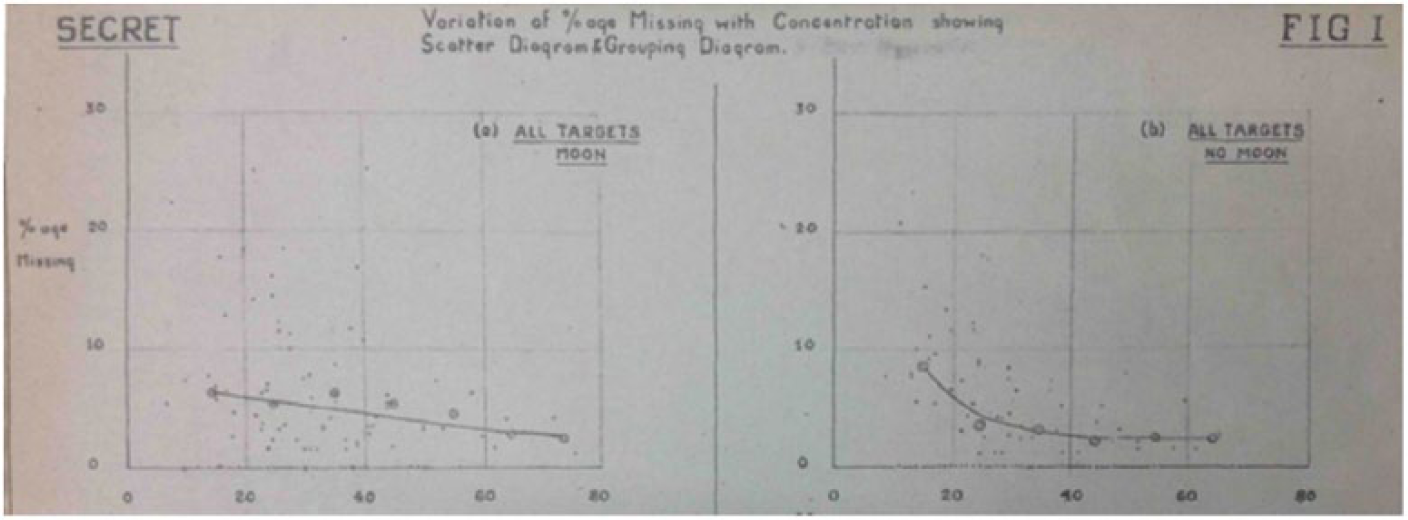
Loss rate as a function of the degree of concentration. Operational Research Section (B.C.), Report No. 29 (The National Archives, AIR 2/7610).
A subsequent report confirmed that concentration did have advantages both en route to and returning from the target. 35 But, as the number of available bombers grew, so did the degree of concentration achieved. Would not ‘chance shots’ by the enemy therefore increase losses? A further OR report showed that this was not the case. 36 Hence the ‘principle of concentration in time and space’ was important for Bomber Command, as stated by Harris himself, 37 both to maximize the destructive effect and to minimize losses, a win-win situation between those two avenues.
It was from the beginning of its mature period in March 1943, when its offensive potential was brought to bear with a real efficiency against Germany, that the ‘concentration principle’ became a standard practice for Bomber Command. But there are two non-enemy-related risks that come to mind when one imagines hundreds of bombers converging towards a given target in darkness with navigation devices that were getting better but still fairly primitive. These are the risks of collision and of bombers being hit by bombs falling from above.
The risk of collision was addressed by the OR Section somewhat late, at the end of 1943. By then the 1943 bomber offensive had been ongoing for several months. The OR Section’s reports dealing with this issue were classified as ‘Memorandums’, which means that their distribution was limited and that they did not necessarily represent the official position of the Command. A first report in December 1943 38 stated that a good knowledge of the actual rate of collisions would be very valuable for operations planning, but that it could not be obtained. The approach adopted was therefore theoretical and the report went on to outline three methods of estimation that arrived at an expected rate of collisions of 0.3 per cent of sorties, with a maximum of 1.5 per cent if evasive manoeuvres reacting to enemy action were taken into account. It was concluded that the collision risk was low enough to be neglected when compared to the benefits of concentration, and was greatly reduced by eliminating evasive actions even in the face of enemy action. Bombing straight and level over the target area had already been recommended by the OR Section as it reduced the time spent in this high-danger zone. 39 Such a recommendation, which obviously increased the efficiency of the bombing, must have been very difficult for the crews facing the real threats to follow. Only when ‘coned’ by searchlights were the pilots instructed to ‘get out of target area by quickest route – (remembering the wind) and return and try again’. The collision-risk question was revisited in February 1944 when attacks on smaller targets (Harris’s panacea targets) were being considered. 40 For bombing operations in good visibility, the collision risk was expressed as NR/12h where N was the number of planes attacking, R the number bombing per minute and h was the height in feet of the bomber stream. For ‘blindbombing’ (bombing from and through clouds) this formula became 3NR/10h. But if the crews initiated evasive manoeuvres, the formula in both cases became a simple NR/h, and thus a much higher collision risk.
Another hazard associated with the high levels of concentration achieved was the danger from bombs falling from above. It was related to the large quantities of incendiaries dropped in operation. As recognized in a June 1943 report, this was a very real risk. 41 The report stated that 54 bombers had reported being hit during the first five months of 1943 and 30 of them had experienced significant damage. It was concluded that during highly concentrated raids, as many as 1 per cent of aircraft could be hit with a 0.1 per cent chance of a fatal outcome. This was a very slight danger when compared to flak and night fighters.
It is clear that the OR studies essentially supported Bomber Command’s goal of an ever-larger concentration of bombers, despite the collision issue and the danger from falling incendiaries. In both cases, the risk was deemed low and acceptable when compared with the advantages of concentration, both in terms of loss reduction and hitting power. However, the problem of estimating the value of protective methods or equipment to reduce losses was the counterpart to maintaining or increasing offensive capacity. Reconciling the two objectives was a constant preoccupation for Bomber Command, with the latter having in general a clear advantage.
A first encounter with this type of choice concerned bombers catching fire after being hit by flak or fighters. An OR report in September 1942 based on observations by bomber crews of other bombers catching fire gave a first indication that something was wrong: ‘it appears significant that none of the damage forms reviewed in this report record fire in the air, it thus seems probable that the risk of fire in the wings proving lethal is greater than has been supposed’. 42 This was followed by studies which finally led to the conclusion that the risk of fire in the wing reservoirs following enemy action was very real. Thus came the proposal to fit the bomber force with nitrogen injection equipment that would displace the fuel fumes. However, since this apparatus weighted a hefty 230 pounds, ‘it would be necessary to consider whether an installation of this weight could be tolerated’. 43 The crews’ fear of being burned alive probably played a role in Bomber Command’s decision to install the equipment. 44
But the Command was not through with the weight-compromise issue. For example, when the wearing of flak jackets was envisioned, an OR report studied the casualties caused by enemy actions and concluded that the risks that could be covered by such a piece of equipment were considerably inferior to the levels of risk from other causes. This was considered a very sensitive subject as the report bears a warning in capital letters strongly restricting its circulation. 45
Dickins went further. When he transmitted the report to the Air Ministry, he wrote in a cover letter that ‘this Command is most anxious to limit the distribution of this report to the barest minimum of those people directly concerned with the information contained therein’. 46 Curiously, the report itself does not mention personnel armour but evaluates the risks for each position aboard the aircraft. The document was probably considered particularly sensitive, since it showed the different degrees of exposure among the crew members. A final decision not to provide flak jackets for British crews was reached in a follow-up report with the same restricted circulation warning: ‘it is shown that about 1 casualty per 1000 sorties might be prevented among returning aircrews’. 47 One must stress the ‘returning’ caveat here. Nothing is known of the fate of wounded crew trying to escape from a fatally hit bomber and no consideration is given in this analysis to flak jackets that could have made a difference in such circumstances. Since it appears that the number of American crewmen who survived a shoot-down of their bomber was significantly higher than that of British crews, 48 this consideration seems quite relevant. Once again, when both these reports were provided to Zuckerman, Dickins deemed it necessary to stress the restriction of their distribution: ‘I should be grateful if you would ensure that these papers [Reports S.77 and S.120] are only seen by those concerned.’ 49
Weight-compromise problems brought the need in 1943 for a general method to deal with it. The issue was given uniformity by being formulated into a mathematical problem. A report produced in December 1943, by none other than the then very young Freeman (John) Dyson,
50
as the initials F.J.D. indicate, outlined this approach: Supposing that a certain piece of equipment (e.g. de-icing equipment) is to be installed in bomber aircraft in order to protect the aircraft against certain types of danger, it is desirable to have a formula which will give the maximum permissable [sic] weight of the equipment. This maximum permissable weight is called the ‘Economic Weight’ of the equipment.
51
This was considered a sensitive issue so that it was classified as an ‘Internal Memorandum’. The key question was one of physical weight. In simple terms, the basic assumption was that the weight of any protective equipment embarked in a bomber reduced by an equivalent amount its bomb load: It is assumed that the installation of the equipment will not affect the rate of production of aircraft, but will affect the proportion of missing and abortive among sorties despatched. It is assumed that the bomb-load of an equipped aircraft is less than that of an unequipped aircraft by the weight or protective equipment carried. …
The value of the effort of Bomber Command may be presumed to be proportional to the tonnage of bombs conveyed to the target area.
The final result was expressed as:

Where:
E: maximum admissible weight for a protective equipment
b: bomb load without the protective equipment
m: loss rate of the bomber type not fitted with this protective equipment
x: loss-rate reduction expected from fitting with this protective equipment
y: reduction in aborted sorties that could result from the fitting of this protective equipment
Later on, this formula was deemed incorrect and a replacement was proposed: 52

Where
E: permissible weight of the protection equipment
b: bomb load per aircraft
a: proportion of aborted sorties without the protection equipment
a': proportion of aborted sorties with the protection equipment
n: proportion of losses without the protection equipment
n': proportion of losses with the protection equipment
It is not known if such formulas were used in practice, but weight studies based on the same assumptions were conducted for different types of protective equipment. For example, consideration was even given to removing sea-rescue equipment altogether. 53 It was observed that over a period of 16 months, the equivalent of 21 aircrews had been rescued. Facing this, the weight of the equipment involved was said to be equivalent to an average bomb load of 6,500 pounds. The quantity of ammunition carried for the turrets was also reconsidered. It was concluded that the provisions for the rear turret could possibly be reduced unless day operations were resumed. 54 The fuel provisioning was also reassessed, which in turn necessitated a further review of the ammunition carried and even the standard 200 pounds weight estimation for crew members was questioned. Offering no explicit conclusion, the OR report recommended additional studies and a standardization of procedures regarding fuel and ammunition provisioning of bombers among the Bomber Command groups. 55
When daylight operations reappeared in the summer of 1944 as the Allies were gaining air supremacy, aircraft faced much more flak and the question of body armour had to be re-examined. The new analysis again rejected this equipment by clearly assuming that the bomb payload had to be maintained. 56 The body armour’s weight was evaluated at a total of 160 pounds (some 23 pounds per crewmember), and was considered cumbersome for the crew. Most importantly, since the bomb load would have to be reduced by the same amount, the report concluded that more sorties would be required to drop the same tonnage on the enemy. Facing more aggressive flak, adopting armour plating for engines was also considered. Once again, the weight analysis determined that this was undesirable on the same grounds, the need to maintain the offensive’s maximum tempo and weight of effort. 57
This priority on maintaining the maximization of the destruction of the enemy over safety considerations for the bombers was not limited to weight matters. Aircraft maintenance was also affected. Coastal Command had adopted a procedure based on differentiated time periods between maintenance for specific types of aircraft components. It was deemed that the number of flying hours was a sound basis for most bomber parts, but for some specific components like the landing gear, the number of sorties was considered more accurate. This approach was seen as too complex by Bomber Command and the related report concluded, without further justification, that keeping the simple flying-time criteria for aircraft maintenance schedules did not increase risks unduly. 58 Simultaneously, another report went as far as recommending an extension of the number of flying hours between maintenance in order to increase the offensive capability, discarding without analysis any adverse safety consequence since ‘these savings in no way prejudice the safety of aircraft on operations’. 59
OR reports also reveal another striking aspect of the priority given to the destruction inflicted on the enemy over consideration of losses. Raid results were consistently estimated in terms of the degree of destruction achieved regardless of the number of bombers lost. In one example among many, a June 1943 attack on Krefeld was deemed ‘highly successful’ as it was estimated that 60 per cent of the city was set on fire. Yet the losses amounted to 6 per cent of the 705 bombers involved. 60 Three days later, an attack on Elberfeld with 627 bombers was also considered ‘highly successful’ despite losing 5.4 per cent of the attacking bomber force. 61 A worst-case example of this destruction-based culture in estimating the results of raids is the attack on Kassel in October 1943. The raid was considered an ‘outstanding success’ since ‘the main town area has been almost entirely devastated, and that in addition heavy industrial damage has been inflicted upon suburban areas’ despite the loss of 42 of the 443 bombers reporting attack, a loss rate of 9.5 per cent 62 while a loss rate in excess of 4 per cent was considered unsustainable. 63
The occurrence of such high loss rates at this stage of the bombing offensive should have provoked the curiosity of some of the OR scientists, and raised the possibility that something new and efficient had appeared in the enemy’s defences. That the use of upward firing guns by the German night fighters was not suspected and therefore that no study of appropriate countermeasures like the addition of belly guns to the bombers appears in Bomber Command’s OR work was, according to Dyson, ‘the greatest failure of the ORS’. 64
As the ORS reports suggest, it appears that the aircraft protection schemes studied by the OR Section were evaluated on the basis of the degree by which they decreased Bomber Command’s offensive capability, instead of their possible results in reducing the loss rates, or to put it more clearly, in the potential saving of airmen’s lives. The imperative was often expressed as maintaining offensive capability, while in fact from the summer of 1943 onwards Bomber Command’s striking power rapidly increased, since both the number of available bombers and their efficiency were growing, as Graph 1 shows (starting from the creation of the OR Section in September 1941).
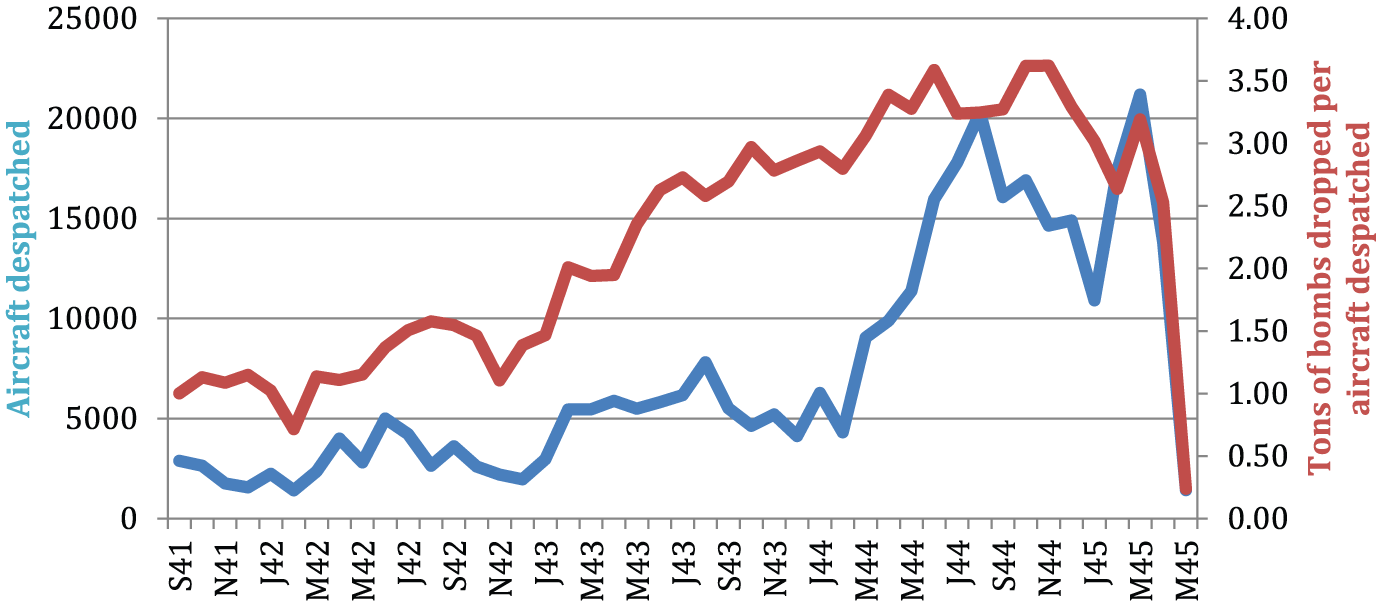
Data from Sir Charles Webster and Noble Frankland, The Strategic Air Offensive against Germany 1939–1945, Volume IV, Annexes & Appendices (Uckfield, East Sussex, 2006 (1961)), pp. 429–38, 454–7. The ‘Aircraft despatched’ data used in the calculation of ‘Tons of bombs dropped per aircraft despatched’ includes both night and day operations and all types of bomber (heavy and light).
Protection equipment was studied by the OR Section on a piece-by-piece basis. Seen in terms of an ‘economical weight’, always evaluated against an equivalent pound-per-pound loss of bomb load, each piece of gear was judged undesirable. A cumulative study could have given different results, but no trace of this has emerged from the work of the OR Section. Nevertheless, it is apparent from the formidable gain in Bomber Command’s offensive capability, due both to greater efficiency and the increasing number of aircraft available, that a relatively low reduction in bomb load per aircraft despatched would have had a very limited effect on the degree of destruction inflicted on the enemy. What this degree was is still debatable. Overy states that ‘The strategic bombing offensives were expected to yield three kinds of dividend: dislocation and destruction of the enemy war economy; progressive demoralization of the enemy population subjected to bombing; and specific political ends related to the current war situation.’
65
He goes on to analyse those expectations, which he deems were unrealistic: ‘The historical narrative of the bombing war nevertheless confirms that there existed throughout the conflict a wide gap between what was claimed and what it actually achieved in material and military terms’.
66
Overy also states that, in practical terms, the intense bombing of Germany mostly achieved The diversion of a large part of the German fighter force to the home front, the establishment of a dense web of ground anti-aircraft defences, and the recruitment of more than a million men, women and boys to man them [that] distorted German strategy and starved the fronts in the Soviet Union, Italy and France of vital aircraft, both fighters and bombers.
67
In his recent analysis, O’Brien disagrees and concludes that ‘the air-sea war between the Germans and the British and Americans was the defining campaign of the war – by a considerable measure’. 68
As far the strategic bombing offensive is concerned, his main argument is that from the summer of 1944: equipment losses [for Germany] before the battlefield actually outpaced those of the battlefield, as the crippling of Germany’s fuel production coupled with an assault on its rail network meant that considerably more than half of the country’s potential and actual production was lost before firing a shot.
69
This shows that the strategic bombing offensive, while being recognized as an important part of the allied effort against Germany, can be seen as secondary in terms of their final victory. Nevertheless, the intensity of this operation attained such levels from 1944 until the end of the war in Europe that the reduction in the tonnage of bombs that would have been required to better protect the bombers and their crews would have made little, if any, difference in the defeat of Germany. The intensity of this campaign was such that even if each bomber had delivered a few hundred pounds less than the some 8,000 pound bomb load average reached in 1945, 70 it would still have imposed the same constraints on Germany in terms of fighters and anti-aircraft measures or in losses in equipment before it reached the battlefield. In spite of this constantly accelerating offensive capability which was very apparent from the spring of 1943 and even if the defences of the Reich were gradually being reduced from the fall of 1944, the OR Section’s work does not show a significant reduction in its clear priority given to the offensive. As demonstrated by this analysis, the ratio of offensive-to-losses reduction reports remains higher than 2:1 in this period and the analysis of the reports’ contents shows a continuing effort to maximize the raids results in terms of destruction inflicted on the enemy. What is particularly revealing is that there is no analysis in the OR Section’s work of the feedback gain that protective measures for the bombers might have produced. Their calculations did not take into account how the reduction in bomber aircraft and flight crews’ losses that came with increased protective measures would have increased the forces available for further offensive missions against Germany in terms of both quantity and quality. Each mission gave air crews more experience in successfully carrying their task. That such a consideration was not taken into account further demonstrates that offensive considerations had priority.
The OR work performed by civilian scientists for Bomber Command during the conflict reveals the choice that was made in favour of maximizing the offensive when similar results could have been obtained with an orientation towards a minimization of the resources, in human lives and materiel, that were used to hit Germany. It was well recognized during the war that the cost in crewmembers was very high. Dickins himself noted in 1943 that ‘for a missing rate of 4% [common for raids of the period], 3 crews out of every 10 will survive 30 operations [thus ending their operational tour]’. 71 This consideration, as the work of OR reveals, was not weighty enough to offset the choices in favour of the maximization of the offensive. The costs in aircrews were therefore well known and bluntly stated, but they seemed acceptable since it was presumed that the bombing results were instrumental to an eventual victory, an assumption which ‘remained the prevailing view for much of the war despite all the evidence to the contrary’. 72 True, Bomber Command’s natural role was offensive. Its mission was to hit Germany as hard as possible. However, this could have been achieved with results barely distinguishable from those actually observed on the bombed grounds of Germany after the war 73 with a significant economy of human and material resources had OR work’s priorities been less oriented towards a destruction that came with little consideration for the protection of its bomber crews, protection which could have been effected at the least without a significant reduction of Bomber Command’s considerable destructive power, if not by its actual increase.
Footnotes
Acknowledgements
I would like to thank Andrew Barros, Lorne Breitenlohner, and Talbot Imlay for their helpful comments on earlier versions of this article and The National Archives for authorizing the publication of Figure 1. This final version also owes a great deal to the very constructive and meaningful comments from the anonymous reviewers for this journal.
Funding
This research received no specific grant from any funding agency in the public, commercial, or not-for-profit sectors.
1
A founding note on this revolutionary approach was produced by one of the most famous practitioners of OR during the Second World War: Patrick Maynard Stuart Blackett, Scientists at the Operational Level, September 16, 1941, Archives of the Royal Society, London, PB/4/7/1 (D84).
2
As the most recent studies are concerned, a general overview of the bombing offensives by all sides on all theatres of the Second World War is provided by Richard Overy, The Bombing War – Europe 1939–1945 (London, 2013). A more specific work on the Allied bombing of Germany’s cities has been produced by Pierre-Etienne Bourneuf, Bombarder l’Allemagne – L’offensive alliée sur les villes pendant la Deuxième Guerre mondiale (Paris, 2014). A recent analysis concluding that the air–sea war against Germany and Japan was instrumental in the Allied victory can be found in Phillips Payson O’Brien, How the War was Won (Cambridge, 2015).
3
For a short overview of the development of OR in Bomber Command, see Maurice W. Kirby and R. Capey, ‘The Area Bombing of Germany in World War II: An Operational Research Perspective’, The Journal of the Operational Research Society 48:6 (1997), pp. 661–77. For a more extensive analysis see Randall T. Wakelam, The Science of Bombing: Operational Research in RAF Bomber Command (Toronto, 2009), p. 347. In broader terms, the historiography of Operational Research (or Operations Research as it is referred to in the United States) is very large. A good starting point is William Thomas, ‘The Heuristics of War: Scientific Method and the Founders of Operations Research’, The British Journal for the History of Science 40:2 (June 2007), p. 252 n. 2.
4
Martin Middlebrook and Chris Everitt, The Bomber Command War Diaries – An Operational Reference Book 1939–1945 (Barnsley, 2014), p. 11.
5
According to Harris, Bomber Command lost some 41 per cent of its aircrews during the War. Overy, The Bombing War, p. 408.
6
Overy, The Bombing War, pp. 287–8.
7
Harris to Charles Portal [C.A.S], November 1 1944 (The National Archives, AIR 8/1745).
8
Robert S. Ehlers Jr, Targeting the Third Reich – Air Intelligence and the Allied Bombing Campaigns (Kansas, 2009), pp. 262–4.
9
Blackett, Scientists at the Operational Level, p. 3.
10
Richard Peirse to the Under Secretary of State, Air Ministry, 8 August 1941 (The National Archives, AIR 2/5352).
11
(Unsigned, undated) ‘Appendix B’ Note on duties of Operations Research Officer (The National Archives, AIR 14/1218).
12
Wakelam, The Science of Bombing, p. 37.
13
Stephen Budiansky, Blackett’s War (New York, 2013), p. 146. Significantly, following a farewell note from Larnder when he was replaced as CinC of Fighter Command, Dowding responded, ‘Thanks. This war will be won by science thoughtfully applied to operational needs.’ Harold Larnder, ‘The Origin of Operational Research’, Operations Research 12:2 (1984), p. 474.
14
Budiansky, Blackett’s War, p. 245.
15
Sir Arthur Harris, Bomber Offensive (Barnsley, 2005), pp. 71–2.
16
Harris, Bomber Offensive, p. 133.
17
Most of the Bomber Command OR records at The National Archives are found in the AIR 14 files in which Dickins presence is abundant.
18
Solly Zuckerman, From Apes to Warlords (London, 1988), p. 234.
19
Victor Bissonnette and Freeman Dyson, Memorandum of Conversation, Princeton (New Jersey), November 18, 2013 (Montréal, 2013). Dyson has also expressed his opinion of Dickins and the work atmosphere in Bomber Command’s OR Section in some publications. See Freeman Dyson, Disturbing the Universe (New York, 1979) and ‘A Failure of Intelligence – Operational Research at Bomber Command, 1943–1945’, Technology Review 109:5 (2006), pp. 62–71.
20
Guy Hartcup, The Effect of Science on the Second World War (New York, 2000), p. 110.
21
Wakelam, Science of Bombing, p. 38.
22
Sir Robert Saundby, Air Bombardment – The Story of its Development (New York, 1961).
23
Harris, Bomber Offensive, pp. 71–2.
24
Wakelam, Science of Bombing, p. 37.
25
Bissonnette and Dyson, Memorandum.
26
Ministry of Defence Air Historical Branch (RAF), Operational Research in Bomber Command (The Laurier Center for Military Strategic and Disarmament Studies, The Ronnie Shephard Fonds, Wilfrid Laurier University, Waterloo (Ontario, Canada)), p. 12.
27
Ministry of Defence Air Historical Branch (RAF), Operational Research in Bomber Command, p. 9. It was also observed that such devices could help reduce losses through better navigation to and from the targets. Operational Research Section (B.C.) – Report No. 74, JGW (ORS2) – An Investigation into the Effect of GEE on Casualties, 18 July 1943 (The National Archives, AIR 14/1446).
28
Harris, Bomber Offensive, p. 144.
29
The term used by Harris to designate bombing objectives other than large German urban areas that were assigned to Bomber Command against his own views. See Henry Probert, Bomber Harris – His Life and Times (London, 2006), p. 257. Overy recently stated that Harris ‘spent the rest of the war grimly contesting every attempt by what he called “Panacea Target mongers” and “Diversionists” to prevent him bombing city areas’. Overy, The Bombing War, p. 298.
30
Ministry of Defence Air Historical Branch (RAF), Operational Research in Bomber Command, pp. 15–16.
31
Examples of such memoranda headers are found in The National Archives, AIR 14/3062.
32
Harris, Bomber Offensive, p. 83.
33
Sir Henry Tizard to N.H. Bottomley, 25 September 1941 (The National Archives, AIR 2/7610).
34
Operational Research Section (B.C.) – Report No. 29, HLB/RJS (ORS2) – An Investigation into the Effect on Bomber Losses of Concentration in Time at the Target and Duration of the Attack, 11 March 1942 (The National Archives, AIR 2/7610).
35
Operational Research Section (B.C.) – Report No. 34, LCL/RJS (ORS2) – Preliminary Note on the Effect on Bomber Losses of Concentration in Space en route, 30 May 1942 (The National Archives, AIR 14/396).
36
Operational Research Section (B.C.) – Internal memorandum No. 32, SCB (ORS2) – Concentration in Time, March–July 1942, 18 October 1942 (The National Archives, AIR 14/3062).
37
Harris, Bomber Offensive, p. 83.
38
Operational Research Section (B.C.) – Internal memorandum No. 87, ORS2 – The Frequency of Collisions between Bombers on Night Operations, 3 December 1943 (The National Archives, AIR 14/3062).
39
Bomber Command Tactical Memorandum – Evasive Action at the Target, 24 May 1943 (The National Archives, AIR 14/4594).
40
Operational Research Section (B.C.) – Internal memorandum No. 86, The Collision Risk Involved in a Precision Attack on a Single Mark by a Moderate Number of Heavy Bombers, 15 February 1944 (The National Archives, AIR 14/3062).
41
Operational Research Section (B.C.) – Report No. B.140, JGW/EAL/RJS (ORS2), A Note on the Number of Incendiary Bombs Falling on Bomber Aircraft in Concentrated Raids, 30 June 1943 (The National Archives, AIR 14/1445).
42
Operational Research Section (B.C.) – Report No. 57, EAL/EMD (ORS2), Note on the Vulnerability of Various Aircraft Fuel & Oil Systems to Enemy Action Damage, 29 September 1942 (The National Archives, AIR 14/4544).
43
Operational Research Section (B.C.) – Report No. S.74, EAL (ORS2), A Note on the Fire Risk in Bomber Aircraft, 22 December 1942 (The National Archives, AIR 14/1447).
44
Notes of Meeting Held by the Secretary of State to Consider the Development and Production of Items of Scientific Equipment, 28th June, 1943, Meeting 17(43), 28 June 1943 (The National Archives, AIR 20/2355).
45
‘THIS REPORT HAS BEEN PREPARED FOR THE INFORMATION OF THOSE CONCERNED WITH THE ARMOUR PROTECTION OF PERSONNEL IN BOMBER AIRCRAFT, AND IT IS OF THE GREATEST IMPORTANCE THAT THE INFORMATION CONTAINED IN IT SHOULD ONLY BE ALLOWED TO COME TO THE NOTICE OF THOSE DIRECTLY CONCERNED IN THIS WORK.’ Operational Research Section (B.C.) – Report No. S.77, EAL/DGO (ORS2), Casualties among Aircrew Personnel Directly Due to Enemy Action on Night Operations, 17 February 1943 (The National Archives, AIR 14/1803).
46
Basil G. Dickins, Note to the Officer in Charge, Operational Research Center, Air Ministry, Whitehall ‘Distribution of Report No. S77’, 12 March 1943 (The National Archives, AIR 14/1803).
47
Operational Research Section (B.C.) – Report No. S.120, ORS2, A Further Note on Casualties among Personnel Directly Due to Enemy Action on Night Operations, 29 January 1944 (The National Archives, AIR 14/2686).
48
There are several sources dealing with this question. They provide slightly conflicting figures but in general there seems to be a ratio of survival near 2:1, favouring the American crews. Freeman Dyson refers to such a ratio found by one of his colleagues in 1944: ‘From American bombers shot down in daylight, about fifty percent [of crewmen] escaped. From the older types of british night bomber, Halifax and Stirling, about twenty-five per cent. From Lancasters, fifteen per-cent.’ Dyson, Disturbing the Universe, p. 27. Figures established after the war confirm this result. The survival rate upon shoot-down for Bomber Command is 27 per cent using data from Sir Charles Webster and Noble Frankland, The Strategic Air Offensive against Germany 1939–1945, Volume IV, Annexes & Appendices (Uckfield, East Sussex, 2006 (1961)), appendix 41, p. 440. For the Americans, the corresponding figure for the European theatre of operations is 46.6 per cent based on Richard G. Davis, Bombing the European Axis Powers – A Historical Digest of the Combined Bomber Offensive, 1939–1945 (Maxwell Air Force Base, Alabama, 2006), table 4, p. 586.
49
Dickins to Zuckerman, 23 November 1944 (University of East Anglia, Zuckerman papers, SZ/OEMU/44/20). Copies of both reports received by Zuckerman are in file SZ/OEMU/45/18.
50
Freeman Dyson was 19 years old when he joined Bomber Command’s OR Section on 25 July 1943.
51
Operational Research Section (B.C.) – Internal Memorandum No. 135, FJD/MTA (ORS2), Note on the ‘Economic Weight’ of Protective Equipment, 10 December 1943 (The National Archives, AIR 14/3062).
52
Operational Research Section (B.C.) – Internal Memorandum No. 136, ORS2, The Economic Weight of Aircraft Protection Equipment, 16 May 1944 (The National Archives, AIR 14/3062).
53
Reuben J. Smeed (head of the ORS2 unit), Note prepared for Dickins and addressed to the Royal Aircraft Establishment Director, Weight of Air-Sea Rescue Equipment, 6 September 1943 (The National Archives, AIR 14/1800).
54
Operational Research Section (B.C.) –Memorandum No. 68, ORS2, Ammunition Fired in Air to Air Combats at Night by Bomber Aircraft, 15 April 1943 (The National Archives, AIR 14/7803).
55
Operational Research Section (B.C.) – Report No. B.195, GAR/RHC (ORS1), Investigation into the Petrol & Bomb Loads, 3 February 1944 (The National Archives, AIR 14/1445).
56
Operational Research Section (B.C.) – Internal Memorandum No. 146, ORS2, Note on the Value of Body Armour to Bomber Aircrew, 2 January 1945 (The National Archives, AIR 14/3062).
57
Operational Research Section (B.C.) – Report No. S.208, ORS2, Note on the Extent of Bomber Losses Due to Enemy Action Damage to Radiators of Liquid Cooled (Merlin) Engines, 3 March 1945 (The National Archives, AIR 14/1448).
58
Operational Research Section (B.C.) – Report No. S.170, TES/KAS (ORS1), The Relation between Flying Hours, Number of Landings and Lapse of Time, 16 August 1944 (The National Archives, AIR 14/1448).
59
Operational Research Section (B.C.) – Report No. 105, KAS (ORS6), The Experimental Extension of the Minor Inspection Period for Operational Lancasters from 50 to 75 Flying Hours, 10 August 1944 (The National Archives, AIR 14/4145).
60
Operational Research Section (B.C.) – Report No. B.145, LCL (ORS1), Interim Report on the Attack on Krefeld 21/22 June, 1943, 8 July 1943 (The National Archives, AIR 14/1445).
61
Operational Research Section (B.C.) – Report No. B.147, LCL (ORS1), Interim Report on the Attack on Elberfeld 24/25th June, 1943, 20 July 1943 (The National Archives, AIR 14/1445).
62
Operational Research Section (B.C.) – Report No. B.182, LCL (ORS1), Interim Report on the Attack on Kassel 22/23rd October, 1943, 1 November 1943 (The National Archives, AIR 14/1445).
63
Middlebrook and Everitt, The Bomber Command War Diaries, p. 283. Harris considered that a continued loss rate of 5 per cent would have contracted the strength of the Command. Martin Mace and John Grehan, Bomber Harris – Sir Arthur Harris’ Despatch on War Operations 1942–1945 (Barnsley, 2014), appendix F – Expansion and Re-equipment, #31.
64
Dyson, A Failure of Intelligence, p. 65.
65
Overy, The Bombing War, pp. 613–14.
66
Overy, The Bombing War, p. 632.
67
Overy, The Bombing War, pp. 626–7.
68
O’Brien, How the War was Won, pp. 484–5.
69
O’Brien, How the War was Won, p. 481.
70
This is the maximum figure achieved by Bomber Command. It occurred in October and November 1944 as derived from Webster and Frankland, The Strategic Air Offensive against Germany 1939–1945, Volume IV, Annexes & Appendices, pp. 429–38 (aircraft despatched) and pp. 454–7 (tonnage of bombs dropped). It includes both night and day operation and all types of aircraft, that is, both heavy and light bombers.
71
Dickins, Loose Minute, 19 July 1943 (The National Archives, AIR 14/1800).
72
Overy, The Bombing War, p. 247.
73
The Americans proceeded to an extensive examination of the strategic bombing results (United States Strategic Bombing Survey – USSBS) that started towards the end of the War. The British followed immediately after the end of the conflict with their own, if comparatively limited effort (British Bombing Survey Unit – BBSU). See Webster and Frankland, The Strategic Air Offensive against Germany 1939–1945, Volume IV, Annex V – The British and United States Surveys of the Strategic Bombing Offensive, pp. 40–58.