




Abstract
The US government implemented the State–Joint Chiefs of Staff (JCS) Meeting to look over its politico-military policies and strategies to implement NSC 68/4 during the Korean War. The meeting became a critical organization to conduct the war as a limited war by developing a limited goal and providing strategies for a decision-making apparatus after the removal of General MacArthur from the post of Commander of the United Nations in March 1951. The meeting later provided politico-military directives to the JCS to continue the war in limited terms, supported the armistice negotiation, and contributed to the success of the first year’s agreement.
A New War without a Hero
During the meeting of the 75th National Security Council (NSC) on 14 December 1950, President Harry S. Truman gave significant instructions to the Secretaries of State and Defense to cooperate to consider politico-military aspects of the execution of measures stipulated in NSC 68/3. 1 This meeting and the decisions it produced became a symbol of the Cold War. Truman and his cabinet members understood that the Korean War had entered a new phase with the intervention of Communist China and declared a ‘National Emergency’ to cope with the threat of global war with Communist countries. At the meeting, the participants adopted NSC 68/4 to prepare for a global war in the future. This moment has been regarded as a critical point in the early Cold War era, as US policymakers foresaw the possibility of a world war in the nuclear age.
Unlike the NSC document and the proclamation of a national emergency, Truman’s instruction for intra-governmental cooperation to oversee long-term politico-military strategies has not attracted interest among researchers for decades. 2 However, this instruction was particularly significant because it brought about the emergence of frequent State–JCS (Joint Chiefs of Staff) Meetings (SJM) as part of the US war-conducting mechanism. There is no monograph that analyses the role of the SJM during the Korean War and the Cold War. We have only sporadic references that explain the work of the meeting. The History Section of the Joint Chiefs of Staff dealt with SJM in The History of the Joint Chiefs of Staff: The Joint Chiefs of Staff and National Policy, Vol. III, The Korean War Part I. At the same time, some minutes of the meetings were compiled in Foreign Relations of the United States 1951 Korea and China, Vol. VII, Part I.
The intervention of the Communist Chinese People’s Liberation Army (CPLA) in the Korean War and the military failures of the United Nations (UN) forces contributed to the creation of the SJM. The CPLA began to intervene in the Korean War from 19 October 1950. The Chinese dispatched XXXVIII, XXXIX, and XL Corps to the west front and surprised the UN forces that were marching to the Korean–Chinese border at the beginning of November 1950. 3 The UN forces were pursuing reunification of Korea based on the UN General Assembly Resolution of 7 October 1950, 4 but their advance was propelled by the Commander in Chief of the United Nations Command (CINCUNC), who achieved great success at the Inchon Landing Operation on 15 September 1950. General MacArthur pushed his troops to chase the North Korean People’s Army (NKPA) to the border. The UN troops encountered little resistance from the NKPA on the march. Political and military leaders in the United States who gathered at Wake Island on 15 October 1950 had little doubt that UN forces would succeed in reunifying Korea. 5
The CPLA, however, stopped the advance of UN forces and even compelled them to withdraw. The CPLA had intense engagements with leading UN forces from 25 October 1950 to 6 November. These surprise attacks inflicted serious damage to the II Corps of the Republic of Korea (ROK) and the I Corps of the US and forced them to relinquish the bridgehead of the Chongchon River. Despite this situation, General MacArthur was determined to resume his offensive to end the war before Christmas. Neither he nor the Joint Chiefs of Staff correctly understood the situation, mainly due to their lack of information. MacArthur ordered his units to advance north again on 24 November 1950, but the move was a humiliating failure. The CPLA deceived UN forces into advancing then enveloped their units. As a result, from 5 December 1950 the US VIII Army was forced to withdraw to the south, abandoning Pyongyang after 45 days of occupation. Furthermore, the US X Corps on the eastern front was isolated in the beachhead around Heungnam and encircled by the CPLA IX Army. Political and military leaders realized that a new war had begun.
On 28 November 1950, at the meeting of the NSC, conferees agreed that they were facing a new war and were concerned that the CPLA intervention would lead to a general war with communist countries. With this view of the situation, Secretary of Defense General George C. Marshall and the three service secretaries suggested in writing that the USA limit the war to the Korean Peninsula and simultaneously build up Western military power. To limit the war, they recommended not invading Chinese territory, nor employing Chinese Nationalist Forces in Taiwan, but strengthening UN forces using non-US troops. Secretary of State Dean Acheson heightened the sense of fear by arguing that the USA could not gain victory over China, even if it had some tactical success, because the Soviet Union would join the war on the side of Communist China and North Korea. 6
In fact, limiting the war to the Korean Peninsula had been the prime objective of the United States since the beginning of the conflict on 25 June 1950. The US government had tried to avoid a general war with Communist China and the Soviet Union. US political and military leaders had vivid memories of the Second World War and never wanted to repeat that disaster. At the same time, they were determined not to appease the Communist challenge in Korea. Based on the lessons of 1938 in Munich, they believed that appeasement would embolden the Communists to expand their aggression to other parts of the world. The US government decided to use military power to stop the North Korean invasion of South Korea and to limit the conflict to the peninsula in order to avoid another world war.
The limited war strategy in the Korean War was part of the American Cold War containment strategy. Containment pursued not the destruction of Communism but the halt of its expansion. 7 Soon after the Second World War, the USA established a containment strategy in response to Soviet expansionism. The diplomat George Kennan advocated the strategy of containment in his widely read article, ‘The Sources of Soviet Conduct’, published in Foreign Affairs in 1947. Based on his long experience as a Russian expert, Kennan concluded that the Soviet Union was employing psychological methods to gradually expand its influence over Western countries. He suggested boosting the self-confidence of war-torn Western countries by facilitating economic recovery. To this end, he recommended that the US government integrate Germany into the European economy and take a positive stance for Japan’s revival. 8 In Kennan’s meaning of the term, containment was an economic, psychological, and indirect approach to block the expansion of Communism. However, the containment strategy became more direct and confrontational in the process of dealing with the Communist insurgency in Greece and the Soviet Union’s pressure on Turkey to station naval forces in the Bosporus Strait in 1947. Eventually, the US government elaborated a more comprehensive version of its containment strategy in 1950 in the policy statement NSC 68, which was stimulated by the Soviet Union’s successful nuclear test in August 1949.
The US military supported the containment strategy by building up strategic bombing capabilities. After the Second World War, the USA rapidly demobilized, largely out of fear of economic recession. The US government could not maintain large armed forces; men should return to their homes and jobs, and airplanes and ships should be mothballed. Instead of large conventional forces, the USA began to rely on nuclear bombs and long-distance bombers that could deliver the lethal bombs to the territory of the Soviet Union. As long as the USA retained the bombers and its monopoly on nuclear capability, it could deter Soviet challenges by the threat to use those formidable weapons. Based on this concept, the US military developed a series of war plans that relied on massive nuclear bombing against expected Soviet military aggression with conventional arms in Europe and Asia. Operation Plans PINCHER (1946), HALFMOON (1948), and OFFTACKLE (1949) envisioned bombing Soviet military and industrial targets to reduce war capabilities, after initial attacks by the Soviet Union. In addition, the JCS elaborated mobilization plans to transform US war potential into actual war capabilities. 9
However, the US military did not pay enough attention to a limited war. Responding to limited war must be part of US efforts to deter world wars. If the USA failed to deter a limited war, this war could develop into a major conflict involving great powers. Unlike a total war, limited wars could happen in peripheral areas and could not be deterred by nuclear bombs. To deal with small-scale challenges, the USA should have well-trained and fully equipped standing forces composed of rapidly deployable ground troops, naval vessels, and fighters. At the same time, the military should have well-studied plans for limited wars. However, in contrast to these necessities, the military focused on the large-scale challenge the Soviet Union posed to Western Europe. 10 In 1945, then Army Chief of Staff, General George C. Marshall wrote a memorandum arguing that if a future war were to happen, it could become a total war, a view reiterated by Dwight D. Eisenhower two-and-a-half years later. 11 Thus, the USA entered the war in Korea without proper military capabilities and plans. 12
The Joint Chiefs of Staff were empowered as the supreme military organization for conducting a war, under civilian leadership. The JCS became the statutory body to interpret political decisions and transform them into military operations in theatres. Top-brass officers of the JCS were members of the NSC, and they met with the Commander in Chief. They had opportunities for conversations with high-ranking civilian officials, which gave them an overall understanding of government policies. Under this structure, theatre commanders were expected to follow the directions of the JCS in order for their operations to achieve the stated political goals.
Even after his failure in the first week of November 1950, after the entry of the CPLA, in his report to the JCS on 9 November, MacArthur insisted on a new offensive to end the Korean War. 13 He argued that UN forces should adopt an aggressive approach to deal with Chinese troops, in contrast to the appeasement of Munich 1938. He contended that he would occupy the rest of the peninsula with his new offensive. 14 This time, the JCS took a cautious stance because of the undefined size and objectives of the CPLA. The JCS assumed that the CPLA could be defeated by determined US efforts alone but they realized that the risk of a global war increased with Soviet assistance to the Communist forces. As a result, the JCS recommended settling Chinese intervention using diplomatic methods in the United Nations and reviewing the missions of CICUNC. 15
However, the JCS did not try to change the direction of operations of General MacArthur. The NSC members, with the absence of President Truman, discussed the future US course of action in Korea at its 71st meeting on 9 November 1950. The members should have made important decisions about MacArthur’s plan at the meeting, but because of the lack of determination of the JCS, the members of the Security Council acceded to MacArthur’s desire. Later, the US political and military leaders had another chance to circumvent the direction of the US war efforts on 21 November, when they gathered to re-examine General MacArthur’s plan to march to the Chinese border. At this time, they decided to recommend that General MacArthur establish a buffer zone along the border after occupying the entire area up to the border. 16 Furthermore, the leaders skipped the issue of the Korean War during the 72nd NSC meeting on the next day, 22 November, at which President Truman presided. 17 In this way, the US government lost the chance to avoid the forthcoming catastrophe in Korea.
Abandoning commanding functions over theatre operations was a grave mistake for the US government. The JCS, Defense Secretary, or President Truman should have done something to check the situation carefully and devise optimal courses of action. The JCS did not dare cancel the offensive of MacArthur, because it had been overwhelmed by the aura of General MacArthur since the success of the Inchon Landing operation. 18 In addition, the JCS wanted to avoid the criticism that it deprived MacArthur of the chance of another success. 19 Even President Truman was not in a good position to oppose MacArthur’s plan to end the war, because if the president ordered MacArthur to stop the offensive and to withdraw UN forces, he would be condemned for appeasing the Communists. 20 After all, the US government had no function to control and command a theatre commander who pursued aggressive operations that opposed the government’s cautious approach. The US government’s well-established command structure was temporarily paralysed.
The Emergence of SJM and Its Extended Role
In the end, American political and military leaders were able to recover their authority to command the war because of the severe military disaster that followed Chinese intervention. The CPLA’s counter-offensive ignited by MacArthur’s new drive on 24 November 1950 imposed serious damage to UN forces. Having received news of this debacle, the NSC considered changing the goal of the Korean War at the 73rd meeting on 28 November. Five days later, the top Defense and State officials convened another meeting to find a solution to the disaster in Korea. At this meeting, Acheson suggested an armistice as a final way to end the conflict, and other members did not oppose his idea. However, they decided to cede the decision to the coming summit between Truman and British Prime Minister Clement R. Attlee.
21
In a series of conferences from 4 to 8 December, Truman and Attlee agreed to new goals for the Korean War. They would end the war through negotiation and announced this goal to the public in a communiqué.
22
Thereafter, Truman convened an NSC meeting on 11 December to devise the necessary steps to support the agreements reached in the Truman–Attlee summit. The president defined the goal of the United States as follows:
23
We will consider a cease-fire, but must insist upon a cease-fire which does not place UN forces at a military disadvantage and which does not involve political concessions. Details of a cease-fire should be negotiated in order to protect the security of UN forces before a cease-fire is accepted. The Joint Chiefs of Staff will prepare as a matter of urgency the military conditions on which a cease-fire would be acceptable.
The members of the NSC agreed with Truman’s stance on the goal for the war, and reached a consensus on different courses of action in Korea. On the other hand, on 14 December 1950 the NSC adopted NSC 68/4 to prepare the USA for a new phase of the Cold War.
At first, the USA tried to reach an agreement to conclude an armistice with Communist China through the efforts of a special committee of the UN. At this moment, the People’s Republic of China dispatched a delegation headed by Wu Hsiuchuan to appeal to the UN Security Council regarding US aggression in the Taiwan Straits. 24 UN member countries were eager to cooperate to bring an end to the hostilities in the Korean Peninsula. Ahead of the negotiation, on 10 November the US government submitted a Six-power Resolution to give confirmation that UN forces would not invade Chinese territory. 25 The resolution was submitted to the UN Security Council but was later vetoed by the Soviet Union. 26
Because the Indian ambassador to the People’s Republic of China, K. M. Panikkar, had direct access to Zhou Enlai in Beijing, Indian representatives to the UN took the initiative in the negotiation efforts. B. N. Rau met with Wu and conveyed US intentions for the armistice. Rau added that the USA wanted to establish a demilitarized zone and intended to engage in further negotiation. Wu did not show a positive response, and objected to the Six-power Resolution. 27 The resolution was the brainchild of US diplomacy to soothe Communist Chinese concerns for their security. Meanwhile, Asian countries in the UN drafted a resolution to urge a cease-fire. The US delegation to the UN worked to shape a small committee to devise satisfactory cease-fire terms, following the initiative of the Asian countries. 28 A committee composed of Nasrollah Entezam (Iran), Lester B. Pearson (Canada), and Benegal Rau (India) made efforts to persuade the Communist Chinese delegation to pursue an armistice. However, on 22 December the Communist Chinese government blatantly rejected the proposal for an armistice by blaming US opposition to Communist China’s membership in the United Nations. 29
As the hope of beginning negotiation through the arbitration of the UN committee dimmed, the US government began to seek more direct approaches to achieve a cease-fire. This option should involve some successful military actions to block Chinese advances in the field. Then the USA could exploit military achievements to persuade China to accept an armistice. In this regard, President Truman wanted to know if UN forces could hold their positions in the peninsula. In addition, Truman and Acheson believed the United States had a moral obligation to defend South Korea. They agreed to continue military operations in Korea under the rubric of collective security at a meeting at Blair House on 26 December 1950. 30 Specifically, Acheson argued that the CPLA military strength was limited because it only had numerical superiority over UN forces and had to maintain extended lines of communication. At the same time, Truman emphasized that the USA should not give up South Koreans to be slaughtered by Communists. 31
At this point, the SJM began to focus on this issue. The SJM consisted of Ambassador Philip C. Jessup, Assistant Secretary of State for Far Eastern Affairs Dean Rusk, Deputy Undersecretary H. Freeman Matthews, and Paul Nitze from the State Department; the Joint Chiefs representing the Department of Defense; and James S. Lay from the NSC as observer. From 24 January 1951 they met weekly or biweekly at the Pentagon. On the first day, General Omar Bradley mentioned that ‘the meeting was not intended to make decisions over matters but to leave records of discussants to be consulted later by working levels’. 32 In fact, General Bradley re-emphasized the goal of the meeting by stating at the meeting of 11 April that ‘agreed minutes were only to indicate topics discussed’. His remarks showed that the JCS basically regarded the meeting as an opportunity to hold discussions with their counterparts in the State Department. 33 However, the members of the meeting naturally came to understand its purpose as a mechanism to elaborate policies for the war.
The SJM discussions on the Korean War began 30 January 1951. The main focus was to set a military goal that could be politically sustainable. This time, the participants in the meeting were satisfied with the idea of limiting the battle area in connection with military goals. The JCS contended that it would be meaningless to UN forces to move beyond the 38th Parallel. Nitze supported this idea by mentioning that staying below the line would be good politically. 34 The Figure 1 shows the 38th Parallel and major cities of South and North Korea. At least, the members were confident that UN troops could hold the current front line. They had received reports from Collins and Vandenberg that morale in the VIII Army was quite positive. 35 The two Joint Chiefs who were dispatched to the Far East Command to inspect the morale of troops were impressed by the leadership of the new VIII Army Commander, General Matthew Ridgway, and the strong will of the soldiers.
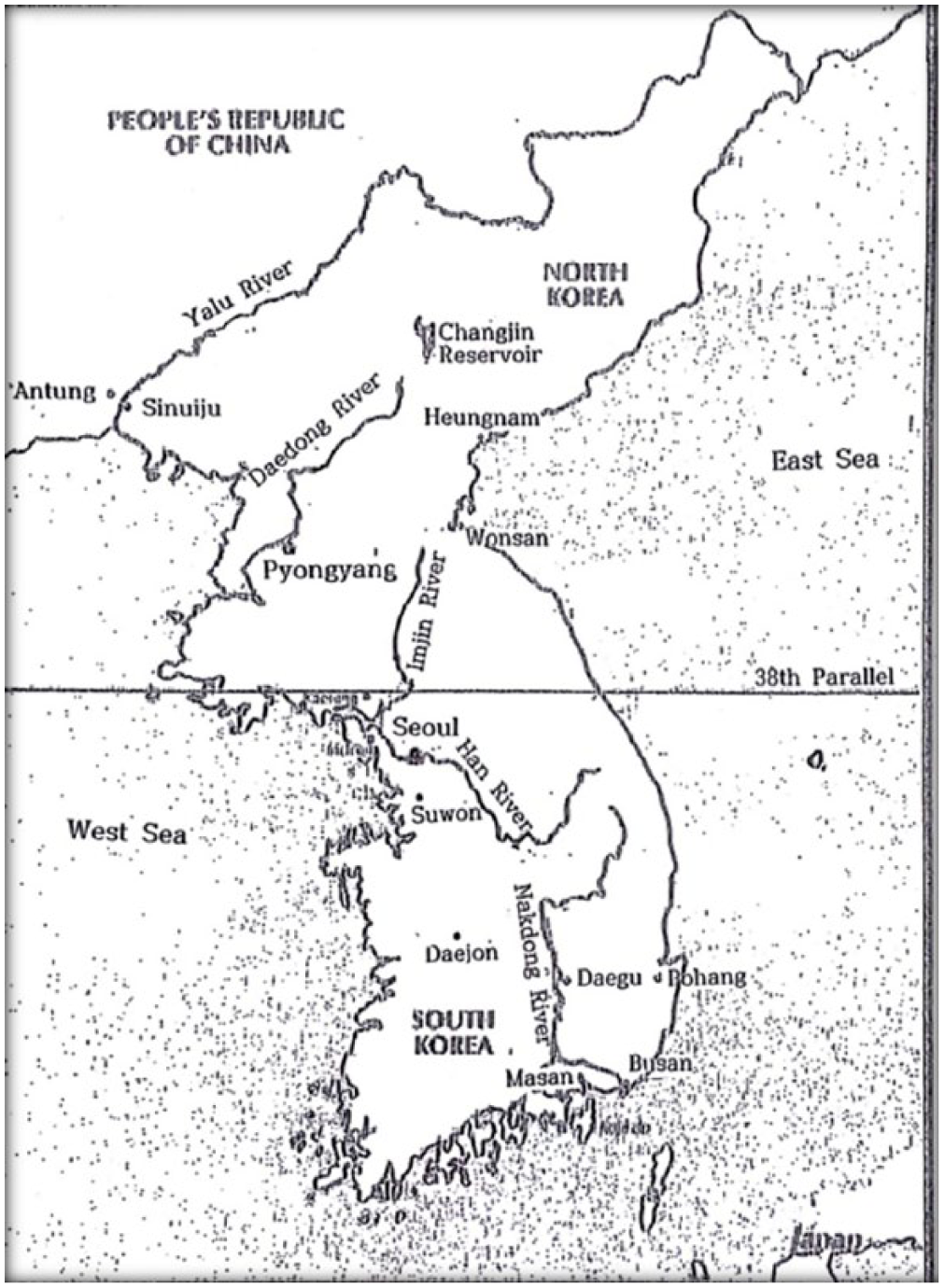
Korean Peninsula.
In the third meeting, on 6 February, the participants explored the goal of the war in detail. They thought that they had five lines of actions to pursue: reinforcing UN forces and attempting to unify Korea; withdrawing UN forces; maintaining a stalemate; achieving a cease-fire agreement by UN negotiations with the restoration of the 25 June 1950 status quo; or settling the Korean problem by defeating the Beijing regime. 36 Among these options, a cease-fire followed by UN negotiation was regarded as the best one. At the fourth meeting, the State Department suggested more concrete goals for the cease-fire. Presenting a paper containing basic ideas for the cease-fire in the form of NSC reports, they sought the opinions of the JCS. 37 The main points of the paper were to achieve a cease-fire along the 38th Parallel by military assaults on the enemy and to build up ROK forces to the point that would allow a partial withdrawal of UN forces if a cease-fire were not achieved. 38 After presenting the paper, Dean Rusk argued that if the USA excluded extreme courses of actions like unification of Korea or unilateral withdrawal, stabilization in the Korean Peninsula would automatically become the only goal of the USA. 39
However, the JCS had a different view from that of State. The Joint Chiefs claimed that a cease-fire could not be an objective but would be one element in an overall agreement. 40 At the beginning, General Bradley expressed his opinion that the current Korean situation required the decision of political objectives before the military requirements could be determined. He had no doubt of the clear hierarchy in the relationship between political objectives and military objectives. In his belief, a cease-fire could not be a political goal but it should be a factor that could support political goals. The JCS might have shared Bradley’s view of relations between political and military objectives. In their understanding, a cease-fire could be achieved as a result of negotiations among belligerents at the end of the war rather than pursued as an objective. The members of the JCS had not fought to reach an armistice during the Second World War.
The difference between State and Defense regarding restoration of the border at the 38th Parallel as an objective of the war was resolved when the VIII Army retook Seoul in the middle of March 1951. Because of the advance of the UN forces in the field, State and Defense needed to define directives regarding the 38th Parallel. To this end, the SJM was held on 15 March 1951. Participants from Defense agreed to advance beyond the 38th Parallel, with the exception of General Vandenberg, who was concerned about shortened lines of communication of the CPLA and a subsequent decrease in the effectiveness of UN air operations. In the same vein, Paul Nitze argued that the terrain below the Han River offered the best defensive positions, based on the long Chinese line of communications. 41 In the end, a few members of the SJM gathered on 19 March in a follow-up meeting to define the northern limit of military advance. They agreed to move to a ‘diagonal (line), running northeast from the Imjin River to Wonsan … maintaining sufficient air space between it and the Yalu River’ and containing major lateral lines of communication. 42
This settlement of the goal of the war turned out to be a remarkable accomplishment of the SJM. The US government was able to have an attainable goal in politico-military terms. This goal became a basic consideration in defining US military objectives that would enable the UN Command to reach an armistice. After establishing this goal, on 15 March 1951 the State Department finished a draft titled ‘United States National Objectives and Policy in Asia’, which was circulated to NSC staff members. As the title shows, the paper intended to set forth overall US policies in Asia, including specific objectives in the Korean War. In the paper, the State Department outlined the objectives of the USA as terminating hostilities and ending aggression while avoiding general war with Communist countries. To this end, the USA would pursue an acceptable political settlement with Communist China and the Soviet Union. In order to reach such a settlement, the USA needed to continue military actions to penalize the aggressor and to build up dependable South Korean armed forces. 43 In this context, the 38th Parallel would ‘be sought and held [and action] should be north of the parallel and chosen for its tactical defensive possibilities and practicality of attainment’. 44
Later, the State Department established US objectives in the Korean War within the big picture of America’s policies toward Asia. State used a deductive method to devise proper US objectives for the war, which could serve larger US objectives. To consider the lower-level objectives in the Korean Peninsula, State disregarded the hierarchy between political and military goals as long as they could support global and Asian objectives. In this regard, maintaining a line north of the 38th Parallel was an important politico-military objective that should bring an acceptable settlement. For this objective, UN forces would continue punitive actions against the Communist aggressors. The Truman administration sought to avoid a world war and damage of US interests in world politics. Therefore, UN forces should obtain a line just north of the parallel rather than unification or withdrawal and the military should be used to penalize the aggressors.
The 15 March paper had the same logic of the NSC 48/3 that was revealed on 26 April 1951. In the context of new developments caused by the participation of the CPLA, the State Department revised NSC 48/2, ‘The Position of the U.S. with Respect to Asia’, which had been published on 30 December 1949. The new version of NSC report, NSC 48/3, was given a new name: ‘United States Objectives, Policies and Courses of Action in Asia.’ In fact, in late November 1950 the Department of Defense had requested the revision of NSC 48/2 in the light of recent developments. 45 After reflecting on the opinions of the Department of Defense, on 4 May 1951 NSC decided on NSC 48/4. On 17 May, it finally published NSC 48/5, which stipulates US objectives in the Korean Peninsula as following: 46
(1) Terminate hostilities under appropriate armistice arrangements;
(2) Establish the authority of the Republic of Korea over all Korea South of a northern boundary so located as to facilitate to the maximum extent possible, both administration and military defense, and in no case south of the 38th Parallel;
(3) Provide for the withdrawal by appropriate stages of non-Korean armed forces from Korea;
(4) Permit the building of sufficient ROK military power to deter or repel a renewed North Korean aggression until the above current objective is attainable, continue to oppose and penalize the aggressor.
The NSC 48/5 represents the same principles as the conclusions of the SJM. The State and Defense high-ranking officers had developed overall and practical objectives through cooperation at the SJM.
SJM for a Limited War and Armistice Negotiation
Meanwhile, General MacArthur was losing his leadership in the war theatre. The Commander of the VIII Army, General Ridgway, precipitated the demise of MacArthur’s authority. Ridgway was a person with less political ambition and more faithfulness to the Truman administration. He had different views than MacArthur on how to conduct the Korean War. Ridgway had criticized MacArthur for pursuing an absolute victory over China, which could have led to enormous destruction. At the same time, in the eyes of Ridgway, MacArthur had less belief in a collective security system and his attitudes toward limited war issues contrasted with those of other major decision-makers. Furthermore, Ridgway considered that MacArthur had seriously challenged the principle of civilian control over military affairs. 47 Ridgway himself had proved that limited victory in the battlefield was possible during Operation Wolfhound, when he concentrated fire power on the CPLA, which had poor manoeuvrability. MacArthur, by contrast, was pessimistic about gaining military victories against the Red Chinese forces during this spring offensive.
With his criticism and the confidence gained in recent success on the battlefield, Ridgway showed very different attitudes toward his boss. Unlike General Walker, who had usually stood attentively to MacArthur’s right rear side whenever MacArthur spoke, Ridgway listened to MacArthur’s speech while sitting in a conference room. 48 At the same time, Ridgway maintained more direct connections with the JCS. When he succeeded in stopping the CPLA, the Joint Chiefs visited his units and established a bypass chain of command in dealing with the CPLA’s advancement which connected Ridgway directly to the JCS and Truman. As a result, MacArthur ‘tentatively had endorsed the Truman–JCS–Ridgway policy’ to stop CPLA movements. 49
The resignation of General MacArthur from the top position of the US forces in the Far East brought the expansion of the role of the SJM to direct US war efforts for the Korean War. MacArthur decided his destiny by making an announcement challenging the policy of the Korean War on 24 March 1951. At this point, Truman was on the verge of suggesting an armistice to Communist China to end the war without great territorial loss of South Korea. Truman and his advisers attached great importance to quelling the Korean situation to enhance the preparedness of US forces to defend the homeland and European soil from future Communist invasions. To intentionally antagonize China, MacArthur made a mockery of Chinese war efforts and offered a dialogue for an armistice between the commanders. His announcement ruined Truman’s suggestion and US government efforts to end the war on favourable terms through negotiations with the Communist Chinese government. Truman became furious about MacArthur’s senseless behaviour; in fact Truman already issued an alert to MacArthur not to make a public announcement without permission on 6 December 1950, because MacArthur had caused political troubles for the Truman administration with his inappropriate remarks or letters about the war several times before. Finally, Truman determined to relieve him as Commander of the UN forces on 8 April 1951.
MacArthur’s resignation and Ridgway’s inauguration as the CICUNC enabled the SJM to play an important role in the war. The members of the SJM made directives for the war to the commander of UN forces without obstacles. This role had been played by General MacArthur since the beginning of the war. However, after his resignation, the JCS naturally assumed the role of commanding the war. As a result, the JCS asked for advice from their counterparts at the State Department. For instance, the JCS sought advice from State participants about whether Ridgway could advance even to the Yalu River or should remain at the 38th Parallel. 50 At this time, UN forces secured a line containing Hwachon Reservoir north of the 38th Parallel.
To this question, most members suggested that UNC maintain a line just north of the 38th Parallel, from the Imjin River in the West to Wonsan on the East Coast. 51 At the same time, SJM tried to provide General Ridgway with flexibility in dealing with the build-up of CPLA in the vicinity of the 38th Parallel and to avoid the possibility of Soviet intervention. After dialogue in SJM, on 31 May 1951 the JCS sent Ridgway the directive JCS 92831, which banned crossing the line containing Hwachon Reservoir in his pursuit of enemy forces. The JCS ordered Ridgway to get the permission of the JCS before crossing the line in land operations. However, it allowed guerrilla operations and amphibious operations at the tactical level to protect troops and maintain contact with enemy forces. 52
After adopting NSC 48/5 as the basic policy for the Korean War, the SJM tended to focus on developing directives for the CICUNC to pursue negotiations with Communist belligerents. In fact, the State Department initiated the negotiations by rehiring former diplomat George Kennan after some failures to begin negotiations through the UN. Kennan contacted Jacob Malik, Soviet representative to the UN, and succeeded in visiting Malik at his summer house on Long Island on 31 May 1951. 53 At the next meeting, Malik mentioned that the UN should approach the North Korean and Chinese delegations in order to move negotiations forward. Furthermore, Malik delivered a speech on a UN radio programme that had a similar message: ‘first-step discussions should be started between the belligerents for a cease-fire and an armistice providing for the mutual withdrawal of forces from the 38th Parallel’. 54 When Kennan began to contact Malik, General Ridgway was informed about the situation and asked to provide any relevant military perspectives. 55
On 28 June 1951 some members of the SJM met to formulate US policy toward the negotiations. From the military side, eight generals, including General Bradley, Chairman of the JCS, General Vandenberg, Air Force Chief of Staff, General Collins, Army Chief of Staff, Lt General Bolte, Deputy Chief of Staff for Plans, and Admiral McCormick, Vice Chief of Naval Operations, joined the meeting. From the State Department side, Dean Rusk and U. A. Johnson, Director of the Office of Northeast Asian Affairs, participated. Rusk distributed a checklist that emphasized the necessity of keeping the negotiations at a military level to avoid extraneous political problems. 56 His list contained critical points that would regulate overall features of the negotiations.
Besides the intention to limit the dialogue to the military level, the list stipulated the location for negotiations as Jutlandia, a Danish hospital ship, with the Gaesung area as an alternative. At the same time, Rusk thought that a representative of the CICUNC should be designated from two- or three-star generals, with a staff including an officer from the South Korean Army. According to him, the representative of the CICUNC should be directed from the JCS and the CICUNC should not consult UN representatives in Korea or Japan. Specifically, Rusk emphasized that all instructions for the negotiations should be based on NSC 48/5 and the JCS memorandum of 27 March 1951. 57 As a result, Rusk’s checklist became the guideline for future negotiations.
Rusk’s ideas received positive reactions from the participants except for some minor arguments suggesting that they consider more aggressive options. After the meeting, the members moved quickly to change the checklist into directives. Admiral Davis and Mr Johnson drafted a message for General Ridgway after consulting with General Bradley, Mr Hickerson, Rusk, and Secretary Acheson.
58
On the same day, another meeting was held at 2:30 p.m. with Secretary Marshall present to discuss and revise the draft. Finally, the draft was approved by President Truman and was sent to General Ridgway as JCS memorandum 95174 on 28 June at 3:40 p.m.
59
The initial draft of the message was as follows:
60
As Commander in Chief of the United Nations Command I have been instructed to communicate to you the following: I am informed that you may wish to discuss the formulation of armistice terms by which the fighting can be stopped under conditions which will assure against the resumption of hostilities. I, on my part, start ready to designate suitable representatives to meet with representatives of your command at a time and place to be mutually agreed. Upon the receipt of word from you that such a meeting is desired, I will designate appropriate representatives and am prepared to suggest a time and place for meeting.
Upon receiving the message, CICUNC General Ridgway asked for a teletype conference to suggest alterations. Ridgway’s staff and the members of the SJM began the conference at 8:21 p.m. on the same day, less than four hours after receiving the message. General Ridgway mentioned that he would prefer to suggest a place for the meeting in his initial message to the Commander of the Communist forces, but the SJM members were reluctant to accept his idea. Ridgway persuaded his counterparts by arguing that suggesting the place could bring the initiative in the negotiations to the UN side. With this argument, the SJM members agreed to consider the suggestion further.
In addition, Ridgway tried to insert a sentence indicating that the armistice negotiations would be initiated based on the wishes of the Communists. However, the conferees in Washington disagreed with that sentence because it would be interpreted as indicating that the Communists sued for peace. 61 The next morning, a limited number of members, including Rusk and Bradley, had another meeting to explore Ridgway’s suggestion. They decided to exclude the sentence in order not to damage the Communists’ prestige and to accept his suggestion to designate the Jutlandia as the meeting site. They then agreed to redraft the message and to send it to General Ridgway as soon as the president approved it. They recommended that the message should be announced by Ridgway on 30 June at 8:00 a.m. Tokyo time/29 June 6:00 p.m. in Washington. 62
At this point, Admiral Sherman, Chief of Naval Operations and Paul Nitze, Chief of Policy Planning at State, had stayed in Tokyo and joined the teletype conference on Ridgway’s side. Their visit was planned to assist General Ridgway and Admiral Turner Joy, Commander Naval Forces, Far East, with the armistice negotiations before Malik’s radio speech on 23 June. 63 This reveals that the JCS and State cooperated closely to promote the negotiations, as they dispatched key members of the SJM to Tokyo. At the same time, this proves a positive relationship between CICUNC and his counterparts in Washington. Sherman and Nitze gave opinions about the organization of the negotiations to Ridgway. They agreed to send Admiral Joy, and Joy selected Rear Admiral Arleigh Burke for his principal assistant. After Sherman returned, Nitze remained in Tokyo and worked with Joy on the armistice negotiations for additional days. 64
As was planned, General Ridgway released the message on 30 June 1951, which began the armistice talks for the Korean War. 65 It should thus be noted that the SJM played a pivotal role in initiating the armistice negotiation. The SJM suggested a first message for the talks and examined Ridgway’s suggestions. The members of the SJM actively moved to produce proper directions to begin armistice negotiations, including military affairs. In this process, the State Department offered basic guidelines and the JCS staff officers cooperated closely. Most importantly, the theatre commander, General Ridgway, interacted with the SJM harmoniously, unlike his predecessor. At this moment, President Truman fully exercised his authority to command the war with the politico-military support of the SJM and the subordination of a theatre commander. This was a great development in conducting the war for the US government. Later, Acheson recalled that at the beginning of June 1951, the White House, officials of State and Defense, and the Commander in Tokyo were able to reach unanimity in terms of political goals, strategy, and tactics for the first time since the beginning of the Korean War. 66
Conclusion
The SJM was created to supervise politico-military affairs in order to fulfil the obligations described in NSC 68/4. However, because its members had authorities and power from State and Defense, the SJM evolved into a critical organization to fill the power vacuum caused by the military failure of General MacArthur. The SJM devised a military goal by overcoming differences about hierarchy between the political and military objectives of the two departments. The SJM also produced directives to conduct the war that served the political goals of the administration in full authority over the theatre commander. In addition, the SJM played a pivotal role in commencing the armistice negotiations to end the war based on goals stipulated in NSC 48/5.
The SJM endowed the JCS with ‘a life’ by providing it with political advice. The JCS was able to be free from the shadow of General MacArthur with the participation of officials from the State Department. At the initial phase of the war, the JCS had followed MacArthur’s opinions, but since the creation of the SJM, the JCS began to make independent decisions to guide the war. As a result, the JCS recovered its own functions to command the war. In addition, after recovering its authority, the JCS came to convey top civilian officials’ views to the theatre commander. Because of the normalization of the JCS, the US government came to fully execute civilian control over the military.
Officials of the State Department contributed significantly to the rise of the SJM. Rusk and Acheson provided generals with ideas and perspectives, and Nitze with details of the big picture. Their flexibility regarding the relationship between political and military goals challenged the rigid perspectives of generals who had experienced the Second World War. At the same time, the strategic perspectives of the State Department participants, who had abundant experience of international politics, nurtured brass officers who had served in military fields only. Specifically, after the dismissal of General MacArthur, the enthusiastic participation of State officials became key factors that enabled the SJM to offer politico-military directives and principles to the theatre commander.
The SJM has no parallel in the history of the United States. It was the main body for conducting a limited war in the era of nuclear arms. Before the Korean War, the USA had no methods or tools to deal with local disputes. The USA had only plans for nuclear war employing strategic bombers and nuclear bombs. Although the US government decided to fight a limited war at the initial stage of the North Korean invasion, it moved close to the red line of an expanded war, even to the possibility of total war with China using nuclear bombs. With the work of the SJM, the US government discovered perspectives through which to understand limited wars and on the basis of this, constructed a system to do so.
Footnotes
Funding
The author(s) disclosed receipt of the following financial support for the research, authorship, and/or publication of this article: The author spent one year over at the Mershon Center of the Ohio State University focusing on his research with generous support of Mershon Center.
1
Minutes of the 75th Meeting of the National Security Council, President’s Secretary’s File, Box 182, Harry S. Truman Library, Independence, MO.
2
The meeting was mentioned by James F. Schnabel and Robert J. Watson in The History of the Joint Chiefs of Staff: The Joint Chiefs of Staff and National Policy, Vol. III, The Korean War Part I (Washington, D.C., 1978). Some minutes of the meetings were compiled in United States Department of State, Foreign Relations of the United States 1951 Korea and China, Vol. VII, Part I (Washington, D.C., 1976), (hereafter FRUS) 4th meeting on 13 February 1951, at pp. 174–7 and 8th meeting on 15 March 1951, at pp. 232–4. In addition, the minute of the meeting on 29 May 1951 was recorded in FRUS Korea and China, Vol. VII, pp. 470–2.
3
CPLA named the corps as army.

5
President Truman met General MacArthur at the island on 15 October 1950 to discuss future direction of the Korean War with Secretary of the Army Frank Pace, Ambassador at Large Philip Jessup, General Omar N. Bradley, Assistant Secretary of the State Dean Rusk, Mr W. Averell Harriman, Commander in Chief Pacific Command Admiral Arthur W. Radford, and Ambassador to the Republic of Korea John Muccio. MacArthur gave great conviction of the victory to Truman and his staff at the conference.
6
FRUS 1950 Korea, Vol. VII, pp. 1242–9.
7
David Rees, Korea: The Limited War (New York, 1964), p. xii.
8
John L. Gaddis, Strategies of Containment (Oxford, 2005), pp. 32–7.
9
Samuel P. Huntington, The Common Defense: Strategic Programs in International Politics (New York, 1961), pp. 43–5.
10
Huntington, The Common Defense, pp. 43–5.
11
Huntington, The Common Defense, pp. 43–5.
12
Rees, Korea: The Limited War, p. 30; Kyengho Son, ‘Jeonjaenge Natanan Migukui Jehanjeonjaeng Suhaeng Chegyebunseok: Junggukgun Gaeip Ihu Gukmubuui Yeokhal Hwakdae Gwajeongul Jungsimuiro [Analysing U.S. War Efforts to Limit the Korean War: Focusing on the Expansion of the Role of the State Department after the Intervention of the CPLA]’, Gukjejeongchinonchong 55.4 (2015), p. 113.
13
FRUS 1950 Korea, Vol. VII, pp. 1107–10.
14
FRUS 1950 Korea, Vol. VII, pp. 1107–10.
15
Joint Chiefs of Staff, ‘Views of the Joint Chiefs of Staff’, 9 November 1950, President’s Secretary File, Box 182, Harry S. Truman Library, Independence, MO.
16
FRUS 1950 Korea, Vol. VII, pp. 1204–8; Son, ‘Jeonjaenge Natanan Migukui Jehanjeonjaeng Suhaeng Chegyebunseok’, p. 116.
17
Minutes of 72nd NSC Meeting on 22 November 1950, President’s Secretary File, Box 182, Harry S. Truman Library, Independence, MO.
18
John W. Spainer, The Truman–MacArthur Controversy (Cambridge, MA, 1959), p. 134; Omar Bradley and Clay Blair, A General’s Life (New York, 1983), p. 604. General Matthew Ridgway assailed Joint Staffs for their lukewarm attitudes toward MacArthur’s plan under the influence of MacArthur’s success since the Inchon Landing.
19
Dean Acheson, The Korean War (New York, 1971), p. 72.
20
Spainer, The Truman–MacArthur Controversy, p. 134; Son, ‘Jeonjaenge Natanan Migukui Jehanjeonjaeng Suhaeng Chegyebunseok’, p. 117.
21
FRUS 1950 Korea, Vol. VII, pp. 1323–3; Son, ‘Jeonjaenge Natanan Migukui Jehanjeonjaeng Suhaeng Chegyebunseok’, p. 118.
22
FRUS 1950 Korea, Vol. VII, pp. 1476–9.
23
Minutes of the 74th Meeting of the National Security Council, President’s Secretary File, Box 182, Harry S. Truman Library, Independence, MO.
24
FRUS 1950 Korea, Vol. VII, p. 1134.
25
FRUS 1950 Korea, Vol. VII, pp. 1126–7. The other five countries were Cuba, Ecuador, France, Norway, and the United Kingdom.
26
FRUS 1950 Korea, Vol. VII, p. 1487.
27
FRUS 1950 Korea, Vol. VII, pp. 1490–2.
28
FRUS 1950 Korea, Vol. VII, pp. 1518–20. Acheson suggested this idea to the US delegation to the UN.
29
FRUS 1950 Korea, Vol. VII, pp. 1594–8.
30
Secretary Marshall, Secretary John Snyder, General Bradley, and Spokesman Joseph Short joined the meeting.
31
FRUS 1950 Korea, Vol. VII, p. 1601.
32
Substance of Discussions at State–JCS Meeting Held in Room 2c-923, the Pentagon Building on Wednesday, 24 January 1951, Entry A1-558J, Policy Planning Staff/Council Meetings with DoD and JCS, 1947–62, RG 59 General Records of the Department of State, National Archives and Records Administration (hereafter NARA), College Park, MD; Son, ‘Jeonjaenge Natanan Migukui Jehanjeonjaeng Suhaeng Chegyebunseok’, p. 125.
33
Substance of Discussions at State–JCS Meeting Held in Room 2c-923, the Pentagon Building on Wednesday, 11 April 1951, Entry A1-558J, Policy Planning Staff/Council Meetings with DoD and JCS, 1947–62, RG 59 General Records of the Department of State, NARA, College Park, MD.
34
Substance of Discussions at State–JCS Meeting Held in Room 2c-923, the Pentagon Building on Wednesday, 30 January 1951, Entry A1-558J, Policy Planning Staff/Council Meetings with DoD and JCS, 1947–62, RG 59 General Records of the Department of State, NARA, College Park, MD.
35
CINCFE Tokyo Japan From Collins 17 Jan. 51, CCS 381 Far East, 11-28-50 S.2, RG 218 JCS Geographic Files Box 14, NARA, College Park, MD.
36
Memorandum for the Record on State–JCS Meeting Held in Room 2C-923, the Pentagon Building on Tuesday, 6 February 1951, Entry A1-558J, Policy Planning Staff/Council Meetings with DoD and JCS, 1947–62, RG 59 General Records of the Department of State, NARA, College Park, MD.
37
FRUS 1951 Korea and China, Vol. VII, p. 174.
38
FRUS 1951 Korea and China, Vol. VII, pp. 172–4.
39
FRUS 1951 Korea and China, Vol. VII, p. 175; Memorandum for the Record, p. 1, State–JCS Meeting Held in Room 2C-923, the Pentagon Building on Tuesday, 13 February 1951, Entry A1-558J, Policy Planning Staff/Council Meetings with DoD and JCS, 1947–62, RG 59 General Records of the Department of State, NARA, College Park, MD.
40
FRUS 1951 Korea and China, Vol. VII, p. 175; Memorandum for the Record, 2, State–JCS Meeting Held in Room 2C-923, the Pentagon Building on Tuesday, 13 February 1951, Entry A1-558J, Policy Planning Staff/Council Meetings with DoD and JCS, 1947–62, RG 59 General Records of the Department of State, NARA, College Park, MD. Some copies of the memorandum show that General Vandenberg made this claim.
41
FRUS 1951 Korea and China, Vol. VII, pp. 232–4; Memorandum for the Record, State–JCS Meeting Held in Room 2C-923, the Pentagon Building on Thursday, 15 March 1951, Entry A1-558J, Policy Planning Staff/Council Meetings with DoD and JCS, 1947–62, RG 59; Son, ‘Jeonjaenge Natanan Migukui Jehanjeonjaeng Suhaeng Chegyebunseok’, pp. 129–30.
42
FRUS 1951 Korea and China, Vol. VII, pp. 246–7.
43
Memorandum for the Senior NSC Staff on 25 April 1951. This memorandum was prepared to examine the memorandum of 15 March 1951. Asia, US Objectives, Policies & Courses of Action, NSC 48 Series Folder #4, Asia, US Objectives, & Policies & Courses of Action Box 4, Lot 61D167 Entry A1 1583 A&B, RG 59 Policy Planning Council, Alphabetical Files, 1948–61, NARA College Park, MD.
44
Dean Acheson, Present at the Creation (New York, 1969), p. 667.
45
Memorandum for Mr Jessup by Max W. Bishop on 22 November 1950. NSC 48 Series (Folder # 3) to Asia, Position with Respect to, NSC 48 Box 2, Lot 61D167, Entry A1 1583 A&B, RG 59 Alphabetical Files, 1948–61 Asia, NARA College Park, MD.
46
NSC 48/5, Asia, US Objectives, Policies & Courses of Action, NSC 48 Series Folder #4, Asia US Objectives, Policies & Courses of Action to Southeast Asia, US Objectives & Courses of Action, Box 4 Lot 61D167 Entry A1 1583 A&B, RG 59, Policy Planning Council, Alphabetical Files, 1948–61, NARA, College Park, MD.
47
Matthew B. Ridgway, The Korean War: How We Met the Challenge, How All-Out Asian War Was Averted, Why MacArthur Was Dismissed, Why Today’s War Objectives Must Be Limited (Garden City, NY, 1967), pp. 144–53.
48
Rees, Korea: The Limited War, p. 164.
49
Rees, Korea: The Limited War, pp. 183–4.
50
FRUS 1951 Korea and China, Vol. VII, p. 471. Interestingly, the record of the meeting on 29 May 1951 does not exist in the file box Policy Planning Staff/Council Meetings with DoD and JCS, 1947–62, RG 59 General Records of the Department of State.
51
FRUS 1951 Korea and China, Vol. VII, p. 471.
52
FRUS 1951 Korea and China, Vol. VII, p. 490.
53
Acheson, Present at the Creation, pp. 684–5.
54
Acheson, Present at the Creation, pp. 684–5.
55
Acheson, Present at the Creation, pp. 684–5.
56
FRUS 1951 Korea and China, Vol. VII, p. 566.
57
FRUS 1951 Korea and China, Vol. VII, pp. 569–70.
58
FRUS 1951 Korea and China, Vol. VII, p. 569.
59
FRUS 1951 Korea and China, Vol. VII, p. 569.
60
FRUS 1951 Korea and China, Vol. VII, p. 577.
61
FRUS 1951 Korea and China, Vol. VII, p. 584.
62
FRUS 1951 Korea and China, Vol. VII, p. 586.
63
Paul Nitze, Ann M. Smith, and Steven L. Rearden, From Hiroshima to Glasnost: At the Center of Decisions (New York, 1989), pp. 113–15.
64
Nitze, Smith, and Rearden, From Hiroshima to Glasnost, pp. 113–15.
65
James F. Schnabel and Robert J. Watson, History of the Joint Chiefs of Staff: The Joint Chiefs of Staff and National Policy, Volume III, 1951–1953, The Korean War, Part Two (Washington, D.C., 1998), p. 3.
66
Acheson, Present at the Creation, p. 629.