



Abstract
This article analyses policing, ill-discipline, and crime in the Australian–American alliance during the Second World War. Though these topics have received considerable scholarly attention, previous studies have been narrowly focused both geographically and thematically. Providing a broad analysis of these subjects, this article places these issues within their wider political and legal context, and examines the nature of cooperation between Australian police (both military and civil) and their US allies. It also traces general patterns of ill-discipline and crime in Australia and its territory of Papua and mandate of New Guinea, highlighting policies that successfully limited inter-Allied violence.
On 24 November 1942, Australia soldiers at an American canteen – called Postal Exchanges (PXs) – in Brisbane, Queensland, attempted to stop US military police from hitting an American soldier with their riot clubs. A scuffle broke out and more US military police joined the fray, swinging their clubs. Relations between Australian men and US military personnel had been worsening as the year came to an end. The Americans cleared the PX, but the fight had attracted a large crowd of Australian soldiers. Australians besieged the canteen, demanding that the heavy-handed US military policemen be handed over. The military police were not forthcoming and the rioters attempted to force their way in. The Australian military police (referred to as provosts) and civil police were reluctant to intervene. As tensions rose, the US military police became increasingly nervous and an Australian soldier was killed by a shotgun blast. That night and the following day packs of Australian men roamed the streets attacking any Americans they could find. 1 This riot, known as the ‘Battle of Brisbane’, is the most well-known breakdown of law and order in Australia during the Second World War. This article places this infamous incident within the lesser-known broader context of policing, ill-discipline, and crime in the Australian–American alliance.
The Australian–American alliance during the Second World War has received considerable attention. Military historians have thoroughly examined the impromptu military relationship, highlighting the rapidly deteriorating Allied strategic situation that led to Australia assuming the role of a major Allied base in early 1942. They have also examined the clash of military cultures in 1942, successful combined operations in 1943, and a divergence of strategic interests in 1944 and 1945. 2 The effect of the US military presence on Australian society has also generated much scholarship. Historians have carefully charted the ebb and flow of Australian attitudes towards this presence. Except for those scholars focused on Western Australia, many have noted a gradual decline in Australian–American relations with the sharpest drop in Queensland where most US troops were stationed. 3 Furthermore, the topic of sexual relations has captivated historians, 4 as has Australia’s reception of black US troops. 5
Policing, ill-discipline, and crime have also received considerable attention, yet significant gaps remain. The broader legal and political issues related to the implementation of US military justice in Australia have only received passing interest, as has cooperation between law enforcement organizations. 6 Patterns of crime and ill-discipline have been thoroughly sketched out, although studies have been narrowly focused on Australia (particularly Queensland). 7 With the exception of Yorik Smaal’s Sex, Soldiers and the South Pacific, which analyses the interlocking Allied investigations into same-sex sexual activity, policing, crime, and ill-discipline as aspects of Australian–American military relations in the Australian territory of Papua and mandate of New Guinea remain largely unexamined. 8 This is a considerable oversight because a vast network of bases, home to thousands of Allied troops, was threaded throughout the region to Australia’s north. 9
Taking a wider view of policing, ill-discipline, and crime in the Australian–American alliance is important. By stepping back from social relations in particular cities and states, these issues can be considered within the context of high-level legal, administrative, and political discussions that delineated Australian and US juridical boundaries. Furthermore, a broad scope provides a more nuanced picture of Australian–American relations during this period. Notorious events that strained Allied relations such as the Battle of Brisbane, as well as the murder of three Melbourne women in May 1942 by US Private Eddie Leonski, have captured both the scholarly and popular historical imagination. 10 A wider perspective that encompasses Australia, as well as Papua and New Guinea, pulls the general patterns of Allied policing, ill-discipline, and crime into sharper focus and highlights successful approaches reducing inter-Allied violence.
This article provides a wide survey of policing, crime, and ill-discipline in the Australian–American alliance. I first outline the high-level legal and political discussions that delineated juridical boundaries in Australia, highlighting the influence that concurrent debates about the legal status of US military personnel in the UK had on Australian policymakers. I argue that the existence of US military justice in Australia was dependant on the good will of the Australian government. Cooperation between Allied law enforcement organizations in Australia is subsequently examined. I posit that US military authorities were to a considerable degree reliant on Australian support to maintain law and order. Furthermore, I demonstrate that while relations between Australian and US law enforcement were amiable, personnel shortages, cultural differences, and confused juridical boundaries caused tension. Finally, patterns of crime and ill-discipline in Australia and Papua and New Guinea are compared. It is argued that, despite some similarities in what needed to be policed (such as pilfering, black market activities, and interracial violence), relations between Allied troops were tranquil in Papua and New Guinea when compared to Australia. This was the result of careful policies that limited the availability of alcohol and limited troops’ interactions with women. Taken together, these arguments suggest that, while Allied relations were strained at times, Australian–American cooperation in the area of policing and justice was effective.
High Politics and Extraterritorial Jurisdiction
In early 1942, Allied leaders grappled with the complex matter of implementing US military justice in Australia and its territories amid significant military, political, and organizational change. Australia was simultaneously shifting to a ‘total war’ footing and accommodating an increasingly large foreign military force. This prompted the introduction of new instruments of control into the government’s administration implemented under the National Security Act (1939–40), which allowed the government to bypass normal parliamentary and legislative processes. 11 Meanwhile, the US logistic and administrative organization in Australia, the US Army Forces in Australia (USAFIA), was rapidly expanding to meet the demands of the growing US forces in the region. For its own administrative purposes, the USAFIA divided Australia into base sections (see Fig. 1). On 18 April 1942, General Douglas MacArthur’s GHQ South West Pacific Area (SWPA) was established and three subordinate organizations were created: Allied Land Forces, Allied Air Forces, and Allied Naval Forces. 12
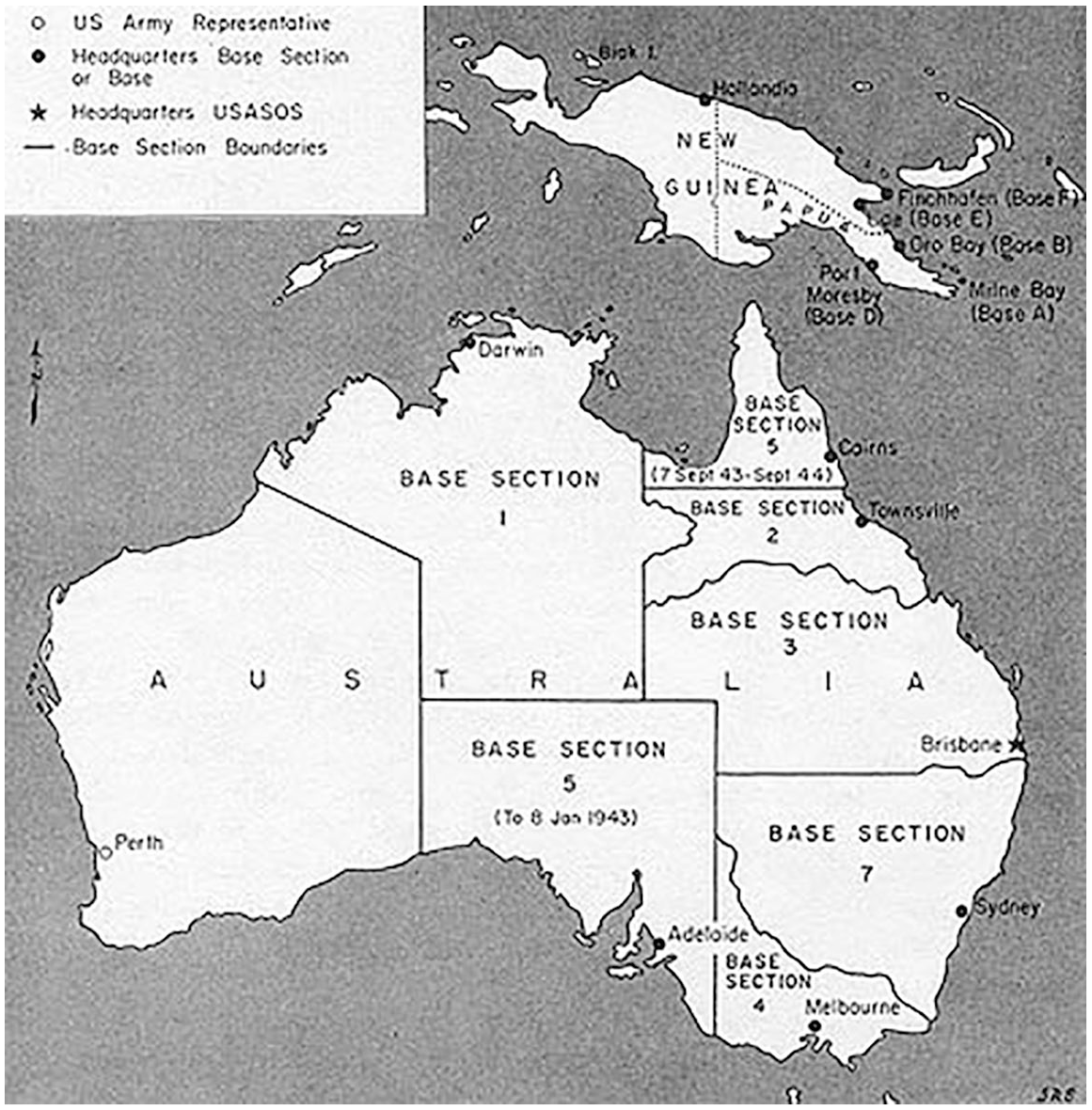
US Base Sections in Australian and Papua and New Guinea. Available online, https://www.ozatwar.com/ozatwar/basesection.htm.
Invariably some US troops stationed in Australia or passing through would be arrested by Australian civil police and provosts for violating Australian laws. The question confronting Australian leaders was whether US military personnel would be tried in Australian or US courts. This complex legal problem relates to the concept in international law known as ‘extraterritorial jurisdiction’ – that is, the right of the state to exercise legal jurisdiction beyond its borders. In early 1942, ‘extraterritoriality’ for friendly armed forces within an allied country had a long history. Most notably, during the Great War, France granted the other Entente powers and the US Expeditionary Force extraterritorial jurisdiction. However, the British were extremely reluctant to extend this courtesy to US forces stationed in the United Kingdom and US troops were withdrawn before the issue was formally resolved. 13 The British and Americans resumed this debate in 1942. Yet, unlike the 1918 negotiations, these Anglo–American discussions affected Australian policymakers who were charting the contours of their own alliance with the USA.
Shortly after the outbreak of war with Japan, the Australian government anticipated the need to clarify the jurisdiction for visiting US forces. Published in the Commonwealth Gazette (or ‘gazetted’) on 24 December 1941, the National Security (Allied Forces) Regulations (NSR) stipulated that an ‘allied force’ (the small US task force already in Australia) could operate its own military courts-martial. 14 However, the NSR fell short of granting the Americans full jurisdiction over their own forces. This was unacceptable to the commander of the USAFIA Lieutenant General George Brett. In a 19 March 1942 letter to the Australian Prime Minister John Curtin, Brett requested that all US military personnel arrested by ‘local authorities as an offender against the municipal law … be surrendered for appropriate action under the application of military law governing the United States forces’. 15
The Australian government trod carefully. Australian criminal law belonged to state and territory governments. Thus, granting Brett’s request would necessarily involve ‘interference with the jurisdiction of State Courts’. Further, there was disagreement about the limits of US jurisdiction within Australia’s key decision-making body, the War Cabinet. The Department of the Air thought that the American request ought to be fully granted, noting that ‘this course was adopted in the war zone in France in 1914–1918’ and, further, Greece granted the 2nd Australian Imperial Force (AIF) extraterritoriality in 1941. However, the Department of the Army maintained that serious crimes committed by US military personnel against Australians (‘murder, manslaughter, rape etc.’) be dealt with in Australian criminal courts. Thus, the War Cabinet decided to wait for advice from the British government which was considering the legal status of US forces in the UK. 16
The British were extremely reluctant to grant US forces in the UK full extraterritorial jurisdiction. According to British law, British military personnel were liable to local courts for violations of civil or criminal laws, as were Allied personnel. The British government worried that if the American request for extraterritorial jurisdiction was granted, exiled Allied governments in the UK would make similar demands. Conversely, the US government thought it was possible that UK courts might show undue leniency and, more importantly, that American public opinion would be opposed to the trial of conscripts by foreign courts. To the suggestion that US troops only be subject to British laws while off duty, the US government insisted that conscripts deployed overseas against their will were always on duty. 17 Eventually, the British War Cabinet acceded to American demands. As David Reynolds has argued, this was largely due to the ‘adamantine rigidity of the American case’ and partly because the size of the anticipated US force might have strained British judicial resources. 18 On 28 April 1942, the Secretary of State for Dominion Affairs cabled the Australian government notifying them that all criminal offences commitment by US personnel in the UK would be handled by ‘United States Service Tribunals in this country’. 19
While the Australian government was waiting for an outcome in the UK, a juridical clash in South Australia brought Brett’s request for extraterritorial jurisdiction to the Australian government’s attention in April 1942. Both state police and the US Army claimed jurisdiction over a US soldier accused of raping a local woman. The Australian Secretary of Defence, Fredrick Shedden, explained to MacArthur’s Adjutant General that the South Australian premier would be satisfied if the accused soldier was kept under close arrest by the US Army. 20 Weighing in on the issue, MacArthur agreed to these terms, but implied that the Australian government was dragging its feet on the matter of US extraterritoriality: ‘It matters little as to the minutiae by which such crimes are punished, but it is of the utmost importance to all concerned that prompt and drastic action be accomplished.’ Formal proceedings could not take place until the matter of extraterritorial jurisdiction for US forces in Australia had been settled. 21
The Australian government gazetted new orders under the NSR on 6 May 1942. If a member of the US armed forces was arrested or detained on charge in any Australian state or territory then the nearest ‘appropriate’ US officer ‘shall be notified and, if he so requests, the member shall be handed over to him’. 22 Conversely, US military police could also arrest Australian soldiers and hand them over to the proper authorities. While scattered, criticisms of the new orders were pointed. A staunch critic of the wartime government’s emergency powers, Labour MP Frank Brennan warned Curtin, ‘If you start monkeying with trial by jury you will be asking for trouble.’ 23 More dramatically, the naturalist David G. Stead complained to the Queensland’s Minister of Justice that the NSR facilitated ‘the erection of a foreign State within our Australia State’. 24 More recently, historians Kay Saunders and Helen Taylor claimed that the NSR greatly limited the ability of local police to ‘maintain public law and order’. 25
These assessments highlight the limitations placed on Australian courts, but understate the powers of Australian provosts and civil police. Under the NSR, Australian police could arrest and detain US military personnel. Furthermore, beyond the stipulation that US troops be handed over to US authorities for trial in courts-martials, the NSR provided no procedure guiding the exchange. Thus, Australian officials could and often did charge US personnel arrested for violating Commonwealth laws in court before relinquishing them to US authorities. 26 Subsequent formal legal proceedings were, of course, the responsibility for US military authorities and, as we shall see, the Americans resisted any Australian effort to extend the powers of the Australian judiciary over US forces.
Although US military authorities were prepared to fight to protect their exclusive jurisdiction over US personnel, they realized that the functioning of US military justice in Australia was dependent on the goodwill of the Australian government. Consequently, MacArthur’s staff dealt cautiously with sensitive issues such as reciprocation of extraterritoriality. Following Britain’s lead, the Curtin government adopted a loose attitude towards reciprocation. 27 Incidents were handled on a case-by-case basis until February 1943 when police at Townsville refused to take into their custody an Australian crewman of the US merchant ship SS Portmar accused of striking a US soldier. MacArthur personally brought the incident to Curtin’s attention. That the two highest authorities in the SWPA liaised on such trivial administrative matters baffled officers at SWPA GHQ. MacArthur’s G-1 (personnel officer), complained to his chief of staff, ‘I can see no recourse except for the Commander in Chief [MacArthur] to insist of the handling of such cases in [US] military courts’, although ‘doing so may have wide and undesirable repercussions, and might involve a rescinding by the Australians of their agreement to turn US offenders over to the US authorities for trial.’ 28 Curtin and MacArthur agreed that merchant seamen would be tried in an Australian criminal court. At MacArthur’s request, Curtin also decentralized the administration of such incidents to the states’ deputy crown solicitors and USAFIA – now called the US Army Services of Supply (USASOS) – base commanders. 29
Similarly, the sensitivity of MacArthur’s GHQ to Australian public opinion betrays some anxiety about the status of US military justice in Australia. Most US courts-martial were closed. However, staff at GHQ’s Public Relations Office believed that certain high-profile cases (particularly murder) ought to be handled in open court. Australian civil and military officials were invited, as were journalists. 30 The publication of high-profile cases was obviously intended to publicly demonstrate the efficiency and fairness of US military justice. However, certain conditions were placed on Australian attendees and newspapers to protect the reputation of the US armed forces. For example, GHQ’s public relations strategy for the court martial of triple-murderer Eddie Leonski stipulated that only spectators with passes were permitted entry into the court; just three Australian officials could remain after the president cleared the court for the hearing of ‘scandalous testimony’; and, newspaper articles could be censored ‘to ensure that matters which from a military standpoint should not become public are deleted’. 31
Maintaining Law and Order in Australia
The existence of US military justice in Australia rested on permissions granted by the Australian government. US military authorities were also heavily reliant on civil police to maintain discipline among thousands of US troops in Australia. State police throughout Australia detained countless US troops and handed them over to US authorities. For the USASOS Provost Marshal’s investigative division – which handled more complex crimes such as the ‘misappropriation of government property, pilfering of supplies and goods, manufacture of illegal beverages, sex perversion’ – cooperation with state police was ‘indispensable’. Furthermore, ‘Where a civilian, military person, or property of another nationality was involved the case was handled jointly with local civil police.’ Finally, the USASOS Provost Marshal was reliant on the crime lab at Brisbane Police Department for forensic analysis until a US facility was established at Manila, Philippine Islands, in October 1945. 32
Although less dependent on Australian provosts than civil police, US military police developed a close relationship with their Australian counterparts. To foster good relations between the two organizations, US military police were occasionally attached to Australian provost units working in areas densely populated with US troops. 33 Valuable as such exchanges were, training played a more important role in maintaining cohesive relations. In 1942 and 1943, 87 officers and non-commissioned officers from the US Military Police Corps attended the Australian Land Headquarters (LHQ) Provost Training School. 34 Alongside Australian students, they completed a six-week course covering a range of subjects from first aid to obtaining and assessing evidence. 35 These graduates shared their enhanced understanding of Australian Army Provost policies and procedures with their own units. And according to the Australian Provost Directorate’s history, ‘The attendance of US Officers and NCOs greatly assisted in the co-operation between these two Provost Services.’ 36 While it does not seem that Australian provosts attended US training centres in Australia, American officers gave guest lectures covering US law and the organization of the US Military Police Corps at LHQ Provost Training School. 37
Amiable relations between Australian and US military police were punctuated by moments of tension. Relations were poorest in 1942 because there were few trained and experienced Allied military police in Australia. US resources were overstretched. By June 1942, the USASOS Provost Marshal believed that Brisbane required a full military police company (more if the base continued to grow), whereas Townsville had to make do with a mixed detachment of combat and service troops pressed into service as military police. 38 The Townsville base section complained that this detachment ‘does not constitute an effective MP unit on account [of] lack of experience for such duty’. 39 Because the Army Provost Crops preferred to recruit high-quality and experienced personnel, the Australian situation was even worse and the ‘shortage of personnel became acute in 1943’. 40
Coupled with the rapidly growing military population in Australia, these personnel shortages contributed significantly to the Battle of Brisbane which was undoubtedly the lowest point in the relationship between Australian and US military police. The Australians’ performance was lacklustre to the point of negligence. In the opening stage of the riot, provosts and local police failed to come to the aid of US military police. Only after an Australian was shot and the crowd briefly dispersed was an Australian picket line formed outside the American PX. The Australian Queensland Lines of Communication Provost Company was underpowered and poorly trained. 41 Thus, some Australian Army signallers were pressed into service. Intimidated by the crowd, some handed their unloaded .303 riles to the belligerent troops. Worse still, Queensland constables disarmed some picketing signallers mistaking them for rioters. Though the crowd gradually dispersed, the Australians still failed to take charge of the situation and attacks on Americans continued throughout the night and following day. 42 Notably, the officer commanding the US 814th Military Police Company, which bore the brunt of Australian aggression, made no mention of intervention by Australian authorities in his report on the incident. 43 The commander of Base Section 3 (Brisbane) was more explicit in his criticism, accusing the Australian provosts of failing ‘to perform their functions of maintaining order’. 44
Differing attitudes towards the use of weapons also contributed to the violence of 26–7 November 1942. Unlike Australian provosts, all patrolling US military police were required to carry a riot club and a pistol (see Fig. 2). 45 This surprised some Australians. Shortly after returning home to Sydney from the Middle East, an AIF provost, John Jeffcotte, was alarmed to see ‘overweight gents wearing American uniforms and swinging huge clubs’. He observed that this was a cultural difference. In the American ‘approach to authority … the big club may have made some intimidating effect on them’, whereas ‘it would have started a riot with our men’. 46 Indeed, while acknowledging that Australians were the main instigators of the Battle of Brisbane, Australian intelligence officers at LHQ placed some blame on the heavy-handedness of US military police ‘who did not hesitate to display firearms and batons and use them in emergency’. Conversely, US military police considered the methods of Australian provosts ‘namby-pamby’. 47
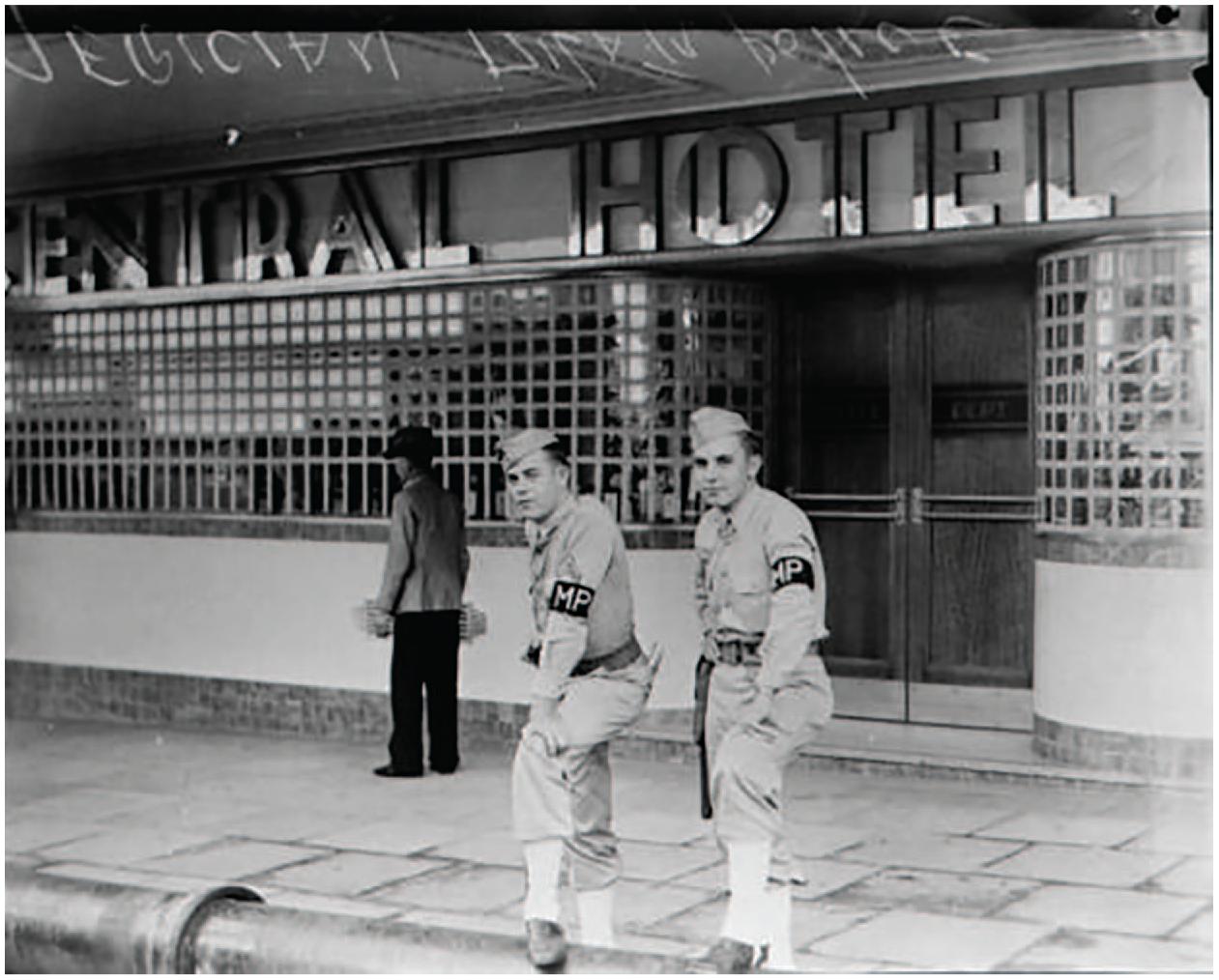
Two US military policemen posing outside the Central Hotel Brisbane, Queensland, in 1942. The heavy riot club visible on the belt of the man on the right was standard issue for patrolling US military police. Source: Sunday Sun Collection, John Oxley Library, Available online at https://hdl.handle.net/10462/deriv/91340.
Relations were further strained in 1942 by some residual ambiguity regarding judicial boundaries. In October 1942, the officer commanding E Company (US 162nd Regiment) complained that Australian soldiers at Rockhampton, Queensland, had not been informed that US military police had the authority ‘to arrest an Australian and turn him over to the proper authorities’. The origin of this complaint was a brawl at a dance hall precipitated by US military police’s arrest of an Australian airman. While the fight was short and not too violent, a standoff developed as Australian troops sided with their provosts and Americans joined their military police. A larger clash was ultimately avoided, but the situation reached ‘a point of high tension’. 48
The final major juridical clash in Australia was between the US Army and Townsville officials. In late 1942, Townsville officials attempted to extend their authority by issuing summons to US personnel, triggering a bitter fight over jurisdiction. Brisbane’s Telegraph reported that 16 US personnel had been issued summons to appear in court for traffic violations. Appearing at the Court of Petty Sessions, a US representative insisted that, under the NRS, these cases ought to be dealt with ‘in accordance with the laws of the US forces in Australia’. 49 Townsville officials subsequently escalated the situation when they fined two American lieutenants even though they did not appear in court and the US Army did not recognize the authority of the court. In response, the Americans declared that the NSR had been breached. Eventually the Australian Attorney-General Herbert Evatt was drawn into the squabble. Evatt sided with the Americans and, thus, the NSR was modified to stipulate that US personnel issued with summons fell under US jurisdiction. 50
Patterns of Crime and Ill-Discipline in Australia
It is fortunate that such moments of disharmony between Allied law enforcement organizations were few and did not extend far beyond 1942. Maintaining law and order in Australia was a difficult job. The most common offence committed by Allied soldiers was absent without leave (AWOL). 51 This is not surprising given the proximity of Allied units to population centres. While AWOL threatened to undermine military efficiency, many other offences conspired to damage inter-Allied relations in Australia.
Theft and black market activities were widespread. US personnel stole from Australian businesses and people. 52 Much to the frustration of US quartermasters, US military stores and supplies also fell prey to Australian pilferers. In August 1942, the USASOS Base 3 (Brisbane) reported that about 75 per cent of stores and supplies in shipments made from Brisbane to Darwin were ‘stolen on route’. 53 Similarly, Australians took advantage of the Americans’ higher wages and ignorance of Australian currency by frequently overcharging them for goods and services. 54 Some Americans understandably began to feel underappreciated and exploited. In December 1943, unit censors monitoring letters noticed an increase in negative comments about Australian civilians. ‘Now that the threat is over, they don’t appreciate us any more’, one soldier grumbled. Another complained that, ‘These Aussies know the Yanks always have plenty of money, they put any kind of price on things.’ 55
Traffic offences were particularly common among Americans. According to the USASOS Provost Marshal, they comprised about 19 per cent of offences between July 1942 and February 1943. 56 Though speeding was common, 57 the history of the US Military Police Corps in the Pacific framed traffic offences as another cultural clash. US units scattered around Australia struggled to adjust to traffic laws that varied between states and territories. Furthermore, ‘the Australian and US armies had their own basic regulations and means of enforcing them’. 58
Military and civil police were also regularly involved in breaking up brawls. In late 1942, antipathy between Australian and US troops was palpable. An Australian Commonwealth Security Service report attributed the ‘antagonistic spirit’ developing between Australian and US troops in north Queensland to the Americans’ higher wages. 59 Of course, sexual rivalry also played a role. Public displays of affection, which were an integral part of courtship in US culture, disgusted Australian men. 60 Many AIF troops in the Middle East had grown concerned about the fidelity of their wives and lovers exposed to wealthy and well-dressed GIs. 61 While the Battle of Brisbane was the largest anti-American riot, there were also large brawls in Melbourne in late 1942 and early 1943. 62 Allied commanders took these incidents seriously. Lecturing Australian officers in Sydney on 9 December 1942, the commander of the Australian 2nd Army Lieutenant General Iven MacKay claimed that organized attacks on US troops by Australians ‘almost amount to civil war’. 63
Tensions between Australian and US troops decreased in the second half of 1943. Many Australian troops simply grew accustomed to the American presence. As provost John Jeffcotte recalled, soldiers who were not ‘used to the Americans’ were more likely to get into brawls with them. 64 In July 1943 US unit censors also noticed the effects of joint training and combined operations in the second half of 1943. Troops’ letters ‘express high regard for the Australian soldier’s fighting stamina, co-cooperativeness and friendliness’. 65 Invariably isolated scraps continued to break out, but there were no major clashes between Australian and US troops from early 1943 onwards. 66
A small number of American offences in Australia were ‘serious crimes’: murder, manslaughter, and sexual assault. 67 It is difficult to gauge just how much the American presence produced an increase in sexual violence against women and girls, as it is likely that some crimes went unreported. However, Queensland state police attributed a slight increase in sexual crimes in 1943 to US servicemen: of the 287 cases of rape, 23 offenders were American. 68 Statutory rape is also difficult to track because it was essentially regarded by US military police and judiciary as a social problem, rather than a criminal offence. Military personnel caught with underage Australian girls were often simply ignored; if the case went to court, the accused were usually acquitted. 69
Drunkenness and associated behavioural problems presented a persistent problem. Drunkenness accounted for about 20 per cent of total US offences recorded from July 1942 and February 1943. 70 Similarly, in August 1942, there was an average of 190 Australian Army arrests per week in Brisbane, 86 of which were for drunkenness. 71 Not only did drunkenness produce irritating and vulgar behaviour, it greatly contributed to inter-Allied violence. Some drunk troops were easily provoked. For example, after ‘about five pots’ and some wine an Australian soldier threw a glass at an American merchant marine who called him ‘yellow’ at a Brisbane milk bar. The glass missed its mark, smashing into the face of a young Australian woman instead. 72 Others were simply violent drunks. An Australian sailor was sentenced to 12 months’ imprisonment with hard labour for what Justice E.A. Douglas described as ‘a most brutal assault’ on an American near Story Bridge, Brisbane. Pearson admitted that he had been drinking heavily ‘and was in a state of mind where he was capable of attacking anyone, irrespective of nationality or class’. 73
Given that black troops comprised only a small fraction of US forces in Australia, their presence was a source of disproportionate anxiety for Allied authorities. Wedded to the concept of a homogenously white Australia (a belief typified by a collection of restrictive immigration and citizenship legislation known as the ‘White Australia Policy’), the Australian government predicted that the reception of black Americans in Australia ‘would not be favourable’. 74 Unable to turn away black units, they insisted that they be deployed in remote areas in Australia or Papua. If they ended up in towns and cities, black troops were usually funnelled into segregated districts or recreational facilities. This system of racial segregation complemented the internal systems of segregation within the US armed forces. 75 Contrary to the Australian government’s expectations, black Americans were received warmly by many Australians. 76 However, most white Australians disapproved of interracial sexual relationships, reflecting common fears of miscegenation and a stereotype that black male sexuality was inherently dangerous and uncontrollable. 77
Furthermore, black troops also had to contend with the racism within the US armed forces. Relations between white and black US troops were poor and often violent in unsegregated areas. 78 Additionally, many US military police and white commanders of African American units regarded black Americans as naturally unruly troops who only responded to firm (often violent) discipline. 79 Given their close working relationship with US military police, this attitude was unsurprisingly adopted by some Australian provosts and police. For example, Jeffcotte approvingly recalled a story told by the commanding officer of a black unit at Mt Isa, Queensland: a southern American had apparently summarily executed a black soldier as a ‘show of force’ to prevent a riot. 80 Violence begat violence and some black troops lashed out. The most serious incident of collective violence was the so-called ‘Townsville Mutiny’ within the 96th Engineers General Service Regiment on 22 May 1942. In response to the abusive behaviour of two white lieutenants, a group of black troops attempted to murder their superior offices. 81
Policing Papua and New Guinea
As in Australia, US military authorities had exclusive jurisdiction over US military personnel in Papua and New Guinea. However, arrangements for policing Allied forces in Papua and New Guinea differed from Australia in one crucial respect: the civil police force overseen by the wartime manifestation of the Australian colonial administration, the Army’s Australian New Guinea Administrative Unit (ANGAU), was principally concerned with the region’s indigenous population: it had neither the resources nor the authority to police Allied military personnel. 82 However, in cooperation with military police, ANGAU did mediate relations between troops and civilians, of which more later. The limitations of the Australian civil organization in Papua and New Guinea pushed Australian and US military police into a closer working relationship, and they engaged in a greater range of joint policing duties than in Australia.
Allied military police tackled pilfering collaboratively. For example, in Papua’s two main ports, Port Moresby and Milne Bay, local military police commanders established joint Australian-American detachments to keep unauthorized personnel away from port areas and monitor service troops serving as stevedores (see Fig. 3). 83 While these measures generally minimized pilfering, eradicating this disciplinary issue would have required a dramatic change in the attitudes of Allied soldiers, particularly Australians. As Americans were usually better supplied than Australians, they were targeted by Australians. For example, in late December 1942, an Australian airman at Port Moresby wrote in his diary, ‘Until our showers are ready we are showering with the Yanks and it is a cause of envy every time we walk through their well-equipped camp.’ The following day he felt entitled to wander through ‘the Yanks camps and grabbed a few boxes’ of ‘comforts’. 84 In addition to tight security around military stores and supplies, Australian commanders broadcasted in orders the harsh disciplinary action taken against pilferers. 85
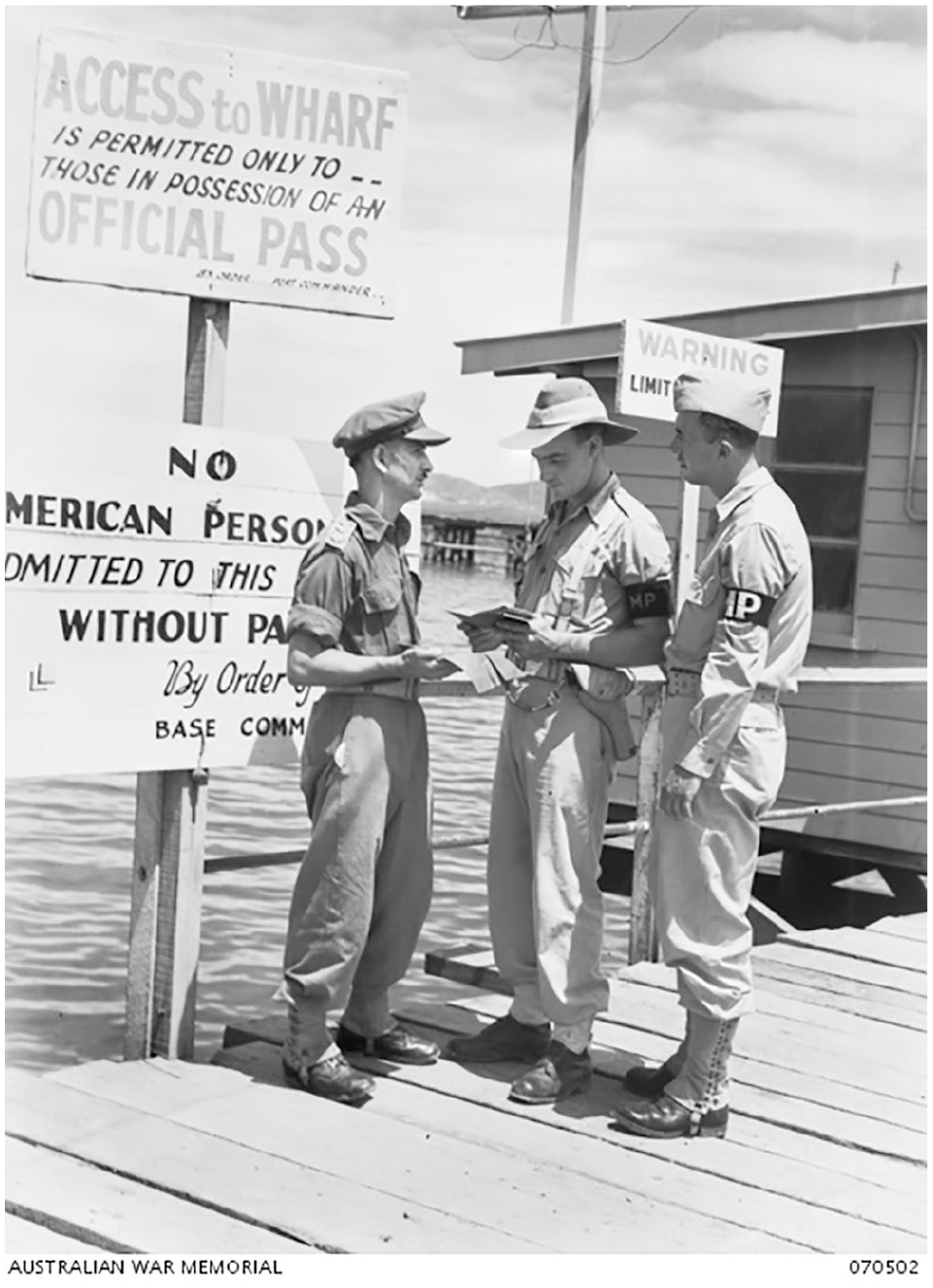
Australian and US military police check the pass of an Australian officer boarding a ship at Port Moresby in February 1944. 070502, AWM.
The effectiveness of deterrent measures is doubtful. Many Australians stole from US supply depots when given the opportunity. Most notably, the shift of the Americans’ logistic centre of gravity to the Philippines in 1945 was accompanied by waves of pilfering from recently vacated and lightly guarded US facilities in Papua, New Guinea, and Bougainville Island (Solomon Islands). 86
Australian and US military police also cooperated to minimize traffic offences. Combined jeep-equipped traffic patrols were first established at Port Moresby and later at Lae, New Guinea, which replaced the latter as the Allies’ main base in Papua and New Guinea. 87 Australians regarded poor road discipline as a peculiarly US offence which rankled some American commanders. 88 Writing to the Australian New Guinea Force (NGF) Headquarters in early April 1943, the Provost Marshal at USASOS Advanced Base, Port Moresby, complained that provosts from the 11th Division’s Provost Company posted to the combined jeep patrol were discriminating against Americans in the area. 89 The 11th Division’s commander Major General Cyril Clowes deeply resented the accusation and claimed that the numbers of Australian offences recorded were in fact higher (194 Australian compared to 153 American). From Clowes’s perspective, this misunderstanding was caused by the absence of a direct line of communication between the USASOS Advanced Base and the 11th Division Provost Company – a policy which could ‘only result in undesirable friction and ill feeling’. He successfully argued that Australian provost ‘keep close [and direct] contact’ with US military police at Port Moresby. 90
Allied military police struggled to eradicate black markets, which sprouted and thrived in base areas. To supress black market activities military police monitored canteens and recreational areas for signs of trading. In some cases, unit commanders attempted to identify ringleaders by inspecting troops’ mail for conspicuously large sums of money being sent home. 91 Some, however, simply accepted black markets as par for the course. When the Australian NGF’s Assistant Provost Marshal (APM), Major Norman Cowper, visited Lae in October 1943, he spotted two Australians with ‘shirts bulging with American cigarettes’ purchased from US troops. The Deputy Assistant Provost Marshal (DAPM) responsible for provost operations at Lae admitted that there was ‘heavy traffic’ in such supplies. 92
As in Australia, Australian black marketeers inflated prices for American customers. On 19 May 1944, the officer commanding the 35th Australian Works Company, Major Donald Wells, was arrested by provosts in Port Moresby for gambling at an American cinema. A subsequent investigation revealed a criminal network within the company with the officer commanding at its centre. One lucrative racket involved the company’s canteen officer who sold Australian canteen goods (spaghetti, peaches, and camp pie) to the neighbouring African American 91st Engineer Battalion at inflated prices. Each night Wells and the canteen officer met to ‘cook’ the unit’s record books and divide the profits. 93
Alcohol was perhaps the most sought after black market commodity. Under normal circumstances American PXs served light beer, yet Australian canteens did not begin serving alcohol until 1 August 1944. Until that time, there was a complete prohibition on alcohol in Papua and New Guinea. 94 No doubt, some military personnel smuggled alcohol from Australia. Some merchant seamen visiting ports profited by selling alcohol to troops at exorbitant prices, resulting in strict policies preventing them from leaving wharf areas. 95 Troops also made a crude beverage called ‘Jungle Juice’ by brewing fruit and alcohol used for industrial purposes (namely isopropyl, methyl, and pure ethanol). As Australian Army doctors discovered, only ethanol can be somewhat safely consumed by humans: isopropyl and methyl have severe and potentially lethal effects. 96 Allegedly concerned by rumours that some men had been hospitalized by Jungle Juice, Major Wells ordered the creation of an illegal still in his company’s quartermaster store. This way, he could ‘ensure that nothing else but wholesome and healthy ingredients were used’ (such as raisins, solpack apples, and honey). 97 Altruism aside, Wells also made a tidy profit from the business: a salesman could expect to get between ‘£2 ½ and £5 per bottle’ from neighbouring US units. 98
War trophies and other souvenirs also circulated widely. Troops were permitted to keep trophies if they were first examined by intelligence officers. However, many trophy hunters were extremely reluctant to part with their treasures. 99 For example, AIF’s 2/13th Battalion’s Sergeant Craig Charles guarded his ‘Jap luger’ fiercely, as he expected to get ‘at least £15’ from Americans ‘trying to buy odds and ends’. 100 With little opportunity to salvage genuine souvenirs, some Australians in support or static defence units crafted trinkets from scrap metal. When ‘spruiking’ (promoting) their wares to Americans, Australians often claimed that their souvenirs were made from captured Japanese vehicles. At Port Moresby, Corporal Ernie Hoffman (a black boxer of local renown) told Enoch P. Waters (war correspondent for The Chicago Defender), ‘I am being constantly approached by Australian soldiers with aluminium trinkets, rings, necklaces, bracelets, pins, which they claim have been made from metal salvaged from wrecked Japanese Zeros.’ 101 Though this practice was begrudgingly accepted by Australian authorities, eventually these ‘profitable hobbies’ were so widespread that Australian base commanders promulgated orders warning that some troops had ‘a very elastic view’ of what material constitutes ‘scrap’ and potentially spent more time making souvenirs than working. 102 At Lae, trading in souvenirs was eventually prohibited and provosts were stationed at the local US Red Cross hut to enforce the ban. 103
Of course, there also were many Papua New Guineans eager to trade with Allied military personnel. As Hoffman informed Waters, ‘Natives, alive to the demand for souvenirs, are doing brisk business in grass skirts, mats, carved walking sticks, totem poles, necklaces and ornaments fashioned from sea shells.’ 104 However, to trade with so-called ‘natives’ for cultural artefacts or fresh food, Allied troops had to contend with ANGAU. Not only did ANGAU control the flow of ‘native labour’ to Allied forces, 105 it also mediated relations between Papua New Guineans and troops. 106 A highly paternalistic organization, ANGAU inserted itself into economic exchanges between ‘natives’ and troops. In November 1944, for example, the ANGAU district officer at Lae complained that trading for fresh produce from ‘native gardens’ was apt to deprive villagers. 107 Reluctant to establish a checkpoint at the village due to a shortage of provosts, Lae’s DAPM interviewed the villages’ ‘tultuls’ (officials) who claimed troops’ business was most welcome. Nonetheless, orders were circulated throughout the district, stipulating that ANGAU regulated all trade between Allied forces and locals. 108
If patterns of illicit exchange common in Australia persisted in Papua and New Guinea, so too did interracial violence. By mid-1944, reports of unrest in black units had surfaced. Particularly worrying were the actions of Private Samuel Hawthorne who, like the Townsville mutineers in 1942, attacked his white superiors on 5 March 1944. After a dispute that resulted in Hawthorne’s arrest, the black private calmly fired two clips of his M1 carbine into his company’s orderly tent killing two lieutenants and wounding a sergeant. Hawthorne then shot himself in the chest and was saved by doctors only to be hanged nine months later. 109 This act of violence, combined with many less serious incidents, prompted an USASOS investigation by intelligence officer Lieutenant Colonel N. Sauve. Sauve visited New Guinea in July 1944, speaking to the white commanders of black units, military police, and base intelligence officers. Though some officers warned of an imminent race riot, Sauve thought this threat was greatly exaggerated. While highlighting some provocations by white troops, Sauve’s report placed most of the blame on black newspapers (particularly The Chicago Defender) which he believed ‘stir up race feeling’ among black troops. 110
However, interracial violence was largely an internal problem for the US armed forces in Papua and New Guinea. Australian provosts’ encounters with rebellious black troops were fleeting and few. Provosts at Lae briefly contended with belligerent black troops at Lae’s Malahang Beach. This popular recreational beach was out of bounds to African Americans, but black personnel defiantly visited the beach using amphibious vehicles to by-pass checkpoints. 111 Even more provocative was an attempt by a group of black Americans to cross a Bitibum River ford into the Australian base area at Lae ‘without authority’ on 11 January 1945. Highlighting the concern with which this behaviour was viewed, an extra US military policeman was added to the check point and the guards were equipped with a submachine gun. 112
Generally, there is no evidence of clashes between Australian and US troops in the operational areas. This may partly reflect the effectiveness of shared recreational activities designed to give Australian and US troops an opportunity to interact and potentially bond. 113 However, the relative tranquillity in Papua and New Guinea is more likely the result of two broader factors. First, the shortage of alcohol precluded widespread drunkenness. As noted above, military personnel could buy small amounts of alcohol in black markets, but alcohol was officially prohibited until 1 August 1944. Aware of the link between ill-discipline and drunkenness, strict issuing systems were implemented after this date. Australian troops treated their ration of two bottles of beer per week at one shilling and three pennies each with ‘apathy’. 114 Although Americans could draw one can of beer per day from PXs, the beer was light (3.2 per cent) and, as an American officer told war correspondent Enoch P. Waters, ‘The quantity required to get drunk … is more than the average man can consume.’ 115 While this officer was perhaps deliberately downplaying troops’ capacity for drinking, it is true that there was still not enough alcohol available to fuel widespread drunkenness even after the prohibition was lifted. As one provost recalled, troops generally ‘waited until they got home before they played up’. 116
Second, there was far less opportunity for sexual rivalry to emerge in Papua and New Guinea. Despite an enduring mythology that the Pacific Theatre was devoid of women, Allied servicewomen and philanthropic workers were deployed there in considerable numbers and indigenous women lived in the regions engulfed by the war. 117 However, a wide range of restrictive polices existed to limit troops interactions with women. First, Allied rank and file were largely prohibited from interacting with servicewomen and volunteers. Officers, on the other hand, could interact with servicewomen, and special amenities, such as a fenced-off section at Malahang Beach at Lae (see Fig. 4), were created for these purposes. 118 Unsurprisingly, this fostered resentment among troops and rumours abounded that servicewomen were little more than sex workers for the officer class. 119 Destructive as these disparaging rumours were to the reputations of servicewomen, officers’ privileges produced tension within the Allied armed forces, rather than between them.

Two unidentified Australian troops look longingly into the officers and servicewomen’s section at Malahang Beach, Lae (017775, AWM).
There is also no evidence that Allied troops violently competed for the affections of Papua and New Guineans. This could be because, as Sean Brawley and Chris Dixon have argued, Allied troops found Melanesian women unattractive because they had not been sexualized in Western cultures to the extent Polynesian women had. 120 However, ANGAU also limited sexual interactions between troops and ‘native’ women and women in refugee camps that fell under their administration. Patrol officers were watchful for signs of prostitution. For example, on 16 June 1944 an ANGAU patrol officer at Lae informed the Australian sub base DAPM that Americans had been visiting the Bitibum Evacuee Village and having sex with a girl from a recently arrived ethnic Chinese family from the Caroline Islands. Provosts established a checkpoint the following day and ‘intercepted’ 26 US troops. 121 Of course, ANGAU could not mediate every encounter between soldiers and civilians, and some Papua New Guineans were sexually assaulted and exploited. 122 Nonetheless, ANGAU (in cooperation with military police) posed a significant barrier between Allied troops and civilian women.
While such policies supressed sexual rivalry between Allied troops, thus contributing to cohesive Allied relations, fears for the safety of white servicewomen also contributed to harsh policing of black US troops in Papua and New Guinea. As was the case in Australia, anxiety about black sexuality was fairly widespread within the Allied military administration in Papua and New Guinea. 123 Australian fears about black troops supposed proclivity towards rape and subsequent racist polices were clearest at Lae. In early 1944, the 2/7th Australian General Hospital was established on the banks of the Busu River about 5 miles from the port and town area (the administrative centres of both the Australian and America base areas). 124 Shortly after the hospital’s nurses arrived, NGF’s Inspector of Supplies insisted that the 2/7th needed guards at night because of ‘reports of Negro personnel being in the area’. 125 The black American population at Lae and Nadzab was high – about 4,705 (roughly 17 per cent of the total all US enlisted men in the area). 126 In addition to extra security for servicewomen, the Australian base authorities attached armed Australian provosts to black truck drivers carrying supplies from the Liberty Ship docks in the US base area to Australian depots. 127 Anxieties deepened in May 1945 when 300 Australian Woman’s Army Service personnel began to relieve servicemen in the Australia base. Servicewomen were instructed to be vigilant regarding black troops. Corporal Amy Taylor recalled that they heard ‘stories about what these people [black troops] were doing and I just felt afraid’. 128 No doubt, the heightened sense of racial tension created by racist Allied polices significantly contributed to Taylor’s fears.
Conclusion
This article has provided broad coverage and analysis of policing, ill-discipline, and crime in the Australian–American alliance. Such a vantagepoint is crucial to placing these issues in the overarching legal and political context, as well as identifying wider patterns in Australia and its territories. While this addresses a significant gap in the literature, there is still scope for further research. The development of US military detention barracks in Australia and use of state prisons deserves close investigation. Moreover, comparative research should also be done contrasting debates regarding extraterritorial jurisdiction for US armed forces in Britain and other Commonwealth countries during the Second World War. These promising new lines of inquiry would benefit from building on the arguments developed in this article.
One of this article’s key arguments was that the US armed forces were reliant on the Australian government and law enforcement organizations to maintain law and order in two important ways. First and most importantly, the existence of US military justice in Australia rested on permissions granted by the Australia government. Second, US military police were dependent on Australian civil police to investigate crimes, especially those involving Australian citizens. I also argued that, on balance, cooperation between Australian and US law enforcement organizations was good. Exchanges of personnel and joint training at the LHQ Provost Training School were particularly important to cohesive relations between Australian and US military police. Finally, this article has demonstrated that patterns of crime and ill-discipline in Australia and the territory of Papua and the mandate of New Guinea had some similarities in terms of what needed to be policed. There were, however, some differences, the most important of which was a lack of violent rivalry between Allied troops outside Australia. This reflected the careful regulation of alcohol and a network of policies that limited troops’ access to women.
US military justice and law enforcement organizations were not easily transplanted onto Australian society between 1942 and 1945. Legal machinery had to be negotiated and officials (both civil and military) at all levels had to form working relationships. Further, hosting a large and diverse military population in Australia and its territories produced a dizzying array of social problems. Yet, complex and vast as these challenges were, Australians and Americans generally cooperated effectively in the areas of policing and military justice.
Footnotes
Acknowledgements
The author would like to thank his two anonymous reviewers, Matt Haultain-Gall, Genevieve Dashwood, and Yorick Smaal.
Funding
The author(s) received no financial support for the research, authorship, and/or publication of this article.
1
For a thorough account see Peter A. Thompson and Robert Macklin, The Battle of Brisbane: Australians and Yanks at War (Sydney, NSW, 2001).
2
The military relationship has received considerable interest, but the most comprehensive works are: David Horner, High Command: Australia and Allied Strategy, 1939–1945 (Sydney, NSW, 1982); Peter J. Dean, MacArthur’s Coalition: US and Australian Operations in the Southwest Pacific Area, 1942–1945 (Lawrence, Kansas, 2018).
3
For overviews see Eli Daniel Potts and Annette Potts, Yanks Down Under 1941–1945: The American Impact on Australia (Melbourne, Victoria, 1985); Kate Darian-Smith, ‘The Home Front and the American Presence in 1942’, Peter J. Dean, ed., Australia 1942: In the Shadow of War (Melbourne, Victoria, 2013), pp. 70–88. For studies focused on Queensland see Kay Saunders, War on the Homefront: State Intervention in Queensland 1939–1948 (St Lucia, Queensland, 1993); John McKerrow, The American Occupation of Australia, 1941–1945: A Marriage of Necessity (Newcastle, UK, 2013). For a study of Victoria (particularly Melbourne) see Darian-Smith, On the Home Front: Melbourne in Wartime 1939–1945 (Melbourne, Victoria, 1990), pp. 203–29. For studies focused on Western Australia see Anthony J. Barker and Lisa Jackson, Fleeting Attraction: A Social History of American Servicemen in Western Australia during the Second World War (Nedlands, WA, 1996); Michael Sturma, Fremantle’s Submarines: How Allied Submariners and Western Australians Helped to Win the War in the Pacific (Annapolis, Maryland, 2015).
4
See Yorick Smaal, Sex, Soldiers and the South Pacific, 1939–1945: Queer Identities in Australia in the Second World War (London, 2015); Marilyn Lake, ‘Female Desires: The Meaning of World War Two’, Marilyn Lake and Joy Damousi, eds, Gender and War: Australians at War in the Twentieth Century (Melbourne, Victoria, 1995); Rosemary Campbell, Heroes and Lovers: A Question of National Identity (Sydney, NSW, 1989); Michael Sturma, ‘Loving the Alien: The Underside of Relations between American Servicemen and Australia Women in Queensland, 1942–1945’, Journal of Australian Studies 13 (1989).
5
Some historians have argued that black troops were treated with fear and hostility, whereas more recently scholars have suggested that they were received warmly. For proponents of the first argument see Saunders, War on the Homefront, pp. 59–81; Saunders and Helen Taylor, ‘The Reception of Black American Servicemen in Australia during World War II: The Resilience of “White Australia”’, Journal of Black Studies 25 (1995), pp. 331–48. For proponents of the second argument, Chris Dixon, African Americans and the Pacific War, 1941–1945: Race, Nationality and the Fight for Freedom (New York, 2018), pp. 136–75; Sean Brawley and Dixon, ‘Jim Crow Down Under? African American Encounters with White Australia, 1942–1945’, Pacific Historical Review 71 (2002), pp. 607–32.
6
The most detailed studies include McKerrow, A Marriage of Necessity, pp. 193–236; Saunders and Taylor, ‘The Impact of Total War upon Policing’, Mark Finnane, ed., Policing in Australia Historical Perspectives (Sydney, NSW, 1987), pp. 154–7.
7
See Thompson and Macklin, The Battle of Brisbane; Barker and Jackson, Fleeting Attraction, pp. 202–18; Campbell, Heroes and Lovers, pp. 135–66; Potts and Potts, Yanks Down Under 1941–1945, pp. 228–37.
8
Although same-sex sexual relations were indeed regarded as a disciplinary issue, this topic has been examined in detail elsewhere and is not discussed in this article. See Smaal, Sex Soldiers and the South Pacific, 1939–1945, pp. 99–125; Smaal and Graham Willett, ‘Conduct Unbecoming: Homosex, Discipline and Military Cultures in the Second World War’, Ben Wadham and Andrew Goldsmith, eds, Criminologies of the Military: Militarism, National Security and Justice (Oxford, 2018), pp. 169–88.
9
For accounts of Allied logistics in the SWPA see Ross Mallet, Australian Army Logistics, 1943–1945 (doctoral thesis, Australian Defence Force Academy, 2007); John Moremon, A Triumph of Improvisation: Australian Army Operational Logistics and the Campaign in Papua July 1942 to January 1943 (doctoral thesis, Australian Defence Force Academy, 2000); Alvin P. Stauffer, The Quartermaster Corps: Operations in the War against Japan (Washington, DC, 1990).
10
For detailed accounts of the Leonski affair see Ian Shaw, Murder at Dusk: How US Soldier and Psychopath Eddie Leonski Terrorised Wartime Melbourne (Sydney, NSW, 2018); Ivan Chapman, Private Eddie Leonski: The Brownout Strangler (Sydney, NSW, 1982).
11
For an outline of the emergency measures implemented following the outbreak of war with Japan see Paul Hasluck, The Government and the People, 1942–1945 (ACT, 1970), pp. 116–32; Stuart Macintyre, Australia’s Boldest Experiment: War and Reconstruction in the 1940s (Sydney, NSW, 2015), pp. 105–7.
12
See Louis Morton, Strategy and Command: The First Two Years (Washington, DC, 2000), pp. 198–256.
13
See Archibald King, ‘Jurisdiction Over Friendly Foreign Armed Forces’, The American Journal of Internal Law 36 (1942), pp. 539–61.
14
The two relevant orders were: Allied Forces (Application of the Defence (Visiting Forces) Act 1939) Order and Allied Forces (Relations with Civil Authorities) Orders. See Commonwealth of Australia Gazette No. 277, 24 December 1941, National Archives Australia (NAA): A663, O3/2/1199.
15
Letter, 19 March 1942, Brett to Curtin, NAA: A816, 19/312/94.
16
‘National Security (Allied Forces) Regulations – Applications to United States Forces’, Memo, 16 April 1942, War Book Officer, NAA: A816, 19/312/94.
17
See Cablegram, 28 April 1942, Secretary of State for Dominion Affairs to Prime Minister’s Department, NAA: A816, 19/312/94.
18
David Reynolds, Rich Relations: The American Occupation of Britain, 1942–1945 (New York, 1995), p. 146.
19
Cablegram, 28 April 1942, Secretary of State for Dominion Affairs to Prime Minister’s Department, NAA: A816, 19/312/94.
20
Letter, 26 April 1942, Shedden to Colonel B.M. Fitch, Box 913, Record Group (RG) 496, National Archives Records and Administration, College Park, Maryland (NARA).
21
Letter, 28 April 1942, MacArthur to Shedden, Box 913, RG 496, NARA, College Park, Maryland. By May 1942 there were two other rape cases pending. See Potts and Potts, Yanks Down Under 1941–1945, p. 235.
22
‘US Authorities to Try Members of US Forces’, Canberra Times, 28 May 1942, p. 2.
23
‘US Army’s Powers: Amended Regulations’, Sydney Morning Herald, 28 May 1942, p. 6. In addition to Brennan, other critics of emergency powers included Maurice Blackburn, Arthur Calwell on the Labour government side, and Archie Cameron on the Opposition side. Hasluck, The Government and the People, p. 121.
24
Letter, 25 May 1942, David G. Stead to Queensland’s Minister of Justice cited in McKerrow, A Marriage of Necessity, p. 25.
25
Saunders and Taylor, ‘The Impact of Total War upon Policing’, p. 155.
26
For example see ‘US Sailor in Court’, Townsville Daily Bulletin, 22 September 1942, p. 2; ‘US Navy Officer Charged’, The Telegraph, 11 September 1944, p. 2; ‘US Soldiers Charged’, Cairns Post, 3 March 1945, p. 3.
27
The Secretary of State of Dominion Affairs advised the Australian government that the British government did not demand from the Americans any ‘formal grant of reciprocity’. The cabinet asked, however, the Americans to be prepared to reciprocate in the event of British forces being stationed in America or US-administered territory. Cablegram, 9 June 1942, Secretary of States for Dominion Affairs to Prime Minister’s Department, NAA: A816, 19/312/94.
28
GHQ SWPA Fact Sheet, 20 February 1943, Brigadier General Charles Stivers to Major General Richard Sutherland, Box 913, RG 496, NARA.
29
Letter, 20 February 1943, MacArthur to Curtin; letter, 20 March 1943, Curtin to MacArthur – both in Box 913, RG 496, NARA.
30
For example, the court-martial of Private Avalino Fernandez, who beat a Brisbane woman to death on 19 June 1944, was open to journalists. See ‘Paratrooper Guilty of Murder’, The Age, 22 July 1944, p. 3.
31
‘Censorship of News Stories on General Court-Martial Trail’, Memo, 4 June 1943, Fitch to Public Relations Officer, Box 913, RG 496, NARA.
32
P. 9, ‘Provost History Pacific, 1942–1947’, Box 1166, RG 338, NARA. Similarly, the Australian Provost Marshal also regarded cooperation with state police commissioners and local police to be of ‘great value’ and of the ‘utmost importance to ensure friendly cooperation’. P. 29, ‘History of the Provost Directorate HQ’, AWM54, 803/1/1.
33
For example, 12 US military policemen were attached to Northern Territory Force’s provost company ‘in order to foster good relations between the [provost] services’. War Diary Entry, 5 May 1942, Assistant Provost Marshal Northern Territory Force, AWM52, 18/1/6.
34
There were no American students in the period 1944–1945. War Diary, LHQ Provost School, July 1942–1944, AWM52, 34/7/1.
35
See ‘LHQ Provost Training School: Syllabus of Training: 6 Weeks Duration’, AWM54, 943/18/1.
36
Pp. 25–6, ‘History of the Provost Directorate HQ’, AWM54, 803/1/1.
37
For example see War Diary Entry, 24 August 1942 and 25 August 1942, LHQ Provost School, July 1942–1944, AWM52, 34/7/1.
38
Letter, Provost Marshall General to Chief of Staff USAFIA, 6 June 1942, Box 1293, RG 495, NARA.
39
Signal, 8 June 1942, HQ Townsville to HQ USAFIA, Box 1293, RG 495, NARA.
40
P. 9, ‘History of the Provost Directorate HQ’, AWM54, 803/1/1.
41
See Glenn Wahlert, The Other Enemy? Australian Soldiers and the Military Police (Melbourne, Victoria, 1999), pp. 122–6.
42
See Thompson and Macklin, The Battle of Brisbane, pp. 197–217.
43
The company received ten casualties during the riot. War Diary Entry, 26–7 November 1942, Company History 814th Military Police Company, Box 17578, RG 407, NARA.
44
See the comments of Colonel William Donaldson in Dean, MacArthur’s Coalition, p. 132.
45
This was eventually codified in the US manual. See FM 19–5: Military Police (Washington, DC: War Department, 1944), p. 21. On the other hand, the Australian manual provost manual did not insist that each provost be armed while patrolling. See Australia Army Provost Corps: Manual of the Military Police Branch (Melbourne, Victoria, 1943).
46
John Jeffcotte, Confessions of a Provost (unpublished manuscript, MSS1046, Australian War Memorial (AWM)), p. 400.
47
Dudley McCarthy, South-West Pacific Area: First Year Kokoda to Wau (Canberra, 1959), p. 626.
48
‘Authority of Military Police over the Australian Soldier’, Letter, 3 October 1942, Captain James E. McShane to Chief of Staff, 41st Division, AWM60, 185/1/159.
49
‘State Lae Rights on USA Forces Queried’, Telegraph, 18 July 1942, p. 2.
50
See McKerrow, A Marriage of Necessity, pp. 20–4.
51
In a report from the USASOS Provost Marshal’s Office for the period July 1942–February 1943 AWOL accounted for 23 per cent of the total 9,851 offences recorded. These figures have been collated by totalling statistics provided monthly. This report does not provide figures for each base section. Reports probably do not include offences from military police units attached to larger US Army formations (such as division and corps), Air Force provost units, and US Navy shore patrols, which were beyond the responsibility of the USASOS Provost Marshal. ‘USASOS, SWPA, Provost Marshal History, July 1942–February 1943’, File 2, Box 3, Richard J. Marshall Papers, US Army War College, Carlisle, Pennsylvania (USAWC). Some Australian figures are even higher. AWOL accounted for about 77 per cent of the 26,096 Australian Army offences in New South Wales in 1943. See table 5 in Wahlert, The Other Enemy? p. 121.
52
See Potts and Potts, Yanks Down Under 1941–1945, pp. 228–37; A Marriage of Necessity, pp. 197–206.
53
‘Supply Situation’, Report, 8 August 1942, Colonel D.C. Cordiner to Marshall, Australia 1942, Box 1, Richard J. Marshall Papers, USAWC.
54
See Darian-Smith, On the Home Front, p. 215.
55
P. 3, ‘Morale Report for December 1943’, 2nd Lieutenant Elio V. Frattaroli, Box 449, RG. 496, NARA.
56
‘USASOS, SWPA, Provost Marshal History, July 1942–February 1943’.
57
See War Diary Entry, 6 May 1942, Assistant Provost Marshal I Corps, AWM52, 19/1/1; ‘Brisbane’, Memo, Lieutenant Colonel, H.H. Vaughan, Box 1293, RG 496, NARA.
58
Pp. 12–13, ‘Provost History Pacific, 1942–1947’, Box 1166, RG 338, NARA.
59
P. 4, ‘Security Service Report for the State of Queensland, Week Ending 5 November 1942’, Report, NAA: BP361/1, 14/2/43 PART 1.
60
See Lyn Finch, ‘Consuming Passions: Romance and Consumerism during World War II’, in Gender and War, pp. 105–16.
61
See John Barrett, We Were There: Australian Soldiers of World War II Tell Their Stories (Victoria, 1987), pp. 312–14; Campbell, Heroes and Lovers, pp. 135–66.
62
See Darian-Smith, On the Home Front, p. 219.
63
‘Talk Delivered by Lieut.-General Sir Iven MacKay, GOC-in-C Second Australian Army’, Transcript, 9 December 1942, MacKay, Australia 1942, Box 1, Richard J. Marshall Papers, USAWC.
64
Jeffcotte, Confessions of a Provost, p. 449.
65
‘Morale Report for Period July 1 to 16, 1943, Inclusive’, Report, Box 449, RG 496, NARA. See also Dean, MacArthur’s Coalition, pp. 225–46.
66
In fact, the last major riot involving large numbers of Allied soldiers involved few Australians. The antipathy between New Zealanders, particularly Maoris, and Americans in the busy port of Fremantle, Western Australia, culminated in a riot on 12 April 1944. Two Maoris were stabbed to death. Barker and Jackson, Fleeting Attraction, pp. 202–18.
67
For example, serious crimes amounted to less than 1 per cent of offences recorded by the USASOS Provost Marshal between July 1942 and February 1943. ‘USASOS, SWPA, Provost Marshal History, July 1942–February 1943’.
68
Potts and Potts, Yanks Down Under 1941–1945, p. 231
69
See McKerrow, A Marriage of Necessity, pp. 216–22.
70
‘USASOS, SWPA, Provost Marshal History, July 1942–February 1943’.
71
See Wahlert, The Other Enemy? p. 124.
72
The soldier, Frank Brooks, was charged with unlawful assault but acquitted in Brisbane Criminal Court. ‘Acquitted of Assault Charge’, Truth, 14 October 1945, p. 22.
73
‘12 Months for “Brutal Assault”’, Telegraph, 20 March 1944, p. 2.
74
‘Presence of United States Coloured Troops in Australia’, Advisory War Council Minute, 29 January 1942, NAA: A2685, 1330.
75
See Saunders and Taylor, ‘The Resilience of “White Australia”’; Saunders, War on the Homefront, pp. 59–80.
76
See Dixon, African Americans and the Pacific War, pp. 136–75.
77
See Saunders, ‘In a Cloud of Black Lust: Black GIs and Sex in World War II’, Gender and War, pp. 177–90.
78
See Saunders, ‘In a Cloud of Black Lust’; McKerrow, A Marriage of Necessity, pp. 154–63.
79
For an assessments of racism against black Americans in the US Army see Dixon, African Americans and the Pacific War; Maria Höhn and Martin Klimke, A Breath of Freedom: The Civil Rights Struggle, African American GIs, and Germany (New York, 2010); Harvard Sitkoff, ‘Racial Militancy and Interracial Violence in the Second World War’, The Journal of American History 58 (1971), pp. 667–70.
80
Jeffcotte, Confessions of a Provost, pp. 445–6. For similar examples see Saunders, War on the Homefront, pp. 70–2.
81

82
For a comprehensive history for ANGAU see Alan Powell, The Third Force: ANGAU’s New Guinea War, 1942–1946 (Melbourne, Victoria, 2003).
83
For Milne Bay see Orders, 18 December 1942, Major Harry Hawkeswood, AWM52: 1/5/26. For Port Moresby see ‘Report of Conference between DQ & OMG, NG Force and AA & OMG, 11 Aust Div, 1200L, 15 Feb 1943’, AWM52: 1/5/26.
84
P. 17, Diary (transcribed), J. Clark, PR01241, AWM. A historical study of Australian Army supply problems came to the same conclusion. See Francis Miley and Andrew Read, ‘The Implications of Supply Accounting Deficiencies in the Australian Army during the Second World War’, Accounting History Review 22 (2012), pp. 73–91.
85
For example, NGF orders in January 1943 included an announcement that an Australian sapper had been sentenced to six months detention for stealing 71 packets of US cigarettes. ‘(3) Minute of Publication’, NGF Orders Serial No. 1/43, 4 January 1943, Lieutenant General Edmund Herring, AWM52, 1/5/51.
86
For complaints at Port Moresby see ‘Stolen Meteorological and Other Equipment from 5th American Air Force Camp during the Last 10 Days’, Circular, 14 April 1945, AWM52, 1/8/3. For Lae see ‘Minutes of Commander’s Conference, 25 June 1945’, AWM52, 1/8/15; ‘Minutes of Commander’s Conference 15 August 1945’, AWM52, 1/8/15. For Bougainville see ‘Losses of Unit Stores’, Circular, 23 October 1944, 4 Base Sub Area HQ, AWM52, 1/8/17.
87
For Port Moresby see ‘A Branch – Resume for Week Ending 25 Mar’, Report, AWM52, 1/5/51. Combined jeep patrols continued at Lae until July 1945 when most US military police left Lae. ‘Minutes of Commanders Conference’, 2 July 1945, AWM52, 1/8/15.
88
For example, in late 1942 the 6th Division’s adjutant general complained that the roads leading to the township often had ‘the appearance of a main city thoroughfare’ and that US troops driving to cinemas were the ‘main offenders’. ‘(4)’, War Diary, 6th Division AQ Branch, AWM52, 1/5/13.
89
See War Diary Entry, 4 April 1943, AWM52, 1/5/52.
90
Letter, 5 May 1943, Clowes to NGF Headquarters, AWM52, 1/5/26.
91
See Letter, 12 April 1944, Pilot Officer Norman Bartlett to Evie Bartlett, Box 43, Norman Bartlett Papers, MS6884/10/8, National Library of Australia (NLA).
92
Report, 24 October 1943, Cowper, AWM54, 917/8/1.
93
Wells profited about £20 from this venture. Statement given by Private Williams Towards, NAA: A471, 59773.
94
Even though the US 6th Army was formed into a task force (Alamo Force) and removed from NGF in early 1943, the USASOS still ‘issued no beer at all’ in Papua and New Guinea. Walter Kruger, From Down Under to Nippon (Washington, DC, 1953), p. 133.
95
See War Diary Entry, 29 October 1943, 27 December 1943, and 28 December 1943, 2/2nd Lines of Communication Provost Company, AWM52, 18/2/31. For restrictive policies towards merchant seamen at Papuan ports see ‘Security’, Combined Counter Intelligence Centre (CCIC) Conference, 27 June 1943, and ‘Merchant Seamen’, CCIC Conference, 18 July 1943; both in AWM54, 423/9/27.
96
Over four months in 1945, eight Australians were admitted to medical units at Borneo with acute methyl poisoning – six men died. ‘Acute Methyl Alcohol Poisoning’, Dr John H. Colebatch, AWM54, 481/12/223.
97
Statement given by Wells, NAA: A471, 59773.
98
Statement given by Leslie Barns, NAA: A471, 60854.
99
In August 1943, the CCIC complained that despite wide advertising of the checking procedure in unit newspapers, troops did not understand that an article ‘may be returned to a nominated address after examination by Intelligence’. ‘Souvenirs’, CCIC Conference, 8 August 1943, AWM54, 423/9/27.
100
Diary Entry, 9 October 1943, Craig Charles, Folder 3, PR00906, AWM.
101
Enoch P. Waters, ‘Pacific Patter’, The Chicago Defender, 28 August 1943, p. 9.
102
‘Excessive Manufacture and Sale of Souvenirs’, Memo, 28 March 1944, AWM52, 1/8/6.
103
‘APM Report for Week Ending 13 October 1944’, AWM52: 1/8/15.
104
Waters, ‘Pacific Patter’, p. 9.
105
For an account of ANGAU’s labour polices see Noah Riseman, ‘Australian [Mis]treatment of Indigenous Labour in World War II Papua ad New Guinea’, Labour History 89 (2010), pp. 163–82.
106
Villages were out of bounds to troops without passes issued by ANGAU. See War Diary Entry, 6 August 1943, Assistant Provost Marshal NGF, AWM51, 18/1/3.
107
‘Minutes of Commander’s Conference’, 1 November 1944, AWM52: 1/8/15.
108
‘Minutes of Commander’s Conference’, 8 November 1944, AWM52: 1/8/15.
109
‘Samul Hawthorne’, Judge Advocate General Board of Review, SWPA (Washington, DC, 1946).
110
P. 2, ‘Report on Racial Problems’, 31 July 1944, Sauve, Box 913, RG 496, NARA.
111
‘Minutes of Commander’s Conference’, 18 October 1944, AWM52, 1/8/15; ‘Minutes of Commander’s Conference’, Report 19 October 1944, Sauve, Box 913, RG 496, NARA.
112
‘DAPM Report for Week Ending 12 January 1945’, Sauve, Box 913, RG 496, NARA.
113
See Liam Kane, ‘Paving the Way to a “Good Understanding”: Recreation and Australian–American Army Cooperation in the South West Pacific Area, 1941–1945’, Australasian Journal of American Studies 37 (2018), pp. 27–52.
114
‘Chief of General Staff Weekly Letter – Adjutant and Quartermaster Notes’, Report, 5 August 1944, AWM52: 1/5/53.
115
Enoch P. Waters, ‘Morale Soars as Pacific Troops Get First Beer’, The Chicago Defender, 16 September 1944, p. 14.
116
Robert Hicks cited in Wahlert, The Other Enemy? p. 154.
117
For an analysis and deconstruction of this myth see Sean Brawley and Dixon, Hollywood’s South Seas and the Pacific War: Searching for Dorothy Lamour (New York, 2012).
118
Officers could also invite servicewomen to luxurious Allied officers’ clubs. See Kane, ‘Paving the Way to a “Good Understanding”’.
119
A US Army chaplain in Western Australian claimed that in the SWPA over 90 per cent of American nurses were ‘openly living in adultery and concubinage with officers’. ‘Extract from Enclosed Letter’, Message, 16 July 1943, Captain Wilbur G. Fender to Theatre Censor, USAFFE, Box 448, RG 496, NARA. Similarly, an Australian soldier urged his wife not to join the Australians Women’s Army Service because ‘officers and other chaps that work with them always seem to consider them easy game’. ‘Extracts and Information’, 4 November 1944, Detachment 1st Australian Field Censorship Company, AWM52, 1/8/22. For a deeper examination of this topic see Brawley and Dixon, Searching for Dorothy Lamour, pp. 101–23.
120
See Searching for Dorothy Lamour, pp. 72–3.
121
‘DPAM Report for Week Ending 21 July 1944’, AWM52, 1/8/15.
122
See Neville K. Robinson, Villagers at War: Some Papua New Guinean Experiences in World War II (Canberra, ACT, 1979), pp. 103–4; The War Diaries Eddie Allan Stanton: Papua 1942–1945, New Guinea 1945–1946, ed. Hank Nelson (Sydney, NSW, 1996), p. 84.
123
See Leisa D. Meyer, ‘Creating GI Jane: The Regulation of Sexuality and Sexual Behaviour in the Women’s Army Corps during World War II’, Feminist Studies 18 (1992), p. 590; Walter A. Luszki, A Rape of Justice: MacArthur and the New Guinea Hanging (Lanham, Maryland, 1991).
124
The Americans had most of the town and port area to the east of the Butibum River, whereas Australians had the area to the river’s west. On 26 October, the Australia zone was widened to include the whole area from Nadzab to Hopoi, excluding the US base. ‘Administrative Instruction No: Q39’, 26 October 1943, AWM54, 589/3/1.
125
‘Situation Report, Week ending 22 January 1944’, AWM52: 1/8/15.
126
This also includes units in the Nadzab area. Officers are not included as the officers of black American units were usually white. Figures drawn from ‘Station List of Troops in Southwest Pacific Area’, 8 January 1944, Box 29, RG 407, NARA.
127
No clear orders for this system of segregation were issued, but it was obviously in place. For example, after an unescorted black serviceman was discovered with a truck bogged in the Australia area, the Lae Sub Base Area DAPM investigated the incident. He was convinced that provosts were generally carrying out the ‘Very strict instructions’ given on ‘subject of Negros east of the Bitibum River’ – that is, the Australian base area. ‘DAPM Report for Week Ending 5 May 1944’, AWM52: 1/8/15.
128
Interview, 30 April 2003, Amy Taylor, No. 4, Australians at War Film Archive.