



Abstract
World War II caused a significant problem of missing persons. It is estimated that it resulted in between 8 and 10 million missing in Europe alone. This article examines three categories of missing – civilians, children, and Jews – and assesses the phenomenon’s short-term effects. Facing the need to deal with the problem, the Allied armies and the humanitarian organizations came to the realization that it must be dealt with as an issue with political implications. It is suggested that missing persons should be included as a third category in the results of the war, in addition to the living and the dead.
Keywords
I. Introduction
Sergio Simon was only 6 years old when he was deported from Italy to Auschwitz. That his father was Catholic did not help the young son of a Jewish mother. Together with his mother Gisella, and several members of her family, Sergio arrived in Auschwitz-Birkenau on 4 April 1944. At first, the boy and his mother remained together, but Sergio was soon taken from her and moved to an unknown location. At the end of the war, Gisella and Sergio’s father, Eduardo, were reunited and began tirelessly searching for their son. They sought the help of the Italian authorities, international relief organizations, and the Jewish Agency, hoping against hope that their son had somehow made it to Mandatory Palestine. Sadly, it was of no avail; no trace of Sergio could be found. Only in 1979, the journalist Günther Schwarberg discovered and published the story of the children of Bullenhuser Damm. Sergio, together with 19 other children, had been taken to a school in the town of Bullenhuser Damm outside of Hamburg. There they became the subjects of cruel human experiments. On 20 April 1945, Sergio and the other children were murdered, together with their four caretakers, prisoners from Holland and France, and 26 Soviet prisoners of war.
Sergio’s mother, Gisella never accepted that her son had been murdered. To her dying day, she continued hoping that he would return.
Sergio was not the only one. Millions of other people, civilians and soldiers, men, women, and children, simply vanished during the war. As the dust finally began to settle, post-war Europe emerged as a scene of massive, desperate searches by family members, friends, and governments to discover the fates of those who had gone missing during the war. Indeed, one consequence of wars and armed conflicts that only recently has begun receiving some, but not sufficient, attention is the countless number of people who go missing, victims of the unpredictable events and ravages of war. This phenomenon afflicts every individual living through violent conflicts, regardless of their allegiance or position. World War II (WWII), lasting over 5 years and fought on multiple fronts across vast swaths of territory, from Russia through North Africa and the Mediterranean and to the Pacific, resulted in a massive number of missing persons from the far-flung places affected by the war.
In this article, I argue that the phenomenon of missing persons should be considered as a distinct category when discussing the results of WWII and the Holocaust. The extensive personal, national, and international efforts devoted to addressing this phenomenon, as well as its deep impact on both personal and national post-war rehabilitation, warrant treating this issue as an independent field of research. To support this position, I will review the problem of missing persons after WWII, showing why the phenomenon was large and widespread, and examining the ways in which various organizations tried to help solve the problem. In the conclusions, I will discuss the meaning and significance of the phenomenon of wartime missing persons within the context of the totality of the results of WWII. Due to space limitations, certain aspects of the phenomenon cannot be examined here, among them the influence on the establishment of new families in the post-war period, the commemoration and memory of missing persons which become a significant issue in the years after the war.
In recent years, a growing number of studies have been devoted to the question of missing persons after WWII, with most of these focused on examining the efforts of individuals or organizations to uncover specific missing persons and detailing the fate of the missing persons. Among the notable studies published in recent years on the subject is Tracing and Documenting Nazi Victims Past and Present, published by the Archives of the International Tracing Service (ITS). This edited volume includes 10 articles on the location of wartime missing persons, with additional articles on the establishment of the ITS archive and its additional functions. 1 Also notable is Dan Stone’s forthcoming book Fate Unknown. 2 These studies join the work done by Jenny Edkins, who devoted two chapters of her book to describing the search for missing persons after WWII. 3 There are also studies on the efforts to trace missing persons belonging to different ethnic groups, such as Jan Lambertz’s article on missing Jews, 4 and Neil Gregor’s work on attempts to locate missing Wehrmacht soldiers. 5 Another line of research addresses the various search organizations created in order to solve the problem of the missing persons, the most prominent among them being the Red Cross and the ITS. 6
While these studies have shed new light on the subject of searches for missing persons and relatives after WWII, they do not treat the subject of missing persons as an independent category when reviewing the results of the war. However, the foundations for examining the issue of missing persons as an independent subject must be laid before even examining the efforts of different institutions and individuals to resolve the missing persons’ problem – for example, by establishing widespread tracing networks. Such large numbers of missing persons after the war created problems that transcended the emotional distress and lack of knowledge experienced by relatives. The tracing centres established in the immediate wake of the war sought to ameliorate these difficulties by searching for lost loved ones and individuals. Nevertheless, the greater problem of missing persons had a profound influence on post-war societies, affecting their recovery and recuperation efforts.
In this article, I seek to establish the subject of missing persons as a result of WWII, and the Holocaust which took place in it, as an additional, substantial and distinct consequence of these catastrophic events. Although WWII and the Holocaust are different events with different motivations and problem sets, and required different measures in the rehabilitation of their victims, both of them created a large problem of missing persons, which needed to be solved after the war. Only after understanding that missing persons represented a widespread and painful phenomenon can the various solutions proffered for solving the problem begin to be addressed. For this reason, the present article will examine the different national and international tracing organizations created after the war, based on the assumption that the very existence of these organizations is evidence of the import and impact of the phenomenon. In this context, the article focuses on the reasons for the establishment of the various tracing bodies, and does not address their effectiveness or modes of action.
II. Who is a missing person?
The status of missing persons as a distinct group relies on the complex definition of the term ‘missing person’, which differs from the definition of a living or a dead person. Missing persons exist (in personal memory and later in collective memory) only by virtue of information supplied by actual people who remember them and who take action with the intention of preserving their memory. According to Malcolm Payne, the status of a missing person is conferred when a person’s absence from their social environment is defined by other participants in the same circles as a problem, leading them to feel they must search for the missing person. 7 Sometimes other bodies or authorities join in making such a determination, or take official steps to define a person as missing. In effect, the recognition that a certain person is missing is predicated on the fact that others are looking for them; another person is needed to signal the existence, and lack, of the missing person. Thus, the question of a person’s absence is largely, if not totally, dependent on the extent to which this person is sought, particular by their nearest family and relatives. Missing persons for whom no one is searching are quickly consigned to oblivion, as if they had never existed. For this reason, without external indications of an absence, there can be no missing person.
Another challenge in defining the distinct nature of missing persons is the subject’s dynamic nature. People are defined as missing only when someone is looking for them, but there is yet no information about their whereabouts. From the moment information about their fate is uncovered, the once missing become either alive or dead. The ‘missing person’ status is also voided when the family or state may decide, for different reasons, to call off the search and declare the lack of any definitive information as proof of death. This is a subjective decision that is in the hands of those conducting the search, with some quickly reaching the conclusion that their missing loved ones are dead, while others continuing to search for years on end.
Several scenarios could have contributed to the massive disappearance of people in WWII. The new warfare methods such as the blitz and the blitzkrieg, and the deliberate transfer of civilians from place to place such as the abduction of children to be raised by Aryan families, in what was known as the Lebensborn project, caused millions of people to lose contact with their family members.
The Jewish people endured not only the murder of millions of its people but also an unknown number of missing persons. In addition to other circumstances that caused people to vanish in the war, the Jews were subject to violent persecution, extermination, forced deportations from their homes and cities, and forced separation from their families. Often, Jews were murdered, in different places and times from those they had last been seen. Another reason was the lack of information on the victims and survivors, because of the lack of documentation about the mass murder in some places. Even in places which did document the victims like camps and ghettos, many of these documents were destroyed during the German retreat. 8
Distinction needs to be made between civilians and soldiers when assessing the situation of missing persons in the aftermath of war, and, specifically, WWII. This division into these two categories was recognized by the Third Geneva Convention that clearly distinguished between soldiers, who take an active part in the fighting or support it, and uninvolved civilians, who are legally not supposed to be taken captive, even if they fall into enemy hands. 9 The Geneva Accords, signed by world powers in 1929, and ratified in 1949, clearly prohibited the torture of prisoners of war, and required that the lives of enemy soldiers who had been taken captive be protected. However, the status of a ‘soldier who has been lost in battle’ belongs in a grey area not defined in international law. Who has responsibility for searching for these soldiers? The military to which they belonged? Or the countries in which they disappeared? And even more difficult is the problem of how to treat missing soldiers in cases where there is no report that a soldier has fallen captive, a not unlikely possibility in combat against guerrilla or rebel forces. 10 The present article deals with missing citizens, but it is crucial to recognize the fact that in WWII, many missing were soldiers. Different and unique circumstances led to the disappearance of soldiers including captivity and large battleships. In addition, different methods of searching were established to search the MIA (missing in action). The topic of searching for missing soldiers after WWII deserves extensive research; however, it lies beyond the scope of this paper. For research that examines aspects of the topic, see, for example, Krivosheev, Franklin, Hawley, and others. 11
III. Civilians
The situation of missing civilians was quite different. Governments and search agencies were not always aware of the absences of citizens and non-citizens, and certainly not during the chaotic period immediately following the war. Even when a government took responsibility and actively investigated the absence of its citizens or residents, the working assumption was that these people were dead, and the authorities were seeking evidence to substantiate this premise. Thus, a gap arose between the families of the missing persons and the official search agencies and governmental authorities in terms of their basic motivations for undertaking the search, the manner of searching, and the question of commemoration. The plight of the missing afflicted all the liberated nations of Europe. According to UNRRA (The United Nations Relief and Rehabilitation Administration) estimates, on 30 May 1946, even after many millions of people had returned to their homes after the war, the fate of millions of people remained unknown to their governments and family members. The UNRRA report that details the attempts to locate the missing persons reports that more than 3,585,000 people in liberated countries were listed as missing. A further attempt to assess the number of missing persons as a result of WWII was made by the American geographer Malcolm J. Proudfoot in his important book European Refugees: 1939-52: A Study in Forced Population Movement:
The number of estimated missing persons by country:
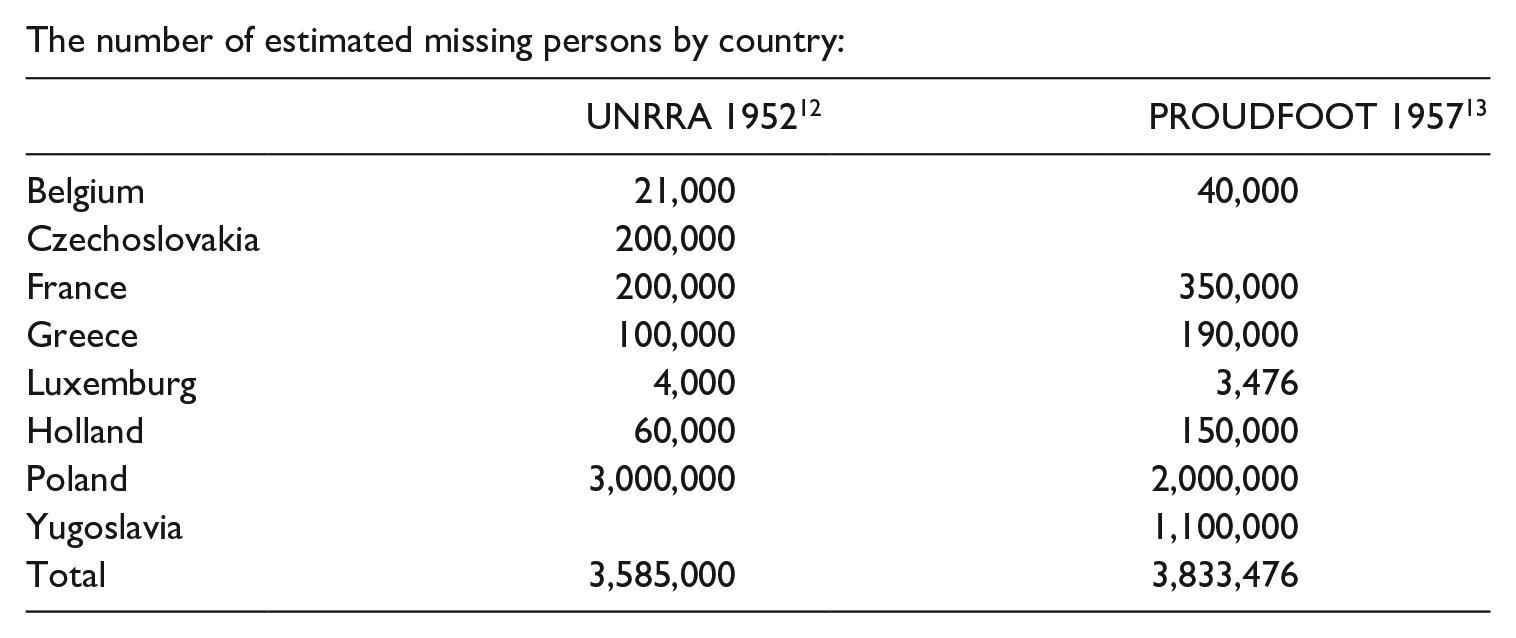
This table combines the number of soldiers and civilians, but does not include missing persons from the United States, the Scandinavian countries, England, and the Soviet Union. Nor does this table include the figures of the countries that fought with the Germans, such as Italy, Romania, and Bulgaria, or those with sovereignty, such as the Baltic States, and of course, it ignores the Pacific War. Thereby it reflects only a small portion of phenomenon. These numbers also do not include 1.7 million German citizens – soldiers, civilians, and children – who disappeared, and whom the German Red Cross was responsible for locating, of whom only about half a million were ever successfully identified either as living or dead. 14 Thus, it can reasonably be estimated that the number of missing persons resulting from WWII amounted to between 8 and 10 million people.
UNRRA divided the missing persons into six categories:
1. Forced Labourers or Volunteers
Most of the people in this category returned home after repatriation, but some did not, and their families sought help in locating them. The reasons why these people had not returned were diverse, with the most likely cause being that they had died in war-related circumstances. Yet there was also a possibility that these people were alive but merely not interested in returning home, for a variety of reasons.
2. Germany Army Conscripts
Most of these people died in battle, and their families were not informed. Others, however, were captured and imprisoned, primarily in Soviet camps for German prisoners of war. These detentions were also not reported to the families, and the fate of these people remains uncertain.
3. Allied Prisoners of War
Most Allied prisoners of war who did not return home by 1946 were likely deceased, but their countries were never notified of their deaths, and so they remained listed as missing.
4. Political Prisoners
The majority of the political prisoners who were deported to the camps and survived the war returned home. Those who did not most likely died as a result of the difficult living conditions in the camps and the rampant diseases there. However, conclusive establishment of their deaths necessitates detailed research in the registration ledgers of the relevant work, concentration, and exterminations camps, as well as death notifications from other places, and research on the death marches conducted both in Germany and elsewhere during the final months of war. As some of these data are missing, it is unlikely that such research can ever be fully undertaken, and thus the fate of many of these people will remain unknown.
5. Jews and Other Ethnic Minorities
Members of these groups were murdered in mass killing actions, often without any documentation that might help establish their identities. However, as there were also some who survived these atrocities, family members were left hoping that their loved ones were still alive, despite not having made contact.
6. General Missing Persons
This category referred to a group of displaced persons (DPs), about whom family members in various countries were unsuccessfully searching for information.
The missing persons’ problem was even more severe with respect to children, who could be separated into two primary groups: living children who had lost contact with their families, and were therefore still considered missing by their families; and children who had disappeared, and were most likely dead, but whose parents had no knowledge of their death, and were therefore searching for them. Sometimes these two groups overlapped, as in the case of wandering children whose parents were looking for them. But this was not always the case. Sometimes the children had lost both of their parents, and sometimes they were too young to even know who their parents were. Sometimes the parents did not know that their children had been saved, and, for this reason, were not searching for them.
According to a report of UNESCO (The United Nations’ Educational, Scientific, and Cultural Organization), after the war, there were millions of abandoned children across Germany, the Soviet Union, and different European states, who were, in effect, homeless. 15 These children, most of whom had lost contact with their families during the war, represent a painful phenomenon whereby the war separated many children from their parents for a variety of reasons. Some children, like the rest of their families, were persecuted for their backgrounds, particularly Jewish children. 16 Other children, although not persecuted personally, were forced to leave their families due to wartime circumstances. Such was the case with millions of German children who were sent to live in rural areas after their fathers had been sent to war, their mother having been enlisted in the wartime production efforts, and the Allied bombings having rendered life in cities perilous. 17 Children also vanished within the mass flight of refugees escaping the advancing Allied forces. Some of the refugees tried to advance towards those they perceived as liberators, while others, particularly in the east, where they were facing advancing Soviet forces, fled in disarray inland into Germany. The ensuing disorder caused many children to lose contact with their families. 18
Another important category of missing children was the group of children kidnapped by the Nazi authorities in order to undergo ‘Aryanization’. On 19 February 1942, a widely circulated decree published by the Reich Commissioner for the Consolidation of German Nationhood stated that the Polish people had kidnapped Nordic-looking children, given them Polish names, and placed them in orphanages and foster homes. German representatives in the occupied areas were called upon to locate children with Aryan characteristics, and those who met the Reich’s physical and mental tests were sent to orphanages run by the Lebensborn Project. 19 Some of the children kidnapped in this manner were very young, and at the end of the war, the authorities had difficulty identifying them and returning them to their homes. The greatest challenge was identifying children, mostly, who had undergone ‘Germanization’. 20 Eugeniuss Bartczak from Łodz was a case in point. According to the Polish Foreign Office, Eugeniuss was born on 3 December 1935, to a family the Nazis defined as ‘Volksdeutsche’ (descendants of Germans living outside of Germany). When he was 4, the city of Łodz was run over by German forces, and Eugeniuss was taken to a German educational institution, where he was renamed and educated as a German child. At the end of that year, Eugeniuss was adopted by an SS officer who took an interest in the child’s story. Eugeniuss’ case was amply documented, and his identify had been positively confirmed. However, the British authorities refused his biological parents’ demand for his repatriation to Poland and return to them, claiming that yet another separation from what he now considered his family would be even more damaging to him. 21 According to Polish authorities, the case of Eugeniuss Bartczk was not unique: more than 200,000 children were kidnapped to Germany in a similar manner, and were searched for by their families after the war. 22
At the end of the war, many children found their way home or to their families even without the help of the organized relief agencies, but their success in returning depended on a number of factors. The first was the age of the child. Only from a certain age can a child know and be able to articulate personal information about themselves: their own names, their parents’ names, and their place of residence. Knowing this personal information, these children, either with the help by passersby or on their own initiative, could return home. Second, the child’s family and home had to have survived the war. Third, the duration of the separation between the children and their family had to be brief enough that the children still felt more attached to their original homes than to their new surroundings; when this was not the case, the separation from the new home proved more difficult. 23 As most of these factors were present in the case of German children, many of them did manage to return home on their own. 24
Most often, those looking for lost children were their family members, who undertook their searches either privately, or with the help of the search agencies. Yet in cases where there were no families left to conduct a search, different institutions, chief among them the ITS, took steps to locate missing children and return them to their countries. The reason for this was that in the post-war period, the children’s absence, and the need to return them to their lands of origin, became an issue of national and social importance. 25 The problem of missing children, even more than that of missing adults, made the tension between the private tragedy and the national one far more palpable. Ostensibly, every missing child was missed most by their parents and family, thereby making the matter primarily a private one. Nonetheless, the various authorities that dealt with the issue acted under the conviction that children were, first and foremost, parts of the collective into which they had been born. Thus, they assumed it was in the children’s best interest to return to their own countries, even if their biological family was gone, and there were relatives there to care for them. Those working to return these missing children to their homelands assumed that life in a foreign country could be full of conflicts and uncertainties, thereby undermining the children’s sense of identity. The idea that a child of a certain nationality should not live with a family of another nationality, even if it was a caring, normative family, clearly cloaked a number of psychological and nationalist preconceptions concerning alleged ‘national character’. 26
With Jewish children, as well, nationality was given preference over adoptive families; in these cases, not only was it assumed that children’s best interest lay in their returning to their homelands, but most of those engaged in searching for child survivors saw them as the key to the national revival of the Jewish people as a whole. A statement by the World Jewish Congress in 1945 declared that ‘the number of Jewish children has dwindled significantly, and thus every Jewish child is of even greater importance’. 27 As Sara Shner-Nishmit, who played an active part in the Koordynacja (the Zionist Coordination Committee for the Redemption of Jewish Children), wrote concerning the motives to remove children from the houses of those who had saved them, even when it was clear that the adoptive family was a good one, ‘Our people have lost millions of their children, and Eastern European Jewry has vanished, never to return’. 28 For this reason, the Koordynacja activists felt it was their responsibility to return every lost children they could to the Jewish people as a whole, and not necessarily to any particular family. This was even more the case concerning Jewish children who were left without a family. Therefore, for example, the Allied armies decided that the legal guardians of these children should be the various Jewish organizations, who would decide where the children would be sent after they were located. 29
IV. Missing Jewish persons
Even before the end of the war, it was clear that there would be many missing Jewish persons once the fighting ended. Search agencies had begun tracing missing persons even during the course of the war, and had already started taking into account the legal and financial repercussions of dealing with such large numbers of missing persons. In a 1944 report prepared for the War Preparation Committee of the Swiss Jewish Community, Dr Hans Klee wrote, The events of recent years have made the previously known phenomenon of missing persons a much more widespread event. Regulating the repercussions of this phenomenon is fast becoming an important task of national and international law. The number of missing persons increases significantly with the progress of modern technology, and in particular air and sea transit, which in many places have led to the establishment of special legal provisions. Nonetheless, the number of missing persons created, either directly or indirectly, by the war is unusual. As a result of bombardments, sunken ships, evacuations, the mass flight of civilian populations, and additional reasons, the number of missing people is rising. Perhaps in the future we will be able to ascertain when their lives were cut short, provided they leave us with some form of earthly remnant. The Jewish population in Europe is particularly, although not exclusively, influenced by these events. Because an inordinate percentage of world Jewry lived in countries directly affected by the war – among them Poland, the Baltic states, Serbia, Bukovina, and the Western regions of Russia – the Jewish population was forced to emigrate. The number of emigrants who never arrived at their destination is not low, but above all else, Jews in many countries are the objects of a merciless policy of destruction that has led to the infamous deportations, mass executions, and death camps. Jews today are being led to concentration camps, work camps, and other forms of forced incarceration. One is justified in stating that they were sent to these places without their relatives, or anyone else who takes an interest in their fate, being informed. The obscurity in which these matters are taking place is great, and the International Committee of the Red Cross has never been given the opportunity to investigate specific categories of people, for example, on a national basis . . . As a result, the number of missing people has increased significantly.
30
As noted in the report, the missing persons faced a very harsh reality because of the combination of a number of factors. Despite the report’s assumption that most of the missing persons were no longer alive, their personal, financial, and legal status remained uncertain, due to the uncertainty as to whether or not they were still alive. Among the diverse reasons for this difficult situation were the following:
1. Lack of Proper Documentation
While many of the victims of WWII lacked proper death certificates, the problem was especially pronounced regarding Jews, in whose case this lack was often created by an intentional destruction of information regarding the victims. This helps explain why it has been difficult for Holocaust researchers throughout the ensuing years to establish the precise number of Jewish Holocaust victims. It is true that many of the deportation lists from the ghettos to the death camps, the concentration camps, and the forced labour camps did survive, and that after the end of the war, lists created by the Nazis in the death camps were found, in which there were details regarding the number of people murdered, and the identities of inmates who died from exhaustion and intentional starvation. However, in many cases, the retreating German forces also destroyed the camp registry ledgers. Some of the camps’ survivors realized the importance of the surviving registries, collected them, and provided them to various authorities so that the information could be published. One famous case of this type occurred when an index of 160,000 who were in the Theresienstadt Ghetto was destroyed, and all that was left of it were two lists: one, containing the names of 10,000 survivors; and the other containing the names of 20,000 people who had been deported from various concentration camps, particularly from Hungary and Poland, to Theresienstadt during the last days of the Nazi regime. 31 After the war, the Allied armies understood that collecting this material was of utmost importance, and they established a unit for tracing information in documents seized by the military which acted in tandem with the unit for tracing missing persons. 32
2. Emigration and Escape
Many people unsuccessfully attempted to escape from the ravages of war, and at times, there was no one who was able to identify them, so the fact of their death was never properly recorded. In a time during which immigrants swept across Europe, there was not always someone who could recognize the deceased, and, as a result, those searching for them were not able to find any information. Thus, many of these people remain listed as missing, even if they were, in fact, dead.
3. Intentional Murder
Cases of intentional murder were not always documented, such as during the German invasion of the Soviet Union, and the beginning of the systematic murder of the Jews in the General Government areas. In these cases, entire towns of men, women, and children were reduced to bloody killing fields, and no documentation was kept of who had been murdered, or even of how many. Even when the murder was recorded – as, for example, in some of the extermination camps, the concentration camps, and the labour camps – these documents were often destroyed when the German forces retreated.
In the UNRRA reports and those drafted by refugee organizations, there is usually no reference to searches conducted according to different nationalities. The reports refer, rather, to the total number of missing persons, and emphasize that the regional tracing centres were responsible for identifying specific locations. Nonetheless, two reports devote specific attention to the subject of locating Jewish missing persons, although they approach the subject from different perspectives. 33
In the first report, The Tracing of Missing Persons in Germany on an International Scale from June 1946, the Jews appear once, when they are mentioned in a list of the different groups that were part of the widespread problem of missing persons. This list also included an entry noting the presumed fate of each person. According to this list, most of the forced labourers and workers who volunteered to serve Germany returned home, and those who did not were most likely dead or had no desire to return. Members of the German military were mostly presumed dead, or prisoners of the Red Army. Allied prisoners of war were presumed to have died in German hands without having been identified. Political prisoners who had not returned home were presumed dead, and their deaths could only be established after an in-depth perusal of the camp lists. Jews and other ethnic minorities were mostly executed in large numbers without documentation, and therefore certain knowledge of their death could be ascertained only by carefully studying all extant documents. 34
The second report, History of the International Tracing Service 1945-1951, written 6 years after the first one, emphasizes the role of the Holocaust. In the introduction to the subject of missing persons, the report states that the devastation of the war, in particular the persecution of the Jews by the Nazis, resulted in a significant displacement of populations by 1943, causing a large number of family members to lose touch with each other. 35
Although the rest of this report does not refer specifically to the Jews, it should be noted that the report opens with the fate of the Jews and the Holocaust as the first reason for the large number of post-war missing persons. Perhaps this can be attributed to the fact that, by the early 1950s, the widespread knowledge about the fate of the Jews and the Holocaust had become a central signifier of WWII in general, despite the fact that most of the wartime causalities were not Jewish. Or perhaps it is because, unlike other missing persons, whose status had become clearer since the end of the war, the fate of many Jews was still uncertain even after 6 years. For whatever reason, the status of many Jews remained unknown.
V. Attempts to solve the problem
The problem of missing persons after the Holocaust affected a variety of areas in which families and authorities tried to find solutions, two of which will be addressed in this article. The first problem was, of course, the uncertainty concerning the fate of the missing individuals, a matter deeply troubling for their relatives. The second problem concerned the property registered to missing persons, and the legal challenges in turning over these estates to their heirs, the state, or the property’s current occupants. Two processes were created to address these issues. The first sought to ascertain information by applying a personal, particular perspective to try to gather information about every missing person. The second was an international legal attempt to achieve an agreement normalizing the status and property of wartime missing persons.
Searches for relatives: personal, national, and international
From the beginning of the post-war period, searching for relatives was often the first action undertaken by displaced civilians across Europe, and Holocaust survivors in particular.
36
These searches often provoked considerable turmoil, leading many people to wander across vast areas looking for their loved ones. Koppel Pinson, for example, describes the condition of the Jews in the DP camps in the first year after the war as follows: During the greater part of the first year of liberation much of the restlessness and wandering of the Jewish DP’s was an almost mad hunt for family and friends. The tracing bureaus set up by the relief agencies never inspired sufficient confidence among the DPs in either their efficiency or speed. And so, driven by a mad fury, the first thought of liberated Jews was to rush about seeking traces of their lost relatives. The slightest clue would send them on a trek of hundreds of miles over many a border and without concern for personal safety. Sometimes the clues led to a successful reunion with another surviving member of the family; most of the time it became only a search for details regarding the last days of the sought ones – when and where it happened.
37
Earl Harrison’s report about the DP camps also notes the emotional and psychological tensions as well as the disquiet evoked by the camp residents’ intense desire to locate and reunite with their family members: The most absorbing worry of these Nazi and war victims concerns relatives – wives, husbands, parents, children. Most of them have been separated for three, four or five years, and they cannot understand why the liberators should not have immediately undertaken the organized effort to reunite family groups. Most of the very little which has been done in this direction has been informal action by the displaced persons themselves with the aid of devoted Army Chaplains, frequently Rabbis, and the American Joint Distribution Committee.
38
Harrison’s recommendation to establish tracing centres was consistent with the intentions of the Allied military leaders, who were seeking ways to normalize the situation and stabilize post-war society by, among other things, returning the refugees to their counties of origin. The establishment of national and international tracing services was an attempt to solve the problems of uncertainty and restlessness that afflicted so many people in the wake of the war. 39 It was hope that in this way, the DPs would be able to find those for whom they were searching, and that this would give them the psychological freedom to devote themselves to rebuilding their lives. The relief organizations all considered reconnecting severed families and locating missing persons as the primary, and most important, action which most clearly motivated post-war DPs in Europe, among them also the Jewish survivors.
However, there were humanitarian organizations that did not wait for the fog to clear before beginning the search for missing persons. The Red Cross and others were continuing a legacy that started in WWI.
In 1863, Henry Dunant led to the creation of the International Committee for Relief to the Wounded following the battle of Solferino between France, Italy, and Austria, This became the International Committee of the Red Cross (ICRC). The organization’s main goal was to provide medical assistance to soldiers and civilians. The captivity of hundreds of thousands of soldiers during World War I revealed the need for an information centre for families and captured soldiers to find each other. Hence, the Red Cross opened an international agency for the assistance and information on prisoners of war. On 3 September 1914, the first list of names of wounded French POWs was received at the association’s office. By the end of the war, the Red Cross files contained information about approximately 7,000,000 names of soldiers and civilians who had taken part in the war. Those whose names did not appear on Red Cross lists were declared as missing and therefore requiring special consideration. 40
Efforts to locate missing persons and connecting people and families separated due to the war soon became the main occupation of the Red Cross. About 120,000 people visited the offices during 1918, and hundreds of thousands of letters received from families passed through the Red Cross seeking information on POWs. When WWII began, the ICRC once again made their search bureaus operational.
Other organizations began their activity during the WWII despite the challenging conditions and paucity of information from Nazi Germany. Unfortunately, in many cases, their efforts were in vain. Germany’s failure on the Russian front marked the end of the war and the focus of the Allied forces towards the rehabilitation of society in the aftermath of the war. At first, the Allied Expeditionary Force thought they would take full responsibility for the problem of missing persons. However, with time, the Allied military leaders came to understand that the immense number of people involved, along with the non-military nature of the task, made it a mission for which the Army was unsuited. They decided, therefore, to divide the responsibility. In November 1944, a decision was made that the Supreme Headquarters of the Allied Expeditionary Force would be responsible for DPs from Allied nations, the Germans would care for German DPs, and UNRRA would care for citizens of enemy nations persecuted for racial and religious reasons, or because they had cooperated with the Allies. 41 It was clear to both the Allied armies and to UNRRA that action must be taken to locate missing persons, but the first to set concrete plans in motion was UNRRA, which, in 1944, drafted proposals for the establishment of a tracing service. By September of that year, they had already asked the Red Cross to cooperate with them in establishing a European-wide tracing organization for locating DPs. 42 The intention was to create a searching service that would operate according to the model established by the British Red Cross Society (BRCS), which called for creating searching bureaus according to distinct national and regional boundaries. 43
BRCS was one of the leading actors in searching for missing persons. In May 1940, the BRCS created a search division that differentiated between locating missing persons from Allied nations and those from Axis countries. After the war, the department’s role was altered, empowering it to locate civilians in all the territories freed from German occupation. In June 1944, 57 different search organizations united under the auspices of the BRCS, and together they forced the UKSB (the United Kingdom Search Bureau for German Austrian and Stateless Persons from Central Europe). Jewish search organizations were also among the 57 founding groups, including the Jewish Refugees Committee and the Association of Jewish Refugees. 44
The BRCS representatives became central players in locating missing persons during the war with the use of innovative methods not yet accepted by the more traditional Swiss Red Cross. Until that time, search methods relied on primarily written contact with foreign authorities and requests for information, and therefore were dependent on the goodwill of these parties to provide the requested information. By contrast, the BRCS understood that without applying a more active approach, they will not be able to achieve essential data, and thus preferred to employ different tactics, such as deployment to battlefields and behind enemy lines in order to collect information. One of the first operations conducted by BRCS for the active retrieval of information was in Belgium in [1944], when BRCS team members raided a Gestapo building in order to obtain information about the fates of various missing persons. 45 The index they collected held more than 160,000 names of people listed as missing. 46 The end of the war represented an important turning point for all parties, and the BRCS was no exception. Due to the sheer scale of work to be done, additional search organizations were created, and the role of the BRCS shrank. After liberation, searches became the joint responsibility of the BRCS, the British Control Commission, UNRRA, and the American Jewish Joint Distribution Committee.
UNRRA was another organization that was established in 1943 as an extension of the United Nations, with the intention of aiding in refugee resettlement and rehabilitation. Members of this organization were concerned with the problem of the displaced and missing persons, and considered their role to include helping locate missing persons. As early as 1944, UNRRA began discussing the establishment of a general tracing service for the DPs it was expected to be responsible for.
Although UNRRA’s main responsibility concerned the refugees’ rehabilitation and physical health, UNRRA also placed an emphasis on the refugees’ psychological welfare. In an UNRRA announcement made in June 1945, the organization stated that ‘The United Nations’ Administration is concerned not only with relief – that is with the provision of material needs – but also with rehabilitation, the amelioration of psychological suffering and dislocation. For men do not live by bread alone’. 47 One of the main ways in which the organization attempted to rehabilitate the refugees was by locating missing persons, thereby allowing them to rebuild their families. UNRRA was mandated to handle the matter. But, at the same time, the Supreme Headquarters of the Allied Expeditionary Force expressed a desire to take responsibility for locating missing persons, and their agreement with the BRCS and UNRRA, concluded only a few months earlier, de facto was cancelled. 48
In the summer of 1945, the discord between UNRRA, the BRCS, and the Supreme Headquarters of the Allied Expeditionary Force reached a high point concerning the issue of which organization would be charged with locating missing persons, and the manner in which this responsibility would be carried out. Power struggles between the various organizations and disagreements led to many requests being stymied. The lack of coordination, collaborative methods, and, above all, disparities in the way the missing persons were listed, severely limited the helpfulness of the tracing service. Although undoubtedly created as an expression of good intentions, the tracing service seldom achieved actual results. The steadily deteriorating situation and the lack of replies to requests to locate missing persons led the Combined Displaced Persons Executive (CDPX) to decide the time had come to take responsibility for the matter. In July 1945, as the Supreme Headquarters of the Allied Expeditionary Force was being dissolved, the establishment of centralized registration, to be managed by a Central Tracing Bureau (CTB) was announced, with the intention that responsibility for the Bureau would be transferred to UNRRA and the other search agencies. 49 In addition, a decision was made that each country should establish its own tracing service that would collect all the requests for information concerning its citizens, and be in contact with the central office. At the beginning of 1946, the CTB was relocated to Arolsen (today: Bad Arolsen), in Germany, where it has been situated ever since. Arolsen was chosen because of its relatively central location, which, though still located inside the American sector, allowed it to collect information from all four Allied occupation sectors. 50
The Bureau answered requests for information from the four regional tracing offices located in the different sectors, as well as from Austria, Italy, and more than 20 national tracing offices. In addition to locating individuals, the Bureau collected lists from registration centres, and relayed the information to the other centres, an activity for which it employed 263 workers. 51 In 1947, UNRRA left, and the International Refugees Organization (IRO) assumed responsibility for managing the office, the name of which was now changed to the ITS, the International Tracing Service. In 1951, the Red Cross assumed responsibility for the management of the centre, which had meanwhile expanded significantly, employing some 1,000 people, among them 640 internationals and 40 locals. It also housed archives with the names of nearly 10 million families and individuals.
Declarations of death for missing persons
The recognition granted by various rehabilitation organizations and governments to the problem of missing persons as a result of the war, and the understanding that this problem was a significant factor in other issues, including that of abandoned property, was never in question. While not representing the statistical majority of cases, at least not in the immediate post-war years, Jewish missing persons were nonetheless a central reference point in the general discussion about refugees. This fact led the Jewish organizations, chief among them the World Jewish Congress in New York, to set in motion a procedure for the international, statutory recognition of missing persons. This was meant primarily to provide families some relief for the predicaments in which they found themselves due to their familial or close relationships with the missing persons. In keeping with this goal, as early as the end of 1945, and even more so during 1946, an initiative took shape calling for an international agreement that would declare missing persons to be dead after a certain number of years. 52
On 15 March 1950, after 4 years of work by the Joint and the World Jewish Congress, and with the help of a sub-commission appointed by the United Nations Economic and Social Council, an international conference was held to ratify the treaty on the death declaration of missing persons. Twenty-five countries took part in the conference held in Lake Success, New York. 53
At the basis of the declaration stood the recognition that the war had resulted in many people being listed as missing, because their deaths had not been recorded, and no positive confirmation for them could be found. A memo by the World Jewish Congress, drafted in preparation for the conference, noted that the victims of the war could be divided into two groups: the first included people who had died in the region where they had lived, while the second group included victims who had been deported elsewhere, and had died of hunger and diseases, or had been murdered without documentation. Some of them had left behind spouses whose personal status was now unclear, and property whose ownership was ambiguous. Due to the wide geographic range of the war, some cases, several states were required to discuss the affairs of a single person. For example, three states were needed in order to establish the legal status of a case in which a Polish Jew, who owned property in Poland, had been deported to Germany, where he vanished, and whose wife was found living in Israel at the end of the war. For this reason, the Congress argued, an international treaty should be enacted that would seek to solve such problems to the extent possible. 54
The goal of the treaty was to create a common basis which relatives could use to submit requests for recognition of a missing person as dead, with all the standard legal implications of such a declaration. The treaty allowed each country to set its own rules regarding such declarations of death, particularly concerning the question of the period of time that needed to pass until the missing person could be declared legally dead. In addition, the signatory states had to define which jurisdiction would discuss the case, and ensure that from the moment a case was opened in one location, another member state would not reopen the same case elsewhere. The decision made in each case would be reported to an international office run by the United Nations, which would handle all the applications and decisions, thereby ensuring unity of law. The signatory states’ independence was a necessary condition for passing the treaty, and for this reason, the treaty included a clause stipulating that each signatory state was obliged to pass legislation resolving the status of missing persons.
The treaty was ultimately signed on 6 April 1950 by most members of the United Nations, and expressed the recognition of the relief organizations and the institutions charged with the rehabilitation of Europe that the missing persons problem was an impediment to the ability of society to recuperate after the catastrophe of WWII. 55
VI. Conclusion
The widespread efforts described above by military and humanitarian organizations to locate missing persons raise the question of why these institutions chose to devote such great efforts to the subject of the missing persons, which could also have been construed as a private matter, affecting certain families as private groups. An internal UNRRA report, submitted to the Commander of the chief of operations for Germany, was adopted by the IRO, and was incorporated into the organization’s operative procedures as early as 21 February 1946. The report lays out its authors’ understanding of the actions necessary to locate missing persons. 56 According to them, the location of missing persons had previously been considered a civilian problem with a narrow international impact, which had been dealt with by a number of national agencies. But the massive uprooting of populations caused by WWII forced the Allied governments to consider the problem of missing persons as a distinct category of an unprecedented nature.
When the problem of missing persons first arose, it was considered primarily as a humanitarian concern. Reunifying deported families, returning children to their parents, reconnecting contacts severed by years of occupation and war were actions undertaken in a genuine effort to help people whose world had collapsed, and who were now attempting to restore their lives. The absence and lack of knowledge of the fate of so many of their family members disturbed the peace of mind they required to rebuild their lives. Many surviving family members refused to accept the presumption of state institutions that those missing were dead, never to return. 57 In essence, the fabric of European society had been radically ripped apart during the war years that even the most fundamental of all social building blocks – the family unit – was split asunder. The first step in recovery and rehabilitation was to reunite the scattered individuals into the family framework. But though the living returned home, and the dead were buried – if not physically, then at least symbolically – the missing were consigned to a hazy, indeterminable twilight. This ambiguity could give rise to conflicts between the families, who, lacking any evidence to the contrary, wanted to continue to cling to the belief that their loved ones were still alive, and the authorities, who sought to hasten the declaration of death as much as possible. But, very quickly, the relief organizations realized that the need to solve the problem of missing persons was inextricably linked to the rehabilitation of the population as a whole, and not just to that of individuals. The DPs’ deep-seated desire to restore their pre-war connections and search for relatives led many of them to wander restlessly from one place to another, refusing to settle in the areas to which they had been assigned, or to take part in repatriation, for fear that the relocation would prevent them from being reunited with their family members, who might one day return. As the matter was a source of profound distress for so many people, the various relief organizations realized that a necessary precondition for any repatriation or resettlement plan was the establishment of a central tracing agency that would try to address the problem of the missing persons. 58
After the war, many expected the status of missing person to be a temporary one, a problem that would be solved with the development of suitable searching procedures, and after the mayhem of liberation had passed. However, unfortunately this scenario did not come to pass. Despite all the efforts invested in locating missing persons and tackling the problem from a legal perspective, the phenomenon of missing persons continued to play a central role in the post-war period. This is clear in the gap between the number of requests received by the ITS and the number of definitive answers produced, with most tracing requests failing to produce a result. For example, between 1 July 1949 and 30 June 1950, the ITS received 134,306 tracing requests, 44,988 of which were new requests, submitted directly to the ITS, and 89,318 were requests submitted by other agencies. Of these, 19,063 were located, or at least some information on them was uncovered; that is, a total of 14.2 per cent. In 23,936 cases, no traces were found, and 91,307 cases were left open. 59 Successful identifications were truly a drop in an ocean. According to the list of estimated missing persons by country drafted by the European Tracing Services, the number of wartime missing persons – excluding those from Germany, the Soviet Union, and the Allied armies – amounted to about 4 million people. In the estimation of the various tracing services, most of these missing people had lost their lives during the war. 60
The situation with respect to the Jewish missing persons was similar, if not worse. The tracing office operated by the JDC (the American Jewish Joint Distribution Committee or “The Joint”) between 1944 and 1949 received some 750,000 tracing requests from relatives of missing persons from around the globe. Among them, 40,000 were ascertained to be alive, and 10,000 others could be confirmed as dead. The fate of the remaining 700,000 people remained unknown. 61 We can note a similar tendency in the report published by the World Jewish Congress (WJC), stating that of 580 tracing requests received between April and July 1954, information conclusively proving or disproving a person’s death could be found in only 10 cases, and that 233 other cases were defined as untraceable (i.e. missing persons about whom there is no information). 62
One of the organizations that was relatively successful in tracing missing persons after the Holocaust was the Jewish Agency’s Search Bureau for Missing Relatives that was active in Mandatory Palestine and continued to function after the establishment of the state of Israel. This organization focused primarily on searching for relatives of survivors and Holocaust victims living in Israel. Thanks to its geographic specificity, and the relatively high density of Holocaust survivors in Israel, the Search Bureau achieved a success rate of 30 per cent within a number of years. 63 These numbers reinforce the assumption that the missing persons’ problem was perceived as significant, and that it had continued social relevance even many years after the Holocaust.
Pauline Boss argues that having a family member declared a missing person is one of the most difficult emotional experiences of loss that can be endured. This is because the continuing absence and lack of conclusive information does not allow for the closure needed to begin a mourning process, after which a return to life is possible. With missing persons not officially declared as dead, and certainly not considered so according to sociological definitions, their families refrain from acknowledging their deaths on a practical if not on an emotional level. Yet because this reality is not always only a temporary one, certainly not when dealing with victims of catastrophes who will probably never be located, efforts must be made to help the relatives of missing persons come to grips with reality as it is. They must learn to understand absence as a protracted state, and not merely as a liminal stage that soon passes. Rather, it is a state of uncertainty that may last for years or even indefinitely. This condition requires different coping mechanisms than a ‘normal’ death. 64
In recent years, there is a growing awareness that the problem of missing persons resulting from wars and genocides must be addressed as an issue in its own right. Missing persons create a sense of unease, an instability that does not allow life to be rebuilt. For this reason, in contrast to the way in which the subject was understood decades ago – as a private matter affecting individuals and families – the Red Cross is leading the development of a comprehensive system that will enable populations that have experienced crises such as war, genocide, or natural disaster, to better cope with the absence of thousands of people who most likely will never be found. 65 This article seeks to depict the problem of missing persons after WWII as an independent category, one distinct from the two other problems created by the war, namely, the rehabilitation of those left alive, and the commemoration of the victims who had died, as well as the legal reckoning with those who had murdered them. Between the living and the dead, there lay a massive abyss of missing people, individuals about whom traces had been lost. Even many years after the war ended, families, governments, and various relief organizations maintained active efforts to locate these missing persons. In contrast to the once prevailing assumption that the fate of all its victims would be known within a few years after the war, the uncertainty conceived in the fog of war has refused to dissipate, more than half a century later.
Footnotes
Funding
The author(s) disclosed receipt of the following financial support for the research, authorship, and/or publication of this article: This research has been supported by the Research Authority at Herzog Academic College.
