



Abstract
Objective
Evidence is scarce about whether colorectal cancer screening can affect the quality of life of participants, particularly in terms of novel screening strategies in Eastern populations.
Methods
From 2018 to 2021, the TARGET-C trial randomly allocated 19,373 participants to one of three screening strategies: (A) one-time colonoscopy; (B) annual faecal immunochemical test with positives referred for colonoscopy; and (C) annual risk-adapted screening with low-risk participants referred for faecal immunochemical test and high-risk participants referred for colonoscopy. Two rounds of follow-up after baseline screening were conducted over the 3-year period. Based on the TARGET-C, a EuroQol five-dimensional questionnaire-based quality of life survey was administrated to the participants, and utility scores and related changes were used as the main outcomes.
Results
Taking by-strategy utility scores for participants before being screened at baseline as the comparators (n = 2921), the changes in utility scores after baseline screening were −0.008 (P < 0.050) for strategy A, 0.006 (P < 0.050) for strategy B and 0.000 (P > 0.050) for strategy C, and the overall difference in quality of life changes among the three strategies was significant (P < 0.001). Taking the same comparators as above, the changes in utility scores for participants in the second round of follow-up (n = 9201) were 0.011 (P < 0.050), 0.011 (P < 0.050) and 0.005 (P < 0.050), respectively, and the overall difference was neither clinically meaningful nor statistically significant (P = 0.113).
Conclusions
None of the three colorectal cancer screening strategies had a major effect on the participants’ quality of life over the 3 years. Within one round of screening, incorporating risk-adapted screening and/or faecal immunochemical test might offset the quality of life impact from colonoscopy screening.
Keywords
Introduction
Colorectal cancer (CRC) is a major global public health challenge and contributed 1.11 million deaths and 2.31 million new cases worldwide in 2023; the corresponding numbers in China were 0.26 million and 0.61 million, respectively. 1 Higher incidence, better survival and higher mortality rates are used to derive the extent of burden of disability-adjusted life years (DALYs), which combines the years lived with disability and years of life lost. CRC is responsible for the second- and third-highest number of DALYs among all cancers globally and in China, respectively. 1 A 10-year increasing pattern reported for late-stage diagnoses implies potential challenges for CRC control in populations in China. 2
Regular screening has been shown to be effective in reducing CRC incidence, mortality and economic burden.3–7 However, potential harms exist and should be considered carefully when evaluating screening performance. Common harms related to CRC screening include false-positive tests and the related negative psychosocial consequences, overdiagnosis, bleeding and perforation.8,9 All of these adverse effects may have a negative effect on the individual's quality of life (QoL). Through the use of various patient-reported outcome instruments to obtain a general or global health score, QoL assessment has become an important factor in the evaluation of cancer screening.10–12 It helps to capture the broader impacts of screening on individual well-being, beyond clinical outcomes. While certain adverse effects of screening, such as adverse events during colonoscopies or surgical procedures, have been previously reported, evidence for their impact on QoL is still limited (especially in populations in Eastern countries), and the findings remain inconsistent.4,13
Although some studies have reported that faecal immunochemical tests (FITs) and colonoscopies do not affect QoL, and even that participants can benefit from them in terms of QoL,14–17 others have reported that the effect of colonoscopy on QoL is large, especially in people who have positive results.18,19 Western studies are not necessarily applicable to Eastern populations owing to the diversity of population, economic and sociocultural contexts. Recently, Eastern countries have begun to pay attention to the relationship between screening and QoL. A study has shown that screening for breast cancer may reduce the QoL of participants. 10 With respect to CRC, existing studies have shown that individuals with CRC tend to have a worse QoL, 20 but the impact of screening for CRC on QoL has not yet been reported especially in multi-strategy comparisons. Evidence for novel CRC screening strategies, such as risk-adapted screening, on QoL is lacking globally.
In 2018, China conducted the first large-scale, multicentre, randomized controlled trial to evaluate the differences among colonoscopy, FIT and a risk-adapted approach for CRC screening: the TARGET-C study. 21 Previous reports from this trial revealed that the risk-adapted approach, as a novel screening strategy, is a feasible and cost-favourable strategy for population-based CRC screening.22–24 In this article, we further evaluated the impact of CRC screening on participants’ QoL, particularly regarding the novel risk-adapted screening strategy, and explored the relevant factors influencing QoL.
Methods
The TARGET-C study (Chinese Clinical Trial Registry: ChiCTR1800015506; 2018/04/03), a population-based CRC screening randomized controlled trial conducted in six cities (Taizhou, Lanxi, Changsha, Hefei, Xuzhou and Kunming) in five provinces (Zhejiang, Hunan, Anhui, Jiangsu and Yunnan), was initiated in May 2018 under the supervision of a steering committee. The trial's design has been published separately, and it enrolled residents aged between 50 and 74 years. 21 After enrolment, 19,373 participants were randomly allocated to one of three screening strategies at a 1: 2: 2 ratio: (A) one-time colonoscopy; (B) FIT with positives referred for colonoscopy; and (C) annual risk-adapted screening with low-risk participants referred for FIT and high-risk participants referred for colonoscopy. From May 2018 to October 2021, three rounds of screening were conducted. In the current substudy, we invited a subsample of those invited to the study to fill out a QoL survey. The survey was approved by the Institutional Review Board of the Cancer Hospital of the Chinese Academy of Medical Sciences. All participants signed informed consent forms at the site of recruitment.
This study was implemented as part of the TARGET-C trial to assess the impact of CRC screening on participants’ QoL, using utility scores and related changes as the main outcomes.
Study design and participants
A total of 3800 participants were sampled from the three screening strategies at baseline, with all participants surveyed before and after screening. The timing and administration method of the face-to-face questionnaire were as follows: For participants receiving FIT, follow-up was conducted by field investigators approximately one week after the results were received. The survey methods were flexible, and included home visits, phone calls or inviting participants to community centres. For participants undergoing colonoscopy, the questionnaire was required to be completed before they left the screening site, within 24 h after the procedure. The annual risk-adapted screening strategy uses the Asia Pacific Colorectal Cancer Score for risk assessment at baseline. High-risk participants undergo colonoscopy, while low-risk participants are offered FIT screening, with colonoscopy for those with a positive FIT result. For FIT-negative participants or those not receiving colonoscopy at baseline, risk assessments are repeated annually, and screening interventions are adjusted accordingly. With respect to the FIT strategy, participants underwent FIT screening at baseline, with those who tested positive referred for colonoscopy. In subsequent annual follow-ups, participants who were not diagnosed with CRC underwent FIT annually. 21 For the one-time colonoscopy strategy, we adopted a systematic sampling method to select participants whose ID ended with 3, 6, or 9 until the target sample size was reached. For the FIT and annual risk-adapted screening strategies, we focused on participants whose primary screening results were positive. All of them were included in the investigation, and the participants whose results were negative were systematically sampled until the target sample size was reached. During the first round of follow-up screening, we surveyed all the participants whose primary screening results were positive and a random sample of 20% of participants whose baseline screening results were negative from the three screening strategies. The survey pattern for the second round of follow-up screening was similar to that of first round and included all the participants surveyed in the previous round. After all the screenings were completed, the participants were invited to complete the questionnaires again.
Utility measures
The simplified Chinese version of the five-level EuroQol five-dimensional questionnaire (EQ-5D-5L) was used to describe the QoL of screening participants in this study, which included five dimensions (mobility, self-care, usual activities, pain/discomfort and anxiety/depression) with five levels (responses to each dimension). The questionnaire was administered face-to-face by a trained interviewer; alternatively, the patients completed the survey by themselves. For both alternatives, researchers were on hand to answer any questions that arose. The main outcomes were utility scores and related changes. The utility scores, an overall QoL indicator integrated with multiple descriptive dimensions, were calculated on the basis of the five-dimensional results and the Chinese-specific scoring algorithm. 25 The algorithm yielded utility scores ranging from −0.391 (for health state 55555) to 1.000 (for health state 11111), with 0.000 representing death, 1.000 representing full health, and a negative value indicating that the health state was worse than death. The higher the score is, the better the QoL. The changes in utility scores were calculated by taking utility scores for the participants before being screened at baseline as the comparators. The minimally important difference (MID) has been defined as the lowest change (beneficial or that would result in a change in treatment) in a patient-reported outcome. 26 A utility difference higher than the MID is deemed clinically relevant, and the MID in this study was 0.069. 27
Sociodemographic information, including age, sex, educational background, occupation, marital status, household income and health insurance status, was collected through a self-designed questionnaire. All screening-related outcomes were linked to the main trial.
Statistical analyses
Participants with definite basic information and complete outcomes were included in the final analysis. The study population characteristics were calculated and compared among the three strategies. The Pearson chi-square test was used to compare the differences in categorical variables. Owing to a skewed distribution, the nonparametric Kruskal–Wallis test was applied to test the differences in utility scores and related changes among the different strategies. We used the generalized estimation equation to calculate the changes in utility between different predefined time points (adjusted for age, sex, centre, education, occupation, marital status, household income and health insurance) and explored the impact of sociodemographic variables on the changes in the utility of the overall baseline screening (univariate analysis and multivariate analysis). Taking by-strategy utility scores for the participants before being screened at baseline as comparators, we used a generalized linear mixed model to evaluate the changes in utility scores for participants in the two rounds of follow-up, adjusting for age, sex, centre, education and marital status. Owing to the high ceiling effect of the utility scores (all predefined survey points were above 85%) collected in Hunan, it is possible to overestimate the average utility scores and underestimate the change. Accordingly, in this study, we performed a sensitivity analysis in the absence of Hunan participants to calculate the utility scores and evaluate their changes. All analyses were performed using R version 4.0.3. All tests were two-sided, with statistical significance set at a P value <0.050.
Results
A total of 2921 eligible participants were included in the final analysis, with 523, 1072 and 1326 eligible for the colonoscopy, FIT and risk-adapted screening strategies, respectively. At the baseline screening, the proportion of invited participants who declined to participate in the QoL assessment was 31.2% in the colonoscopy group, 10.1% in the FIT group and 20.8% in the risk-adapted screening group (Supplemental eFigure 1). The characteristics of the participants who agreed to participate at baseline are shown in Table 1. The characteristics of those who completed the two rounds of follow-up screening are shown in Supplemental eTable 1. Among the 2921 participants, 1383 (47.3%) were men, and the mean age was 61.0 ± 6.5 years. There were no significant differences in education and marital status among the three strategies, but there were differences in sex, occupation, household income and health-care insurance.
Baseline characteristics of included participants.

FIT: faecal immunochemical test; SD: standard deviation; UEBMI: urban employee's basic medical insurance; URBMI: urban resident's basic medical insurance; NRCMS: new rural cooperative medical scheme.
Deleted data are not taken into account in the calculation of the P-value.
Before the baseline screening, the utility scores of the three strategies were 0.974 (95%CI: 0.969 to 0.979) for the colonoscopy strategy, 0.975 (0.972 to 0.978) for the FIT strategy and 0.980 (0.977 to 0.983) for the risk-adapted screening strategy. After being screened at baseline, the utility scores of the EQ-5D-5L among the three strategies were 0.967 (0.961 to 0.973), 0.980 (0.977 to 0.983) and 0.981 (0.978 to 0.984), respectively. The utility scores of participants in the colonoscopy strategy were significantly lower than those in the other two strategies (P = 0 .006) (Table 2). Compared with before being screened, more problems in the dimension of pain/discomfort were reported in the colonoscopy strategy after the baseline screening (Figure 1). Over the three rounds of screening, the utility scores for the colonoscopy, FIT and risk-adapted strategies were 0.985 (0.982 to 0.988), 0.986 (0.985 to 0.987) and 0.985 (0.983 to 0.987), respectively. There was no statistically significant difference in the utility scores among the three screening strategies (P = 0.113). Compared with the post-baseline screening, progressively fewer problems in the dimension of pain/discomfort were reported among the three strategies after each round of follow-up.
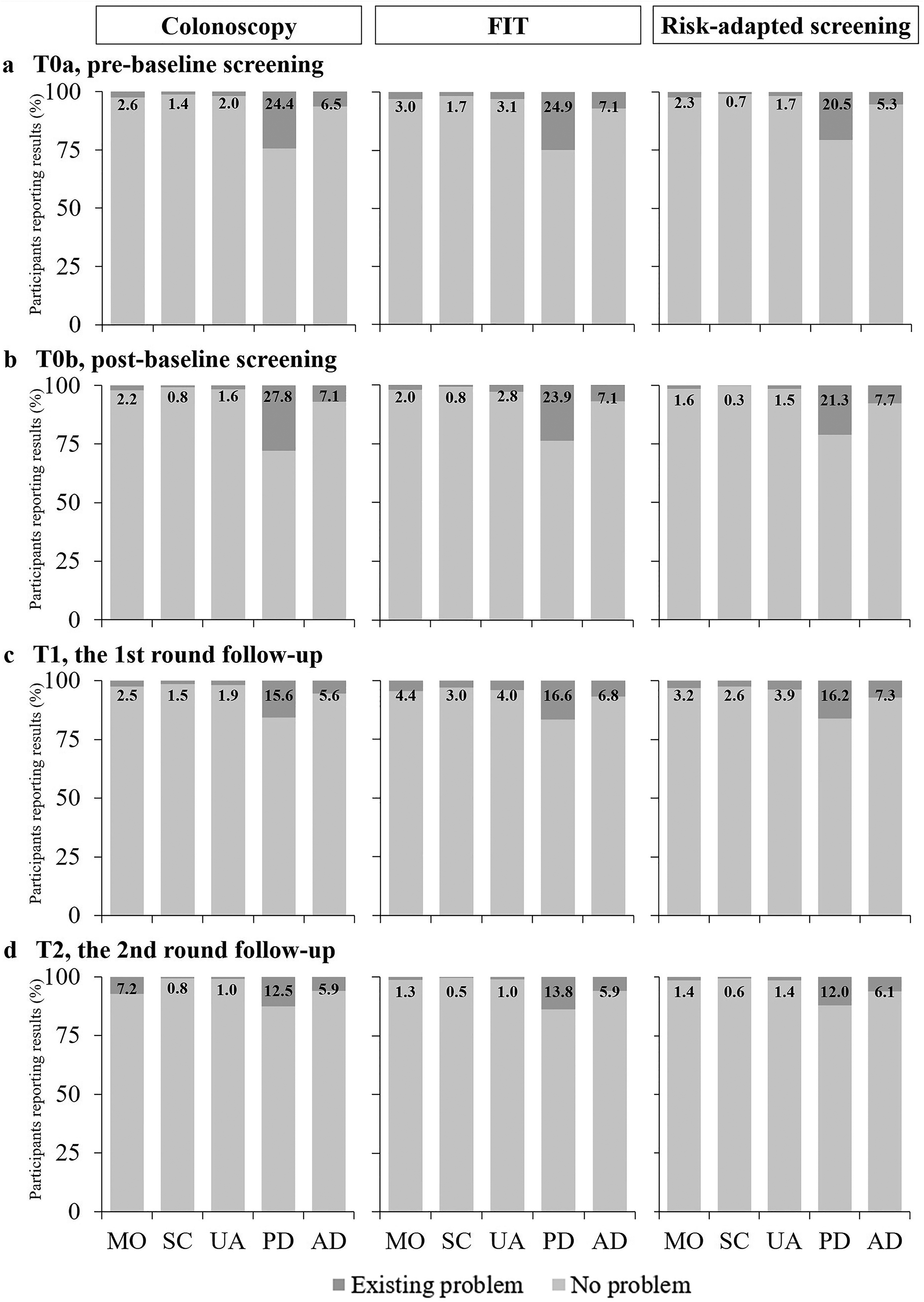
Distribution of EQ-5D-5L problems reported of the study participants in different strategies, including (a) T0a, pre-baseline screening; (b) T0b, post-baseline screening; (c) T1, the first round follow-up and (d) T2, the second round follow-up. FIT: faecal immunochemical test; MO: mobility; SC: self-care; UA: usual activities; PD: pain/discomfort; AD: anxiety/depression.
Utility scores of the study participants, by screening strategy.

FIT: faecal immunochemical test; CI: confidence interval.
aT0a: pre-baseline screening; T0b: post-baseline screening; T1: the first round follow-up; T2: the second round follow-up. bP < 0.050.
Taking by-strategy utility scores for the participants before baseline screening as comparators, the changes in utility scores after baseline screening were −0.008 (−0.012 to −0.004, P < 0.050) for the colonoscopy strategy, 0.006 (0.003 to 0.008, P < 0.050) for the FIT strategy and 0.000 (−0.003 to 0.002, P > 0.050) for the risk-adapted screening strategy and the overall difference in QoL changes among the three strategies was significant (P < 0.001). Taking the same comparators as above, the changes in utility scores for participants in the second round of follow-up were 0.011 (0.006 to 0.015, P < 0.050), 0.011 (0.008 to 0.014, P < 0.050) and 0.005 (0.002 to 0.008, P < 0.050), respectively. However, the magnitude of these changes is less than the MID (0.069); In other words, these statistically significant differences are not clinically meaningful.
The sensitivity analysis revealed that participants in each round of all the CRC screening strategies would have a lower average utility score if the data from Hunan were not included. The utility scores of the colonoscopy, FIT and risk-adapted screening strategies before the baseline screening were 0.968 (0.962 to 0.974), 0.971 (0.967 to 0.975) and 0.974 (0.970 to 0.978), respectively. After the three rounds of screening, the utility scores increased to 0.983 (0.980 to 0.986), 0.983 (0.981 to 0.985) and 0.983 (0.981 to 0.985), respectively. The trend of change in the utility scores between different rounds remained the same (eTable 3). Among the three strategies, the absolute value of the changes in the utility scores for participants in the second round of follow-up, compared with before being screened, increased more significantly after the Hunan data were removed.
Univariate analysis revealed that age, sex, centre, occupation, marital status and health-care insurance were significantly associated with the utility scores. Among them, centre (P < 0.001), marital status (P = 0.035) and health-care insurance (P < 0.001) affected the colonoscopy strategy; centre (P < 0.001), occupation (P = 0.006) and health-care insurance (P = 0.008) affected the FIT strategy; and age (P < 0.001) and sex (P < 0.001) affected the risk-adapted screening strategy. More detailed information is provided in Supplemental eTable 2. Multivariate analysis revealed that age, sex and centre were factors influencing the utility scores (Table 3). Older and male participants tended to have lower utilities in the risk-adapted screening strategy.
Factors associated with changes in utility scores in different strategies at baseline screening.

FIT: faecal immunochemical test; CI: confidence interval; UEBMI: urban employee's basic medical insurance; URBMI: urban resident's basic medical insurance; NRCMS: new rural cooperative medical scheme.
Discussion
To our knowledge, the current study is the first report to comprehensively analyse the changes in QoL associated with CRC screening, including a novel screening strategy, in Eastern populations. In contrast to previous studies, this study investigated whether the change in QoL depended on the type of screening strategy, and demonstrated that the risk-adapted screening approach and established screening strategies had no major impact on QoL among screening participants over the 3 years. The large sample size, multicentre design and multiple rounds of follow-up make this study unique. The hierarchical screening network will provide novel perspectives for applying trial findings in conventional screening practices in the future.
Although the three screening strategies had no effect on the QoL of the participants over the 3 years, within the baseline screening, the colonoscopy strategy would reduce the participants’ QoL, while the FIT and risk-adapted screening strategies did not affect the QoL. To assess clinical relevance, we used the threshold of MID. Owing to all the changes in the utility scores in this study being rather small, none of them exceeded the MID, even the changes that were statistically significant. Therefore, these changes are not clinically relevant. In addition to the QoL reported in this study, other characteristics of the screening strategies play crucial roles in influencing participants’ test preferences. For instance, although colonoscopy has worse outcomes in terms of pain and discomfort, which may reduce participants’ willingness to choose this method, it offers higher diagnostic accuracy and could lead to fewer long-term adverse outcomes, such as interval cancers and the opportunity costs associated with false-positive results following FIT.
The colonoscopy strategy reduced the immediate QoL (utility scores after the baseline screening survey) of the screening participants, mostly reflected in a decline in the pain/discomfort score dimension. This is related to the fact that colonoscopy is an invasive examination. 20 Pain/discomfort decreased over time, and we found that the scores had either improved or returned to their prescreening levels after the second round of follow-up. However, two other studies reported that colonoscopy did not affect QoL, and even that average-risk individuals benefit from it.15,17 Importantly, all of these studies provided sedation to the screening participants, which directly affected the pain/discomfort dimension scores. Given these differences, it should be noted that no sedation or analgesic agents were used during the colonoscopies in our study, making direct comparisons with the aforementioned studies difficult. Our data also indicate that the prevalence of anxiety and depression increased in the colonoscopy and risk-adapted screening groups, but not the FIT group, after baseline screening. During the follow-up period, anxiety and depression in three groups tended to decrease overall. Furthermore, after screening and during the follow-up period, both the FIT group and the risk-adapted screening group had higher concurrent scores than did the colonoscopy group, which may be related to the higher false-positive rate in the FIT group, potentially inducing more anxiety and depression. 18 However, these changes are very small and are not clinically significant.
Compared with the one-time colonoscopy strategy, the FIT strategy had a similar detection rate and a higher participation after second round of follow-up. 24 In this strategy, colonoscopy is still the gold standard. Participants with confirmed positive FIT results are scheduled for subsequent diagnostic colonoscopy. Previous studies conducted in Western countries have shown that the FIT test has a limited effect on the QoL of screening participants,14,16 with one study suggesting that only people with positive results may experience a decrease in QoL. 16 In this study, we found that by taking utility scores for the participants before baseline screening, the FIT strategy had no effect or even slightly improved the QoL of participants after baseline screening. FIT appeared to counteract the overall negative effect of colonoscopy on participants. After the second round of follow-up, the effect was still there or even more significant. There are several reasons for this: (1) FIT does not affect QoL.18,20 (2) In the FIT strategy, FIT and colonoscopy were performed in tandem. In addition, the triage effect of FIT for primary screening reduced the number of people who needed a colonoscopy, thereby attenuating the impact of colonoscopy on the overall QoL. (3) Primary screening with FIT has a psychological buffering effect on screening participants, which can help reduce the impact of colonoscopy on QoL.
As a novel screening strategy, the risk-adapted screening strategy is widely promoted in China, and its screening capacity and participation level are similar to those of the FIT strategy.24,28–32 Risk assessment also led to diversion, with no reduction in QoL, after both baseline screening and the second round of follow-up. Studies exploring the effect of risk-adapted screening on QoL are lacking, preventing any external comparisons. Although none of the three screening strategies affected QoL among the screening participants over the 3 years, the differences in participation suggest that FIT and high-risk assessment may be superior strategies. Moreover, previous studies have confirmed that compared with established colonoscopy and FIT strategies, a risk-adapted screening strategy is a feasible, effective and cost-favourable personalized CRC screening strategy.22–24 In the future, we believe that this risk-adapted approach could be adopted as a promising approach for population-based CRC screening programs, particularly in health-care resource-constrained settings. In addition, the detailed screening-strategy-specific utility scores from the current study could also facilitate measuring of burden of DALYs for CRC in the future. 32
In this study, the mean of the screening participants’ utility score was 0.975 for the colonoscopy strategy, 0.976 for the FIT strategy and 0.980 for the risk-adapted screening strategy. The mean scores of the three strategies were higher than the utility scores reported in a previous study (0.932–0.956) for the general population over 50 years old in urban China. 33 This may be because the overall ceiling effect was 75.7% in our study, which is greater than that in the previous study (54.0%). In another study, using data from the 2020 Tianjin Health Service Survey, the utility scores of the general population (49.3% male, mean age 55.2 years, ranging from 18 to 102 years) ranged from 0.936 to 0.942, and the ceiling effect value was 72.8%. Compared with this previous study, our study revealed not only a greater overall ceiling effect but also a greater ceiling effect for each dimension. 34 When the data from Hunan Province were removed in the sensitivity analysis, the ceiling effects overall and for each dimension were mitigated, and the utility scores of the participants were reduced. In addition to the ceiling effect, the area and population investigated in the previous studies are different from our study. Also, this study investigated a population recruited for voluntary CRC screening, who may be more concerned about their health status and have a healthier body condition. The main outcome of this study was the change in the utility score, and a higher mean score has a limited effect on the change. The ceiling effect in Hunan province was 9% greater than the overall study level, which significantly impacts the overall utility scores. The reasons behind this phenomenon are complex and may be related to factors such as social desirability bias.35–37 For instance, respondents may be more likely to report better health states to align with social expectations rather than answer truthfully. Additionally, the survey population in Hunan may be younger and healthier, but the exact cause remains unknown.
The sampling method for the QoL subsample was not entirely random. In the FIT and risk-adapted groups, participants were selected on the basis of positive screening results, whereas the colonoscopy group was chosen randomly. This approach may overrepresent individuals with abnormal findings, potentially introducing bias in QoL estimates. Previous studies have indicated that individuals with positive screening results typically experience higher levels of anxiety and psychological distress than their screen-negative counterparts do.14,16,18 In this study, for evaluations within the same screening strategy, the increased proportion of screen-positive individuals in the follow-up sample may have contributed to a lower overall QoL score and a more substantial overall change in utility values. Furthermore, when different screening strategies are compared, given that the FIT and risk-adapted groups have a greater proportion of positive results than the colonoscopy group does, the magnitude of the decrease in QoL associated with these two strategies may be more pronounced, thus leading to less significant differences in effect changes between the groups. Given these factors, the generalizability of the results to broader real-world screening populations should be approached with caution.
There are several other limitations. First, the ceiling effect is a well-acknowledged deficiency of the EQ-5D-5L, and it was higher than 70% among the three strategies in this study. Second, as a generic instrument, the EQ-5D-5L lacks descriptive richness in disease-specific symptoms and functions. More CRC-specific instruments should be used to assess QoL; in the future, data collected using the Functional Assessment of Cancer Therapy-Colorectal (FACT-C) questionnaire 38 will be evaluated to expand the current analysis. Third, this study used the EQ-5D-5L to evaluate QoL. Previous studies have shown that the 5L version of the EQ-5D outperforms the original 3L version concerning its even distribution of outcomes, level of information provided, convergent validity and ceiling impact. However, the utility scores of the 5L version are always higher than those of the 3L version.12,39 Fourth, depending on the specifics of the survey site, there were instances where the systematic sampling of participants whose primary screening results were negative did not follow the protocol exactly, which may have affected the overall representativeness and may have had an impact on the results. Fifth, as height and weight data were not collected in this study, the models could not be adjusted for BMI, which may have introduced residual confounding. In addition, during the follow-up phase, information on occupation, household income and health-care insurance was not collected, and therefore these variables were not included in the subsequent generalized linear mixed model. Finally, this study focuses on the evaluation of CRC screening strategies within a multicentre randomized controlled trial and is not an evaluation of an ongoing public screening program. Therefore, the findings may not fully capture the complexities and challenges associated with real-world screening programs.
Conclusion
In summary, this large-scale trial demonstrated that neither the novel screening strategy (a risk-adapted screening approach) nor any of the established CRC screening strategies significantly affected the participants’ QoL over the 3 years. However, within one round of screening, incorporating risk-adapted screening and/or FIT tests might partially offset the QoL impact from colonoscopy screening. As a feasible, cost-favourable strategy without impact on QoL, the risk-adapted approach seems to have great promise for the future, particularly for environments with constrained colonoscopy resources.
Supplemental Material
sj-docx-1-msc-10.1177_09691413261430309 - Supplemental material for Changes in quality of life in colorectal cancer screening: A multicentre trial in populations in China
Supplemental material, sj-docx-1-msc-10.1177_09691413261430309 for Changes in quality of life in colorectal cancer screening: A multicentre trial in populations in China by Xin-Yi Zhou, Yan-Jie Li, Hong Wang, Sen-Yao Cai, Xin Wang, Su-Yang Zou, Lingbin Du, Xianzhen Liao, Donghua Wei, Dong Dong, Yi Gao, Hongda Chen, Min Dai and Ju-Fang Shi in Journal of Medical Screening
Footnotes
Acknowledgements
The authors wish to thank all the study staffs from the filed provinces being involved in the TARGET-C study. We are also grateful to all the participants for attending this survey.
Ethics approval and consent to participate
The study was approved by the Ethics Committee of the National Cancer Centre/Cancer Hospital, Chinese Academy of Medical Sciences and Peking Union Medical College (18-013/1615). Informed consent was obtained from all eligible participants.
Authors’ contributions
JFS, MD and HC conceptualized and designed the current study, acquired funding and administrated and supervised the study. YJL, HW, LD, XL, DW, DD and YG participated in the acquisition of data and analysis, and interpretation of data. XYZ, YJL, HW and SYC participated in the statistical analysis, interpreted the data and drafted the manuscript. XW and SYZ contributed to data curation and visualization. All authors critically revised the manuscript and approved the final version.
Funding
The authors disclosed receipt of the following financial support for the research, authorship, and/or publication of this article: This work was supported by the CAMS Innovation Fund for Medical Sciences (2017-I2M-1-006) and an Open Competition Grant from Health Policy and System Sciences of China Medical Board (19-340).
Declaration of conflicting interests
The authors declared no potential conflicts of interest with respect to the research, authorship, and/or publication of this article.
Data availability
Researchers wishing to use the data will need to complete a request for data sharing form describing a methodologically sound proposal. The form will need to include the objectives, what data are requested, timelines for use, intellectual property and publication rights, data release definition in the contract and participant informed consent, and so on. A data sharing agreement from the sponsor may be required.
Supplemental material
Supplemental material for this article is available online.

References
Supplementary Material
Please find the following supplemental material available below.
For Open Access articles published under a Creative Commons License, all supplemental material carries the same license as the article it is associated with.
For non-Open Access articles published, all supplemental material carries a non-exclusive license, and permission requests for re-use of supplemental material or any part of supplemental material shall be sent directly to the copyright owner as specified in the copyright notice associated with the article.
