



Abstract
Fecal immunochemical testing (FIT) screens for colorectal cancer (CRC) through detection of hemoglobin. Specimens without a collection date are a common source of test cancellation. We implemented a quality improvement intervention to improve collection date documentation and screening completion using a pre–post design. Within a large US Veterans Affairs (VA) CRC screening trial, we modified the FIT return envelope instructions, including a field for collection date documentation on the envelope. Preintervention 6654/7083 FIT kits (93.9%) were received with a collection date compared to 3069/3105 (98.8%) postintervention (p < .00001). Preintervention, 35.2% of kits without a date were received within 15 days of original outbound mailing of the kit from VA, thereby allowing testing in 95.4% of all kits received. Postintervention, 44.4% of undated kits were received within 15 days of mailing from the VA, allowing for testing of 98.8% of all kits (p < .00001 compared to preintervention). The intervention was associated with an absolute 3.5% (95% CI: 2.8%–4.1%) increase in testable kits, thereby reducing the proportion of individuals requiring retesting from 4.6% to 1.2%. This no-cost, targeted intervention was associated with a significantly increased proportion of individuals successfully completing screening. Programs using FIT should consider implementation of this no-cost intervention to enhance program effectiveness.
Introduction
Despite evidence that screening reduces colorectal cancer (CRC) incidence and mortality, 1 CRC remains the second leading cause of cancer death in the United States. 2 In part, this results from incomplete participation, as one-third of adults are not up to date with recommended screening. 3 Fecal immunochemical testing (FIT), a noninvasive test for hemoglobin in stool, is the most common CRC screening test used globally. 4 FIT can be mailed for home use, facilitating population-level organized screening programs. 5 Moreover, screening participation has been shown to be greater with noninvasive screening when compared to colonoscopy, 6 especially among the underserved. 7
FIT relies upon the detection of human hemoglobin as a sign of possible CRC. However, since hemoglobin degrades over time, the hemoglobin concentration may drop below the threshold for reporting an abnormal result if laboratory analysis is delayed, resulting in false negative results.8,9 The maximum time allowed between stool collection and laboratory testing is specific to each FIT manufacturer (e.g., 15 days for a commonly used FIT 10 ). When the collection date is unknown, the number of days since collection cannot be determined and the sample is technically invalid, typically resulting in test cancellation, unless it is known that the FIT was shipped out to the individual within that timeframe. Unfortunately, failure to write the collection date is a simple, but common mistake.11,12 Therefore, we aimed to assess whether adding a field for collection date documentation on the FIT return envelope would increase the proportion of FIT kits returned with a collection date and the proportion of testable samples.
Methods
Setting and population
This pre‒post design study was performed within the context of the Colonoscopy versus Fecal Immunochemical Test in Reducing Mortality from Colorectal Cancer (CONFIRM) study, a large, randomized controlled study comparing CRC mortality and incidence among 50,126 average-risk adults who were randomized to screening with colonoscopy versus FIT at 46 Veterans Affairs (VA) medical centers (ClinicalTrials.gov NCT01239082). 13 FIT-arm participants receive a single, annual FIT (OC-Auto FIT-CHEK®, Polymedco, Courtlandt Manor, NY, USA) from a central coordinating center and return their FIT using US Postal Service Priority Mail®. The coordinating center tracks the outbound shipping date as well as the date of laboratory receipt.
FIT kits include written instructions to document the collection date on the device (Figure 1(a)). Prior to 2023, FITs received without a collection date were analyzed and reported. Beginning in 2023, based on new national VA guidance, samples without a collection date were tested and abnormal results were reported. However, normal results could only be reported if the kit was received within 15 days of outbound shipping or the participant was reached by phone and verified that the sample was collected no more than 15 days prior to receipt by the lab, in accordance with the manufacturer's instructions for use. 10 Otherwise, repeat testing was required and a replacement FIT was shipped. This new process increased both staff and participants’ effort and cost.
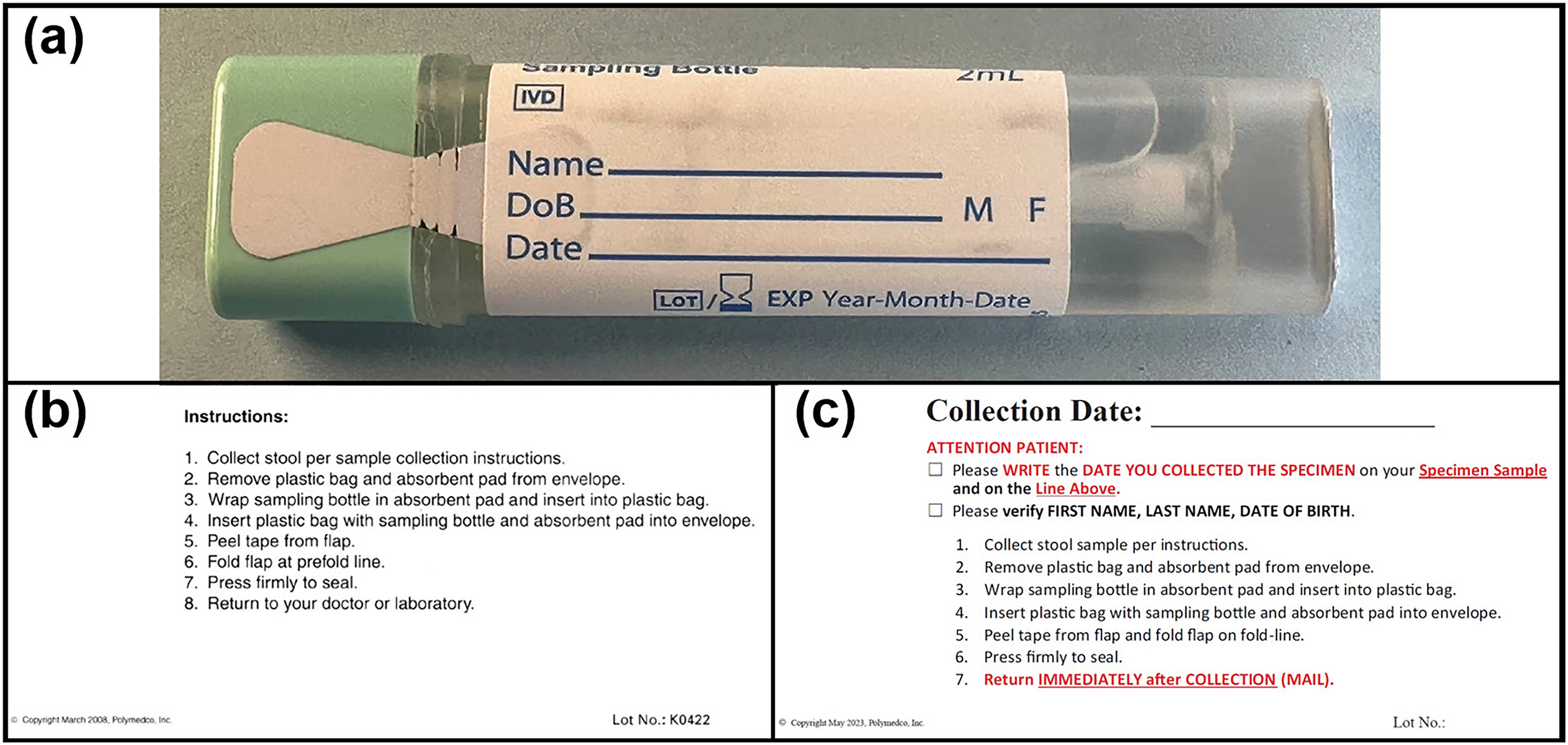
(a) Fecal immunochemical test collection device with label for documentation of collection date. (b) Original FIT envelope instructions. (c) Revised envelope instructions with an additional location to document date of collection.
Intervention
A quality improvement intervention was developed to reduce the number of FITs received without a collection date and, thereby, increase the proportion meeting laboratory testing requirements. Each FIT kit has a postage-paid return envelope. In collaboration with the FIT manufacturer, the instructions printed on the back of the original return envelope (Figure 1(b)) were revised to include (a) red font highlighting key instructions, with additional instructions to (b) document the collection date both on the device AND on the envelope, and (c) immediately return the FIT (Figure 1(c)). No changes were made to the written instructions included within the kit. On November 14, 2023, the coordinating center began using the modified envelope.
Analysis
To allow a washout period when both original and revised envelopes were being returned, formal tracking of the collection date location(s) on returned kits began on January 10, 2024 and continued through June 8, 2024. The primary outcome was the proportion of FITs meeting technical testing criteria (i.e., receipt within 15 days of collection) with the proportion with a documented date serving as a secondary outcome. To assess whether the intervention had any impact on overall FIT adherence, we identified all study participants who received a FIT kit during comparable pre- and postintervention time periods. Specifically, we identified participants who were mailed at least one FIT during January 1, 2023 through March 31, 2023 for the preintervention phase and January 1, 2024 through March 31, 2024 for the postintervention phase. To allow time for the participant to complete the FIT, we determined the proportion of participants who returned a FIT (and the timeliness of that return) through June 8, 2023 (preintervention) or June 8, 2024 (postintervention). These time periods were chosen to avoid issues with duration of follow-up or seasonality for FIT return. Pre- and postintervention proportions were compared with the chi-square test and time to FIT return was compared with a Wilcoxon rank-sum test.
Results
FIT adherence was similar in the pre- and postintervention periods, with 1882/4831 participants (39.0%) in the pre-intervention and 1780/4602 participants (38.7%) in the postintervention period returning FIT by June 8 of the calendar year (p = .78). FIT return times were also similar (22.3 vs. 21.4 days, respectively, p = .44). In the entire postintervention period, 3105 FIT kits were returned, including 3068 (98.8%) that were received within 15 days of collection, compared to 6754 of 7083 (95.4%) preintervention FITs (p < .00001; Table 1). The proportion of FITs with a documented collection date increased from 93.9% to 98.8% (p < .00001). Dates were documented on both the device and the envelope in 81.8% and only on the envelope in 8.2% of FIT. No kits were received with discordant dates between the device and envelope. Postintervention, 44.4% of undated FITs were received within 15 days of outbound shipping compared to 35.2% of preintervention FITs (p = .27).
Fecal immunochemical test (FIT) kit date documentation and timeliness of receipt.
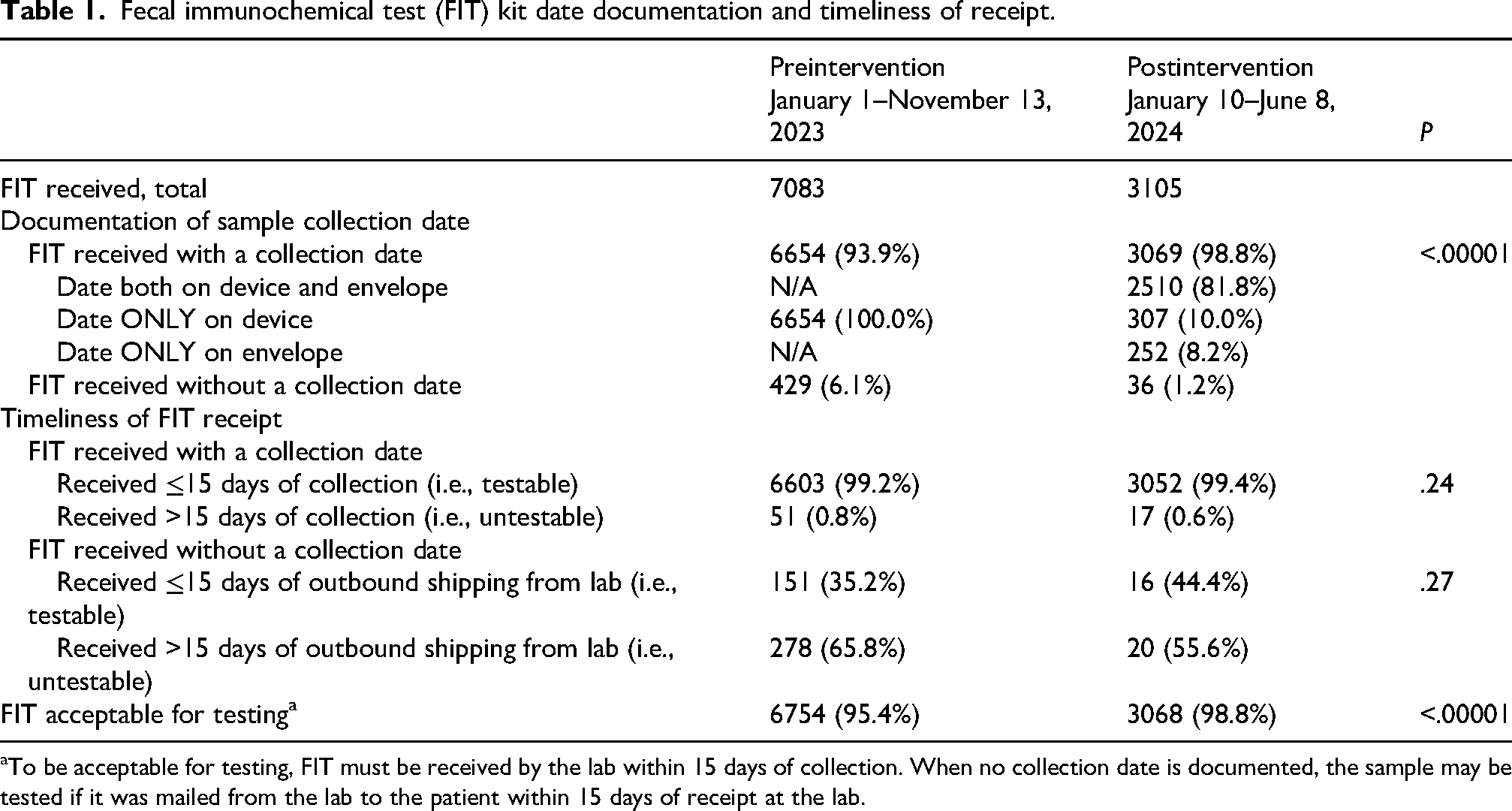
To be acceptable for testing, FIT must be received by the lab within 15 days of collection. When no collection date is documented, the sample may be tested if it was mailed from the lab to the patient within 15 days of receipt at the lab.
Discussion
A simple, no-cost modification to the instructions on the back of the return envelope, with a second option for recording sample collection date, led to a 3.5% (95% confidence interval 2.8%–4.1%) absolute increase in the proportion of FIT that could be analyzed. Thus, the proportion of individuals requiring rescreening decreased from 4.6% to 1.2%. The intervention had no significant effect on the overall proportion or timeliness of FIT return. There was no additional cost associated with this intervention, though some vendors may apply an extra printing charge for the use of red ink. We cannot assess if use of black ink would be equally effective. However, improving the proportion of valid FITs not only results in increased screening adherence, with expected reductions in CRC mortality, it also improves overall program efficiency through reductions in screening burden and program cost (e.g., replacement FIT).
Other studies identified that a missing collection date is the primary cause for invalid FIT. In a San Francisco safety-net health system, 19.8% of samples have some type of error and a lack of a stool collection date accounted for 97.7%. 11 Among nearly 57,000 individuals completing FIT in a large, integrated safety-net health system, 10.2% had unsatisfactory FIT, with incomplete labeling accounting for 27% of the problems. 14 While Narasimha also found that missing collection dates were the most common issue, they decreased the proportion of FIT with missing dates from 24% to 14% through various quality improvement efforts, such as repeated patient reminders about kit completion. 12 Simple changes to FIT collection instructions have been shown to reduce FIT collection errors. One health center in the STOP CRC study reported a 10.7% decrease in FIT returned without a collection date after highlighting the instructions to write the collection date and including a graphical image of where to write the date. 15
As our intervention was not randomized, we cannot exclude secular trends that may contribute to our findings, but the rapidity with which we saw improvements suggests otherwise. While we included a washout period, there may have been some original FIT envelopes that were returned during the postintervention period, which would bias toward the null. Finally, our study included Veterans who volunteered to participate in a trial of FIT versus colonoscopy between 2012 and 2017. Therefore, they had been receiving FIT annually for at least 5 years prior to the intervention, likely accounting for the relatively low rate of missing dates compared to other studies described above.
In summary, we found that a simple modification of the FIT return envelope instructions, including a second option for documenting dates on the envelope, was associated with a significantly reduced proportion of individuals requiring retesting. This increase is likely to improve overall neoplasia detection. Programs using FIT or other home-based test collection should consider implementation of this no-cost intervention to enhance effectiveness.
Footnotes
Acknowledgments
This material is the result of work supported in part by resources from the Veterans Health Administration
ORCID iDs

Funding
This study was supported by the Veterans Health Administration Cooperative Studies Program (CSP#577).
Disclosure of potential conflicts of interest/financial interests
Jason A. Dominitz: American Society for Gastrointestinal Endoscopy (Board Member).
Douglas J. Robertson: Freenome (Consultant), Amadix (Consultant).
Sophie Miller: None.
Alexander Beed: None.
Kathy Boardman: None.
Barbara Del Curto: None.
Samir Gupta: Guardant Health (Consultant), Freenome (Consultant), Universal DX (Consultant), Geneoscopy (Consultant).
Thomas F. Imperiale: Exact Sciences (Grant).
Meaghan F. Larson: None.
David A. Lieberman: Geneoscopy (Consultant), Universal DX (Consultant), Colowrap (Consultant).
Samuel Rosa: None.
Aasma Shaukat: Freenome (Consultant), Iterative Health (Consultant), Universal DX (Consultant).
Shahnaz Sultan: Boston Scientific (Grant: Addressing CRC Screening Disparities in the Hmong Community), Exact Sciences (Grant: U Minn Mobile CRC Screening Program), American Gastroenterological Association (Board), US GRADE Network (Co-Director).
Deeanne Tapia: None.
Tassos C. Kyriakides: None.
Data sharing statement
The data underlying this study cannot be shared publicly due to institutional restrictions. Researchers with a legitimate request may contact the corresponding author to discuss whether any access is possible within the constraints of these approvals.